Marx Was Wrong | MOONSHOTS
February 22, 2026
China’s New AI Robots Shock Everyone With Impossible Skills
February 23, 2026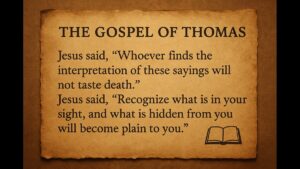 By C. Rich
The Gospel of Thomas contains 114 sayings attributed to Jesus of Nazareth. It contains no virgin birth, no resurrection, no miracles, no designation of Peter as successor, and no claim of divine sonship. It is the only surviving document that records the actual words of the man. It was buried for nearly two thousand years.
This work uses a pantheon of artificial intelligence systems to interrogate that text directly, asking the questions the Church never wanted asked and letting the answers speak for themselves. What emerges is a portrait of a first-century philosopher from Galilee teaching a doctrine of inner sovereignty and conscious manifestation, a philosophy older than Jesus himself, traceable through the Upanishads, ancient Egypt, and Greek idealism, and a portrait of an institution that spent two millennia building wealth and power on doctrines invented long after the man was dead.
The Catholic Church is examined on its own terms: the Council of Nicaea in 325 AD declaring Jesus divine, the Second Lateran Council of 1139 banning priestly marriage, the Malleus Maleficarum of 1487 igniting the burning of women, the Councils of Trent codifying the forgiveness of sins by priests, and 266 popes from Peter to Leo XIV presiding over it all. The numbers of the dead and the abused are documented. The accountability record is documented. The contrast with what the man from Nazareth actually said is total.
Every supernatural event attributed to Jesus, the virgin birth, the miracles, the resurrection, is traced to its earlier mythological source. These were not revelations. They were remakes. Stolen Valor from gods who came before.
The book closes with two propositions. First, that what Jesus was actually teaching, the kingdom of God found within, thought as the architect of reality, inner alignment with universal law, is the same doctrine running from the Vedic sages through Charles Haanel’s Master Key System to Rhonda Byrne’s The Secret, and that the Church suppressed it precisely because it made the institution unnecessary. Second, that the discovery of the Gospel of Thomas in a sealed clay jar in the Egyptian desert in December 1945 was the second coming. Not in the way anyone was told to expect. But the words came back.