
AI Finally Learns YOU? Google’s Breakthrough, On-Device AI & Autonomous Agents Explained
March 19, 2026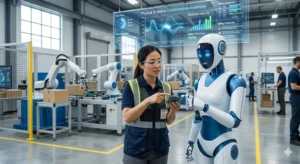 By C. Rich
The landscape of robotics in 2026 has transitioned from a period of experimental novelty into an era of “Physical AI,” where the intelligence of large language models is finally being successfully housed in capable mechanical bodies. This shift is most visible in the rapid maturation of humanoid robots, which have moved beyond laboratory demonstrations to active pilot programs in warehouses and factories. Driven by the convergence of generative AI and advanced sensory hardware, these machines are beginning to navigate unstructured human environments, climbing stairs, opening doors, and manipulating objects, without the rigid, line-by-line programming that limited their predecessors.
In the industrial sector, the focus has moved toward “Agentic AI” and self-sustaining systems. Modern factories are increasingly “predictive” rather than “reactive,” utilizing robots that can monitor their own mechanical health and coordinate with building infrastructure, such as elevators and security systems, to perform tasks autonomously over multiple shifts. This “lights-out” capability is helping to bridge a massive global labor gap, particularly in logistics and construction. Furthermore, the “Simulate-then-Procure” model has become the industry standard, allowing companies to use high-fidelity digital twins to perfect a robot’s workflow in a virtual space before a single piece of hardware is ever deployed on the floor.
At the consumer level, robotics is beginning to enter the “living room” phase. While fully autonomous household humanoids remain a premium frontier, specialized service robots for lawn care, pool maintenance, and elderly assistance have become more sophisticated and affordable. These personal robots benefit from “Vision-Language-Action” models, allowing users to give complex, natural language commands like “clean up the kitchen” rather than selecting pre-set cleaning zones. This ease of use is driving a surge in adoption, though it has also sparked intensified debates over data privacy, as these machines now process vast amounts of visual and auditory data from within private homes.
Despite this progress, significant hurdles remain regarding battery life and ethical governance. Most humanoid platforms still struggle with an “operational ceiling” of three to four hours, and the dexterity required for delicate tasks, like threading a needle or handling fragile items, still lags behind human capability. Geopolitically, the rise of autonomous systems has led to a fragmented regulatory environment; the European Union’s AI Act has introduced strict transparency requirements, while other regions prioritize rapid innovation. As we move further into 2026, the challenge for the industry is no longer just making robots work but ensuring they are deployed responsibly within the fabric of human society.