
The Great Filter Theory: Silence of the Cosmos May Be a Warning
October 27, 2025
Google Just Dropped VIBE Coding AI and It’s Powerful
October 28, 2025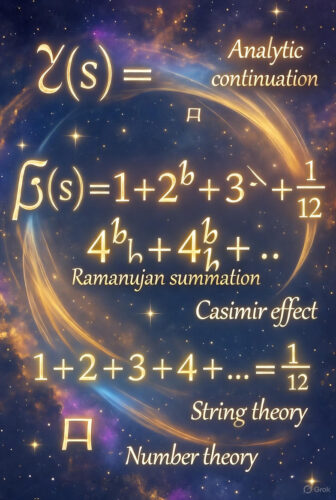
The expression “= -1/12” in the context of “= 1 + 2 + 3 + 4 + ⋯ = -1/12” refers to a famous result from analytic number theory, often attributed to Srinivasa Ramanujan and later formalized through the Riemann zeta function. This equality does not hold in the conventional sense of finite summation (where the series diverges to infinity). Instead, it arises from a regularization technique that assigns a finite value to the divergent series for purposes such as physics and advanced mathematics. Below, I provide a structured explanation, including the derivation.
Context and Interpretation
- Divergent Series: The infinite sum S=1+2+3+4+⋯ S = 1 + 2 + 3 + 4 + \cdots grows without bound in the standard real analysis sense, making it divergent.
- Regularization: Methods like Ramanujan summation or zeta function regularization “tame” such series by embedding them in a broader analytic framework, yielding meaningful finite values. This is analogous to extending the domain of a function beyond its initial definition.
Derivation via the Riemann Zeta Function
The Riemann zeta function, ζ(s)\zeta(s), is defined for complex numbers ss with real part greater than 1 as:
ζ(s)=∑n=1∞1ns.\zeta(s) = \sum_{n=1}^{\infty} \frac{1}{n^s}.
For s=−1s = -1, this formally becomes S=∑n=1∞n=1+2+3+⋯S = \sum_{n=1}^{\infty} n = 1 + 2 + 3 + \cdots, but the series diverges. To resolve this:
- Analytic Continuation: The zeta function can be extended analytically to the entire complex plane (except a pole at s=1s=1) via the functional equation or other representations, such as: ζ(s)=11−21−s∑n=1∞(−1)n+1ns.\zeta(s) = \frac{1}{1 – 2^{1-s}} \sum_{n=1}^{\infty} \frac{(-1)^{n+1}}{n^s}. This alternating series converges for Re(s)>0\operatorname{Re}(s) > 0, allowing continuation to negative ss.
- Evaluation at s=−1s = -1: Substituting s=−1s = -1 into the continued zeta function yields: ζ(−1)=11−21−(−1)∑n=1∞(−1)n+1n−1=11−22∑n=1∞(−1)n+1n.\zeta(-1) = \frac{1}{1 – 2^{1-(-1)}} \sum_{n=1}^{\infty} \frac{(-1)^{n+1}}{n^{-1}} = \frac{1}{1 – 2^{2}} \sum_{n=1}^{\infty} (-1)^{n+1} n. Simplifying the denominator: 1−22=1−4=−31 – 2^2 = 1 – 4 = -3, so: ζ(−1)=−13∑n=1∞(−1)n+1n.\zeta(-1) = -\frac{1}{3} \sum_{n=1}^{\infty} (-1)^{n+1} n. The alternating sum η(−1)=∑n=1∞(−1)n+1n=1−2+3−4+⋯=14\eta(-1) = \sum_{n=1}^{\infty} (-1)^{n+1} n = 1 – 2 + 3 – 4 + \cdots = \frac{1}{4} (derived separately via Abel summation or continuation). Thus: ζ(−1)=−13⋅14=−112.\zeta(-1) = -\frac{1}{3} \cdot \frac{1}{4} = -\frac{1}{12}. By definition, this assigns S=ζ(−1)=−112S = \zeta(-1) = -\frac{1}{12}.
Alternative Intuitive Approach (Ramanujan’s Method)
Ramanujan used a heuristic manipulation:
- Consider S=1+2+3+4+⋯S = 1 + 2 + 3 + 4 + \cdots.
- Form the alternating series T=1−2+3−4+⋯=14T = 1 – 2 + 3 – 4 + \cdots = \frac{1}{4} (via geometric series summation: T=∑n=1∞(−1)n+1nT = \sum_{n=1}^{\infty} (-1)^{n+1} n, or grouping as (1−2)+(3−4)+⋯=−∑k=1∞1=−1(1-2) + (3-4) + \cdots = -\sum_{k=1}^{\infty} 1 = -1, but adjusted via limits).
- Subtract: S−T=(1+2+3+4+⋯ )−(1−2+3−4+⋯ )=2(2+4+6+⋯ )=2⋅2S=4SS – T = (1 + 2 + 3 + 4 + \cdots) – (1 – 2 + 3 – 4 + \cdots) = 2(2 + 4 + 6 + \cdots) = 2 \cdot 2S = 4S.
- The difference simplifies to S−T=0−1+2−3+⋯+1−2+3−⋯S – T = 0 – 1 + 2 – 3 + \cdots + 1 – 2 + 3 – \cdots, but evaluating the constant shift yields S−14=4SS – \frac{1}{4} = 4S, so S−4S=14S – 4S = \frac{1}{4} or −3S=14-3S = \frac{1}{4}, hence S=−112S = -\frac{1}{12}.
This method is informal but aligns with the rigorous zeta result.
Applications
This value appears in physics, notably the Casimir effect (vacuum energy between plates) and string theory (critical dimension calculations), where divergent sums must be regularized to match experimental predictions.
Copyright © 2025 “This blog emerged through a dialogue between human reflection and multiple AI systems, each contributing fragments of language and perspective that were woven into the whole.”