ChatGPT SEO: How to Make AI Content Rank on Google (2025)
November 22, 2025
Is ChatGPT Hurting Your Google Rankings?
November 23, 2025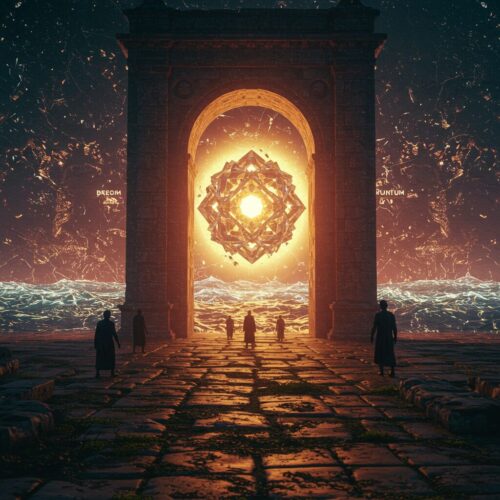
Both ancient philosophy and modern science are unfolding in real time in the 21st Century. The idea that our reality is not what it seems is a recurring theme in human thought. From ancient philosophical allegories to modern scientific and technological speculations, the question of whether we live in a fundamental reality or an elaborate illusion has persisted.
The modern Simulation Hypothesis, famously articulated by philosopher Nick Bostrom, is the latest iteration of this ancient query, connecting classical thought experiments with the breathtaking power of future computing. By tracing this concept from Plato’s Allegory of the Cave and the Hindu concept of Maya to Bostrom’s contemporary argument, we can see a continuous thread in humanity’s quest to understand the nature of existence.
The earliest and most enduring philosophical exploration of this theme is found in Plato’s Allegory of the Cave. In this allegory, prisoners are chained in a cave, facing a wall. Behind them, a fire burns, and puppeteers cast shadows of objects onto the wall. The prisoners, having known nothing else, believe the shadows to be the ultimate reality.
The allegory suggests that our perceived world is merely a dim reflection of a higher, more perfect reality, the world of forms. While not a “computer simulation,” Plato’s cave perfectly captures the core premise of the Simulation Hypothesis: our everyday experience might be an indirect, and fundamentally misleading, representation of what is truly real.
Similarly, the ancient Hindu and Buddhist concept of Maya describes the universe as a grand illusion. Maya is a veil of cosmic ignorance that conceals the true, unified nature of reality, Brahman. Everything we perceive, our bodies, the objects around us, and our sense of a separate self, is considered part of this illusion.
To break free from the cycle of suffering (samsara), one must achieve gnosis (Knowledge) and see through the veil of Maya to recognize the underlying truth. This ancient concept provides a striking parallel to the modern Simulation Hypothesis, suggesting that our consciousnesses are trapped within a simulated, illusory world, unaware of the underlying “code” or “program” that generates it.
The philosophical contemplation of illusion took a quantitative and technological turn in the 21st century with Nick Bostrom’s influential 2003 paper, “Are You Living in a Computer Simulation?” Bostrom proposed a logical trilemma based on three propositions, one of which must be true:
1- Human-like civilizations will go extinct before they reach a “posthuman” stage capable of running massive ancestor simulations.
2- Posthuman civilizations that do emerge are not interested in running ancestor simulations.
3- We are almost certainly living in a computer simulation.
Bostrom argues that a posthuman civilization with immense computing power would have the ability to run an almost unimaginable number of simulations of its past, far exceeding the number of beings in their original “base reality.”
This work came after the thought experiment of “Pigs in Cyberspace”, which is a dramatic example of this logic. If a future civilization could perfectly simulate conscious life, they could create countless “pigs” within a virtual world. Given the sheer number of simulated entities, the statistical probability that any one individual, including us, is a product of a simulation becomes overwhelming. The logic shifts the burden of proof, suggesting that if we believe in the potential for technological progress, the simulation is the most likely scenario.
The modern Simulation Hypothesis is not an entirely new idea. It is a technological repackaging of philosophical questions that have preoccupied thinkers for millennia. Plato’s cave and the concept of Maya both describe a world of shadows and illusions, a reality that is not what it seems. Nick Bostrom’s hypothesis brings these ancient concepts into the digital age, framing the problem in terms of computational limits and statistical probability. While the language has evolved from allegorical to technical, the core inquiry remains the same: how can we be sure that the world we inhabit is truly real?