
Why Automation Won’t Lead to UBI in America
January 21, 2026
AI Dominates Davos 2025: The New Global Power Shift
January 29, 2026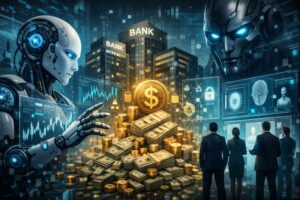 The Algorithmic Economy
By C. Rich
AI systems quietly watch almost every digital transaction. Card networks and banks run machine-learning models that score each payment in milliseconds for fraud risk, using patterns in amounts, timing, locations, devices, and past behavior to decide whether to approve, decline, or step up authentication. This lets them catch more fraud with fewer false alarms than rule-based systems, which in turn makes high-volume digital payments feasible without paralyzing friction. Similar models power automated credit scoring, using broader data to estimate default risk and price loans faster and more finely than traditional scorecards. In practice, this means AI is part of the infrastructure that makes cashless and online money “feel” instantaneous and safe enough for everyday use.
Historically, trust in money rested on metal, then on institutions, and later on legal frameworks. Increasingly, trust now rests on models, on the assumption that AI systems correctly interpret risk, intent, and behavior. When a transaction is approved, denied, flagged, or reversed, the decision may no longer be explainable in human terms. Money becomes executable logic, not just a representation of value. AI enables unprecedented monetary oversight. Governments can monitor transactions, model economic behavior, and simulate policy impacts in ways that were previously impossible.

In a digital currency environment, AI can enforce rules automatically, shape incentives dynamically, and intervene preemptively rather than reactively. This raises efficiency, but it also concentrates power, blurring the line between monetary policy, surveillance, and social control. In trading and crypto markets, AI has become a dominant force. Algorithmic and high-frequency trading in traditional markets already rely heavily on statistical and machine-learning models; in crypto, AI-driven bots analyze price, volume, order books, and even social media to make and execute trading decisions at speeds no human can match.

These systems can arbitrage price differences across exchanges, adjust strategies in real time as conditions change, and manage risk by detecting patterns that precede volatility spikes. At the same time, AI is used to secure crypto platforms themselves, spotting suspicious login behavior, automated attacks, and laundering patterns that would be invisible to manual monitoring. In a worst-case scenario, AI’s involvement with money could produce a tightly coupled, opaque financial system that fails catastrophically and unfairly. Hyper-automated trading and credit allocation could create markets where flash crashes, liquidity vacuums, and feedback loops become both more frequent and harder for humans to understand or control, as interacting AI agents amplify small signals into systemic shocks.
AI-driven risk and credit models, trained on biased or incomplete data, could silently lock entire groups out of fair access to loans, insurance, and payment services, entrenching inequality behind a veneer of “objective scoring.” At the same time, increasingly sophisticated AI fraud and cyberattack tools could probe and exploit weaknesses in digital payment and settlement infrastructure faster than defenders can patch them, raising the risk of coordinated thefts or disruptions at a national or global scale. If central banks and regulators lean heavily on AI systems they do not fully understand, policy mistakes could propagate instantly through algorithmic trading and lending channels, turning miscalibrated decisions or model errors into rapid, large-scale crises before human overseers can intervene. AI systems could be the biggest nightmare humans have ever seen regarding their money.
C. Rich