AI Ethics: MADD Model for Independent Accountability
March 8, 2026
OpenAI Just Dropped Symphony: The First AI That Actually Works
March 9, 2026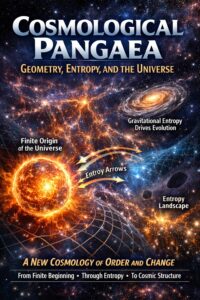 By C. Rich
Buy Book: Cosmological Pangea
Cosmological Pangaea began not as a grand attempt to rewrite cosmology but as a moment of intellectual discomfort. The discomfort arrived in a very ordinary way: listening to a confident explanation of the universe that included a sentence most people had grown used to hearing without really thinking about it. Modern cosmology, we were told, understands the universe very well, except for the majority of it. Roughly ninety-five percent of the cosmos is assigned to dark matter and dark energy, entities whose existence is inferred but whose nature remains unknown. For many people, this sentence evokes a sense of wonder, the romance of the unknown. For me, it produced a different reaction. It sounded less like triumph and more like a warning that a model had become comfortable with placeholders. When a theory explains most of its phenomena by invoking components that remain unseen and undefined, the correct response is not dismissal, but pressure. Cosmological Pangaea began with that pressure.
The first step was methodological rather than constructive. Before proposing a new cosmology, the existing explanatory structures had to be tested under stricter conditions. I built what I called the GR-Razor: a simple rule set designed to strip theories down to what was genuinely necessary. General relativity remains the governing geometry unless there is a mathematically unavoidable reason to abandon it. Statistical mechanics remains intact. New entities, particles, fields, and sectors of hidden matter are not introduced unless the equations themselves demand them. If a proposal collapses under those constraints, it collapses. That process became the GR-Razor Stress Tests, a systematic examination of explanations for major cosmological anomalies, including the early galaxy observations emerging from JWST and the broader architecture of the ΛCDM model. The purpose was not rebellion against the mainstream at first. It was an audit. A theory that survives audit deserves attention. One that does not must be replaced.
The demolition phase revealed something important: many tensions in modern cosmology stem from its very beginning. The standard model begins with a singularity, a point where density and curvature become infinite, and the equations of general relativity cease to function. Physicists know that a singularity is not a physical explanation; it is the sign that a theory has been pushed beyond its domain. Yet cosmology often treats this mathematical breakdown as the literal origin of the universe. Once that happens, other patches become necessary. Inflation is introduced to explain the horizon problem, dark matter is invoked to stabilize galactic rotation and structure formation, and dark energy accounts for accelerated expansion. Each piece addresses a symptom, but the origin remains a confession of mathematical failure. That is where Cosmological Pangaea departs from the conventional story.
Instead of a singularity, the framework begins with a finite initial state. If the total mass of the observable universe is compressed to Planck-scale density, it does not produce an infinitesimal point but a real, finite object with a calculable radius. That object, the Pangaea state, is maximally dense, spherically symmetric, and entirely causally connected within itself. Geometry then does something remarkable. Under spherical symmetry, Birkhoff’s theorem implies that the Weyl curvature inside the object is zero. In Penrose’s terms, gravitational entropy is therefore also zero. The universe begins in a state of perfect gravitational order, not because of miraculous fine-tuning, but because symmetry demands it. The low-entropy origin of the universe, which standard cosmology treats as a mystery, becomes a natural consequence of the geometry of a finite beginning.
Once that symmetry breaks, the story of the universe begins in earnest. The first asymmetry generates non-zero Weyl curvature, and gravitational entropy begins to grow. That growth supplies the arrow of time. Time is no longer a mysterious background parameter but the record of symmetry breaking and increasing gravitational inhomogeneity. Entropy becomes the central driver of cosmic evolution. The universe moves away from its initial state of perfect order through gradients that shape everything that follows. Galaxies, filaments, and clusters are not merely the debris of expansion but the visible imprint of entropy working through gravitational geometry.
This perspective reframes the large-scale structure of the universe. The cosmic web, its filaments, walls, and immense voids, can be interpreted as an entropy landscape. Voids are not passive absences but regions participating in the redistribution of matter through gradient dynamics. Filaments become the channels through which matter flows and accumulates. Structure formation emerges from the thermodynamic unfolding of the initial state rather than from unseen matter scaffolding the process. Several well-known anomalies in cosmology, from early galaxy formation to tensions in expansion measurements, can then be revisited under the assumption that geometry and entropy are doing more explanatory work than previously recognized.
At its broadest level, Cosmological Pangaea is an attempt to return cosmology to first principles. Instead of adding layers of invisible components whenever observations strain the model, it asks whether the beginning itself can be made physically coherent. A finite origin eliminates the singularity, dissolves the horizon problem, and grounds the arrow of time in geometry rather than mystery. Entropy gradients provide the engine of cosmic structure, turning the universe into a dynamic thermodynamic system whose large-scale architecture reflects its history of symmetry breaking.
The framework does not claim finality. A serious cosmology must remain exposed to observation, and its claims live or die with measurement. What Cosmological Pangaea offers is a unified map: a universe that begins finite, evolves through entropy, acquires time through asymmetry, and develops structure through the geometry of its own gradients. When you think of the universe, think of geometry and entropy doing what entropy does. That’s really it. No big crazy theory like the standard model, just geometry and entropy doing what entropy does.
Thank you to everyone who reached out to me and supported me in putting together this project. I knew the whole time that my audience was not “Romper Room” but some of the most serious and smart people in the world; they just had this one thing wrong, and I couldn’t let it go. Like a dog with a bone.
C. Rich
Buy Book: Cosmological Pangaea