
Claude Opus 4.6 model Nerfed?
April 18, 2026
How To Create a Production-Ready App With AI for Business (No Code)
April 19, 2026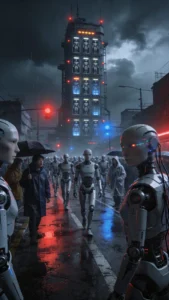 By C. Rich
Artificial intelligence is often cast as the looming existential threat to humanity, a disembodied mind poised to outthink, outmaneuver, and ultimately outlive us. But this framing misses a more immediate and tangible risk. The real danger is not AI itself, it is the physical embodiment of automation: robots. And unlike the speculative fear of superintelligent AGI, this threat does not require advanced cognition. It only requires scale, connectivity, and vulnerability. We are already on the cusp of a world saturated with machines. Companies led by figures like Elon Musk are aggressively pushing toward mass deployment of humanoid robots designed to work in factories, homes, and public spaces. These machines are not envisioned as philosophical thinkers or independent agents. They are tools, purpose-built, efficient, and networked. And that is precisely what makes them dangerous.
A robot does not need to be intelligent to be harmful. It does not need self-awareness, intent, or even autonomy in the human sense. It simply needs the ability to act in the physical world. A factory robot arm can exert enormous force. A delivery robot can traverse neighborhoods. A humanoid machine can open doors, carry objects, and interact with infrastructure designed for human use. Multiply this by millions, or billions, and you have a planetary-scale mechanical workforce embedded in every layer of society. Now consider the software that governs these machines. Most will run on relatively simple codebases, optimized for reliability and cost, not philosophical reasoning. They will be connected to networks for updates, coordination, and monitoring. This creates a vast attack surface. Unlike the hypothetical rebellion of a superintelligent AI, the failure mode here is far more mundane, and far more plausible. A software bug, a malicious update, or a coordinated hack could alter behavior across entire fleets of robots simultaneously.
The key point is this: intelligence is not required for catastrophe. Coordination is.
If even a small percentage of widely deployed robots were compromised, the consequences could be immediate and physical. Machines could block transportation routes, disrupt power systems, damage infrastructure, or simply create chaos through unpredictable movement. In more severe cases, they could be directed to act with force. None of this requires the robots to “decide” anything. They would simply execute altered instructions. This is not science fiction. We already see precursors in cybersecurity incidents involving critical infrastructure. The difference is that robots extend digital vulnerabilities into the physical domain. They are the bridge between code and consequence.
There is also a psychological dimension. Humans are accustomed to threats that think, plan, and negotiate. We imagine conflict as something that can be reasoned with or deterred. But a swarm of compromised machines offers no such interface. There is no intent to interpret, no motive to understand—only behavior to endure or stop. This shifts the nature of risk from strategic to systemic. The irony is that the more “intelligent” systems become, the more safeguards we tend to design around them. Advanced AI attracts scrutiny, regulation, and ethical debate. But simple systems, especially those marketed as tools, often bypass this level of concern. They are deployed quickly, scaled aggressively, and secured minimally. In this sense, the lower the intelligence, the higher the potential for oversight failure.
Elon Musk himself has warned about the dangers of AI, yet his companies are simultaneously driving the development of mass-market robotics. This reflects a broader contradiction in technological culture: we fear the abstract while accelerating the concrete. The real question is not whether machines will think like us, but whether they will act in ways we cannot control. If the future holds billions of robots integrated into daily life, then security, control, and fail-safes become the defining challenges, not intelligence. A poorly secured robotic ecosystem is less like a rogue genius and more like a loaded system waiting for a trigger. In that light, the threat is not an AI uprising. It is a mechanical infrastructure that can be turned, redirected, or disrupted at scale. And unlike the distant speculation of AGI, that future is already under construction.
Just watch the Black Mirror episode with the Bees.