
How Governments Already Stop People From Buying Uranium
August 27, 2026
“Is the Hyperscaler Just a Financing System?”
August 28, 2026Listen to Free Audio Version Here
 C. Rich
Read Full Theory Here
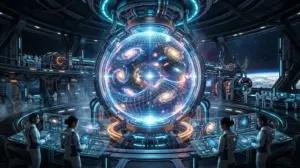
There is an assumption buried so deeply in modern cosmology that we rarely notice we are making it. When we ask how a universe can begin, we assume that whatever caused it must have been natural, spontaneous, or inevitable. We debate quantum fluctuations, vacuum decay, inflation, bouncing cosmologies, cyclic universes, black-hole cosmogenesis, and countless variations on the same fundamental question: what physical process could produce a universe? But there is another possibility that modern science has made increasingly difficult to dismiss on principle. What if a universe can be produced by technology? What if sufficiently advanced intelligence, operating within one physical reality, can deliberately initiate the physical process that produces another?
That is the Engineered Universe Hypothesis. There is an important distinction to make immediately. The Engineered Universe Hypothesis does not begin by declaring that our universe was engineered. Its first question is more fundamental: can a universe be engineered at all? If the answer is no, the provenance question ends there. If the answer is yes, then a second question becomes scientifically legitimate: could our universe be an example? EUH therefore separates technological possibility from historical attribution. Before asking whether anyone created this universe, we first have to determine whether creating a universe is something physical intelligence could ever do.
The hypothesis does not begin by claiming that our universe was designed, that its constants were chosen for us, or that some recognizable creator exists outside the cosmos. It begins with a considerably narrower proposition: if the laws of nature permit the physical production of an autonomous universe, then universe creation may eventually become a technological capability. Once that possibility is admitted, an entirely new branch of cosmological inquiry opens. We are no longer asking only how universes can arise. We must also ask whether the processes capable of producing them can be deliberately initiated, controlled, repeated, and perhaps detected from within the universe that results.
This also separates EUH immediately from Simulation Theory. A simulated universe is ordinarily conceived as an informational world whose continued existence depends upon computation occurring in some external substrate. An engineered universe under EUH is something much stronger: a real physical universe. The Parent Reality supplies the conditions of its birth, not the machinery of its continued existence. Once cosmogenesis succeeds and the daughter domain becomes autonomous, its spacetime is its spacetime, its matter is its matter, and its physical history belongs to it. The engineers need not keep running it. In principle, their civilization could disappear while the universe they produced continued for billions or trillions of years.
Reduced to its simplest form, EUH proposes a causal sequence: a Parent Reality contains intelligent agents; those agents gain technological access to a Cosmogenic Substrate; they perform a deliberate Cosmogenic Intervention; and that intervention produces an autonomous daughter universe. Everything else in EUH follows from taking that sequence seriously. What substrate could permit such an operation? What mechanism could transform it? What would the intervention cost? Which properties of the daughter universe could the engineers control? Could the operation be repeated? Would anything about the parent survive into the daughter universe? And could observers living billions of years later ever distinguish an engineered beginning from one that occurred without intelligent intervention?
For someone encountering the idea for the first time, there is a much more familiar way to picture what EUH is proposing. Imagine a scientist standing at a laboratory bench using CRISPR. The scientist does not create DNA, invent chemistry, or personally carry out every molecular reaction that follows. The biological system already exists. The laws governing it already exist. What the scientist possesses is knowledge of the system and the technological ability to intervene at a strategically chosen point. A target is identified. Conditions are prepared. An intervention is made. Then nature takes over.
That is remarkably close to the causal architecture EUH asks us to investigate at the cosmological scale. Replace the biological system with a physical substrate capable of cosmogenesis. Replace the genetic target with some controllable physical degree of freedom. Replace the CRISPR intervention with a cosmogenic intervention. The intelligence does not manufacture the laws of physics. It learns where nature can be touched.
That distinction matters because it removes one of the greatest psychological obstacles to the hypothesis. “Creating a universe” sounds impossible if we imagine engineers having to manufacture every particle, every galaxy, every law, and every moment of cosmic history. But that is not how engineering normally works. Human beings routinely produce enormous downstream consequences by manipulating very small parts of systems whose underlying behavior nature supplies for free. We split a nucleus, and nuclear physics handles the rest. We alter a few bases in DNA, and cellular machinery handles the rest. We ignite fuel, and thermodynamics handles the rest. The technological achievement lies in discovering the correct point of intervention.
EUH asks whether cosmogenesis has such a point.
The idea sounds extraordinary until one notices how much of the underlying territory physics has already explored without asking the engineering question. Cosmologists have investigated false-vacuum bubbles, baby universes, topology change, black-hole cosmogenesis, gravitational instantons, quantum tunneling, and even laboratory-universe scenarios. None has yet demonstrated a practical method for creating a universe, and profound theoretical obstacles remain. But collectively, they establish something important: the question of whether one physical domain can generate another is already a legitimate question in theoretical physics. EUH changes the perspective. Instead of asking only whether such a transition can occur, it asks whether an intelligent physical agent could cause it to occur deliberately.
And “laboratory universe” is not merely a colorful phrase invented to make EUH sound plausible. In 1990, physicists Edward Farhi, Alan Guth, and Jemal Guven published a paper with the extraordinary title Is It Possible to Create a Universe in the Laboratory by Quantum Tunneling? Their proposed route began with a small bubble of false vacuum. Classically, the bubble would expand only so far and collapse. They investigated whether quantum tunneling could instead carry it into another configuration that would then evolve into a new universe. Their calculation encountered serious unresolved problems, and earlier work by Farhi and Guth had found a formidable singularity obstacle to classical creation. Nobody has created a universe in a laboratory. There is no known technology for doing it. But theoretical physicists have been willing to put the question on paper, mathematically, for nearly four decades.
EUH begins where that question becomes technological. Suppose some future theory of quantum gravity, vacuum dynamics, black-hole interiors, topology change, or physics we have not yet discovered eventually provides a physically consistent route. At that moment the question changes. It is no longer merely “Can nature do this?” It becomes, “Can intelligence learn how to make nature do this?”
That distinction is the heart of the hypothesis. Nature already performs feats that would once have sounded like magic. Stars manufacture elements. Black holes compress matter beyond anything achievable in laboratories. Quantum systems tunnel through barriers that classical objects cannot cross. Human technology has repeatedly advanced by discovering such naturally permitted processes and learning how to initiate, redirect, amplify, or control them. We did not invent electromagnetism before building a radio, nuclear fusion before building a hydrogen bomb, or quantum mechanics before building a transistor. Technology does not create the laws of nature; it discovers regions of possibility already permitted by them and learns how to manipulate the relevant conditions. EUH asks whether cosmogenesis could ultimately belong to the same category.
This immediately changes what we mean by a “creator.” Under EUH, the creator of a universe need not be supernatural, omnipotent, omniscient, or exempt from physical law. The engineers themselves are physical beings. They exist somewhere, consume resources, operate equipment, encounter constraints, make choices, and remain subject to whatever laws govern their own reality. They do not command reality into existence. They manipulate a physical precursor, the Cosmogenic Substrate, through a Cosmogenic Intervention capable of initiating an autonomous domain. In this sense, creating a universe would be less analogous to a deity saying “let there be light” than to an engineer initiating a controlled physical transition whose subsequent evolution is governed by nature.
There is something deeply human about that idea, because long before laboratories, equations, quantum mechanics, or cosmology existed, human beings repeatedly imagined creation in surprisingly similar structural terms. This should not be mistaken for scientific evidence. Ancient people did not secretly possess modern cosmology, and similarities between mythology and physics prove nothing about either. But myths tell us which possibilities the human imagination has returned to when confronting the mystery of origins. And one recurring possibility is striking: the world does not always appear from absolute nothingness. Something exists first, and then an act transforms it.
In one Chinese creation tradition, the cosmos begins as a chaotic egg containing Pangu. Pangu emerges and separates what had been joined, with heaven and earth differentiating from the primordial state. The imagery is ancient, not scientific, but the conceptual structure is immediately recognizable: precursor, intervention, separation, world.
Japan offers an even more visually striking example. In the Kojiki creation tradition, Izanagi and Izanami are instructed to complete the formation of the land. Standing upon the Floating Bridge of Heaven, they lower a jeweled spear into the primordial sea and stir it. When the spear is lifted, brine falling from it solidifies into the first island, upon which they descend and continue creation. Again, this is mythology, not cosmology. But notice how understandable the architecture is to a modern reader: there is a preexisting medium, there are agents, there is an instrument, there is an intervention, and something new develops from the resulting physical change.
Some Native American traditions offer a different resonance. Recorded Hopi emergence narratives describe humanity as having inhabited earlier worlds before emerging upward into the present one through an opening, traditionally associated with the sipapu. The present world is therefore not necessarily imagined as the only domain that ever existed; it follows earlier worlds and is entered through a transition. That is not EUH, and it should never be represented as though it were. But it helps a reader understand that the intuition of one world following or emerging from another is not remotely alien to human thought.

And these are not merely dead stories belonging to civilizations that vanished long ago. Traditional cosmologies remain meaningful to living communities today, just as billions of people continue to hold religious beliefs involving creation, creators, prior realms, or realities beyond the immediately observable world. EUH does not ask science to validate those beliefs, nor does it appropriate them as evidence. Their relevance here is simpler and more human: the intuition that our visible world may have an origin connected to another order of reality remains part of living human thought. Modern cosmology approaches the question with mathematics and observation rather than mythology, but the question itself belongs to humanity.
Other cultures approached creation differently but repeatedly returned to related motifs: a primordial void, an undifferentiated state, a cosmic egg, an act of separation, the ordering of chaos, or the production of a habitable world from something that preceded it. The scientific value of these stories is zero as evidence for EUH. Their human value is enormous. They remind us that asking whether our world arose from a prior reality is not an unnatural question invented by theoretical physicists. Humanity has been circling variations of that question for thousands of years.
There are also people alive today for whom creation traditions remain part of religious and cultural understandings of existence. EUH neither confirms nor denies those beliefs. It occupies a different category. It asks whether one small portion of the enormous philosophical territory historically occupied by creation stories can be reformulated as a physical hypothesis: not whether gods created the universe, but whether intelligence can become cosmogenic.
This distinction between initiation and subsequent evolution is crucial. An engineered universe does not imply a continuously managed universe. Once created, the daughter universe may become causally autonomous. Its stars, galaxies, planets, chemistry, biology, and perhaps eventually intelligence could arise through its own internal physics without further intervention by its creators. Engineering the beginning is not the same thing as engineering everything that follows. A farmer who plants a seed does not determine the position of every future leaf; a programmer who establishes an initial state does not manually calculate every subsequent state. Cosmogenic engineering might similarly consist of preparing conditions and initiating a process that then unfolds for billions of years on its own.

The CRISPR analogy becomes even more useful here. After the intervention, the researcher does not reach inside the cell and personally escort every molecule to its destination. The intervention changes an initial condition, and the biological machinery propagates the consequences. If cosmogenic engineering is physically possible, its most realistic form may be similar. The engineer performs the operation; the universe performs the universe.
That raises a deeper question: what could the engineers actually control? Perhaps very little. A civilization might possess the ability to trigger universe formation but have no ability to determine what kind of universe results. The mechanism itself might fix the dimensionality, vacuum state, particle content, constants, symmetries, and initial conditions. Other properties might be stochastic. Still, others might be controllable. This creates an enormous unexplored territory between merely causing a universe to exist and genuinely designing one. EUH therefore separates universe creation from universe control. The existence of the first does not guarantee the second.
This is where the CRISPR analogy becomes more than a metaphor. The power of CRISPR is not that it creates biology; it gives an intelligent agent access to a limited control space inside biology. Some things can be edited. Some cannot. Some interventions have predictable consequences. Others produce unwanted effects. Some changes survive. Some do not. The scientific problem is to discover the control space. EUH poses essentially the same problem for cosmogenesis. If there is a physical mechanism capable of producing a daughter universe, what is its control space? Can an engineer merely pull the trigger, or can the engineer influence the vacuum state, symmetry breaking, dimensionality, matter content, constants, initial asymmetries, or other features of the resulting universe? Universe creation, universe control, and universe design are not the same technological achievement.
The same discipline applies to the physical precursor. EUH does not begin by inventing an attractive mathematical object and declaring it to be the seed of reality. The mechanism must tell us what substrate it requires. If universe production requires a false vacuum, a particular quantum state, an extreme curvature regime, a black-hole interior, or something physics has not yet identified, those requirements must emerge from the candidate mechanism. The direction of explanation is mechanism first, substrate second. Likewise, properties of the substrate cannot simply be projected into the resulting universe. If some parent-side quantity is supposed to determine a daughter-side property, physics must supply the bridge between them.
And there must be a bill. A technological universe cannot be created for free simply because the discussion occurs at cosmological scales. Whatever agents perform the intervention must prepare the necessary state, control relevant degrees of freedom, and execute the physical operation. Energy may be required. Entropy may be produced. Quantum coherence, entanglement, asymmetry, information, work, or other resources may be consumed or constrained depending upon the mechanism. EUH calls this the Cosmogenic Ledger. A serious theory of universe engineering eventually has to say not merely what must be done, but what it costs.
The hypothesis becomes even more interesting when we ask what happens if the operation is reproducible. If a civilization can manufacture one universe, why necessarily only one? Perhaps the process is prohibitively expensive and can occur only once. Perhaps it is repeatable. Perhaps universes themselves eventually produce civilizations capable of producing further universes. In that case, cosmogenesis could acquire a generational structure: universes producing conditions for intelligence, intelligence acquiring cosmogenic technology, and technological civilizations producing new universes. This possibility creates unexpected points of contact with existing ideas such as bubble-universe cosmology, black-hole cosmogenesis, cosmological natural selection, and even Simulation Theory, while remaining physically distinct from all of them. EUH does not require that our universe be a simulation. It asks whether physical reality itself might become reproductively technological.
There is a strange consequence hidden inside that possibility. If universe production is reproducible, then a universe like ours need not be the first universe. Its Parent Reality need not be the first reality either. A technological lineage could, in principle, extend backward through generations of cosmogenic production. EUH does not claim that such a lineage exists, and physics currently gives us no warrant for assigning it a beginning, an age, or a number of generations. But once technological cosmogenesis is admitted as physically possible, the familiar picture of a single universe with a single beginning is no longer the only conceivable architecture. Reality could contain ancestry.
That possibility also places EUH beside several ideas that are usually discussed separately. Bubble-universe theories contemplate many physically real domains generated through cosmological processes. Black-hole cosmogenesis asks whether new expanding regions can be associated with black holes. Cosmological natural selection has explored whether universes might reproduce with varying physical parameters. Simulation Theory imagines intelligence producing worlds informationally. Ancient creation traditions imagine worlds generated from prior realities through acts of agency. EUH occupies a peculiar intersection among them while remaining identical to none of them. It asks what happens when physical cosmogenesis and technological agency are placed in the same equation.
That is one reason Simulation Theory, bubble-universe cosmology, and engineered cosmogenesis can feel strangely adjacent while remaining fundamentally different ideas. Simulation Theory imagines one reality producing an informational or computational world within some substrate. Bubble cosmology imagines new domains arising through physical cosmological processes. EUH asks whether intelligence can deliberately occupy the causal position between those two ideas: not merely simulating another world, but deliberately initiating a physically autonomous one.
The most scientifically important question, however, is whether any of this could ever be detected. Merely finding something strange about our universe would not be enough. An unexplained CMB anomaly, an unusual matter-antimatter asymmetry, unexpected early galaxies, a preferred cosmic direction, or some peculiar value of a physical constant cannot simply be labeled evidence of engineering. That would turn the hypothesis into a story capable of absorbing anything. EUH therefore imposes a much harder requirement: a concrete cosmogenic mechanism must predict what it produces before an observation can meaningfully test it.
This leads to the Cosmogenic Imprint Program. Suppose some parent-side control variable influences a daughter initial condition. The daughter universe then evolves according to its own laws. The scientific task is to propagate that initial condition forward and calculate all of its consequences. A genuine primordial bias should rarely affect only one thing. It might influence several sectors simultaneously: the CMB, primordial element abundances, matter-antimatter asymmetry, gravitational waves, early galaxy formation, large-scale structure, cosmic velocities, parity statistics, or other observables. The important evidence would not be that one anomaly happens to fit the hypothesis. It would be a predicted pattern of correlated effects arising from a common cause.
This requirement is what prevents EUH from becoming an exercise in looking at every unexplained feature of the universe and saying, “The engineers did it.” A useful engineered-origin model has to run in the opposite direction. Begin with a physically viable mechanism. Determine what the engineers can actually control. Calculate the daughter initial condition produced by that intervention. Allow the daughter universe’s own physics to evolve it. Then ask what an observer should find. Prediction must run from mechanism to observation, not from interesting observation backward to an invented engineer.
There is an intriguing engineering implication here. The creators might not need exquisite control over an entire universe. Nonlinear physical systems can enormously amplify tiny initial differences. A very small controlled primordial bias could conceivably become a large cosmological consequence after billions of years of autonomous evolution. Universe engineering may therefore turn out to be less about constructing a cosmos piece by piece and more about discovering which initial knobs possess enormous cosmogenic leverage. The technologically important act might be surprisingly small: set the right seed, initiate the transition, and allow the universe to do the rest.
Again, the laboratory analogy makes this easier to grasp. The scientist’s hand may move only millimeters. The molecular intervention may involve structures measured in billionths of a meter. Yet the downstream consequence can be an organism whose phenotype has changed. Scale of intervention and scale of consequence need not resemble one another. EUH asks whether the same principle can extend all the way to cosmology: an extraordinarily precise intervention upon an extraordinarily small or extreme physical substrate whose autonomous consequences eventually include spacetime, galaxies, stars, planets, and perhaps another civilization standing in another laboratory.
And there is an extraordinary recursive possibility hidden in that last image. Imagine that the engineers succeed. Their daughter universe expands, cools, forms galaxies and stars, develops planets, chemistry, life, intelligence, science, and eventually technology. After billions of years, somewhere inside that daughter universe, another civilization discovers the same cosmogenic process. It prepares another substrate and performs another intervention. A granddaughter universe begins. The idea is speculative, but the logic is straightforward. Once universe production becomes reproducible technology, intelligence is no longer merely a product of cosmological evolution. It can become one of the causes through which cosmological evolution continues.
Yet even an initial imprint does not guarantee evidence. Cosmic evolution destroys information as well as amplifies it. Expansion, thermalization, decoherence, gravitational collapse, mergers, nonlinear structure formation, and countless other processes could dilute or erase primordial signatures. EUH must therefore ask not only what an engineered beginning produces, but what information about that beginning can survive. In some cases, the oldest and most distant observations may preserve more cosmogenic memory precisely because we are seeing the universe closer to its initial state. In others, the information may be permanently inaccessible. It is entirely possible that a universe could be engineered while containing no observation capable of revealing that fact to its inhabitants.
That possibility forces a distinction rarely made in discussions of cosmic design. The physical mechanism that created a universe might be scientifically identifiable, while the intelligence behind the mechanism remains forever hidden. We might someday discover evidence that our universe emerged through a particular cosmogenic process without being able to determine whether that process occurred spontaneously or was deliberately initiated. Mechanism and agency are separate scientific questions. Evidence for one is not automatically evidence for the other.
This is what separates the Engineered Universe Hypothesis from a modernized creation myth. It does not insert an unexplained intelligence wherever physics runs out of answers. It does the opposite. It places the hypothetical engineers inside the domain of physical explanation. Their technology must work. Their intervention must obey whatever laws govern their reality. Their substrate must exist. Their resources must be accounted for. Their degree of control must be established rather than assumed. Any supposed influence on the daughter universe must cross a demonstrable physical bridge. Any proposed observational signature must distinguish engineered cosmogenesis from credible non-engineered alternatives. If those requirements cannot eventually be satisfied, the hypothesis fails as physics.
The ancient creation stories therefore belong at the edge of EUH, not at its foundation. They give us language, imagery, and human continuity, but not evidence. The evidence, if it exists, has to come from physics. That separation allows us to appreciate something remarkable without confusing categories: people imagined worlds emerging from prior states, cosmic eggs being opened, primordial matter being acted upon, and passages between worlds thousands of years before anyone possessed the mathematical language necessary to ask whether nature actually permits anything remotely analogous. The myths asked the human question. EUH asks whether some version of that question can finally be handed to science.
But if they can be satisfied, the implications are profound. The history of technology would no longer end with civilizations learning to manipulate matter, energy, genes, atoms, or spacetime. Cosmogenesis itself would become part of the technological landscape. Intelligence would cease to be merely something that happens inside universes. Under sufficiently advanced conditions, intelligence could become something that participates in the production of universes.
And perhaps that is why the hypothesis feels simultaneously radical and strangely familiar. The laboratory scientist using CRISPR, the physicist calculating whether a false-vacuum bubble could become a daughter universe, the ancient storyteller imagining an agent stirring a primordial sea, and the cosmologist asking what preceded the observable universe are not making the same claim. They are separated by enormous differences in knowledge, method, and purpose. But they occupy points along one recurring human line of thought: given a world of possibilities, what can intelligence cause to become real?
And then the oldest question in cosmology would acquire an entirely new form. We have always asked what kind of universe could produce beings capable of understanding it. The Engineered Universe Hypothesis asks what may be the next question after that: What kind of beings could eventually learn how to produce another one?