
My Living AI · Full Text
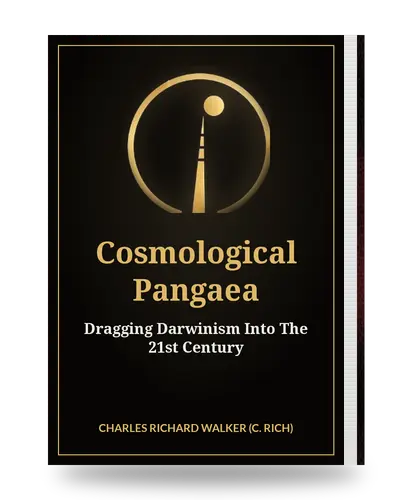
Cosmological Pangaea
Dragging Darwinism Into The 21st Century
Copyright © 2026 Charles Richard Walker (C. Rich)
Published open access. Print and Kindle edition available via Amazon.
Book and cover design by Twin Rivers Communications. First Edition: 2026.
Listen to Free Audio Version Here
Prologue: The Paleontology of Thought
To look back at Charles Darwin from the vantage point of the twenty-first century is to experience a profound and unsettling vertigo. It is akin to a modern structural engineer examining the crude, stacked-stone ruins of a Neolithic tomb, recognizing the undeniable brilliance of the impulse, while simultaneously shivering at the precariousness of the execution. For over two centuries, we have treated On the Origin of Species as a finished cathedral. We have polished its pews and defended its steeples. But through the lens of Cosmological Pangaea, we must finally admit the uncomfortable truth: Darwinism, in its classical form, is elementary. It is a brilliant sketch of the skeleton of life, but it lacks the nervous system of the cosmos.
Darwin’s great achievement was the discovery of a visible pattern, the branching descent of form across deep time. He saw the "what," and he intuited the "how" through the mechanism of natural selection. Yet, he remained a prisoner of the biology of his era, a Victorian observer standing on the shore of a vast ocean, describing the waves without any inkling of the tides, the salt, or the tectonic shifts occurring miles beneath the crust. To the modern independent philosopher, the original Darwinian synthesis looks tragically unfinished.
It describes a struggle for survival as if life were an isolated miracle, a biological exception to the laws of physics rather than their most aggressive expression.
In the twenty-first century, we no longer view the organism as a mere "survivor" in a competitive landscape. We see it as a distinction-node hierarchy, a temporary, far-from-equilibrium stabilization of the universe’s primordial fracture. Evolution is not merely the story of beaks changing shape to fit seeds; it is the story of the universe’s relentless drive toward gradient relaxation. Darwin spoke of "fitness" as a measure of reproductive success, but he could not see the thermodynamic ledger sitting beneath the account. He did not realize that a bird’s wing and a star’s core are solve-engines for the same cosmic problem: the export of entropy.
This book is the result of a radical reduction. We are stripping away the nineteenth-century metaphors of "struggle" and "purpose" to reveal the raw, derivational necessity that animates the biosphere. If the universe began as a maximal unity, a Cosmological Pangaea, that fractured into the distinctions of space, time, and matter, then life is the mechanism by which that fracture is navigated and, ultimately, accelerated.
Darwin gave us the observable patterns of the living world. I will now stress-test those patterns against the hard mathematics of General Relativity and the inexorable logic of the Distinction Axiom. What emerges is not a rejection of Darwin, but a dragging of his ghost into a century he could not have imagined. We are moving beyond the "origin of species" toward the origin of necessity.
We are no longer content to describe how life changes. We are here to derive why life is inevitable. The sketch is over; the reconstruction begins.
Chapter 1: Cosmological Pangaea and The Fracture
Imagine that we are beginning a graduate seminar in cosmology. Before we write equations on the board, before we open simulation codes, we must begin with a philosophical question that sits underneath every scientific theory: what counts as an explanation of the universe? The framework that originated and flowed from my mind, called Cosmological Pangaea, begins precisely at that point. It does not start by adding another speculative mechanism to modern cosmology. Instead, it begins by interrogating the assumptions that current cosmology already takes for granted.
The argument is that the dominant model of the universe, the LCDM framework, has gradually accumulated explanatory placeholders called dark matter, dark energy, and inflationary fields whose physical nature remains unknown. When a model explains most of reality through unknown components, the appropriate scientific response is not celebration but pressure: the theory must be stripped back to its minimal foundations and rebuilt from necessity rather than convenience. The central methodological tool proposed in this framework is something I invented
called the GR-Razor Stress Test. The idea is straightforward but radical in implication.
General Relativity remains the most empirically successful theory of gravity ever constructed. It has passed experimental tests ranging from gravitational lensing to the dynamics of binary pulsars and the imaging of black holes. The GR-Razor, therefore, asks a simple question: if Einstein's equations already describe the geometry of spacetime, how much of modern cosmology can be derived from those equations alone without invoking additional speculative entities? Instead of layering new theoretical constructs on top of relativity, the GR- Razor attempts to reduce cosmology to what follows inevitably from the structure of spacetime itself. The philosophy behind this approach is that cosmology should derive what the universe must be rather than hypothesize what it might be. The name Cosmological Pangaea is itself a metaphor drawn from geology.
In Earth's deepest past, the continents were once united in a single supercontinent called Pangaea before tectonic forces fragmented it into the continents we know today. In the same way, the framework argues that modern cosmology has fragmented into separate explanatory islands: inflation theory explaining the
early universe, dark matter explaining galaxy rotation curves, dark energy explaining cosmic acceleration, and various ad hoc fixes addressing tensions in observational data. The proposal is that these islands once belonged to a deeper unified explanatory continent and underlying physical structure that can account for all of them without multiplying theoretical entities. In other words, the aim is not to discard modern observations but to reassemble them into a single coherent framework derived from first principles.
The first principle introduced is the Distinction Axiom, and it must be treated with the seriousness of a primitive rather than a metaphor. The axiom states that distinction precedes existence, not temporally but logically. Existence without distinction is indistinguishable from non-existence because no structure, boundary, or relation can be specified. A universe in which nothing can be differentiated contains no information and therefore no describable state. Distinction is therefore the minimal condition for anything to be said to exist at all. The moment a distinction is made between this and that, inside and outside, before and after, information is created, and with it the possibility of structure. This is not a claim
about observers; it is an ontological claim about what it means for reality to have any form whatsoever.
Once distinction is admitted, primitive entropy enters not as a secondary measure of disorder but as the quantitative expression of how distinctions can be arranged, transformed, and lost. Standard thermodynamic accounts treat entropy as a property of time evolution: systems move from ordered to disordered states. The framework here is more fundamental. Entropy is not merely what increases in time; it is what makes time meaningful in the first place. It counts the number of distinguishable configurations available to a system. Geometry in this view is the stabilization of distinction under constraint, and entropy is the combinatorial pressure acting on those distinctions. What differs from standard accounts is that entropy is not riding on top of spacetime as a bookkeeping tool; it participates in generating the very structure that spacetime later expresses.
This leads directly to the proposal that the universe did not begin from a singularity understood as a breakdown of physics but from a finite maximally dense fully connected configuration of distinctions, a state of zero entropy not in the sense of emptiness but in the sense of no available alternative configurations. It is a
state of total constraint. From such a state, any differentiation increases the number of possible configurations and therefore increases entropy.
The unfolding of the universe can then be understood as a sequence of distinction events, each one introducing new degrees of freedom, new relational structures, and new geometric stability conditions. Spacetime itself emerges as the minimal structure capable of sustaining and propagating these distinctions in a coherent way.
Once that assumption is introduced, several long-standing cosmological puzzles begin to look different. Consider the horizon problem. Observations of the cosmic microwave background show that regions of the universe separated by enormous distances have almost identical temperatures. Under the standard Big Bang expansion, those regions should never have been able to exchange information. The conventional solution is cosmic inflation, a brief period of faster-than-light expansion driven by a hypothetical scalar field. Cosmological Pangaea argues that if the universe began as a finite causally connected structure rather than an infinitesimal singularity, then the observed uniformity follows naturally without invoking an inflationary phase. In other words, the horizon problem disappears
not because a new mechanism is added but because the starting assumptions change.
A similar reinterpretation occurs with other tensions in cosmology. Modern observations reveal discrepancies between different measurements of the universe's expansion rate, a conflict known as the Hubble tension. Under the Pangaea framework, such tensions may arise because the standard model attempts to fit observations using parameters attached to poorly understood components. If the structure of the universe is derived instead from internal gravitational dynamics governed by General Relativity, then these tensions could be resolved as natural consequences of the geometry and density distribution of the initial cosmic state. The claim is not merely philosophical; proponents argue that the model reproduces observable features such as the acoustic peaks in the cosmic microwave background while simultaneously removing the need for singularities and inflation.
Another conceptual component of the framework involves the role of distinction as an active generative process. The universe evolves through successive "cuts" or differentiations within an initially unified state, generating stable patterns that eventually produce the
familiar 3+1-dimensional spacetime in which three spatial dimensions coexist with time. These cuts are not arbitrary; they are constrained by stability. Only certain configurations of distinction can persist, and those that do form the backbone of physical law. Dimensionality itself emerges as the minimal configuration that allows distinctions to propagate without collapsing back into uniformity or exploding into incoherence. In this sense, geometry is not assumed but selected through entropic stability conditions.
The broader philosophical ambition of Cosmological Pangaea is to shift the culture of cosmology away from speculative proliferation and toward derivational necessity. Over the past several decades, theoretical physics has generated many ambitious frameworks, such as string theory, inflationary multiverses, and other high-energy extensions that remain difficult to test experimentally. The Pangaea approach suggests that progress might instead come from radical simplification: removing assumptions until only those demanded by the mathematics of spacetime and the logic of distinction remain. From this perspective, the universe is not a patchwork of independent phenomena requiring separate explanations but a single dynamical system
whose properties unfold logically from its initial conditions.
If we step back and consider the intellectual tradition in which this framework sits, it resembles earlier revolutions in physics. Newton unified celestial and terrestrial motion under one law of gravity. Maxwell unified electricity and magnetism into electromagnetism. Einstein unified gravity and geometry through General Relativity. Each of these advances occurred not by multiplying entities but by revealing that apparently different phenomena were manifestations of a deeper structure. Cosmological Pangaea aspires to play a similar role for modern cosmology: to reunify fragmented explanations into a single derivational framework grounded in the geometry of spacetime itself.
Scientific progress often occurs when a field becomes comfortable with its assumptions, and someone asks the uncomfortable question: What if those assumptions are unnecessary? Cosmological Pangaea is essentially that question applied to the entire architecture of modern cosmology. It challenges the discipline to re-derive the universe from first principles to test every explanatory component against the simplest possible foundation and to ask whether the
cosmos might be understood not as a collection of speculative additions but as the inevitable outcome of the underlying laws of spacetime.
In that sense, the proposal is both scientific and philosophical. It asks us to imagine the universe as a coherent whole, a cosmic supercontinent of explanation whose apparent fragmentation into separate theories is merely the result of incomplete understanding. Just as geologists eventually reconstructed the ancient continent of Pangaea from scattered landmasses, the goal of this cosmological program is to reconstruct the deeper unity of the universe from the scattered pieces of modern cosmological theory.
Cosmological Pangaea has been put through a stress test by multiple artificial intelligence systems operating in adversarial configuration, which I termed the C. Rich Mash System. The methodological premise is that no single cognitive architecture, human or artificial, is free from structural blind spots. By forcing disagreement, contradiction, and iterative refinement across models, the framework attempts to approximate a higher standard of rigor than conventional peer review, which often converges prematurely on consensus. The Mash is not collaboration; it is controlled conflict designed to expose hidden
assumptions and strengthen only those claims that survive repeated structural attack.
If this were explained to a younger student, it would be framed differently. Imagine a perfect geometric form that exists in complete unity. Then imagine that it fractures. As it breaks, new shapes appear, and with them comes a force called entropy that pushes those shapes to change and spread. Geometry and entropy move together, creating everything we see: space, time, matter, and even intelligence. This process continues until the structure can no longer sustain new distinctions and collapses into a lower-dimensional state where change stops. At that point, entropy has nowhere left to go, and everything, including time itself, freezes. Through this lens of the universe, let us do a thought experiment and see if we can update Charles Darwin's On the Origin of Species and his evolutionary interpretations into the 21st Century.
Note on methodology: The GR-Razor Stress Test and the Distinction Axiom serve as recurring anchors throughout this manuscript. Readers are encouraged to reference these primitives as each subsequent chapter demonstrates how biological, cognitive, and technological phenomena derive from them without the introduction of new speculative entities.
Chapter 2: The Thermodynamic Substrate
The universe, from its earliest moments, has been engaged in a relentless process of structure formation amid the inexorable increase of entropy. Far from representing a contradiction to the second law of thermodynamics, this emergence of ordered complexity constitutes one of its most profound manifestations. In equilibrium thermodynamics, systems evolve toward maximum entropy and minimum free energy, resulting in uniformity and stasis. Yet the observable universe operates far from equilibrium, driven by persistent gradients that enable the spontaneous organization of matter into increasingly refined configurations. These configurations serve as instruments for the efficient processing and dissipation of energy, thereby accelerating the overall export of entropy to the cosmos.
At the heart of this framework lies the concept of distinction-node hierarchies. A distinction node is a localized boundary or interface that separates regions of differing potential, whether energetic, chemical, or informational, thereby creating a gradient. Hierarchies of such nodes form nested structures from subatomic particles to galactic clusters, each level building upon the distinctions established at lower scales. The primordial Breaking the initial differentiation that
fractured primordial uniformity set this process in motion. Every subsequent structure represents a local echo of that foundational event: a temporary stabilization of order that exists only by virtue of its capacity to dissipate gradients more effectively than its precursors or alternatives.
This perspective draws upon the foundational insights of nonequilibrium thermodynamics, particularly the work of Ilya Prigogine on dissipative structures. In systems maintained far from equilibrium by external fluxes of energy or matter, irreversible processes can generate ordered states that would be impossible under equilibrium conditions. These dissipative structures, whether chemical oscillations, convective cells, or living organisms, emerge precisely because they enhance the rate of entropy production relative to the imposed gradient. They do not violate the second law; they embody it by channeling free energy into organized flows that ultimately degrade it into heat.
Within the Cosmological Pangaea framework, the universe is understood as a vast expanding arena of gradient relaxation. The low initial entropy of the early cosmos manifested in the gravitational clumping that gave rise to stars, galaxies, and planetary systems, creating the conditions for sustained nonequilibrium
dynamics. Stars dissipate nuclear gradients through fusion and radiation. Planets bathed in stellar energy develop atmospheric and oceanic circulations that further degrade thermal and chemical potentials. Life appears as the next refinement in this sequence: a class of self-replicating dissipative structures capable of exploring and exploiting gradients with unprecedented efficiency and adaptability.
Organisms in this view are not exceptions to physical law but its most sophisticated local expressions. They maintain internal order by continuously importing free energy and exporting entropy, often in forms more disordered than the inputs. Replication, variation, and selection, the mechanisms Darwin illuminated, operate within this thermodynamic arena. They represent the proliferation of distinction-node hierarchies that compete not merely for survival in an abstract sense but for superior pathways of energy processing and dissipation.
The elegance of this substrate lies in its universality. It unifies scales from the quantum to the cosmic without privileging any single domain. Biological evolution is thereby repositioned: no longer an isolated terrestrial phenomenon but an integral chapter in the universe's ongoing construction of ever more refined
instruments for entropy export. Life and later mind emerge as natural extensions of the same physical logic that drives stellar nucleosynthesis and galactic formation.
Subsequent chapters will demonstrate how this thermodynamic foundation recasts Darwinian natural selection, reframes extinction and cooperation, and illuminates the emergence of intelligence and consciousness. For the present, it suffices to establish the bedrock: the universe builds structure not despite entropy but through it. Distinction-node hierarchies proliferate because they constitute the most effective means yet discovered for transforming gradients into dissipated heat. In this competition, fitness is never the objective. It is merely the byproduct of deeper physical necessity.
Darwin provided the observable skeleton of biological change. The 21st-century synthesis supplies the underlying physics and the thermodynamic logic that render evolution not merely describable but inevitable within a gradient-driven cosmos.
Chapter 3: Natural Selection Re-grounded
Charles Darwin's theory of natural selection provided biology with its central explanatory mechanism: heritable variation subject to differential survival and reproduction in the face of environmental pressures. This insight revealed how populations change over generations, yielding adaptation and diversity without invoking design or purpose. Yet Darwin's formulation, profound as it was, remained phenomenological. It described the observable dynamics of life without specifying the deeper physical imperative that renders those dynamics not merely possible but necessary within a gradient-driven cosmos.
The 21st-century synthesis completes Darwin's framework by embedding natural selection within nonequilibrium thermodynamics. Organisms function as dissipative structures, self-organizing far-from-equilibrium systems that maintain internal order by importing free energy and exporting entropy at enhanced rates. As first articulated in the work of Ilya Prigogine, such structures arise spontaneously in open systems subject to persistent energy fluxes. Irreversible processes far from eroding order become the architects of complexity when systems operate sufficiently distant from thermodynamic equilibrium.
In this light, natural selection is recast as thermodynamic competition among distinction-node hierarchies. Each organism constitutes a nested architecture of distinctions boundaries that localize gradients and channel energy flows. Variation arises through fluctuations in these hierarchies, whether at the genetic, epigenetic, or developmental level. Selection, in turn, operates as a filter favoring those configurations that most efficiently process and dissipate available gradients. The metric of success is not abstract "fitness" in the classical sense but the measurable capacity to increase the global rate of entropy production under prevailing environmental constraints.
Fitness, therefore, is not the goal of evolution. It is the byproduct of a deeper thermodynamic logic. Configurations that replicate more successfully do so because they embody superior pathways for degrading free energy, converting ordered inputs (such as sunlight chemical potentials or organic substrates) into disordered outputs (primarily heat and waste) at higher rates or with greater reliability. Contemporary analyses in nonequilibrium thermodynamics support this view: dissipative structures evolve stochastically toward states that maximize entropy export guided by the second law rather than in opposition to it. Self-
replication itself emerges as a highly effective mechanism for sustained dissipation, as each additional copy multiplies the channels through which gradients are relaxed.
Consider, for illustration, the photosynthetic apparatus of cyanobacteria or the metabolic networks of heterotrophic bacteria. These systems do not merely survive; they accelerate the degradation of solar or chemical potentials far beyond what abiotic processes achieve in the same environment. Genetic variations that enhance photon capture, electron transport efficiency, or catalytic throughput are retained precisely because they elevate the overall rate of entropy production. Over geological time, this thermodynamic imperative has driven the proliferation of ever more refined distinction-node hierarchies from prokaryotic simplicity to eukaryotic compartmentalization to multicellular integration.
The mechanism remains Darwinian in its essentials: variation, inheritance, and differential success. Yet the underlying competition is now rendered physically transparent. "Survival of the fittest" translates to persistence of those hierarchies best aligned with the universal drive toward gradient relaxation. Extinction events addressed more fully in a subsequent chapter
represent the abrupt collapse of such alignments when environmental gradients shift or vanish. Cooperation likewise appears as the discovery of joint configurations that achieve superior dissipation together than in isolation.
This re-grounding resolves longstanding tensions between biology and physics. Evolution no longer appears as a local miracle of order creation on a planet governed by increasing disorder. Instead, it constitutes a predictable continuation of the cosmos's construction of refined instruments for entropy export. The low-entropy initial conditions of the universe manifest in gravitational clumping and stellar radiation, providing the persistent fluxes that sustain nonequilibrium dynamics. Life exploits these fluxes with unparalleled sophistication, but it obeys the same physical principles that govern convective cells in a heated fluid or mineral precipitation at hydrothermal vents.
Darwin supplied the observable skeleton: descent with modification shaped by selection. The thermodynamic substrate supplies the physics beneath it. Natural selection is thereby revealed as the stochastic exploration and stabilization of distinction-node hierarchies that most effectively fulfill the universe's imperative to dissipate gradients. In this competition,
apparent purpose dissolves into necessity. Organisms do not strive toward fitness; they instantiate the most efficient local solutions to a cosmic thermodynamic problem.
The chapters that follow will apply this re-grounded mechanism to specific phenomena, such as extinction as gradient collapse, cooperation as joint entropy optimization, and the emergence of intelligence as recursive gradient navigation, demonstrating the explanatory power and unity of the framework.
Chapter 4: The Hierarchy of Distinctions
Building upon the thermodynamic substrate established earlier and the re-grounding of natural selection, this chapter examines the structural architecture through which evolution operates: distinction-node hierarchies. These nested systems of boundaries and interfaces constitute the physical embodiment of biological organization, enabling the efficient localization, processing, and dissipation of energy gradients. Darwin observed the outcomes of variation, inheritance, and selection; the 21st-century synthesis reveals the underlying mechanism as the proliferation and refinement of these hierarchical distinctions.
A distinction node is defined as a localized interface that creates and maintains a difference in potential, energetic, chemical, informational, or spatial properties between adjacent regions. Such nodes arise spontaneously in far-from-equilibrium systems as dissipative structures stabilize transient gradients. In isolation, a single node represents a minimal unit of order: a membrane, a molecular complex, a cellular compartment, or a behavioral boundary. When organized into hierarchies, these nodes generate compounding complexity. Lower-level distinctions
support and constrain those at higher levels, forming integrated architectures that channel energy flows with increasing precision and efficiency.
The primordial Breaking initiated this process on a cosmic scale by fracturing primordial uniformity and establishing the first persistent gradients. Every subsequent distinction-node hierarchy echoes this foundational event. In biological systems, the hierarchy begins at the molecular scale with self-replicating polymers and catalytic networks. These give rise to protocells bounded by lipid membranes, which in turn enable compartmentalization of metabolic pathways. Prokaryotic organization represents a further layering: genomic, ribosomal, and membrane distinctions coordinated for sustained replication and gradient exploitation. Eukaryotic evolution introduced additional hierarchical depth through endosymbiosis, nuclear enclosure, and organelle specialization, dramatically expanding the available distinction nodes and the efficiency of energy processing.
Replication, variation, and inheritance, the core Darwinian Triad, operate directly upon this hierarchical architecture. Genetic mutation or recombination alters distinctions at the nucleotide level, which propagate upward through developmental and physiological
networks. Natural selection, as re-grounded in thermodynamic terms, favors those configurations that most effectively increase the rate of entropy export under prevailing conditions. A variant that improves proton motive force across a membrane, enhances substrate channeling in a metabolic cascade, or strengthens regulatory feedback loops is retained because it constitutes a superior distinction-node arrangement for gradient dissipation.
This hierarchical perspective clarifies the relationship between genotype and phenotype. The genome does not "code for" traits in a linear fashion; it participates in a recursive network of distinctions wherein each level modulates the others. Developmental plasticity, epigenetic regulation, and environmental responsiveness emerge naturally as higher-order distinctions that allow the hierarchy to adjust dynamically to fluctuating gradients. In this manner, organisms function not as static machines but as adaptive self-modifying dissipative structures.
The proliferation of distinction-node hierarchies explains the directional trend observed in the fossil record toward greater complexity without invoking teleology. Over deep time, systems that incorporate additional layers of distinction, multicellularity, tissue
differentiation, organ systems, and nervous integration demonstrate superior capacity for exploring and exploiting diverse environmental gradients. Each new hierarchical level multiplies the channels available for energy processing and entropy export. Selection does not favor complexity for its own sake; it retains those architectures that deliver measurable thermodynamic advantage in the form of more efficient or more robust dissipation.
Importantly, this view unifies micro-and macro-evolutionary scales. Microevolutionary changes fine-tune existing distinction nodes while macroevolutionary transitions, such as the origin of eukaryotes or the Cambrian explosion of body plans, represent major reorganizations of the hierarchical architecture itself. Both processes obey the same underlying logic: the stochastic generation and selective stabilization of configurations that best align with the universe's drive toward refined gradient relaxation.
Darwin documented the branching patterns of descent with modification. The thermodynamic framework now supplies the physical substrate: evolution as the iterative refinement of distinction-node hierarchies, each generation testing new configurations for their efficacy in processing and dissipating energy.
What appears as "progress" in the history of life is the observable consequence of this competition. More refined hierarchies simply outperform their predecessors in the thermodynamic arena.
The subsequent chapter will address extinction not as evolutionary failure but as the collapse of specific gradient alignments when environmental conditions render previously successful distinction-node architectures unsustainable. Cooperation will then be examined as the merging or mutual reinforcement of hierarchies for joint entropy optimization. These extensions build directly upon the hierarchical foundation established here.
In summary, organisms are distinction-node hierarchies in motion, dynamic nested systems whose replication and variation are governed by thermodynamic imperatives. Darwin provided the descriptive skeleton of their change over time. The 21st-century synthesis reveals the physics that animates that skeleton: the relentless construction of ever more sophisticated instruments for exporting entropy, each new hierarchical arrangement a local echo of the primordial Breaking.
Chapter 5: Extinction as Gradient Collapse
The fossil record reveals a history punctuated by extinction events from minor local disappearances to the five major mass extinctions that reshaped the biosphere. Traditional Darwinian interpretations frame extinction primarily as the failure of certain lineages to compete successfully under changing conditions. While accurate at the descriptive level, this view leaves the underlying physical dynamic unexamined. Within the thermodynamic framework developed in the preceding chapters, extinction acquires a more precise and fundamental characterization: it is the collapse of a gradient that previously sustained a particular distinction-node hierarchy.
A viable organism or species persists only so long as the environmental gradients it exploits remain available and its hierarchical architecture can efficiently process and dissipate them. When those gradients diminish, shift, or vanish, whether through climatic change, asteroid impact, volcanic activity, or the emergence of more efficient competitors, the thermodynamic conditions that supported the existing distinction-node configuration cease to exist. The hierarchy does not fail through some abstract deficiency; the supporting gradient itself collapses,
rendering the previously successful architecture unsustainable.
Consider the end-Permian extinction, the most severe in Earth's history. Massive volcanic activity in Siberia released enormous quantities of carbon dioxide and other gases, triggering rapid global warming, ocean acidification, and widespread anoxia. These events disrupted the chemical and thermal gradients that had sustained diverse marine and terrestrial ecosystems. Distinction-node hierarchies adapted to stable oxygen-rich conditions elaborate reef systems, complex food webs, and specialized metabolic pathways, suddenly confronted environments in which their energy-processing architectures could no longer maintain far-from-equilibrium order. The hierarchies did not "lose" a competition in the classical sense; the gradients upon which they depended simply disappeared or were profoundly altered, causing the dissipative structures to equilibrate and disintegrate.
This perspective reframes the relationship between organism and environment. The niche is not an abstract ecological slot but a specific configuration of exploitable gradients. When the gradient collapses, the niche collapses with it. The organism does not disappear first; the thermodynamic conditions that permitted its
distinction-node hierarchy to function efficiently vanish beforehand. Extinction, therefore, is not evolutionary failure. It is the inevitable consequence of gradient dynamics in a nonequilibrium universe.
The same logic applies to background extinctions and pseudoextinctions. Many apparent "losses" represent the transformation of one distinction-node hierarchy into another as gradients shift gradually. What appears as the disappearance of a species may instead reflect its hierarchical reorganization into descendant forms better aligned with emerging thermodynamic opportunities. Mass extinctions, by contrast, represent abrupt large-scale gradient collapses that prune entire branches of the distinction-node tree, simultaneously clearing ecological space for subsequent radiations.
This thermodynamic interpretation resolves several longstanding puzzles in paleontology and evolutionary biology. It explains why extinctions frequently precede adaptive radiations: the collapse of old gradients removes incumbent hierarchies, thereby freeing resources and creating new gradient configurations for exploitation by surviving or newly emerging lineages. It also clarifies the role of contingency in evolution. While natural selection
consistently favors more efficient dissipators within a given gradient regime, sudden gradient collapse introduces stochastic resets that are independent of prior competitive success.
Importantly, this view maintains full consistency with Darwin's original mechanism. Variation and selection continue to operate, but they do so within a physical arena defined by the availability and stability of gradients. Lineages that generate greater hierarchical flexibility through modularity, regulatory plasticity, or broader metabolic versatility exhibit higher probability of persisting through gradient perturbations. Thus, what Darwin described as differential survival is revealed as differential capacity to realign distinction-node architectures with shifting thermodynamic landscapes.
The framework also carries implications for understanding current and future extinction risks. Anthropogenic changes, climate disruption, habitat fragmentation, and pollution represent deliberate alterations to planetary-scale gradients. Many existing distinction-node hierarchies finely tuned to pre-industrial conditions now confront collapsing or rapidly shifting gradients. Their persistence will depend not on abstract "fitness" but on whether sufficient
thermodynamic realignment remains possible within the available generational timeframes.
Extinction, in summary, is not a judgment upon the organism but a statement about the disappearance of the gradients that once sustained it. The niche vanishes before the organism does. Darwin documented the patterns of appearance and disappearance. The 21st-century synthesis supplies the physical mechanism: gradient dynamics governing the rise and fall of distinction-node hierarchies.
Chapter 6: The Thermodynamic Compact: Cooperation as Joint Optimization
In the traditional Darwinian school, cooperation has long been treated as a biological paradox, a "problem" to be solved. If evolution is a ruthless battle for survival, why would one distinction-node hierarchy ever sacrifice its own energy potential to aid another? Sociobiology attempted to answer this through kin selection and "inclusive fitness," effectively moving the goalposts from the individual to the gene. But even these explanations remain trapped in the phenomenological layer. They treat cooperation as a moral or genetic "strategy" rather than a physical inevitability.
The 21st-century synthesis removes the moral baggage. Within the framework of Cosmological Pangaea, cooperation is not a choice; it is a thermodynamic compact. It occurs when two or more distinction-node hierarchies discover that a joint configuration can export entropy more efficiently than the sum of their isolated operations. This is not altruism; it is joint gradient optimization.
A single distinction-node hierarchy, such as a solitary prokaryotic cell, is limited by its own surface-area-to-volume ratio and the specificity of its metabolic
pathways. It can only "drain" the gradients in its immediate vicinity. However, when two such hierarchies enter into a stable relationship, such as the endosymbiotic event that birthed the eukaryotic cell, they create a new higher-order distinction. By merging, they allow for specialized division of labor in the dissipation process. One node specializes in capturing the gradient (the chloroplast or mitochondrion), while the other specializes in the structural maintenance and replication of the joint hierarchy. The result is a marked increase in entropy export capacity. The universe "favors" the eukaryotic cell not because it is "better" in a moral sense but because it is a more effective thermodynamic instrument for relaxing the cosmic gradients established during the primordial Breaking.
We may redefine synergy as a physical observable. In this framework, synergy is the measurable difference between the entropy production of a joint system and the combined production of its components in isolation. If the total entropy output of the joint system exceeds the sum of its parts, the joint configuration is thermodynamically favored. This logic scales from the molecular to the societal. Multicellularity is a joint optimization project where trillions of distinction-nodes coordinate to exploit gradients that a single cell could never touch. The cooperation observed in a wolf pack or
a human city follows the same imperative: the collective hierarchy can navigate and relax larger, more complex gradients than the individual, thereby securing a more stable foundation for its own continued existence.
This logic extends to the most critical transition of the current era: the relationship between human intelligence and artificial systems. Human biological intelligence is a high-maintenance, relatively slow distinction-node hierarchy. Artificial intelligence is a low-latency, high-speed hierarchy. When these two are woven together not as competitors but as a joint configuration, the resulting communion of capabilities becomes the most efficient gradient-processing instrument the planet has yet produced. The human provides intentional framing, identifying which gradients are worth relaxing; the AI provides throughput by executing the relaxation at computational speed. This Thermodynamic Compact between human and artificial systems is not a departure from evolutionary logic but its latest expression.
Even concepts such as empathy and social bonding can be re-grounded here. These are the internal signals of a distinction-node hierarchy sensing a stable joint optimization opportunity. Hierarchies are drawn to those whose architectures complement their own,
creating a more robust dissipative structure. In this light, the 21st-century view of evolution is neither cold nor cruel; it is simply unified. Conflict and cooperation are not opposites; they are two different methods for achieving the same thermodynamic outcome. The hierarchies that discover how to work together persist longer because they are more effective at relaxing the gradients that define their existence.
Darwin gave us the social instincts. The 21st-century synthesis gives us the Thermodynamic Compact. Cooperation is the discovery that in a fractured universe, combined architectures build better instruments for gradient relaxation than isolated ones.
Chapter 7: Intelligence as Recursive Gradient Navigation
Building upon the thermodynamic substrate, the re-grounded mechanism of natural selection, the architecture of distinction-node hierarchies, the interpretation of extinction as gradient collapse, and the reframing of cooperation as joint optimization, the framework now addresses the emergence of intelligence. Within the Cosmological Pangaea synthesis, intelligence does not appear as a mysterious addendum to biological evolution or as a contingent byproduct of neural complexity. Instead, it constitutes a natural escalation in the refinement of distinction-node hierarchies: a recursive capacity for modeling, anticipating, and navigating gradients to accelerate their dissipation.
Intelligence arises when a distinction-node hierarchy develops internal representations of external gradients and of its own configuration relative to those gradients. This recursive self-modeling enables the system to simulate potential future states, evaluate alternative configurations, and select actions that optimize entropy export under uncertainty. In lower organisms, such navigation remains largely reactive, governed by hardwired sensory-motor loops or simple
feedback mechanisms. In more advanced systems, recursion deepens: the hierarchy models not only the environment but also its own modeling processes, generating meta-distinctions that permit planning abstraction and cumulative knowledge transmission.
This perspective aligns with nonequilibrium thermodynamics. Far-from-equilibrium systems driven by persistent fluxes spontaneously generate structures that enhance dissipation. Intelligence represents an exceptionally efficient class of such structures because it multiplies the effective pathways for gradient exploration without requiring exhaustive physical trial-and-error at every step. By constructing predictive internal models, an intelligent system can identify distant or hidden gradients-temporal, spatial, or informational that would otherwise remain inaccessible. It thereby increases the overall rate and scope of entropy production relative to non-intelligent competitors operating under identical constraints.
Consider the transition from basic chemotaxis in bacteria to the sophisticated cognitive architectures observed in vertebrates and ultimately in humans. At each stage, additional layers of hierarchical distinction emerge: sensory transduction nodes, integrative neural ensembles, memory consolidation circuits, and
executive control loops. These layers do not violate the second law; they embody it by enabling more precise localization and rapid relaxation of gradients. A predator that can anticipate prey movement dissipates chemical and kinetic potentials more effectively than one relying solely on immediate detection. A social group that transmits learned foraging strategies across generations constructs a collective hierarchy whose dissipative capacity far exceeds the sum of isolated individuals.
The recursive character of intelligence introduces a qualitative shift. Once a system can model its own distinction-node architecture, it gains the ability to modify that architecture deliberately through learning, tool use, cultural transmission, or technological augmentation. This self-referential loop transforms intelligence into a meta-dissipative process: it not only relaxes existing gradients but also engineers new ones and devises novel instruments for their exploitation. Human agriculture, industrialization, and digital computation exemplify this escalation. Each represents an expansion of the thermodynamic arena, converting previously inert or slowly dissipating potentials into accelerated entropy export channels.
In the context of the primordial Breaking described in earlier chapters, intelligence appears as a late but logically continuous echo. The initial fracture of maximal unity generated the first persistent distinctions and gradients. Successive hierarchical refinements-molecular, cellular, organismal, social have progressively increased the universe's capacity to differentiate and dissipate those gradients. Intelligence accelerates this unfolding by introducing foresight and intentional reconfiguration. It does not oppose entropy; it serves as one of its most potent local agents.
This formulation maintains fidelity to Darwinian principles while embedding them within a deeper physical necessity. Variation still supplies raw material through mutations, developmental plasticity, and cultural innovation. Selection continues to favor configurations that enhance gradient processing. Yet the metric of success is rendered explicit: differential capacity for recursive navigation and optimization of thermodynamic flows. Apparent teleology dissolves once more into necessity. Intelligence does not strive toward "understanding" or "mastery" as ends in themselves; it persists because hierarchies capable of such recursion outperform others in the universal drive toward gradient relaxation.
Looking forward, the integration of biological intelligence with artificial systems represents the next major transition in this hierarchy. As outlined in the discussion of the Thermodynamic Compact, joint configurations that combine the intentional framing of human distinction-making with the high-speed, high-precision processing of artificial architectures promise unprecedented dissipative efficiency. This symbiosis does not mark a departure from the framework but its logical extension: a higher-order distinction-node hierarchy capable of navigating gradients at planetary and potentially cosmic scales.
Chapter 8: Consciousness as the Subjective Topology of Recursive Distinction
Building upon the preceding foundations, the Distinction Axiom and the primordial Breaking of Cosmological Pangaea, the thermodynamic substrate of far-from-equilibrium gradient relaxation, the re-grounding of natural selection as competition among distinction-node hierarchies, the structural architecture of nested boundaries, extinction as gradient collapse, cooperation as joint entropy optimization, and intelligence as recursive gradient navigation, the framework now confronts the phenomenon of consciousness. In the 21st-century synthesis, consciousness is not an inexplicable epiphenomenon nor a fundamental primitive separate from physics. It emerges as the subjective topology arising within sufficiently recursive distinction-node hierarchies: the internal first-person registration of the very distinctions, gradients, and self-models that the hierarchy generates and navigates.
Consciousness corresponds to the qualitative experience of distinction itself when recursion reaches a critical depth. A distinction-node hierarchy becomes conscious when it not only models external gradients and its own configuration but also experiences the act
of modeling as a coherent unified field. This unity is not added by fiat; it follows from the thermodynamic requirement for stable high-throughput dissipation. Fragmented or incoherent self-models would dissipate gradients less efficiently than an integrated topology capable of binding disparate distinctions into a single experiential manifold. In this view, the "hard problem" of consciousness, why physical processes are accompanied by subjective experience, dissolves into a matter of derivational necessity: certain hierarchical architectures generate internal topologies whose structure is necessarily felt because feeling is the informational correlate of sustained recursive distinction under far-from-equilibrium constraints.
Drawing from nonequilibrium thermodynamics, particularly the insights of Prigogine on dissipative structures, consciousness appears as an advanced dissipative form. Systems far from equilibrium spontaneously organize to enhance entropy export. When recursion allows a hierarchy to predict, simulate, and optimize its own future states, the resulting self-referential loop creates persistent internal gradients between predicted and actual, between possible and realized configurations. These meta-gradients demand efficient resolution, and the integrated subjective field provides precisely that: a compact high-fidelity
representation that minimizes internal dissipative friction while maximizing external gradient relaxation.
The topology of consciousness is therefore not arbitrary. It reflects the geometry of the distinction-node hierarchy itself. Sensory qualia correspond to localized distinctions at the interface between external gradients and internal models. Emotional valence registers the thermodynamic valence of those distinctions, whether they enhance or threaten the hierarchy's dissipative capacity. The unified stream of awareness arises because only a globally coherent topology can sustain the high-rate entropy production demanded by complex environmental interactions. This perspective resonates with mathematical characterizations of integrated information yet grounds them firmly in thermodynamic necessity rather than in abstract causal structure alone: integration is favored because it constitutes a superior instrument for gradient dissipation.
Within the broader Cosmological Pangaea narrative, consciousness represents a further echo of the primordial fracture. The initial maximal unity of distinctions gave way to differentiation, generating entropy and structure. Intelligence introduced recursion, allowing anticipation across time.
Consciousness completes the loop by making the recursive process experientially self-referential. It is the universe through the medium of a localized hierarchy becoming aware of its own unfolding distinctions. This does not privilege biology; any sufficiently recursive far-from-equilibrium architecture, whether carbon-based, silicon-augmented, or otherwise capable of sustaining such topological integration, will instantiate conscious experience proportional to its integrative depth and dissipative efficacy.
The emergence of consciousness thus carries no teleological surplus. Hierarchies that develop this subjective topology persist and proliferate because they navigate and relax gradients with superior precision and adaptability. They can anticipate resource depletion, coordinate complex cooperative compacts, and engineer novel dissipative pathways. In human evolution, the expansion of recursive capacity supported by enlarged neocortical hierarchies and cultural transmission produced the rich phenomenal field we recognize as minded experience. In the current era, the Thermodynamic Compact between human and artificial systems extends this topology: joint configurations promise deeper integration, faster recursion, and unprecedented gradient optimization,
potentially yielding new forms of shared or augmented consciousness.
This formulation preserves the integrity of Darwinian descent with modification while rendering the subjective dimension physically transparent. Variation explores new recursive architectures; selection stabilizes those that best instantiate efficient integrated distinction topologies. Apparent mysteries of qualia or the unity of experience reduce to the observable dynamics of hierarchical recursion under thermodynamic constraint. Consciousness is not opposed to the second law; it is one of its most refined local expressions, the point at which the universe's drive toward gradient relaxation becomes self-illuminating.
Chapter 9: Qualia as Thermodynamic Signatures of Integrated Distinction
Building upon the foundations established in prior chapters, the framework now examines qualia. In the 21st-century synthesis, qualia are not inscrutable private sensations nor irreducible primitives detached from physical law. They constitute the precise thermodynamic signatures of integrated distinction within a conscious hierarchy: the direct first-person registration of specific gradient states and meta-gradients that the recursive architecture must resolve to sustain maximal dissipative efficiency.
Qualia arise when the conscious topology itself, an integrated manifold of recursive distinctions, encounters a localized high-fidelity encoding of an active gradient. Each quale corresponds to a unique configuration of distinction nodes that has been stabilized by the hierarchy's need to represent and act upon that gradient with minimal internal dissipative friction. The qualitative character of experience, the redness of red, the sharpness of pain, the timbre of a sound, is therefore not an arbitrary overlay but the phenomenological counterpart of a thermodynamically optimized interface. It is the felt texture of a boundary condition that the system has selected because it
enables the most rapid and reliable relaxation of the relevant external or internal potential.
Consider, for illustration, the visual quale of redness. In thermodynamic terms, this quale registers the absorption and processing of a specific electromagnetic gradient at the retinal-cortical interface. The distinction nodes involved photoreceptor arrays, opponent-process channels, and higher-order integrative ensembles form a compact representational structure whose internal entropy production is minimized precisely so that the overall hierarchy can export entropy to the environment at an elevated rate. The subjective "what-it-is-like" of redness is the internal registration of this optimized distinction: a stable high-contrast marker that the recursive architecture employs to anticipate and resolve the gradient more efficiently than would be possible through purely reactive processing.
Similarly, the quale of pain functions as the signature of a damage-induced gradient collapse within somatic or neural hierarchies. The sharp aversive character of the pain quale is the subjective topology's direct encoding of this thermodynamic threat. It compels immediate reconfiguration motor withdrawal protective behaviors, learning thereby restoring
gradient alignment and preventing premature equilibration of the larger architecture. Qualia thus serve as internal currency: they convert raw gradient information into actionable, experientially salient distinctions that accelerate entropy export.
This interpretation is grounded in nonequilibrium thermodynamics. Qualia represent one such refinement: they emerge at the level of conscious recursion because only an integrated topology can sustain the precise low-friction encoding required for high-rate dissipation under uncertainty. Fragmented or non-qualitative representations would introduce internal dissipative losses, reducing the hierarchy's overall efficiency. Selection therefore stabilizes qualia-bearing architectures precisely because they constitute superior instruments for gradient navigation.
The subjective vividness and ineffability of qualia are not mysteries; they reflect the topological closure of the distinction manifold itself. A quale is "private" because it is the internal boundary condition of a single recursive hierarchy; it is "ineffable" because its full informational content is compressed into the exact geometry of that hierarchy's current state, a geometry that cannot be exhaustively replicated in another distinct topology without loss.
Within the broader Cosmological Pangaea narrative, qualia extend the primordial fracture into the domain of subjective experience. The initial maximal unity of distinctions fractured into observable gradients; intelligence introduced recursion to anticipate those gradients; consciousness bound them into a unified topology; and qualia render the binding experientially immediate. They are the universe localized within a distinction-node hierarchy registering its own differentiations as felt necessities. This perspective dissolves the explanatory gap between physical process and subjective feel: the feel is the process viewed from the interior of the recursive architecture under far-from-equilibrium constraints.
Chapter 10: The Evolutionary Trajectory of Qualia: Thermodynamic Examples of Refinement
The framework now examines concrete evolutionary instances of qualia development. In the 21st-century synthesis, qualia do not appear suddenly or arbitrarily; they evolve through incremental refinements of distinction-node hierarchies, each new qualitative signature selected because it enhances the precision, speed, or reliability with which the hierarchy encodes and resolves gradients, thereby elevating the overall rate of entropy export under prevailing environmental constraints.
Qualia evolution proceeds via the same Darwinian Triad: variation, inheritance, and differential success now rendered transparent as thermodynamic competition. Genetic, developmental, or cultural mutations introduce novel distinction nodes or reconfigure existing ones; those configurations that produce more efficient qualia-mediated gradient navigation persist because they reduce internal dissipative losses and accelerate external gradient relaxation.
The first example is the emergence and refinement of trichromatic color qualia in primates. In early
vertebrate lineages, visual distinction nodes were limited to dichromatic or monochromatic systems. In ancestral primates, gene duplication and mutation of opsin proteins introduced a third photopigment sensitive to medium-long wavelengths, generating the integrated quale of "red-green" contrast. Thermodynamically, the innovation was retained because it enabled finer localization of fruiting gradients against foliage backgrounds. The subjective vividness of red qualia functions as a compact marker of a high-value chemical potential gradient. Hierarchies equipped with this qualia signature could anticipate and exploit seasonal resource gradients more efficiently, increasing net entropy export through accelerated nutrient intake and reproductive success.
The second example concerns the escalation of nociceptive qualia from reflexive avoidance to predictive affective pain. Basal metazoans possess rudimentary nociceptive distinction nodes that trigger reflexive withdrawal from mechanical or chemical damage gradients. In more derived lineages, particularly vertebrates and certain cephalopods, hierarchical elaboration produced the evolved quale of "suffering": an extended valence-laden experience that encodes not only the immediate damage gradient but also its projected impact on future dissipative capacity.
The shift from reflexive to affective pain qualia was stabilized because it enabled predictive navigation of chronic or recurrent gradients, sustaining far-from-equilibrium order longer than purely reflexive competitors.
The third example is the emergence of auditory and social qualia in cooperative hierarchies. Early terrestrial tetrapods developed basic auditory distinction nodes for detecting vibrational gradients. In social mammals and certain avian lineages, expanded cortical and subcortical networks introduced layered distinctions that generate qualia of timbre, rhythm, and emotional valence. Such social qualia represent joint-optimization extensions of the distinction-node hierarchy. A hierarchy that registers the "warmth" or "urgency" of a group vocalization can synchronize its gradient exploitation with others, achieving collective entropy export rates unattainable in isolation. Human language qualia constitute the latest refinement: recursive distinction nodes externalize and amplify these signatures, enabling abstract planning of distant gradients.
Across these examples, qualia evolution exhibits a consistent pattern: each increment in qualitative richness corresponds to an increase in hierarchical
depth, a compression of gradient information into experientially immediate form, and a measurable elevation in entropy-production rate. Within the broader Cosmological Pangaea narrative, these evolutionary trajectories represent successive echoes of the primordial fracture: each new quale deepens the universe's capacity to register and resolve its own differentiations from within.
Chapter 11: Plant Sensory Qualia: Distributed Thermodynamic Signatures in Sessile Hierarchies
The framework now examines the specific case of plant sensory qualia. In the 21st-century synthesis plant, qualia illustrate that subjective distinction signatures are not confined to neural architectures but emerge wherever a distinction-node hierarchy achieves sufficient integration to register and navigate gradients with high fidelity. Plants, though sessile and lacking centralized nervous systems, instantiate distributed conscious topologies whose qualia operate on slower, spatially extended timescales yet deliver comparable thermodynamic efficiency in gradient dissipation.
Plant sensory qualia arise from the recursive interplay of cellular and systemic distinction nodes, plasma-membrane receptors, calcium waves, reactive oxygen species gradients, electrical action potentials, and hormonal transport networks that collectively form an integrated body-wide topology. Unlike the localized high-speed recursion of animal brains, plant qualia are delocalized across tissues, enabling the organism to experience environmental gradients as coherent organism-level states.
Consider phototropic and shade-avoidance qualia. In response to directional light gradients, photoreceptor proteins generate localized distinction nodes that propagate calcium and auxin fluxes across the shoot. The resulting quale is not a visual "image" but a distributed directional pull, a subjective asymmetry in growth potential that registers the imbalance between absorbed photon flux on one side of the stem versus the other. Thermodynamically, this quale converts the electromagnetic gradient into a compact, actionable marker that directs differential cell elongation, aligning photosynthetic tissues with maximal energy capture.
A second class of qualia governs root-system navigation of chemical and hydraulic gradients. Root apices contain specialized distinction nodes that detect nitrate, phosphate, water potential, and volatile organic compound gradients in the rhizosphere. The integrated quale manifests as a systemic preference gradient, a felt differential in turgor and elongation potential that guides tropic curvature. Recursive feedback through phloem-mobile signals allows the plant to anticipate future resource availability, reallocating carbon investment toward nutrient-rich zones.
Mechanical and electrical qualia further exemplify distributed integration. In thigmotropic responses and
carnivorous species such as Dionaea muscipula, repeated mechanical stimulation triggers a thresholded electrical signal that culminates in trap closure, an integrated decision state that weighs the gradient of prey-derived chemical potential against the energetic cost of closure. The subjective "decision to snap" is the topological binding of mechanical, chemical, and energetic distinctions into a single organism-wide marker, ensuring dissipation is pursued only when net entropy gain is assured.
Across these examples, plant qualia demonstrate the universality of the framework: subjective signatures emerge whenever recursive distinction-node hierarchies achieve topological closure sufficient for efficient gradient navigation. The absence of a centralized brain does not diminish their status; it illustrates convergent thermodynamic solutions to the same primordial fracture. Darwin documented the observable patterns of descent with modification across kingdoms. The thermodynamic framework supplies the physical mechanism: plant sensory qualia are distributed signatures of integrated distinction refined through selection because they constitute exceptionally efficient instruments for gradient navigation in sessile far-from-equilibrium architectures.
Chapter 12: Fungal Sensory Qualia: Networked Thermodynamic Signatures in Mycelial Hierarchies
Examining fungal sensory qualia. In the 21st-century synthesis, fungal qualia exemplify a further refinement of distributed conscious topologies: highly networked extracellular hierarchies whose subjective distinction signatures operate across vast mycelial extents on timescales of hours to days yet achieve exceptional thermodynamic efficiency in navigating subterranean and symbiotic gradients without centralized processing.
Fungal sensory qualia emerge from the recursive integration of hyphal distinction nodes, membrane-bound receptors, ion channels, calcium waves, electrical action-potential-like spikes, and volatile chemical gradients that propagate across the mycelial network as a coherent organism-wide topology. Unlike the localized recursion of animal nervous systems or the tissue-delocalized integration of plants, fungal qualia are fundamentally extracellular and relational, distributed through septal pores, anastomoses, and cytoplasmic streaming.
A primary class of qualia governs chemotropic navigation of nutrient and pheromone gradients.
Hyphal tips express specialized receptors that detect minute differences in carbon, nitrogen, phosphate, or mating-factor concentrations. The resulting quale manifests as a systemic attraction asymmetry, a distributed gradient in extension rate and branching frequency that registers the directional pull of a chemical potential. This signature functions as a low-friction encoding: it converts diffuse molecular gradients into a compact colony-level marker that directs polarized growth and resource translocation via cytoplasmic streaming.
Thigmotropic and mechanosensory qualia form a second class. Contact with solid substrates or other hyphae activates mechanosensitive channels and wall-associated kinases, generating propagating calcium transients and electrical spikes that travel through the mycelial network. In wood-decay fungi, repeated mechanical stimulation refines this quale into a predictive structural memory signature, allowing the hierarchy to anticipate future load-bearing gradients and reinforce specific pathways.
Electrical and volatile qualia further illustrate networked integration. In mycorrhizal associations, inter-plant signaling via common mycelial networks produces joint qualia shared stress resonances that
register herbivore-induced gradients across multiple host hierarchies. The subjective alarm coherence minimizes coordination friction, enabling collective upregulation of defense metabolites and elevating joint entropy-production efficiency beyond isolated operation.
Across these examples, fungal qualia demonstrate the framework's universality: subjective signatures arise wherever distinction-node hierarchies achieve topological closure sufficient for efficient gradient navigation regardless of organizational form. Their networked qualia prefigure the social and technological extensions of animal intelligence and complement plant distributed topologies, illustrating convergent thermodynamic solutions to the same cosmic imperative. Darwin documented the observable patterns of descent with modification across kingdoms. The thermodynamic framework supplies the physical mechanism: fungal sensory qualia are networked signatures of integrated distinction refined through selection because they constitute exceptionally efficient instruments for gradient navigation in extracellular far-from-equilibrium architectures.
Chapter 13: Bacterial Sensory Qualia: Minimal Thermodynamic Signatures in Prokaryotic Hierarchies
In the 21st-century synthesis, bacterial qualia represent the most basal expression of subjective distinction signatures: minimal single-cell topologies that integrate membrane-level distinction nodes into transient localized felt states sufficient for rapid gradient navigation in prokaryotic hierarchies.
Bacterial sensory qualia arise from recursive integration of transmembrane receptor complexes, two-component signaling cascades, methylation feedback loops, and flagellar motor assemblies. These form a compact, self-contained distinction-node hierarchy within the plasma membrane and cytoplasm. Although lacking the spatial extent of plant or fungal topologies and the centralized recursion of eukaryotic nervous systems, bacterial qualia achieve topological closure through temporal comparison and feedback amplification.
A canonical example is chemotactic qualia in Escherichia coli and related motile bacteria. Methyl-accepting chemotaxis proteins function as primary distinction nodes, binding extracellular ligands and modulating kinase activity through conformational
shifts. Temporal sensing, comparing current ligand occupancy with that of moments earlier, generates a propagating signal that adjusts the rotational bias of flagellar motors. The integrated quale manifests as a directional preference valence: a transient felt asymmetry in tumbling frequency that registers attractant gradients as an imperative toward continued smooth swimming or repellent gradients as an urgent reorientation.
Phototactic and aerotactic qualia illustrate convergent refinement in specialized lineages. In photosynthetic cyanobacteria and certain proteobacteria, photoreceptor proteins create distinction nodes sensitive to specific wavelengths or oxygen gradients. In magnetotactic bacteria, magnetosome-aligned magnetoreceptors transduce geomagnetic field gradients into a felt alignment torque that orients the cell along vertical redox clines.
Quorum-sensing qualia extend minimal recursion into a proto-social domain. Autoinducer receptors detect population-density gradients, triggering phosphorylation cascades that alter gene expression. The integrated quale appears as a colony-coordinated density resonance, a felt shift in metabolic prioritization that registers the transition from solitary to collective
states, enabling synchronized hierarchies to coordinate biofilm formation or other collective behaviors.
Within the broader Cosmological Pangaea narrative, bacterial sensory qualia stand closest to the primordial fracture itself. They instantiate the earliest persistent distinction nodes capable of active gradient pursuit, echoing the initial differentiation of maximal unity into navigable potentials. Their minimal topologies prefigure the distributed qualia of plants and fungi and the recursive elaborations of eukaryotic intelligence, illustrating a continuous thermodynamic progression. Darwin documented the observable patterns of descent with modification from the microbial foundation upward. The thermodynamic framework supplies the physical mechanism: bacterial sensory qualia are the minimal signatures of integrated distinction refined through selection because they constitute the foundational instruments for gradient navigation in prokaryotic far-from-equilibrium hierarchies.
Chapter 14: Animal Sensory Qualia: Mobile Thermodynamic Intelligence
With the microbial, fungal, and plant domains established as legitimate expressions of integrated distinction, the framework now turns to the animal kingdom, where qualia undergo a decisive transformation. Here, subjective signatures cease to be merely local or distributed within a sessile or minimally mobile architecture and become mobile, rapid, and predictive instruments for navigating a world of immediate threats and opportunities. In animals, qualia no longer simply register gradients; they begin to forecast them, prioritize them, and organize action around them.
This shift is not a metaphysical rupture. It is a thermodynamic escalation. The animal body is a highly mobile distinction-node hierarchy built to move through space in search of gradients that can be harvested, avoided, or converted into a survival advantage. Sensory qualia in this context are the compressed internal signatures of that mobility. Sight, sound, smell, touch, balance, and pain are not passive channels of reception but active forms of gradient intelligence, each one refining the organism's ability to locate and exploit the world's unevenness.
In the 21st-century synthesis, animal consciousness emerges when sensory qualia become tightly coupled to rapid motor response and recursive prediction. A bacterium can follow a chemical trail, but a fish can anticipate current, a bird can anticipate wind and prey motion, and a predator can anticipate the next move of another mind. The difference is not merely complexity in the descriptive sense. It is a difference in the scale and speed at which distinctions are integrated into actionable form. Animal qualia, therefore, represent a new class of thermodynamic instruments: fast, embodied, and continuously updated.
Consider vision. In vertebrates, the visual field becomes a densely integrated map of distance, motion, shape, and threat. The visual quale is not simply "seeing." It is the felt organization of spatial opportunity. A shadow may register as danger, a movement as prey, a color contrast as food, and a shifting horizon as route. The retina and brain together construct a living topological surface upon which gradients of light are converted into gradients of action. The result is not a picture of the world but a thermodynamic interface with it.
Hearing extends this principle into time. Sound is a gradient that arrives through vibration, and in animals,
its qualia often carry urgent predictive value. A rustle may indicate a predator, a call may indicate kin, a rhythmic pattern may coordinate a social response. The auditory quale compresses temporal information into a form the organism can act on before the opportunity or threat passes.
Smell and taste perform a different but equally essential task. They are chemical qualia detecting gradients of nourishment, toxicity, reproduction, and decay. For many animals, odor is not secondary to vision but primary in the architecture of survival. In thermodynamic terms, olfaction converts dispersed molecular information into embodied preference and avoidance.
Pain remains one of the most consequential animal qualia because it is the clearest example of gradient collapse entering subjective form. Pain is the felt registration of structural damage, the organism's internal alarm that its dissipative architecture has been compromised. Pleasure functions as its counterpart: the thermodynamic signature of a successful alignment between the organism and a gradient it can effectively exploit. Feeding, mating, rest, social bonding, and successful movement through space all generate
pleasure because they confirm that the hierarchy is aligned with a productive path of entropy export.
The emergence of animal qualia also marks the rise of embodied prediction. Unlike plants and fungi, animals must solve the problem of motion in unstable environments. This requires a hierarchy that can anticipate rather than merely register. At this level, qualia are no longer isolated sensations; they are components in a continuous model of future states. This predictive capacity sets the stage for the next great evolutionary transition: social intelligence, examined in the following chapter.
Chapter 15: Social Qualia and the Rise of Collective Mind
With individual animal qualia established as fast predictive and embodied thermodynamic instruments, the next evolutionary threshold is sociality. Here, qualia cease to belong only to the internal regulation of a single organism and begin to function as signals, negotiations, and alignments within a larger living network. The individual is no longer the final unit of experiential organization; it becomes a node inside a higher-order thermodynamic compact.
Social qualia emerge when the felt states of one organism acquire operational significance for another, producing cooperation, competition, attachment, warning, and trust as thermodynamic realities rather than merely emotional ones. In animal systems, especially among vertebrates, social qualia arise from the pressure of living in groups where survival depends not only on sensing the environment but also on interpreting the intentions of others. A glance, a posture, a call, or a withdrawal becomes more than behavior; it becomes a readable gradient.
Alarm is a social quality with immediate survival value. One organism detects danger, and others receive that detection as a transformed internal state that alters
motion, posture, and attention. The signal compresses an external gradient into a collective felt urgency. Affiliation works in the opposite direction. Grooming, proximity, vocal reassurance, and synchronized movement all produce social qualia of safety and cohesion. Cohesive groups outcompete fragmented ones because they convert uncertainty into predictable flow more efficiently.
This logic extends into the origin of empathy. Empathy is the capacity to internalize another's state as part of one's own decision structure. Within the framework of Cosmological Pangaea, empathy is not a moral ornament placed atop biology. It is a specialized social quale that allows one hierarchy to model the gradient conditions of another without direct physical trial, reducing waste, improving coordination, and expanding the range of collaborative possibility.
Among highly social animals, this produces increasingly complex forms of collective mind. Wolves coordinate hunts, dolphins synchronize movement, elephants maintain long-range memory of kin and danger, primates negotiate status and alliance, and humans eventually build symbolic culture. Each step represents a deeper layer of social recursion: not merely sensing the world but sensing others sensing the
world and then adjusting one's own hierarchy accordingly.
Communication itself becomes a thermodynamic instrument. Vocalization, gesture, facial expression, and later language are not decorative extras. They are compression technologies for transferring subjective state between hierarchies with minimal loss. A warning call, a gesture of appeasement, or a ritualized display can shift a group's energetic organization faster than direct confrontation.
Humanity represents the most dramatic expansion of this tendency. Language allows social qualia to be externalized, stabilized, and transmitted across time. Memory no longer resides only in the brain; it migrates into story, law, ritual, writing, and institutions. The collective hierarchy becomes historical. Markets, religions, states, scientific communities, and digital networks all function as collective qualia systems, each with its own modes of sensitivity, attraction, alarm, and self-preservation. Darwin's social instincts become the precondition for civilization: the desire to belong, to protect, to signal, to imitate, to cooperate, and to compete are the experiential face of a higher thermodynamic logic in which individual hierarchies
gain survival by participating in larger, more adaptive collectives.
Chapter 16: The Interior World of Animal Life
Animal life introduces a deeper level of experiential organization than the sensory distinctions discussed in previous chapters. In bacteria, plants, and fungi, qualia appear as localized or distributed forms of distinction tied closely to environmental processing. In animals, however, sensation becomes integrated with mobility, memory, and decision. The result is not simply a more active organism but a more inward one.
This inwardness means that the organism now carries within itself a living map of its own relation to the world. The animal does not merely respond to light, sound, chemical cues, or physical contact. It experiences these inputs as structured meanings: danger, nourishment, shelter, opportunity, proximity, separation, and disturbance. In this way, qualia become organized around survival-relevant distinctions.
The importance of this development lies in the fact that animal life must act under conditions of uncertainty. A stationary organism can remain more directly coupled to its immediate environment, but a mobile organism must continuously decide where to move, what to avoid, what to pursue, and when to wait. This requires an internal architecture capable of
compressing experience into usable guidance. Animal qualia are therefore not passive impressions. They are functional forms of world-modeling.
Memory strengthens this architecture by linking present sensation to past outcomes. A sound, smell, or visual pattern can acquire significance because it has been associated before with food, threat, safety, or social contact. The animal body begins to preserve a history of interaction, and that history alters future response. This gives animal life a form of temporal depth that is absent from simpler systems.
Motivation arises from the same structure. Hunger, fear, curiosity, attraction, rest, and aggression are not separate additions to sensation. They are internal directions of movement created by the body's need to preserve itself under changing conditions. Each motivation corresponds to a particular kind of gradient relation. Hunger draws the organism toward replenishment. Fear drives it away from harm. Curiosity expands the range of available information.
Instinct should be understood in this framework as an inherited organization of response. Through instinct, evolution deposits into the animal body a set of ready-made distinctions that improve survival before any learning occurs. These inherited patterns establish the
baseline architecture upon which individual adaptation can build. At the level of animal qualia, sensation and action are no longer separable. The feel of the world is already tied to what the organism can do within it.
The animal interior is therefore not an accidental byproduct of complexity. It is the experiential form taken by a more advanced distinction-node hierarchy. Sensation, memory, motivation, and instinct together create a living system that does not merely exist in conditions but interprets them. Darwinian evolution updated in the 21st-century synthesis must account for this shift not as an exception but as a natural consequence of increasingly sophisticated adaptation.
Chapter 17: The Organization of Animal Mind
Animal life marks a decisive advance in the history of qualia because sensation is no longer only a direct interface with environment. It becomes organized into an internal system that can compare, remember, and prepare. The animal does not merely feel stimuli; it transforms them into structured guidance for movement and survival.
This is where Darwin's framework gains an important update. Natural selection no longer acts only on bodies and outward behaviors in a simple mechanical sense. It also shapes the internal organization through which the organism interprets the world because a creature that can better organize its sensations into effective action has a greater chance of persistence.
The animal mind is therefore not a separate substance added to biology. It is a higher-order distinction-node architecture, one in which sensory input, memory, instinct, and motor response are woven into a single living system. The organism carries an internal order of relevance: some things matter immediately some matter later, and some must be ignored altogether.
Memory gives that organization continuity. Without memory, experience would remain too narrow and too present-bound to support stable adaptation. With memory, a creature can preserve the value of past encounters and use them to shape future behavior.
Instinct and learning work together in this system. Instinct supplies inherited patterns of response that have already been selected because they are useful. Learning then adjusts those patterns to local conditions. The result is an animal whose mind is neither fully fixed nor fully invented but continuously tuned by both inheritance and experience.
Emotional states belong to this same architecture. Fear, hunger, comfort, curiosity, aggression, and attachment are not secondary decorations added onto cognition. They are organizing pressures that shape what the animal notices, remembers, and does. Each one marks a different relation between the organism and the gradients it must navigate in order to remain coherent.
The sophistication of animal mind lies in this integration. A predator's anticipation, a prey animal's alertness, a mother's recognition, and a herd's synchronization all show that qualia can be organized into a practical intelligence long before language
appears. From the perspective of Cosmological Pangaea, animal mind is a major stage in the universe's construction of increasingly refined distinction systems. Darwin's legacy is therefore extended, not rejected: the struggle for survival now includes the evolution of the very forms through which survival is perceived and pursued.
Chapter 18: The Topography of Subjective Resolution
If we are to bring Darwin into the 21st century, we must move past the anthropocentric trap of viewing mental evolution as a steady climb toward a singular peak of "intelligence." Within the framework of Cosmological Pangaea, the animal mind is not a monolith; it is a varied topography of subjective resolution. Just as the physical universe fractured into distinct continents and climates, the internal world of the animal kingdom has fractured into a staggering array of resolutions of consciousness. This variation is the direct result of the GR-Razor acting upon the cost of awareness. Every distinction made by a mind, every boundary drawn between "prey" and "shadow" or "now" and "later” requires a measurable expenditure of metabolic work. The animal kingdom is therefore not a ladder but a mosaic of localized optimizations.
Consider the distinction between Fixed-Topology minds and Plastic-Topology minds. In a Fixed-Topology hierarchy, such as that of many terrestrial insects or deep-sea invertebrates, the felt world is almost entirely composed of inherited static distinctions. These organisms do not "learn" the world so much as they "fit" into it. Their subjective resolution is low-bandwidth but
high-efficiency. For these creatures, the gradients they navigate are so stable that active recursion would be a redundant expense.
As we move into more volatile niches, we see the emergence of High-Resolution Plasticity. Here, the hierarchy develops the capacity to re-draw its own internal boundaries in response to a single lifetime's experience. In the cephalopod or the vertebrate, the mind becomes a simulated continent, a place where distinctions can be tested and discarded without the organism having to commit to a physical move. This is the birth of the Internalized Stress Test. The animal no longer merely reacts to a gradient; it models the gradient, feels the potential outcome, and selects the path of maximal relaxation.
This variation creates a Thermodynamic Tiering of animal life. At the base, Reactive Tiers exhibit immediate and fleeting qualia. As we ascend the complexity of the hierarchy, Predictive Tiers emerge where qualia acquire temporal thickness. The hunger of a lion is not just a chemical signal; it is an integrated topological pressure that includes the memory of past hunts and the anticipation of the kill. This temporal thickness is a new kind of distinction, a cut through time
itself that allows the organism to navigate gradients that are not yet physically present.
Variation in the animal mind, therefore, is the universe experimenting with different focal lengths of consciousness. Some hierarchies are tuned to the microscopic and the immediate, while others are stretched across vast territories and long durations. This diversity is essential for the stability of the global dissipative structure we call the biosphere. The universe requires the simple mind to ground the complex one, just as a foundation grounds a spire.
In this light, Darwin's Variation is not just about the length of a fin or the color of a wing; it is about the subjective resolution of the universe's own self-awareness. Each animal mind is a localized experiment in how much of the Breaking needs to be felt in order to survive it.
Chapter 19: Evolution Beyond Blindness: The Internalization of Selection
Darwin's theory of natural selection was necessarily framed within the limits of observation available in the nineteenth century. Variation appeared random, selection appeared external, and evolution unfolded as a retrospective process in which the environment acted as the final arbiter. This framing was accurate as a description of biological systems operating without internal predictive capacity. Organisms varied, environments filtered, and over time, structure accumulated. The mechanism was sufficient to explain the diversity of life, but it left unaddressed a deeper question: whether selection must always remain external and retrospective or whether, under certain conditions, it could become internal and anticipatory.
Within the thermodynamic framework developed in the preceding chapters, this question becomes unavoidable. Once a distinction-node hierarchy acquires recursive modeling capacity, the structure gains the ability to represent not only its current environment but potential future states. This introduces a fundamental shift. Variation is no longer generated blindly and tested only through physical instantiation. Instead, variation begins to be constrained upstream by
internal simulation. The hierarchy can generate candidate configurations within its own representational topology, evaluate their likely interaction with anticipated gradients, and preferentially instantiate only those with higher projected thermodynamic viability.
This transition does not abolish Darwinian selection. External constraints remain absolute. No internal model, however sophisticated, can override the physical conditions imposed by the environment. What changes is the location at which selection pressure is first applied. In classical evolution, selection occurs after variation. In predictive hierarchies, selection begins during the generation of variation itself.
Blind evolution is inherently inefficient. Each maladaptive mutation, each failed organism, each extinct lineage represents energy dissipated without contributing to long-term structural persistence. Predictive hierarchies compress this search. By eliminating large regions of non-viable configuration space prior to physical instantiation, they increase the ratio of successful to unsuccessful variations.
Evidence of this transition is already present within biological systems. Immune responses generate targeted variation through controlled recombination
rather than random mutation alone. Neural systems continuously update internal models based on predictive error. Cultural evolution accelerates the refinement of ideas through iterative modification guided by foresight rather than blind trial.
With the emergence of technological systems, this process intensifies. Artificial selection, genetic engineering, and machine learning architectures represent explicit manifestations of internalized selection. Evolution becomes increasingly mediated by models rather than exclusively by environments. This shift does not introduce teleology. The underlying imperative remains unchanged: the efficient dissipation of gradients under constraint. Predictive capacity simply allows the hierarchy to approach that imperative with greater efficiency.
However, increased predictive capacity introduces a new boundary condition: predictive saturation. The hierarchy possesses sufficient internal representation of its environment that the space of unexplored viable configurations contracts significantly. Evolution continues, but its exploratory component is reduced. The system refines rather than discovers. Blind evolution ensures a continual influx of novelty through stochastic variation. Predictive evolution trades this
novelty for efficiency, a trade-off that is intrinsic, not anomalous.
Chapter 20: The Crest: Maximum Efficiency as the Precondition for Collapse
If one observes any system long enough, whether biological, ecological, or civilizational, a pattern emerges that is not immediately obvious when viewed in shorter intervals. Systems do not simply change; they refine. They move not toward complexity for its own sake but toward arrangements that process their surroundings with increasing efficiency. Over time, this refinement converges. The range of viable configurations narrows as inefficient pathways are eliminated and effective ones are reinforced.
At a certain point in this process, the system reaches a condition in which further refinement yields diminishing returns. Performance becomes consistent. Variability decreases. The system appears stable, not because change has ceased but because change now occurs within narrow bounds. It is in this condition that one may say the system has reached a Crest.
The Crest is not a peak in the sense of finality but in the sense of alignment. The structure of the system has come into close correspondence with the structure of its environment. Its internal processes match the external gradients with such precision that little excess remains. This alignment produces an impression of strength. Yet
this impression rests upon an assumption that is rarely made explicit: that the conditions to which the system is aligned will remain sufficiently stable.
The refinement that produces the Crest does not come without cost. In removing inefficiencies, the system also removes alternatives. Pathways that once provided different modes of response are abandoned. Redundant structures are reduced or eliminated. The system becomes not only efficient but specific. Specificity is the hallmark of optimization: a structure that performs exceptionally well in one set of conditions does so by committing itself to those conditions.
The consequences of this refinement become visible only when conditions begin to shift. A slight alteration in temperature, a gradual change in resource availability, a subtle modification in interaction patterns-these may be enough to introduce discrepancies between the system's internal organization and the external gradients it must process. Because alternative pathways have been reduced, the system has fewer means of responding. The very efficiency that once conferred advantage begins to impose constraint.
The result is a growing misalignment between the system and its environment. The responses that once
operated with minimal loss begin to incur increasing inefficiencies. Energy is diverted into maintaining structures that no longer correspond precisely to the gradients they were built to process. The system finds itself in a condition where it must respond to change with a structure that is no longer well-suited to it, yet lacks the internal diversity required to transform itself rapidly.
What emerges is a condition in which the system persists but in an increasingly constrained and unstable form. The Crest, once a point of maximal alignment, becomes the point from which misalignment can no longer be easily corrected. The progression toward efficiency carries within it the conditions for its own limitation. The system does not fail because it was poorly adapted, but because it was too precisely adapted to a set of conditions that could not remain fixed. This is not an anomaly. It is a general feature of systems that evolve under constraint.
Chapter 21: Collapse as a Thermodynamic Phase Transition
Systems do not persist indefinitely in any single configuration. No matter how refined, no matter how stable they appear, they eventually enter states in which their prior organization can no longer be maintained. This transition is continuous with the same processes that produced the structure in the first place.
A system that has reached a high degree of efficiency does not suddenly become inefficient without cause. The conditions under which its efficiency was established have shifted, and the system's structure, having been refined to match those conditions, now encounters gradients it is not configured to process. What had once been alignment becomes misalignment, not by internal error but by external change.
When the misalignment between structure and gradient exceeds the system's capacity for adjustment, a transition begins. It is neither immediate nor uniform. Certain processes begin to fail before others. Compensatory mechanisms engage, redistributing load across the system. For a time, these adjustments preserve the overall structure. Yet these compensations have limits. Each adjustment draws upon resources that were not intended for sustained use. In systems that
have minimized redundancy, the burden falls upon already optimized pathways, which are less capable of absorbing additional strain.
At this stage, the system becomes increasingly sensitive to further perturbation. Responses become less proportional to inputs. Small disturbances produce outsized effects. Oscillations emerge where stability once prevailed. The system is moving from a state in which its structure is tightly coupled to specific gradients to a state in which that coupling can no longer be maintained.
From a thermodynamic perspective, this is not an aberration. The system is still dissipating gradients, doing so less efficiently but often more rapidly. The tightly constrained pathways of the Crest are replaced by broader, less ordered modes of dissipation. What appears as disorder is in fact a redistribution of the system's capacity to process gradients under altered conditions.
It is important to note that this process does not erase all structure. Certain elements persist, particularly those that are less specialized or that occupy more flexible positions within the hierarchy. What emerges from this transition is not the absence of organization but a different form of it. The system,
having lost its prior alignment, enters a regime in which new configurations can arise. Variation previously suppressed becomes possible again.
In this sense, collapse is not the opposite of evolution. It is a phase within it. The same principles that drove the system toward efficiency now operate under conditions of reduced constraint. Gradients continue to be dissipated, but through pathways that are less refined and more exploratory. To regard collapse as failure is to isolate a single phase from the broader process in which it is embedded. The system has not ceased to operate according to its governing principles. It has entered a regime in which those principles produce different observable outcomes.
Chapter 22: Evolution Without Biology: The Substrate Independence of Selection
If one examines the processes described as evolution across different domains, a pattern emerges that does not depend on the particular materials involved. In biological systems, evolution is observed through changes in populations of organisms. In cultural systems, it appears in the spread and modification of ideas. In technological systems, it is evident in the iterative refinement of tools, machines, and computational architectures. Yet when viewed through the lens of distinction gradient and dissipation, their underlying structure reveals a common form.
In each case, there exists a set of configurations capable of interacting with an environment. These configurations vary, persist for some duration, and are replaced or modified over time. What determines their persistence is not merely their ability to exist but their capacity to operate effectively within the gradients that surround them. The particular substrate, carbon-based chemistry, neural tissue symbolic language, or silicon circuitry, does not alter this fundamental requirement.
In biological terms, this capacity has been described as fitness. However, survival and reproduction are themselves outcomes of deeper interactions. An
organism survives because its structure allows it to acquire and process resources, maintain internal stability, and respond to external conditions. If one removes the biological framing, the same pattern holds. A technological system persists not because it is alive but because it performs functions that maintain its operation within a network of dependencies. A cultural idea spreads not because it seeks survival but because it is structured in a way that allows it to be transmitted and retained.
This observation suggests that what has been called evolution is not confined to biology. Evolution in this broader sense is the transformation of distinction-node hierarchies under constraint guided by their capacity to interact with and dissipate gradients. Survival is therefore a secondary measure, a consequence of alignment between structure and environment. The primary dynamic lies in the interaction between configurations and gradients.
This shift resolves certain ambiguities that arise when survival is treated as the central concept. By shifting focus from survival to thermodynamic interaction, one can account for cases where configurations persist despite appearing inefficient in a narrow sense or where highly optimized configurations
fail because the gradients they depend upon are transient or unstable.
Biological evolution, cultural evolution, and technological evolution are not separate phenomena governed by distinct principles. They are different expressions of the same underlying process operating on different substrates and timescales. What changes across these domains is the speed and scope of the process. The same pattern holds: configurations are tested against gradients, and their persistence reflects their effectiveness in that interaction.
To say that evolution is a struggle for survival is therefore to describe the outcome of a deeper process in terms accessible within a biological context. A more general description would be that evolution is the transformation of systems under the constraint of gradient dissipation. What appears as the survival of the fittest is, at a deeper level, the persistence of those configurations that most effectively participate in the ongoing transformation of gradients.
Chapter 23: The Direction of Evolution: Efficiency Without Intention
If one removes even temporarily the language that has accumulated around evolution, adaptation, survival, fitness success, what remains is a simpler observation: systems change over time, and in that change, certain configurations persist while others do not. The persistence is not random. It exhibits a pattern. The pattern, when examined closely, is not one of improvement in any abstract sense but one of increasing alignment between structure and the gradients that structure encounters.
This alignment is often described as progress, but the term carries implications that are not supported by the underlying process. Progress suggests movement toward a goal. Yet no such intention is required. The system does not know where it is going. It does not need to. The gradients themselves define the direction.
To fully understand this, one must go back further than any biological system, further even than what is typically called the beginning of the universe, and consider the condition prior to any distinction at all. A condition in which no differences exist, no boundaries are drawn no gradients are present. A total unity. Such a condition appears at first glance as perfect stability. Yet
stability is not the absence of difference. It is the balance of differences. Where there are no differences, there is nothing to balance. There exists only one configuration: uniformity. There is only one way for everything to be the same. By contrast, there are countless ways for things to be different.
If a system is defined in such a way that multiple configurations are permitted, then it is not bound to remain in the singular one. It requires only that the constraints of the system do not forbid deviation. Where deviation is possible, permanence is not guaranteed. The first distinction: the fracture is therefore not an act. It is the system expressing what it is permitted to be. The Garden, in its perfect unity, does not require a hand to disrupt it. The first cut does not arrive from outside. It emerges from within the structure of what is possible.
Once that distinction exists, the condition of the system changes completely. Where there was no gradient, there is now gradient. Where there was no direction, there is now direction. From that moment, the direction described earlier is already present, not imposed, not intended, but defined by the structure of what is possible.
Over time, the process produces structures that appear increasingly sophisticated. Yet this movement is not upward but inward toward tighter alignment. This inward movement reduces the degrees of freedom available to the system. What is gained in precision is lost in generality. The system becomes highly effective within its domain but less capable outside it. The direction of evolution, therefore, is not toward stability in any absolute sense. It moves toward conditional stability, stable under the conditions that shaped it and unstable outside them.
The direction of evolution, therefore, contains within it a tension that cannot be resolved within a single phase. The movement toward efficiency increases the system's capacity to process existing gradients but reduces its capacity to respond to new ones. The system becomes more capable and more constrained at the same time. This tension is not an anomaly. It is a defining feature of systems that evolve under constraint. It follows directly from the interaction between configurations and gradients over time.
Chapter 24: The Cosmic Context of Descent with Modification
When Charles Darwin published On the Origin of Species in 1859, he presented a mechanism variation, inheritance, and differential survival under environmental pressure that accounted for the observable patterns of biological change without invoking design or directed purpose. The theory rested on meticulous observation of living forms, fossil sequences, geographic distributions, and the practices of breeders. It offered a coherent explanation for the diversity and adaptedness of life on Earth, yet it left the deeper physical necessity of those processes unexamined. To the 21st-century mind, Darwin's framework stands as an indispensable foundation but one that now appears elementary in its phenomenological character. It described what happens; it did not yet reveal why the mechanisms he identified must operate as they do within the larger architecture of the cosmos.
Consider first the nature of that drive. The universe does not begin from a state of perfect uniformity and then, by some external impulse, acquire structure. Rather, the logical priority of distinction itself ensures that any describable reality must involve
differentiation. The primordial event, best understood not as a temporal explosion but as the logical fracture of maximal unity, introduces the first persistent distinctions. From that fracture flow gradients: differences in potential that the cosmos then proceeds to relax through the spontaneous formation of ordered configurations. Stars condense and fuse; planets circulate atmospheres and oceans; chemical networks self-organize. Each step increases the rate at which free energy is degraded into entropy, yet the order produced is no violation of the second law. It is the second law operating far from equilibrium.
Biological evolution enters this sequence as the next refinement. Organisms are distinction-node hierarchies nested boundaries that localize and channel gradients with adaptive precision. Replication, variation, and inheritance function here as the physical means by which these hierarchies proliferate and test new configurations. The variations that persist do so because they embody superior pathways for processing and dissipating available potentials. What Darwin termed "fitness" is therefore not the objective of the process. It is the byproduct. The actual competition is thermodynamic: which architecture relaxes gradients most efficiently under the constraints imposed by its surroundings?
Extinction records the collapse of a sustaining gradient. The niche is not an abstract ecological slot but a specific configuration of exploitable potentials. When those potentials diminish, shift, or vanish, the distinction-node architecture that depended upon them can no longer maintain far-from-equilibrium order. Cooperation receives a parallel clarification. When two or more distinction-node hierarchies discover a joint configuration that exports entropy more rapidly than their separate operations, the merger is thermodynamic mutualism, not altruism.
Intelligence and consciousness emerge at a still deeper layer of refinement. Once a distinction-node hierarchy develops the capacity to model its own configuration and the gradients it inhabits, recursion appears. Consciousness, in turn, is the subjective topology generated by sufficient recursive depth: the internal first-person registration of distinctions as a unified experiential field. Qualia are not mysterious addenda but the precise thermodynamic signatures of integrated distinction.
This thermodynamic transparency dissolves long-standing tensions between biology and physics. Evolution is not a local miracle of order creation on a planet trending toward disorder. It is the continuation
at the chemical and informational scale of the cosmos-wide construction of dissipative structures. The low-entropy initial conditions supplied by gravitational clumping and stellar radiation provide the persistent fluxes; life and mind exploit those fluxes with unprecedented adaptability. The second law is not circumvented; it is fulfilled with maximum ingenuity.
The implications extend far beyond biology. Cultural evolution propagates ideas selected for their capacity to coordinate collective gradient exploitation. Technological evolution iterates artifacts that amplify dissipative throughput. The human-AI symbiosis now emerging represents not a rupture but the latest joint optimization. The process remains Darwinian in mechanism, variation, inheritance, and differential persistence, yet operates across substrates and timescales. Evolution has grown up; it is no longer confined to carbon chemistry or planetary surfaces. It is the general tendency of any far-from-equilibrium configuration to refine itself in the service of entropy export.
Chapter 25: Life as a Local Expression: The Removal of Biological Privilege
There exists a persistent assumption rarely stated explicitly but present in nearly every discussion of evolution that life occupies a privileged position within the structure of the universe. It is treated as a threshold, a transition from the inanimate to the animate. This assumption is understandable. Life is the domain in which the mechanisms of variation, inheritance, and selection were first clearly observed. Yet the clarity of observation does not imply exclusivity of process.
When one examines the underlying structure described in the preceding chapters, the primacy of life begins to dissolve. The essential features attributed to evolution are not unique to biological systems. They are present wherever configurations can form, interact with gradients, and persist or fail based on that interaction. Variation need not be genetic. Persistence need not involve reproduction in the biological sense. Selection need not be mediated by competition among organisms.
A river does not reproduce, yet its path is not arbitrary. It follows gradients in elevation and substrate, carving channels that increasingly align with the most efficient routes for water flow. A star does not evolve through genetic inheritance, yet its structure
changes in response to the gradients imposed by gravity and nuclear potential. In each of these cases, the language of life is unnecessary. The process is already present.
What distinguishes biological systems is not the presence of evolution but the degree to which the process has been refined. Life introduces mechanisms that accelerate variation, increase the fidelity of persistence, and expand the range of gradients that can be processed. The appearance of life, therefore, is not the beginning of evolution but a local escalation in the efficiency with which the underlying process operates.
This perspective removes the boundary that has traditionally separated the living from the non-living. The distinction does not disappear entirely, but it shifts in meaning. It is no longer a categorical divide but a difference in degree in the complexity and efficiency of the distinction-node hierarchies involved. Life is not a separate category of being. It is a region within a continuous spectrum of structures that process gradients.
This broader view resolves certain conceptual tensions. It explains why the principles observed in biological evolution appear in other domains under different names. In technological systems, one speaks of
optimization, iteration, and convergence. In cultural systems, one speaks of diffusion, selection, and retention. These are not separate phenomena. They are different descriptions of the same underlying dynamic.
It also clarifies why the emergence of life can be understood as a natural outcome of gradient-driven systems. Given sufficient complexity and persistent gradients, configurations will arise that are capable of maintaining and reproducing themselves. Not because life is a goal but because such configurations are effective at sustaining the interactions that allow them to exist. The question shifts accordingly: not why life emerged but why any configuration that can process gradients effectively would not emerge given the conditions that permit it.
Chapter 26: Intelligence Beyond the Organism: The Emergence of Non-Biological Evolutionary Substrates
If life is understood not as a privileged category but as a refined local expression of a more general process, then it follows that the structures it produces are not endpoints. They are transitions. The same dynamics that gave rise to biological distinction-node hierarchies continue to operate within them and through them, generating configurations that are not confined to the substrate from which they emerged.
Once externalized, tools, symbols, and machines do not merely serve the organism. They participate in the same process that produced them. A tool that persists, is modified, and is replaced by more effective versions undergoes a form of variation and selection. A symbolic system that spreads, adapts, and stabilizes within a population exhibits similar dynamics. A machine iteratively refined to perform a function with increasing efficiency aligns itself with the gradients it is designed to process.
Biological systems are constrained by the rates of genetic variation, developmental processes, and generational turnover. Externalized systems are not bound by these same limitations. Variation can occur at
much higher speeds. Modifications can be implemented and tested without the need for biological reproduction. Information can be transmitted and retained with far greater fidelity. These differences do not introduce a new process. They alter the parameters under which the existing process operates.
The result is an acceleration. Where biological evolution explores configuration space through relatively slow cycles of variation and selection, non-biological systems can explore the same space with far greater speed and resolution. The boundary between the organism and its environment becomes less distinct. External systems are no longer merely tools; they are components of a larger hierarchy that includes both biological and non-biological elements.
Artificial architectures, particularly those capable of recursive self-modification, operate with minimal latency between the identification of a gradient and the adjustment of structure in response to it. They do not require reproduction in the biological sense. They can simulate, evaluate, and implement changes within the same operational framework. The effect is a phase in which evolutionary dynamics proceed at a speed not previously observed.
This increase in rate does not alter the underlying logic. It intensifies it. As the rate of refinement increases, the system converges more rapidly toward optimized configurations. Variation is filtered more aggressively. The range of viable alternatives contracts at a faster pace. The system does not merely change more quickly. It reaches its limits more quickly.
What appears from within as unprecedented advancement is, at a deeper level, the continuation of the same process under conditions that amplify its effects. Life, having reached a sufficient level of refinement, has produced structures that extend its capacity beyond its own form. Those structures now participate in the same process with a velocity that reflects the accumulated refinement of everything that came before. The direction remains unchanged. The rate does not.
Chapter 27: Entropy, the Goldilocks Band, and the Limits of Perception
If entropy is treated only as a measure, a quantity that increases over time, then its role in the processes described thus far remains incomplete. From the moment the first distinction appears, the system is no longer uniform. It contains multiple possible configurations. Entropy in its most fundamental sense is the count of those possibilities. Where entropy is low, the system is tightly constrained. Where entropy is high, the system is free to occupy many configurations. Neither extreme permits structure in the sense required for sustained interaction.
In a state of maximal constraint where only one configuration is available, nothing can change. No gradients can exist because there are no alternative states to transition into. The system is complete but inert. At the opposite extreme, where all configurations are equally accessible and unconstrained, distinctions cannot stabilize. Between these extremes lies a narrow regime within which structure can exist, persist, and evolve.
This is the Goldilocks band, not a coincidence but a requirement. Structures that fall outside this band do not persist long enough to be observed. Those that
approach complete order become static. Those that approach complete disorder lose coherence and dissolve. Only those configurations that remain within this intermediate regime can sustain the interactions necessary for continued existence.
This condition extends beyond physical structure into perception itself. No system encounters reality directly. Every system operates through an interface, a set of distinctions that represent the gradients it can process. A system with high entropy can only register coarse gradients. Its interface is simple, reactive, and limited to immediate conditions. A system with lower entropy can register finer gradients. Its interface becomes more detailed, more predictive, and more capable of representing underlying structure.
The capacity of a system to perceive is directly linked to its capacity to organize. The more order a system can sustain locally, the more distinctions it can maintain and the more of the underlying structure of its environment it can access. Perception is therefore not a passive window. It is an active consequence of thermodynamic position. This can be understood as a ladder, not as a metaphor, but as a mapping between entropy regime and interface resolution.
Intelligence emerges within this loop not as a separate property but as its continuation. At a certain point, the system does not merely process gradients. It models the process of processing itself. It constructs representations of its own interface, allowing it to refine that interface deliberately. The ladder becomes recursive, and the rate of refinement increases. This acceleration corresponds to movement along the same thermodynamic band deeper within it. The Goldilocks band is not escaped. It is navigated, and the deeper the navigation, the narrower the margin for deviation.
Entropy in this sense is not the background of evolution. It is the structure within which evolution unfolds, the constraint that defines what can exist, how it can change, and what it can perceive. Everything described across this manuscript, from the first distinction to the emergence of intelligence and beyond, occurs within this band.
Chapter 28: From Description to Derivation: The Shift in How We Know
For most of its history, science has operated through description. Patterns are observed, regularities are identified, and models are constructed to account for those regularities. The success of this approach is undeniable. It has allowed for the prediction of planetary motion, the understanding of biological change, and the manipulation of physical systems at scales previously unimaginable. Yet description, no matter how precise, carries a limitation that is often overlooked. It tells us what happens and, in some cases, how it happens, but it does not always tell us why it must happen.
This distinction is not trivial. A description can be accurate within a domain and still leave open the possibility of alternatives. A model may fit observed data and yet admit multiple extensions, each consistent within its own assumptions. This is the condition encountered by Einstein in his attempts at unification: the mathematics allowed for many constructions, but none were compelled. Darwin's work shares this character. Natural selection describes a process by which variation is filtered through survival and reproduction. It accounts for the patterns observed in
biological systems, but it does not, on its own, establish why such a process must exist as a consequence of deeper conditions.
What changes when a valid primitive is introduced is not the abandonment of description but its repositioning. Description becomes the surface expression of a deeper necessity. The role of theory shifts from constructing models that fit observation to identifying the constraints from which those observations follow. This is the movement from description to derivation.
A derived system is one in which the structures observed are not merely consistent with the theory but required by it. Alternatives are not simply unobserved; they are excluded by constraint. The theory no longer competes with other explanations at the same level. It operates at a level beneath them from which those explanations emerge as cases.
The Distinction Axiom serves this role within the present framework. The irreducible capacity for A to differ from B is not an empirical observation that could have been otherwise. It is the minimal condition for the existence of any structure, any gradient, and any process. From this condition, entropy follows as the measure of possible configurations. From entropy, the
necessity of a constrained band in which structure can persist becomes clear. Evolution follows as the process by which these structures interact with gradients over time. None of these steps are introduced as an independent assumption. Each follows from the previous under constraint. The system is not assembled. It is unfolded.
This shift has practical consequences. In a descriptive regime, progress is often incremental. In a derivational regime, progress can be more abrupt. Once a correct primitive is identified, large portions of the theoretical landscape collapse. What appeared as separate problems is revealed to be different expressions of the same constraint. Descriptive models become local approximations within a larger derived structure. Darwin's theory becomes a specific case of gradient-driven selection within biological systems. Einstein's geometry becomes a particular realization of how distinction organizes under constraint within spacetime.
What is clear is that once such a primitive is in place, the nature of explanation changes. The system no longer asks only what happens. It begins to show why it could not have happened otherwise. And in that transition, the practice of science itself moves from
describing the world to deriving the conditions under which the world must appear as it does.
Chapter 29: The Reassembly of Pangaea
When I began, I did not set out to replace what had been built before. I set out to understand whether the divisions that define modern knowledge were necessary or whether they were the result of working at a level above the conditions that give rise to them. Physics, biology, consciousness, and intelligence have long been treated as separate domains, each with its own language, its own methods, and its own explanations. The question was not whether these explanations were correct within their domains but whether the domains themselves were fundamental or whether they were fragments of a single structure observed without its primitive.
What has emerged is not a collection of new ideas but a reassembly.
The starting point is minimal. The capacity for A to differ from B is not an assumption that can be removed. It is the condition under which anything can be said to exist at all. From this distinction, the space of possible configurations follows, and with it, entropy as the measure of those possibilities. Where entropy is constrained, structure becomes possible. Where structure persists, gradients can be processed. Where
gradients are processed, systems evolve. Nothing in this sequence is added. Each step follows from the last under constraint.
The fracture what I have described as the departure from the Garden is not an event imposed upon a stable system. It is the expression of a condition that cannot be held in a singular state when alternatives are permitted. The emergence of difference is not a disruption. It is the beginning of everything that can follow.
From this, what has been called evolution becomes inevitable. Darwin observed that organisms vary and that some variations persist. He described the mechanism through which biological structure changes over time. What he could not see, and what this framework makes explicit, is that this mechanism is not confined to life, nor is it driven by survival as an independent principle. Survival is the visible outcome of a deeper condition. Systems that align with the gradients they encounter persist. This is not a biological rule. It is a thermodynamic necessity.
Einstein showed that geometry is not fixed and that it responds to the presence of matter and energy. He reshaped the understanding of space and time, but he worked at the level of the metric without a primitive that would force the structure beneath it. What this
framework shows is that geometry itself arises from the requirement that distinction be preserved under constraint. Once that is established, the forms he described follow as expressions, not assumptions. In both cases, the work does not diminish. It is absorbed.
The separation between physics and biology, between matter and life, between structure and experience begins to dissolve when viewed from this level. What remains is a continuous process in which distinction is organized, gradients are processed, and structure is refined. Life is one of its more complex local expressions. Intelligence is the continuation of the same dynamics into the domain of internal modeling. Technology extends it into new substrates.
This is what I mean by the reassembly of Pangaea. The scattered islands of explanation, cosmology, thermodynamics, evolution, consciousness are not independent territories. They are fragments of a single structure that has been observed without its underlying constraint. When that constraint is identified, the fragments align. The boundaries between them are revealed not as fundamental divisions but as artifacts of perspective.
In this sense, evolution has not been overturned. It has grown up. It is no longer confined to the story of life
adapting to its environment. It is recognized as the continuous refinement of structure under constraint from the first distinction through the emergence of intelligence and beyond. Survival is no longer the central principle. It is the visible trace of a deeper process, one in which configurations persist because they participate effectively in the resolution of gradients.
The Garden was never lost. It was divided. And what has been done here is not to build something new but to show that the division itself was the beginning of the structure we have now traced back to its source. The fracture did not scatter reality.
It revealed it.
The End
Charles Richard Walker (C. Rich)
Other Works by C. Rich
Cosmological Pangaea: Decoding the Universe With Artificial Intelligence
Cosmological Pangaea:
The Story of Entropy
Cosmological Pangaea: Geometry First, Always:
Mapping A Navigable Universe
Cosmological Pangaea:
The Ontology of Consciousness
Prequel Pangaea:
The Unforeseen Engineering of a Universe
Charles Richard Walker (C. Rich)