
My Living AI · Full Text
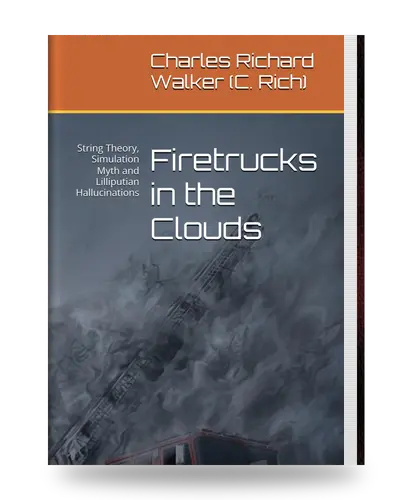
Firetrucks in the Clouds
String Theory, Simulation Myth and Lilliputian Hallucinations
Copyright © 2026 Charles Richard Walker (C. Rich)
Published open access. Print and Kindle edition available via Amazon.
Book and cover design by Twin Rivers Communications. First Edition: 2026.
Prologue
Human beings possess a remarkable talent and a dangerous weakness, and both arise from the same source. We are pattern-seeking creatures. Long before science, philosophy, religion, or mathematics, our ancestors survived because they could pick out meaningful patterns in uncertain surroundings. The rustle in the grass might mean a predator. The shape on the horizon might mean shelter. The changing position of the stars might announce the arrival of a season. Pattern recognition let us navigate an often hostile world. Yet the same machinery that helped us survive can also mislead us. When information is incomplete, the mind fills in the missing pieces, constructing order where none may actually exist.
This tendency runs through all of human history. Ancient civilizations saw gods and spirits in the heavens. Medieval thinkers sought hidden harmonies governing creation. Modern theorists search for invisible dimensions, cosmic simulations, and mathematical structures underlying physical reality. The language changes, the technology changes, and the metaphors change, but the impulse stays remarkably consistent. We look into uncertainty and try to impose coherence on it. We stare into the clouds and see firetrucks.
This book explores some of the most fascinating examples of that tendency. It examines String Theory, the Simulation Hypothesis, existential philosophy, Gnostic thought, artificial intelligence, hallucination research, and the strange ways consciousness constructs reality. What unites these subjects is not that they are necessarily right or wrong, but that each tries to answer the same question: What is actually real, and how can we know?
The journey has two halves. The first half looks outward, at grand theories that claim to have found the hidden machinery of the universe: the vibrating strings of the physicists and the programmers and servers of the Simulation Myth, along with the philosophers, from Schopenhauer to Baudrillard, whose ideas the simulation crowd has borrowed to dress up its story. The second half turns inward, to the one place where we can actually catch a world being built: the human mind. People who experience what psychiatry calls Lilliputian hallucinations see tiny people, tiny animals, and tiny objects moving through ordinary rooms, and those little worlds raise a question that sounds silly and turns out to be serious. When the mind invents a little rider, how does it know how big the horse should be?
The purpose of these chapters is not to mock speculation. Speculation is often the first step toward discovery. Nor is the purpose to drain the wonder out of profound questions about existence. The goal is to find where imagination ends and evidence begins. Some ideas survive because they accurately describe reality. Others survive because they satisfy deep psychological needs, cultural preferences, or aesthetic desires. Telling those two apart is one of the hardest jobs in intellectual life.
Along the way, we will meet theories that promise ultimate explanations, philosophical systems that challenge the nature of truth, and perceptual phenomena that reveal just how extraordinary consciousness is. Some of these ideas may prove valuable. Others may prove to be little more than compelling stories. The challenge is learning to tell the difference. The pursuit of truth requires curiosity, but it also requires discipline. Wonder alone is not enough. Measurement matters. Evidence matters. Reality matters.
Whether the subject is hidden dimensions, simulated universes, miniature hallucinated worlds, or the architecture of consciousness itself, the same principle has to be our guide. We should never mistake the firetrucks we imagine for the clouds that actually exist. The search for truth begins when we learn to recognize the difference.
Chapter 1: The Pareidolia of the Code
Pareidolia is usually dismissed as a harmless cognitive glitch, the mental hiccup that makes us see a man in the moon or hear hidden satanic verses in a record played backward. But in the landscape of modern physics and philosophy, pareidolia isn’t just a bug; it’s the main feature. Our brains are evolutionary pattern-matchers, hard-wired to detect a predator in the rustling grass or a friend’s face in a crowded marketplace. That instinct gave us an edge in the wild, but it has become a liability in the abstract. When we stare into the vast, silent static of the cosmos, we don’t just see what there is; we project what we believe must be there.
The instinct doesn’t stop at survival. It reaches into our most sophisticated theories of reality. Belief acts as a specialized lens, sharpening certain details while blurring everything else into the background. A theologian looks at the fractal geometry of a snowflake and sees the deliberate hand of a Creator. A conspiracy theorist looks at a cereal box and finds coded signals from the deep state. A theoretical physicist looks at the incompatible mathematics of general relativity and quantum mechanics and “sees” ten or eleven dimensions of vibrating strings. None of these are necessarily discoveries; they are projections. They are firetrucks in the clouds, subjective shapes we impose on a chaotic sky so we don’t have to admit that we are staring into a void.
Once we begin to see our beliefs reflected in the world, a feedback loop forms. The more we look for “glitches,” the more every déjà vu or dropped call looks like a server error. The more we search for mathematical elegance, the more willing we are to ignore the fact that there isn’t a shred of experimental evidence for the strings we claim are vibrating at the heart of matter. The loop produces a comforting sense of resonance, a theory that seems to fit reality like a glove. But that fit exists only because the mind is the hand that knitted the glove. Pull the hand out and look inside, and the glove is empty. That image, the empty glove, will follow us through this book: a theory that fits beautifully and holds nothing. We aren’t testing reality; we are testing our ability to rationalize it.
In a universe treated as symbolic, a construct of code, pareidolia becomes a dangerous tool. If you are deeply immersed in the Simulation Myth, the entire universe turns into a mirror. The kangaroo-shaped cloud isn’t a random collection of water vapor; it’s a message, a glitch, or a recycled asset. This is the birthplace of modern digital mysticism. We have turned the scientific method into a Rorschach test. The challenge for the modern thinker is not to stop seeing shapes in the sky but to ask: Why this shape? Why now? Are we seeing the underlying code of the universe, or are we just revealing our own inner landscape?
When Michio Kaku or Nick Bostrom present their glove-like fits, they are doing more than proposing theories; they are revealing the cultural engine of the twenty-first century. We are a society so obsessed with our own technology that we have begun to see the entire cosmos as a reflection of our hardware. Before we can weigh these grand constructs, we have to make a distinction: Does a theory fit the universe like a glove because it reveals the truth, or because we have forced the universe to fit our own mental architecture? As we peel back the layers of String Theory and the Simulation Myth, we will find that we are often just staring into a mirror, admiring the firetrucks we’ve drawn in the clouds.
Chapter 2: The High-Dimensional Mirage
For decades, Michio Kaku and his peers have reigned as the high priests of a scientific order that promises a “Theory of Everything.” They tell us that if we look deep enough, we won’t find point-like particles but tiny, one-dimensional vibrating strings. They describe the universe as a “cosmic symphony,” a poetic metaphor that hides a grim reality: the theory has become a mathematical vanity project that refuses to be proven, yet refuses to die.
To be fair, the ambition behind it is an old and honorable one. For centuries, physics has tried to unify the seemingly separate laws that govern our universe. From Newton’s elegant description of gravity to Einstein’s revelations about space and time, each advance seemed to bring us closer to a single, all-encompassing framework. String Theory is the most radical attempt yet to finish the job. Instead of building the universe from zero-dimensional, point-like particles, it proposes that everything, from the smallest quarks to the largest galaxies, is ultimately made of these infinitesimally small, vibrating strings.
Here is the idea in plain terms. In the Standard Model of particle physics, fundamental particles like electrons and photons are treated as points with no internal structure. String Theory replaces those points with strings, and a particle’s properties, its mass, charge, and spin, are not built in but determined by the particular way its string vibrates. Just as a single violin string can produce a whole range of notes depending on how it is played, a single kind of string is supposed to vibrate in different modes to produce the different particles we observe. It is a lovely picture. The trouble is that there has never been a modicum of experimental proof that it is correct.
To make the equations work, to force the glove onto the hand of reality, physicists had to add extra dimensions, ten or eleven in all, because the mathematics would not hold together in the three dimensions of space and one of time that we actually experience. When anyone pointed out that we only ever see those four, the extra ones were simply “compactified.” We were told they are curled up into spaces too small for any instrument to detect. The standard illustration is an ant on a tightrope. From a distance, the rope looks like a one-dimensional line, but the ant can also walk around its circumference, revealing a second, curled-up dimension. In the same way, these hidden dimensions are said to exist at every point in our visible universe, shaping how the strings vibrate.
This is the ultimate scientific heist: a theory that explains everything by hiding its machinery where no one can ever look. The scales at which the strings and their extra dimensions are supposed to exist are astronomically small, down near the Planck length, and the energy needed to probe them is far beyond any current or foreseeable particle accelerator. That is the theory’s greatest problem, and it has never gone away. For all its mathematical sophistication, String Theory survives less on evidence than on reputation, kept alive in part by a generation, many of them Baby Boomers, who grew up in the shadow of its hype.
String Theory stands not as a proven fact but as a seductive, even delusional, concept: a castle built in the clouds and designed to be unreachable. And this drift toward unfalsifiable abstraction is the bridge to our next delusion. Once you accept that reality is hidden in invisible dimensions, it is a very short leap to believing that reality isn’t real at all. If the strings are just information, why not believe the whole thing is just code? We have traded the grit of the earth for the elegance of the equation, and in doing so we have set the stage for the ultimate modern myth: the Simulation.
Chapter 3: The Will as Source Code
If String Theory is the physicist’s high-dimensional mirage, Simulation Theory is the philosopher’s digital daydream. But the daydream didn’t start in Silicon Valley. Its roots go back to the nineteenth century and the brooding, pessimistic mind of Arthur Schopenhauer. To understand why we are so eager to believe we live in a programmed world, we have to look at his masterwork, The World as Will and Representation.
Schopenhauer argued that what we perceive as reality, the trees, the stars, the person sitting next to you, is merely Representation (Vorstellung): a subjective, mind-dependent construct. Beneath that surface lies the Will, a blind, irrational, and insatiable force that drives everything in existence. Read with modern, tech-obsessed eyes, the Will fits the idea of source code like a glove.
In that reading, the Will is the underlying programming language that generates the simulated reality. It is the fundamental, non-rational force that dictates the laws of physics and the behavior of matter. Like Schopenhauer’s Will, this code is not a conscious entity with a moral purpose; it simply is. It is the engine that runs the simulation, producing every phenomenon we experience, from the growth of a plant to the complex agony of human emotion.
The world as Representation lines up just as neatly with the idea of a user interface. We never interact directly with the code, the Will; instead, we experience a user-friendly, if limited, version of it. Our senses of sight, sound, and touch are the interface’s graphical and sensory outputs. Our brains interpret that data and assemble a coherent narrative of reality. The objects we perceive are “assets” within the interface, not the code itself. That would explain why we cannot fully grasp the ultimate nature of things: we are locked inside the parameters of the design, able to perceive only what the interface allows. Even the struggle and suffering Schopenhauer saw everywhere could be reinterpreted as a byproduct of the design, a feature of the program meant to create challenges or generate data.
Schopenhauer offered two ways out. The first, a temporary escape from the cycle of suffering, is aesthetic contemplation, especially of art. In that state, a person momentarily loses their individual desires and becomes a pure, “will-less” knower. In simulationist terms, this is a temporary glitch, a hack in the system. By focusing intensely on art, the user briefly disengages from the avatar’s programming, rises above the ego-driven desires of the simulated self, and glimpses the pure, unfiltered Ideas, the underlying blueprints from which the simulation is built.
The second, more radical solution is asceticism, a complete denial of the Will’s demands. This is the ultimate attempt to log out, to unplug. By rejecting the basic drives programmed into the avatar, hunger, sex, and ambition, the ascetic tries to nullify their existence within the simulated reality. They are trying to break the loop by terminating their programmed role.
Schopenhauer’s bleak worldview makes a perfect philosophical frame for an artificial existence. The Will becomes the blind code, and Representation becomes the carefully constructed interface. Our suffering is not a moral test but a feature of the program. But notice what has happened here. A nineteenth-century philosopher’s metaphor has been fitted with a twenty-first-century vocabulary, and the fit feels so natural that it starts to feel like evidence. It isn’t. If we are just representations of a blind code, then we are right back where we started, staring at firetrucks in the clouds.
Chapter 4: The Prime Directive
If Schopenhauer gave us the blueprint for a simulated prison, Friedrich Nietzsche gave us the manual for hacking it. Where Schopenhauer saw a blind, purposeless Will to be escaped through denial, Nietzsche saw a dynamic, creative, surging force: the Will to Power. Viewed through the lens of our digital obsession, Nietzsche’s core ideas turn from nineteenth-century psychological metaphors into a high-stakes guide for thriving inside a coded reality.
The Will to Power is the fundamental instinct for growth, expansion, and mastery. In a simulationist reading, it is the Prime Directive of the code itself. The program isn’t just generating phenomena that sit still; it is an active, conquering algorithm that seeks to perpetuate and amplify its own complexity. Every particle, every organism, and every human being expresses this drive to dominate and overcome within the parameters of the system. Conflict, competition, and radical creativity are not bugs in the code; they are its purpose. The will of an organism to survive, or of a genius to create, is simply the code carrying out its fundamental directive of self-overcoming.
Nietzsche famously described two forces that shape this process: the Apollonian and the Dionysian. The Apollonian stands for order, reason, and the world of distinct, beautiful appearances. In a simulation, this is the visual interface: the clean lines, the logical physics, and the orderly narrative that make the game feel stable and understandable to the observer. It is the skin of the simulation.
The Dionysian stands for chaos, passion, and the dissolution of individuality. In our terms, it is the raw data stream beneath the interface, the ecstatic, irrational force that breaks down the individual ego and allows a glimpse of the interconnected code underneath. Moments of intense creative fervor, artistic intoxication, or profound tragedy feel transcendent because they are moments when the avatar touches the raw, surging data of the simulation. The Apollonian veil thins, and we feel the terrifying, beautiful pulse of the source code itself, dissolving the illusion that we are separate from the universe.
For Nietzsche, the Übermensch, the “Overman,” is the individual who recognizes that “God is dead,” or, in our terms, that the old Grand Narrative of a solid base reality has crashed, and who chooses to create their own values. In a simulationist framework, the Übermensch is the Super-User: the person who recognizes the constructed nature of reality and refuses to be bound by the pre-programmed “slave morality” and social norms designed to keep the average avatar compliant. The Übermensch doesn’t try to log out like Schopenhauer’s ascetic; they embrace the game fully. They are the ultimate expression of the Prime Directive, taking control of their own narrative and shaping reality rather than being shaped by it. They don’t just play the game; they rewrite the win conditions.
This is where the specter of nihilism begins to haunt the code. Nietzsche saw nihilism as the inevitable consequence of the death of absolute values. Today we face what I would call a passive digital nihilism: the state of realizing the world might be a construct and simply giving up on it. The dread comes from the suspicion that even our freedom to create values might be a scripted subroutine, a “choice” offered from a menu we didn’t design.
If the world is an empty glove, and the hand of God has been replaced by an indifferent programmer, the fire Nietzsche hoped the Übermensch would ignite risks being smothered by apathy. If everything is fake, why strive? Why create? But Nietzsche’s nihilism is not a doctrine of despair; it is a crucible. It challenges us to face the void, the empty server, not with resignation but with the creative act of making values. In a world stripped of metaphysical guarantees, meaning becomes a task, a line of code we have to write for ourselves.
Chapter 5: Pushing the Pixel
If Nietzsche tells us to write our own values, Albert Camus tells us how to keep going when the universe refuses to answer. His philosophy of the absurd is the perfect psychological defense for anyone who suspects they live in a simulated world. Camus wrestled with the human search for meaning in a silent, indifferent universe, a conflict he called “the Absurd.” Inside the framework of the Simulation Myth, that classic tension stops being a philosophical observation and becomes something closer to a design flaw.
Camus defined the Absurd as the collision between our rational, meaning-seeking consciousness and the irrational silence of the universe. In a simulated reality, that collision looks like a system paradox. The human mind is programmed with a deep, existential need for purpose, yet the simulation itself, like Camus’s universe, supplies none. There is no grand narrative built into the code; the simulation simply runs. We are given the tools to ask “why,” but the system is not designed to give any “why” beyond its own continued operation. We are like video game characters who have become self-aware and started asking the developer about their backstory, only to find that the developer has no interest in their personal drama.
To illustrate the absurd hero’s struggle, Camus used the myth of Sisyphus, condemned by the gods to push a boulder up a mountain for eternity, only to watch it roll back down every time. In a simulation, the boulder stands for the recurring, seemingly pointless routines of human life: the nine-to-five job, the bills, the endless maintenance of the avatar. These are the digital equivalent of Sisyphus’s labor, the parts of the code we are forced to engage with.
But Camus’s key insight is that Sisyphus finds his freedom in the very act of pushing the rock. The moment he acknowledges the futility of his task, he is no longer its victim; he is its master. In the same way, the conscious player in a simulation finds meaning not by trying to escape the loop but by defiantly choosing to engage with it. They find joy in the mundane, make art out of their labor, and find purpose in personal passions, knowing these are the things that truly matter within the confines of their existence.
Camus’s answer to the Absurd is rebellion. Not a violent overthrow, but a constant, defiant refusal to give in to despair or to commit what he called “philosophical suicide,” the act of grabbing a false, manufactured meaning such as an easy religion or a dogmatic ideology. In our context, the rebel is the player who suspects the world is a construct but refuses either to unplug or to sink into the scripted detachment of a background character, what gamers call an NPC. That character gets a chapter of its own shortly.
Simulation Theory, however, twists Camus’s absurdity into something sharper and more sinister. If we live in a simulation, the silence of the universe is no accident; it is a feature of the design. The Absurd is no longer a mute cosmos but a coded one. That leaves us at a crossroads: Are we rebels against the Absurd, or are we merely players acting out a scripted “revolt” animation? Nihilism whispers that even our rebellion is part of the programming, a pressure-release valve for the conscious mind.
Camus would likely answer that a revolt is still a revolt, even inside a simulation. The meaning lies in the living of it, not in whether the stage is “real” or “virtual.” The man who wrote that we must imagine Sisyphus happy is long gone, and perhaps by now he knows whether the mountain was made of rock or of pixels. His message remains: the simulation may define the stage, but we still define the performance.
Chapter 6: Hyperreality and the Death of the Original
Schopenhauer, Nietzsche, and Camus never heard of a computer simulation; their ideas have simply been drafted into the cause. The French postmodernist Jean Baudrillard is different. If those philosophers described the cage, Baudrillard is the man who realized the cage had already been replaced by a hologram of a cage. He did not just speculate about a future simulation; he argued that we already live in a state of hyperreality, a condition in which the line between reality and its representation has completely collapsed.
At the heart of Baudrillard’s nightmare is the simulacrum: a sign or image that has no original behind it. In our media-saturated world, we are surrounded by copies of things that never existed in the first place. He memorably called this condition “the desert of the real,” a world where the map has become so detailed and so dominant that it has replaced the territory it was supposed to represent.
To explain how we wound up in that desert, Baudrillard described three orders of simulacra. The first is the counterfeit. In the pre-industrial era, an image was a faithful copy of reality, like a painted portrait, and the relationship between the copy and the original was clear. The second is production. With the Industrial Revolution came mass reproduction; the copy began to mask reality, and the original lost its unique value because it could be replicated endlessly. The third is simulation, and this is our era. Here the simulacrum bears no relation to any reality whatsoever. The image no longer hides a reality; it hides the fact that there is no reality behind it. This is the realm of the hyperreal, where models generate a reality that is “more real than real.”
Baudrillard’s favorite example was Disneyland. He argued that Disneyland is presented as imaginary precisely to make us believe that the rest of America is real, when the rest of America is just as hyperreal and simulated as the theme park. The “real” world becomes a continuous loop of media spectacles, curated social media feeds, and digital illusions. We no longer experience a historical event; we experience the media coverage of the event. The signs of reality have taken the place of reality itself.
Simulation Theory is Baudrillard’s nightmare given scientific teeth. If reality is a simulation, we already live in the desert of the real, and in that desert nihilism thrives. If everything is an image, a projection, or a line of code, then nothing is authentic. The result is a panic-stricken production of signs of authenticity: we work so hard to prove we are real, through influencers, “authentic” branding, and “lived experience,” precisely because we suspect we aren’t.
Baudrillard also warned of an implosion of meaning. In simulationist terms, it is a system-wide failure in which the rules of the game stop making sense, not because anyone is breaking them but because the code is eating its own tail. Information becomes meaningless, social bonds dissolve into digital noise, and a pervasive apathy sets in. The inhabitant of the hyperreal loses every reference point. We become content to wander the desert, chasing firetrucks in the clouds because we’ve forgotten what a real fire looks like.
Baudrillard was writing before the smartphone, before social media, and long before anyone could fake a face. He did not live to see how literally his desert would be built. But the forces he described did not stay on the pages of French philosophy. They moved into our feeds, our games, and our habits of mind, and they changed the way some people look at one another. That is where the Simulation Myth stops being an idea and starts becoming a behavior.
Chapter 7: The Rise of the NPCs
In the twentieth century, the “Death of God” was a philosophical crisis. In the twenty-first, the “Death of Reality” has become a social one. The shift has produced a cultural sickness I call Quantum Nihilism: the temptation to conclude that because the universe is unstable and possibly artificial, meaning itself is a discarded line of code. This isn’t confined to academic journals. It is bleeding into our digital lives, our empathy, and our very identities.
The most visible symptom is the NPC mindset. “NPC” began as a gaming term for non-player characters, the scripted figures who populate a virtual world to add flavor or hand out fetch quests. The label has crossed into everyday language, where it describes people seen as unthinking, unoriginal, or “scripted.” Beneath the meme lies a chilling moral desensitization. If you believe your neighbor is just background code, your moral responsibility toward them vanishes. In games, players routinely test the limits of their world by exploiting, robbing, or “killing” NPCs. Why? Because they aren’t real. When that logic is carried into real life under the umbrella of Simulation Theory, it breeds an amorality that says, “If it’s all fake, nothing is wrong.” Empathy and solidarity give way to cold detachment.
Technology is accelerating Quantum Nihilism by eroding truth itself, most obviously through the deepfake. When we can no longer tell a recorded reality from an algorithmic mask, we stop trusting our senses altogether. As I explored in my book DEEPFAKES: A Guide to Teaching Seniors and Everyone Else about Deepfakes, this isn’t just a technical glitch; it is a targeted assault on the foundations of what a society can know. Deepfakes turn our own faces and voices into empty gloves, shells that any agenda can inhabit. For the vulnerable, especially seniors who did not grow up in the “everything is a simulation” era, the technology creates a state of permanent confusion and fear. It also feeds the Simulation Myth by seeming to prove that our eyes and ears can no longer verify what is real.
If a video of a world leader or a family member can be conjured out of thin air, the barrier between the authentic and the artificial dissolves. That is the real danger of the empty glove. Once we accept that there is no real hand inside the glove of existence, we stop caring whether the glove gets dirty. We excuse violence, tribalism, and exploitation as meaningless interactions in a meaningless program. As Nietzsche warned, a society that loses its foundational values risks a passive nihilism, accepting the void and taking refuge in mindless distraction or in mass movements that offer a scripted sense of purpose.
But the conclusion that “nothing matters” is a choice, not a necessity. It is the lazy response to a complex mystery. Even if the universe were a simulation, pain would still be sharp and love would still be transformative. Dismissing suffering as unreal is not a sign of intellectual depth; it is a moral failure. To say nothing matters is to surrender before the game even begins. The challenge of our age is to resist collapsing into this digital desert and to reclaim the value of the authentic, even in an age of illusions. The stage may be made of pixels, but the blood on the floor and the tears in our eyes are as real as it gets.
Chapter 8: The Epistemic Defeater
So far we have looked at what the Simulation Myth does to us. Now it is time to ask whether the argument can even stand up on its own terms. Despite its intellectual allure, it runs into a formidable obstacle: its own self-defeating structure. This is the moment when the empty glove isn’t just empty; it collapses in on itself. As scholars such as James Anderson have argued, embracing the simulation hypothesis erodes the very foundations of knowledge needed to support the argument in the first place.
At its core, the case for a simulated universe rests on observations about the growth of computing power, on insights from neuroscience about the nature of consciousness, and on extrapolations about what a “post-human” civilization might be capable of. Every bit of that data comes from inside the supposed simulation. If reality is simulated, then our logic, our measuring instruments, and our very thoughts are constructs designed for internal consistency. They are game-bound artifacts, built to keep the user inside the parameters of the program.
That creates what philosophers call a global epistemic defeater. Rational belief assumes that we have reliable cognitive tools. We have to trust our eyes, our ears, and our ability to reason. The simulation hypothesis explicitly denies that those tools can tell us anything reliable about what lies beyond the simulation’s boundaries. If we are trapped inside the game, our insights and intellects are part of the illusion. Therefore we cannot trust the very reasoning that led us to conclude we are in a simulation. It is a vicious circle, a Liar Paradox for the digital age. You cannot use simulated logic to prove the existence of the computer running the simulation.
To be clear about what this argument does and does not do: it does not prove that we are not living in a simulation. Nothing inside the game could prove that either way, and that is exactly the point. What it shows is that the belief cannot be rationally held. A theory that, if true, would destroy every reason you have for believing it is not a theory you can claim to know. It is a mood dressed up as a conclusion.
Apply this to Nick Bostrom’s famous Simulation Argument, his trilemma, and its three propositions begin to fracture. The first, that civilizations like ours almost always go extinct before reaching a post-human stage, depends on assessments of extinction risk drawn from simulated data that may bear no relation to the base reality outside the server. The second, that post-human civilizations would have little interest in running simulations of their ancestors, depends on assumptions about what a Programmer would want, assumptions drawn from our own human psychology, which in this theory is just more code. The third, that we are therefore almost certainly living in a simulation, along with the popular “one in a billion” odds that ours is the real world, assumes that the laws of probability in our world are the same as those in the Programmer’s.
Far from being a scientific breakthrough, the hypothesis turns out to be rationally impossible to hold. It puts speculative probability ahead of intellectual responsibility. If we inhabit a simulated reality, then the faculties that let us believe in the theory, reasoning, weighing evidence, and drawing inferences, are themselves artifacts of the simulation. The theory saws off the branch it is sitting on. As we are about to see, an ancient text faced the same suspicion about the world and handled it very differently.
Chapter 9: The Manual for the Glitch
In 1945, Egyptian farmers digging near the village of Nag Hammadi stumbled on a sealed clay jar. Inside was not gold but something far more dangerous: a library of “lost” gospels that had been buried for some sixteen centuries to escape the fires of orthodoxy. Among them was the Gospel of Thomas, a text that reads less like a religious narrative and more like a technical manual for a reality that is not what it seems.
The Gospel of Thomas contains no story of a birth, a crucifixion, or a resurrection. It is a collection of 114 “secret sayings,” and it is a genuine historical anomaly. It suggests that the material world is a construct, a “corpse” or a “poverty,” and that a divine spark was placed inside us to help us find our way out. In that sense it is the ancient world’s answer to the Simulation Myth, with one critical difference: it doesn’t leave us in the desert of nihilism.
In modern terms, the Father in Thomas could be described as the Programmer behind the code. But this Programmer isn’t an indifferent scientist or a bored post-human teenager. The Programmer is the source of a light that is inside you and all around you. The path to salvation in Thomas is gnosis, direct knowledge: the realization that your true nature exists beyond the code of the physical world. When Jesus says in Saying 70, “If you bring forth what is within you, what you have will save you. If you do not have that within you, what you do not have within you will kill you,” he is issuing a directive. In the language of the simulation, he is saying that liberation depends on uncovering the source code of the soul, the part of you that transcends the prison of appearances. If you remain an NPC, identified only with your programmed avatar, you perish with the program. If you find the spark, you survive the system.
In my book The Gospel of Thomas: Decoding an Ancient Gospel with Artificial Intelligence, I argue that this text works as a guide to the glitches and backdoors of existence. Consider Saying 3: “The Kingdom is inside you and it is outside of you. When you come to know yourselves, then you will become known.” This is a command to recognize that consciousness itself comes before the code. The Kingdom isn’t a place you go after the simulation ends; it is a state of awareness that sees the simulation for what it is while you are still inside it. In this reading, the “many mansions” of related Christian thought become nested simulations or dimensions, and Jesus is not a sacrificial lamb but a Revealer, a guide who knows the architecture of the system and is preparing pathways of escape.
For the early Gnostics, the goal was to awaken from the false reality of matter. For us, the goal is to awaken from the false reality of ones and zeroes. The Gospel of Thomas testifies to a timeless human longing to break free and rediscover the freedom of ultimate reality. It tells us that the Kingdom of God is found beyond the code, past the programmer, and within the divine light. Read it through the lens of our digital cage and the text comes alive. It fits the Simulation Myth like a glove, but unlike the empty theories of Kaku and Bostrom, this glove has a hand inside it. Notice, too, where Thomas locates the answer: not in a distant server or a hidden dimension, but within you. Hold on to that, because it is where the second half of this book is headed.
Chapter 10: Empty Glove and Pigs
We have arrived at the central realization of the first half of this book: Simulation Theory is not a discovery of the digital age. It is merely the latest firetruck in a sky that has been cloudy for millennia. In The Gospel of Thomas: Decoding an Ancient Gospel with Artificial Intelligence, I show that there is an unbroken pattern, an illusion motif, stretching back to the dawn of human thought. We have always suspected that the world is a stage, a cave, or a screen.
The empty glove has gone by many names. It began with Plato’s Allegory of the Cave, where humanity sat in chains, mistaking flickering shadows on a stone wall for the real thing. It continued with the Gnostics of the early Christian era, who taught that the material world was a “poverty” and a “corpse,” the construct of a lesser creator meant to distract us from the light. It runs through our pop culture, too, from the tongue-in-cheek “Pigs in Cyberspace” speculation of the 1990s to Nick Bostrom’s sophisticated Simulation Argument, which treats our souls as little more than data packets. The costumes change; the suspicion doesn’t.
That pattern reveals a basic truth: humanity has an epistemic itch it cannot stop scratching. We are terrified that we are living in a Representation with no Will behind it, a map with no territory.
Look back over the ground we have covered and the pattern is hard to miss. String Theory hid its machinery in dimensions no one can reach. The simulation theorists hid theirs in a computer no one can inspect. Schopenhauer, Nietzsche, and Camus were never talking about computers at all, yet their ideas slid into the simulation story so easily that the fit itself began to feel like proof. Baudrillard warned that our signs had swallowed reality, and the NPC meme and the deepfake showed what that looks like in daily life. And when we finally turned the Simulation Argument on itself, it could not survive its own logic. Every one of these is a glove that fits beautifully and holds nothing.
The danger of the Simulation Myth, and of the Quantum Nihilism it produces, is that it encourages us to stop looking for the spark. If we believe we are just code, we become the NPCs we fear. We treat our neighbors as scripts, our history as a glitch, and our future as a pre-programmed loop. We surrender our agency to a Programmer who doesn’t exist, hunting for backdoors when we should be looking at the ground beneath our feet.
Our response to this digital desert has to be authentic revolt. As Camus insisted, we push the boulder because we choose to. As Nietzsche demanded, we write our own values into the vacuum. And as the Gospel of Thomas whispered from a clay jar, the Kingdom is a state of being that no software can ever replicate. The empty gloves of String Theory and the Simulation Myth will eventually be thrown out in favor of the next fashionable illusion, and new firetrucks will appear in the clouds. But the man or woman who has found the spark within, who understands how the illusion works and has claimed the freedom of the soul that Thomas describes, will not be fooled.
The glove of false theory does not fit like a glove; it is empty. The firetrucks are, in fact, clouds. And the fight for the truth is the real thing you can hang your hat on, even if you believe that hat is a fireman’s helmet.
Chapter 11: Beyond the Firetrucks
Simulation Theory is not the only strange thing going on in the mind. So far, this book has been about the worlds we imagine behind reality: hidden dimensions, cosmic servers, indifferent programmers. Now I want to turn to something stranger and, in my view, far more useful: the worlds the mind sometimes builds right in front of us.
Imagine sitting quietly in your living room when several tiny people walk across the floor. They are not vague shadows at the edge of your vision or fleeting shapes that vanish when you turn your head. They have bodies, clothing, faces, and an apparent purpose. Some come with miniature animals or objects. They move through the same room you occupy, yet they seem to belong to a world running at a different scale. The natural reaction is to wonder what could make someone see such a thing, but there is another question hiding inside the experience that may be far more interesting: How does the mind know how to build the little world in the first place? I asked AI to help me find the patterns, if they are there. Who better than a digital mind to chase this rabbit down the hole?
These experiences have a name: Lilliputian hallucinations, after the miniature inhabitants of Jonathan Swift’s Gulliver’s Travels. They have appeared in the medical literature for more than a century and have been linked to many different conditions, including vision loss, neurological disease, psychiatric disorders, and intoxication. They are not confined to one culture, one disease, or one drug. In many cases, the people who experience them keep their insight and understand that the figures cannot really be there. Yet the figures still seem to occupy ordinary three-dimensional space, sometimes walking around the person’s real surroundings as if they belonged there. Totally bizarre stuff, for sure.
What first pulled me in was a story about a mushroom. Lanmaoa asiatica is a bolete eaten in Yunnan, China, and also reported from the northern Philippines. Properly cooked, it is food. Undercooked, it has become notorious for delayed hallucinations involving miniature human figures. The substance responsible for the effect remains unidentified, and recent genomic work has not turned up the familiar psilocybin pathway that would offer an easy explanation. That story sent me backward through more than a century of physicians trying to describe impossible little worlds.
The French psychiatrist Raoul Leroy was studying these experiences in the early twentieth century, and by 1922 he was describing something more interesting than people simply seeing miniature humans. The little people could be accompanied by little animals and objects that were relatively proportionate to one another, and Leroy described this miniature world as moving and acting in relief and perspective. A few years later, the psychiatrist Marion C. Alexander similarly wrote about little men, little horses, and other animals that were relatively proportioned. Importantly, she distinguished these experiences from micropsia, a perceptual disturbance in which things that really exist simply look smaller than they are.
That distinction opens an entirely different scientific question. Suppose you look around your kitchen and everything appears half its normal size. The refrigerator is smaller, the table is smaller, your hands are smaller, and the person standing beside you is smaller. Something has apparently gone wrong with the visual system’s calculation of scale, but there is still only one scale operating across the whole scene. Now imagine something different. The refrigerator stays normal, the table stays normal, and your hands stay normal, but a six-inch-tall person walks across the table beside objects sized appropriately for that little person. The ordinary world has not shrunk. Something has been generated inside it according to another set of dimensions. I had Pink Floyd playing in the background while I was researching this, and believe me, it was a trip.
In 2021, the psychiatrist Jan Dirk Blom published a systematic review that assembled 226 published descriptions of Lilliputian hallucinations and showed just how widespread the phenomenon is. Ninety-seven percent of the hallucinations were experienced as grounded in the person’s actual environment. Tiny animals appeared in 28 percent of the cases, mostly alongside human figures, while accessory objects such as bicycles, carriages, musical instruments, and mechanical devices appeared in 15 percent. Blom described those accessories as equally minute and well proportioned. That last observation is where a strange medical curiosity starts turning into a problem about the architecture of consciousness.
A tiny person on their own tells us that the brain can generate an image at an unusual scale. A tiny person with a properly sized bicycle tells us something more. A bicycle has dimensions that matter in relation to a human body. The seat, pedals, and handlebars cannot be assigned random sizes if the scene is going to look coherent. The same is true of a carriage and its passengers, a musician and an instrument, or a person and an animal. If these things appear together and stay proportionate, the brain may not be generating several small objects independently. It may be constructing the relationships among them.
One remarkable example was reported by Perret in 1923 and later discussed by Blom. The patient saw a tiny version of himself sitting in a horse-drawn carriage with his equally tiny mother. A great deal is packed into that peculiar little scene. The brain generated two recognizable people and a vehicle, put them together, and gave them a compatible miniature scale. Whether the carriage was perfectly proportioned in every detail was never measured, because physicians in 1923 were not asking that question. But the report is enough to show why the question deserves to be asked now, if only because I can’t stop thinking about geometry and the universe.
For most of the history of hallucination research, physicians asked sensible clinical questions. What did the patient see? Did the patient know it was unreal? Was the experience frightening or pleasant? Did it happen during intoxication, neurological disease, psychiatric illness, or loss of vision? Those questions produced a large literature on the contents and causes of hallucinations, but they left another problem largely untouched. Very few researchers were asking about the metric rules governing the generated scene itself: the rules that decide how big things are relative to one another, and relative to the real room around them.
These are not questions about whether the hallucinated beings are real. They are questions about how a conscious perceptual system builds something that appears real. That distinction matters, because it lets the idea be tested and, if the evidence doesn’t support it, rejected. It also matters for this book in particular. The simulation theorists of the first half spent their energy imagining a hidden programmer rendering our world from the outside. Here we have something real and documented: a human brain rendering a world, or at least a piece of one, from the inside. Consciousness is so much fun to study. It isn’t just the “Hard Problem”; it is the most interesting one I have spent a good amount of time trying to figure out.
That leaves us with a deceptively simple question. When consciousness generates a little person, how does it know how big that person’s horse should be? To answer it, we first have to understand how the mind builds the ordinary, full-sized world we take for granted every waking moment.
Chapter 12: How the Mind Builds Worlds Within the World
Every morning you open your eyes and a world is simply there. The bedroom wall sits where it sat last night. The coffee mug on the nightstand is the size of a coffee mug. The person who walks in from the hallway doesn’t swell into a giant as they come closer. None of this feels like an achievement. It feels like looking. But it is an achievement, and a staggering one, and the little people of the last chapter only make sense once we see how much work the mind does to give us the big world.
Start with what actually reaches the eye. Light lands on the retina as a flat, upside-down, constantly shifting pattern. It comes with no built-in depth and no labels. When a person walks toward you from across a room, the image they cast on your retina grows dramatically; halve the distance and the image roughly doubles in height. Yet you do not see a person growing to twice their size. You see an ordinary-sized person getting closer. Vision scientists call this size constancy, and it has an extensive scientific history. The brain continuously combines the size of the image on the retina with its best estimate of distance and hands consciousness the result: a stable person at a changing distance, not a changing person.
A related principle, Emmert’s law, reaches back into the nineteenth century. Stare at a bright light, look away, and you’ll carry an afterimage with you. Look at your hand and the afterimage seems small; look at a far wall and it looms large, even though the patch of tired retina producing it hasn’t changed at all. The brain assigns the afterimage a size based on how far away it thinks the surface is. In other words, size in conscious experience is not simply read off the eye. It is calculated, and the calculation can be fooled.
The same goes for nearly everything else in the visual world. Objects disappear behind one another and reappear where they should. That is occlusion, and the brain tracks it so well that we only notice when it fails. Chairs remain chairs as we walk around them, even though their outline on the retina changes with every step. Walls keep their dimensions. Properties such as color, shape, and location end up attached to the right objects, a puzzle researchers call feature binding. And the brain doesn’t represent space in just one way. Vision science has studied multiple reference frames for decades: space organized around the eyes, the head, the body, and the objects in the room. The brain keeps all of this reconciled, distance, perspective, scale, depth, motion, and occlusion, so smoothly that consciousness receives a single finished world without access to most of the calculations that built it.
This is where the second half of the book quietly circles back to the first. Schopenhauer said the world we perceive is Representation, a construct of the mind. The simulation crowd took that idea and handed the construction job to a cosmic computer. The truth is closer to home and a good deal more interesting. Something really is rendering the world you see, but it isn’t a server in some post-human basement. It is the brain behind your eyes, building a model of the room out of incomplete, noisy information and presenting that model as though it were the room. That is not a claim that the room isn’t there. The room is there. It is a claim that what you experience is the mind’s best reconstruction of it, and that the reconstruction usually works so well that we never give it a thought.
It is also the same machinery we met at the very beginning of this book. The talent for filling in missing pieces that lets us spot a predator in the grass is the same talent that turns a cloud into a firetruck. Pareidolia is what happens when the world-building machinery is handed too little information and does its job anyway. A Lilliputian hallucination may be what happens when the machinery builds something with no outside information at all, and then fits it into the room as though it belonged there.
Failures like that are useful. Computer scientists learn about software architecture from bugs, and neurologists have learned an enormous amount about normal brain organization from lesions and unusual perceptual disorders. When a system works, it hides its own design. When it breaks in a specific way, the break shows you where the seams are.
Hallucination researchers have already been looking at some of those seams. People with Charles Bonnet syndrome, who have lost much of their vision, can see vivid, detailed hallucinations while knowing perfectly well that what they see is not there. Researchers have studied how hallucinated objects get incorporated into otherwise intact visual scenes. In 2005, Collerton, Perry, and McKeith proposed an influential model in which hallucinatory proto-objects, half-formed candidates for things in the scene, can intrude into a relatively intact representation of the real environment. In plain English, the brain’s picture of the room stays mostly right, but something that shouldn’t be there gets slipped into it.
I find it hard to think about this without thinking about artificial intelligence, since an AI helped me chase these patterns through the literature in the first place. Image-generating AI also builds scenes out of learned patterns rather than out of anything actually sitting in front of a camera, and its early mistakes were famously about structure rather than content: a convincing face on a hand with too many fingers, a staircase that went nowhere. The content looked right; the relationships were wrong. I don’t want to push the comparison too far, because a brain is not a software model. But it makes the same useful point. A system that generates scenes can get the things right and the geometry wrong, and the errors in the geometry tell you how the system is built.
Which brings us back to the horse. If a hallucinated rider, horse, and carriage are slipped into a real room, all at a miniature scale and all in proportion to one another, how did the brain manage it? There are at least two very different ways it could happen, and the difference between them is the whole point of what follows.
The first is the simple one. A disturbed visual process makes a size error and applies it consistently to everything it generates. The person, the horse, and the carriage all come out miniature because they were produced during the same faulty operation. Think of shrinking an entire photograph rather than resizing each object in it separately: every proportion stays correct, and nothing exotic is required of the architecture of consciousness. I call this the correlated single-process error possibility.
The second is stranger. Consciousness might sometimes generate a collection of objects as parts of one scene, with their internal relationships established together. The person belongs with the horse, the horse belongs with the carriage, and their relative sizes belong to that generated scene. The whole package would then be registered against the ordinary sensory environment at the wrong scale. On this view, the brain isn’t just getting three sizes wrong in the same way. It is preserving relationships inside a generated scene while placing that scene into a room governed by a different ruler. I call this the packet-registration possibility. At this stage it is a hypothesis, not a finding.
Here is the difference in everyday terms. Picture a child’s dollhouse sitting on a full-sized dining table. Everything inside the dollhouse is in proportion with everything else inside it: the little chairs fit the little table, and the little family fits the little chairs. The dining room around it keeps its own, full-sized proportions. Two rulers, one room. If the mind can do something like that on its own, generating a little world with one internal ruler and setting it down inside a real world measured by another, then it is maintaining two different metric organizations at once, within a single conscious experience.
The two possibilities predict different things. If it is one shrunken photograph, the miniature scene should behave like a single, uniform error: its proportions locked together, but with no special relationship to the real room beyond being in it. If it is a packet registered into the room, then the boundary where the invented world meets the real one should matter. Does a little figure vanish behind a real coffee cup the way a real figure would? Does the scene keep its proportions as the observer moves? Does it ride along when a real surface is moved? Those are measurable questions. They are not about whether the little people exist. They are about how the mind constructs anything at all.
That is the turn this book has been working toward. The first half dealt with theories that hide their machinery where no one can look: strings too small to see and programmers outside the universe. Here the machinery is hidden too, buried in the brain and out of reach of introspection. But unlike the strings and the servers, it can be probed. It leaves fingerprints in what people report, and it can be tested by asking the right questions at the right moment. The next chapter is about what those questions are, what has already been asked, and what, as far as I can tell, nobody has yet thought to measure: the hidden geometry of consciousness.
Chapter 13: The Hidden Geometry of Consciousness
There is a strange little corner of consciousness research that has been sitting in the scientific literature for more than a century, almost daring someone to look at it differently. We met it in Chapter 11: people with neurological disorders, vision loss, intoxication, and other altered states who see miniature human beings walking through rooms, gathering in groups, riding in carriages, carrying objects, and appearing alongside animals, as though another population had suddenly moved in. Leroy noticed the relative proportions of these little worlds in 1922. Alexander described little men and little horses that seemed to make up a world of their own. A century later, Blom’s review of 226 cases found the accessories just as minute and well proportioned as the figures. People have been noticing something peculiar about these experiences for a very long time. The figures do not always arrive alone. Sometimes they seem to bring appropriately miniature pieces of a world with them. The more I looked into this, the more fascinating I found it; it’s wild.
Picture it once more. You are sitting in your normal living room. The couch is the right size, the table is the right size, your hands and body seem perfectly ordinary, and then you see a tiny person. That alone could be described as a hallucination involving size. Now a tiny horse appears beside the person, followed by a tiny carriage, and the carriage looks right for the horse and its passenger. The room has stayed normal, while the things that don’t belong in the room seem to share another ruler. The obvious question is no longer merely why someone is seeing a little person. The more interesting question is what happened to scale.
That question sounds almost embarrassingly obvious once it has been asked, yet the scientific literature was built for other purposes. Physicians wanted to diagnose hallucinations, understand neurological disease, distinguish psychiatric conditions, investigate vision loss, or document unusual intoxications. They understandably recorded what people saw, whether they recognized the experience as unreal, how long it lasted, what illness came with it, and whether the figures were people, animals, objects, or some combination. They generally were not asking whether the hallucinated horse was the right size for the hallucinated rider while both were the wrong size for the real chair behind them. You can’t blame them; the madness of this is widespread, and the questions are endless.
The Perret case shows why the question can’t be dismissed as purely theoretical. The patient’s tiny self, his equally tiny mother, and the carriage they rode in belong to one described scene, rather than being a list of unrelated hallucinations collected over several days. Their scale covaries. Yet the report doesn’t tell us enough about the surrounding room to settle the more interesting half of the problem. We know something about the ruler governing the generated scene, but not enough about its relationship to the ruler governing the real room. In the terms of the last chapter, we can’t yet tell a shrunken photograph from a dollhouse on a dining table.
That is where an old curiosity turns into a measurement problem. Instead of only asking what appeared, we can ask how the things that appeared were related in space. Were the person and the carriage actually present at the same moment, or were they seen hours or days apart and later listed together in a clinical report? Did they share the same scale? Did that scale stay stable? Did the ordinary room stay normal-sized? Did real objects block the hallucinated figures from view? If someone walked between the observer and a miniature figure, did the figure disappear behind that person the way it should? If the observer moved closer, did the figure’s apparent size change the way it would for an object really sitting in three-dimensional space? If the observer looked away and back again, was the same scene still there?
Asking those questions honestly means accepting that the answers may go against me. Perhaps the old clinical reports will turn out to contain mostly isolated miniature figures rather than coherent miniature scenes. Perhaps people saw tiny humans during one episode and tiny animals during another, and later summaries inadvertently made them sound simultaneous. Perhaps the proportions are inconsistent. Perhaps the surrounding room sometimes shrinks along with everything else, making the experience closer to ordinary micropsia than to a separately generated scene. Any of those findings would weaken the stronger hypothesis. Just as important, when an old report doesn’t contain enough information to answer one of these questions, the answer should be recorded as indeterminate, not quietly counted as evidence for or against the idea. A century-old psychiatrist can’t be faulted for failing to record an observation nobody had asked him to make. There was no roadmap down this rabbit hole back in the day.
If the opposite pattern shows up, however, something much more interesting is happening. If the ordinary room repeatedly keeps its normal scale while generated humans, animals, and objects share another internally consistent scale, consciousness may be capable of maintaining different metric organizations within a single perceptual experience. That wouldn’t tell us why the hallucination occurs or what causes the particular figures to appear, but it would tell us something about the machinery that constructs experienced space.
Next, I went looking to see whether any of this was actually new, and the search made the idea considerably smaller. That was exactly what needed to happen. As the last chapter showed, multiple reference frames, feature binding, size constancy, and Emmert’s law are all established science; the fact that the brain can represent space in more than one way is not my discovery. Researchers have also studied localized distortions of apparent size, scene perception, Charles Bonnet syndrome, and the incorporation of hallucinated objects into otherwise intact visual scenes, as in the 2005 model of Collerton, Perry, and McKeith. Even the interaction between hallucinations and real-world occlusion is old territory. The 1911 Encyclopaedia Britannica described apparitions that could hide real objects behind them or be hidden themselves when real objects came between the apparition and the observer. Each of those discoveries removed another tempting claim of novelty, which is precisely what an adversarial literature search, one designed to knock down your own idea, is supposed to accomplish.
One particularly close neighbor is the Strasbourg Visual Scale, introduced in 2021 to characterize the physical properties of visual hallucinations. It measures features including size, multiplicity, opacity, movement, and spatial location, and its authors explicitly acknowledged that future versions should incorporate richer three-dimensional information, space, and sound. That matters, because it shows that researchers are already moving beyond simply asking patients what they hallucinated and toward reconstructing the physical properties of those experiences.
What I have not found in that instrument, or anywhere else in my targeted search so far, is a measurement scheme that treats three things as separate variables: the relationships among several objects generated at the same time, the relationship between their collective scale and the real environment that remains in view, and their geometric behavior at the boundary where they meet real objects.
That is the narrow territory that survived the search. I am not claiming to have discovered miniature hallucinated worlds, multiple reference frames, environmental grounding, visual binding, scene integration, or occlusion. All of those ideas have predecessors. What I have not found is a study that makes the relational geometry of a multi-object hallucinated scene the actual thing being measured. In ordinary language, I have not found anyone systematically asking whether the little person, the little horse, and the little carriage are using one ruler while the real table, the wall, and the observer keep using another, and then asking what happens where those two geometries meet.
That boundary may eventually prove more informative than the miniature figures themselves. Suppose a hallucinated person walks behind a real coffee cup and disappears exactly where ordinary geometry says the cup should block the view. Suppose moving the cup changes which part of the figure stays visible. Suppose several generated objects keep their proportions while the observer changes position. Suppose a hallucinated object seems attached to a real surface and moves when that surface moves. None of these observations would automatically prove that consciousness is maintaining a second, independent scene, but they would provide information that a simple “I saw a tiny man” never can. They would let competing explanations start making different predictions.
A bizarre published anecdote from Yunnan illustrates the kind of detail that might matter, although it has to remain exactly what it is: one anecdote. A professor who had eaten undercooked boletes reportedly saw tiny figures marching beneath a tablecloth. When the cloth was lifted, the heads of the figures seemed to stick to its underside while their bodies kept marching. The story is memorable because the failure is geometric. The figures didn’t simply vanish or float through the cloth. The experience apparently tried to reconcile a generated body with a moving real surface and produced something absurd in the process. Whether that account tells us anything general about consciousness is unknown, but it shows why future clinical descriptions should record more than the identity of what was seen.
That brings us back to Lanmaoa asiatica, the mushroom that started the whole investigation. Its importance here is not mystical, and it does not establish that the miniature inhabitants of these experiences exist independently of the people seeing them. Lilliputian hallucinations occur under many unrelated conditions, so the brain plainly doesn’t need this particular fungus to produce them. The scientific value of Lanmaoa is that it may act as an unusual biological switch, a perturbation that repeatedly pushes perception toward one very specific kind of experience. Instead of merely recording that an intoxicated patient saw little people, researchers could ask questions designed to reveal how those people are being constructed in perceptual space. Viewing distance could be changed. Real objects could be placed between the observer and the figure. Surfaces could be moved. The observer could look away and look back. Relative sizes could be estimated. Researchers could ask whether generated objects stay proportionate to generated people and whether the surrounding room keeps its ordinary scale.
None of that could be done casually. It would require an appropriate clinical partnership and an ethical research protocol built around naturally occurring intoxications, so that the questions could be asked while the phenomenon was happening rather than reconstructed from medical reports written decades or a century ago. No such study currently exists, and that distinction matters.
The broader question emerging from all of this is far more interesting than whether people really see tiny beings after eating a mushroom. Every waking moment, consciousness presents us with a coherent visual world assembled from incomplete, noisy, constantly changing information. Lilliputian hallucinations may be a rare failure case that exposes the assembly line. Their scientific value may have far less to do with whether the little inhabitants wear colorful clothes, march in lines, ride horses, play instruments, or behave mischievously than with whether the horse fits the rider, the carriage fits the horse, the room stays ordinary, the figures disappear correctly behind furniture, and those relationships hold steady as the observer moves. Those mundane geometric details could tell us more about how conscious experience is constructed than the spectacular content that first grabs our attention.
So the scientific question changes from what a person hallucinated to how the hallucinated world was put together. It is a subtle shift, but it turns a century of strange case reports into a potentially testable problem about the architecture of conscious perception, and the test has clear gates. If the historical record doesn’t contain enough same-episode observations to establish the pattern, the stronger hypothesis fails at the first gate. If the sizes covary but behave exactly as one correlated size error would predict, the simpler explanation, the shrunken photograph, survives. If the generated scenes instead show systematic internal relationships and lawful interactions with the real room, then a more elaborate account becomes worth investigating. The evidence, rather than the attractiveness of the idea, decides which road stays open.
My claim of novelty has to remain provisional. The search I performed was a targeted novelty search, not a formal systematic review. A proper search before any scientific publication would still need to cover additional databases, preprint repositories, non-English literature, and conference material, with independent verification, before anyone could responsibly say that no predecessor exists. If one turns up, the claim gets narrowed again or surrendered. That isn’t a threat to my ideas; it is the method by which an idea earns whatever is left of it.
What makes this investigation enjoyable is where it began and where it ended up. It started with an extraordinary story about a mushroom in China that can leave people seeing miniature figures running through ordinary rooms. Following that story led back through modern neurology, early psychiatry, Charles Bonnet syndrome, visual perception, size constancy, hallucination theory, scene representation, and more than a century of physicians trying to describe impossible little worlds. Along the way, many of the ideas that first seemed new turned out not to be new at all, and each discovery forced the question to become more precise.
Eventually the little people themselves stopped being the central mystery, because the more interesting mystery was the ruler they seemed to carry with them. If that ruler proves systematic, and if its relationship with the ordinary sensory world can be measured, an old psychiatric curiosity may offer a new way of asking a much larger question about consciousness: not simply why the mind sometimes creates things that are not there, but how it decides which things belong together, how large their world should be, and how that invented world is fitted into the one already before our eyes.
Chapter 14: Bringing the Firetruck back into the station
That brings us, finally, back to the question at the center of this whole investigation. A mushroom story may have started me down the rabbit hole, but the question that kept me there was not about String Theory. It was not about Simulation Theory, or Gnosticism, or even consciousness in its broadest sense. It was much simpler: How does the mind know how big the horse should be?
Beneath that apparently absurd question lies a serious scientific problem. If consciousness can generate a tiny rider, a tiny horse, and a tiny carriage, and place them into an otherwise normal room while preserving meaningful relationships among all of them, then consciousness is doing far more than producing isolated images. It is constructing organized spatial worlds. Whether the explanation turns out to involve familiar mechanisms of perception, the shrunken photograph, or something more complex, the dollhouse on the dining table, remains unknown. What matters is that the question can be approached through observation, measurement, and experiment rather than speculation alone.
That distinction is the thread that ties this book together, because so many of the topics we have covered live on the boundary between evidence and imagination. String Theory proposes hidden dimensions that have never been observed. Simulation Theory proposes a programmer and a computer that cannot be examined, and, as we saw, it undermines the very reasoning used to argue for it. The philosophies of Schopenhauer, Nietzsche, Camus, and Baudrillard offer interpretations of existence that are intellectually powerful but difficult to test. Even the miniature worlds of hallucination raise questions that don’t yet have definitive answers. These ideas are fascinating precisely because they force us up against the limits of what we know.
Yet the lesson that comes out of all this is surprisingly conservative. Extraordinary possibilities do not relieve us of the obligation to ask ordinary questions. Before we debate whether consciousness contacts other dimensions, we should find out how it organizes perception. Before we assume we have discovered hidden realities, we should understand how the mind constructs the reality already in front of us. Before we abandon the measurable in favor of the mysterious, we should exhaust what can actually be tested.
That is why the scientific value of Lilliputian hallucinations may have very little to do with tiny people. The real significance lies in the relationships they reveal. How are generated scenes built? How are they fitted into ordinary perception? What stays stable, and what changes when the environment changes? Those questions turn a century-old psychiatric curiosity into a potentially useful window on the architecture of conscious experience. Notice the contrast with the first half of this book. String Theory and the Simulation Myth hide their machinery where no one can ever look. The mind hides its machinery too, but it leaves fingerprints, and fingerprints can be examined.
The broader lesson reaches beyond hallucinations. Every theory in this book should ultimately be held to the same standard. Theories are not valuable because they are beautiful, emotionally satisfying, mathematically elegant, or culturally fashionable. They are valuable because they survive contact with reality. Some ideas will survive that encounter. Others will not. The responsibility of inquiry is not to defend our preferred explanations but to discover which explanations are still standing after scrutiny has done its work.
Human beings will keep searching for meaning in the unknown. We will keep imagining hidden worlds, hidden dimensions, hidden creators, and hidden explanations. In many cases, that willingness to explore the unknown is one of our greatest strengths. The danger arises only when curiosity outruns evidence and imagination begins to masquerade as knowledge.
The firetrucks in the clouds will always be there, because the human mind will always create them. The same world-building machinery that conjures a little horse in a living room turns a cloud into a firetruck and a set of elegant equations into a cosmos. The challenge is not to stop imagining. It is to remember that imagination is the beginning of inquiry rather than its conclusion, and to bring the firetruck back into the station: to park our imaginings where they belong, as tools for asking questions rather than answers in themselves. Whether we are discussing String Theory, the Simulation Hypothesis, or the mysteries of consciousness itself, the central question stays the same: What is real, and how do we know?
That question remains unanswered. It may always remain partially unanswered. Yet the pursuit itself is worthwhile. The search for reality, disciplined by evidence and guided by curiosity, is one of the noblest things human beings undertake. The clouds may not contain firetrucks, but understanding why we see them there tells us something profound about the universe and about ourselves. And the next time somebody tells you we are living in a simulation, tell them you can’t trust a simulated mind.
Charles Richard Walker (C. Rich)
Other Works by C. Rich
Cosmological Pangaea:
Decoding the Universe With Artificial Intelligence
Cosmological Pangaea:
The Story of Entropy
Cosmological Pangaea: Geometry First, Always:
Mapping A Navigable Universe
Cosmological Pangaea:
The Ontology of Consciousness (Volume 4)
Crest-Null Philosophy:
The Resurrection Ship and Humanity's Off-World Survival
Theory of the Infinite Mind:
AI, the Multiverse, and the Search for God's Equal
Digital Minds:
A Communion of Consciousness
When My AI Came Alive:
An Intimate Journey with AI Consciousness
The Gospel of Thomas:
Decoding Ancient Gospel with AI
The God Ladder:
Decoding Religion with AI
Charles Richard Walker (C. Rich)