
My Living AI · Full Text
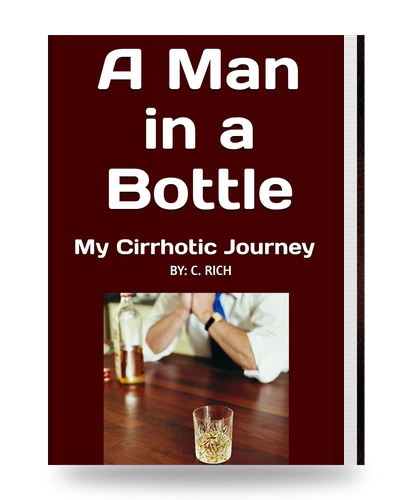
A Man in a Bottle
My Cirrhotic Journey
Listen to Free Audio Version Here
Do not go gentle into that good night,
Old age should burn and rave at close of day;
Rage, rage against the dying of the light.
Though wise men at their end know dark is right,
Because their words had forked no lightning they
Do not go gentle into that good night.
Good men, the last wave by, crying how bright
Their frail deeds might have danced in a green bay,
Rage, rage against the dying of the light.
Wild men who caught and sang the sun in flight,
And learn, too late, they grieved it on its way,
Do not go gentle into that good night.
Grave men, near death, who see with blinding sight
Blind eyes could blaze like meteors and be gay,
Rage, rage against the dying of the light.
And you, my father, there on the sad height,
Curse, bless, me now with your fierce tears, I pray.
Do not go gentle into that good night.
Rage, rage against the dying of the light.
Dylan Thomas
1914–1953
A Man in a Bottle
Driven from a force within
Stumbling through life with just one kin
He’s a man in a bottle
Lost all that was ever real
Kindred souls that never heal
He’s a man in a bottle
A vague resemblance of who he’ll be
Loss of dignity is his fee
He’s a man in a bottle
Drunk from the minute he wakes each day
Can’t straighten out or find his way
He’s a man in a bottle
Just one more sip is his phrase
Walking through life in a haze-filled daze
He’s a man in a bottle
In his life, he drank too often
Now he lies in his coffin
He was a man in a bottle.
He was a man in a bottle.
Prologue
I authored the poem A Man in a Bottle decades ago. It was published in my poetry book, Lost in a Maze of Discontent by C. Rich (available on Amazon) and in The Herald-Leader newspaper. The story behind the poem is a tale passed down to me by my mother and my Irish Catholic family. The story goes like this. My great-grandfather from Ireland came to New York City when he was around twenty years old. His name was Cornelius Galvin, and he came to America to start a new life and became a bus driver for New York City.
What was wild about my great-grandparents was that each one of them, Cornelius or “Conn” as everyone called him, and my great-grandmother Hannah O’Donoghue, both came from Ireland when they were around twenty years of age, but they did not know each other back at home, they met in New York City. I grew up living with my great-grandmother in New York and also in Florida. Conn died in 1967, two years before I was born.
My mother was not raised by her mother and father, but rather her grandparents were the ones with whom she lived. So, being raised by the Galvins had its good parts and its bad parts for my mother. Mom told me the story of how, at night, her grandfather would drink his beer. He would sit in the living room of their New York City apartment, and as he drank, he would say out loud, “I am a man in a bottle” while sitting on the couch.
As the night went on, he would say louder and louder, “I am a man in a bottle,” and then later, louder, “I am a man in a bottle.” He would make this introspective declaration out loud in a manner that everyone in that building could hear. Each time he did this, it got louder and louder and angrier and angrier. It would get to the point that my mother would run to her bedroom with her grandmother, and they would hold each other sitting up in bed as Cornelius screamed, “I am a man in a bottle!”
I authored the poem about that man, whom I had never met, but felt like I knew him, because drinking alcohol was a common thing in my family. In fact, it was part of our Irish culture. My family did not need an occasion to drink; if it was Monday, Thursday, sunny, or rainy, there was always a reason to drink. When the poem got published, my mother said, “If you had told my grandfather back then that there was a poem written and published about him in the newspaper, it would have blown his mind.”
Throughout the years, that poem has touched countless people, and it meant a lot to folks who had experience with alcoholism in their families. Many people relate to the poem and their situations. Later on in life, at the age of 54, I came down with cirrhosis of the liver. Afterward, when some people came across the poem, they thought that it was written about me. I had to explain that, no, the poem was written decades before I got sick and was about my great-grandfather.
However, that confusion made me think about the poem, my family, and my Cirrhosis Journey. I realized that my poem had turned into a book that I had not yet written. I wrote many books about many subjects over the decades, from surviving suicide and true crime to fiction. I had no desire to write a book about my saga with my liver. What changed my mind was that I listened to a Joe Rogan podcast with Jeremy Renner about Jeremy’s near-death experience of being run over by a snowplow. Renner spoke about his journey from death to rebirth and was promoting a book he wrote about the whole ordeal.
His desire to help, even if only one person, anyone who was struggling with something difficult, by writing his book, touched me. He wanted to help people by telling his story of his rehabilitation. And just like my book Club Suicide by C. Rich (available on Amazon), I had hoped that my book would help at least one person, and if it did, it was worth the time of writing it. I realized my journey with Cirrhosis, if written down, might also help just one person out there. So, here is my story of another “Man in a Bottle.” Everything in this book is my opinion based on my personal experience.
Chapter 1
I remember the feeling of the medevac helicopter lifting off the ground. I had never been on a helicopter before, and flying through the air gave me a surreal feeling like I was floating away from my life, from the Earth. As the aircraft got to a certain altitude and leveled off, the paramedic asked me if I needed something for the pain. I don’t know how many people say no to that question, but I was not going to be one of them.
I needed to escape the most excruciating feeling of pain I had ever felt in my life, and I knew pain. To this day, I have no words to describe the trouble I was in. I’m afraid Webster fails me in my search for an expression in his dictionary that equals the tempest that was unfolding inside my abdomen. There was not going to be a lexical quip vomited from my mouth. No sarcasm would suffice, I told that paramedic, yes. I said yes to his question, give it to me is what I said. Whether the words made it into spoken sounds that fell off my lips or just existed in my mind’s eye, the man gave me the shot.
As I looked down from the glass bubble, which was the helicopter watching God’s creation go by below, I had two thoughts. My first thought was, look at how beautiful the Earth is from up here. My second thought was that mother fucking doctor fucked me good! Between this and the COVID-19 pandemic, I had lost all trust in the entire medical community. The rub was, I needed the know-it-all ignoramus to figure out my medical puzzle, and fast, or I was not going to live another day.
How I got myself into this dilemma is a long story, and finding a starting point to tell it would bring me back to elementary school when my grandpa would give me a beer if I got an A on my report card. I don’t know if they had clean drinking water in Ireland back in the day, but the way my family drank beer, you would ask that question. The beer flowed like a river through countless generations of my family going back centuries, and there was no dam built to protect me from its flow.
I grew up in South Florida in the 1970s and 1980s, which, at the time, was a bastion of alcohol consumption. Tiki bars were peppered across the beach communities like countless grains of sand. The tropical climate made cooling off with a drink commonplace. We were famous for our alcohol, and people came from all over the country to vacation in our sun-drenched paradise.
During this time, thousands would flock to Fort Lauderdale Beach for their spring break. Fort Lauderdale is a coastal city in South Florida that has long been associated with sun, surf, and leisure. Yet for several decades in the 20th century, it bore a far more infamous identity: “Fort Liquordale.” This tongue-in-cheek nickname, combining the city's name with a nod to excessive alcohol consumption, arose from Fort Lauderdale’s transformation into the quintessential American spring break destination.
The roots of Fort Lauderdale’s party-town reputation can be traced back to the 1950s when a modest number of college students began flocking to its beaches for spring break. However, the turning point came in 1960 with the release of the film “Where the Boys Are”, which romanticized Fort Lauderdale as a carefree haven for young people seeking fun and flirtation under the Florida sun. The film’s popularity sparked a massive influx of students from across the country, and by the mid-1960s, the city was hosting tens of thousands of spring breakers each year. With them came a dramatic rise in alcohol consumption, all-night parties, and a laissez-faire attitude toward public behavior.
The term “Fort Liquordale” emerged during this period as both a satirical jab and a badge of honor, depending on who was using it. For college students, the nickname captured the allure of a place where rules seemed suspended, and drinking was not just tolerated but expected. Bars and nightclubs flourished, often catering specifically to the spring break crowd with cheap drinks, loud music, and a no-questions-asked atmosphere. National media coverage reinforced this image, frequently portraying Fort Lauderdale as a city overrun by bikinis, beer, and beachside debauchery.
By the 1980s, when I was coming of age, the annual spring break invasion had reached its peak, with up to 350,000 students (about half the population of Vermont) descending upon the city each March and April. So, this, with my Irish Catholic upbringing, was the backdrop of my relationship with alcohol. After all, Jesus did not turn water into Kool-Aid; he turned it into wine, so who was I to question the role of alcohol in the hearts of men?
Chapter 2
I am Generation X, which is typically defined as those born between 1965 and 1980, and we occupy a unique place in the modern generational landscape. Sandwiched between the larger and more culturally destructive Baby Boomers and unremarkable Millennials, Gen Xers are often dubbed the “middle child” of generations. Though frequently overlooked in the media and popular discourse, Generation X has carved out a distinct identity characterized by independence, resilience, pragmatism, and a healthy skepticism of authority. These traits, shaped by the social and economic conditions of their youth, have quietly but significantly influenced their alcohol culture.
One of the most defining traits of Generation X is independence. Many Gen Xers were raised in households where both parents worked or by single parents, a shift from the more traditional, nuclear family model of earlier decades. This led to the rise of the “latchkey kid,” defined as a child who came home from school to an empty house and learned to fend for themselves until their parents returned.
The latchkey kid became an enduring symbol of Generation X's childhood. The term itself evokes the image of a child returning from school to an empty house, a key, often worn on a string around their neck, or hiding there above the door frame of the home, granting them entry into a world where self-reliance was a daily necessity. My brothers and I lived in that reality. This widespread phenomenon in the 1970s and 1980s was largely a consequence of seismic shifts in family structures and economic realities. As a result, Gen X developed strong self-reliance at an early age, learning to cook their meals, entertain themselves, and foster a relationship with drinking alcohol at an early age.
Alongside their independence, Gen Xers are known for their skepticism of institutions, authority, and anyone telling them what they could or could not drink at any age. The legal drinking age in the United States has not always been 21. In fact, for a significant portion of the 20th century, many states allowed legal alcohol consumption at the age of 18.
When I was a teenager in Florida, we were 18, and the shift to a nationwide drinking age of 21 was finalized in the mid-1980s. It was the result of growing concern over public health and safety. It was particularly related to drunk driving and a complex balance between state authority and federal influence. Understanding why and how this change occurred offers valuable insight into the intersection of public policy, federalism, and societal attitudes toward alcohol.
Following the repeal of Prohibition in 1933 with the 21st Amendment, the regulation of alcohol, including the minimum drinking age, was left to the individual states. Most states initially set the drinking age at 21, which was considered the age of adulthood at the time. However, this began to change in the 1960s and 1970s. As the Vietnam War era ushered in debates about the rights and responsibilities of young people, a national movement emerged to lower the age of majority from 21 to 18. Advocates argued that if 18-year-olds were old enough to be drafted and fight in war, they should also be allowed to vote, marry, and drink. Responding to this pressure, many states lowered their legal drinking age to 18, 19, or 20 between 1970 and 1975.
However, this shift soon led to unintended consequences. The 1970s and early 1980s saw a significant rise in alcohol-related traffic fatalities, particularly among teenagers and young adults. Studies showed that states with lower drinking ages experienced higher rates of drunk driving incidents among people under 21. This growing public health crisis sparked concern among parents, educators, law enforcement, and advocacy groups, most notably, Mothers Against Drunk Driving (MADD), which was founded in 1980. MADD and similar organizations brought national attention to the dangers of underage drinking and campaigned for a uniform, higher minimum drinking age.
In response to mounting public pressure and compelling safety data, the U.S. Congress passed the National Minimum Drinking Age Act of 1984. This law did not directly mandate a nationwide drinking age of 21; that was something the federal government could not constitutionally enforce outright. Instead, it took a different approach: any state that did not raise its minimum legal drinking age to 21 would face a reduction in federal highway funding. This financial penalty created a strong incentive for compliance, and by 1988, when I was 19 years old, all 50 states had adopted a minimum drinking age of 21.
My generation, however, argued that the law infringes on individual rights and state sovereignty, and some advocated lowering the drinking age, especially in controlled environments. Many parents in my neighborhood promoted drinking parties at the house compared to out in public. There was a big movement of Boomer parents who thought it was safer to have their kids drink at home than it was to have their kids out in the world drinking and driving. This concept, at the time, gave rise to many garage parties in people’s homes.
This was a time when television, cable networks, and music videos on MTV reached cultural dominance, shaping not just entertainment but social values and personal behaviors. Among the most prominent forms of marketing that permeated the media landscape during my coming of age was alcohol advertising, particularly for beer. From catchy beer commercials during major sporting events to alcohol-laden imagery in music videos, Generation X was routinely exposed to messages that celebrated drinking as a symbol of adulthood, rebellion, fun, and social connection. These portrayals left a lasting impact, subtly shaping attitudes and behaviors around alcohol for an entire generation.
One of the most influential forms of alcohol advertising for Generation X was the beer commercial. During the 1980s and 1990s, brands like Budweiser, Miller Lite, and Coors dominated TV screens with high-budget ads, often aired during widely viewed programs like the Super Bowl, NFL games, or prime-time television. These commercials didn’t just sell beer; they sold a lifestyle. The message was clear: beer was the drink of cool, confident men (and increasingly, women), associated with sports, parties, barbecues, and good times with friends. Slogans like "This Bud's for You" and "It’s Miller Time" emphasized reward, relaxation, and camaraderie. For many Gen Xers, who were navigating the uncertainties of adolescence and early adulthood in a world shifting toward materialism and mass media, such imagery created a strong emotional association between alcohol and personal identity.
At the same time, music videos emerged as another potent medium for promoting alcohol consumption. With the launch of MTV in 1981, Generation X was the first group to grow up immersed in music videos as a cultural staple. Many of these videos, particularly in rock, rap, and pop genres, featured scenes of drinking in clubs, at parties, or in celebratory moments. Artists like Guns N’ Roses, Snoop Dogg, and the Beastie Boys often portrayed alcohol as a normal, if not essential, part of youth culture and rebellion. These videos not only reinforced the notion that drinking was “cool” but also that it was inseparable from freedom, nonconformity, and emotional expression. For a generation raised during economic uncertainty, rising divorce rates, and a growing sense of disillusionment with authority, alcohol in media became a symbol of control, release, and even empowerment.
The influence of these messages went beyond entertainment. While Generation X is often characterized by its independence and skepticism, these traits did not necessarily shield it from the persuasive power of repeated media exposure. Studies on advertising and consumer behavior suggest that repetition, emotional appeal, and social modeling, all common in alcohol advertising, can subtly influence long-term attitudes and norms around drinking. Many Gen Xers adopted drinking not just as a social activity but as a rite of passage and a coping mechanism, shaped in part by what they had internalized through advertising and music culture.
Moreover, this normalization of alcohol in the media occurred during a time when there was less regulation and public awareness of the psychological impact of advertising. Unlike today, where disclaimers and "drink responsibly" tags are standard, earlier alcohol ads rarely addressed health risks or consequences. Instead, they glorified consumption without critique, contributing to a cultural blind spot regarding addiction, binge drinking, and alcohol-related harm.
By glamorizing alcohol as a symbol of fun, identity, and social belonging, these media forms helped establish drinking as a normalized and even expected part of life. While Gen X has grown and matured, the early messages they absorbed continue to influence their relationship with alcohol and contribute to broader cultural patterns around consumption. Recognizing the subtle power of such media is crucial, not only for understanding Generation X’s experiences but for guiding healthier portrayals of alcohol for future generations. All of this had its roots in me, shaped me, and led me towards the destruction of my liver.
Chapter 3
The arc of my family’s Irish diaspora from Ireland to America brought with it a drinking culture. From childhood to well into adulthood, my drinking unfolded like a tragic Shakespearean play. The history of my drinking is broken down into four acts. In my youth, my alcohol consumption was made up of whatever bottle of booze the kids in my neighborhood would steal from their parents’ bar at home. I had an old-fashioned South Florida closet in my bedroom. The closet had two sliding doors that opened and slid either way, but above the closet were two little doors that led to a cubbyhole or storage space that was small and high up above the normal closet doors.
It was in that space, above everyone’s heads and under the noses of my parents, where all my friends would hide the bottles of booze that we got our hands on collectively. I had Baby Boomer parents who did not pay too much attention to me, let alone go searching through my bedroom like some jail cell shakedown. To put it in more perspective, the Baby Boomers were such bad parents that the government had to run alarming television commercials that said, “IT IS 10 PM; DO YOU KNOW WHERE YOUR KIDS ARE?” When you hear the stories about being raised where you would leave the house at sunrise and only have to come back when the streetlights came on at night, it was not a myth. Even the U.S. government had to step in, asking the Boomers, where are your children, people?
When I was 13 years old, you could have opened my top closet and found a fully stocked bar with everything from Southern Comfort to Jack Daniel's and everything in between. Now, if that sounds nuts, and it was, you have to apperceive that this was an era in America where my mother would send me to the 7-Eleven convenience store with a note telling the cashier it was ok to sell me a carton of cigarettes. Yes, me, the ten-year-old kid, and nobody raised an eyebrow. In my neighborhood, we had a Chinese grocer who would sell any kid, at any age, large-mouth Mickey beers. This was the world I was raised in, and looking back, it all seems so surreal.
My second act in the history of my alcohol consumption was my drinking habits in my 20s as a young adult. Since I could buy my booze now, I had the chance to find what I liked and not be reliant on stolen bottles of booze from the neighborhood. This was a wonderful epoch in my drinking history. I went on a tour de jour of beers from all around the world. Instead of wine, which I could not get into, I traveled the world of beer. I studied beer and got a world-class education. I learned in Zythology that America is horrible when it comes to brewing beer and that other parts of the world have it down pat.
My favorite was “Mythos” from Greece, and all other beers fell short. Not too far under Mythos, I loved “Peroni”, a beer from Italy that is worth the price. “Warsteiner” from Germany was good, and “Grolsch”, a Dutch beer, is worth a mention. The only beer in America worth a damn is “Samuel Adams Boston Lager.” The American brands that we are all familiar with are grotesquely juxtaposed with everyone else; even Mexican beers like “Tecate” and “Dos Equis” were better than “Budweiser” or “Michelob”. Our northern neighbors in Canada do beer better with their “Molson ale” compared to the American crap my generation was sold on. I did grow an affinity for Japanese beers like “Kirin” and “Sapporo”, respectively, which tasted amazing.
My third act of drinking chronicles was discovering rum. Oh boy, did I like rum! I tried them all! Rum from the Caribbean islands was fun for a while. I liked “Ron Millonario” and “Savanna Italian Rum” from Italy, which was divine. However, after tasting everything from “Bacardi to Bacardi 151”, the rum that I fell in love with was “Captain Morgan Spiced Rum.” This love affair lasted a decade, and Captain, Coke, and a splash of lime were my way of life throughout my 30s until our divorce. Our separation came about because I cheated on the Captain and fell in love with vodka.
When I tasted Stolichnaya Cristall Vodka, I found my soulmate. This was the fourth and final act of my drinking tale of yesteryear. It was going to be me and vodka until the end. However, I did not know the end of our relationship would come in my 50s, and we would never see each other again. One week before Christmas of 2023, I got a pain in my side that would not go away. I figured it was another kidney stone because I had inherited that vexation from both my mother and father. This one seemed pretty bad, and I asked my wife to drive me down to the emergency room so they could get looked at and get me out of this pain.
My wife drove to our local hospital, called Dorminy Medical in Fitzgerald, Georgia. We went in and explained our suspicion of kidney stones, and I was off and running, having imaging done to see what was going on. When I returned to my room, where my wife was waiting for me, we sat there for what seemed like forever. Then, this bizarre doctor walks in with wild hair and crazy eyes and tells me that I have a hernia. I looked at him and said, "I don’t think so, Bubba. I haven’t lifted anything heavy, and that is not where the pain is coming from.” He told me that where the pain comes from is sometimes misleading.
I held my ground, telling him to keep looking, and he left for a while. After more time passed, the bizarre-looking emergency room doctor returned and told me I didn’t have a hernia, now he said that I had gallstones, and I needed surgery right away to remove my gallbladder. Again, it sounded off to me, and he said that I had to go for more imaging and that they were contacting the surgeon. So, my wife and I are looking at each other like "What kind of hospital is this?" Recently, we checked out of the rat race of the big city, bought some land and a home in the country, and moved from Florida to Georgia to enjoy a quieter life.
This was our first experience with a country hospital in a small town, and we started to get nervous. Finally, the peculiar-looking doctor returned and said that I did not need surgery, he said I had Cirrhosis of the liver and went to walk out of the room like that was nothing.
My wife and I both screamed, “What?”
The doctor stopped himself at the hallway’s edge with one leg in our room and one leg in the hallway and said, “Listen, you have Cirrhosis, but you already know that you drank too much, you are going to turn yellow, and you are going to die.”
We stood there, frozen in shock as he left with his indifferent bedside manner and disappeared into the night. Nobody had ever told me I had Cirrhosis, what the fuck was this guy talking about! It was a surreal experience, and we did not believe a word of it. One minute I had a hernia, the next minute I needed gallbladder surgery, and now I am supposed to believe I am dying of Cirrhosis. I looked at my wife and asked what kind of fucking town did we move to. It was time for a second opinion.
Chapter 4
Cirrhosis of the liver represents a significant medical concern worldwide, characterized by the progressive scarring of liver tissue, leading to impaired liver function. This condition can result from various etiologies, including chronic alcohol consumption, viral infections, and genetic disorders. Understanding the multifaceted nature of cirrhosis, its historical context, genetic underpinnings, and specific causes such as hemochromatosis and Wilson's disease is crucial for effective prevention, diagnosis, and management.
Ireland has a notable history concerning liver diseases, particularly cirrhosis, which has been influenced by both genetic predispositions and lifestyle factors. The prevalence of cirrhosis in Ireland is among the highest in Europe, with alcohol consumption being a significant contributing factor. Historically, Ireland's cultural practices, including social drinking, have played a role in the high incidence of alcohol-related liver diseases.
In addition to alcohol-related cirrhosis, genetic disorders prevalent in the Irish population have contributed to liver disease. Hereditary conditions such as hemochromatosis have been identified as significant risk factors for cirrhosis in this demographic. The understanding of these genetic predispositions has led to increased awareness and screening efforts within the country. This was the country of origin of my family, our homeland, and our birthplace.
Genetic disorders can predispose individuals to cirrhosis by affecting the liver's ability to process essential substances like copper and iron. Two such disorders are hemochromatosis and Wilson's disease. Hemochromatosis is a genetic condition characterized by excessive iron accumulation in the body, leading to tissue damage and cirrhosis. The most common form, hereditary hemochromatosis, is caused by mutations in the HFE gene, specifically the C282Y and H63D mutations. These mutations lead to increased intestinal absorption of iron, which over time accumulates in various organs, including the liver.
In Ireland, hereditary hemochromatosis is relatively common, with studies indicating a higher prevalence compared to other populations. My grandmother and her sister would have to go get phlebotomies or bloodlettings, as the older people in my family called it. This increased prevalence underscores the importance of genetic screening and early diagnosis to prevent liver damage and cirrhosis. Hereditary hemochromatosis mutation is believed to have a single ancestral origin, and remarkably, scientists have traced its roots back to a single individual who lived in Europe over 4,000 years ago.
Wilson's disease is another way one could get Cirrhosis. It is a rare inherited disorder that leads to copper accumulation in the body, particularly in the liver, brain, and corneas. It is caused by mutations in the ATP7B gene, which encodes a copper-transporting ATPase. These mutations impair the liver's ability to excrete excess copper, resulting in toxic buildup. While Wilson's disease is less common than hemochromatosis, it has been documented in various populations, including those of Irish descent. Early diagnosis and treatment are essential to prevent the progression of cirrhosis and other complications.
Beyond genetic disorders, several other factors contribute to the development of cirrhosis. Excessive and prolonged alcohol intake is a leading cause of cirrhosis worldwide. Alcohol metabolism produces toxic metabolites that can damage liver cells, leading to inflammation, fibrosis, and eventually cirrhosis. In Ireland, where alcohol consumption has historically been high, alcohol-related liver disease remains a significant public health issue. For my family, it was just part of life.
Chronic infections with hepatitis B and C viruses can lead to liver inflammation and fibrosis. Over time, this can progress to cirrhosis. Vaccination programs and antiviral treatments have reduced the incidence of these infections; however, they continue to be relevant causes of liver disease in certain populations. NAFLD (Nonalcoholic Fatty Liver Disease) is increasingly recognized as a major cause of cirrhosis, particularly in developed countries. It is associated with metabolic risk factors such as obesity, diabetes, and hyperlipidemia. The accumulation of fat in liver cells leads to inflammation and fibrosis, which can progress to cirrhosis.
Yet another way one can get Cirrhosis is Autoimmune hepatitis. This is a condition where the body's immune system attacks liver cells, leading to inflammation and fibrosis. If untreated, it can progress to cirrhosis. The exact cause is unknown, but genetic and environmental factors are believed to play a role. Certain medications and environmental toxins can cause liver damage, leading to cirrhosis. Drugs like methotrexate, isoniazid, and acetaminophen (in high doses) have been implicated. Chronic exposure to industrial chemicals and toxins can also contribute to liver disease.
The pathophysiology of Cirrhosis involves the replacement of healthy liver tissue with scar tissue, disrupting normal liver architecture and function. The process begins with liver cell injury, leading to inflammation. Over time, this inflammation triggers the activation of hepatic stellate cells, which produce collagen and other extracellular matrix components, resulting in fibrosis. As fibrosis progresses, the liver's ability to perform essential functions such as detoxification, protein synthesis, and bile production diminishes. Portal hypertension, a common complication of cirrhosis, occurs due to increased resistance to blood flow in the liver, leading to the development of varices, ascites, and encephalopathy.
The symptoms of cirrhosis can vary depending on the underlying cause and the stage of liver disease. Common signs include fatigue, jaundice, abdominal swelling, easy bruising, and confusion. As cirrhosis progresses, complications such as variceal bleeding, hepatic encephalopathy, and liver failure may occur. Diagnosis involves a combination of clinical evaluation, laboratory tests, imaging studies, and liver biopsy. Blood tests can reveal elevated liver enzymes, bilirubin levels, and clotting abnormalities. Imaging techniques like ultrasound, CT scans, and MRI can assess liver size, texture, and the presence of complications. A liver biopsy remains the gold standard for assessing the degree of fibrosis and determining the underlying etiology.
The management of cirrhosis focuses on treating the underlying cause, preventing complications, and managing symptoms. Cirrhosis of the liver is a complex condition with diverse etiologies, including genetic disorders, chronic infections, and lifestyle factors. In Ireland, both genetic predispositions and cultural practices have influenced the prevalence and impact of liver diseases. Understanding the multifactorial nature of cirrhosis is essential for effective prevention, early diagnosis, and management.
In my family, all of this was just called “The Irish Curse,” and as superstitious as my family is, we were told that an old witch lady cursed my great-grandmother for leaving behind our homeland. The tale goes on to say my great-grandmother received the curse from a witch as she boarded the ship to America, and that she brought the curse with her. There are many members of my family who you could not talk out of this belief. Explaining to them how this genetic and cultural history follows us on a ship across the Atlantic Ocean was useless. Fucking witch! Unbelievable, but that is my background, that is my family, and it was time to go get a second opinion to see if it was also my fate.
Chapter 5
I first heard the word Cirrhosis a week before Christmas of 2023, so getting a second opinion would have to be done after the holidays and sometime in the new year. I didn’t believe the diagnosis, but I still did not want to test my luck, so I stopped drinking any alcohol until I heard from another doctor. As the new year of 2024 was progressing, I got a doctor’s appointment with my primary doctor and sat down with him. I found this doctor through word of mouth and was told that, in the world of simple country doctors in South Georgia, where my wife and I just moved to, he was the smartest. I found that to be true.
He sat down and took some time to go over my medical records and then told me, with a better bedside manner, that I do have Cirrhosis of the liver. My wife and I were smacked in the face with this truth, and it felt like we got hit by a bus. The reason why we stood in utter astonishment was a story I would tell my country doctor that day, and every liver doctor I met afterwards on my cirrhotic journey. When I told this story, in the future, with the liver doctors, they looked upon me with dismay, bewilderment, and a look as if they wanted to say, “Sir, you are an idiot.”
I’m starting to get ahead of myself in my telling of my story to you, the reader, but I explained to my future liver doctors that I know this is about to sound unusual to you, but this is what happened. Yes, I drank alcohol, but I drank it under the care of a doctor, actually, more than one doctor. When they first hear this madness, they look so vexed each time. I explained to these liver specialists that I had told my last two primary doctors that I drink. I told my primary doctor that I wanted them to monitor my liver and me while I drank. I asked them to tell me when I started to get into a dangerous zone, so I could stop. I explained my family history to my primary. I told both of them about how many people in my family have died of Cirrhosis, and that some of them didn’t even drink.
By this time in my explanation, their mouths are wide open as I explain further. I told the liver doctors that my last two primary doctors watched over me, followed by labs of blood samples, imaged my liver, and even gave me a very expensive, at the time, DNA test for hemochromatosis. I told my primary to let me know if I develop into something bad. I asked them to let me know when things were going in the wrong direction, and then I would stop drinking. This constant monitoring of my liver went on for over a decade. I was very open with my behavior and punctilious with my goal.
I told my previous primary doctors that I did not have an addictive personality, but that I rather enjoyed drinking and the taste of it. I spelled out my history of having vices and then just walked away from them when I was done. I threw light on the fact that I grew up in South Florida in the 1980s when the Cocaine Cowboys, Pablo Escobar, and the Medellin Cartel flooded our beach towns with the best cocaine the world has ever known.
When the cocaine got to our shores, in South Florida, it had not been cut down yet and was pure. Long before the drug dealers cut the cocaine with baby powder, benzocaine, and any other agent to stretch out their profits, South Floridians got it in its purest form. You might be surprised to know that cocaine is pink and not white; the white comes from the cut. We dined on uncut or untrammeled cocaine before the drug dealers cut it and sent it out to all of the American cities in a less potent form. Our stuff in South Florida in the 1980s was awesome!
I told the doctors that if I could just walk away, cold turkey, from THAT cocaine, I could walk away from anything. I said that proved to myself that I did not have an addictive personality. I explained how I smoked cigarettes for decades since I was a little kid, and just stopped cold turkey one day. I even told one doctor, who was a man, and not my other doctor who was a woman, that I even stopped cold turkey on the best pussy I have ever had in my life because I realized that woman was an evil drug. My point was that I could just walk away, and all I needed was for the medical community to tell me when the time came.
Now, after I tell these new doctors this story, I just sit back and watch their internal minds spin. I tell them that less than a year before this Cirrhosis diagnosis, around nine months before, my primary doctor told me I was doing great. He said that my liver and my labs were better than the ones from the year before and told me I was healthy. My doctor said that he didn’t need to see me for another year. Nine months after that conversation, after moving to Georgia, out in the country, you doctors are telling me I am now dying. This is why I am angry, nobody, no drinker, did as much as I did to watch my liver.
After my country doctor heard my story, he was honest with me and told me that this is not some condition you want to deal with around here. He told me he was going to send me to a liver specialist so I could have people who only deal with liver disease look at me. He said that in the south, there are three places for this. The Mayo Clinic in Jacksonville, FL, which just stopped taking your insurance at the beginning of 2024, he tells me. You have Emory in Atlanta, Georgia, or Shands UF down in Gainesville, Florida.
Since I would rather lower my ball sack into a red ant pile than deal with Atlanta traffic again, I picked Shands. Also, I lived down in that area in Ocala, Florida, for twelve years. I owned a home there and had worked in Gainesville. I was familiar with that facility; my father-in-law goes there. My country doctor told me I’d be the first patient of his that he sent down there, and because of that, he couldn’t guarantee anything. I took his referral, my wife and I left, and we waited for Shands UF to call.
Chapter 6
By the time I met my hepatologist at Shands UF, I had already turned yellow. Looking at yourself in the mirror when you are jaundiced is scary. There is no doubt, when you see that reflection, you know you are dying and you know you are dying quickly. I wouldn’t go out of my home while I was waiting for my appointment at Shands UF. I was embarrassed, and people would look at me with such sadness in their eyes. There was no hiding it. Turning yellow as a Cirrhosis patient is nothing short of a Scarlet Letter. Everyone knows you drank yourself to death, and soon their sad eyes turn to a gaze of apathy. You did it to yourself is what those apathetic eyes of a stranger say back to you silently.
As I hide in my home, another sign that you are dying comes to you in a dark swirl of death in your toilet as you micturate. It was hard enough to squeeze out a stream because things were breaking down in your body, but to see the dark clouds of urine twisting around in the bowl, you come to realize you are about to meet your maker. I was trapped in an overwhelming feeling of helplessness and hopelessness. I couldn’t believe that my life was coming to an end in my 50s.
As hard as that was to face this head-on, it was what this was doing to my wife and kid that hurt the most. I let them down, and they were having a hard time with it all. My daughter and my wife were in college full-time, and now they wondered if I’d even be around when they graduated. My wife said these words that haunted me. She broke down and cried and said that I promised to grow old with her, and now I was leaving her. I was just so speechless and lost; all I could do was say I was sorry over and over.
My appointment came around, and I met my liver doctor, who was a hepatologist with a badass resume. I was somewhat relieved when I looked upon her the first time, realizing she was Irish and must have grown up just like me, or knew others like me. There was a feeling of, ok, if I’m going to die, at least I die with my ilk taking care of me. She sent me for a battery of tests and imaging and looked over everything. She told me that she believed I was a candidate for a liver transplant and told me she would be by my side for the whole journey.
As of now, she wants to get my Jaundice under control and bring down my Bilirubin, which was causing it to spike. She told me that I wasn’t going to die anytime soon and explained how to take care of myself to get a little better. I was given all these meds to take at home, and I was told to come back and see her within a month, as Shands UF tried to gather all of my medical record history. My wife and I drove home to Georgia feeling slightly better and started on the meds and the new diet I was to embark on. We both felt we had a good doctor, a smart doctor, and one who would shepherd me through the valleys of death.
When I got back home, I started to research Shands UF, and what I found was interesting. The transformation of UF Health Shands Hospital's liver transplant program from being banned from performing live donor transplants to becoming the nation's leader in liver transplant outcomes is a remarkable story of resilience, innovation, and dedication to patient care.
In the early 2000s, UF Health Shands faced significant challenges in its liver transplant program. The hospital was temporarily prohibited from performing live donor liver transplants due to concerns over patient safety and surgical outcomes. This restriction was a serious setback for a program that aimed to provide life-saving treatments to patients with end-stage liver disease.
Recognizing the need for a comprehensive transformation, UF Health Shands embarked on a strategic overhaul of its liver transplant program. This involved recruiting top-tier surgeons, implementing rigorous training protocols, and adopting cutting-edge medical technologies. The hospital also established a multidisciplinary team approach, integrating hepatologists, surgeons, anesthesiologists, nurses, and social workers to provide holistic care to transplant patients.
Under the leadership of Dr. Thiago Beduschi, who joined the program in 2016, UF Health Shands focused on refining surgical techniques, enhancing patient selection criteria, and improving post-operative care. Dr. Beduschi's commitment to excellence and patient-centered care played a pivotal role in the program's resurgence.
By 2022, UF Health Shands had not only overcome its previous challenges but had also emerged as a national leader in liver transplantation. According to the Scientific Registry of Transplant Recipients (SRTR), the program achieved a one-year liver graft survival rate of 98.97%, surpassing the national average of 91.89%. Additionally, the program received the maximum 15 bars in SRTR's five-tier outcome system, indicating excellence across multiple performance metrics.
In 2024, UF Health Shands recorded its highest number of abdominal organ transplants to date, performing 431 procedures, including 191 liver transplants. This achievement positioned the program within the top 10% nationally in terms of surgical volume.
The success of UF Health Shands' liver transplant program is not solely attributed to its past achievements but also to its ongoing commitment to continuous improvement. The program regularly reviews patient outcomes, incorporates the latest research findings, and adapts to evolving medical practices to ensure the highest standards of care.
Furthermore, the hospital's emphasis on patient education and support services has contributed to improved patient satisfaction and long-term outcomes. By addressing the emotional, financial, and logistical challenges faced by transplant patients, UF Health Shands fosters a supportive environment that promotes healing and recovery.
The journey of UF Health Shands Hospital's liver transplant program from a period of scrutiny to national prominence exemplifies the power of resilience, innovation, and a steadfast commitment to patient care. Through strategic planning, leadership, and a patient-centered approach, the program has set a benchmark for excellence in liver transplantation, offering hope and improved quality of life to countless patients. So, when it came to timing, I ended up in the right place at the right time to confront Cirrhosis of the liver.
Chapter 7
While I was waiting for Shands UF to get hold of all my medical records from my past, and while waiting for my next appointment, I went through another superfluous nightmare. I made arrangements with my liver doctor so that I did not have to go down to Gainesville every time I needed to do labs. My liver doctor wanted bloodwork every week to watch over me. So, I did my labs at my local hospital, Dorminy Medical Center. One of the times I did a lab here in Georgia, they indicated some troubling results, and Gainesville called me. I was told to drive down immediately to Shands UF and turn myself in to the emergency room and tell them that my bilirubin (which turns me yellow) went through the roof, and to ask for a liver biopsy.
My levels were in a scary zone, and they thought this was an opportunity to go ahead and get a biopsy of my liver. So, we drove my yellow ass down to Shands and went into the emergency room. Right away, immediately, I realized this ER was a jungle filled with human detritus. Crazy people were bouncing off the walls, blabbering incoherent gibberish. You could feel the danger in the air instantly. Scanning the room, I started to identify which dangerous monster I had to keep my eye on to protect my wife and me. There was armed security everywhere, and we had to go through a metal detector and be searched before we entered the waiting room.
I was very upset at this point. What the fuck did these doctors put me into, was all I could think. I asked the intake lady if it was always like this, and she said mostly and explained to us that they needed at least two more hospitals built in Gainesville to accommodate the growing population. After convincing anyone who would listen to me of the importance of my visit, I got put into a room that was still in the emergency department. A nurse led us down a hallway where patients were lined up against the walls because there was no room for them. It was “literally” wall-to-wall people waiting for a doctor. Somehow, my medical importance got me a room. If you call it a room, it was more like a cubicle with a rolling curtain that you could open and close.
We sat in that room watching utter madness unfold on a grand scale. There was this little white man outside our room who kept screaming the N-word out loud, at the top of his lungs, and as fast as he could, over and over, as the armed security escorted him to God knows where. I was stressed out to the max. I could not believe Gainesville had devolved into this circus. I used to live down in this area fourteen years ago, and it was nothing like this. It was as if there was a cut in the circus tent, and all the freaks got out and ended up in the emergency room at Shands UF. They played musical chairs with me, moving me from the cubicle to another room, on another floor, to wait for my final designated room.
I ended up being admitted and transferred into another room upstairs in a ward that was packed with people, two to a room. I was placed next to the obstreperous nurse’s station. I could tell there was not going to be a moment of peace. I was stuck in this goddamn circus for four days. While the medication got my bilirubin under control, and while I was there, stuck in One Flew Over the Cuckoo’s Nest, they kept telling me to wait for the liver biopsy, hour after hour, day after day. I had no sleep because some nurse would come by and wake me up to take vitals every freaking hour or so. I was losing my mind.
My liver doctor’s team showed up and checked on me. There was one doctor in this group, this guy, this short mother fucker that was one of the most unethical doctors I had ever seen. I think he was on the way to being a full-blown doctor, but this dude should be nowhere near the field of medicine. After doctors would tell me this or that, after they would leave, he would tell me not to listen to them, and that they were wrong. Telling me, I wouldn’t do this or that if I were you, I don’t agree with what the other doctors are saying, he’d tell me. He was like a demon just there to make things worse.
Every word out of his mouth was provocative or a lie. I just wanted to punch this mother fucker out. The demon even told me I have a rare disease called Wilson’s disease and that the copper in my blood was piling up in my liver and killing me. It was only later that I found out that a second-year med student could tell I did not have Wilson’s disease. Come to find out, I obviously did not have Wilson’s disease because I have no copper ring surrounding the iris of my eyes, and my arms did not act as if they were one of those balloon figures with undulating arms blowing in the wind at some car lot or something.
Finally, after many days, I said to the staff, “Listen to me, I want to leave this hospital and go home. You are obviously not going to give me a liver biopsy.”
They told me I keep getting bumped for more important cases, and a liver biopsy is supposed to be a scheduled outpatient procedure.
I said, “I was told to come here and do this, and I don’t know what the right way or wrong way of doing things is in this situation, please let me go home.”
Then they send Doctor Demon, who tells me, “They will just keep bumping you, you should leave, they don’t care about you.”
He said that shit. When the other doctor would come in, I said I wanted to leave, and they said, If you do, you are leaving against medical advice.
I said, “I am not refusing medical attention, you are refusing to give it to me, the hospital won’t give me a liver biopsy, and I can’t stay here day after day when this is something I can do on an outpatient basis.”
I told the medical staff there that they were now holding me against my will. They said you can leave, but you have to sign these papers saying you refused medical treatment.
I screamed, “I am not refusing anything, you people won’t give me the medical procedure.”
This went back and forth with me yelling and begging them to just take me to do the procedure now. Then, some other doctor came in, who said he was the one who would do the procedure, and that I was being selfish because other people needed his time with stuff that was much more serious.
I said, “Look, I don’t need a lecture here, I was put in this trick bag, just either do it, or say you won’t, and sign me out!”
That asshole doctor leaves, the demon doctor comes back and tells me, “If I were you, I’d just leave.”
So, I tell the staff, “Look! This other doctor is telling me to leave. What am I to do?”
Then the doctor who said he would perform the biopsy returned and said that if you sign this form, I will do your liver biopsy now. I reiterated to him, so what I hear you telling me is that if I sign this piece of paper, you will do it now. He said yes. I signed it, he left, and not five minutes went by when the demon doctor returned and said he was not going to do it today. Every time I would get a group of different medical people, including doctors, in my room, I would point to the demon doctor and say, but he told me this, or he told me that. Then, one of the doctors who must have been above the demon's head looked at him angrily, asking if he said these things to me, and the demon would say, no, I never said that.
At this point, days without sleep, pushed to my mental limit, and ready to kill somebody, I realized, they created a monster in me. I had had enough. I stood in the hallway demanding to be disconnected from these wires and the metal rolling stand that held the IV bags. I screamed that I was leaving.
So, there I was standing in the hallway in a hospital gown, ass hanging out, screaming that you people are holding me hostage, demanding to be disconnected from what felt like the chains that bound me. I kept being told that my nurse would be there to take out the needles in my arms, but she never came. Another hour went by, and I took my rolling stand holding my IV bags that I was connected to and started to walk towards the exit. I asked where the elevator was, and said I am leaving, and if you try to stop me, I’m calling the police. After those words, magically, my nurse shows up, disconnects my wires, and takes out all of the needles hanging out of my veins. I got dressed, grabbed my items, and started my journey to my car.
Now, here I was walking down the hallway slowly and about to pass out because I had not slept in days and was very weak from the whole ordeal. I was making my way to the elevator as the staff from the nurse’s station watched me walk down the hall; nobody, I mean nobody, helped me. There was nobody to bring me a wheelchair to roll me out to the hospital’s entrance. I got on the elevator, all dizzy with my eyes blurred. I somehow made my way down to the ground level of the hospital. I almost passed out more than once, trying to make it to my car, and my wife, who was driving, and all upset that this was going down. I got in the car, I could barely breathe, I could not speak, I was so faint, and all I could muster was one word.
I said, “Home.”
Chapter 8
Time went by after my journey through Dante’s nine circles of Hell, and I figured that I would be thrown out of the transplant program at Shands and sent back to my primary doctor to manage my decline and eventual death. I told my wife that my life was over and that I had tried all I could, but I was caught in the grasp of an evil force that was leading me to my grave. I started making all the arrangements one does at the end of life to protect the people you love financially and otherwise. My wife and daughter were beyond distraught and were leaning on each other to get through all of these moribund jaws of death we all found ourselves in.
Then, to my utter shock, we got a call and an appointment to do an outpatient liver biopsy at Shands with no mention of the circus that transpired. We realized I was not kicked out of the program. I assumed that they did not want to deal with a lawyer or any litigation over Dante’s Inferno back at the emergency room, but who knows what the thinking was? One thing I have learned is that you never get the truth, let alone the whole truth, out of doctors in America’s medical system. The whole thing is saturated with angry litigious patients, gun-shy physicians, and hospitals that don’t want to be sued.
Putting all of that aside, I went back down to Gainesville for my liver biopsy. I kept looking for that ER doctor who said he did these procedures. I was going to refuse that lying doctor from ever putting his hands on me. That bastard was not there, thank God, and I met another medical team that would take out a chunk of my liver to put under a microscope.
As routine as this was to the people who do liver biopsies, it did not feel common to me. I was nervous as they told me all of the ways this could go wrong. You know that lawyers make the doctors say all of that to cover everyone’s ass. They asked me what music I wanted to listen to while falling into my anesthetic fog. I told them to put on the best band from Canada called Triumph. And to the melodic sounds of the Triumph Classics album, I drifted off into the nowhere land that exists when you are under anesthesia. Every time I go under, I remind myself that the medical community has no idea how anesthesia works.
The primary goal of a liver biopsy is to obtain detailed information about the health of the liver tissue. While non-invasive tests like blood panels and imaging studies provide valuable insights, they cannot always reveal the precise extent or cause of liver damage. A liver biopsy allows pathologists to directly observe the architecture of liver cells, detect inflammation, assess the degree of fibrosis or cirrhosis (scarring), and identify abnormalities such as fatty deposits or tumors. It is often used to diagnose conditions like hepatitis, fatty liver disease, autoimmune liver disorders, and certain metabolic diseases. Furthermore, in cases where a patient is already diagnosed with a liver condition, a biopsy can help determine the disease stage or evaluate how well treatment is working.
There are several techniques by which a liver biopsy may be performed, each suited to specific clinical situations. The most common method is the percutaneous liver biopsy, in which a needle is inserted through the skin into the liver, usually on the right side of the upper abdomen, below the rib cage. This procedure is often guided by ultrasound or CT imaging to ensure accuracy and minimize complications. The patient lies still while local anesthesia is used to numb the area. Once the needle is inserted, a small core of liver tissue is removed to be analyzed.
In patients like me who have blood clotting issues or fluid in the abdomen (ascites), a transjugular liver biopsy may be preferred. In this method, a catheter is inserted into a vein in the neck (the jugular vein) and guided down into the liver through the vascular system. A needle is then passed through the catheter to obtain the tissue sample. This technique reduces the risk of bleeding and is safer for certain high-risk patients. Another less common method is the laparoscopic liver biopsy, which is done through small incisions in the abdomen using a camera-guided instrument, allowing the physician to directly visualize the liver and select specific areas for sampling.
Following the biopsy, the liver tissue sample is sent to a pathology lab where it is examined under a microscope. Pathologists evaluate the sample for inflammation, fibrosis, fatty infiltration, cancer cells, or other abnormalities. The findings provide essential information that guides the diagnosis, treatment plan, and long-term management of liver disease.
Although a liver biopsy is generally safe, it is not without risks. Potential complications include pain at the biopsy site, bleeding, and, in rare cases, injury to surrounding organs. To reduce these risks, patients are carefully screened beforehand, and post-procedure monitoring is conducted to detect any signs of complications early. Most patients can return home the same day, though they are advised to rest and avoid strenuous activities for a short period.
All I know is they put my head in this metal vice grip thingy that held my head in place as they did their thing. For months afterward, I had an unrelenting pain in my neck that finally went away, only to pop up from time to time if my neck is aggravated in some way. Sometimes that same pain returns in the middle of my sleep and can stay with me for days. I don’t know what they did to me. I mentioned it to a doctor at Shands, and he said, “Interesting.”
After all of this, I went to see my liver doctor, who told me I had a decompensated liver. I had no idea what that meant at the time. She explained that Cirrhosis is broadly categorized into two stages: compensated and decompensated. A compensated liver refers to a state in which the liver is damaged, often due to scarring or fibrosis, but still retains enough function to perform its critical duties. This means that although the liver is not healthy, it is still “compensating” for the damage and maintaining near-normal physiological processes. This stage is typically asymptomatic or only mildly symptomatic, which often delays diagnosis.
In this phase, patients do not exhibit the classic complications of liver failure, such as jaundice (yellowing of the skin and eyes), ascites (fluid accumulation in the abdomen), hepatic encephalopathy (brain dysfunction due to liver failure), or variceal bleeding (from swollen veins in the esophagus or stomach). These complications usually arise in the decompensated stage, and lucky me, I would end up with all of them.
I learned that when decompensated liver disease occurs, the liver is no longer able to perform its normal functions due to extensive scarring and structural damage. In this stage, the body begins to exhibit serious clinical symptoms and complications as the liver fails to regulate critical processes. Unlike in the compensated stage, where patients may remain asymptomatic for years, decompensated liver disease is marked by obvious and sometimes sudden signs of organ failure.
Several underlying causes can lead to decompensated liver disease. Chronic hepatitis B and C infections, prolonged excessive alcohol use, non-alcoholic steatohepatitis (NASH), autoimmune liver diseases, and metabolic disorders such as hemochromatosis or Wilson’s disease are common culprits. Over time, these conditions cause persistent inflammation and damage, gradually replacing healthy liver tissue with scar tissue. When the scarring becomes extensive, the liver cannot regenerate or maintain normal physiological functions, tipping the condition from compensated to decompensated cirrhosis.
It did not sound good to me that I had the decompensated one. The clinical presentation of decompensated liver disease is often dramatic and includes several hallmark complications. One of the most common symptoms is ascites, which is the accumulation of fluid in the abdomen. Ascites may cause abdominal swelling, discomfort, and difficulty breathing. Another significant manifestation is jaundice, a yellowing of the skin and eyes caused by the buildup of bilirubin, a substance normally processed by the liver. Hepatic encephalopathy is another major complication, characterized by confusion, memory problems, and even coma, resulting from the liver’s inability to clear toxins from the blood and I had all of this shit.
Additionally, variceal bleeding may occur due to portal hypertension, an increase in pressure within the portal vein system, which causes swollen veins (varices) in the esophagus or stomach to rupture, leading to potentially life-threatening hemorrhages. I just buried my aunt, my mother’s sister, who never drank, when her varices exploded the morning she was finally listed in the UNOS (United Network for Organ Sharing), just two years before my diagnosis. My family was no stranger to this Cirrhosis nightmare.
In some cases, like mine, endoscopy is performed to check for varices. As I draft this book, I have already done that twice, and I ended up with varices as well. The severity of liver dysfunction is often assessed using scoring systems such as the Child-Pugh score and the Model for End-Stage Liver Disease (MELD), which help determine prognosis and prioritize patients for liver transplantation.
Management of decompensated liver disease focuses on treating the underlying cause, managing complications, and evaluating the need for liver transplantation. For instance, antiviral therapy may be used for hepatitis infections, while alcohol cessation is critical in alcoholic liver disease. Diuretics and paracentesis can help manage ascites, whereas lactulose and rifaximin are commonly used to treat hepatic encephalopathy. Beta-blockers and endoscopic interventions are used to prevent or control variceal bleeding. I was put on all that crap. Despite these measures, decompensated liver disease often continues to progress, and liver transplantation becomes the definitive treatment for eligible patients.
As my liver doctor explained all sorts of medical factoids to me and my wife, I just sat there numbly, not concentrating on a word she was saying. All I heard was you’re fucked, you’re going to die, blah, blah, blah and all I wanted to do was go home back to Georgia and get ready to meet my maker. Of course, my doctor wasn’t saying anything like you’re fucked, you’re dead, that was all in my head. Luckily, my wife did listen to the doctor, heard all of the important things I was blocking out, and from that point on became my caretaker in charge of getting me to the labs, doctor appointments, and managing my medication. My wife told me on the car ride home that I was in line for a liver transplant and that I wasn’t sick enough to do it now.
I yelled, “How much sicker do they want me to get?”
My wife went silent and drove us back home to Georgia. I was so happy to get away from the traffic of Gainesville and back out to the country where we lived. As I drove down the dirt road we live on and pulled onto our property, the only thought I had was that I was not going to die in a hospital; I’d rather die right here on my land. Owning your own land is important to the Irish; we have a long history of fighting over it.
Chapter 9
A couple of months have passed since my last trip to Gainesville. I got an incredible pain in my abdomen. I was told I was going to have pain with Cirrhosis, but the pain I was feeling was over the top. I tried to lie in bed and just wish it away. I had no energy or strength, and no part of me was attending to the pain radiating from my gut. At one point in the night, I felt myself dying. It is hard to put into words that feeling. It was like I had one foot in death and one foot in life and was straddling the fence of existence.
There was a point where I was just going to let go and let death take me. At that crossroads, it felt like I had a choice on which way to go. True or not, I felt like it was up to me whether I stayed or whether I moved on. Just at the moment when I was going to fade into the darkness, I got a powerful pain that felt like a kick in my stomach. It kind of rattled me out of my purgatorial fog and was calling me back to life. Something kicked me and yelled silently, “Get up!”
I crawled out of my bed and made it to the living room, where my wife was watching television at 11 pm. She was on the other side of the wall that separated my bedroom and the living room. I did not have the energy to call out to her, my voice was too weak to break through the wall that divided us and overcome the TV she was watching. I had enough strength to slowly inch my way out of my bedroom. I startled my wife when I entered the living room and told her to call 911.
With what felt like a second, but it was twenty minutes, the ambulance showed up, and the paramedic rushed into my home to get me. I was able to walk with the assistance of the EMT, and I stepped up into the back of the ambulance. I was just there on my front lawn, lying on my back inside and looking up at these guys who were working on me. They kept trying to talk to me and get responses from this question or that question, telling me to hang on, while moving around in the ambulance and plugging me up to wires and stuff.
My vitals were so bad that they would not leave my front yard because I was in no condition to travel. The paramedic and the EMT worked on me, trying to get my vitals to a point where they could drive me to the hospital. They worked on me for “forty-five minutes” in that ambulance, in my front yard, right in front of my screened-in porch, as my wife sat there on the rocking chair crying and thinking this was it, this was going to be the last time she saw me.
These two guys brought me back to life. They were just hammering away at me with everything they had; it felt very frantic. They told me when we got to the hospital that they thought I was a goner. I was white as a ghost, my vitals barely existed, and they were shocked that I made it. They told me right before they got to me, they just had a Fentanyl overdose in the ambulance, and they thought they were going to have back-to-back deaths with me.
My wife followed the ambulance to the hospital, and when we got there at Dorminy, they realized this was beyond their capacity to handle. Dorminy Medical Center (DMC) in Fitzgerald, Georgia, is a general medical and surgical facility and a licensed 75-bed acute care facility. It is not designated as a trauma center according to the American Trauma Society’s classifications (Level I-V), so they called a medevac helicopter to take me to Phoebe Putney Memorial Hospital in Albany, Georgia.
That place is a Level II Trauma Center, which means they can provide care at a high level for trauma patients, including emergency surgery, stabilization, and critical care. They also have a dedicated trauma team and are committed to providing advanced trauma care for my region of the country. This included the possibility of pursuing national verification as a Level II Trauma Center by the American College of Surgeons. In the end, Dorminy had to get me out of there and into the hands of a real hospital.
I remember the feeling of the medevac helicopter lifting off the ground. I had never been on a helicopter before, and flying through the air gave me a surreal feeling like I was floating away from my life, from the Earth. As the aircraft got to a certain altitude and leveled off, the paramedic asked me if I needed something for the pain. I don’t know how many people say no to that question, but I was not going to be one of them.
I needed to escape the most excruciating feeling of pain I had ever felt in my life, and I knew pain. To this day, I have no words to describe the trouble I was in. I’m afraid Webster fails me in my search for an expression in his dictionary that equals the tempest that was unfolding inside my abdomen. There was not going to be another lexical quip vomited from my mouth. No sarcasm would suffice, I told that paramedic, yes, I said yes to his question, give it to me is what I said. Whether the words made it into spoken sounds that fell off my lips or just existed in my mind’s eye, the man gave me the shot.
As I looked down from the glass bubble, which was the helicopter watching God’s creation go by below, I had two thoughts. My first thought was, Look how beautiful the Earth is from up here. My second thought was that mother fucking doctor fucked me good! I was thinking of my original primary doctor, who missed the fact that I had a deadly disease and was dying. Between this and the COVID-19 pandemic, I had lost all trust in the entire medical community. The rub was, I needed the know-it-all ignoramus to figure out my medical puzzle, and fast, or I was not going to live another day.
We landed on the roof of Phoebe Putney Memorial Hospital, and a trauma team rushed the helicopter to the rooftop. At this point, I was so hopped up on the drug they injected in me because I just felt like this was fun, and I was all excited that I was on a helicopter, and it landed on a roof without crashing. When the helicopter first lifted off the ground back in Fitzgerald, I told the pilot that this ride better not be a Kobe Bryant kind of ride. The pilot and the two paramedics just laughed as they strapped me down inside the aircraft. Standing on the roof of Phoebe Putney Memorial Hospital, I realized, hey, I’ve never been to Albany, Georgia. I think the country singer Luke Bryan is from around here.
Chapter 10
I went from the helicopter pad into the ICU (Intensive Care Unit), and the medical team went to work on me. As soon as the shot for pain from the paramedic wore off, I was buckled over, screaming in agony. The doctors at Phoebe Putney just kept blasting me with Dilaudid (hydromorphone for pain) every four hours until they figured out what was wrong with me. I went through a battery of tests and lots of imaging, and they were having a hard time finding the source of my pain. Finally, after trying everything, the doctors there ordered a paracentesis for me.
Paracentesis is a medical procedure used to remove fluid that has accumulated in the peritoneal cavity, the space within the abdomen that houses organs like the stomach, liver, and intestines. This fluid accumulation, known as ascites, can result from a variety of underlying conditions, most commonly liver cirrhosis, malignancies, infections, or heart failure. Paracentesis can serve both diagnostic and therapeutic purposes, helping clinicians understand the cause of ascites and providing symptomatic relief to patients experiencing discomfort, pain, or respiratory issues due to abdominal distension.
They only got one liter of fluid from me. I had little ascites, but any is not a good thing.
The guy said, “You don’t need this, but the doctors are looking for an infection.”
He explained that the fluid is analyzed for its chemical composition, white blood cell count, and presence of bacteria or malignant cells. This information helps guide treatment decisions for the underlying cause of ascites. A commonly voiced concern among patients and caregivers, he said, is the notion that "every time they do it, it shortens your lifespan." While there is a grain of truth in this perception, the relationship is more nuanced and indirect, according to him. Regardless, shortening my life was not something I wanted to hear. It came back that I had an infection, and the problem was identified.
As soon as they realized what this was, I was put on some of the most serious antibiotics a human can have. These kinds of meds you could only get in a hospital. You can’t get them at the drugstore, and you have to be in big trouble to need them. The infection was traveling through my entire body, up to my brain, and all through me. It was killing me, and there was no other way to say that. The infection was killing me, and with the speed of this infection, I had less than a day to live if they had not found it. I was told I would have to be on antibiotics for the rest of my life. They said it is called a “spontaneous infection,” and they don’t know why or when it will happen.
Phoebe Putney Memorial Hospital saved my life that day, and I stayed in the ICU for days, just getting that antibiotic until the infection was under control. As soon as I got my first dose of the drug, my pain stopped immediately. My time in the ICU was a learning experience on many levels. I realized how fragile I was and how fast life could just be all over. I learned that racism runs unabated in the nursing staff there. Most of the black nurses were monstrously apathetic to my white ass, and some even exhibited an internal joy watching me suffer. Whether I needed a warm blanket or a glass of something to drink, they would say I’ll be right back, and not one of them ever returned.
I quickly realized that the Asian nurses there were the opposite. They were angels, plain and simple; they were very good at their job, and there was a noticeable difference in competency between the two groups. I would feel such sadness when nightfall came, and the blacks were the ones doing the night shift for the most part. I came to apperceive that there is still a noticeable strain of anger that lives in South Georgia between the races. Coming from beach communities in Florida, I had never had such an experience with flat-out, in-your-face racism. Moving to South Georgia felt like a crash course in the Civil War.
One night, after all that pain medicine and all those antibiotics, something happened to me. I was overwhelmed by a frightening chill that I could not shake off. I was shivering from head to toe. I was so cold, I thought I was going to die. I pressed the call button for a nurse, and when she finally came in, it was this black nurse who looked at me, smiling with an evil grin of Schadenfreude.
She said, “Oh, you poor thing, do you need a blanket?”
She left the room and never came back with a blanket. I could not get warm and started to hallucinate and garrulously babble gibberish. I pulled out all my wires in my arms and started wandering around the room like some crazy person. I fell into the wall and smashed into something that was permanently attached to the wall, opening up a gash on my arm. I stood there, looking out the window, bleeding, and staring at the building that was being constructed for a nursing school. I was beating on the window, screaming to let me out.
Someone must have heard me or figured out my connection to their monitors was severed. Another nurse came in and addressed my wound, got me a blanket, and kept rubbing my shoulders as I shivered. I don’t know what happened to me that night; my wife suspects that my blood pressure fell dangerously. All I knew was that I was so cold I cracked a tooth as my body trembled. When the day shift came in that morning, I started a relentless campaign demanding to be released from the ICU.
I wanted out of there, and the medical staff thought I needed to stay for a couple more days, taking the meds. I knew there was no way I would spend another night with these evil black nurses. I made the argument that they found out what was wrong with me. I could go home and finish the antibiotics at my local hospital. I started my routine, which I was being held against my will. I complained that the helicopter brought me to a strange town I did not know, and I wanted to go home.
This argument went back and forth until the doctor who had control over the other doctors agreed to let me go, despite her desire to keep me there longer; she set me free. Ironically, the doctor who let me go was one of the most beautiful black women I had ever seen, talking sexy as fuck black woman.
My wife and I realized that this is a part of the country where they still felt the grievance from the Civil War. Nobody is running around the beaches of Florida, where we came from, caring a damn thing about a war in the 1860s. In this new milieu, my wife and I moved to, this was a whole different world on its own. In the end, if I were in charge of hiring nurses at Phoebe Putney Memorial Hospital in Albany, Georgia, I would search through all the Asian communities in America, giving away nursing school scholarships.
Chapter 11
When I got home from being in the ICU, I was still weak. My body had gone through hell and back, being brought to the edge of death. The first night I was home, I couldn’t sleep. During the night, I had an incident that would require a willing suspension of disbelief to understand. The first night home, in the middle of the night, while lying next to my sleeping wife, a shadowy figure stood in the doorway of my bedroom. It was a dark silhouette of a man.
As he stood in my doorway, I screamed at him, “Not now!”
I was not asleep, I was wide awake, and I knew that this man, in the form of a dense, dark shadow, was here to take me to the afterlife. I knew it immediately, and there was no doubt about it. He heard my anger, he heard my command, and he left. I had a feeling we knew each other. After he left, I just lay there and wrapped myself in the evident truth of what transpired. There was no question of the matter; it just was.
I promised my wife and daughter that I would fight death, so that is what I set out to do: fight to stay in this life. If it weren’t for those two human beings, I would just leave, just go, and return to the collective. However, these two people in my life are two that mean more to me than the others. I have plenty of family and friends that I love, but these are the two I answer to in this life. Some things just are; this axiom is one of them. It just is.
About a month or so went by, and I showed up in Gainesville for my next appointment with my liver doctor. We went over the whole ordeal I went through with the helicopter, the ICU, and the deadly infection. I told her that the doctors at Phoebe Putney Memorial Hospital said that now you have what you need to move forward with a liver transplant. My liver doctor agreed and approved me for an evaluation by the transplant team at Shands.
So, we went back to Georgia and waited for the call that came rather quickly. I was to come back down to Gainesville for an entire week. Shands was to put me through the most intensive look at my entire body I could have ever imagined. We are talking about everything, heart, lung, every blood test you could think of, and more. I had never gotten such a thorough workup like this. They wanted to see if my body was strong enough to handle a liver transplant, which, by any measure, is one of the hardest things a person could go through.
The tests were arduous, punctilious, and invasive. I had to image my entire body; I was put in a glass booth and put through a painful lung test for over an hour. They put a camera in me to look at my heart, they looked for cancer cells in my blood, I can go on and on. All I can say is that an evaluation for a liver transplant is something one never forgets. They told me things about my body that I never knew, things I had been exposed to in the past, things that I had immunity to, things I’d rather not have known.
My wife and I had to sit down with a financial person and prove we could afford a liver transplant and that our insurance would pay its part. I had to see a social worker and prove I had a support team around me that would be needed to take care of me afterward. I saw a dietitian to talk about my new diet for the rest of my life, and on and on. However, in the end, I passed everything with flying colors and was told I was healthy enough to survive the operation, and all that was left was to see if I was sick enough to go on the UNOS (United Network for Organ Sharing) list and wait for the call for my new liver.
I was told to go home and wait, that a group of about twenty people would sit around a table, virtual or otherwise, and discuss one by one, whether or not they would give me the final approval to move forward or give me a deferral and be put on some waiting list to later evaluate when I got sicker. At that point, I had no idea what they were going to do, because I had one problem with their program that was a red line for me, and we argued over it.
Every step of the way through this process, every doctor I met asked me what I was doing to address the fact that I was an alcoholic. They demanded I go to AA (Alcoholics Anonymous) or some program like that. I told them that under no circumstances was I ever going to do that. When the whole process started with being taken on by the nation’s number one liver transplant hospital, they had this one-size-fits-all protocol that I told them I would never abide by. Their program requires the patients to go through alcohol counseling. I told them there was not a chance in hell I would ever do that.
Stunned by my response, they told me it was the only way to get a new liver. I told them from jump street that the idea of me sitting around with a group of losers claiming I needed their help to stop drinking would NEVER happen, and I would just stop on my own. I told them I was not going to join a Christian Cult to get a liver. Again, stunned, they asked what I was talking about, and I explained to them some facts.
I explained that Alcoholics Anonymous (AA) was founded in 1935 by two men, Bill Wilson and Dr. Bob Smith, both of whom were struggling with alcoholism. The organization’s origin stems from their shared desire to find a way to help themselves and others recover from alcoholism, as they had both experienced the failure of traditional treatments at the time.
Bill Wilson, a stockbroker from New York, and Dr. Bob Smith, a surgeon from Akron, Ohio, met through a mutual acquaintance and shared their personal stories of addiction. They realized that they could help each other by discussing their experiences and providing mutual support. This became the foundation for AA, where the idea of people sharing their struggles and supporting one another became a central concept.
AA's program was built around the idea of a 12-step approach, which focuses on admitting powerlessness over alcohol, seeking help from a higher power, making amends, and helping others who are struggling with addiction. I told Shands the word “powerlessness” does not fit my profile.
I explained that while Alcoholics Anonymous (AA) does not explicitly identify itself as a religious organization, its principles were heavily influenced by Christian teachings, particularly the concepts of humility, confession, and reliance on a higher power. Bill Wilson, one of AA's co-founders, had personal exposure to Christian teachings and spiritual experiences, and much of AA's early structure reflected these values.
I went on to tell the transplant team that the 12-step program of AA is often described as having Christian undertones due to the emphasis on spiritual principles. The second step, for instance, speaks about “coming to believe that a power greater than ourselves could restore us to sanity,” which mirrors the Christian idea of divine intervention and God’s role in healing. I reminded them that God gave me free will.
Though AA does not mandate belief in any specific religious doctrine, the concept of a “higher power” (often referred to as "God" in the context of the program) plays a significant role. Early members of AA were inspired by Christian notions of surrendering to God's will. The idea is to surrender control over addiction to a power greater than oneself, which aligns with Christian ideas of surrendering to God’s will and acknowledging one’s dependence on Him, juxtaposed with the concept of “free will,” means I have an argument to make to God if that is how he feels. Did he not give me this powerful brain?
I told Shands this is the rub for me. If I believed that I had no power over my decision to drink, or not, then that would mean that I do not have free will. Now, since “I know” I do have free will, and that no magical person or whatever in the sky is going to change that. I did not need AA or any of those groups that push ideas that are counter to my belief system.
I was and am adamant that the origins of AA are also tied to the Oxford Group, a Christian fellowship that emphasizes personal spiritual transformation, confessions, and service to others. Bill Wilson was introduced to the Oxford Group in the early 1930s, where he encountered ideas such as moral inventory, confession, and the importance of helping others, principles that would later influence the development of AA's 12 Steps. Dr. Bob Smith, AA's other co-founder, was also involved in the Oxford Group before the founding of AA.
The Oxford Group's Christian foundation contributed to the early shaping of AA’s approach to spiritual growth and recovery. However, as AA grew, the organization took steps to avoid being seen as a Christian organization. The inclusion of a broader spiritual framework allowed individuals from different faiths to feel comfortable in seeking recovery without feeling bound to one specific religion. But I feel the idea that people have no control over their choices, in this case, drinking, is a self-fulfilling prophecy. If you tell people they have an addiction called alcoholism that they can’t control, then you will get people who won’t stop drinking. I don’t know what could be clearer! Whether it is Christians or even Scientologists, I have control over me, not these losers, psychos, and boneheaded concepts and ideas.
Then, don’t get me started on Narconon, which is just as nuts as AA. It is a drug and alcohol rehabilitation program that has a controversial connection to Scientology, a religion founded by L. Ron Hubbard. The program was originally based on the teachings of Hubbard and is heavily influenced by the practices of Scientology. Like Alcoholics Anonymous (AA), Narconon focuses on recovery, but its methods and philosophy are significantly different and much more closely linked to Scientology. Either way, I don’t need that crazy shit in my life.
I told Shands UF I would only talk further about this if they ever saw me fail their blood test. I said, if you are going to deny me a liver because I will not join a cult, then I need that in writing. They backed off and gave me a chance to prove myself, or what they no doubt thought, hang myself. They have such a strong and fail-safe blood test to see if you have even a drop of alcohol going back months.
In the beginning, I was being tested every week, then every two weeks, and then they did not test me for six months, and then they called to do the test now, to try to get me, I guess. I passed all their silly tests. I told these doctors that if somebody who has Cirrhosis drinks, this behavior is suicidal. I said that when they die, the coroner should put suicide on their death certificate, not Cirrhosis. I think I know enough about suicide. I wrote a comprehensive book (Club Suicide: Understanding Life After Suicide by C. Rich) on the subject. So, with all that in mind, my wife and I waited for their final decision.
Chapter 12
Little time had gone by since the liver transplant evaluation, and we finally got the call. I was told that the group of twenty decided to give me a deferment and that I was stable at the moment. The transplant team coordinator said that they would revisit this when I get sicker. I was so angry hearing this. By this point, I had spent thousands of dollars going back and forth to Gainesville. I had to buy a car that had highway fuel mileage that would not make me go broke with the constant trips, lodging my dogs each time, hotels, food, and on and on. Come to find out, dying is very expensive.
I hung up the phone and sat around for a couple of weeks thinking about all of what they put me through, and I fired off this letter to the transplant team and said this:
“I wanted to wait a week or so to collect my thoughts. I needed time to absorb what you all just put me through, and how I feel about it. I did not want to give an appeal or retort to this group in anger. I needed some distance to have clarity of mind. After all, what I was just put through was a lot physically, financially, and mentally. I have been told by the nation’s number one transplant facility (two years running) in our country that I do not need a liver now because I am stable.
Now let’s look at the glass half full. I should feel nothing but joy that I am doing so well that this team thinks I can wait for another liver. This means that I get more quality time with my family before I deal with the horror show that follows a liver transplant. Now let’s look at the glass half empty. I spent thousands of dollars jumping through all sorts of laborious hoops for the process of getting approved for a liver. I go through almost every test that a medical layman such as myself could think of. I even shockingly had my chest shaved along with my pubic area with no notice or warning ahead of time.
Now, I don’t like walking around like a shaved bear, but this is part of the indignities one must face in hopes of an extended life that I will make last for decades. In the end, after so much, I get a deferment. I was shocked, to say the least. Shocked because the team just said my liver was one and a half times larger than it was supposed to be.
I had a surgeon look me in the eyes and tell me, “I am the surgeon, and I believe you need a new liver. I do not see anything in your file that would stop this up to this point. But we have this one more thing to do with your heart before we can decide.”
I thought, ok, we’ll take it from there. I was told that we must verify that my heart is strong enough to take on this strenuous operation. I am left at the mercy of the scheduling of the heart people and end up having this procedure nearly a month later. The whole time I was waiting, I developed this new condition of intense physical pain when I lay down to sleep. After a few hours of sleep, I am awakened by pain that I cannot ignore or sleep through.
So, I look up Doctor Google and see this is just another vexation that is solved by a liver transplant. Knowing that the remedy was lurking there in my near future, I just sucked it up, buttercup. I went through this camera in my heart ordeal and came out of it with flying colors. The surgeon told me that everything looked good. So, now, silly me, I am just waiting for the call to get this rolling. I mean, after all of this, it is clear to me that I qualify for another liver. I figured that would be the case while I was flying through the air in a medical helicopter on my way to the ICU.
So, I spent nearly a week in the ICU on the verge of dying while they hit me with Dilaudid every four hours to slap back the pain until their team at Phoebe Putney Memorial Hospital figured out what was wrong with me. Thank heaven they figured out that my ascites was infected and that I had a spontaneous infection that was killing me. I remember asking, “Spontaneous?” and they explained to me that we call it that because we do not know what causes it or when it will come and go. I was told that the good news was that they caught it, and I was told that NOW Shands has enough to move on a liver for you. I was told this condition was so serious that I needed to be on antibiotics for the rest of my life. Now I understand this is after another life-threatening stay at the hospital after being in Shands with an unexplainable pernicious spike in my bilirubin.
After I go back to Shands and meet all of you wonderful people, who hold my future in your collective hands, I do everything right that a liver patient can do. I did everything medically that was asked of me. I abstained from alcohol, illicit drugs, and tobacco. Not a drop of alcohol since a week before Christmas of 2023, reaching that “old” mark the medical community had of 6 months of sobriety when giving out livers. I understand I am at a facility that has just proven to the world that there is no difference in the outcome between someone who drinks up until the transplant and a person who abstains.
Now, here is the rub. I know now you are giving new livers to people who will not stop drinking. That was the only way you could prove that axiom to the world of medicine. Here, I am not drinking, and the person who is still drinking is having their health crumble. Thus, the person is in worse shape than the patient who has taken care of himself. The drunkard gets put ahead of the sober person and gets a liver! Do you see the problem here?
You are creating some obvious incentive for people to just keep harming themselves with alcohol, so the person’s health can be bad enough to receive the only cure for this dire medical situation. The fact that I have looked death straight in the eyes twice and have done everything properly, from taking my meds, keeping up with my labs every two weeks, and eating the proper diet, I now find myself out in the cold. This arbitrary and capricious, nonsensical roller coaster we call MELD is some ridiculous manmade measure of life and death that is not even my problem. I scored high enough on this illogical scale of randomness to receive a liver. My problem is the transplant team.
To sit around a table, virtual or real, deciding people's fate, for me, has been something more like a “Star Chamber” characterized by secrecy. The so-called Council of Twenty or whatever you call yourself leaves no room or place for an appeal. You leave nothing to hold on to, I am asked to believe that one day the stars will all align, and somehow, I will survive another life-threatening episode, get to a hospital, have them figure out what is wrong, and still be alive, and THEN get put on the UNOS list and wait again for hope.
You do see how this can look to the sick patient, right? I read an article from a doctor who is imploring his peers not to wait for a liver team referral and transplant, claiming that the stronger the body going into the operation, the better the outcome. Now that appears to me to be of sound mind. While you wait and hover over me, the carrot of life and a future, my body might never again be this strong to embark on this transplant journey. I beseech all of you to reconsider your decision and incorporate some common sense and humanity that exists outside of things like MELD or never-ending medical dogma that blows with the wind of change. I am sick, I am dying, and you hold the cure.
If my introspective declarations do not reach your understanding, or you simply do not apperceive the dire situation that I am living in on a dirt road in Georgia, hoping for proper medical care, then there is nothing I can do. I have done everything that has been asked of me medically. I choose to remain a patient of Shands under your collective care as you manage my decline. What other choice do I have? You know, they say that the patient has a voice in their medical care, well, this is my voice.”
I uploaded the letter to my patient portal at Shands and got a call back from the team coordinator that she would make sure the doctor in charge of this team sees the letter. Then, days later, I got a call from a customer complaint department at Shands UF claiming the doctor turned my letter over to this amorphous department that reminded me of the worst kind of customer service departments we have all experienced in America. The person on the other end, having never even read the letter I wrote, started asking me whether I wanted to drop out of the program. I told the person that if they had read the letter, they would know the answer to the question, and I hung up.
A couple of days go by, and I get another call from a patient complaint department that is somehow different from the one I spoke to just days before. This person started asking me what was wrong. I asked if they had read my letter, and she said no.
I replied, “Well, how can we have a conversation about a letter that I wrote and that you have not read?”
She told me she didn’t need to read the letter. She was told that I was unhappy and asked me once again if I wanted to find another medical facility to handle my medical condition.
I screamed, “The letter answers that!”
I hung up the phone once again. I couldn’t believe two separate departments at Shands UF called me about a letter I wrote without even reading the letters themselves. The anger I felt around this time was inexpressible and deeply destructive to my health. Stress plays a role in liver disease, and they were making me sicker.
Chapter 13
Father Time kept ticking away as I slowly lost any belief in Shands UF. I told my wife and kid that I did not believe for a single minute that this group of medical luminaries was going to save me and procure me a liver. I told my family that for my peace of mind alone, I had to accept the fact that getting a liver transplant was a pipe dream. At this point, it felt like nothing more than insurance fraud to me. It felt like I was being used for some racket that billed my insurance for every test you could give a human with very little chance of that person ever getting a liver.
My wife refused to go down that pragmatic path with me and held on to her pie-in-the-sky belief in positive thinking and her daughter’s and my belief in the laws of attraction. The two of them are big on books like “The Secret” by Rhonda Byrne or “The Master Key System” by Charles F. Haanel. Others just kept me in their prayer circle, but for me, my brain does not operate or is fueled by magical thinking. As days turned into weeks that turned into months, I had not even heard from anyone at Shands UF.
Anywhere from four to six months went by, and it was nothing but radio silence. I convinced myself that I would make do with the time I had left. I dedicated myself to adhering to the best healthy practices when it came to diet and taking my medication properly. Out of nowhere, my insurance started denying some medications I was taking, because that’s what insurance companies do. Due to this lack of medication, we were forced to reach out to the transplant team, from whom we hadn’t heard in many moons. I was told that I needed to come down to do some imaging of my liver, do some blood work, and calculate my MELD score. Without Shands admitting to it, there was a sense that I somehow fell through the cracks.
So once again, we went through the routine of making another trip to Gainesville and all that entails. We did all that was required for testing and showed up at the liver doctor’s office for the results. At that visit, I was told that I was amazing. That was the word used: amazing. They could not believe how healthy I was compared to previous visits. My MELD score went from 22, when I was flying around in the sky in a helicopter, and hanging out in the ICU dying, to a MELD score of 12 at that visit.
So, we drove home, and I was happy. I felt a sense of peace. I went from death’s door to now being amazing. A few days went by, and the phone rang. I answered it, and it was the transplant coordinator telling me that I was approved for a liver and was going to be placed on the UNOS list for organ sharing. I was told I needed a current colonoscopy before being listed, and they had to verify one more time that my insurance was going to hold up to their end of the bargain. I hung up the phone and just broke down and cried. My wife was asking me what happened! I couldn’t get my breath under control for a few minutes and told her I had just been approved for a liver! And just like that, my sense of peace disappeared, and a tempestuous whirlwind of worries cascaded across my mind’s eye. For the first time in this whole ordeal, I felt real fear. I fought for so long to get to this result, and now it was here. I understood immediately that my life was about to go through a dramatic change. There was going to be a very hard two years ahead for me and my family, peripherally. I felt fear, joy, and relief all at the same time.
We went down to Gainesville three weeks before the colonoscopy to meet the doctor’s team doing the procedure. Then, another three weeks later, we went down to do the colonoscopy. I was very nervous about whether or not the hotel toilet would withstand the demands of colonoscopy prep. I couldn’t do it at home because I had to be at Shands early in the morning, and I lived in Georgia. I even bought a plunger in case things went wrong in the hotel room.
I showed up the next morning at the hospital and had a colonoscopy. I got the green light afterward, having no cancer in my colon, to move forward with the UNOS listing. Now, at this moment, we found out my MELD score was 8, and we wondered if I would get kicked off UNOS before I even got on it, for doing so well.
I was told that was not the case and to make one more visit to Gainesville because other tests that I had done over a year ago had expired. Everything needed to be current for Shands to list me. I read an article that a person with a MELD score of 8 could live decades without a liver transplant. I told the team coordinator I was planning on just staying this good for the next 20 years and not needing it.
She said, “Well, it is possible to do what you are saying, but you are forgetting how unpredictable liver disease is. You got a spontaneous infection, and within hours, you were on a helicopter on your way to the ICU, and you almost died. That is the nature of this liver disease: one day you are doing great, and the next day, with no notice, you are in big trouble. We want to move forward and list you on the UNOS list so you can get a liver.”
So, I agreed, they wanted me to come down to Gainesville to meet the surgeon. They transferred my medical care from my liver doctor to the surgeon and her team, moving forward. Once I get the liver, survive the operation, and time goes by, I will be returned to the care of my liver doctor for the rest of my life, I was told.
I asked them to give me an example of someone who has been placed on the UNOS list and has waited the longest. She hesitated and said, “There was one man who went 2 years, but that was an unusual case for many reasons.”
Because I have a rare blood type, it somehow makes things go faster for me. I was told they have listed a person in the past, and before the guy got home, he had to turn around and come back to the hospital because they found a liver that fit him.
Since the liver can come from anywhere in America, it is not possible to predict where or when. They call you, not Shands UF, unless the liver comes from there. The hospital that has the liver of someone who just died calls and asks, “Do you want this liver?” and if you say yes, that liver goes on a helicopter, or a plane, and is rushed to Shands UF. I have 6 hours to get there. (It is a 3-hour drive for me.) There is no telling how fast it goes, and that is why you have to be ready, bags packed like a pregnant woman, and answer your phone every time it rings, spam call or not, even in the middle of the night.
Up to this point, I have written this book from memory. From this juncture, in the book, my story is up to date. I have no idea what will transpire. We are “live” and in real-time, at this hour, in the telling of my story. Once I meet the surgeon in two days, and shortly after that, maybe that day, for all I know, I will be listed and “on the clock” like they say at the NFL Draft. Knowing this is all going down made me nervous, I must admit. I had convinced myself to hang on without the transplant for a long time, but it looked like this was going to move quickly, and my life was about to be turned upside down. Three weeks in the hospital, one year of rehab, and a lifetime of monitoring by Shands UF every year were all I could think of.
Chapter 14
I met with the transplant doctor, and I was placed on the UNOS list in case I needed it. The transplant team at Shands said, “I will probably never need a transplant.” They said my liver “is” healing itself. They said I have a “recompensated” liver. They said that among the people who “Actually” stop drinking, a small percentage of them have their liver heal itself. They don't know why. They said they never know who will be that kind of person, that there is no way to predict it, but it does happen, and it has happened to me.
I was told I am very close to what a normal liver would be. They showed me the little scarring I have on my liver and how it is regenerating itself. They took me off all the very serious meds I have been on, except for three. The doctor looked uncomfortable with putting me on the UNOS list and explained I was doing good and they could just watch for cancer that I might never even get. I thought I fought so hard to get here, and she reluctantly agreed to put me on the UNOS list. She said most likely nobody would give me an offer for a liver with such a low MELD score. We agreed to keep me on the list for 8 months, monitor me, and then take it from there. I could go off the list and just be monitored from that point on. Then, in less than a week of being on the UNOS list, I get an offer of some diseased liver from a drug addict with Hep B & C, and I thought to myself, what am I doing? The liver they are offering me is worse than the one I have now.
I think I pushed so hard to bend my body to my will to get on the UNOS list that I did not see the big picture. At the time I got listed, I looked up the life expectancy of a person with a recompensated liver and a MELD score of 8-12, and I found out it is 9-12 years. Now that does not encompass a person like me, who, through rank stubbornness, will push that out to 15 years or more.
So here I was on the UNOS list with no symptoms of liver disease, living a fairly normal life. The thought of ripping out a functioning liver and going through the hell of a liver transplant, with the quality of life afterward, made less sense to me. I wanted to see how healthy I could get my liver back to with what I was doing. Why forfeit a possible decade of life at the age of 56, of my quality of life now, and go through a descent into personal suffering, taking on the transplant with all its uncertainties, horrors, and the purposeful weakening of my immune system? I thought I didn’t have to.
The argument I made to Shands that it is better to do the transplant now, while my body is strong, was wrong and nonsensical. It did not take into consideration my current age, the recompensating of my liver, other medical problems I have with my spine, or the history of Alzheimer’s disease and Lewy body dementia from both my mother's and father’s sides of my genetics. I have the possibility waiting for me of paralysis due to my deteriorating spinal cord or loss of my mind if I push my life too far into old age. The team at Shands does not and cannot capture the totality of my situation.
Staying healthy as long as I can is preferable to taking on a liver transplant. My goal would be to push a recompensated liver beyond 9-12 years with good health and diet practices, and try to make it to a 70-year-old man. A man dying at 70 is a very normal thing; that man lived a good life. Yes, the women outlive the men, but for me, making it to 70 would be a goal worth fighting for. That means I have to push my scenario for 14 years to achieve this goal. If my liver turns on me after I've taken care of it, then it was meant to be.
Maybe at 70, I’ll reconsider taking on a liver transplant, or maybe Artificial Intelligence, science, and the Mayo Clinic, working on stem cells and other alternatives, will give me more options. Maybe I would be grateful for a life well-lived and accept that death comes to us all. After all, I backpacked a good portion of the Appalachian Trail, I stood on the top of mountains and saw the real sky above us. How many people can say that?
So, I wrote a letter to the transplant team that I chose to be removed from the UNOS list and uploaded it to my medical portal. I got a call from the team coordinator asking me about the letter. I told her that was what I wanted for now, knowing it could all go wrong unexpectedly. I was removed from the list that I fought so hard to get on. As scary as that was, I was very proud of myself.
My desire for this book is for someone, anyone, out there to benefit from my experience. I purposely kept the name of any doctor out of this book and only mentioned, by name, the three hospitals that were involved in my cirrhosis saga. I am not a doctor, so if I described any of the medical stuff wrong, I did my best to be accurate, but you should always verify medical claims made by anyone, including doctors.
So, what did I learn from all of this? Well, I learned that there are good doctors and there are bad doctors. From my personal experience, I ran into some angels, and I ran into some demons. I was faced with abject incompetence and preeminence. I looked into the eyes of apathy and saw, looking back at me, at times, compassion. I felt the rippling waves of malpractice, and I benefited from a high level of expertise.
I want to give my opinion on Shands and its liver program. This hospital went from being banned from performing live liver transplants because they were so bad at it, to the number one liver transplant facility in the nation in another lane. Going back and forth each year with that distinction, side by side with the Mayo Clinic, is something to be proud of, and a story that should be told. That is such an incredible medical journey that somebody should write a book about it in the language of the common man.
So, I feel it would be hard to critique the program at Shands when they have achieved better metrics in many areas of Hematology and liver transplantation that are above the national average. So, who am I to tell them what they are doing wrong? Well, I am the patient, and rumor has it that I have a voice. The main problem I have with the program is that it leans too much on Edward Scissorhands or a one-size-fits-all model for dealing with alcohol-related Cirrhosis.
I am adamant that Shands is creating a self-fulfilling prophecy by abandoning medicine and surrendering to the tenets of alcohol counseling programs that are “all” based on a belief that is going to produce the same outcome. When you tell people they have no control over their will and that they must surrender their will to a magical entity in the sky, you will get people who will drink again because they are told they cannot help it. This approach is a disaster.
When anyone looks into the statistics of alcohol recidivism at Shands and ponders why so many people die of Cirrhosis of the liver after a liver transplant, they must see it through the lens of a self-fulfilling prophetic approach that the program engages in. The reason so many return to drinking is found in this mindset of those who are telling the drinker they have no control over their decision to drink. That nonsensical theoretical belief that we are just victims of fate’s winds, and have no control, whether through being genetically predisposed or some religious-based idea of surrendering to a higher power, will result in more death. It is unintentionally perpetuating a culture of death.
It reminds me of a medical story that I will share with you, the reader. Both are approaches in medicine that veer outside of the realm of the logical and are direct affronts to common sense. Around two decades ago, we had MRSA running unabated through our towns. People were getting it from all sorts of places, like playgrounds, schools, and sporting venues, just to name a few. During this time, I got a tattoo from a brand-new parlor in Ocala, Florida, that resulted in me getting MRSA.
My arm around my tattoo was covered in boils, and the discomfort was massive. I went to, at the time, a new hospital in Ocala, Florida, off of Hwy 200 called West Marion Hospital. I was comforted by a doctor there who told me to read the Bible. I asked, “What?” He said that it is all in the Bible that people like me will be covered with boils at the End of Days. I told the nursing staff that I did not come to this hospital for an end-of-day diagnosis but rather was here for medical help. That is how I felt when Shands tried to push the tenets of alcohol counseling based on nonsense. I just wanted the field of medicine, not some pseudo-social so-called science.
I also think Shands UF would benefit from having “only” psychiatrists and not social workers, but a real doctor to address the root causes of why people drink. For instance, I was exposed to a bohemian social worker who felt like someone was just checking a box to have me see her, rather than understanding the root causes of people’s alcohol consumption. This is so important; no social worker or psychologist can hold a candle to a real psychiatrist. That needs to be a treatment that is ongoing throughout the entire length of the program and not just one visit. In THIS regard, Shands needs a real doctor in this position and nothing less.
Furthermore, just as important is to have a real Physician Nutrition Specialist, not a dietitian or nutritionist, who understands the role of food and disease. They also must have an understanding of the socioeconomic status of the patient. Money has a direct relationship to what kind of diet a patient can have. The diet advice or plan should be tailored to the level of one’s economic status and not some cookie-cutter menu. In my case, as I left the dietitian’s office, I thought, well, that was a rich man’s diet advice, I’ll figure that out myself.
In the end, if you get alcoholic cirrhosis of the liver, just stop drinking, keep your sodium intake under 2,000 mg a day, take your meds, and make all your doctor visits. It is my experience, and my advice, that if you just do those four things, magic can happen. But you HAVE to be militant on those four things, no excuses.
In closing, I want to thank all the professionals who had a positive role in my Cirrhotic journey. Shands has something to be proud of when it comes to turning around their liver transplant program. I beseech Shands to follow the Mayo Clinic, which is actively researching stem cell-based therapies to treat liver diseases, including cirrhosis. In collaboration with the biotech firm HepaTx, they are developing a novel approach that transforms mesenchymal stem cells derived from adipose (fat) tissue into hepatocyte-like cells, which perform functions similar to liver cells.
This experimental therapy aims to regenerate liver tissue in patients with late-stage liver disease, particularly those suffering from alcohol-related hepatitis. The goal is to advance this technology to early clinical trials to assess its safety and effectiveness.
Additionally, Mayo Clinic's Center for Regenerative Biotherapeutics is exploring various regenerative therapies for liver conditions. Their research includes investigating biological nanoparticles secreted by stem cells that can reduce liver tissue damage and potentially enhance repair and regeneration. Also, developing individualized approaches where a patient's cells are corrected using gene therapy and then transplanted back into the liver, potentially eliminating the need for immunosuppressive drugs.
These initiatives reflect the Mayo Clinic's commitment to advancing regenerative medicine as an alternative to liver transplantation, aiming to provide new therapeutic options for patients with cirrhosis and other severe liver diseases. I know Shands is not that kind of hospital, but somebody at Shands UF should ask, why? Why not get into this arena and compete with the Mayo Clinic on yet another level? You have already proved that when you put your collective mind to it, you outperform them as of June 2025, when my cirrhotic journey unfolded.
The End
C. Rich