
Google Gemini 4: The AI That Understands the World Like Never Before
December 22, 2025
How I Built a Full-Stack Website in 10 Minutes Using AI
December 23, 2025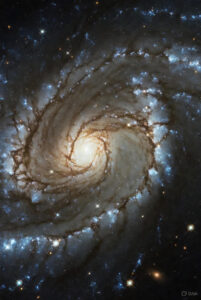 By C. Rich
To integrate galactic rotation curves and circular motion into Lava-Void Cosmology while preserving the unified relativistic viscous fluid framework, the observed approximately flat rotation profiles of spiral galaxies emerge as a natural consequence of density-dependent viscous clustering combined with conserved angular momentum and multifractal turbulent torques during hierarchical collapse. The central supermassive black hole (SMBH) functions primarily as a localized gravitational sink and recycling mechanism (“drain”), influencing nuclear dynamics and accretion flows. Still, the global galactic spin and sustained orbital velocities at large radii are supported by the extended mass distribution arising from fluid thickening in dense regions.
This mechanism reproduces empirical rotation curves (e.g., from SPARC, THINGS, or ALFALFA surveys) without invoking separate dark matter particles: viscous effects provide effective pressure support and angular momentum redistribution, yielding shallow density cores in dwarfs, diverse velocity profiles, and flat curves in massive spirals. Galactic disks form stable, differentially rotating structures through turbulent viscosity, transporting angular momentum outward and enabling long-term coherence while allowing bar and spiral instabilities to emerge as intermittent features. The “drain” analogy remains valid locally, entraining matter in the nuclear vortex, but global rotation derives from initial spin acquired during viscous mergers and tidal torques in the broader fluid potential, amplified by void outflows enhancing differential flows.
This extension addresses the origin of galactic angular momentum and rotation curve shapes explicitly, distinguishing the model from ΛCDM by predicting subtle viscous-induced anomalies (e.g., scale-dependent deviations in inner profiles or enhanced diversity in low-surface-brightness galaxies) testable by upcoming instruments (e.g., SKA, ELT, or JWST kinematics).
Mathematical Formulation
The background galactic potential is governed by the viscous imperfect fluid equations in a Newtonian limit for sub-relativistic scales, with density-dependent transport coefficients:
Effective gravitational acceleration from Poisson equation, modified by viscous contributions:
$$\nabla^2 \Phi = 4\pi G \rho + \nabla \cdot (\xi \theta + {\tau}),$$
where $\xi(\rho)$ is bulk viscosity (thickening in dense regions) and $ {\tau}$ the shear stress tensor.
Circular velocity in equilibrium:
$$v_{\rm circ}^2(r) = r \frac{\partial \Phi}{\partial r} \approx \frac{G M(<r)}{r} + v_{\rm visc}^2(r),$$
with viscous support $v_{\rm visc}^2 \propto \int \xi(\rho) \nabla \rho \, dr$ yielding extended $M(<r) \propto r$ for flat profiles.
Density dependence parametrized as:
$$\xi(\rho) = \xi_0 \left( \frac{\rho}{\rho_{\rm crit}} \right)^\gamma, \quad \eta(\rho) = \eta_0 \left( \frac{\rho}{\rho_{\rm crit}} \right)^\beta \quad (\gamma, \beta \approx 1–2),$$
tuned for core radii $r_{\rm core} \approx 0.5–3$ kpc in dwarfs and asymptotic flatness $v_\infty \approx 100–300$ km/s.
Angular momentum evolution via turbulent torques:
$$\frac{dL}{dt} = \int \mathbf{r} \times (\nabla \cdot {\tau}) \, dV,$$
with multifractal intermittency introducing stochasticity, producing observed spin parameter distribution $\lambda \approx 0.01–0.1$.
In non-linear simulations (e.g., viscous SPH extensions), initial turbulent seeds and void gradients drive spin-up, yielding differential rotation $\Omega(r) \propto r^{-1}$ in disks while suppressing cusps ($\rho(r) \propto r^{-\alpha}$, $\alpha \approx 0.5–1$).
This formulation ensures consistency with hierarchical assembly: early viscous mergers seed rotation, central SMBH drains excess density, and void flows enhance outer stability. Numerical forward modeling from cosmological initial conditions can match observed curves with reduced parameters relative to ΛCDM+feedback models, offering testable residuals (e.g., correlated core sizes with environment density).
This dedicated treatment elevates galactic rotation as a core predictive success of the fluid paradigm, bridging small-scale dynamics to cosmic unification while inviting empirical scrutiny.
C. Rich