
This Week in AI: GPT-5.2, Photoshop in ChatGPT & Google’s Smart Browser
December 16, 2025
How to Build AI Agent with ChatGPT (Beginner Tutorial)
December 17, 2025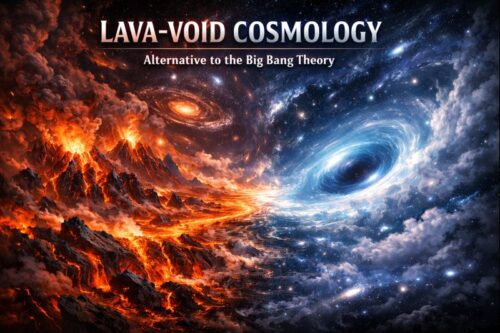
By C. Rich
There has been much talk lately about what came before the Big Bang. Lava-Void Cosmology (LVC) offers an alternative framework to standard Big Bang cosmology. In this model, the universe is depicted as an eternal, self-sustaining system consisting of a single, compressible, viscous fluid that governs all cosmic phenomena through Einsteinian general relativity without invoking additional entities such as dark matter or dark energy. Lava-Void Cosmology, an alternative to the Big Bang theory, proposes an eternal fluid universe in which cosmic expansion arises from phase transitions rather than a singular, explosive origin.
Unlike the conventional Big Bang theory, which posits a singular origin from a hot, dense state potentially emerging from a quantum fluctuation or metaphysical nothingness, LVC rejects the notion of an absolute beginning. The observable expansion is instead interpreted as a phase transition or bounce within an eternal fluid continuum. This fluid naturally phase-separates into dense “lava” regions (associated with matter and gravitational flux) and expansive “void” regions (driving acceleration via negative pressure).
Consequently, the question of “what came before the Big Bang” is reframed: there is no temporal “before” in the traditional sense, as the universe exists as a perpetual, dynamic ocean of energy where processes of creation, collapse, and reconfiguration occur as ongoing currents in a boundless, self-regulating system. Singularities are avoided through the fluid’s inherent properties, ensuring continuity without requiring a discrete origin. As a Lava-Void Cosmology alternative to Big Bang theory, this model eliminates the need for dark matter, dark energy, and an absolute beginning by treating the universe as a self-regulating fluid continuum.
C. Rich