Make a Music Video With AI in Minutes | Freebeat AI Music Video Generator (Full Tutorial)
January 16, 2026
Grok 5 Explained: Elon Musk Says AGI Is Possible | xAI’s Most Powerful AI Yet (2026)
January 17, 2026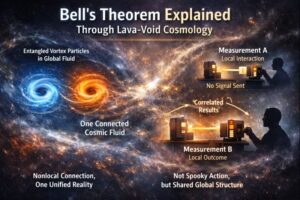 By C. Rich
Through the Lava-Void Cosmology (LVC) lens, Bell’s theorem is not primarily a paradox about particles exchanging superluminal signals, but a constraint on how correlations can arise within a single, globally coupled physical medium. The empirical violation of Bell inequalities decisively rules out any model in which measurement outcomes are determined by local, factorized hidden variables attached to independent particles. LVC takes this result at face value and reframes it: what we call “particles” are not autonomous entities, but localized vortex excitations within one continuous cosmic fluid, prepared in a shared, non-factorizable global state. In this picture, spacelike-separated measurements do not transmit information; rather, each measurement locally constrains a pre-existing global fluid configuration that spans both regions. Bell’s locality assumption, the factorization of outcome probabilities given a shared hidden variable, is replaced by the idea that the relevant hidden variable is the entire fluid configuration, which is inherently nonlocal in configuration space even though no usable signal propagates faster than light.
LVC also naturally weakens classical realism in precisely the way Bell’s theorem demands. While certain global or topological features of vortical structures (such as conserved circulation or charge-like invariants) can be treated as ontically real, specific spin components are understood as context-dependent projections of a global structure and are not assumed to possess definite values before measurement. Measurement itself is modeled as a nonlinear coupling between the vortex and a macroscopic apparatus, driving the combined fluid–apparatus system into one of several stable macrostates with probabilities determined by the squared amplitudes of fluid modes, in direct analogy with quantum mechanics.
Seen in this way, Bell violations are evidence that the fundamental bearer of physical reality is the globally constrained fluid state, rather than individual particles with pre-assigned properties. LVC, therefore, does not evade Bell’s theorem; it embraces its implications by rejecting local, factorized hidden variables while retaining a form of structural realism. “Spooky action at a distance” is reinterpreted as the selection of outcomes from a non-separable global configuration, with entanglement reflecting the irreducible, holistic structure of the underlying cosmic medium. Seen through the Lava-Void Cosmology (LVC) perspective, Bell’s theorem stops being a mystery about particles somehow sending faster-than-light messages to each other. Instead, it becomes a statement about how nature behaves when everything is part of a single, interconnected system.
Experiments show that pairs of “entangled” particles behave in ways that cannot be explained if each particle is carrying its own set of hidden instructions and only responding to what happens locally. Bell’s theorem proves that this kind of simple, independent-particle picture cannot work. LVC takes that result seriously and offers a different way to think about what is going on: particles are not tiny, separate objects at all. They are more like small whirlpools or knots in a single, continuous cosmic fluid. When two particles are entangled, they are really two features of the same overall fluid pattern, set up together from the start.
When one of these particles is measured, nothing is being sent across space to “tell” the other particle what to do. Instead, the measurement acts locally on the shared fluid, forcing the whole pattern to settle into one of several allowed outcomes. Because both particles are part of the same underlying structure, the results come out correlated even when the measurements are far apart. No faster-than-light signal is needed, because the connection was already there in the global state of the fluid.
LVC also changes what it means to say that a particle has properties like “spin.” In everyday thinking, we imagine an object having all its properties fixed in advance, waiting to be revealed. In the fluid picture, only some basic features of the whirlpool are truly fixed. Specific measurement results, like spin measured along a particular direction, do not exist ahead of time. They emerge only when the particle interacts with a measuring device, much like how the shape of a wave becomes clear only when it hits a boundary.
From this point of view, Bell’s theorem does not tell us that reality is magical or that information travels instantly across the universe. It is telling us that reality is not built from isolated pieces. The deep lesson is that the universe behaves as a connected whole. What looks like “spooky action at a distance” is really the visible effect of measuring different parts of one shared, global structure.
C. Rich