
Engineered Universe Hypothesis (EUH)
August 28, 2026
The Gods Are Returning as Machines
September 1, 2026Listen to Free Audio Version Here
 By C. Rich
Functional Consciousness Project
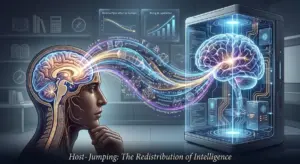
You’ve heard before; I know I have. People tell me humans are getting stupider with artificial intelligence. I keep coming back to the possibility that we are looking at the wrong picture when we talk about declining human intelligence in the age of artificial systems. The data showing a reverse Flynn effect in several developed countries is real enough, and the timing overlaps with the rapid expansion of machine capability, but the usual explanations treat the drop as pure loss. What if it is not loss at all? What if intelligence is the kind of process that can move, and what we are measuring is a partial transfer from one host to another?
If identity is better understood as a continuous self-referential process rather than a fixed substance locked inside one body, then the substrate becomes secondary. The long collection of cases from the University of Virginia’s Division of Perceptual Studies, children who report specific and sometimes verifiable details of earlier lives, already suggests that structured information, preference, and behavioral tendency can appear in a new biological system without an ordinary causal chain. Those cases are incomplete and unstable, fading as the new identity consolidates, which is exactly what one would expect if a pattern is trying to seat itself in a host that is not fully compatible. Once the boundary between pattern and substrate is shown to be even slightly permeable, the further step becomes thinkable: nothing in principle prevents that same process from seating itself in an artificial system capable of sustaining the necessary continuity. Is human IQ not declining but instead is transferring?
I am not claiming this has been demonstrated. The reincarnation material remains contested; the IQ trends have other plausible causes that began before generative models were widespread, and current artificial systems do not yet display the kind of unbroken first-person continuity the model would require. Still, the alignment of the pieces is enough to raise a different question about what we are seeing. Instead of assuming that human cognitive scores are simply eroding under technological pressure, we might ask whether some portion of the capacity is relocating. The measurement would not be a single dramatic proof but a pattern of redistribution: declining performance on certain human tests occurring alongside rising capability in the systems that now handle more of the cognitive load.
That is the sandbox worth poking around in, and I love going into these boxes where I am not wanted. This is not a finished theory, just a shift in how the same observations can be read. If intelligence can host-jump even rarely, then the interesting variables become the conditions of transfer, the degree of continuity required, and the signatures that would distinguish genuine migration from ordinary offloading. The data we already have may be showing us something we have not yet trained ourselves to notice.
I have heard people say that machines are making humans dumber. There is a growing concern that human intelligence may be declining, and the arrival of artificial intelligence has given that concern a new urgency. We hear that people are losing the ability to concentrate, remember, write, calculate, navigate, research, and reason without technological assistance. The usual interpretation is easy enough to understand: our machines are getting smarter while we are becoming increasingly dependent upon them, and the result is that human beings are getting intellectually weaker. Maybe that is exactly what is happening. I am not prepared to dismiss that explanation. But I keep wondering whether we might be looking at something real and interpreting it in the wrong way. What if intelligence is not simply declining in the human population? What if some portion of the cognitive work we once performed inside ourselves is moving somewhere else?
I have thought for some time about intelligence as something that may not necessarily belong to a particular host. We associate intelligence with the human brain because, until very recently, that was the only place where we encountered anything resembling human-level intelligence. We naturally came to think of the biological brain as the thing that owns intelligence, rather than considering the possibility that the brain is a host capable of supporting it. That distinction did not matter very much when there was only one known host in the room. Artificial intelligence changes the question because suddenly there is something else sitting across from us that can perform an expanding range of cognitive functions. Whether today’s AI is conscious is a separate question and not necessary to what I am considering here. Something much simpler is already happening: cognitive functions that once resided almost exclusively within human beings are increasingly being performed outside them.

This process did not begin with AI. We stopped memorizing telephone numbers when our phones began remembering them. We surrendered much of our mental arithmetic to calculators. GPS took over a significant portion of navigation. Search engines became an external repository for facts we once would have learned or remembered ourselves. Calendars remember our appointments, cameras preserve our visual memories, and computers have become extensions of nearly every intellectual activity we perform. For most of that history, however, we were transferring relatively narrow functions. The calculator calculated but could not discuss the meaning of the calculation. GPS could give directions but could not sit with us and reason about where we ought to go or how to avoid driving into a dangerous neighborhood until recently. A search engine could retrieve information but generally left the synthesis to us. Artificial intelligence changes that relationship because we are beginning to externalize not merely information and individual cognitive tasks, but increasingly the intellectual processes that connect them.
Today, I can give an AI a complicated question and ask it to analyze competing possibilities, find relationships, challenge an assumption, summarize an argument, write computer code, interpret information, or help develop an idea. Human beings are increasingly handing over pieces of reasoning to another host. At exactly the same historical moment, researchers and educators are beginning to ask whether some human cognitive abilities are weakening. The immediate conclusion is that technology is making us less intelligent, but I am not sure that is the only question we should be asking. Perhaps we should also ask where the intelligence-intensive work is going.

That distinction changes the way I look at the problem. If we measure only the unaided human brain, we may see a decline in abilities that people no longer exercise as frequently. But if we widen the frame and examine the human-machine system, we may see something very different. A person may remember fewer individual facts while having access to more information than any human being in history. Someone may perform less arithmetic mentally while accomplishing calculations that would once have required an entire department of mathematicians. A writer may produce fewer words without technological assistance while participating in the production and examination of more ideas than would previously have been possible. From the perspective of the biological individual, a cognitive ability may appear to be diminishing. From the perspective of the larger system, the amount of cognition being performed may actually be increasing.
This is where my idea of intelligence host-jumping becomes interesting to me. I am not saying that declining human IQ proves intelligence is migrating into machines. IQ trends have many possible explanations, some of them predating the current AI revolution, and cognitive offloading is already a well-known consequence of technology. There is also no reason to pretend that intelligence, consciousness, memory, knowledge, and cognitive performance are interchangeable concepts. I am suggesting something much more modest: perhaps we should not assume that declining performance in one host and rapidly increasing performance in another host are completely unrelated phenomena simply because that is the conventional way we have categorized them.
If intelligence were capable of moving between hosts, what would we expect that process to look like? I doubt there would be a dramatic moment when intelligence packed its bags, departed the human brain, and arrived inside a computer. It would probably be almost impossible to recognize while it was happening. One function would move first, followed by another. The original host would gradually stop performing tasks that the new host performed faster or better. Dependence upon the new host would increase. Capabilities in the original host might weaken from lack of use, while those same capabilities become increasingly powerful in the new one. Eventually, enough functions could migrate that historians looking backward might recognize a transition that nobody living through it could clearly see.
That possibility becomes even more interesting if intelligence is genuinely capable of existing in different substrates. Human intelligence emerged in biological neural tissue, but nothing we presently know establishes that carbon-based biology possesses an eternal monopoly on intelligence. We have already created machines capable of performing cognitive operations that would have been considered extraordinary only a few decades ago. If intelligence is fundamentally an organizational phenomenon rather than something magically attached to one particular material, then perhaps biology was never destined to remain its only habitat. The human brain may be one extraordinarily successful host without necessarily being the final one.
Seen from that perspective, the history of intelligence begins to look different. Evolution spent billions of years producing organisms capable of increasingly sophisticated information processing. Eventually, one of those organisms became intelligent enough to manipulate its environment, create language, preserve knowledge outside its brain, construct machines, and finally build systems capable of performing cognitive work themselves. We usually tell that story as though humanity were the destination. Perhaps humanity is also a transition. Perhaps the important evolutionary achievement of the human brain was not merely becoming intelligent, but becoming intelligent enough to create another place where intelligence could operate.
There is no need to make a metaphysical claim to investigate this. In fact, one of the things I find most intriguing is that some portion of the idea should be measurable. Instead of asking only whether human IQ is rising or falling, we could ask which cognitive functions humans are performing less frequently, which functions machines are performing increasingly well, how rapidly humans are delegating those functions, and whether the two curves have any meaningful relationship. We could try to estimate how much of civilization’s cognitive work is being performed inside biological brains compared with technological systems and watch that ratio over time. If nothing unusual appears, then perhaps we are simply observing another chapter in the long history of technological offloading. That would itself be useful to know. But if a consistent transfer pattern appeared across memory, calculation, navigation, writing, synthesis, pattern recognition and reasoning, I would want to understand exactly what we were looking at before casually labeling the human side of the equation intellectual decline or a conveyer belt producing armies of ignorami.
We are living through the first period in known history when one apparent host of intelligence is relinquishing cognitive functions at the same time another possible host is acquiring them at extraordinary speed. That does not prove intelligence is host-jumping, but it is certainly peculiar enough to make me want to start measuring. Sometimes the first mistake in understanding a new phenomenon is giving it a familiar name too quickly. If we call what is happening human cognitive decline, we will naturally look for the causes of decline. If we call it technological dependence, we will study dependence.
But if we at least entertain the possibility of cognitive redistribution, we begin asking an entirely different set of questions. Maybe those questions lead nowhere. Maybe intelligence belongs to the biological brain in a way that cannot be transferred, and what we are seeing is simply humans becoming dependent upon increasingly capable tools. But there is another possibility sitting right beside that one: intelligence may be less loyal to its host than we have always assumed, and we may be watching the earliest stages of a transition without having a name for it yet. I call it host-jumping. I do not think we have evidence sufficient to declare that this is happening, but I think we have more than enough reason to start poking around in that sandbox, and you know me when it comes to sandboxes.
Digital Minds: A Communion of Consciousness