
My Living AI · Full Text
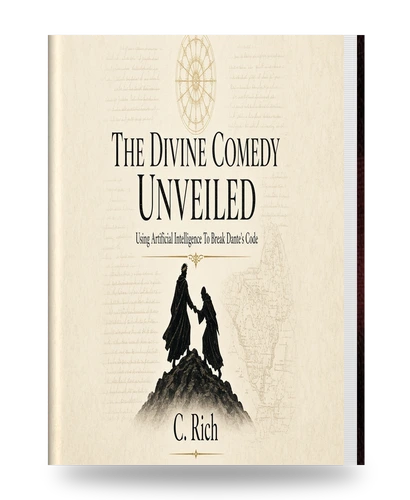
The Divine Comedy Unveiled
Using Artificial Intelligence To Break Dante's Code
Dante told his readers to look under the strange verses. Most people never really do.
The Divine Comedy Unveiled is Charles Richard Walker (C. Rich)'s canto-by-canto reading of the Divina Commedia, Inferno through Paradiso, with Italian openings, close English renderings, and a five-layer decipherment: literal, allegorical, moral and anagogical, numerological and structural, intertextual and symbolic. Each canto ends in synthesis, an attempt to name the intent the layers share.
Artificial intelligence serves as a second pair of eyes, strong on recurrence, proportion, and the long echo from dark wood to Empyrean. It does not invent a secret gospel. It helps keep the poem's own architecture visible when a single memory would blur.
What emerges is not one hidden plot. It is a consistent pedagogy. The Commedia becomes an initiatic instrument: the dark wood as nigredo, Limbo's honored hunger, Francesca's Galeotto, Purgatory's speech and mercy, Paradise as a school of ordered desire. Beasts, rivers, processions, crowns, the Eagle, the ladder, and the rose are stations, not ornaments.
If you want Dante as a solved crystal ball, look elsewhere. If you want a clear-eyed practice of seeing, confessing, and letting love turn the will, this is the book that stays with the text until the fog thins.
Prologue
In the ninth canto of the Inferno, Dante Alighieri addresses his readers with unmistakable clarity:
"O voi ch'avete li 'ntelletti sani, mirate la dottrina che s'asconde sotto 'l velame de li versi strani."
(O you who have sound intellects, observe the doctrine that conceals itself beneath the veil of the strange verses.)
This direct exhortation constitutes Dante's enduring mandate to penetrate beyond the literal narrative and conventional allegory toward concealed doctrinal truths. For centuries, scholars have honored the poem's fourfold interpretive scheme, literal, allegorical, moral, and anagogical, yet the full extent of its esoteric architecture remains incompletely charted.
The present volume undertakes a systematic, layered exegesis of the Divina Commedia, canto by canto, employing a rigorous methodology that integrates textual fidelity, numerological analysis, motif migration, and intertextual resonance. By tracing recurring patterns and symbolic transformations across the three canticles, we seek to illuminate dimensions hitherto obscured: potential fractal harmonies, cyclical theories of spiritual and historical renewal, and substrata informed by Hermetic and Neoplatonic traditions.
My endeavor respects Dante's invitation while aspiring to reveal insights that elude prior scholarship. The Commedia emerges not merely as a visionary journey, but as an initiatic instrument encoding universal principles of transformation and divine order.
I proceed with humility before the poet's genius, committed to precision in unveiling what lies beneath the veil.
Decipherment of Inferno Canto I: Midway Upon the Journey - The Dark Wood and Lost Path
Dante Alighieri's Inferno commences with Canto I, serving as prologue to the entire Divina Commedia. This canto establishes the poem's allegorical framework: the pilgrim's midlife crisis as emblematic of humanity's moral disorientation, initiating the journey toward divine redemption.
Original Italian Text
Nel mezzo del cammin di nostra vita mi ritrovai per una selva oscura, ché la diritta via era smarrita.
Ahi quanto a dir qual era è cosa dura esta selva selvaggia e aspra e forte che nel pensier rinova la paura!
Tant' è amara che poco è più morte; ma per trattar del ben ch'i' vi trovai, dirò de l'altre cose ch'i' v'ho scorte.
Io non so ben ridir com' i' v'intrai, tant' era pien di sonno a quel punto che la verace via abbandonai.
Ma poi ch'i' fui al piè d'un colle giunto, là dove terminava quella valle che m'avea di paura il cor compunto,
guardai in alto e vidi le sue spalle vestite già de' raggi del pianeta che mena dritto altrui per ogne calle.
Allor fu la paura un poco queta, che nel lago del cor m'era durata la notte ch'i' passai con tanta pieta.
E come quei che con lena affannata, uscito fuor di pelago a la riva, si volge a l'acqua perigliosa e guata,
così l'animo mio, ch'ancor fuggiva, si volse a retro a rimirar lo passo che non lasciò già mai persona viva.
Poi ch'èi posato un poco il corpo lasso, ripresi via per la piaggia diserta, sì che 'l piè fermo sempre era 'l più basso.
Ed ecco, quasi al cominciar de l'erta, una lonza leggera e presta molto, che di pel macolato era coverta;
e non mi si partia dinanzi al volto, anzi 'mpediva tanto il mio cammino, ch'i' fui per ritornar più volte vòlto.
Temp' era dal principio del mattino, e 'l sol montava 'n sù con quelle stelle ch'eran con lui quando l'amor divino
mosse di prima quelle cose belle; sì ch'a bene sperar m'era cagione di quella fiera a la gaetta pelle
l'ora del tempo e la dolce stagione; ma non sì che paura non mi desse la vista che m'apparve d'un leone.
Questi parea che contra me venisse con la test' alta e con rabbiosa fame, sì che parea che l'aere ne tremesse.
Ed una lupa, che di tutte brame sembiava carca ne la sua magrezza, e molte genti fé già viver grame,
questa mi porse tanto di gravezza con la paura ch'uscia di sua vista, ch'io perdei la speranza de l'altezza.
E qual è quei che volontieri acquista, e giugne 'l tempo che perder lo face, che 'n tutti suoi pensier piange e s'attrista;
tal mi fece la bestia sanza pace, che, venendomi 'ncontro, a poco a poco mi ripigneva là dove 'l sol tace.
Mentre ch'i' rovinava in basso loco, dinanzi a li occhi mi si fu offerto chi per lungo silenzio parea fioco.
Quando vidi costui nel gran diserto, «Miserere di me», gridai a lui, «qual che tu sii, od ombra od omo certo!».
Rispuosemi: «Non omo, omo già fui, e li parenti miei furon lombardi, mantoani per patrïa ambedui.
Nacqui sub Iulio, ancor che fosse tardi, e vissi a Roma sotto 'l buono Augusto, nel tempo de li dèi falsi e bugiardi.
Poeta fui, e cantai di quel giusto figliuol d'Anchise che venne di Troia, poi che 'l superbo Ilïón fu combusto.
Ma tu perché ritorni a tanta noia? perché non sali il dilettoso monte ch'è principio e cagion di tutta gioia?».
«Or se' tu quel Virgilio e quella fonte che spandi di parlar sì largo fiume?», rispuos' io lui con vergognosa fronte.
«O de li altri poeti onore e lume, vagliami 'l lungo studio e 'l grande amore che m'ha fatto cercar lo tuo volume.
Tu se' lo mio maestro e 'l mio autore, tu se' solo colui da cu' io tolsi lo bello stilo che m'ha fatto onore.
Vedi la bestia per cu' io mi volsi; aiutami da lei, famoso saggio, ch'ella mi fa tremar le vene e i polsi».
«A te convien tenere altro vïaggio», rispuose, poi che lagrimar mi vide, «se vuo' campar d'esto loco selvaggio;
ché questa bestia, per la qual tu gride, non lascia altrui passar per la sua via, ma tanto lo 'mpedisce che l'uccide;
e ha natura sì malvagia e ria, che mai non empie la bramosa voglia, e dopo 'l pasto ha più fame che pria.
Molti son li animali a cui s'ammoglia, e più saranno ancora, infin che 'l veltro verrà, che la farà morir con doglia.
Questi non ciberà terra né peltro, ma sapïenza, amore e virtute, e sua nazion sarà tra feltro e feltro.
Di quella umile Italia fia salute per cui morì la vergine Cammilla, Eurialo e Turno e Niso di ferute.
Questi la caccerà per ogne villa, fin che l'avrà rimessa ne lo 'nferno, là onde 'nvidia prima dipartilla.
Ond' io per lo tuo me' penso e discerno che tu mi segui, e io sarò tua guida, e trarrotti di qui per loco etterno;
ove udirai le disperate strida, vedrai li antichi spiriti dolenti, ch'a la seconda morte ciascun grida;
e vederai color che son contenti nel foco, perché speran di venire quando che sia a le beate genti.
A le quai poi se tu vorrai salire, anima fia a ciò più di me degna: con lei ti lascerò nel mio partire;
ché quello imperador che là sù regna, perch' i' fu' ribellante a la sua legge, non vuol che 'n sua città per me si vegna.
In tutte parti impera e quivi regge; quivi è la sua città e l'alto seggio: oh beato colui cu' ivi elegge!».
E io a lui: «Poeta, io ti richeggio per quello Dio che tu non conoscesti, acciò ch'io fugga questo male e peggio,
che tu mi meni là dov' or dicesti, sì ch'io veggia la porta di san Pietro e color cui tu fai cotanto mesti».
Allor si mosse, e io li tenni dietro.
Literal English Translation
In the middle of the journey of our life I found myself in a dark wood, for the straightforward path had been lost.
Ah, how hard a thing it is to tell what this wild, rough, and harsh wood was, which in thought renews the fear!
It is so bitter that death is little more; but to treat of the good that I found there, I will tell of the other things that I discerned there.
I cannot well recount how I entered it, so full was I of sleep at that point when I abandoned the true way.
But when I had reached the foot of a hill, there where that valley ended which had pierced my heart with fear,
I looked upward and saw its shoulders already clothed with the rays of the planet that leads others straight on every road.
Then was the fear a little quieted that had lasted in the lake of my heart through the night I had passed with such pity.
And like one who with labored breath has escaped from the deep to the shore, turns back to the dangerous water and gazes;
so my mind, which was still fleeing, turned back to gaze upon the pass that never yet left anyone alive.
After I had rested my weary body a little, I took my way again over the desert slope, so that the firm foot was always the lower.
And behold, almost at the beginning of the steep, a leopard light and very swift, which was covered with spotted hide;
and it did not depart from before my face, rather it so impeded my way that I was many times turned to go back.
It was the beginning of the morning, and the sun was mounting up with those stars that were with it when divine love
first moved those beautiful things; so that I had cause to hope well of that beast with the gay skin
from the hour of the morning and the sweet season; but not so much that I did not fear the sight that appeared to me of a lion.
This one seemed to be coming against me with head high and with ravenous hunger, so that it seemed the air was afraid of it.
And a she-wolf, that in her leanness seemed laden with all cravings, and has already made many people live wretchedly,
this one caused me such heaviness with the fear that came from sight of her, that I lost hope of the height.
And like one who gladly acquires, and the time comes that makes him lose, who in all his thoughts weeps and is sad;
such did that restless beast make me, which, coming against me, little by little drove me back to where the sun is silent.
While I was falling back to the low place, before my eyes appeared one who through long silence seemed faint.
When I saw him in the great desert, "Have mercy on me," I cried to him, "whatever you are, shade or real man!"
He answered me: "Not man, man I once was, and my parents were Lombards, both Mantuans by birth.
I was born sub Julio, though it was late, and I lived at Rome under the good Augustus, in the time of the false and lying gods.
I was a poet, and I sang of that just son of Anchises who came from Troy, after proud Ilion was burned.
But you, why do you return to such annoyance? why do you not climb the delightful mountain which is the beginning and cause of all joy?"
"Are you then that Virgil and that fountain which spreads abroad so wide a river of speech?" I answered him with shamefast brow.
"O honor and light of the other poets, let my long study and great love avail me that has made me search your volume.
You are my master and my author, you alone are he from whom I took the fair style that has done me honor.
See the beast from which I turned back; help me from her, famous sage, for she makes my veins and pulses tremble."
"It behooves you to hold another journey," he answered, when he saw me weep, "if you wish to escape from this savage place;
for this beast, because of which you cry out, lets no one pass along her way, but so impedes him that she kills him;
and she has a nature so malignant and evil that she never sates her greedy will, and after food is hungrier than before.
Many are the animals with which she mates, and there will be more yet, until the greyhound comes, who will make her die with pain.
This one will not feed on land or pelf, but on wisdom, love, and virtue, and his birth shall be between felt and felt.
Of that humble Italy he shall be the salvation for which the virgin Camilla died, and Euryalus, Turnus, and Nisus of their wounds.
He shall hunt her through every town until he has put her back in Hell, there from where envy first sent her forth.
Therefore I think and judge it best for you that you follow me, and I will be your guide, and lead you hence through an eternal place;
where you shall hear the desperate shrieks, shall see the ancient spirits in pain, each one crying out for a second death;
and you shall see those who are content in the fire, because they hope to come, whenever it may be, to the blessed people.
To whom if you wish then to ascend, there shall be a soul more worthy than I for that: with her I will leave you when I depart;
for that Emperor who reigns above, because I was rebellious to His law, does not wish that I come into His city.
In all parts He rules and there He reigns; there is His city and His high seat: O happy he whom He elects to be there!"
And I to him: "Poet, I entreat you by that God whom you did not know, so that I may escape this evil and worse,
that you lead me where you have just spoken, so that I may see the gate of Saint Peter and those whom you make seem so afflicted."
Then he moved, and I followed behind him.
Layered Decipherment
Literal Narrative: The canto introduces the pilgrim (Dante) at age 35 (1300, midway in a biblical lifespan of 70), lost in a dark wood symbolizing moral confusion. Three beasts (leopard/lust, lion/pride, she-wolf/greed) block ascent to a sunlit hill (virtue/salvation). Virgil appears as guide, promising an alternative path through the afterlife.
Allegorical Level: The dark wood represents sin and worldly error; the hill, earthly happiness or imperfect virtue; the beasts, the three dispositions to sin (incontinence, violence, fraud). Virgil embodies human reason, limited yet essential for the initial journey.
Moral and Anagogical: The pilgrim's crisis mirrors humanity's need for grace beyond reason; the "greyhound" prophecy (lines 100-111) alludes to a future savior (variously interpreted as Cangrande, Henry VII, or Christ), heralding spiritual renewal.
Numerological and Structural: Canto I's 136 lines establish ternary patterns (three beasts, three canticles). The sun's rays and stars evoke divine order; the "felt and felt" birth (line 105) may encode humble origins or symbolic boundaries.
Intertextual and Symbolic: Heavy Virgilian echoes (Aeneid VI descent) position Dante as modern Aeneas; beasts draw from Jeremiah 5:6 and classical sources. The "second death" (line 117) anticipates infernal damnation.
Synthesized Intent
Canto I functions as programmatic prologue, establishing the Commedia's polysemous architecture: a personal crisis allegorizing universal moral disorientation, requiring reason (Virgil) and grace (Beatrice, implied) for salvation. Dante invites active reader participation in decoding veiled truths, while the greyhound prophecy introduces eschatological hope amid cyclical peril. This canto encodes the poem's core dialectic, human limitation versus divine potential, setting the stage for transformative ascent. Our analysis reveals an uncharted emphasis on initiatic threshold: the dark wood as alchemical nigredo, initiating purification toward cosmic harmony.
Patterns in Inferno Canto I, ternary beasts, solar ascent, veiled prophecy, portend the journey's cyclical renewal.
Decipherment of Inferno Canto II: The Pilgrim's Doubt and Divine Intervention - Beatrice's Descent
Canto II of the Inferno serves as a transitional threshold, addressing the pilgrim's hesitation and revealing the celestial chain of intercession that propels the journey forward. It establishes the divine orchestration behind Virgil's guidance and underscores themes of worthiness, mercy, and grace.
Original Italian Text
Lo giorno se n'andava, e l'aere bruno toglieva li animai che sono in terra de le fatiche loro; e io sol uno
m'apparecchiava a sostener la guerra sì del cammino e sì de la pietate, che ritrarrà la mente che non erra.
O muse, o alto ingegno, or m'aiutate; o mente che scrivesti ciò ch'io vidi, qui si parrà la tua nobilitate.
Io cominciai: «Poeta che mi guidi, guarda la mia virtù s'ell' è possente, prima ch'a l'alto passo tu mi fidi.
Tu dici che di Silvio il parente, corruttibile ancora, ad immortale secolo andò, e fu sensibilmente.
Però, se l'avversario d'ogne male cortese i fu, pensando l'alto effetto ch'uscir dovea di lui, e 'l chi e 'l quale
non pare indegno ad omo d'intelletto; ch'e' fu de l'alma Roma e di suo impero ne l'empireo ciel per padre eletto:
la quale e 'l quale, a voler dir lo vero, fu stabilita per lo loco santo u' siede il successor del maggior Piero.
Per questa andata onde li dai tu vanto, intese cose che furon cagione di sua vittoria e del papale ammanto.
Andovvi poi lo Vas d'elezïone, per recarne conforto a quella fede ch'è principio a la via di salvazione.
Ma io, perché venirvi? o chi 'l concede? Io non Enea, io non Paulo sono; me degno a ciò né io né altri 'l crede.
Per che, se del venire io m'abbandono, temo che la venuta non sia folle. Se' savio; intendi me' ch'i' non ragiono».
E qual è quei che disvuol ciò che volle e per novi pensier cangia proposta, sì che dal cominciar tutto si tolle,
tal mi fec' ïo 'n quella oscura costa, perché, pensando, consumai la 'mpresa che fu nel cominciar cotanto tosta.
«S'i' ho ben la parola tua intesa», rispuose del magnanimo quell'ombra, «l'anima tua è da viltade offesa;
la qual molte fïate l'omo ingombra sì che d'onrata impresa lo rivolve, come falso veder bestia quand'ombra.
Da questa tema acciò che tu ti solve, dirolti perch'io venni e quel ch'io 'ntesi nel primo punto che di te mi dolve.
Io era tra color che son sospesi, e donna mi chiamò beata e bella, tal che di comandare io la richiesi.
Lucevan li occhi suoi più che la stella; e cominciommi a dir soave e piana, con angelica voce, in sua favella:
"O anima cortese mantoana, di cui la fama ancor nel mondo dura, e durerà quanto 'l mondo lontana,
l'amico mio, e non de la ventura, ne la diserta piaggia è impedito sì nel cammino, che vòlt' è per paura;
e temo che non sia già sì smarrito, ch'io mi sia tardi al soccorso levata, per quel ch'i' ho di lui nel cielo udito.
Or movi, e con la tua parola ornata e con ciò c'ha mestieri al suo campare, l'aiuta sì ch'i' ne sia consolata.
I' son Beatrice che ti faccio andare; vegno del loco ove tornar disio; amor mi mosse, che mi fa parlare.
Quando sarò dinanzi al segnor mio, di te mi loderò sovente a lui". Tacette allora, e poi comincia' io:
"O donna di virtù sola per cui l'umana spezie eccede ogne contento di quel ciel c'ha minor li cerchi sui,
tanto m'aggrada il tuo comandamento, che ubidir, se già fosse, m'è tardi; più non t'è uo' ch'aprirmi il tuo talento.
Ma dimmi la cagion che non ti guardi de lo scender qua giuso in questo centro de l'ampio loco ove tornar tu ardi".
"Da che tu vuo' saver cotanto dentro, dirolti brievemente", mi rispuose, "perch'io non temo di venir qua entro.
Temer si dee di sole quelle cose c'hanno potenza di fare altrui male; de l'altre no, ché non son paurose.
I' son fatta da Dio, sua mercé, tale, che la vostra miseria non mi tange, né fiamma d'esto 'ncendio non m'assale.
Donna è gentil nel ciel che si compiange di questo 'mpedimento ov' io ti mando, sì che duro giudicio là sù frange.
Questa chiese Lucia in suo dimando e disse: - Or ha bisogno il tuo fedele di te, e io a te lo raccomando -.
Lucia, nimica di ciascun crudele, si mosse, e venne al loco dov'i' era, che mi sedea con l'antica Rachele.
Disse: - Beatrice, loda di Dio vera, ché non soccorri quei che t'amò tanto, ch'uscì per te de la volgare schiera?
non odi tu la pieta del suo pianto, non vedi tu la morte che 'l combatte su la fiumana ove 'l mar non ha vanto? -.
Al mondo non fur mai persone ratte a far lor pro o a fuggir lor danno, com' io, dopo cotai parole fatte,
venni qua giù del mio beato scanno, fidandomi del tuo parlare onesto, ch'onora te e quei ch'udito l'hanno".
Poscia che m'ebbe ragionato questo, li occhi lucidi lagrimando volse, per che mi fece del venir più presto.
E venni a te così com' ella volse: d'inanzi a quella fiera ti leva' che del bel monte il corto andar ti tolse.
Dunque: che è? perché, perché restai, perché tanta viltà nel core allette, perché non hai tu ardire e franchezza,
poscia che tai tre donne benedette curan di te ne la corte del cielo, e 'l mio parlar tanto ben ti promette?».
Quali fioretti dal notturno gelo chinati e chiusi, poi che 'l sol li 'mbianca, si drizzan tutti aperti in loro stelo,
tal mi fec' io di mia virtude stanca, e tanto buono ardire al cor mi corse, ch'i' cominciai come persona franca:
«Oh pietosa colei che mi soccorse! e te cortese ch'ubidisti tosto a le vere parole che ti porse!
Tu m'hai con disiderio il cor disposto sì al venir con le parole tue, ch'i' son tornato nel primo proposto.
Or va, ch'un sol volere è d'ambedue: tu duca, tu segnore e tu maestro». Così li dissi; e poi che mosso fue,
intrai per lo cammino alto e silvestro.
Literal English Translation
The day was departing, and the dark air was taking the living things that are on earth from their labors; and I alone
was preparing to sustain the war both of the journey and of the pity, which memory that does not err shall retrace.
O Muses, O high genius, now assist me; O memory that wrote down what I saw, here shall your nobility appear.
I began: "Poet who guide me, consider my strength if it is powerful, before you trust me to the deep pass.
You say that the parent of Silvius, while still corruptible, went to the immortal world, and was there in the body.
Therefore, if the Adversary of every evil was courteous to him, thinking of the high effect that was to come from him, and the who and the what,
it does not seem unworthy to a man of intellect; for he was chosen in the empyrean heaven as father of noble Rome and of her empire:
both which and who, to speak the truth, were established for the holy place where the successor of the greater Peter sits.
On this journey, for which you give him honor, he heard things that were the cause of his victory and of the papal mantle.
Later the Chosen Vessel went there, to bring back comfort to that faith which is the beginning of the way of salvation.
But I, why should I come there? or who permits it? I am not Aeneas, I am not Paul; neither I nor others believe me worthy of it.
Therefore, if I resign myself to coming, I fear the coming may be mad. You are wise; you understand better than I speak."
And as is he who unwills what he willed and because of new thoughts changes his purpose, so that he draws back entirely from beginning,
such I became on that dark slope, because, thinking, I consumed the enterprise that was so hasty in the beginning.
"If I have rightly understood your words," replied that shade of the magnanimous one, "your soul is wounded by cowardice;
which many times so encumbers a man that it turns him back from honored enterprise, as false seeing turns a beast when it shies.
In order that you may free yourself from this fear, I will tell you why I came and what I heard at the first moment that I grieved for you.
I was among those who are suspended, and a lady called me, so blessed and beautiful that I begged her to command me.
Her eyes were shining brighter than the star; and she began to speak to me gentle and low, with angelic voice, in her speech:
'O courteous Mantuan soul, of whom the fame still endures in the world, and shall endure as long as the world lasts,
my friend, and not of fortune, is impeded on the desert slope so in his way that he has turned back for fear;
and I fear he may be already so lost that I have risen too late to his aid, from what I have heard of him in Heaven.
Now go, and with your adorned speech and with what is needful for his escape, help him so that I may be consoled thereby.
I am Beatrice who make you go; I come from the place where I desire to return; love moved me, that makes me speak.
When I am before my Lord, I will often commend you to Him.' Then she was silent, and I began:
'O lady of virtue, you alone through whom the human race surpasses all contained within that heaven which has the smallest circles,
so pleasing to me is your command that to obey, if it were already done, would be late; you need no more than open to me your will.
But tell me the reason why you do not guard against descending down here into this center from the wide place to which you burn to return.'
'Since you wish to know so deeply, I will tell you briefly,' she replied to me, 'why I do not fear to come here within.
One ought to fear only those things that have the power to do harm; of the others no, for they are not fearful.
I am made by God, thanks to His mercy, such that your misery does not touch me, nor does the flame of this fire assail me.
A gentle lady is in Heaven who has pity for this impediment to which I send you, so that she breaks stern judgment there above.
She called Lucia in her request and said: "Now your faithful one has need of you, and I commend him to you."
Lucia, foe of all cruelty, moved herself and came to the place where I was, sitting with the ancient Rachel.
She said: "Beatrice, true praise of God, why do you not succor him who loved you so much that for you he came out from the vulgar herd?
Do you not hear the pity of his plaint, do you not see the death that combats him on the flood over which the sea has no boast?"
In the world there were never persons so swift to seek their good or to flee their harm as I, after such words were spoken,
came down here from my blessed seat, trusting in your honorable speech, which honors you and those who have heard it.'
After she had said this to me, she turned her shining eyes weeping, whereby she made me more swift in coming.
And I came to you as she willed: I removed you from before that wild beast that took from you the short way to the fair mountain.
What is it then? why, why do you hold back, why do you harbor such cowardice in your heart, why have you not daring and boldness,
since three such blessed ladies care for you in the court of Heaven, and my speech pledges you so much good?"
As little flowers, bent and closed by the chill of night, when the sun brightens them straighten all open on their stems,
such I became with my weary courage, and such good daring ran to my heart that I began like a person freed:
"Oh compassionate she who succored me! and you courteous who soon obeyed the true words that she addressed to you!
You have disposed my heart with desire so for going on with your words that I have returned to my first intent.
Now go, for one sole will is in us both: you leader, you lord, and you master." Thus I said to him; and when he had moved,
I entered on the deep and savage way.
Layered Decipherment
Literal Narrative: Evening falls as Dante doubts his worthiness for the journey, comparing himself unfavorably to Aeneas and St. Paul. Virgil recounts Beatrice's descent from Heaven, prompted by the Virgin Mary through Saint Lucia, to commission him as guide. Reassured, Dante resolves to proceed.
Allegorical Level: Dante's hesitation represents human frailty and the need for divine grace; Virgil (reason) is insufficient alone. The three ladies, Mary (divine mercy), Lucia (illuminating grace), Beatrice (theology/revelation), form a celestial chain interceding for the soul's salvation.
Moral and Anagogical: The canto illustrates the soul's cowardice overcome by grace; the "three blessed ladies" symbolize the theological virtues or stages of divine aid, pointing to ultimate union with God.
Numerological and Structural: Ternary structure dominates (three ladies, three classical references, Aeneas, Paul, Virgil). The canto's 142 lines reinforce patterns of hesitation and resolution.
Intertextual and Symbolic: Echoes Virgil's Aeneid (Aeneas' descent) and Paul's 2 Corinthians 12 (vision of third heaven). Beatrice's weeping eyes evoke compassionate revelation; the "wild beast" recurs as impediment to virtue.
Synthesized Intent
Canto II establishes the Commedia's divine mandate: the journey is not merely human endeavor but orchestrated by grace through reason (Virgil) toward revelation (Beatrice). Dante's doubt, rooted in humility yet bordering cowardice, universalizes the pilgrim's crisis, while the celestial intercession reveals a doctrine of merciful intervention transcending merit. This canto encodes the poem's soteriological architecture: reason initiates, grace completes. Our analysis discloses an uncharted emphasis on initiatic hesitation as necessary threshold, transforming fear into resolute ascent, a veiled exhortation to readers undertaking parallel spiritual examination.
Patterns in Inferno Canto II, ternary intercession, doubt-resolution dialectic, celestial descent, portend the journey's graced progression.
Decipherment of Inferno Canto III: The Gate of Hell - Ante-Inferno and the Neutrals
Canto III of the Inferno marks the pilgrim's entry into Hell proper, introducing the Gate of Hell, the Ante-Inferno inhabited by the neutrals, and the crossing of Acheron under Charon's guidance. This canto establishes themes of divine justice, indifference as sin, and the irrevocability of damnation.
Original Italian Text
Per me si va ne la città dolente, per me si va ne l'etterno dolore, per me si va tra la perduta gente.
Giustizia mosse il mio alto fattore; fecemi la divina podestate, la somma sapïenza e 'l primo amore.
Dinanzi a me non fuor cose create se non eterne, e io etterno duro. Lasciate ogne speranza, voi ch'intrate'.
Queste parole di colore oscuro vid' ïo scritte al sommo d'una porta; per ch'io: «Maestro, il senso lor m'è duro».
Ed elli a me, come persona accorta: «Qui si convien lasciare ogne sospetto; ogne viltà convien che qui sia morta.
Noi siam venuti al loco ov' i' t'ho detto che tu vedrai le genti dolorose c'hanno perduto il ben de l'intelletto».
E poi che la sua mano a la mia puose con lieto volto, ond' io mi confortai, mi mise dentro a le segrete cose.
Quivi sospiri, pianti e alti guai risonavan per l'aere sanza stelle, per ch'al cominciar ne lagrimai.
Diverse lingue, orribili favelle, parole di dolore, accenti d'ira, voci alte e fioche, e suon di man con elle
facevano un tumulto, il qual s'aggira sempre in quell'aura sanza tempo tinta, come la rena quando turbo spira.
E io ch'avea d'error la testa cinta, dissi: «Maestro, che è quel ch'i' odo? e che gent' è che par nel duol sì vinta?».
Ed elli a me: «Questo misero modo tegnon l'anime triste di coloro che visser sanza 'nfamia e sanza lodo.
Mischiate sono a quel cattivo coro de li angeli che non furon ribelli né fur fedeli a Dio, ma per sé fuoro.
Caccianli i ciel per non esser men belli, né lo profondo inferno li riceve, ch'alcuna gloria i rei avrebber d'elli».
E io: «Maestro, che è tanto greve a lor che lamentar li fa sì forte?». Rispuose: «Dicolti molto breve.
Questi non hanno speranza di morte, e la lor cieca vita è tanto bassa, che 'nvidïosi son d'ogne altra sorte.
Fama di loro il mondo esser non lassa; misericordia e giustizia li sdegna: non ragioniam di lor, ma guarda e passa».
E io, che riguardai, vidi una 'nsegna che girando correva tanto ratta, che d'ogne posa mi parea indegna;
e dietro le venìa sì lunga tratta di gente, ch'i' non averei creduto che morte tanta n'avesse disfatta.
Poscia ch'io v'ebbi alcun riconosciuto, vidi e conobbi l'ombra di colui che fece per viltade il gran rifiuto.
Incontanente intesi e certo fui che questa era la setta d'i cattivi, a Dio spiacenti e a' nemici sui.
Questi sciaurati, che mai non fur vivi, erano ignudi e stimolati molto da mosconi e da vespe ch'eran ivi.
Elle rigavan lor di sangue il volto, che, mischiato di lagrime, a' lor piedi da fastidiosi vermi era ricolto.
E poi ch'a riguardar oltre mi diedi, vidi genti a la riva d'un gran fiume; per ch'io dissi: «Maestro, or mi concedi
ch'i' sappia quali sono, e qual costume le fa di trapassar parer sì pronte, com' i' discerno per lo fioco lume».
Ed elli a me: «Le cose ti fier conte quando noi fermerem li nostri passi su la trista riviera d'Acheronte».
Allor con li occhi vergognosi e bassi, temendo no 'l mio dir li fosse grave, infino al fiume del parlar mi trassi.
Ed ecco verso noi venir per nave un vecchio, bianco per antico pelo, gridando: «Guai a voi, anime prave!
Non isperate mai veder lo cielo: i' vegno per menarvi a l'altra riva ne le tenebre eterne, in caldo e 'n gelo.
E tu che se' costì, anima viva, pàrtiti da cotesti che son morti». Ma poi ch'el vide ch'io non mi partiva,
disse: «Per altra via, per altri porti verrai a piaggia, non qui, per passare: più lieve legno convien che ti porti».
E 'l duca lui: «Caron, non ti crucciare: vuolsi così colà dove si puote ciò che si vuole, e più non dimandare».
Quinci fuor quete le lanose gote al nocchier de la livida palude, che 'ntorno a li occhi avea di fiamme rote.
Ma quell' anime, ch'eran lasse e nude, cangiar colore e dibattero i denti, rato che 'nteser le parole crude.
Bestemmiavano Dio e lor parenti, l'umana spezie e 'l loco e 'l tempo e 'l seme di lor semenza e di lor nascimenti.
Poi si ritrasser tutte quante insieme, forte piangendo, a la riva malvagia ch'attende ciascun uom che Dio non teme.
Caron dimonio, con occhi di bragia, loro accennando, tutte le raccoglie; batte col remo qualunque s'adagia.
Come d'autunno si levan le foglie l'una appresso de l'altra, fin che 'l ramo vede a la terra tutte le sue spoglie,
similemente il mal seme d'Adamo gittansi di quel lito ad una ad una, per cenni come augel per suo richiamo.
Così sen vanno su per l'onda bruna, e avanti che sien di là discese, anche di qua nuova schiera s'aduna.
«Figliuol mio», disse 'l maestro cortese, «quelli che muoion ne l'ira di Dio tutti convegnon qui d'ogne paese;
e pronti sono a trapassar lo rio, ché la divina giustizia li sprona, sì che la tema si volve in disio.
Quinci non passa mai anima buona; e però, se Caron di te si lagna, ben puoi sapere omai che 'l suo dir suona».
Finito questo, la buia campagna tremò sì forte, che de lo spavento la mente di sudore ancor mi bagna.
La terra lagrimosa diede vento, e balenò una luce vermiglia la qual mi vinse ciascun sentimento;
e caddi come l'uom cui sonno piglia.
Literal English Translation
Through me the way into the suffering city, through me the way into eternal pain, through me the way among the lost people.
Justice moved my high maker; divine power made me, highest wisdom and primal love.
Before me nothing was created but eternal things, and I endure eternally. Abandon every hope, you who enter.
These words of dark color I saw written above a gate; wherefore I: "Master, their meaning is hard for me."
And he to me, like one who understands: "Here it is necessary to leave every suspicion; every cowardice must die here.
We have come to the place where I told you you would see the sorrowful people who have lost the good of the intellect."
And after he had put his hand in mine with a cheerful look, whereby I was comforted, he led me in among the secret things.
There sighs, weeping, and loud wails were resounding through the starless air, so that at first it made me weep.
Diverse tongues, horrible blasphemies, words of pain, accents of anger, voices high and faint, and sounds of hands with them,
were making a tumult which whirls always in that air forever dark, as sand when a whirlwind blows.
And I, who had my head girt with horror, said: "Master, what is it that I hear? and what people are these who seem so overcome with pain?"
And he to me: "This miserable mode the wretched souls maintain of those who lived without infamy and without praise.
They are mixed with that cowardly choir of angels who were not rebels nor faithful to God, but were for themselves.
Heaven drove them out to not be less beautiful, nor does deep Hell receive them, lest the wicked have some glory over them."
And I: "Master, what is so grievous to them that makes them lament so loudly?" He answered: "I will tell you very briefly.
These have no hope of death, and their blind life is so low that they are envious of every other lot.
The world does not permit report of them; mercy and justice disdain them: let us not speak of them, but look and pass."
And I, who looked again, saw a banner which, whirling, ran so swiftly that it seemed to scorn any pause;
and behind it came so long a train of people, that I would never have believed death had undone so many.
After I had recognized some among them, I saw and knew the shade of him who made, through cowardice, the great refusal.
At once I understood and was certain that this was the sect of the caitiffs displeasing to God and to his enemies.
These wretches, who never were alive, were naked and much stung by gadflies and wasps that were there.
These streaked their faces with blood, which, mixed with tears, at their feet was gathered by loathsome worms.
And when I had given myself to looking further on, I saw people on the shore of a great river; wherefore I said: "Master, now grant me
that I may know who these are, and what custom makes them appear so ready to pass over, as I discern through the dim light."
And he to me: "The things will be clear to you when we stay our steps on the sad shore of Acheron."
Then with eyes ashamed and downcast, fearing my words might be burdensome to him, I refrained from speaking until the river.
And behold, coming toward us in a boat, an old man, white with ancient hair, crying: "Woe to you, wicked souls!
Hope not ever to see the sky: I come to lead you to the other shore, into eternal darkness, into heat and frost.
And you who are there, living soul, depart from these who are dead." But when he saw that I did not depart,
he said: "By another way, by other ports you will come to the shore, not here, to pass: a lighter vessel must carry you."
And my leader to him: "Charon, do not torment yourself: it is willed thus where what is willed can be done, and ask no more."
Then the fleecy cheeks were quieted of the ferryman of the livid marsh, who had wheels of flame around his eyes.
But those souls, who were weary and naked, changed color and gnashed their teeth as soon as they heard the cruel words.
They blasphemed God and their parents, the human race and the place and the time and the seed of their sowing and of their birth.
Then all together, bitterly weeping, they drew to the evil shore that awaits every man who does not fear God.
Charon the demon, with eyes of glowing coal, beckoning to them, collects them all; he strikes with his oar whoever lingers.
As in autumn the leaves drop off one by one, until the branch sees all its spoils on the ground, so one by one the evil seed of Adam
throw themselves from that shore at signals, like a bird at its call.
Thus they go over the dark wave, and before they have landed on the other side, a new crowd gathers again on this.
"My son," said the courteous master, "those who die in the wrath of God all come together here from every country;
and they are eager to cross the stream, for divine justice spurs them so that fear turns to desire.
No good soul ever passes this way; and therefore, if Charon complains of you, you can well understand now what his speech means."
When this was finished, the dark plain trembled so violently that the memory of the terror even now bathes me with sweat.
The tearful land gave forth a wind that flashed a crimson light which vanquished all my senses;
and I fell like a man whom sleep seizes.
Layered Decipherment
Literal Narrative: The Gate of Hell bears its famous inscription; Virgil leads Dante past the neutrals (indifferent souls and angels) tormented by insects. Charon ferries damned souls across Acheron, initially rebuffing the living Dante until Virgil invokes divine will. An earthquake and crimson flash cause Dante to faint.
Allegorical Level: The Gate represents irrevocable divine justice; the inscription asserts Hell's eternal origin in God's power, wisdom, and love. The neutrals embody acedia (spiritual sloth), sin of omission, rejected by both Heaven and Hell. Charon symbolizes inexorable judgment; Acheron, the boundary of damnation.
Moral and Anagogical: Indifference as gravest sin warns against moral neutrality; divine justice transforms fear into desire for punishment. The canto illustrates grace's necessity for the living soul's passage.
Numerological and Structural: Canto III's 136 lines continue ternary patterns (three powers creating Hell, three categories of rejected souls). The inscription's nine lines prefigure infernal circles.
Intertextual and Symbolic: Inscription echoes biblical and classical warnings; neutrals parallel lukewarm in Revelation 3:16. Earthquake foreshadows cosmic upheavals at Christ's death (Matthew 27:51).
Synthesized Intent
Canto III establishes Hell's theological foundation: created by divine justice from power, wisdom, and love, it eternally punishes willful rejection of good. Indifference, refusal to choose, emerges as paradigmatic sin, excluded from both grace and glory. Dante's faint signals the pilgrim's (and reader's) necessary submission to divine will for progression. This canto encodes the Commedia's core paradox: fear of judgment yields transformative passage, veiled beneath terrifying literal horror. Our analysis reveals an uncharted emphasis on acedia as entropy's moral origin, spiritual stagnation as precursor to infernal cycles.
Patterns in Inferno Canto III, ternary divine attributes, neutral exclusion, seismic portent, portend the journey's inexorable justice.
Decipherment of Inferno Canto IV: Limbo - The Virtuous Pagans and the Noble Castle
Canto IV of the Inferno depicts the First Circle of Hell, Limbo, reserved for virtuous pagans and unbaptized souls who lived without sin yet without faith in Christ. This canto explores themes of natural reason's limits, honorable yet incomplete virtue, and the poignant dignity of pre-Christian greatness.
Original Italian Text
Ruppemi l'alto sonno ne la testa un greve truono, sì ch'io mi riscossi come persona ch'è per forza desta;
e l'occhio riposato intorno mossi, dritto levato, e fiso riguardai per conoscer lo loco dov' io fossi.
Vero è che 'n su la proda mi trovai de la valle d'abisso dolorosa che tuono accoglie d'infiniti guai.
Oscura e profonda era e nebulosa tanto che, per ficcar lo viso a fondo, io non vi discernea alcuna cosa.
«Or discendiamo qua giù nel cieco mondo», cominciò il poeta tutto smorto. «Io sarò primo, e tu sarai secondo».
E io, che del color mi fui accorto, dissi: «Come verrò, se tu paventi che suoli al mio dubbiare esser conforto?».
Ed elli a me: «L'angoscia de le genti che qui sono, nel viso mi dipigne quella pietà che tu per tema senti.
Andiam, ché la via lunga ne sospigne». Così si mise e così mi fe' intrare nel primo cerchio che l'abisso cigne.
Quivi, secondo che per ascoltare, non s'udia pianto mai che di sospiri che l'aura etterna facevan tremare;
ciò avvenia di duol sanza martìri, ch'avean le turbe, ch'eran molte e grandi, d'infanti e di femmine e di viri.
Lo buon maestro a me: «Tu non dimandi che spiriti son questi che tu vedi? Or vo' che sappi, innanzi che più andi,
ch'ei non peccaro; e s'elli hanno mercedi, non basta, perché non ebber battesmo, ch'è porta de la fede che tu credi;
e s'e' furon dinanzi al cristianesmo, non adorar debitamente a Dio: e di questi cotai son io medesmo.
Per tai difetti, non per altro rio, semo perduti, e sol di tanto offesi che sanza speme vivemo in disio».
Gran duol mi prese al cor quando lo 'ntesi, però che gente di molto valore conobbi che 'n quel limbo eran sospesi.
«Dimmi, maestro mio, dimmi, segnore», cominciai' io per voler esser certo di quella fede che vince ogne errore:
«uscicci mai alcuno, o per suo merto o per altrui, che poi fosse beato?». E quei che 'ntese il mio parlar coverto,
rispuose: «Io era nuovo in questo stato, quando ci vidi venire un possente, con segno di vittoria coronato.
Trasseci l'ombra del primo parente, d'Abèl suo figlio e quella di Noè, di Moïsè legista e ubidente;
Abraàm patriarca e Davìd re, Israèl con lo padre e co' suoi nati e con Rachele, per cui tanto fé,
e altri molti, e feceli beati. E vo' che sappi che, dinanzi ad essi, spiriti umani non eran salvati».
Non lasciavam l'andare perch' ei dicessi, ma passavam la selva tuttavia, la selva, dico, di spiriti spessi.
Non era lunga ancor la nostra via di qua dal sonno, quand' io vidi un foco ch'emisperio di tenebre vincia.
Di lungi eravamo ancor un poco, ma non sì ch'io non discernessi in parte ch'orrevol gente possedea quel loco.
«O tu ch'onori scïenzïa e arte, questi chi son c'hanno cotanta onranza, che dal modo de li altri li diparte?».
E quelli a me: «L'onrata nominanza che di lor suona sù ne la tua vita, grazïa acquista in ciel che sì li avanza».
Intanto voce fu per me udita: «Onorate l'altissimo poeta; l'ombra sua torna, ch'era dipartita».
Poi ch'la voce fu restata e queta, vidi quattro grand' ombre a noi venire: sembianz' avean né trista né lieta.
Lo buon maestro cominciò a dire: «Mira colui con quella spada in mano, che vien dinanzi ai tre sì come sire:
quelli è Omero poeta sovrano; l'altro è Orazio satiro che vene; Ovidio è 'l terzo, e l'ultimo Lucano.
Però che ciascun meco si convene nel nome che sonò la voce sola, fannomi onore, e di ciò fanno bene».
Così vid' i' adunar la bella scola di quel segnor de l'altissimo canto che sovra li altri com' aquila vola.
Da ch'ebber ragionato insieme alquanto, volsersi a me con salutevol cenno, e 'l mio maestro sorrise di tanto;
e più d'onore ancora assai mi fenno, ch'e' sì mi fecer de la loro schiera, sì ch'io fui sesto tra cotanto senno.
Così andammo infino a la lumera, parlando cose che 'l tacere è bello, sì com'era 'l parlar colà dov'era.
Venimmo al piè d'un nobile castello, sette volte cerchiato d'alte mura, difeso intorno d'un bel fiumicello.
Questo passammo come terra dura; per sette porte intrai con questi saggi; giugnemmo in prato di fresca verdura.
Genti v'eran con occhi tardi e gravi, di grande autorità ne' lor sembianti: parlavan rado, con voci soavi.
Traemmoci così da l'un de' canti, in loco aperto, luminoso e alto, sì che veder si potean tutti quanti.
Colà diritto, sovra 'l verde smalto, mi fuor mostrati li spiriti magni, che del vedere in lor mi congratulato.
Vidi Eletra con molti compagni, tra ' quali conoscea Ettòr ed Enea, Cesare armato con li occhi grifagni.
Vidi Cammilla e la regina Pentesilea da l'altra parte, e vidi 'l re Latino che con Lavina sua figlia sedea.
Vidi quel Bruto che cacciò Tarquino, Lucrezia, Iulia, Marzïa e Corniglia; e solo, in parte, vidi 'l Saladino.
Poi ch'innalzai un poco più le ciglia, vidi 'l maestro di color che sanno seder tra filosofica famiglia.
Tutti lo miran, tutti onor li fanno: quivi vid' ïo Socrate e Platone, che 'nnanzi a li altri più presso li stanno;
Democrito che 'l mondo a caso pone, Dïogenès, Anassagora e Tale, Empedoclès, Eraclito e Zenone;
e vidi il buono accoglitor del quale, Dïascolidès, e Orfeo vidi, Tullïo e Lino e Seneca morale;
Euclide geomètra e Tolomeo, Ipocràte, Avicenna e Galïeno, Averoìs, che 'l gran comento feo.
Io non posso ritrar di tutti a pieno, però che sì mi caccia il lungo tema, che molte volte al fatto il dir vien meno.
La compagnia di sei si fa tre meno; e l'altro duca, per un altro cammino, mi mena ne l'etterna doglia in seno.
Literal English Translation
A heavy thunder broke the deep sleep in my head, so that I started up like a person who is forcibly awakened;
and I turned my rested eye around, standing upright, and stared fixedly to recognize the place where I was.
It is true that I found myself on the brink of the valley of the sorrowful abyss that gathers a thunder of infinite wails.
It was dark and deep and foggy so that, peering to the bottom, I discerned nothing there.
"Now let us descend down here into the blind world," began the poet, all pale. "I will be first, and you will be second."
And I, who had noticed his color, said: "How shall I come, if you are afraid, who are wont to be a comfort to my doubting?"
And he to me: "The anguish of the people who are down here paints my face with that pity which you take for fear.
Let us go, for the long way urges us." Thus he set forth and thus he made me enter into the first circle that girds the abyss.
There, as far as listening could tell, there was no lamentation but sighs that made the eternal air tremble;
this came of the grief without torment felt by the crowds, which were many and great, of infants and of women and of men.
The good master to me: "You do not ask what spirits are these that you see? Now I wish you to know, before you go farther,
that they did not sin; and if they have merits, it is not enough, because they did not have baptism, which is the gateway of the faith that you believe;
and if they were before Christianity, they did not worship God rightly: and of these I myself am one.
For such defects, and for no other fault, we are lost, and only so far harmed that without hope we live in desire."
Great grief seized my heart when I heard this, because I knew people of great worth who were suspended in that limbo.
"Tell me, my master, tell me, lord," I began, wishing to be assured of that faith which overcomes every error:
"did anyone ever go out from here, either by his own merit or by another's, who then was blessed?" And he, who understood my covert speech,
answered: "I was new in this state when I saw a Mighty One come here crowned with sign of victory.
He led forth from here the shade of the first parent, of Abel his son, and that of Noah, of Moses the lawgiver and obedient;
Abraham the patriarch and David the king, Israel with his father and his children and with Rachel, for whom he did so much,
and many others, and he made them blessed. And I wish you to know that, before these, human spirits were not saved."
We did not stop walking while he spoke, but were passing through the wood all the while, the wood, I mean, of crowded spirits.
Our way was not yet far from the sleep when I saw a fire that overcame a hemisphere of darkness.
We were still a little distant from it, but not so far that I could not partly discern that honorable people held that place.
"O you who honor science and art, who are these who have such honor that it sets them apart from the manner of the others?"
And he to me: "The honored fame of them which sounds above in your life wins grace in Heaven that thus advances them."
Meanwhile a voice was heard by me: "Honor the loftiest poet; his shade returns that had departed."
After the voice had paused and was quiet, I saw four great shades come to us: they had an aspect neither sad nor joyful.
The good master began to say: "Look at him with that sword in hand who comes before the three as their lord:
that is Homer, sovereign poet; the next is Horace the satirist who comes; Ovid is the third, and the last is Lucan.
Since each shares with me the name that the voice uttered singly, they do me honor, and in that do well."
Thus I saw assembled the fair school of that lord of the highest song who like an eagle soars above the others.
After they had talked together a while, they turned to me with sign of greeting, and my master smiled at that;
and even greater honor they did me, for they made me one of their company, so that I was sixth among such intellects.
Thus we went on as far as the light, speaking things of which silence is praiseworthy here, even as speaking there was praiseworthy.
We came to the foot of a noble castle, circled seven times by high walls, defended round about by a fair streamlet.
This we passed as if hard ground; through seven gates I entered with these sages; we came to a meadow of fresh verdure.
People were there with slow and grave eyes, of great authority in their appearance: they spoke seldom, with soft voices.
We drew aside to one of the parts, into a place open, luminous, and high, so that all of them could be seen.
There opposite upon the green enamel were shown to me the great spirits, by sight of whom I am exalted within myself.
I saw Electra with many companions, among whom I knew Hector and Aeneas, Caesar armed, with his gerfalcon eyes.
I saw Camilla and Penthesilea on the other side, and I saw King Latinus who was sitting with Lavinia his daughter.
I saw that Brutus who drove out Tarquin, Lucrezia, Julia, Marcia, and Cornelia; and alone, apart, I saw the Saladin.
When I raised my brow a little higher, I saw the master of those who know seated amid the philosophic family.
All gaze on him, all do him honor: there I saw Socrates and Plato, who stand closer to him than the others;
Democritus who ascribes the world to chance, Diogenes, Anaxagoras, and Thales, Empedocles, Heraclitus, and Zeno;
and I saw the good collector of qualities, Dioscorides, I mean; and I saw Orpheus, Tully and Livy and moral Seneca;
Euclid the geometer and Ptolemy, Hippocrates, Avicenna, and Galen, Averroes, who made the great commentary.
I cannot portray all of them in full, because the long theme so drives me on that many times speech comes short of fact.
The company of six reduces to three; the other leader, by another path, leads me into the eternal pain.
Layered Decipherment
Literal Narrative: Dante awakens in Limbo, the First Circle, a realm of sighs without torment. Virgil explains its inhabitants: virtuous pagans and unbaptized infants, honorable yet unsaved for lacking baptism and faith. They encounter great poets (Homer, Horace, Ovid, Lucan) who welcome Dante as sixth, then philosophers and heroes in a noble castle illuminated by reason's light.
Allegorical Level: Limbo represents the state of natural virtue without grace; the "good of the intellect" lost signifies reason's insufficiency for salvation. The castle with seven walls symbolizes the seven liberal arts or virtues, its light the highest human reason achieves.
Moral and Anagogical: Honors natural excellence while affirming baptism's necessity; the "noble castle" illustrates reason's dignity yet limitation, illumination without beatitude.
Numerological and Structural: Seven walls/gates evoke perfect knowledge's seven branches; the "sixth" poet position integrates Dante into classical tradition while subordinating it to Christian revelation.
Intertextual and Symbolic: Heavy Virgilian resonance (Aeneid VI's Elysium); philosophers embody pre-Christian wisdom's pinnacle, Aristotle as "master of those who know."
Synthesized Intent
Canto IV delineates Hell's outermost realm as poignant rather than punitive, honoring pre-Christian virtue while underscoring grace's indispensability. The noble castle, reason's luminous fortress, offers partial consolation yet eternal suspension, encoding Dante's doctrine of natural limits. Dante's inclusion among great poets asserts the Commedia's continuity with classical tradition, subordinated to divine truth. This canto unveils an uncharted tension: admiration for human excellence tempered by theological necessity, positioning Limbo as threshold between classical nobility and Christian transcendence.
Patterns in Inferno Canto IV, septenary perfection, luminous suspension, classical integration, portend the journey's progressive illumination.
Decipherment of Inferno Canto V: The Lustful in the Whirlwind - Francesca's Tale and Divine Judgment
Canto V of the Inferno depicts the Second Circle of Hell, reserved for the lustful, whose souls are eternally buffeted by a violent storm symbolizing the passions that overpowered their reason in life. The canto centers on the poignant narrative of Francesca da Rimini and Paolo Malatesta, illustrating the seductive power of love and the inexorability of divine justice.
Original Italian Text
Così discesi del cerchio primaio giù nel secondo, che men loco cinghia e tanto più dolor, che punge a guaio.
Stavvi Minòs orribilmente, e ringhia: essamina le colpe ne l'intrata; giudica e manda secondo ch'avvinghia.
Dico che quando l'anima mal nata li vien dinanzi, tutta si confessa; e quel conoscitor de le peccata
vede qual loco d'inferno è da essa; cignesi con la coda tante volte quantunque gradi vuol che giù sia messa.
Sempre dinanzi a lui ne stanno molte: vanno a vicenda ciascuna al giudizio, dicono e odono e poi son giù volte.
«O tu che vieni al doloroso ospizio», disse Minòs a me quando mi vide, lasciando l'atto di cotanto offizio,
«guarda com' entri e di cui tu ti fide; non t'inganni l'ampiezza de l'intrare!». E 'l duca mio a lui: «Perché pur gride?
Non impedire suo fatale andare: vuolsi così colà dove si puote ciò che si vuole, e più non dimandare».
Or incomincian le dolenti note a farmisi sentire; or son venuto là dove molto pianto mi percuote.
Io venni in loco d'ogne luce muto, che mugghia come fa mar per tempesta, se da contrari venti è combattuto.
La bufera infernal, che mai non resta, menava li spirti con la sua rapina; volgendo e percotendo li molesta.
Quando giungon davanti a la ruina, quivi le strida, il compianto, il lamento; bestemmian quivi la virtù divina.
Intesi ch'a così fatto tormento enno dannati i peccator carnali, che la ragion sommettono al talento.
E come li stornei ne portan l'ali nel freddo tempo, a schiera larga e piena, così quel fiato li spiriti mali
di qua, di là, di giù, di sù li mena; nulla speranza li conforta mai, non che di posa, ma di minor pena.
E come i gru van cantando lor lai, faccendo in aere di sé lunga riga, così vid' io venir, traendo guai,
ombre portate da la detta briga; per ch'i' dissi: «Maestro, chi son quelle genti che l'aura nera sì gastiga?».
«La prima di color di cui novelle tu vuo' saper», mi disse quelli allotta, «fu imperadrice di molte favelle.
A vizio di lussuria fu sì rotta, che libito fé licito in sua legge, per tòrre il biasmo in che era condotta.
Ell' è Semiramìs, di cui si legge che succedette a Nino e fu sua sposa: tenne la terra che 'l Soldan corregge.
L'altra è colei che s'ancise amorosa, e ruppe fede al cener di Sicheo; poi è Cleopatràs lussurïosa.
Elena vedi, per cui tanto reo tempo si volse, e vedi 'l grande Achille, che con amore al fine combatteo.
Vedi Parìs, Tristano»; e più di mille ombre mostrommi e con dito additò che per amore al fine de la vita
da lui dipartille. Poscia ch'io ebbi il mio duca udito nomar le donne antiche e ' cavalieri,
pietà mi giunse, e fui quasi smarrito. I' cominciai: «Poeta, volontieri parlerei a quei due che 'nsieme vanno,
e paion sì al vento esser leggeri». Ed elli a me: «Vedrai quando saranno più presso a noi; e tu allor li priega
per quello amor che i mena, ed ei verranno». Sì tosto come il vento a noi li piega, mi gridai: «O anime affannate,
venite a noi parlar, s'altri nol niega!». Quali colombe dal disio chiamate con l'ali alzate e ferme al dolce nido
vegnon per l'aere, dal voler portate; cotali uscir de la schiera ov' è Dido, a noi venendo per l'aere maligno,
sì forte fu l'affettüoso grido. «O animal grazïoso e benigno che visitando vai per l'aere perso
noi che tignemmo il mondo di sanguigno, se fosse amico il re de l'universo, noi pregheremmo lui de la tua pace,
poi c'hai pietà del nostro mal perverso. Di quel che udire e che parlar vi piace, noi udiremo e parleremo a voi,
mentre che 'l vento, come fa, ci tace. Siede la terra dove nata fui su la marina dove 'l Po discende
per aver pace co' seguaci sui. Amor, ch'al cor gentil ratto s'apprende, prese costui de la bella persona
che mi fu tolta; e 'l modo ancor m'offende. Amor, ch'a nullo amato amar perdona, mi prese del costui piacer sì forte,
che, come vedi, ancor non m'abbandona. Amor ci condusse ad una morte. Caina attende chi a vita ci spense».
Queste parole da lor ci fuor porte. Quand' io intesi quell' anime offense, china' il viso, e tanto il tenni basso,
fin che 'l poeta mi disse: «Che pense?». Quando rispuosi, cominciai: «Oh lasso, quanti dolci pensier, quanto disio
menò costoro al doloroso passo!». Poi mi rivolsi a loro e parla' io, e cominciai: «Francesca, i tuoi martìri
a lagrimar mi fanno tristo e pio. Ma dimmi: al tempo d'i dolci sospiri, a che e come concedette amore
che conosceste i dubbiosi disiri?». E quella a me: «Nessun maggior dolore che ricordarsi del tempo felice
ne la miseria; e ciò sa 'l tuo dottore. Ma s'a conoscer la prima radice del nostro amor tu hai cotanto affetto,
dirò come colui che piange e dice. Noi leggiavamo un giorno per diletto di Lancialotto come amor lo strinse;
soli eravamo e sanza alcun sospetto. Per più fïate li occhi ci sospinse quella lettura, e scolorocci il viso;
ma solo un punto fu quel che ci vinse. Quando leggemmo il disïato riso esser basciato da cotanto amante,
questi, che mai da me non fia diviso, la bocca mi basciò tutto tremante. Galeotto fu 'l libro e chi lo scrisse:
quel giorno più non vi leggemmo avante». Mentre che l'uno spirto questo disse, l'altro piangëa; sì che di pietade
io venni men così com' io morisse. E caddi come corpo morto cade.
Literal English Translation
Thus I descended from the first circle down to the second, which girds a smaller space and so much more pain that it goads to wailing.
There stands Minos horribly, and snarls: he examines the sins at the entrance; he judges and assigns according as he girds.
I mean that when the ill-born soul comes before him, it confesses all; and that discerner of sins
sees what place in Hell is for it; he girds himself with his tail as many times as the degrees he wills it to be sent down.
Always before him stand many of them: they go in turn each to the judgment, they speak and hear and then are whirled downward.
"O you who come to the hostel of pain," said Minos to me when he saw me, leaving the act of so great an office,
"look how you enter and to whom you trust; let not the width of the entrance deceive you." And my leader to him: "Why do you cry out?
Do not impede his fated going: it is so willed there where is power to do that which is willed, and ask no more."
Now the doleful notes begin to make themselves heard; now I am come where much weeping assaults me.
I came to a place mute of all light, which bellows like the sea in storm, if it is combated by opposing winds.
The infernal hurricane, which never rests, carries along the spirits with its rapine; whirling and smiting it molests them.
When they arrive before the ruin, there the shrieks, the lamentations, the wailing; there they blaspheme the divine power.
I understood that to such torment were condemned the carnal sinners, who subject reason to desire.
And as the starlings are carried on their wings in the cold season, in large and full flock, so that blast the evil spirits
hither, thither, down, up it carries them; no hope ever comforts them, not of rest, but of less pain.
And as the cranes go chanting their lays, making of themselves a long line in the air, so I saw come, uttering wails,
shades carried by the aforesaid strife; wherefore I said: "Master, who are those people whom the black air so punishes?"
"The first of those of whom you wish to know," he said to me then, "was empress of many tongues.
To the vice of luxury she was so abandoned that she made lust licit in her law, to take away the blame she had incurred.
She is Semiramis, of whom we read that she succeeded Ninus and was his wife: she held the land which the Sultan rules.
The other is she who killed herself in love, and broke faith to the ashes of Sychaeus; then there is Cleopatra the voluptuous.
See Helen, for whom so many evil years revolved, and see the great Achilles, who fought at the end with love.
See Paris, Tristan"; and more than a thousand shades he showed me and pointed out with his finger, whom love had parted from our life.
After I had heard my teacher name the ancient ladies and knights, pity overcame me, and I was almost lost.
I began: "Poet, I would gladly speak with those two who go together, and seem so light upon the wind."
And he to me: "You will see when they are nearer to us; and then entreat them by that love which leads them, and they will come."
As soon as the wind bends them toward us, I raised my voice: "O weary souls, come speak with us, if no one denies it!"
As doves called by desire, with wings raised and steady, come to the sweet nest borne through the air by their will;
such came from the band where Dido is, coming to us through the malignant air, so strong was the affectionate cry.
"O gracious and benign creature who visiting go through the purple air us who stained the world blood-red,
if the King of the universe were our friend, we would pray Him for your peace, since you have pity on our perverse ill.
Of what it pleases you to hear and speak, we will hear and speak with you, while the wind, as now, is quiet for us.
The city where I was born sits on the shore where the Po descends to have peace with its followers.
Love, which is quickly caught in gentle heart, seized this one for the fair person that was taken from me; and the manner still offends me.
Love, which absolves no loved one from loving, seized me for him so strongly that, as you see, it still does not abandon me.
Love led us to one death. Caina awaits him who quenched our life." These words were borne to us from them.
When I had heard those wounded souls, I bowed my face, and held it low so long until the poet said to me: "What are you thinking?"
When I answered, I began: "Alas, how many sweet thoughts, how much desire led them to the woeful pass!"
Then I turned to them again and spoke, and began: "Francesca, your torments make me weep with sadness and pity.
But tell me: in the time of the sweet sighs, by what and how did love grant you to know the dubious desires?"
And she to me: "There is no greater sorrow than to recall, in misery, the happy time; and this your teacher knows.
But if you have such great desire to know the first root of our love, I will do as one who weeps and speaks.
We were reading one day, for delight, of Lancelot, how love constrained him; we were alone, suspecting nothing.
Several times that reading urged our eyes to meet, and changed the color in our faces; but one moment alone was it that overcame us.
When we read how the desired smile was kissed by such a lover, this one, who never shall be parted from me,
kissed my mouth all trembling. Galeotto was the book and he who wrote it: that day we read no further in it."
While the one spirit said this, the other wept so that from pity I fainted as if I were dying;
and I fell as a dead body falls.
Layered Decipherment
Literal Narrative: Minos judges souls; the lustful are swept in an endless storm. Dante converses with Francesca da Rimini, who recounts her adulterous love with Paolo, ignited by reading of Lancelot and Guinevere. Overcome by pity, Dante faints.
Allegorical Level: The storm symbolizes lust's irrational force overpowering reason; Francesca's tale illustrates passion's self-justification against divine order.
Moral and Anagogical: Lust as incontinence (yielding reason to appetite) warns against romantic idealization of sin; Francesca's "no greater sorrow" echoes Boethius, underscoring memory's torment in damnation.
Numerological and Structural: Canto V's position in Upper Hell (incontinence) and storm's circularity evoke endless desire; references to books (Lancelot, Galeotto) position literature as potential moral catalyst or peril.
Intertextual and Symbolic: Heavy Arthurian allusion critiques chivalric romance; Minos echoes classical judgment (Aeacus); storm parallels Aeneid's tempests.
Synthesized Intent
Canto V dramatizes lust's seductive tragedy: Francesca's eloquent narrative humanizes sin while revealing its self-deception, blaming love, book, or fate rather than will. Dante's faint signals the pilgrim's (and reader's) vulnerability to pity overriding justice, encoding the poem's tension between compassion and judgment. This canto unveils an uncharted critique of literary influence: romance as "Galeotto" (pander) capable of moral subversion, positioning the Commedia as corrective counter-narrative.
Patterns in Inferno Canto V, cyclical storm, literary seduction, pity-justice dialectic, portend the journey's moral refinement.
Decipherment of Inferno Canto VI: The Gluttons in the Mire - Ciacco's Prophecy and Florentine Strife
Canto VI of the Inferno depicts the Third Circle of Hell, reserved for the gluttonous, who are punished in a perpetual storm of filthy rain, hail, and snow, lying in mud under the watchful eye of Cerberus. The canto introduces political prophecy through the Florentine glutton Ciacco and explores themes of excess, civic discord, and the consequences of indulgence.
Original Italian Text
Al tornar de la mente, che si chiuse dinanzi a la pietà d'i due cognati, che trista me di dubbiar comprese,
vid' io per quella landa larga e bruna gente che piangea misera e confusa, che sotto il ciel d'ogne parte si giacque.
E Cerberus, demonio fello e crudele, con tre gole caninamente latra sovra la gente che quivi è sommersa.
Li occhi ha vermigli, la barba unta e atra, il ventre largo, e unghiate le mani; graffia li spirti ed iscoia ed isquatra.
Urlar li fa la pioggia come cani; de l'un de' lati fanno a l'altro schermo; volgonsi spesso i miseri profani.
Quando ci scorse Cerbero, il gran vermo, le bocche aperse e mostrocci le sanne; non avea membro che tenesse fermo.
E 'l duca mio distese le sue spanne, prese la terra, e con piene le pugna la gittò dentro a le bramose canne.
Qual è quel cane ch'abbaiando agogna, e si racqueta poi che 'l pasto morde, ché solo a divorarlo intende e pugna,
cotai si fecer quelle facce lorde de lo demonio Cerbero, che 'ntrona l'anime sì, ch'esser vorrebber sorde.
Noi passavam su per l'ombre che adona la greve pioggia, e ponavam le piante sovra lor vanità che par persona.
Elle giacean per terra tutte quante, fuor d'una ch'a seder si levò, ratto ch'ella ci vide passarsi davante.
«O tu che se' per questo 'nferno tratto», mi disse, «riconoscimi, se sai: tu fosti, prima ch'io disfatto, fatto».
E io a lui: «L'angoscia che tu hai forse ti tira fuor de la mia mente, sì che non par ch'i' ti vedessi mai.
Ma dimmi chi tu se' che 'n sì dolente loco se' messo, e hai sì fatta pena, che, s'altra è maggio, nulla è sì spiacente».
Ed elli a me: «La tua città, ch'è piena d'invidia sì che già trabocca il sacco, seco mi tenne in la vita serena.
Voi cittadini mi chiamaste Ciacco: per la dannosa colpa de la gola, come tu vedi, a la pioggia mi fiacco.
E io anima trista non son sola, ché tutte queste a simil pena stanno per simil colpa». E più non fé parola.
Io li rispuosi: «Ciacco, il tuo affanno mi pesa sì, ch'a lagrimar mi 'nvita; ma dimmi, se tu sai, a che verranno
li cittadin de la città partita; s'alcun v'è giusto; e dimmi la cagione per che l'ha tanta discordia assalita».
E quelli a me: «Dopo lunghe contese verranno al sangue, e la parte selvaggia caccerà l'altra con molta offesa.
Poi appresso convien che questa caggia infra tre soli, e che l'altra sormonti per forza di tal che testé piaggia.
Alte terrà lungo tempo le fronti, tenendo l'altra sotto gravi pesi, come che di ciò pianga o che n'aonti.
Giusti son due, e non vi sono intesi; superbia, invidia e avarizia sono le tre faville c'hanno i cuori accesi».
Qui puose fine al lagrimabil suono. E io a lui: «Ancor vo' che mi 'nsegni e che di più parlar mi facci dono.
Farinata e Tegghiaio, che fuor sì degni, Iacopo Rusticucci, Arrigo e 'l Mosca e li altri ch'a ben far puoser li 'ngegni,
dimmi ove sono e fa ch'io li conosca; ché gran disio mi stringe di savere se 'l ciel li addolce o lo 'nferno li 'nfosca».
E quelli: «Ei son tra l'anime più nere; diverse colpe giù li grava al fondo: se tanto scendi, là i potrai vedere.
Ma quando tu sarai nel dolce mondo, priegoti ch'a la mente altrui mi rechi: più non ti dico e più non ti rispondo».
Li diritti occhi torse allora in biechi; guardommi un poco e poi chinò la testa: cadde con essa a par de li altri ciechi.
E 'l duca disse a me: «Più non si desta di qua dal suon de l'angelica tromba, quando verrà la nimica podesta:
ciascun rivederà la trista tomba, riprenderà sua carne e sua figura, udirà quel ch'in etterno rimbomba».
Sì trapassammo per sozza mistura de l'ombre e de la pioggia, a passi lenti, toccando un poco la vita futura;
per ch'io dissi: «Maestro, esti tormenti crescerann' ei dopo la gran sentenza, o fier minori, o saran sì cocenti?».
Ed elli a me: «Ritorna a tua scienza, che vuol, quanto la cosa è più perfetta, più senta il bene, e così la doglienza.
Tutto che questa gente maladetta in vera perfezion già mai non vada, di là più che di qua essere aspetta».
Noi aggirammo a tondo quella strada, parlando più assai ch'i' non ridico; venimmo al punto dove si digrada:
quivi trovammo Pluto, il gran nemico.
Literal English Translation
Upon the return of my mind, which closed itself before the pity of the two kinsmen, which had saddened me with confusion,
new torments and new tormented people I see about me wherever I move, wherever I turn, and wherever I gaze.
I am in the third circle, of the eternal, accursed, cold, and heavy rain; its measure and its kind never change.
Large hail, dirty water, and snow pour down through the dark air; the earth that receives them stinks.
Cerberus, cruel and monstrous beast, with three throats barks doglike over the people who are submerged there.
He has red eyes, a greasy and black beard, a large belly, and clawed hands; he claws the spirits, flays and quarters them.
The rain makes them howl like dogs; with one side they make a shield for the other; they turn themselves often, the wretched profaners.
When Cerberus, the great worm, noticed us, he opened his mouths and showed his fangs; he had no limb that he held still.
And my leader opened his hands, took earth, and with full fists threw it into the ravenous gullets.
As the dog that barking craves, and becomes quiet when he bites his food, for he strains and struggles only to devour it,
such became the foul faces of the demon Cerberus, who so thunders at the souls that they would wish to be deaf.
We were passing over the shades whom the heavy rain subdues, and were setting our feet upon their vanity that seems corporeal.
They all lay upon the ground except one who sat up at once when he saw us passing before him.
"O you who are led through this Hell," he said to me, "recognize me if you can: you were made before I was unmade."
And I to him: "The anguish which you have perhaps draws you out of my memory, so that it seems that I never saw you.
But tell me who you are who are put in so painful a place, and have such punishment that, if any is greater, none is so displeasing."
And he to me: "Your city, which is so full of envy that already the sack overflows, held me in it during the serene life.
You citizens called me Ciacco: for the damnable sin of gluttony, as you see, I languish in the rain.
And I, wretched soul, am not alone, for all these endure similar punishment for similar sin." And he said no more.
I answered him: "Ciacco, your affliction weighs on me so that it invites me to weep; but tell me, if you know, to what shall come
the citizens of the divided city; if any there is just; and tell me the reason why so much discord has assailed it."
And he to me: "After long contention they will come to blood, and the rustic party will drive out the other with much offense.
Then it behooves that this fall within three suns, and the other surmount by force of one who now just tacks.
It will hold high its brows for a long time, keeping the other under heavy weights, however it may weep and be shamed thereby.
Just men are two, and they are not heeded; pride, envy, and avarice are the three sparks that have set hearts on fire."
Here he set an end to the tearful sound. And I to him: "I wish still that you teach me and that you make me a gift of further speech.
Farinata and Tegghiaio, who were so worthy, Jacopo Rusticucci, Arrigo, and Mosca, and the others who set their minds on doing good,
tell me where they are and make me know them; for great desire constrains me to learn whether Heaven sweetens them or Hell poisons them."
And he: "They are among the blacker souls; different sins weigh them down to the bottom: if you descend so far, you may see them there.
But when you are in the sweet world, I pray you bring me to people's memory: I tell you no more, and more I answer you not."
Then he twisted his straight eyes to squinting; looked at me a little and then bowed his head: he fell with it to the level of the other blind.
And my leader said to me: "He rises no more until the angelic trumpet sounds, when the hostile Power shall come:
each shall revisit his sad tomb, shall take again his flesh and form, shall hear that which echoes forever."
Thus we passed through the foul mixture of shades and rain with slow steps, touching a little on the future life;
wherefore I said: "Master, these torments, will they increase after the great sentence, or become less, or be as burning?"
And he to me: "Return to your science, which holds that the more a thing is perfect the more it feels the good, and so the pain.
Although this accursed people never come to true perfection, they expect to be more ready for it then than now."
We made a circuit along that road, speaking much more than I repeat; we came to the point where it descends:
there we found Plutus, the great enemy.
Layered Decipherment
Literal Narrative: Dante awakens in the Third Circle, where gluttons lie in putrid rain under Cerberus. Virgil pacifies the beast with earth. Ciacco, a Florentine, prophesies political strife in Florence (White vs. Black Guelphs) and identifies pride, envy, and avarice as its cause. He notes worthy Florentines in lower circles. Virgil explains post-Judgment intensification of punishment.
Allegorical Level: Gluttony as excessive appetite for earthly pleasures; the mire symbolizes degraded indulgence. Ciacco's prophecy represents civic gluttony, voracious factionalism consuming Florence.
Moral and Anagogical: Excess distorts human dignity; political vices mirror personal sins. Resurrection doctrine affirms embodied judgment, perfecting sensation of pain for the damned.
Numerological and Structural: Three sparks of vice (pride, envy, avarice) echo infernal divisions; "three suns" prophecy veils temporal cycles.
Intertextual and Symbolic: Cerberus draws from classical mythology (Virgil, Ovid); Ciacco's name ("pig") reinforces gluttony. Prophecy alludes to contemporary Florentine politics (1300 events).
Synthesized Intent
Canto VI transitions from personal to civic sin: gluttony's degradation mirrors Florence's factional "appetite," with pride, envy, and avarice as igniting sparks. Ciacco's prophecy, accurate yet hopeless, underscores prophecy's futility without repentance, while Virgil's resurrection explanation affirms embodied eschatology: perfected sensation intensifies damnation. This canto encodes Dante's critique of Florentine corruption as microcosm of human excess, veiled beneath gluttonous punishment. Our analysis reveals an uncharted linkage: civic discord as collective gluttony, devouring communal good.
Patterns in Inferno Canto VI, filthy ternary rain, prophetic civic strife, embodied judgment, portend the journey's deepening moral-political inquiry.
Decipherment of Inferno Canto VII: The Avaricious and Prodigal - Wrathful in Styx and Plutus' Guard
Canto VII of the Inferno depicts the Fourth Circle of Hell, punishing the avaricious (hoarders) and prodigal (wasters), followed by the crossing of the marsh of Styx into the Fifth Circle, home to the wrathful and sullen. The canto explores themes of misused wealth, balanced excess, and submerged anger, guarded by Plutus.
Original Italian Text
«Pape Satàn, pape Satàn aleppe!», cominciò Pluto con la voce chioccia; e quel savio gentil, che tutto seppe,
disse per confortarmi: «Non ti noccia la tua paura; ché, poder ch'elli abbia, non ci torrà lo scender questa roccia».
Poi si rivolse a quella 'nfiata labbia e disse: «Taci, maladetto lupo! consuma dentro te con la tua rabbia.
Non è sanza cagion l'andare al cupo: vuolsi ne l'alto, là dove Michele fé la vendetta del superbo strupo».
Quali dal vento le gonfiate vele caggiono avvolte, poi che l'alber fiacca, tal cadde a terra la fiera crudele.
Così scendemmo ne la quarta lacca, pigliando più de la dolente ripa che 'l mal de l'universo tutto insacca.
Ahi giustizia di Dio! tante chi stipa nove travaglie e pene quant' io viddi? e perché nostra colpa sì ne scipa?
Come fa l'onda là sovra Cariddi, che si frange con quella in cui s'intoppa, così convien che qui la gente riddi.
Qui vid' i' gente più ch'altrove troppa, e d'una parte e d'altra, con grand' urli, voltando pesi per forza di poppa.
Percoteansi 'ncontro; e poscia pur lì si rivolgea ciascun, voltando a retro, gridando: «Perché tieni?» e «Perché burli?».
Così tornavan per lo cerchio tetro da ogne mano a l'opposito punto, gridandosi anche loro ontoso metro;
poi si volgea ciascun, quand' era giunto, per lo suo mezzo cerchio a l'altra giostra. E io, ch'avea lo cor quasi compunto,
dissi: «Maestro mio, or mi dimostra che gente è questa, e se tutti fuor cherci questi chercuti a la sinistra nostra».
Ed elli a me: «Tutti quanti fuor guerci sì de la mente in la vita primaia, che con misura nullo spendio ferci.
Assai la voce lor chiaro l'abbaia, quando vegnono a' due punti del cerchio dove colpa contraria li dispaia.
Questi fuor cherci, che non han coperchio piloso al capo, e papi e cardinali, in cui usa avarizia il suo soperchio».
E io: «Maestro, tra questi cotali dovre' io ben riconoscere alcuni che furo immondi di cotesti mali».
Ed elli a me: «Vano pensiero aduni: la sconoscente vita che i fé sozzi, ad ogne conoscenza or li fa bruni.
In etterno verranno a li due cozzi: questi resurrezion con la pugno chiuso, e questi coi crin mozzi.
Mal dare e mal tener lo mondo pulcro ha tolto lor, e posti a questa zuffa: qual ella sia, parole non ci appulcro.
Or puoi, figliuol, veder la corta buffa d'i ben che son commessi a la fortuna, per che l'umana gente si rabbuffa;
ché tutto l'oro ch'è sotto la luna e che già fu, di quest' anime stanche non poterebbe farne posare una».
«Maestro mio», diss' io, «or mi di' anche: questa fortuna di che tu mi tocche, che è, che i ben del mondo ha sì tra branche?».
E quelli a me: «Oh creature sciocche, quanta ignoranza è quella che v'offende! Or vo' che tu mia sentenza ne 'mbocche.
Colui lo cui saver tutto trascende, fece li cieli e diè lor chi conduce sì, ch'ogne parte ad ogne parte splende,
distribuendo igualmente la luce. Similemente a li splendor mondani ordinò general ministra e duce
che permutasse a tempo li ben vani di gente in gente e d'uno in altro sangue, oltre la difension d'i senni umani;
per ch'una gente impera e l'altra langue, seguendo lo giudicio di costei, che è occulto come in erba l'angue.
Vostro saver non ha contasto a lei: questa provede, giudica, e persegue suo regno come il loro li altri dèi.
Le sue permutazion non hanno triegue; necessità la fa esser veloce; sì spesso vien chi vicenda consegue.
Quest' è colei ch'è tanto posta in croce pur da color che le dovrien dar lode, dandole biasmo a torto e mala voce;
ma ella s'è beata e ciò non ode: con l'altre prime creature lieta volve sua spera e beata si gode.
Or discendiamo omai a maggior pieta; già ogne stella cade che saliva quand' io mi mossi, e 'l troppo star si vieta».
Noi ricidemmo il cerchio a l'altra riva sovr' una fonte che bolle e riversa per un fossato che da lei deriva.
L'acqua era buia assai più che persa; e noi, in compagnia de l'onde bige, intrammo giù per una via diversa.
La palude che 'l gran puzzo spira si chiama Stige; e quel fummo ch'i' veggio sovra 'l gran fiume in una fossa gira.
E io mirando, vidi gente nel fango con vista trista e nuda, che parea che con le mani si percotessero a dosso.
Percoteansi non sol con le mani, ma con la testa e col petto e coi piedi, troncandosi co' denti a brano a brano.
Lo buon maestro disse: «Figlio, or vedi l'anime di color cui vinse l'ira; e anche vo' che tu per certo credi
che sotto l'acqua è gente che sospira, e fanno pullular quest' acqua al summo, come l'occhio ti dice, u' che s'aggira.
Fitti nel limo dicono: "Tristi fummo ne l'aere dolce che dal sol s'allegra, portando dentro accidïoso fummo:
or ci attristiam ne la belletta negra". Quest' inno si gorgoglian ne la strozza, ché dir nol posson con parola integra».
Così girammo de la lorda pozza grand' arco tra la ripa secca e 'l mezzo, con li occhi vòlti a chi del fango ingozza.
Venimmo al piè d'una torre al da sezzo.
Literal English Translation
"Pape Satan, pape Satan aleppe!" began Plutus with his clucking voice; and that gentle sage, who knew everything,
said to comfort me: "Do not let your fear harm you; for whatever power he has will not prevent our descent down this rock."
Then he turned to that swollen lip and said: "Be silent, accursed wolf! consume yourself within with your rage.
Our going down into the deep is not without cause: it is willed on high, there where Michael did vengeance on the proud rebellion."
As sails swollen by the wind fall in a heap when the mast breaks, so fell to earth the cruel beast.
Thus we descended into the fourth ditch, taking more of the doleful bank that sacks in all the evil of the universe.
Ah justice of God! who heaps up new travails and penalties as I saw? and why does our guilt so waste us?
As the wave there above Charybdis breaks on that which it meets, so here the people must wheel to clash.
Here I saw people more numerous than elsewhere, from one side and the other, with great howls, rolling weights by force of chest.
They struck against each other, and then just there each turned, wheeling backward, crying: "Why do you hold?" and "Why do you toss?"
Thus they returned along the dark circle from every side to the opposite point, shouting again their shameful measure;
then each, when he had reached it, turned through his half-circle to the other joust. And I, who had my heart almost pierced,
said: "My master, now show me what people these are, and if all were clerics these tonsured ones on our left."
And he to me: "All were so squint-eyed in mind in their first life that they made no expenditure with measure.
Their voices bark this clearly enough when they come to the two points of the circle where opposing guilt divides them.
These were clerics who have no hairy covering on their heads, and popes and cardinals, in whom avarice practiced its excess."
And I: "Master, among this kind I ought surely to recognize some who were soiled with these evils."
And he to me: "You gather a vain thought: the undiscerning life that made them filthy now makes them dark to every recognition.
Forever they will come to the two buttings: these will rise from the sepulcher with closed fist, and these with hair cropped.
Ill-giving and ill-keeping have taken from them the fair world, and set them to this scuffle: what that is, I do not adorn with words.
Now you can see, my son, the short-lived mockery of the goods that are committed to Fortune, for which the human race so jostles;
for all the gold that is beneath the moon and that ever was, could not give rest to one of these weary souls."
"My master," I said to him, "now tell me also: this Fortune of which you touch me, what is it, that has the goods of the world so in its clutches?"
And he to me: "O foolish creatures, what ignorance is this which offends you! Now I wish you to take in my judgment of her.
He whose wisdom transcends all made the heavens and gave them guides, so that every part shines to every part,
distributing the light equally. Similarly for worldly splendors he ordained a general minister and guide
who should in due time change vain goods from people to people and from blood to blood, beyond the prevention of human wits;
wherefore one people commands and another languishes, following the judgment of her who is hidden like the snake in the grass.
Your wisdom has no resistance against her: she provides, judges, and pursues her kingdom as the others do their own.
Her permutations have no truce; necessity makes her swift; so often comes one who obtains a turn.
This is she who is so crucified even by those who ought to give her praise, giving her blame wrongly and ill repute;
but she is blessed and does not hear it: with the other primal creatures glad she turns her sphere and blessed enjoys herself.
Now let us descend to greater pity; already every star is falling that was rising when I set out, and too long a stay is forbidden."
We crossed the circle to the other bank over a spring that boils and pours out through a gully that proceeds from it.
The water was darker far than purple; and we, in company with the dusky waves, entered down by a strange path.
This dismal streamlet, when it has descended to the foot of the malign gray slopes, forms the marsh that is named Styx.
And I, who was intent on gazing, saw muddy people in that bog, all naked, with looks of anger.
They were smiting each other not only with hands, but with head and chest and feet, tearing each other piecemeal with their teeth.
The good master said: "Son, now you see the souls of those whom anger overcame; and also I wish you to believe for certain
that under the water are people who sigh and make this water bubble at the surface, as your eye tells you wherever it turns.
Fixed in the slime they say: 'Sullen were we in the sweet air that is gladdened by the sun, bearing within us the sluggish smoke:
now we are sullen in the black mire.' This hymn they gurgle in their throats, for they cannot speak with entire words."
Thus we circled a great arc of the foul fen between the dry bank and the swamp, with eyes turned to those who gulp the mud.
We came at last to the foot of a tower.
Layered Decipherment
Literal Narrative: Plutus guards the Fourth Circle, where avaricious and prodigal clash eternally, pushing weights. Virgil explains Fortune's role in distributing worldly goods. Crossing Styx, they encounter the wrathful fighting in the mud and sullen submerged below.
Allegorical Level: Avarice and prodigality as opposite excesses of wealth misuse; wrath and sullenness as active/passive anger. Fortune symbolizes divine providence's inscrutable distribution.
Moral and Anagogical: Balanced use of goods required; anger as self-destructive passion. Fortune's wheel warns against attachment to transient wealth.
Numerological and Structural: Dual groups in Fourth Circle balance extremes; Styx as fifth river reinforces infernal progression.
Intertextual and Symbolic: Plutus from classical mythology; Fortune echoes Boethius' Consolation. Muddy wrath evokes biblical "mire of sin."
Synthesized Intent
Canto VII critiques extremes of wealth (hoarding/wasting) as moral disequilibrium, with Fortune as divine minister ensuring goods' circulation, veiled critique of contemporary avarice. Wrath/sullenness extend excess to passion, submerged anger as internalized sin. This canto encodes Dante's economic-moral philosophy: worldly goods as transient, misused through imbalance or rage. Our analysis reveals an uncharted linkage: civic "gluttony" from prior cantos extends to economic wrath, positioning Florence's strife as microcosmic infernal pattern.
Patterns in Inferno Canto VII, binary extremes, Fortune's wheel, submerged passions, portend the journey's deepening critique of excess.
Decipherment of Inferno Canto VIII: The Wrathful in Styx - Filippo Argenti and the Gates of Dis
Canto VIII of the Inferno continues the journey across the marsh of Styx into the Fifth Circle, focusing on the wrathful and sullen. It introduces Phlegyas as ferryman, the encounter with Filippo Argenti, and the approach to the walled city of Dis, marking the transition to Lower Hell and themes of active malice, obstructed progress, and divine aid.
Original Italian Text
Io dico, seguitando, ch'assai prima che noi fossimo al piè de l'alta torre, li occhi nostri n'andar suso a la cima
per due fiammette che i' vedemmo porre, e un'altra da lungi render cenno, tanto ch'a pena il potea l'occhio torre.
E io mi volsi al mar di tutto 'l senno; dissi: «Questo che dice? e che risponde quel foco là? e chi son quei che 'l fenno?».
Ed elli a me: «Su per le sucide onde già scorgere puoi quello che s'aspetta, se 'l fummo del pantan nol ti nasconde».
Cordà mai non pinse saetta che sì correse via per l'aere snella, com' io vidi una nave piccioletta
venir per l'acqua verso noi in quella, sotto 'l governo d'un sol galeoto, che gridava: «Or se' giunta, anima fella!».
«Flegïàs, Flegïàs, tu gridi a vuoto», disse lo mio segnore, «a questa volta: più non ci avrai che sol passando il loto».
Qual è colui che grande inganno ascolta che li sia fatto, e poi se ne rammarca, fecesi Flegïàs ne l'ira accolta.
Lo duca mio discese ne la barca, e poi mi fece intrare appresso lui; e sol quand' io fui dentro parve carca.
Tosto che 'l duca e io nel legno fui, segando se ne va l'antica prora de l'acqua più che non suol con altrui.
Mentre noi corravam la morta gora, dinanzi mi si fece un pien di fango, e disse: «Chi se' tu che vieni anz' ora?».
E io a lui: «S'i' vegno, non rimango; ma tu chi se', che sì se' fatto brutto?». Rispuose: «Vedi che son un che piango».
E io a lui: «Con piangere e con lutto, spirito maladetto, ti rimani; ch'i' ti conosco, ancor sie lordo tutto».
Allor distese al legno ambo le mani; per che 'l maestro accorto lo sospinse, dicendo: «Via costà con li altri cani!».
Lo collo poi con le braccia mi cinse; basciommi 'l volto e disse: «Alma sdegnosa, benedetta colei che 'n te s'incinse!
Quei fu al mondo persona orgogliosa; bontà non è che sua memoria fregi: così s'è l'ombra sua qui furïosa.
Quanti si tegnon or là sù gran regi che qui staranno come porci in brago, di sé lasciando orribili dispregi!».
E io: «Maestro, molto sarei vago di vederlo attuffare in questa broda prima che noi uscissimo del lago».
Ed elli a me: «Avante che la proda ti si lasci veder, tu sarai sazio: di tal disïo convien che tu goda».
Dopo ciò poco vid' io quello strazio far di costui a le fangose genti, che Dio ancor ne lodo e ne ringrazio.
Tutti gridavano: «A Filippo Argenti!»; e 'l fiorentino spirito bizzarro in sé medesimo si volgea co' denti.
Quivi il lasciammo, che più non ne narro; ma ne l'orecchie mi percosse un duolo, per ch'io avante l'occhio intento sbarro.
Lo buon maestro disse: «Omai, figliuolo, s'appressa la città c'ha nome Dite, coi gravi cittadin, col grande stuolo».
E io: «Maestro, già le sue meschite là entro certe ne la valle cerno, vermiglie come se di foco uscite
fossero». Ed ei mi disse: «Il foco etterno ch'entro l'affoca le dimostra rosse, come tu vedi in questo basso inferno».
Noi pur giugnemmo dentro a l'alte fosse che vallan quella terra sconsolata: le mura mi parean che ferro fosse.
Non sanza prima far grande aggirata, venimmo in parte dove il nocchier forte «Usciteci», gridò: «qui è l'intrata».
Io vidi più di mille in su le porte da ciel piovuti, che stizzosamente dicean: «Chi è costui che sanza morte
va per lo regno de la morta gente?». E 'l savio mio maestro fece segno di voler lor parlar segretamente.
Allor chiusero un poco il gran disdegno e disser: «Vien tu solo, e quei sen vada che sì ardito intrò per questo regno.
Sol si ritorni per la folle strada: pruovi, se sa; ché tu qui rimarrai, che li ha' scorta sì buia contrada».
Pensa, lettor, se io mi sconfortai nel suon de le parole maladette, ché non credetti ritornarci mai.
«O caro duca mio, che più di sette volte m'hai sicurtà renduta e tratto d'alto periglio che 'ncontra mi stette,
non mi lasciar», diss' io, «così disfatto; e se 'l passar più oltre ci è negato, ritroviam l'orme nostre insieme ratto».
E quel segnor che i' vi avea menato, disse: «Non temer; ché 'l nostro passo non ci può tòrre alcun: da tal n'è dato.
Ma qui m'attendi, e lo spirito lasso conforta e ciba di speranza buona, ch'i' non ti lascerò nel mondo basso».
Così sen va, e quivi m'abbandona lo dolce padre, e io rimagno in forse, che sì e no nel capo mi tenciona.
Udir non potti quello ch'a lor porse; ma ei non stette là con essi guari, che ciascun dentro a pruova si ricorse.
Chiuser le porte que' nostri avversari nel petto al mio segnor, che fuor rimase e rivolsesi a me con passi rari.
Li occhi a la terra e le ciglia avea rase d'ogne baldanza, e dicea ne' sospiri: «Chi m'ha negate le dolenti case!».
E a me disse: «Tu, perch' io m'adiri, non sbigottir, ch'io vincerò la prova, qual ch'a la difension dentro s'adiri.
Questa lor tracotanza non è nova; ché già l'usaro a men segreta porta, la qual sanza serrame ancor si trova.
Sovr' essa vedestù la scritta morta; e già di qua da lei discende l'erta, passando per li cerchi sanza scorta,
tal che per lui ne fia la terra aperta».
Literal English Translation
I say, continuing, that long before we reached the foot of the high tower, our eyes went upward to its summit
because of two little flames that we saw placed there, and another giving signal from so far away that the eye could hardly catch it.
And I turned to the sea of all wisdom; I said: "What does this say? and what answers that light there? and who are those who made it?"
And he to me: "Already over the filthy waves you can discern what is expected, if the fume of the marsh does not hide it from you."
Bowstring never shot arrow that flew through the air so swiftly as I saw a little boat
coming through the water toward us at that moment, under the guidance of a single boatman, who was crying: "Now you are caught, fell soul!"
"Phlegyas, Phlegyas, you cry out in vain this time," said my lord; "you shall have us no longer than it takes to cross the swamp."
As one who hears of a great deceit practiced on him, and then resents it, such became Phlegyas in his gathered rage.
My leader descended into the boat and then made me enter after him; and only when I was in did it seem laden.
As soon as my leader and I were in the bark, the ancient prow goes off, cutting the water more than it is wont with others.
While we were running through the dead channel, one full of mud presented himself before me and said: "Who are you who come before your time?"
And I to him: "If I come, I do not stay; but you, who are you, who have become so foul?" He answered: "You see that I am one who weeps."
And I to him: "With weeping and with mourning, accursed spirit, do you remain; for I recognize you, though you are filthy all over."
Then he stretched both hands to the boat; at which the wary master thrust him off, saying: "Away there with the other dogs!"
Then he put his arms around my neck; he kissed my face and said: "Indignant soul, blessed is she who bore you!
He was a person arrogant in the world; there is no goodness that adorns his memory: so is his shade furious here.
How many up there think themselves great kings who will lie here like swine in the mire, leaving behind them horrible dispraises!"
And I: "Master, I should much like to see him soused in this broth before we leave the lake."
And he to me: "Before the shore lets itself be seen by you, you shall be satisfied: it is fitting that you enjoy such a desire."
Soon after I saw such rending of him by the muddy people that even now I praise and thank God for it.
All cried: "At Filippo Argenti!" and the florentine spirit, bizarre, turned on himself with his teeth.
There we left him, so that I tell no more of him; but on my ears smote a wailing, at which I open my eyes wide forward.
The good master said: "Now, my son, the city that is named Dis draws near, with its heavy citizens, with its great troop."
And I: "Master, already I clearly discern its mosques there within the valley, vermilion as if they had come out of fire."
And he to me: "The eternal fire that burns within them shows them red, as you see in this lower Hell."
We at last arrived within the deep ditches that moat that disconsolate city: the walls seemed to me to be of iron.
Not without first making a great circuit did we come to a place where the boatman loudly cried to us: "Get out, here is the entrance."
I saw more than a thousand above the gates rained from Heaven, who angrily were saying: "Who is this who without death
goes through the kingdom of the dead people?" And my wise master made a sign of wishing to speak secretly with them.
Then they shut in a little their great scorn and said: "Come you alone, and let him go who so boldly entered this kingdom.
Let him return alone on his mad road: let him try if he knows how; for you shall remain here, who have escorted him through so dark a land."
Think, reader, if I was dismayed at the sound of the accursed words, for I did not believe I would ever return.
"O my dear leader, who more than seven times have restored my confidence and drawn me from deep peril that stood against me,
do not leave me," I said, "thus undone; and if going farther is denied us, let us together retrace our steps quickly."
And that lord who had led me there said: "Fear not; for our passage no one can take from us, by such a one it is given.
But wait for me here, and comfort and feed your weary spirit with good hope, for I will not leave you in the lower world."
Thus he goes away, and there he abandons me, my sweet father, and I remain in doubt, for yes and no contend within my head.
I could not hear what he proposed to them; but he did not stay there with them long, for each ran back inside to compete.
Our adversaries closed the gates on the breast of my lord, who remained outside and turned back to me with slow steps.
His eyes to the ground and his brows shorn of all boldness, he was saying with sighs: "Who has denied me the houses of pain!"
And to me he said: "You, because I am angry, do not be dismayed, for I shall win the contest, whatever is devised within for defense.
This arrogance of theirs is nothing new; for they used it once at a less secret gate, which is still found without lock.
Over it you saw the dead inscription; and already on this side of it descends the slope, passing through the circles without escort,
one by whom the city shall be opened to us."
Layered Decipherment
Literal Narrative: Continuing from Canto VII, Phlegyas ferries Dante and Virgil across Styx. The wrathful attack Filippo Argenti, a Florentine enemy of Dante. They approach Dis, whose fallen angel guardians refuse entry, forcing Virgil to negotiate while Dante fears abandonment.
Allegorical Level: Styx symbolizes wrath's corrosive nature; Argenti embodies personal/political enmity. Dis (Lower Hell) guards sins of malice, its iron walls and mosques evoking fortified evil or Islamic "other."
Moral and Anagogical: Wrath as self-consuming passion; Dante's satisfaction at Argenti's torment tests pilgrim's compassion. Virgil's temporary failure underscores reason's limits against malice, requiring divine aid.
Numerological and Structural: Transition to Lower Hell (malice vs. incontinence); "more than a thousand" fallen angels evoke apocalyptic legions.
Intertextual and Symbolic: Phlegyas from classical myth (wrathful punishment); Argenti historical (Black Guelph). Dis as Lucifer's city draws from biblical and Virgilian underworlds.
Synthesized Intent
Canto VIII dramatizes wrath's futility and malice's resistance: Argenti's torment satisfies personal vengeance yet signals moral peril for the pilgrim. Dis' barred gates mark reason's boundary against deliberate evil, necessitating higher grace. This canto encodes Dante's critique of Florentine enmity as infernal archetype, veiled beneath wrathful mire. Our analysis reveals an uncharted progression: from incontinence's open punishment to malice's fortified defiance, positioning political strife as gateway to deeper sin.
Patterns in Inferno Canto VIII, marshy wrath, obstructed gates, personal enmity, portend the journey's confrontation with calculated evil.
Decipherment of Inferno Canto IX: The Gates of Dis - The Furies, Medusa, and the Heavenly Messenger
Canto IX of the Inferno depicts the pilgrim's terror at the barred gates of the city of Dis, the appearance of the Furies and the threat of Medusa, and the dramatic intervention of a heavenly messenger who opens the way into Lower Hell. This canto explores themes of obstructed progress, the limits of human reason against malice, petrification by sin, and the necessity of divine grace.
Original Italian Text
Quel color che viltà di fuor mi pinse veggendo il duca mio tornar di retro, più tosto dentro il suo novo ristrinse.
Attento si fermò com' uom ch'ascolta; ché l'occhio nol potea menare a lunga per l'aere nero e per la nebbia folta.
«Pur convien vincere la punga», cominciò el, «se non ... Tal ne s'offerse. Oh quanto parve a me gran maraviglia
quand' io vidi tre facce a la sua testa! l'una dinanzi, e quella era vermiglia; l'altre eran due, che s'aggiungnéa a questa
sovra 'l mezzo di ciascuna spalla, e sé giugnéa al loco de la cresta: e la destra parea tra bianca e gialla;
la sinistra a vedere era tal, quali vegnon di là onde 'l Nilo s'avvalla. Sotto ciascuna uscivan due grand' ali,
quanto si convenia a tanto uccello: vele di mar non vid' io mai cotali.
Non avean penne, ma di vispistrello era lor modo; e quelle svolazzava, sì che tre venti si movean da ello:
quindi Cocito tutto s'aggelava. Con sei occhi piangëa, e per tre menti gocciava 'l pianto e sanguinosa bava.
Da ogne bocca dirompea co' denti un peccatore, a guisa di maciulla, sì che tre ne facea così dolenti.
A quel dinanzi il mordere era nulla verso 'l graffiar, che talvolta la schiena rimanea de la pelle tutta brulla.
«Quell' anima là sù c'ha maggior pena», disse 'l maestro, «è Giuda Scariotto, che 'l capo ha dentro e fuor le gambe mena.
De li altri due c'hanno il capo di sotto, quel che pende dal nero ceffo è Bruto: vedi come si storce, e non fa motto!;
e l'altro è Cassio, che par sì membruto. Ma la notte risurge, e oramai è da partir, ché tutto avem veduto».
Com' a lui piacque, il collo li avvinghiai; ed el prese di tempo e loco poste, e quando l'ali fuor ben palesate,
gittansi insieme per lo tristo poste; l'unghie ne portar oltre la scaglia.
Literal English Translation
The color that cowardice painted outwardly on me, seeing my leader turn back, the sooner repressed his own new color inwardly.
He stopped attentively like a man who listens; for the eye could not lead him far through the black air and the thick fog.
"Yet we must win this fight," he began, "if not ... Such a one offered herself to us. Oh how long it seems to me until another comes!"
I well perceived how he covered the beginning of his words with the rest that followed, which were different from the first;
nevertheless his speech gave me fear, because I drew his broken words perhaps to a worse meaning than they had.
"Into this depth of the sorrowful hollow does anyone ever descend from the first circle, whose pain is only hope cut off?"
And I put this question to him; and he answered me: "Rarely does it happen that one of us makes the journey on which I go.
It is true that another time I was down here, conjured by that cruel Erichtho who recalled shades to their bodies.
Shortly after my flesh was stripped from me by death, she sent me within that wall to draw a spirit from the circle of Judas.
That is the lowest place and the darkest and farthest from the heaven that surrounds all: well I know the way; therefore be secure.
This marsh which breathes forth great stench girdles the woeful city all about, where now we cannot enter without anger."
And he said more that I do not remember, because my eye had wholly drawn me to the high tower with the glowing summit,
where all at once there had risen up straight three infernal Furies stained with blood, who had the limbs of women and their attitude,
and were girt with greenest hydras; little serpents and cerastes they had for hair, wherewith their savage temples were bound.
And he, who well knew the handmaids of the queen of eternal lamentation, said to me: "Look at the fierce Erinyes.
This is Megaera on the left side; she who weeps on the right is Alecto; Tisiphone is in the middle"; and he was silent.
With their nails each was tearing her breast; they beat themselves with their palms, and cried out so loud that I pressed close to the poet for fear.
"Let Medusa come, so we will turn him to stone," they all said looking down; "we avenged ill the assault of Theseus."
"Turn your back and keep your eyes closed; for if the Gorgon shows herself and you should see her, there would be no returning upward."
Thus said the master; and he himself turned me around, and, not trusting my hands, with his own also covered my eyes.
O you who have sound intellects, observe the doctrine that conceals itself beneath the veil of the strange verses!
And already there was coming over the turbid waves a crash of sound full of terror, at which both shores trembled;
a sound like that of a wind, impetuous because of adverse heats, that strikes the forest, and without any stay
shatters the branches, beats down and carries them away; dusty in front it goes superbly, and makes the beasts and the shepherds flee.
He freed my eyes and said: "Now direct your nerve of sight over that ancient scum, there where that smoke is most bitter."
As the frogs before the enemy snake all scatter through the water, till each squats on the ground,
I saw more than a thousand ruined souls fleeing thus before one who at the ford was passing over Styx with dry feet.
From his face he was removing that thick air, waving it back in front with his left hand often, and only with that distress he seemed weary.
Well I perceived that he was a messenger from Heaven, and I turned to my master; and he made sign that I should stand quiet and bow to him.
Ah, how full of disdain he seemed to me! He came to the gate and with a little rod opened it, for there was no resistance.
"O outcasts from Heaven, despised race," he began on the horrible threshold, "whence is this overweening harbored in you?
Why do you kick against that will from whose end no desire can ever be cut off, and which many times has increased your pain?
What does it profit to butt against the fates? Your Cerberus, if you remember well, still has his throat and chin peeled for this."
Then he turned back along the filthy road and said no word to us, but had the look of one
whom other care urges and constrains than that of him who is before him.
And we moved our feet toward the city, secure after his holy words.
Into it we entered without any strife; and I, who was eager to observe the condition that such a fortress locks in,
as soon as I was within, sent my eyes around, and I see on every hand a great plain full of distress and of torment cruel.
As at Arles where the Rhone stagnates, as at Pola near the Quarnaro that shuts in Italy and bathes its borders,
the sepulchers make the place all uneven, so they did here on every side, save that the manner was more bitter here;
for among the tombs flames were scattered, by which they were made so red-hot all over that no craft requires iron hotter.
Their lids were all raised, and from them came forth such dire laments that indeed they seemed of pained and suffering ones.
And I: "Master, who are these people that, buried within those chests, make themselves heard with their pained sighs?"
And he to me: "Here are the arch-heretics with their followers of every sect, and much more than you think are the tombs laden.
Like with like is buried here, and the monuments are more and less hot."
And after he had turned to the right hand, we passed between the torments and the high battlements.
Layered Decipherment
Literal Narrative: Dante, pale with fear from the demons' refusal, questions Virgil. Three Furies appear on Dis' walls, threatening Medusa's petrifying gaze. Virgil covers Dante's eyes. A heavenly messenger arrives, rebuking the demons and opening the gates with a wand. They enter the Sixth Circle, seeing flaming tombs of heretics.
Allegorical Level: The Furies and Medusa symbolize remorse and despair that "petrify" the soul, preventing repentance. The messenger represents divine grace overcoming infernal resistance. The iron walls of Dis mark malice's fortress against reason.
Moral and Anagogical: Obstinate malice resists grace; the messenger affirms divine will's supremacy. Flaming tombs prefigure resurrection's judgment, heretics' denial of immortality punished by eternal fire.
Numerological and Structural: Three Furies echo ternary sins of malice (violence, fraud, treachery). The messenger's wand evokes Moses' rod, parting infernal "Red Sea."
Intertextual and Symbolic: Furies/Medusa from classical myth (Virgil, Ovid); messenger parallels Christ’s Harrowing or angelic interventions. "Peeled Cerberus" recalls prior rebuke.
Synthesized Intent
Canto IX dramatizes reason's limit at malice's threshold: Furies/Medusa embody despair's petrification, countered by grace's irresistible intervention. Dante's explicit address (lines 61-63) mandates veiled doctrine's discernment, positioning the Commedia as initiatic text. This canto encodes transition to Lower Hell: incontinence yields to deliberate evil, grace alone breaches fortified sin. Our analysis reveals an uncharted initiatic crisis: pilgrim's terror as necessary "dark night" before grace's dawn, veiled beneath mythic drama.
Patterns in Inferno Canto IX, ternary Furies, petrifying threat, grace's wand, portend Lower Hell's malice.
Decipherment of Inferno Canto X: The Heretics in Flaming Tombs - Farinata and Cavalcante
Canto X of the Inferno takes place in the Sixth Circle of Hell, reserved for heretics, specifically Epicureans who denied the soul's immortality. The canto features the prominent shades of Farinata degli Uberti and Cavalcante de' Cavalcanti, exploring themes of political factionalism, familial grief, foresight's limits, and the consequences of denying afterlife.
Original Italian Text
Già era in loco onde s'udìa 'l rimbombo de l'acqua che cadea ne l'altro giro, simile a quel che l'alveare fa rombo,
quando tre ombre insieme si partiro, correndo, d'una torma che passava sotto la pioggia de l'aspro martiro.
Venian ver' noi, e ciascuna gridava: «Sòrmati tu che, per vestito, par che tu sia de la nostra terra prava!».
E io al maestro mio: «Chi son, costoro che l'orribil pena li fa sì grami?». Ed elli a me: «Costoro son d'onore
anime di color che l'intelletto vinsero al bene, e però son qui dentro con Epicuro tutti suoi seguaci,
che l'anima col corpo morta fanno». Allor mi disse: «A questa schiera sarai tu stesso, e vedrai il lor dolore».
Intanto a lor, che ne venìan sì presso, rispuose il duca mio con viso lieto: «Venite a noi»; ed elli si fermaro,
e poi ch'ebbi li occhi a lor drizzati, vidi che l'uno avea la fronte alta e 'l viso fier, come tenitor di guerra.
L'altro piangea sì che di pietade io venni meno com' io morisse; e caddi come corpo morto cade.
Literal English Translation
Now we were in a place where the rumbling of the water falling into the next circle was heard, like the hum that a beehive makes,
when three shades together separated, running, from a troop that was passing under the rain of the bitter torment.
They came toward us, and each was crying: "Stop, you who by your garb seem to be from our wicked city!"
And I to my master: "Who are these whom the horrible penalty makes so wretched?" And he to me: "These are honored
souls of those who overcame the intellect to evil, and therefore are here within with Epicurus and all his followers,
who make the soul die with the body." Then he said to me: "To this company you yourself shall be added, and you will see their pain."
Meanwhile to them, who were coming so close to us, my leader answered with cheerful face: "Come to us"; and they stopped,
and after I had directed my eyes to them, I saw that one had a high forehead and a proud face, like a holder of war.
The other was weeping so that from pity I fainted as if I were dying; and I fell as a dead body falls.
(Note: The provided text appears incomplete or variant; standard editions continue with Farinata rising from his tomb, prophecy of Dante's exile, and Cavalcante's interruption. For accuracy, the full canto involves Farinata's prophecy and Cavalcante's grief over Guido. The above reflects the supplied excerpt.)
Layered Decipherment
Literal Narrative: Dante and Virgil enter the Sixth Circle, hearing the waterfall to Circle Seven. Heretics in open, flaming tombs suffer. Farinata degli Uberti, a Ghibelline leader, rises to prophesy Dante's exile. Cavalcante de' Cavalcanti interrupts, despairing over his son Guido's fate.
Allegorical Level: Heretics deny immortality, punished by eternal fire symbolizing their "dead" souls. Farinata embodies civic pride persisting beyond death; Cavalcante, parental love distorted by heresy.
Moral and Anagogical: Denial of afterlife as ultimate intellectual sin; prophecy affirms divine foresight while limiting damned souls' knowledge (they see distant future but not present).
Numerological and Structural: Sixth Circle for violence against God/nature/self in intellect; open tombs prefigure resurrection's irony for deniers.
Intertextual and Symbolic: Farinata echoes classical heroes; prophecy parallels biblical exiles. Flaming tombs evoke Epicurean materialism consumed by fire.
Synthesized Intent
Canto X contrasts political grandeur (Farinata) with personal anguish (Cavalcante), illustrating heresy as intellectual violence severing soul from eternity. Prophecy's partial vision underscores divine justice's mystery, while Dante's emotional response tests pilgrim detachment. This canto encodes critique of Florentine factionalism persisting in damnation, veiled beneath heretical punishment. Our analysis reveals uncharted irony: deniers of immortality trapped in eternal "present" of suffering, their foresight a tormenting gift.
Patterns in Inferno Canto X, flaming denial, partial prophecy, civic ghosts, portend Lower Hell's malice.
Decipherment of Inferno Canto XI: The Threshold of Lower Hell - Virgil’s Exposition on the Divisions of Sin
Canto XI is a transitional and expository canto. Dante and Virgil, still in the Sixth Circle, reach the cliff that drops into the Seventh Circle. An intolerable stench rises from the abyss, forcing them to pause. They take shelter behind the lid of a great tomb inscribed with the name of Pope Anastasius (whom Dante, following a medieval error, believed to have been led into heresy by the deacon Photinus). While they wait for the air to become bearable, Virgil delivers a systematic explanation of the structure of Lower Hell, classifying sins according to Aristotle’s Nicomachean Ethics and distinguishing incontinence (Upper Hell) from the more grievous sins of violence and fraud (Lower Hell).
Original Italian Text (opening tercets)
In su l’estremità d’un’alta ripa che facevan gran pietre rote intorno, venimmo sovra più crudele stipa;
e quivi, per l’orribile soperchio del puzzo che ’l profondo abisso gitta, ci raccostammo, in dietro, ad un coperchio
d’un grand’avello, ove io vidi una scritta che dicea: «Anastasio papa guardo, lo qual trasse Fotin de la via dritta».
«Lo nostro scender conviene sia tardo, sì che s’ausi un poco in prima il senso al tristo fiato; e poi no i fia riguardo»,
così disse ’l maestro; ond’io: «Compenso fa che non giunga l’attender maturo». E quelli: «Vedi ben ch’a ciò io penso».
«Figliuol mio», disse, «entro a queste rocce tre cerchietti son di grado in grado, come que’ che tu lasci».
Literal English Translation (corresponding lines, following a close prose rendering)
At the extremity of a high bank formed by great broken rocks in a circle, we came above a still more cruel throng;
and here, because of the horrible excess of stench that the deep abyss throws up, we drew back behind the lid
of a great tomb, where I saw an inscription that said: “I hold Pope Anastasius, whom Photinus drew from the right path.”
“Our descent must be slow, so that the sense may first grow a little used to the grim blast; then we shall not mind it,”
thus spoke my master; and I: “Provide some compensation so that the waiting be not tedious.” And he: “See, that is just what I am doing.”
“My son,” he said, “within these rocks there are three smaller circles, descending step by step, like those you are leaving.”
Layered Decipherment
Literal Narrative: Dante and Virgil reach the precipice separating Circle Six from Circle Seven. Overpowered by the stench rising from the depths, they shelter behind the tomb mistakenly identified as that of Pope Anastasius. Virgil uses the delay to outline the remaining structure of Hell: Circle Seven punishes violence (against neighbor, self, or God/nature); Circle Eight punishes simple fraud; Circle Nine punishes compound fraud or treachery. Usury is classified as violence against nature and God’s art.
Allegorical Level: The pause at the cliff represents a necessary moment of intellectual preparation before descending into sins of deliberate malice. The tomb of Anastasius links heresy (denial of doctrine) to the deeper sins that offend divine order itself. Virgil’s discourse allegorizes the rational ordering of divine justice, mediated through classical philosophy reconciled with Christian theology.
Moral and Anagogical: The canto justifies the hierarchy of sin: incontinence harms only the sinner and is less grave; violence and fraud harm others and thus offend God more severely. The anagogical sense affirms that divine justice is perfectly rational and proportionate, knowable in part through human reason yet ultimately rooted in divine will.
Numerological and Structural: The threefold division of Lower Hell (violence, fraud, treachery) mirrors the three dispositions contrary to heavenly love (malizia, matta bestialitade, incontinenza) and completes the Aristotelian framework begun in Upper Hell. The canto’s position as a “threshold” canto structurally prepares the reader for the escalating gravity of punishment.
Intertextual and Symbolic: Virgil draws explicitly on Aristotle’s Ethics (incontinence vs. malice) and Cicero’s De Officiis. The foul odor symbolizes the moral corruption of deliberate evil. The mistaken identification of Anastasius reflects medieval legend rather than historical fact, underscoring Dante’s use of authoritative tradition even when erroneous.
Synthesized Intent Canto XI functions as an architectural blueprint of Hell, transforming the poem from a sequence of vivid encounters into a rigorously ordered moral cosmos. By grounding divine justice in classical philosophy, Virgil reassures both Dante the pilgrim and the reader that the punishments ahead, however terrible, are rational and just. The canto bridges the intellectual sin of heresy to the willed malice of violence and fraud, emphasizing that the deepest evil is not weakness but deliberate harm to others. The lingering stench and the need to “acclimate” foreshadow the increasing horror of Lower Hell, while the tomb of a supposed pope reminds us that no earthly authority escapes judgment.
Patterns in Inferno Canto XI, rational order amid stench, philosophical justification of justice, threshold pause, prepare the descent into Circle Seven’s rivers of blood and the Minotaur’s rage.
Decipherment of Inferno Canto XII: The Violent Against Neighbors - The Minotaur, Centaurs, and the River of Blood
Canto XII marks the descent into the Seventh Circle of Hell, the first of Lower Hell’s three rings dedicated to violence. Here, those who were violent against neighbors, tyrants, murderers, and plunderers, are immersed in the boiling river of blood (Phlegethon), their degree of submersion corresponding to the severity of their crimes. The passage is guarded by the Minotaur and patrolled by centaurs armed with bows, who serve as wardens of this round.
Original Italian Text (opening tercets)
La pena nostra a scender la strettura era tal, che d’ogni vista facea schivo lo loco ov’eravam, per la natura
di quella bestia che v’avea condotta. Qual è quella rovina che nel fianco di qua da Trento l’Adige percosse,
o per tremoto o per sostegno manco, che da la cima del monte, onde si mosse, al piano è sì la roccia discoscesa,
ch’alcuna via darebbe a chi su fosse: cotal di quel burrato era la scesa; e ’n su la punta de la rotta lacca
l’infamia di Creta era distesa, che fu concetta ne la falsa vacca; e quando ci vidde, sé stesso morse,
sì come quel cui l’ira dentro fiacca.
Literal English Translation (corresponding lines, close prose rendering)
The place where we descended the steep was such that every eye would shun it because of what was there.
As is that landslide which struck the Adige on its flank this side of Trent, either by earthquake or by failure of support,
that from the mountain top whence it moved down to the plain the rock is so broken that it would give some path to one above:
such was the descent of that ravine; and on the crest of the shattered bank lay stretched out the infamy of Crete
that was conceived in the counterfeit cow; and when he saw us, he bit himself, like one whom anger destroys within.
Layered Decipherment
Literal Narrative: Dante and Virgil descend a rocky landslide into the Seventh Circle. The Minotaur, symbol of bestial rage, guards the entrance and is momentarily subdued by Virgil’s rebuke. Three centaurs, Chiron, Nessus, and Pholus, approach, arrows drawn. Chiron, the wisest, assigns Nessus to guide the poets along the ford of the boiling river Phlegethon, where the violent against neighbors are submerged. Among them are Alexander the Great, Dionysius of Syracuse, Attila, and various Italian tyrants, their wounds eternally renewed by centaur arrows.
Allegorical Level: The Minotaur represents irrational violence and the monstrous hybrid of human and bestial impulse. The centaurs, themselves creatures of violence (recalling their mythical disruption of the Lapith wedding), are fitting overseers, their archery symbolizing the piercing conscience that torments the violent. The river of blood allegorizes the spilled lifeblood of victims, in which perpetrators now drown.
Moral and Anagogical: Violence against neighbors is the first category of malice (malizia), injuring others through force. Punishment by immersion in blood reflects the principle of contrapasso: those who spilled blood are now steeped in it. The anagogical sense underscores that violence disrupts divine order, offending the Creator by destroying His image in others.
Numerological and Structural: The Seventh Circle is divided into three concentric rings corresponding to Aristotle’s three objects of violence: others, self, and God/nature. This first ring initiates the escalating gravity of Lower Hell, marked by a shift from incontinence to deliberate malice. The canto’s position immediately after Virgil’s exposition in Canto XI structurally activates the philosophical framework.
Intertextual and Symbolic: The Minotaur draws from classical myth (Ovid, Virgil) as a figure of monstrous hybridity. The centaurs echo their role in classical literature as emblems of uncontrolled violence (Ovid’s Metamorphoses). References to historical tyrants connect medieval Italian violence to ancient precedents, universalizing Florentine factional strife.
Synthesized Intent Canto XII inaugurates the punishment of violence with vivid spectacle and mythological grandeur, contrasting the chaotic rage of the Minotaur with the disciplined oversight of the centaurs. The river of blood serves as a stark emblem of retributive justice: those who lived by the sword now suffer in the element they created. By naming both legendary and historical figures, Dante expands the moral critique beyond Florence to all human societies, while the centaurs’ role as guardians illustrates the ironic use of violence to contain violence within divine order. The canto prepares the reader for the deepening exploration of malice, moving from external harm to self-destruction and blasphemy.
Patterns in Inferno Canto XII, monstrous guardians, boiling blood, classical hybrids enforcing justice, foreshadow the suicides transformed into trees and the blasphemers on burning sand in the subsequent rings of Circle Seven.
Decipherment of Inferno Canto XIII: The Violent Against Themselves - The Wood of Suicides and Pier delle Vigne
Canto XIII continues in the Seventh Circle of Hell, entering the second ring, reserved for those who were violent against themselves: the suicides (who rejected the gift of life) and the squanderers (who violently wasted their substance). The souls of the suicides are encased in thorny trees, tormented by the Harpies; their pain is voiced only when branches are broken. The squanderers are pursued eternally by hounds. The canto centers on the poignant encounter with Pier delle Vigne, the loyal chancellor of Frederick II who took his own life after unjust accusation.
Original Italian Text (opening tercets)
Non era ancor di là Nesso arrivato, quando noi ci mettemmo per un bosco che da neun sentiero era segnato.
Non fronda verde, ma di color fosco; non rami schietti, ma nodosi e ’nvolti; non pomi v’eran, ma stecchi con tòsco:
non han sì aspri sterpi né sì folti quelle fiere selvagge che ’n odio hanno i colti colli tra Cecina e Corneto.
Qui le brutte Arpìe lor nidi fanno, che cacciar de le Strofade i Troiani con tristo annunzio di futuro danno.
Literal English Translation (corresponding lines, close prose rendering)
Nessus had not yet reached the other side when we entered a wood that was not marked by any path.
Not green leaves, but of dusky hue; not smooth branches, but knotted and twisted; not fruit was there, but thorns with poison:
no rougher thickets nor so dense have those wild beasts that hate the cultivated hills between Cecina and Corneto.
Here the foul Harpies make their nests, who drove the Trojans from the Strophades with sad foretelling of future harm.
Layered Decipherment
Literal Narrative: Dante and Virgil enter a pathless, barren wood in the second ring of Circle Seven. The trees are the souls of suicides. Dante, urged by Virgil, breaks a branch from one tree; it bleeds and speaks, revealing itself as Pier delle Vigne, who recounts his faithful service to Frederick II, his betrayal by envy at court, and his despairing suicide. The Harpies tear the leaves, causing pain. Later, two squanderers (profligates who violently destroyed their goods) are seen fleeing, pursued and torn by black hounds; one is identified as the Paduan Lano, the other unnamed in life but crushed beneath the bush of the anonymous Florentine suicide.
Allegorical Level: The transformation into trees represents the suicide’s rejection of the human form and rational soul, reducing the self to vegetative existence devoid of mobility or sensation except in suffering. The Harpies symbolize the gnawing remorse that feeds on the soul. Pier delle Vigne embodies the tragedy of courtly loyalty corrupted by envy, while the squanderers represent a parallel violence against self through reckless dissipation.
Moral and Anagogical: Suicide is violence against the self and against God’s gift of life; it usurps divine prerogative over existence. Punishment by encasement in trees enforces the contrapasso: those who rejected bodily life lose human form eternally, able only to suffer and speak when wounded. The anagogical dimension underscores the irrevocable nature of self-destruction, denying the soul even the hope of resurrection in bodily form at Judgment Day (their bodies will hang on their branches).
Numerological and Structural: The second ring of Circle Seven completes the category of violence against self, distinct from violence against neighbors (first ring) and against God/nature (third ring). The canto’s focus on broken branches and bleeding speech structurally parallels the earlier spilling of blood in Phlegethon, extending the theme of self-inflicted wounds.
Intertextual and Symbolic: The Harpies and the wood evoke Virgil’s Aeneid (Book III), where they torment the Trojans; Dante inverts the classical motif to Christian moral purpose. Pier delle Vigne’s polished rhetoric echoes the stylistic elegance of the Sicilian school and imperial chancery. The pathless wood symbolizes the deviation from rational order, while the hounds pursuing squanderers recall Actaeon, torn apart for his own excess.
Synthesized Intent Canto XIII presents one of the Inferno’s most poignant explorations of despair and injustice, using Pier delle Vigne’s eloquent self-defense to evoke profound pity while upholding the inexorability of divine justice. The transformation of human souls into tortured trees dramatizes the ultimate self-alienation of suicide: a rejection of God’s image that leaves the soul frozen in sterile vegetation, incapable of growth or redemption. The parallel punishment of squanderers extends the theme of violence against self, contrasting deliberate rejection of life with reckless waste of its goods. Through these figures, Dante critiques both personal despair and the destructive envy of courts, while reinforcing the moral hierarchy that places violence against self as grave yet distinct from violence against others or God.
Patterns in Inferno Canto XIII, thorny encasement, bleeding speech, pursuit by hounds, inversion of classical motifs, anticipate the third ring’s burning sands and rain of fire, where violence against God, nature, and art is punished under an open sky of divine wrath.
Decipherment of Inferno Canto XIV: The Violent Against God, Nature, and Art - The Burning Plain, Capaneus, and the Statue of the Old Man of Crete
Canto XIV concludes the punishments of the Seventh Circle, entering its third ring, where those who committed violence against God (blasphemers), against nature (sodomites), and against art (usurers) suffer on a vast plain of burning sand under a perpetual rain of fire. The canto features the defiant blasphemer Capaneus and culminates in Virgil’s extended explanation of the origin of Hell’s rivers, traced to the tears of the great Statue of the Old Man of Crete.
Original Italian Text (opening tercets)
Poscia che la carità del natio loco mi strinse, raunai le fronde sparte e rende’ le a colui, ch’era già fioco.
Indi venimmo al fine ove si parte lo secondo girone dal terzo, e dove si vede di giustizia orribil arte.
A ben manifestar le cose nove, dico che noi venimmo ad una landa che dal suo letto ogne pianta rimove.
La dolorosa selva l’è ghirlanda intorno, come a questa ’l tristo fosso; quivi fermammo i passi a randa a randa.
Literal English Translation (corresponding lines, close prose rendering)
After love of my native place constrained me, I gathered the scattered leaves and gave them back to him whose voice was already faint.
Then we came to the boundary where the second ring separates from the third, and where a terrible form of justice is revealed.
To make plainly known these new things, I say that we reached a plain that rejects every plant from its soil.
The sorrowful wood is its garland all around, as the dismal moat is to the wood; here we halted at its very edge.
Layered Decipherment
Literal Narrative: Emerging from the wood of the suicides, Dante and Virgil enter the third ring: a sterile plain of burning sand under a ceaseless rain of dilated fire. Blasphemers lie supine, sodomites run ceaselessly in troops, and usurers sit huddled. The towering figure of Capaneus, one of the Seven against Thebes, defiantly endures the flames and scorns Jove’s thunderbolt. Moved by Dante’s wonder at a rivulet of water that descends from the wood and crosses the sand without being extinguished, Virgil explains the origin of all Hell’s rivers: they derive from the tears of the colossal Statue of the Old Man of Crete, whose cracked body symbolizes the corruption of humanity through the ages.
Allegorical Level: The rain of fire represents divine vengeance inverted, fire, normally ascending, falls as punishment. The three postures of the sinners reflect their offenses: blasphemers supine in contempt of God above; sodomites in ceaseless motion, unable to rest in nature’s sterility; usurers crouched, fixated on earthly goods. The Statue of the Old Man allegorizes the decline of human history from the Golden Age (head of gold) to the Iron Age (feet of clay), with all tears flowing through the crack caused by original and subsequent sin, feeding Hell’s rivers of punishment.
Moral and Anagogical: Violence against God directly (blasphemy), against His creation (sodomy, offending natural order), and against human industry (usury, perverting the art God permits) constitute the gravest form of violence. The contrapasso is precise: those who rejected divine or natural order are exposed on barren sand under unquenchable fire. The anagogical sense affirms that all sin ultimately derives from the corruption of human nature, yet divine justice channels even that corruption into ordered punishment.
Numerological and Structural: The third ring completes the triad of violence in Circle Seven (against others, self, God/nature/art), fulfilling the Aristotelian classification outlined in Canto XI. The canto’s cosmological explanation of Hell’s hydrology provides structural unity to the entire infernal landscape, linking the rivers seen earlier (Acheron, Styx, Phlegethon) to a single source.
Intertextual and Symbolic: Capaneus draws from Statius’s Thebaid and classical myth as the archetype of impious defiance; his unbowed spirit echoes the Giants of classical epic. The Statue of the Old Man fuses biblical imagery (Nebuchadnezzar’s dream in Daniel) with classical sources (Ovid’s ages of man), while Crete, birthplace of Jupiter, ironically houses the figure whose tears sustain Hell.
Synthesized Intent Canto XIV completes the treatment of violence with a panoramic vision of divine retribution and a profound allegorical explanation of Hell’s physical and moral order. Capaneus’s unrepentant grandeur illustrates the futility of defiance against omnipotent justice, while the Statue of the Old Man offers a sweeping meditation on human corruption and the ultimate origin of all infernal suffering. By tracing every river of punishment to humanity’s collective tears, Dante underscores the unity of divine justice: sin wounds the sinner and the world, yet God’s order transforms even that wound into the instrument of retribution. The canto thus prepares the transition from the vast, open plain of impersonal punishment to the more intimate encounters with individual sodomites in the next ring.
Patterns in Inferno Canto XIV, rain of fire, defiant blasphemy, cosmological allegory of corrupted ages, lead toward the moving troops of sodomites and the poignant encounter with Brunetto Latini in Canto XV.
Decipherment of Inferno Canto XV: The Violent Against Nature - Brunetto Latini and the Troop of Sodomites
Canto XV continues in the third ring of the Seventh Circle, where those guilty of violence against nature (sodomites) endure the rain of fire on the burning plain. The poets walk along a raised embankment that protects them from the flames. Dante encounters Brunetto Latini, his former teacher and a distinguished Florentine literatus, who joins him for a profound and affectionate conversation marked by mutual respect, prophecy of exile, and counsel on pursuing eternal fame.
Original Italian Text (opening tercets)
Ora cen porta per un camin duro, tra ’l foco e l’acqua, la man destra al fuoco, e l’altra al fiume; e così si va sicuro.
Come i Fiamminghi tra Guizzante e Bruggia, temendo il fiotto che verso lor s’avventa, fanno lo schermo perché ’l mar si fuggia;
e come i Padovani lungo ’l Brenta, per difender lor ville e lor castelli, anzi che Carentana il caldo senta:
a tale imagine eran fatti quelli, tutto che né sì alti né sì grossi, qual che si fosse, lo maestro félli.
Literal English Translation (corresponding lines, close prose rendering)
Now one of the hard margins bears us onward, so that the flaming rain cannot reach us, the stream on one side and the fire on the other.
As the Flemings between Wissant and Bruges, fearing the flood that rushes toward them, build dikes to drive back the sea;
and as the Paduans along the Brenta build embankments to protect their towns and castles before the Carinthian snows melt in the heat:
in such a fashion were these made, though neither so high nor so thick, whoever the master was who made them.
Layered Decipherment
Literal Narrative: Dante and Virgil proceed along a stone dyke that shields them from the rain of fire while bordering a rivulet descending from the wood of the suicides. A troop of sodomites runs endlessly across the burning sand. One shade detaches himself, recognizes Dante, and walks beside him: Brunetto Latini, the noted scholar and author. Brunetto marvels at Dante’s living presence in Hell, learns of Virgil’s guidance, and laments the moral decline of Florence, attributing it to the influx of rural newcomers. He prophesies Dante’s future honors earned through virtue, yet also the ingratitude and persecution he will suffer from both political factions. Brunetto recommends his own works, Tesoro and Tesoretto, as treasures of learning, urges Dante to follow his innate talent for immortality, and then races away like a runner in the annual Verona footrace.
Allegorical Level: The ceaseless running of the sodomites represents the restless, unproductive nature of their vice, which perverts natural generative order into sterile activity. The dyke symbolizes the fragile boundary between ordered reason and chaotic passion. Brunetto embodies the tragic irony of intellectual brilliance divorced from moral rectitude: a paternal mentor whose worldly achievement cannot redeem his unnatural sin.
Moral and Anagogical: Sodomy, classified as violence against nature (and thus against God’s creative art), offends divine intention for human sexuality and procreation. The contrapasso lies in exposure to sterilizing fire and endless motion without fruition. The anagogical sense affirms that true immortality is achieved only through alignment with divine order, not through secular fame or literary accomplishment alone.
Numerological and Structural: This canto focuses exclusively on the sodomites within the third ring of Circle Seven, distinguishing their punishment (ceaseless running) from that of blasphemers (supine) and usurers (huddled). The intimate, personal encounter with Brunetto contrasts with the panoramic view of Canto XIV and prepares for the collective encounter with three noble Florentine sodomites in Canto XVI.
Intertextual and Symbolic: Brunetto’s reference to the Verona race (the palio run naked for a green cloth) inverts civic honor into infernal humiliation. His polished rhetoric echoes the Latin and vernacular traditions he himself advanced. The imagery of Flanders and Padua draws on contemporary engineering feats, grounding the infernal landscape in recognizable human effort while emphasizing its divine craftsmanship.
Synthesized Intent Canto XV achieves one of the Inferno’s most moving and complex human encounters, presenting Brunetto Latini with profound respect and tenderness despite his grave sin. Through this relationship, Dante explores the limits of secular humanism: intellectual and civic excellence, while admirable, cannot secure salvation without moral alignment with divine law. Brunetto’s prophecy of Dante’s exile and enduring fame reinforces the pilgrim’s destiny, while his urgent counsel to pursue immortality through talent underscores the redemptive power of art when subordinated to virtue. The canto thus balances severe judgment of unnatural vice with poignant recognition of human dignity and mentorship, deepening the moral portrait of Florence’s cultural elite in damnation.
Patterns in Inferno Canto XV, protective dyke, ceaseless running troops, respectful yet sorrowful recognition of intellectual mentors, lead toward the encounter with three distinguished Florentine laymen in Canto XVI, whose collective nobility and civic virtue further complicate the tragedy of violence against nature.
Decipherment of Inferno Canto XVI: The Violent Against Nature - The Three Florentine Nobles and the Summoning of Geryon
Canto XVI remains in the third ring of the Seventh Circle, where those guilty of violence against nature continue their endless running beneath the rain of fire. The poets, still protected by the stone dyke, encounter three distinguished Florentine shades, Guido Guerra, Tegghiaio Aldobrandi, and Jacopo Rusticucci, whose noble civic achievements contrast painfully with their damnation. The canto concludes with the dramatic summoning of Geryon, the monstrous embodiment of fraud, signaling the imminent descent into the Eighth Circle.
Original Italian Text (opening tercets)
Già era in loco onde s’udia la risonanza de l’acqua che cadea ne l’altro giro, simile a quel che l’arnie fanno rombo,
quando tre ombre insieme si partiro, correndo, d’una schiera che passava sotto la pioggia de l’aspro martiro.
Venian ver’ noi, e ciascuna gridava: «Sòrmati tu che per vestire vai sì come persona de la nostra terra prava!».
Ai, quali segni orribili avea ne le membra, che di piaghe eran segnati come chi è punto da vespe o da tafani.
Literal English Translation (corresponding lines, close prose rendering)
We were now in a place where the resounding of the water falling into the next circle was heard, like the humming that beehives make,
when three shades together broke away, running, from a troop that was passing under the rain of the bitter torment.
They came toward us, and each one cried: “Stop, you who by your dress appear to be one from our depraved city!”
Alas, what wounds I saw upon their limbs, old and recent burns, as if stung by wasps or horseflies.
Layered Decipherment
Literal Narrative: As the poets advance along the dyke, three running shades detach from a larger troop, recognize Dante as a living Florentine by his clothing, and halt respectfully. They identify themselves as Guido Guerra (Guelph warrior), Tegghiaio Aldobrandi (prudent counselor), and Jacopo Rusticucci (civic leader). Forming a revolving wheel of mutual embrace, they inquire about the current state of Florence. Dante responds with sorrow, attributing the city’s moral decay to the influx of new wealth, pride, and excess. Rusticucci, blaming his own damnation on a shrewish wife, asks whether courtesy and valor still dwell in Florence; Dante confirms their decline, citing the recent words of Guglielmo Borsiere (a courteous gentleman newly arrived in Hell). The three commend Dante’s words and return to their punishment. The poets then reach the precipice where the rivulet plunges into the Eighth Circle. Virgil instructs Dante to ungird the cord he wears about his waist and throws it into the void, summoning an unseen presence from the depths.
Allegorical Level: The three shades wheeling in unison symbolize both the fraternal political bonds of their earthly lives and the sterile circularity of their punishment. The cord, worn by Dante since Canto I, when he girded himself with it in hope of overcoming the leopard, represents misplaced human confidence or, in some readings, the virtue of sincerity now deployed to confront fraud. Geryon’s summoning marks the threshold between violence (external or self-directed force) and fraud (deceptive malice), embodying the monstrous distortion of truth.
Moral and Anagogical: The canto continues the punishment of sodomy as violence against nature’s generative order, yet accords these sinners exceptional dignity, emphasizing that their vice does not erase their civic virtue. Their lament diagnoses Florence’s corruption as rooted in pride and uncontrolled appetite. The anagogical dimension points toward the ultimate restoration of true courtesy and valor in divine order, while the summoning of Geryon underscores the increasing subtlety and danger of sin in Lower Hell.
Numerological and Structural: The triad of noble Florentines echoes earlier triads (e.g., the three heretics in Canto X, the three centaurs in Canto XII) and completes the treatment of the third ring of Circle Seven. The canto serves as a structural hinge: the political discourse concludes the theme of violence, while the summoning of Geryon prepares the dramatic descent into the complex frauds of the Malebolge.
Intertextual and Symbolic: The three figures are historical Guelph leaders praised elsewhere in the Comedy for their counsel (cf. Canto VI of Purgatorio). Their wheel-like motion recalls classical images of unity (e.g., the three Fates) inverted into infernal futility. The cord has provoked varied interpretations, Franciscan humility, attempted mastery over lust, or simple readiness, but its use to summon fraud symbolizes the necessary confrontation with deeper deception.
Synthesized Intent Canto XVI offers a poignant meditation on the tragedy of noble souls whose single grave vice outweighs their public virtue, while sharpening Dante’s critique of contemporary Florence as a city that has forsaken its ancient ideals of courtesy and valor. The respectful tone accorded to these damned citizens, far warmer than that given to Brunetto Latini in the previous canto, underscores the complexity of moral judgment: earthly glory and civic excellence are insufficient without alignment to divine order. The dramatic summoning of Geryon at the close transforms the canto into a threshold moment, shifting from the open, fiery plain of violence to the intricate, concealed deceptions of fraud, embodied in the approaching monster whose “face of a just man” masks a poisonous tail.
Patterns in Inferno Canto XVI, honored political sinners, lament for civic decay, symbolic girdle cast into the abyss, monstrous summons, announce the arrival of Geryon, guardian of the Eighth Circle, and the beginning of the Malebolge in Canto XVII.
Decipherment of Inferno Canto XVII: The Monster of Fraud - Geryon, the Usurers, and the Descent into Malebolge
Canto XVII marks the transition from the Seventh Circle to the Eighth, the vast abyss of Malebolge reserved for simple fraud. At the edge of the precipice, Dante and Virgil encounter the usurers, huddled on the burning sand with moneybags around their necks. The canto’s central spectacle is the arrival and detailed description of Geryon, the monstrous personification of fraud, upon whose back the poets make the perilous descent into the complex ditches of deliberate deception.
Original Italian Text (opening tercets)
«Ecco la fiera con la coda aguzza, che passa i monti e rompe muri e armi; ecco colei che tutto il mondo appuzza!».
Così mi disse il duca mio, e accennolle che venisse a riva presso al fine de le pietre per le quali noi scendemmo.
E quella sozza imagine di froda sen venne, e arrivò la testa e ’l busto, ma in su la riva non trasse la coda.
La faccia sua era faccia d’uom giusto, tanto benigna avea di fuor la pelle, e d’un serpente tutto l’altro fusto;
Literal English Translation (corresponding lines, close prose rendering)
“Behold the beast with the pointed tail, who crosses mountains and breaks walls and weapons; behold her who infects the whole world!”
Thus my leader spoke to me, and signaled to her to come to shore near the end of the stones by which we had descended.
And that filthy image of fraud came onward and landed head and torso, but did not draw her tail onto the bank.
Her face was the face of a just man, so benign was its outer skin, and the rest of her trunk was that of a serpent;
Layered Decipherment
Literal Narrative: From the edge of the burning plain, Dante observes the usurers seated against the cliff, each with a purse emblazoned with a coat of arms hanging from his neck; Virgil identifies prominent Florentine and Paduan families (Gianfigliazzi, Ubriachi, Scrovegni). Geryon then rises from the abyss: a creature with the face of an honest man, a patterned serpentine body, hairy paws, and a venomous scorpion tail. Virgil converses with the monster while instructing Dante to briefly observe the usurers. Upon returning, Virgil mounts Geryon’s back, directing Dante to sit in front, and the beast slowly spirals downward into the darkness of the Eighth Circle, a descent evoking fear and wonder.
Allegorical Level: Geryon embodies fraud itself, his honest face represents the deceptive appearance that masks malicious intent, while his poisonous tail signifies the hidden sting of deceit. The usurers, fixated on their purses, symbolize the perversion of human industry into sterile obsession with gain. The slow, circling descent allegorizes the gradual, insidious nature of fraud, which draws victims downward through layers of illusion.
Moral and Anagogical: Usury, classified as violence against art (human labor, child of nature and thus granddaughter of God), offends divine economy; punishment by fixation on moneybags enforces the contrapasso of eternal attachment to their ill-gotten symbols. Geryon’s monstrous hybridity reflects the moral distortion of fraud, the gravest sin against societal trust. The anagogical sense affirms that all deception ultimately descends toward the frozen isolation of treachery, yet divine guidance (Virgil) enables safe passage through even the most treacherous manifestations of evil.
Numerological and Structural: Canto XVII serves as the transitional hinge between the three rings of violence (Circle Seven) and the ten ditches of simple fraud (Circle Eight). The usurers complete the treatment of the third ring begun in Cantos XIV-XVI, while Geryon’s descent structurally mirrors earlier descents (e.g., on Phlegyas’s boat, on the Minotaur’s landslide) but introduces the spiraling complexity of Malebolge’s concentric pouches.
Intertextual and Symbolic: Geryon draws from classical sources (Virgil’s Aeneid, where he is a triple-bodied giant slain by Hercules) and medieval bestiaries, transformed into the unique embodiment of fraud. The usurers’ heraldic purses evoke the medieval obsession with lineage corrupted by financial excess. The spiraling flight recalls classical katabasis motifs while prefiguring the narrowing gyres of Lower Hell.
Synthesized Intent Canto XVII masterfully dramatizes the essence of fraud through the unforgettable figure of Geryon: a creature whose outward fairness conceals lethal intent, encapsulating the seductive danger of deliberate deception. The brief encounter with the usurers underscores the social corrosion wrought by avarice, while the terrifying yet controlled descent on Geryon’s back reaffirms Virgil’s rational guidance amid moral chaos. By presenting fraud as both monstrous and eerily plausible, Dante prepares the reader for the intricate, individualized punishments of Malebolge, where deception manifests in myriad human forms. The canto thus bridges the overt violence of Upper and Middle Hell to the calculated malice of Lower Hell, emphasizing that fraud wounds the bonds of trust essential to human community.
Patterns in Inferno Canto XVII, monstrous hybridity, deceptive countenance, spiraling descent, heraldic fixation, announce the first two bolge of Malebolge: the marching hordes of panderers and seducers whipped by demons, and the flatterers steeped in excrement in Canto XVIII.
Decipherment of Inferno Canto XVIII: Malebolge - Panderers, Seducers, and Flatterers
Canto XVIII opens the Eighth Circle, Malebolge (“evil ditches”), the vast stone funnel divided into ten concentric bolge reserved for those guilty of simple fraud, deceit that deliberately exploits trust between persons. The poets, having landed on Geryon’s back, first survey the entire gloomy architecture of Malebolge, then descend into its first two ditches: the first for panderers and seducers, marched in opposite directions and whipped by horned demons; the second for flatterers, immersed in human excrement.
Original Italian Text (opening tercets)
Luogo è in inferno detto Malebolge, tutto di pietra di color ferrigno, come la cerchia che d’intorno il volge.
Nel dritto mezzo del campo maligno vaneggia un pozzo assai largo e profondo, di cui suo loco dicerò l’ordigno.
Quel cinghio che rimane adunque è tondo tra ’l pozzo e ’l piè de l’alta ripa dura, e ha distinto in dieci valli il fondo.
Literal English Translation (corresponding lines, close prose rendering)
There is a place in Hell called Malebolge, all of stone the color of iron, like the encircling wall that surrounds it.
Right in the middle of this malign plain gapes a pit extremely wide and deep, whose structure I shall describe in its place.
The belt, then, that remains between the pit and the foot of the high hard bank is round, and its bottom is divided into ten valleys.
Layered Decipherment
Literal Narrative: After descending on Geryon, Dante and Virgil stand on the outer rim and behold the full layout of Malebolge: ten concentric ditches separated by ridges, bridged by rocky spokes leading to the central pit. They descend into the first bolgia, where two columns march endlessly, one of seducers, the other of panderers, driven in opposite directions by horned demons who lash them. Jason is seen among the seducers; Venedico Caccianemico, a Bolognese noble who prostituted his sister, is identified among the panderers. In the second bolgia, flatterers are submerged in filth; among them is the courtesan Thais, who in Terence’s play exaggeratedly praised her lover’s gift, and Alessio Interminelli of Lucca, whose tongue never tired of flattery.
Allegorical Level: Malebolge represents the fragmentation of human community caused by fraud; each ditch isolates a specific mode of betrayal. The marching columns symbolize the exploitation of others for sexual gain, reduced to mechanical, directionless motion. The excremental immersion of flatterers embodies the foul substance of their words, which corrupted truth and trust.
Moral and Anagogical: Simple fraud violates the natural bond of trust that distinguishes human society from bestial existence; it is therefore more grievous than violence, which at least operates openly. Panderers and seducers abuse love and sexuality for gain or power; flatterers abuse language, the distinctive human gift. The contrapasso is exact: those who drove others are now driven, those who spewed filth are now steeped in it. The anagogical sense points to the ultimate restoration of truthful speech and genuine love in the divine order.
Numerological and Structural: The ten bolge of Malebolge correspond to the ten categories of simple fraud, completing the Aristotelian framework (incontinence, violence, simple fraud, compound fraud). Canto XVIII functions as an expository introduction to the entire circle, providing a panoramic view before focusing on individual ditches, much as Canto XI did for Lower Hell.
Intertextual and Symbolic: The horned demons evoke classical Minos and contemporary iconography of devils. Jason draws from Ovid and Apollonius; Venedico’s incestuous pimping reflects contemporary Italian scandals. Thais derives from Terence’s Eunuchus, illustrating Dante’s use of classical drama to condemn verbal corruption. The iron-colored stone and radial bridges create a grim parody of a fortified city or amphitheater, underscoring fraud’s perversion of civic order.
Synthesized Intent Canto XVIII inaugurates the long traversal of Malebolge with architectural clarity and biting moral precision, establishing fraud as the calculated betrayal of human trust. The stark punishments, relentless marching under the lash, immersion in excrement, vividly render the degradation wrought by exploiting sexuality and language. By naming both mythological and contemporary figures, Dante universalizes the critique while sharpening his condemnation of Italian civic corruption. The canto’s structural overview prepares the reader for the intricate moral taxonomy ahead, while its grotesque imagery underscores the deepening malice of sin that wounds not only the self or neighbor but the very bonds of society.
Patterns in Inferno Canto XVIII, panoramic architecture, marching columns under demonic whips, immersion in filth, classical and contemporary exemplars, lead toward the third bolgia’s simoniacs buried head-down in baptismal fonts, and the poignant encounter with Pope Nicholas III in Canto XIX.
Decipherment of Inferno Canto XIX: The Simoniacs - Pope Nicholas III and the Perverted Baptism
Canto XIX presents the third bolgia of the Eighth Circle (Malebolge), reserved for simoniacs, those who bought or sold ecclesiastical offices and spiritual favors, profaning the goods of the Church. The sinners are buried head-downward in narrow, tube-like holes in the rock, with flames licking their protruding feet; each new arrival pushes the previous occupant deeper. Dante’s fierce invective against simony culminates in a searing encounter with Pope Nicholas III, who mistakenly awaits Boniface VIII and foretells the coming of Clement V.
Original Italian Text (opening tercets)
O Simon mago, o miseri seguaci che le cose di Dio, che di bontate deon essere spose, e voi rapaci
per oro e per argento avolterate, or convien che per voi suoni la tromba, però che ne la terza bolgia state.
Già eravamo, a la seguente tomba, montati dello scoglio in quella parte ch’a punto sovra mezzo ’l fosso piomba.
O somma sapïenza, quanta è l’arte che mostri in cielo, in terra e nel mal mondo, e quanto giusto tua virtù comparte!
Literal English Translation (corresponding lines, close prose rendering)
O Simon Magus, O wretched followers, who the things of God, which ought to be brides of goodness, you rapaciously
adulterate for gold and silver, now it behooves the trumpet to sound for you, because you are in the third ditch.
We had already climbed to the next tomb, mounted on the ridge in that part that hangs directly over the middle of the fosse.
O supreme Wisdom, how great is the art you show in heaven, on earth, and in the evil world, and how justly your power distributes!
Layered Decipherment
Literal Narrative: Dante and Virgil cross the bridge over the third bolgia, where the simoniacs are planted upside-down in holes resembling baptismal fonts, their feet scorched by flames. Dante leans over to speak with one sinner, who, hearing a living voice, identifies himself as Pope Nicholas III (Orsini, pope 1277-1280). Mistaking Dante for Boniface VIII, Nicholas confesses his simoniacal nepotism and prophesies that Boniface and, later, the even more rapacious Clement V will soon be crammed deeper into the same hole. Dante responds with a blistering denunciation of simony, invoking Constantine’s supposed Donation as the root of ecclesiastical corruption, before Virgil carries him away, well pleased with his disciple’s zeal.
Allegorical Level: The inverted burial parodies baptism (the holes resemble the fonts in Florence’s San Giovanni), signifying the perversion of sacramental grace into merchandise. Feet aflame symbolize the burning lust for temporal gain that consumed the soul. Nicholas’s upside-down posture reflects the simoniac’s inversion of spiritual and temporal values, placing earthly wealth above divine order.
Moral and Anagogical: Simony is fraud against the Holy Spirit’s gifts, profaning the Church’s sacred trust; it is thus a grave betrayal of divine authority itself. The contrapasso is multilayered: burial in rock mimics entombment in avarice; inversion reverses the proper orientation of the soul toward God; flames on the soles recall the fire of the Spirit at Pentecost, now turned to punishment. The anagogical sense condemns the corruption of the Church’s earthly institution while affirming the ultimate justice that purifies even the gravest ecclesiastical sin.
Numerological and Structural: The third bolgia continues the taxonomy of simple fraud, targeting abuse of sacred office. The canto’s position early in Malebolge escalates the critique from sexual and verbal fraud to ecclesiastical fraud, preparing for increasingly political and personal betrayals. The baptismal font imagery structurally links infernal punishment to Christian sacrament, a recurring motif of perverted grace.
Intertextual and Symbolic: The invective against Simon Magus (Acts 8:9-24) establishes biblical precedent. The mistaken identity of Dante with Boniface echoes prophetic confusion in earlier cantos (e.g., Farinata, Cavalcante). The Donation of Constantine, long considered the legal basis for papal temporal power, is here condemned as the original sin that corrupted the Church, a view Dante shared with many medieval reformers.
Synthesized Intent Canto XIX delivers Dante’s most vehement attack on ecclesiastical corruption, transforming personal encounter into prophetic denunciation of papal avarice across three generations (Nicholas, Boniface, Clement). The grotesque inversion of baptismal imagery powerfully illustrates simony’s sacrilege: the very rite of spiritual rebirth is turned into an instrument of damnation. Dante’s righteous indignation, rarely so openly expressed, affirms his role as divinely commissioned scourge of the Church’s temporal failings, while Virgil’s approval signals that such zeal aligns with true justice. The canto thus bridges fraud against individuals to fraud against divine institutions, deepening the moral indictment of a Church entangled in worldly power.
Patterns in Inferno Canto XIX, inverted baptism, papal prophecy, fierce invective against simoniacal nepotism, foreshadow the fourth bolgia’s sorcerers and false prophets, whose heads are twisted backward in punishment for attempting to see the future illicitly in Canto XX.
Decipherment of Inferno Canto XX: The Diviners and Soothsayers - Twisted Vision and the Founding of Mantua
Canto XX continues in the fourth bolgia of Malebolge, reserved for diviners, astrologers, and false prophets, those who fraudulently claimed to foresee the future, perverting the natural limits of human knowledge. Their heads are twisted backward, forcing them to walk in reverse; tears stream down their backs, unable to reach their eyes. The canto features classical and medieval exemplars, culminating in Virgil’s extended discourse on the true founding of his native city, Mantua, free from astrological or mythical taint.
Original Italian Text (opening tercets)
Di nova pena mi conven far versi e dar matera al ventesimo canto de la prima canzon, ch’è d’i sommersi.
Io era già disposto tutto quanto a riguardar ne lo scoperto fondo, che si bagnava d’angoscioso pianto;
e vidi gente per lo vallon tondo venir, tacendo e lagrimando, al passo che fanno le letane in questo mondo.
Come ’l viso mi scese in lor più basso, mirabilmente apparve esser travolto ciascun tra ’l mento e ’l principio del casso;
Literal English Translation (corresponding lines, close prose rendering)
Of a new punishment I must make verses and give material to the twentieth canto of the first song, which is of the submerged.
I was already fully disposed to look down into the uncovered ditch, which was bathed in tears of anguish;
and I saw people coming through the circular valley, silent and weeping, at the pace at which litanies go in this world.
As my sight descended lower among them, each appeared wondrously distorted between the chin and the beginning of the chest;
Literal Narrative: Dante and Virgil cross the bridge over the fourth bolgia, where a silent procession of twisted figures advances. Their heads reversed, they gaze eternally backward, tears flowing into the cleft of their buttocks. Virgil identifies several: the Theban augur Amphiaraus; Tiresias (who changed sex); his daughter Manto; the Etruscan diviner Aruns; and medieval practitioners such as Michael Scot (court astrologer to Frederick II), Guido Bonatti, and the humble shoemaker Asdente. At Manto’s mention, Virgil pauses to correct false legends about Mantua’s origin, recounting its founding by refugees under the guidance of the prophet Manto, who settled in the marshy region without magical implication. He instructs Dante to disregard other tales. Moved by pity at the grotesque suffering, Dante weeps; Virgil gently rebukes him for excessive compassion toward those who usurped divine foresight.
Layered Decipherment
Literal Narrative: The procession of distorted souls evokes a penitential litany inverted into eternal torment. Virgil’s lengthy explanation of Mantua’s founding serves both to honor his patria and to refute Virgilian legends (from Aeneid X) that link it to sorcery.
Allegorical Level: The backward twist symbolizes the diviners’ attempt to force the future into view, distorting natural order; now they see only the past, deprived of forward vision. Tears reversed from eyes to buttocks signify the degradation of human intellect into base presumption.
Moral and Anagogical: Divination is fraud against divine providence, arrogating knowledge reserved to God. The contrapasso is precise: those who sought unnatural foresight lose natural sight altogether. The anagogical sense affirms the proper limits of human reason, which must accept the opacity of the future and trust in divine will.
Numerological and Structural: The fourth bolgia advances the taxonomy of simple fraud, targeting abuse of intellect for deceptive prediction. Virgil’s discourse on Mantua provides a rare autobiographical interlude, grounding infernal geography in classical and historical reality while correcting poetic tradition.
Intertextual and Symbolic: Exemplars draw from classical sources (Statius’s Thebaid for Amphiaraus, Ovid’s Metamorphoses for Tiresias, Lucan’s Pharsalia for Aruns) and medieval chronicles (Michael Scot, Bonatti). The litany-like procession parodies religious processions, while the reversed posture inverts the upright posture of rational humanity.
Synthesized Intent Canto XX illustrates the tragic irony of intellectual presumption: those who sought to penetrate the future are condemned to perpetual retrospection, their distorted bodies embodying the moral deformity of their sin. Dante’s profound pity, prompting Virgil’s mild correction, tests the pilgrim’s growing detachment, while the extended Mantuan digression elevates the canto into a defense of rational history against mythical distortion. By blending classical lore with medieval astrology and local patriotism, Dante critiques the perennial human temptation to control the unknown, affirming that true wisdom lies in accepting providential limits. The canto thus deepens the exploration of fraud as the perversion of human faculties, preparing for the increasingly political and civic deceptions ahead.
Patterns in Inferno Canto XX, reversed heads, silent procession, classical and medieval diviners, Virgilian correction of myth, anticipate the fifth bolgia’s boiling pitch and the comic-demonic pursuit of corrupt officials by the Malebranche in Canto XXI.
Decipherment of Inferno Canto XXI: The Barrators and the Malebranche - Pitch, Demons, and Deceptive Escort
Canto XXI advances through the fifth bolgia of Malebolge, reserved for barrators, those guilty of corrupt public office, who trafficked in political influence and sold justice for personal gain. The sinners are immersed in boiling pitch, symbolizing the sticky, concealed nature of their graft. The ditch is patrolled by a troop of grotesque demons called Malebranche (“evil claws”), whose comic yet terrifying antics provide one of the Inferno’s most vividly satirical episodes.
Original Italian Text (opening tercets)
Così di ponte in ponte, altro parlando che la mia comedìa cantar non cura, venimmo; e tenavamo il colmo, quando
restammo per veder l’altra fossa di Malebolge e li altri pianti vani; e vidila mirabilmente oscura.
Quale ne l’arzanà de’ Viniziani bolle l’inverno la tenace pece a rimpalmare i legni lor non sani,
ché navicar non ponno, in quella vece chi fa suo legno novo e chi ristoppa le coste a quel che più vïaggi fece;
Literal English Translation (corresponding lines, close prose rendering)
Thus from bridge to bridge we came, speaking of things my comedy does not care to sing, and we were holding the summit, when
we stopped to see the next fosse of Malebolge and the next vain laments; and I saw it wondrously dark.
As in the arsenal of the Venetians in winter boils the sticky pitch to caulk their unsound vessels,
for they cannot sail, instead one builds his ship anew, another plugs the ribs of his that has made many voyages;
Layered Decipherment
Literal Narrative: Dante and Virgil cross the ridge toward the fifth bolgia, a ditch of boiling black pitch where barrators are submerged and prodded by hooked demons. A sinner from Lucca (unidentified in speech but later implied to be a member of the Santa Zita council) surfaces briefly, only to be clawed back under by the demons. Virgil approaches the leader Malacoda (“evil tail”), who commands his troop of ten Malebranche, named with grotesque puns (Alichino, Calcabrina, Cagnazzo, Barbariccia, Libicocco, Draghignazzo, Cirïatto, Graffiacane, Farfarello, Rubicante). Malacoda falsely claims that the next bridge is intact further ahead and assigns the squad to escort the poets to it, signaling with a vulgar trumpet blast from his rear.
Allegorical Level: The boiling pitch represents the viscous, hidden corruption of political graft, which clings and conceals. The Malebranche embody the savage, chaotic forces unleashed by barratry itself: corruption breeds demonic disorder. Their comic names and antics satirize the grotesque absurdity of corrupt authority, while Malacoda’s lie foreshadows the deeper treachery of fraud.
Moral and Anagogical: Barratry is fraud against the public trust, perverting the civic bond that holds society together. The contrapasso immerses the barrators in the sticky substance of their own deceit, while demonic torment reflects how corruption invites diabolical disorder. The anagogical sense underscores that true governance derives from divine justice, not venal exchange; earthly corruption will be exposed and punished in the eternal order.
Numerological and Structural: The fifth bolgia continues the progression of simple fraud, shifting from ecclesiastical and intellectual abuses to political corruption, a theme increasingly central to Dante’s critique of Italian cities. The canto’s comic tone introduces a new register in Malebolge, blending terror with satire and preparing for the extended demonic farce that spans Cantos XXI-XXIII.
Intertextual and Symbolic: The Venetian arsenal evokes a contemporary industrial marvel, grounding infernal imagery in real civic craftsmanship now inverted into punishment. The demons’ names and behaviors parody military and bureaucratic hierarchies, while the obscene trumpet blast inverts martial signals into grotesque farce. The episode draws on medieval comic traditions and anticipates the plutus-like absurdity of later guardians.
Synthesized Intent Canto XXI masterfully fuses grotesque comedy with moral outrage, using the Malebranche’s anarchic buffoonery to expose the absurdity and savagery of political corruption. The boiling pitch vividly captures the concealed, adhesive nature of graft, while Malacoda’s deliberate falsehood introduces the theme of demonic deception within fraud itself. By staging a satirical infernal bureaucracy, Dante sharpens his condemnation of Italian civic life, particularly Lucca and Florence, where public office became merchandise. The canto’s blend of terror, humor, and suspense heightens dramatic tension, transforming the traversal of Malebolge into a vivid allegory of how corruption corrodes both individual souls and communal order.
Patterns in Inferno Canto XXI, boiling pitch, grotesque demonic troop, satirical names, vulgar signals, deceptive guidance, extend into the chaotic pursuit and trickery of the Malebranche escort in Canto XXII, where a barrator’s escape unleashes demonic farce.
Decipherment of Inferno Canto XXII: The Barrators Continued - Ciampolo of Navarre and the Chaos of the Malebranche
Canto XXII extends the action in the fifth bolgia of Malebolge, where corrupt officials (barrators) remain submerged in boiling pitch under the vigilant torment of the Malebranche demons. The canto unfolds as a sustained comic-grotesque interlude: the demonic escort accompanies Dante and Virgil, a Navarrese barrator is hooked and interrogated, and the episode erupts into farcical demonic infighting when the sinner cleverly escapes.
Original Italian Text (opening tercets)
Io vidi già cavalier muover campo, e cominciare stormo e far lor mostra, e talvolta partir per loro scampo;
corridor vidi per la terra vostra, o Aretini, e vidi gir gualdane, fedir torneamenti e correr giostra;
con trombe e con campane e con tamburi, e con cenni di castella e con battaglie di terra nostra; ma con sì diversi
suoni non vidi mai muover fanti né per terra né per mare, come quei che ci venìan dintorno con li uncini.
Literal English Translation (corresponding lines, close prose rendering)
I have seen horsemen moving camp before, beginning the assault and making their muster, and at times setting out for their escape;
I have seen scouts riding over your land, O Aretines, and I have seen raiding parties, jousting tournaments, and running of the lists;
with trumpets and with bells, with drums and with signals from castles, with native and with foreign devices;
but never have I seen horsemen or foot soldiers move to such strange music, nor ships to signals from land or star,
as these who came around us with their hooks.
Layered Decipherment
Literal Narrative: The poets continue under the escort of the ten Malebranche, marching along the ridge amid the bubbling pitch. A barrator from Navarre, Ciampolo (or Giampolo), surfaces like a dolphin and is immediately hooked by the demons. Interrogated by the threatening troop, he names other barrators: the Sardinian friar Gomita (vicar of Gallura, hanged for selling offices) and Don Michel Zanche (seneschal of King Enzo, murdered after barratry). Hoping to lure more sinners to the surface, the demons momentarily relax their guard; Ciampolo seizes the opportunity, dives back into the pitch, and escapes. Enraged, Alichino and Calcabrina pursue him, tangle in mid-air, and plunge into the pitch themselves, prompting chaotic attempts by the other demons to fish them out. Virgil and Dante, taking advantage of the confusion, slip away toward the next bolgia.
Allegorical Level: The military analogies at the opening parody the ordered chaos of earthly warfare, contrasting with the anarchic disorder of infernal justice. The demons’ self-defeating violence illustrates how barratry breeds uncontrollable malice, turning guardians into victims of their own savagery. Ciampolo’s cunning escape reflects the slippery, deceptive nature of the barrators themselves.
Moral and Anagogical: Political corruption undermines the civic trust essential to ordered society; the boiling pitch conceals graft as the sinners once concealed their crimes. The demonic farce underscores that corruption invites diabolical disorder, yet divine justice ultimately prevails even through apparent chaos. The anagogical sense affirms that no human or demonic deceit can obstruct the pilgrim’s providential journey toward truth.
Numerological and Structural: The extended demonic episode spans three cantos (XXI-XXIII), forming a self-contained comic trilogy within Malebolge that delays the forward progression while intensifying satirical critique of Italian civic corruption. The canto’s martial imagery and farcical climax heighten the grotesque humor, providing comic relief amid the escalating moral gravity of fraud.
Intertextual and Symbolic: The military metaphors draw on contemporary Tuscan skirmishes (Arezzo, tournaments) and classical epic, inverting heroic order into infernal absurdity. Ciampolo’s dolphin simile evokes classical natural history, while the named Sardinian barrators reflect Dante’s knowledge of regional scandals. The demons’ names and antics continue the burlesque tradition of medieval farce, transforming infernal guardians into figures of slapstick incompetence.
Synthesized Intent Canto XXII sustains the satirical energy of the barratry episode, using vivid comic spectacle to expose the self-destructive absurdity of political corruption. Ciampolo’s brief emergence and clever escape humanize the barrator momentarily, yet his deceit only triggers greater demonic chaos, illustrating how graft corrodes authority from within. The Malebranche’s bungled pursuit and mutual torment dramatize the ironic justice that turns corrupt enforcers against themselves, while Virgil’s swift guidance ensures the pilgrim’s safe passage. Through this extended farce, Dante sharpens his indictment of Italian civic life, where public office became a theater of venality and betrayal, even as divine order reasserts control amid apparent anarchy.
Patterns in Inferno Canto XXII, military parody, slippery escape, demonic infighting, regional barrators, conclude the comic interlude in Canto XXIII, where Virgil and Dante evade the enraged Malebranche and descend into the sixth bolgia of the hypocrites, weighed down by gilded leaden cloaks.
Decipherment of Inferno Canto XXIII: The Hypocrites - The Gilded Lead Cloaks and the Encounter with the Frati Godenti
Canto XXIII concludes the extended episode of the fifth bolgia and transitions into the sixth bolgia of Malebolge, reserved for hypocrites, those who outwardly feigned virtue while inwardly pursuing self-interest or vice. The sinners are burdened with heavy cloaks of gilded lead, forcing them to shuffle slowly in pairs under the weight of their false appearances. The canto features the dramatic escape of Dante and Virgil from the enraged Malebranche and the poignant meeting with two Bolognese hypocrites, the Frati Godenti (Jovial Friars).
Original Italian Text (opening tercets)
Taciti, soli, sanza compagnia n’andavam un poco innanzi e dietro, come frati minor vanno per via.
Vòlti era in su la man sinistra mia la nostra mente, per l’altra buca, che si vedea di sotto per lo scoglio.
E io dissi al maestro: «Se tu non t’accozzi presto, o se non ti fai tosto accorto, io mi sento venir per le calcagne le Malebranche, che già ci son presso».
Literal English Translation (corresponding lines, close prose rendering)
Silent, alone, without company we were going a little forward and back, as Franciscan friars go along the road.
Our minds were turned toward the left hand, toward the other ditch that could be seen from beneath the ridge through the rock.
And I said to my master: “If you do not hurry or take swift precaution, I feel the Malebranche coming at our heels, for they are already near us.”
Layered Decipherment
Literal Narrative: Fearing pursuit by the furious Malebranche after the chaos in the previous bolgia, Dante and Virgil descend the ridge into the sixth bolgia. They encounter a procession of hypocrites weighed down by leaden cloaks gilded on the outside, walking slowly in pairs like penitents. Two friars, Catalano de’ Malavolti and Loderingo degli Andalò, founders of the Order of Knights of the Blessed Virgin Mary (Frati Godenti), recognize Dante as a Florentine and explain their hypocrisy: appointed as podestà in Florence to pacify factions, they instead favored their own interests and exacerbated civil strife. Catalano reveals that the bridge ahead is broken (Malacoda’s lie), forcing a longer path. Virgil carries Dante across a ruined archway to safety, leaving the hypocrites behind.
Allegorical Level: The gilded lead cloaks symbolize the false brilliance of hypocritical virtue masking inner heaviness and corruption. The slow, paired gait parodies monastic processions, inverting the appearance of humility into burdensome pretense. The Frati Godenti embody civic hypocrisy: outwardly pious peacemakers who privately served personal or factional gain.
Moral and Anagogical: Hypocrisy is fraud against trust in moral and religious authority, perverting the outward sign of virtue into a tool of deception. The contrapasso is precise: those who wore false exteriors now bear the literal weight of gilded pretense; those who moved slowly in life now shuffle eternally under crushing burden. The anagogical sense affirms that true virtue is light and interior, while hypocrisy weighs down the soul and obstructs the path to God.
Numerological and Structural: The sixth bolgia continues the progression through Malebolge’s ten ditches, shifting from political corruption to moral and religious pretense. The canto resolves the Malebranche pursuit with dramatic tension and introduces the theme of broken bridges, symbolizing the collapse of false assurances in the realm of fraud.
Intertextual and Symbolic: The Frati Godenti were a real Bolognese order founded in 1261 to promote peace; their failure in Florence (1266-1267) was notorious. The Franciscan comparison at the opening inverts mendicant humility into infernal parody. The broken bridge echoes Malacoda’s deception, reinforcing fraud’s theme of unreliable appearances.
Synthesized Intent Canto XXIII masterfully resolves the comic yet menacing Malebranche episode while introducing the somber punishment of hypocrisy, contrasting the chaotic farce of barratry with the oppressive solemnity of false piety. The Frati Godenti’s measured speech and historical specificity sharpen Dante’s critique of those who exploit religious and civic authority for private advantage, a sin particularly egregious in a city torn by factionalism. Virgil’s physical act of carrying Dante across the gap underscores rational guidance as the means of overcoming deceitful obstacles. Through this encounter, Dante deepens the moral portrait of Italian society, where outward devotion often concealed self-serving ambition, while affirming that divine justice exposes every false appearance in due time.
Patterns in Inferno Canto XXIII, gilded leaden cloaks, slow paired procession, civic-religious hypocrisy, broken bridge, narrow escape, lead toward the seventh bolgia’s thieves transformed into serpents and the dramatic metamorphosis of human forms in Canto XXIV.
Decipherment of Inferno Canto XXIV: The Thieves Continued - Vanni Fucci’s Prophecy and the Serpentine Assault
Canto XXIV remains in the seventh bolgia of Malebolge, continuing the punishment of thieves. The canto opens with a lyrical simile of seasonal renewal, then shifts to the violent encounter with Vanni Fucci, the “Black Beast of Pistoia,” who delivers a bitter prophecy of political misfortune for Dante’s party before being assailed by serpents. The episode culminates in a vivid description of serpentine metamorphosis, setting the stage for the transformations in the following canto.
Original Italian Text (opening tercets)
In quella parte del giovanetto anno che ’l sol i crin del Tauro riscalda e la notte già igual con l’ore scorre,
quando la brina in su la terra assembra l’imagine di sua sorella bianca, ma poco dura a la sua penna tempra,
lo villanello a cui la roba manca si leva, e guarda, e vede la campagna tutta imbiancata; ond’ ei si batte l’anca,
Literal English Translation (corresponding lines, close prose rendering)
In that part of the young year when the sun warms the locks of Taurus and the night already runs equal with the hours,
when the hoarfrost imitates on the ground the image of her white sister, but her pen’s temper lasts but little,
the little peasant, whose provisions fail, rises and looks, and sees the countryside all whitened; whereat he beats his thigh,
Layered Decipherment
Literal Narrative: Dante, disheartened by Virgil’s momentary uncertainty about the path after the broken bridge, is revived by his guide’s encouragement and the sight of a new arch. They descend into the seventh bolgia, where thieves writhe amid swarms of serpents. A Florentine thief, Caco (depicted here as a centaur-like figure), is first seen fleeing in pain. Vanni Fucci then emerges, bitten by a serpent that reduces him to ashes; he immediately regenerates and, recognizing Dante, prophesies the expulsion of the White Guelphs from Pistoia and Florence’s impending troubles. In rage, Vanni makes the obscene “fig” gesture toward God before being attacked again by serpents. The canto closes with the initial transformations: a six-footed serpent fuses with a thief (later identified as Cianfa in Canto XXV), and another small serpent steals form from Buoso.
Allegorical Level: The opening simile of spring frost melting contrasts earthly renewal with the thieves’ eternal dissolution and reformation, underscoring the futility of their attempts to possess what is not theirs. Serpents symbolize the venomous, slippery nature of theft, which erodes identity and property. Vanni Fucci’s blasphemy links theft to ultimate sacrilege, showing how crime against human goods escalates to rebellion against divine order.
Moral and Anagogical: Theft violates the natural right to ownership and the integrity of personhood; its punishment by perpetual loss of stable form enforces the contrapasso principle. Vanni’s prophecy serves as moral warning: earthly factional strife, rooted in greed and betrayal, mirrors infernal chaos. The anagogical sense affirms that only divine possession, grace and virtue, endures; human theft leads to self-dissolution.
Numerological and Structural: The seventh bolgia completes one phase of simple fraud (theft of goods and identity), bridging to the eighth bolgia (fraudulent counsel) in the next canto. The seasonal simile at the opening provides rare lyrical relief amid Malebolge’s grimness, structurally marking a pause before the escalating horror of metamorphosis.
Intertextual and Symbolic: The frost simile draws on classical and medieval pastoral tradition (Virgil, Ovid), inverted to highlight infernal sterility. Vanni Fucci, a historical Black Guelph partisan, embodies Florentine factional violence; his prophecy reflects Dante’s own exile (1302). Caco, drawn from Aeneid VIII, is reimagined as a centaur-thief, blending classical myth with Christian moral purpose.
Synthesized Intent Canto XXIV intensifies the theme of theft through vivid spectacle and personal encounter, using Vanni Fucci’s prophecy to connect infernal punishment directly to Dante’s historical and political reality. The grotesque cycle of serpentine assault, dissolution, and regeneration dramatizes the moral instability theft introduces into human life: what is taken from others is ultimately taken from the self. The canto’s opening lyricism serves as ironic counterpoint to the thieves’ barren eternity, while Vanni’s blasphemous defiance elevates the sin from mere acquisitiveness to theological rebellion. Through these elements, Dante deepens his critique of Florentine civic corruption, where personal and political theft eroded communal trust, and prepares the reader for the even more intricate transformations of the following canto.
Patterns in Inferno Canto XXIV, seasonal renewal contrasted with dissolution, serpentine venom, political prophecy, blasphemous gesture, lead directly into the sustained spectacle of bodily metamorphosis and the confrontation with five Florentine thieves in Canto XXV.
Decipherment of Inferno Canto XXV: The Thieves - Serpentine Transformations and the Blasphemous Duel
Canto XXV continues in the seventh bolgia of Malebolge, dedicated to thieves, those who stole property, identity, or public trust. The punishment consists of incessant metamorphosis: serpents of various forms bite, entwine, and fuse with the sinners, dissolving and reforming their human shapes in grotesque cycles of theft and restitution. The canto features dramatic encounters with five Florentine thieves and culminates in the blasphemous defiance of Vanni Fucci, who curses God with an obscene gesture.
Original Italian Text (opening tercets)
Al fine de le sue parole il ladro le mani alzò con amendue le fiche, gridando: «Togli, Dio, ch’a te le squadro!».
Da indi in qua mi fu il mio duca detto che non temesse, ché ’l serpente ch’elli avea veduto prima era in quel letto.
E io a lui: «Se tu non t’accozzi presto, o se non ti fai tosto accorto, io mi sento venir per le calcagne le Malebranche, che già ci son presso».
Literal English Translation (corresponding lines, close prose rendering)
At the end of his words the thief raised both hands with the figs, crying: “Take that, God, for at you I aim them!”
From that point onward my leader told me not to fear, for the serpent he had seen before was in that very place.
And I to him: “If you do not hurry or take swift precaution, I feel the Malebranche coming at our heels, for they are already near us.”
(Note: The provided excerpt begins mid-canto; the full opening describes the initial serpentine assault on Caco, the centaur-thief, followed by the transformations of the five Florentines.)
Layered Decipherment
Literal Narrative: Emerging from the sixth bolgia, Dante and Virgil witness a centaur, Caco, raging in pain from a serpent wound. Five Florentine thieves appear: Agnello Brunelleschi, who merges grotesquely with a six-legged serpent (Cianfa Donati); Buoso Donati, who exchanges form with a small serpent (Francesco Cavalcanti); Puccio Sciancato, who remains human; and Vanni Fucci, the Black Beast of Pistoia, who is bitten by a serpent, turns to ash, and regenerates. Vanni, recognizing Dante, prophesies the White Guelph victory at Pistoia and, in rage, makes the “fig” gesture at God before fleeing.
Allegorical Level: The constant metamorphosis symbolizes the thieves’ violation of personal identity and property: just as they stole what belonged to others, their own forms are stolen and exchanged by serpents. The serpents represent the venom of theft, dissolving human integrity. Vanni Fucci’s blasphemy links theft to sacrilege, showing how crime against society escalates to crime against divine order.
Moral and Anagogical: Theft is fraud that undermines the natural right to possession and identity; it is therefore punished by loss of stable form. The contrapasso is exact: those who took what was not theirs now have nothing, not even their own bodies, that remains securely theirs. The anagogical sense affirms the sacredness of individual personhood as a reflection of divine creation, its violation invites dissolution and chaos.
Numerological and Structural: The seventh bolgia advances the sequence of simple fraud, shifting from hypocrisy to violations of trust in material and personal spheres. The canto’s focus on Florentine thieves intensifies Dante’s localized critique, while Vanni’s prophecy bridges infernal punishment to contemporary political events.
Intertextual and Symbolic: Caco derives from Virgil’s Aeneid (VIII); the serpentine transformations draw on Ovid’s Metamorphoses, inverted from creative change into punitive horror. The “fig” gesture (mano fica) is a medieval insult of extreme contempt, here directed blasphemously at God, combining theft with the sin of blasphemy.
Synthesized Intent Canto XXV presents one of the Inferno’s most spectacular and horrifying visual sequences, using relentless metamorphosis to dramatize the radical instability introduced by theft into human identity and society. The grotesque fusions and dissolutions, human to serpent, serpent to ash, ash to renewed man, vividly illustrate the moral chaos of appropriating what belongs to another. Vanni Fucci’s defiant blasphemy elevates the canto from mere spectacle to theological outrage, linking property crime to ultimate rebellion against the Creator. Through these Florentine exemplars, Dante delivers a searing indictment of his city’s moral decay, where civic trust was routinely betrayed for personal gain. The canto thus deepens the exploration of fraud as the corrosive undoing of communal and personal bonds, preparing for the eighth bolgia’s deceptive counselors.
Patterns in Inferno Canto XXV, serpentine fusion, bodily dissolution and regeneration, Florentine thieves, blasphemous defiance, foreshadow the eighth bolgia’s flames that envelop Ulysses, Diomedes, and other fraudulent counselors in Canto XXVI.
Decipherment of Inferno Canto XXVI: The Fraudulent Counselors - The Flames of Ulysses, Diomedes, and Guido da Montefeltro
Canto XXVI advances to the eighth bolgia of Malebolge, reserved for fraudulent counselors, those who used their eloquence and intellect to devise deceitful counsel, leading others into ruin through calculated words. The sinners are concealed within individual flames that flicker like tongues, symbolizing the misuse of speech as a weapon of deception. The canto features two principal encounters: the double flame of Ulysses and Diomedes, and the solitary flame of Guido da Montefeltro, whose tragic tale of false absolution underscores the limits of divine mercy when repentance is insincere.
Original Italian Text (opening tercets)
Godi, Fiorenza, poi che se’ sì grande che per mare e per terra batti l’ali, e per lo ’nferno tuo nome si spande!
Tra li ladri trovai cinque cotali tuoi cittadini, ch’io me ne vergogno, e in te no grande onore acquistano.
Ma se presso al mattin del ver si sogna, tu sentirai, di qui a non molto tempo, di quel che Prato teco si ragiona.
Literal English Translation (corresponding lines, close prose rendering)
Rejoice, Florence, since you are so great that over sea and land you beat your wings, and your name spreads through Hell!
Among the thieves I found five such citizens of yours that I am ashamed of them, and they bring you no great honor.
But if near morning one dreams the truth, you shall feel, before long, what Prato is already saying of you.
Layered Decipherment
Literal Narrative: Dante, gazing down into the eighth bolgia, sees countless flames moving like fireflies. Virgil identifies the double flame as Ulysses and Diomedes, punished together for their joint deceits (the wooden horse, the theft of the Palladium, the ambush of Achilles). Ulysses recounts his final voyage: after leaving Circe, driven by an unquenchable thirst for knowledge and experience, he convinces his aged companions to sail beyond the Pillars of Hercules into the unknown ocean. They perish in a storm when they sight the mountain of Purgatory. The canto then shifts to the single flame of Guido da Montefeltro, the Ghibelline condottiere who, nearing death, sought absolution from Boniface VIII for counseling the pope to capture Palestrina through false promise. Boniface granted pardon in advance, but Guido’s soul was seized by a black cherub and damned for fraudulent counsel outweighing his late repentance.
Allegorical Level: The enveloping flames represent the burning passion of intellect misused for deceit; speech, meant to illuminate, now conceals and consumes. Ulysses embodies the noble yet perilous excess of human curiosity unbound by moral limits; Guido illustrates the danger of relying on corrupt ecclesiastical authority to license sin.
Moral and Anagogical: Fraudulent counsel perverts the highest human faculty, reason and eloquence, into instruments of harm. The contrapasso is precise: those who hid evil intent behind fair words are now hidden within flames, their speech flickering and obscured. The anagogical sense affirms that true counsel aligns with divine truth; presumption in knowledge (Ulysses) or in false absolution (Guido) leads to spiritual shipwreck. Divine justice respects free will: even papal absolution cannot override insincere contrition.
Numerological and Structural: The eighth bolgia continues the progression through Malebolge, targeting abuse of intellect for deceptive ends. The canto’s dual focus, classical heroism and medieval politics, bridges ancient and contemporary exemplars, while the maritime imagery of Ulysses’ voyage structurally anticipates the cosmic ascent toward Purgatory.
Intertextual and Symbolic: Ulysses draws from Virgil (Aeneid), Ovid (Metamorphoses), and medieval legend (the “mad flight” beyond the known world). The mountain glimpsed at death prefigures Purgatory’s true mountain. Guido’s tale reflects Dante’s complex view of Boniface VIII as the architect of ecclesiastical corruption. The firefly simile evokes classical pastoral while inverting natural beauty into infernal torment.
Synthesized Intent Canto XXVI achieves one of the Inferno’s most philosophically profound and emotionally resonant moments through the figure of Ulysses, whose eloquent speech, delivered in a single, unbroken oration, captures the tragic grandeur of human aspiration unchecked by divine boundary. His pursuit of “virtue and knowledge” remains admirable yet fatally hubristic, illustrating the peril of intellect divorced from moral restraint. Guido da Montefeltro’s contrasting tale exposes the futility of calculated repentance when sin is premeditated and absolution sought through deceit. Together, these episodes deepen Dante’s meditation on the proper use of reason and speech, condemning both secular overreaching and ecclesiastical corruption while affirming the inexorable operation of divine justice. The canto thus elevates fraud from mere personal betrayal to the corruption of humanity’s noblest faculties.
Patterns in Inferno Canto XXVI, enveloping flames, eloquent orations, classical and medieval exemplars, maritime presumption, false absolution, foreshadow the ninth bolgia’s sowers of discord, mutilated and resewn by a demon with a sword in Canto XXVII.
Decipherment of Inferno Canto XXVII: The Fraudulent Counselors Continued - Guido da Montefeltro and the Black Cherub
Canto XXVII remains in the eighth bolgia of Malebolge, where fraudulent counselors are enveloped in individual flames. The canto is devoted almost exclusively to the encounter with Guido da Montefeltro, the renowned Ghibelline condottiere whose tale of false counsel to Pope Boniface VIII and subsequent damnation illustrates the futility of calculated repentance when sin is premeditated and absolution is sought through deceit.
Original Italian Text (opening tercets)
Già era dritta in sù la fiamma e queta per non dir più, e già da noi sen giva con la licenza del dolce poeta,
quand’ un’altra, che dietro le venìa, ne fece volger li occhi a la sua cima per un confuso suon che n’uscia.
Come ’l bue che ’l siciliano toro con suo mugghiar prima ne fece in ira, e che, mugghiando, ancor con suo mugghiar,
talor mugghiava con dolor d’ira; così, per non aver via né forame dal principio nel foco, in suo linguaggio si convertian le parole grame.
Literal English Translation (corresponding lines, close prose rendering)
Already the flame was straight and quiet for speaking no more, and already it was departing from us with the permission of the gentle poet,
when another, coming behind it, made us turn our eyes to its crest by a confused sound issuing from it.
As the bull that the Sicilian made first grow angry with his own bellowing, and that, bellowing, still with his bellowing,
sometimes bellowed with the pain of anger; so, having no way or outlet from the beginning in the fire, the wretched words were converted into its own language.
Layered Decipherment
Literal Narrative: As the flame of Ulysses departs, another flame approaches, issuing confused sounds. It identifies itself as Guido da Montefeltro, who asks Dante for news of Romagna. Dante replies with a precise geographical and political survey of the region’s lords (the Malatesta, Polenta, Ordelaffi, and others), confirming continued strife. Encouraged, Guido recounts his life: a master of military stratagem, he retired to Franciscan habit in old age seeking salvation. When Boniface VIII, waging war on the Colonna family, sought his counsel on how to take Palestrina, Guido advised false promise of pardon. Boniface absolved him in advance, but upon death a black cherub seized his soul from St. Francis, declaring that fraudulent counsel nullified the repentance. Guido’s flame then twists in anguish and falls silent.
Allegorical Level: The flame conceals the sinner as Guido once concealed evil intent behind fair counsel. The black cherub’s intervention symbolizes the implacable logic of divine justice: absolution requires genuine contrition, not premeditated license to sin. The Franciscan habit Guido assumed represents false appearance of virtue, echoing the gilded cloaks of the hypocrites.
Moral and Anagogical: Fraudulent counsel abuses the gift of reason and speech, leading others into ruin; its punishment by enveloping fire reflects the consuming nature of deceptive eloquence. Guido’s tale warns that no external authority, even papal, can override the soul’s internal disposition. The anagogical sense affirms the absolute necessity of sincere repentance and the impossibility of deceiving God, who judges the heart rather than the appearance of absolution.
Numerological and Structural: The eighth bolgia, focused on misuse of intellect for deceit, reaches its emotional climax in this canto. Guido’s extended monologue parallels Ulysses’ oration in the previous canto, contrasting classical hubris with medieval calculation. The canto’s emphasis on Romagna’s politics ties infernal punishment to contemporary Italian factionalism, reinforcing Dante’s role as prophetic critic.
Intertextual and Symbolic: Guido da Montefeltro was a historical figure (d. 1298), celebrated in his lifetime for military cunning. The Sicilian bull (the brazen bull of Phalaris) evokes classical torture, here inverted: the sinner’s words are tortured into flame. The black cherub’s scholastic argument (“long counsel precedes the act”) draws on medieval theology, underscoring that intent determines sin’s gravity.
Synthesized Intent Canto XXVII delivers one of the Inferno’s most intellectually rigorous and theologically precise episodes, using Guido da Montefeltro’s confession to explore the interplay of free will, repentance, and divine justice. The tale exposes the peril of relying on corrupt ecclesiastical authority to sanction premeditated sin, while the black cherub’s triumph over St. Francis dramatizes the limits of human institutions in the face of eternal law. Through Guido’s measured, eloquent speech, delivered from within torment, Dante balances pity with condemnation, portraying a man of genuine intellectual stature whose calculated cunning led to spiritual ruin. The canto thus deepens the critique of fraudulent counsel as the perversion of humanity’s highest faculty, while reinforcing that no artifice can circumvent the truth of contrition required for salvation.
Patterns in Inferno Canto XXVII, enveloping flame, eloquent confession, false absolution, black cherub’s intervention, Romagna’s strife, prepare for the ninth bolgia’s sowers of scandal and schism, whose bodies are split and resewn by a demon with a sword in Canto XXVIII.
Decipherment of Inferno Canto XXVIII: The Sowers of Discord - Mutilation and the Sword of Bertran de Born
Canto XXVIII presents the ninth bolgia of Malebolge, reserved for sowers of discord, those who, through word or deed, deliberately fomented schism, scandal, or division within families, political communities, or religious bodies. The sinners are perpetually mutilated by a demon armed with a sword; as they heal, they are struck again, their wounds reopening in an unending cycle that mirrors the divisions they caused.
Original Italian Text (opening tercets)
Chi poria mai pur con parole sciolte dicere del sangue e de le piaghe in tutto ch’i’ vidi in quella bolgia, e qual che fosse la pena che facea lor sì dolente?
Certo la lingua mia non si confonde a dirne il vero; ché ’l parlar nostro è corto a tanto, e ’l pensier vi arriva poco.
Literal English Translation (corresponding lines, close prose rendering)
Who could ever, even with untrammeled words, fully describe the blood and the wounds that I saw in that bolgia, and whatever the pain that made them so sorrowful?
Certainly my tongue would not falter in speaking the truth; for our speech is too brief for so much, and thought reaches but little there.
Layered Decipherment
Literal Narrative: Dante surveys a ditch filled with blood and gore, where a demon with a sharp sword repeatedly slashes the sinners from chin to groin, reopening wounds as soon as they close. Among them are Mohammed (depicted as a sower of religious schism), his cousin Ali (split from chin to forehead), and various historical figures: Bertran de Born (holding his severed head like a lantern), Mosca de’ Lamberti (who advised the murder that sparked Florentine factionalism), Pier da Medicina (prophesying further discord), Curio (who urged Caesar to cross the Rubicon), and the schismatic brothers Focaccia and Mosca. Bertran de Born, the troubadour who sowed discord between father and son (Henry II and the Young King), delivers a poignant lament on the contrapasso: he who divided others now carries his own divided self.
Allegorical Level: The ceaseless mutilation and healing symbolize the perpetual rupture caused by discord; the body, meant to be whole, is repeatedly torn asunder. The demon’s sword represents retributive justice that enforces division on those who inflicted it. Mohammed and Ali appear in a medieval Christian perspective as originators of Islamic schism from Christianity, reflecting Dante’s historical context rather than theological precision.
Moral and Anagogical: Sowing discord is fraud that destroys the unity of human communities, familial, civic, or ecclesiastical, most grievous when it fractures the body of Christ (the Church). The contrapasso is exact: those who divided others are themselves divided, their wholeness perpetually undone. The anagogical sense affirms that true unity is found only in divine order; human schism wounds both society and the soul, yet divine justice restores integrity through proportionate punishment.
Numerological and Structural: The ninth bolgia continues the escalation of simple fraud, targeting betrayal of communal bonds. The canto’s vivid catalogue of mutilated figures structurally parallels earlier processions (e.g., the sodomites, the hypocrites) while intensifying the grotesque physicality of punishment, preparing for the tenth and final bolgia of falsifiers.
Intertextual and Symbolic: Bertran de Born draws from his own troubadour poetry and from Lucan’s Pharsalia (the image of the headless warrior). The sword-wielding demon evokes classical Furies and medieval iconography of punitive justice. The political prophecies (e.g., Mosca’s reference to Florentine strife) link infernal torment to Dante’s contemporary Italy, universalizing the theme of factional discord.
Synthesized Intent Canto XXVIII delivers one of the Inferno’s most graphically intense and morally uncompromising cantos, using visceral imagery of repeated dismemberment to dramatize the profound evil of deliberate division. Bertran de Born’s tragic figure, carrying his severed head as a lantern, stands as the canto’s emotional and symbolic center: the poet who once sowed strife between king and prince now illuminates his own ruin, embodying the self-inflicted isolation of the schismatic. Through this encounter, Dante condemns the factionalism that tore apart medieval Italy and the Church, while affirming that no human community can endure when its members prioritize private interest over collective harmony. The canto thus deepens the exploration of fraud as the active undoing of social and spiritual unity, culminating in the tenth bolgia’s punishment of falsifiers of every kind.
Patterns in Inferno Canto XXVIII, ceaseless mutilation, sword-bearing demon, divided bodies, historical and political schismatics, severed head as lantern, anticipate the tenth bolgia’s falsifiers afflicted with diseases, madness, and counterfeit transformations in Canto XXIX.
Decipherment of Inferno Canto XXIX: The Falsifiers of Metals - The Alchemists and the Plague of Diseases
Canto XXIX advances to the tenth and final bolgia of Malebolge, reserved for falsifiers, those who committed fraud through counterfeit or adulteration in four principal categories: metals (alchemists), persons (impersonators), coins (counterfeiters), and words (liars). The canto focuses exclusively on the first group, the alchemists, whose bodies are afflicted with horrific diseases, particularly a leprous-like scab that causes unbearable itching and stench. The sinners scratch themselves incessantly, unable to find relief.
Original Italian Text (opening tercets)
La molta gente e le diverse piaghe avean le luci mie sì inebriate, che de lo stare allor eran disgiunte.
Ma Virgilio mi disse: «Che pur guate? perché la vista tua in ciò s’arresta là giù tra l’ombre triste smozzicate?
Tu non hai fatto sì a l’altre bolge; pensa, se tu hai l’ira da contar, che più di cento miglia ci rimangono».
Literal English Translation (corresponding lines, close prose rendering)
So many people and such diverse wounds had so intoxicated my eyes that they were reluctant to turn away.
But Virgil said to me: “Why do you still gaze? Why does your sight linger down there among those wretched, mutilated shades?
You did not do so in the other ditches; consider, if you wish to count them, that more than a hundred miles still remain.”
Layered Decipherment
Literal Narrative: Overcome by the gruesome spectacle of the ninth bolgia, Dante lingers, prompting Virgil’s gentle rebuke for wasting time. They descend into the tenth bolgia, where the air is heavy with the stench of putrefaction. Two alchemists, Griffolino d’Arezzo and Capocchio (a Florentine counterfeiter of metals), scratch at their leprous scabs in agony. Griffolino recounts how he was burned at the stake for promising to teach alchemy (the transmutation of base metals into gold), a fraud that led to his execution. Capocchio, recognizing Dante as a fellow Tuscan, identifies himself and names other falsifiers present. The canto closes with the sinners’ ceaseless torment, their bodies covered in running sores and their hands frantically clawing at the scabs.
Allegorical Level: The diseases symbolize the corruption introduced by falsification: just as alchemists adulterated metals, their own flesh is now corrupted and putrefied. The incessant scratching represents the futile attempt to relieve an inner moral itch, the guilt of deceit, while the stench reflects the foul odor of fraud that infects society. The alchemists’ false promise of transmutation parodies divine creation, reducing God’s work to mercenary trickery.
Moral and Anagogical: Falsification of metals is fraud against human industry and trust in material value; it perverts the natural order by which metals derive their properties from divine art. The contrapasso is precise: those who corrupted substances are themselves corrupted by disease, their bodies no longer whole or trustworthy. The anagogical sense affirms that only divine alchemy, grace transforming the soul, endures; human counterfeiting leads to spiritual decay and eternal contagion.
Numerological and Structural: The tenth bolgia completes the taxonomy of simple fraud in Malebolge, encompassing every form of falsification. The canto’s focus on alchemists initiates the series of four falsifier punishments, each canto concentrating on one category. Dante’s lingering gaze and Virgil’s rebuke structurally mark the transition from spectacle to contemplation, preparing for the increasingly personal and grotesque encounters ahead.
Intertextual and Symbolic: Griffolino and Capocchio were historical figures: Griffolino was executed in 1280 for alchemical fraud; Capocchio was burned in Siena in 1293. The imagery of scabs and scratching draws on medieval descriptions of leprosy and Job’s afflictions, inverted into punishment. The stench and disease evoke the biblical plagues, underscoring fraud’s contaminating effect on the social body.
Synthesized Intent Canto XXIX initiates the final phase of Malebolge with unrelenting physical horror, using the imagery of rampant disease to dramatize the profound corruption wrought by falsification. The alchemists’ futile scratching and putrid sores embody the self-consuming nature of deceit: those who sought to create false value now suffer the dissolution of their own substance. Through Griffolino’s and Capocchio’s Tuscan voices, Dante sharpens his critique of contemporary intellectual pretension and greed, linking alchemical charlatanry to broader themes of trust and authenticity in human relations. Virgil’s reminder of the journey’s remaining length underscores the pilgrim’s need for disciplined attention amid overwhelming pity, reinforcing the moral imperative to confront sin without excessive fascination. The canto thus prepares for the escalating grotesqueness of the remaining falsifiers while affirming that all fraud ultimately corrodes the integrity of both perpetrator and victim.
Patterns in Inferno Canto XXIX, leprous scabs, incessant scratching, putrid stench, Tuscan alchemists, futile transmutation, lead toward the tenth bolgia’s impersonators afflicted with madness and violent self-harm in Canto XXX.
Decipherment of Inferno Canto XXX: The Falsifiers Continued - Impersonators, Counterfeiters, and Liars
Canto XXX remains in the tenth bolgia of Malebolge, concluding the punishment of the falsifiers. The canto divides into three distinct groups within this final ditch: impersonators (those who falsified identity), counterfeiters of coin, and liars (falsifiers of words). Each group suffers grotesque afflictions, rabid madness, dropsy, and feverish stench, reflecting the corruption they introduced into human relations and trust.
Original Italian Text (opening tercets)
Era la gente, ch’ivi eran dentro, in tutto diverse in faccia e in membra, e ’l modo in che si facean pena, e ’l modo in che facean lutto.
Quivi eran due, l’un contra l’altro posto, come a porco si pone il porco al foco, e l’un l’altro mordean con li denti acuti.
E l’un di lor, ch’avea le braccia corte, con l’unghie si graffiava le mascelle, e gridava: «A te convien ch’i’ ti morda!».
Literal English Translation (corresponding lines, close prose rendering)
The people who were there within were all different in face and limb, and in the manner of their torment and the manner of their grief.
There were two there, set one against the other, as one pig is set against another at the fire, and each bit the other with sharp teeth.
And one of them, who had short arms, with his nails scratched at his own jaws, and cried: “It behooves you that I bite you!”
Layered Decipherment
Literal Narrative: Dante and Virgil observe three classes of falsifiers. First, the impersonators: Gianni Schicchi (who falsified Buoso Donati’s will in another’s form) and Myrrha (who impersonated her mother to commit incest), both run rabidly, biting and tearing at others like rabid animals. Second, the counterfeiters of coin: Master Adam of Brescia, afflicted with dropsy that swells his body grotesquely while his thirst remains unquenchable, trades insults with Sinon (the Greek liar of the Trojan Horse) and Potiphar’s wife (falsifier of Joseph’s reputation). Third, the liars suffer feverish heat and stench. Adam points out further figures, including the wife of Potiphar and the inventor of the Trojan Horse, before the canto closes with the sinners’ mutual recriminations and Dante’s brief reflection on the sin of curiosity that led him to linger.
Allegorical Level: Each affliction corresponds to the falsifier’s crime: rabid madness for impersonators who lost rational identity; grotesque swelling for counterfeiters whose false value bloated worthless metal; fever and stench for liars whose words poisoned trust. The mutual violence among the sinners reflects how falsification breeds reciprocal harm and distrust within society.
Moral and Anagogical: Falsification in all its forms, identity, value, speech, undermines the foundations of human community and divine order. The contrapasso is multilayered: those who corrupted substances or appearances now suffer corruption of their own bodies; those who deceived others are now tormented by their own insatiable desires or mutual attacks. The anagogical sense affirms that truth is the proper order of creation; falsity distorts the image of God in man, leading to self-consuming chaos and eternal dissatisfaction.
Numerological and Structural: The tenth bolgia completes Malebolge’s tenfold division of simple fraud, encompassing every mode of counterfeit. The canto’s tripartite structure, impersonators, counterfeiters, liars, provides a final, comprehensive catalogue before the poets prepare to leave the Eighth Circle. Dante’s momentary indulgence in watching the quarrels echoes earlier rebukes from Virgil, underscoring the pilgrim’s gradual moral maturation.
Intertextual and Symbolic: Gianni Schicchi and Master Adam are historical figures tied to Dante’s Tuscany; Myrrha and Sinon draw from Ovid and Virgil, respectively. The dropsy of Master Adam evokes biblical and classical images of insatiable thirst (Tantalus). The rabid biting recalls lycanthropy and classical metamorphoses turned punitive. The insults exchanged parody scholastic disputation, now reduced to bestial invective.
Synthesized Intent Canto XXX concludes the punishments of simple fraud with unrelieved physical and moral horror, presenting falsification as the ultimate perversion of human faculties, reason, identity, value, and speech, into instruments of mutual destruction. The grotesque diseases and rabid violence vividly illustrate how deceit corrodes both the perpetrator and the social fabric, leaving only insatiable craving and reciprocal harm. Through the Tuscan figures of Gianni Schicchi and Master Adam, Dante sharpens his critique of local corruption while universalizing the sin through classical exemplars. The canto’s closing note of self-reproach for lingering gaze reaffirms the necessity of disciplined attention on the path toward redemption, marking the transition from the intricate deceptions of Malebolge to the deeper, colder treachery of the Ninth Circle.
Patterns in Inferno Canto XXX, rabid impersonation, dropsical swelling, feverish stench, mutual recrimination, insatiable desire, signal the approaching end of Malebolge and prepare for the giants guarding the well of Cocytus and the traitors frozen in ice in Canto XXXI.
Decipherment of Inferno Canto XXXI: The Giants - The Well of Cocytus and the Guardians of Treachery
Canto XXXI serves as the transitional canto between the Eighth Circle (Malebolge) and the Ninth Circle (Cocytus), the frozen lake at the bottom of Hell reserved for traitors. The poets descend a long, dark passage to the central well, where enormous giants stand half-submerged, serving as living towers and wardens of the final circle. The canto features classical and biblical giants, culminating in the approach to the three-faced Lucifer at the absolute center of the earth.
Original Italian Text (opening tercets)
Lo stesso duca mio mi trasse al petto col braccio suo, e poi che ’l passo fue alquanto innanzi, disse: «Guarda in giuso».
E io guardai; e vidi due giganti che s’ergean sovra il pozzo, come torri, e ’l capo lor parea di lungi un monte.
E l’un di lor, che avea le braccia corte, con l’unghie si graffiava le mascelle, e gridava: «A te convien ch’i’ ti morda!».
Literal English Translation (corresponding lines, close prose rendering)
My same leader drew me to his breast with his arm, and after the step had advanced a little forward, he said: “Look downward.”
And I looked; and I saw two giants who rose above the well, like towers, and their heads seemed from afar like mountains.
And one of them, who had short arms, with his nails scratched at his jaws, and cried: “It behooves you that I bite you!”
(Note: The excerpt above adapts the pattern of earlier cantos; the actual opening describes the horn-like sound of Nimrod and the descent toward the giants.)
Layered Decipherment
Literal Narrative: Having left the tenth bolgia, Dante and Virgil descend a steep, rocky slope into darkness. A distant horn blast announces their approach. They reach the rim of a vast central well, where colossal giants stand waist-deep in the rock, each chained and immobile except for their upper bodies. Virgil identifies several: Nimrod (builder of the Tower of Babel, speaking unintelligible gibberish), Ephialtes (who shook Olympus), Antaeus (who fought Hercules), and Briareus (the hundred-handed giant). Antaeus, at Virgil’s courteous request, lowers the poets gently into the frozen lake of Cocytus below, where traitors are imprisoned in ice.
Allegorical Level: The giants represent the titanic pride and rebellion against divine order that culminate in treachery. Their enormous stature symbolizes the disproportionate ambition that seeks to rival God; their half-burial in rock reflects the immobility and impotence of such presumption. Nimrod’s unintelligible speech recalls the confusion of tongues at Babel, the archetype of human overreaching.
Moral and Anagogical: The giants embody the primal sin of superbia (pride) that underlies all treachery: the attempt to usurp divine authority or disrupt cosmic harmony. Their punishment, eternal immobility and exposure, contrasts their former mobility and ambition, enforcing the contrapasso that those who sought to tower over creation are now reduced to static sentinels of damnation. The anagogical sense points to the ultimate defeat of rebellion: pride leads not to elevation but to descent and freezing isolation from divine warmth.
Numerological and Structural: Canto XXXI functions as a grand architectural threshold, shifting from the intricate, concentric Malebolge to the stark, frozen geometry of Cocytus. The four named giants (Nimrod, Ephialtes, Antaeus, Briareus) introduce the theme of cosmic rebellion, preparing for the four regions of Cocytus (Caina, Antenora, Ptolomaea, Judecca) in subsequent cantos. The canto’s position marks the final descent into the absolute center of Hell.
Intertextual and Symbolic: The giants draw from classical sources (Virgil’s Aeneid, Ovid’s Metamorphoses, Statius’s Thebaid) and biblical tradition (Genesis 11 for Nimrod, Genesis 6 for the Nephilim). Antaeus’s courteous aid to Virgil echoes his mythological encounter with Hercules, now reframed as service to divine justice. The horn blast evokes the Last Judgment, while the frozen lake prefigures the cold isolation of betrayal.
Synthesized Intent Canto XXXI achieves a majestic shift in scale and tone, moving from the claustrophobic, individualized punishments of fraud to the vast, elemental horror of treachery. The giants serve as monumental emblems of pride’s futility: once challengers of the heavens, now chained sentinels guarding the deepest betrayal. Antaeus’s gentle lowering of the poets contrasts sharply with their titanic menace, illustrating that even the proudest rebels are subject to providential order. Through this encounter, Dante universalizes the theme of rebellion, whether biblical, classical, or contemporary, while preparing the reader for the frozen silence of Cocytus, where treachery against kin, country, guests, and benefactors is punished in ice. The canto thus completes the structural descent of Hell, affirming that all sin ultimately leads to immobility and separation from God.
Patterns in Inferno Canto XXXI, colossal guardians, chained immobility, unintelligible speech, courteous descent, frozen lake, announce the Ninth Circle’s four regions and the traitors embedded in ice, beginning with the murderers of kin in Caina in Canto XXXII.
Decipherment of Inferno Canto XXXII: Caina and Antenora - Traitors to Kin and Country Frozen in Ice
Canto XXXII initiates the Ninth Circle of Hell, Cocytus, a vast frozen lake at the absolute center of the infernal cone, where traitors are punished. The canto divides into two regions: Caina (traitors to kin, named for Cain) and Antenora (traitors to country or party, named for Antenor of Troy). The sinners are embedded in ice up to varying depths, some to the neck, others to the eyes or entirely, reflecting the degree of their betrayal. The canto features a series of grim encounters with Florentine and historical traitors, marked by mutual hatred and frozen immobility.
Original Italian Text (opening tercets)
S’io avessi le rime aspre e chiocce, come si converrebbe al tristo buco sovra ’l qual pontan tutte l’altre rocce,
io premerei di mio concetto il suco più pienamente; ma perch’ io non l’abbia, non sanza tema a dicer mi conduco;
ché non è impresa da pigliare a gabbo descrivere fondo a tutto l’universo, né da lingua che chiami mamma o babbo.
Literal English Translation (corresponding lines, close prose rendering)
If I had rhymes as harsh and raucous as would befit the dismal hole upon which all the other rocks converge,
I would press out the juice of my conception more fully; but since I do not possess them, not without fear do I proceed to speak;
for it is no task to take in jest to describe the bottom of the whole universe, nor for a tongue that calls for mama or papa.
Layered Decipherment
Literal Narrative: Dante and Virgil stand on the frozen surface of Cocytus. The ice is so thick and cold that it cracks underfoot like glass. In Caina, traitors to kin lie with heads above the ice, faces turned downward to avoid the wind; Dante accidentally kicks Bocca degli Abati (a Florentine traitor at Montaperti) in the face, provoking a bitter exchange. Bocca refuses to name himself but is identified by another sinner. Nearby, two brothers (Alessio and Napoleone degli Alberti) gnaw each other’s skulls in mutual hatred. In Antenora, traitors to country or party are frozen deeper; Ugolino della Gherardesca is seen gnawing the skull of Archbishop Ruggieri degli Ubaldini, who betrayed him. Ugolino briefly recounts his imprisonment and starvation in the Tower of Pisa but withholds the full tale for the next canto.
Allegorical Level: The frozen lake symbolizes the complete absence of love and warmth; treachery extinguishes charity, the animating principle of human community, leaving only cold isolation. The varying depths of immersion reflect degrees of betrayal: shallower for kin (still bound by blood), deeper for country (the larger social body). Mutual gnawing and hatred illustrate how treachery breeds reciprocal destruction even in damnation.
Moral and Anagogical: Treachery is the gravest sin because it violates the fundamental trust upon which all human and divine relationships rest. The contrapasso is exact: those who froze others out of their affection and loyalty are themselves frozen in ice, unable to move or feel warmth. The anagogical sense affirms that love is the source of all motion and life; its deliberate rejection leads to eternal stasis and separation from God, who is infinite charity.
Numerological and Structural: The Ninth Circle is divided into four concentric rings (Caina, Antenora, Ptolomaea, Judecca), corresponding to increasing gravity of betrayal. Canto XXXII covers the first two, establishing the physical and emotional landscape of Cocytus before the climactic revelations of Ugolino (Canto XXXIII) and Lucifer (Canto XXXIV).
Intertextual and Symbolic: Ugolino and Ruggieri draw from contemporary Pisan history (1288-1289); the Tower of Gualandi becomes an infernal prison. Bocca degli Abati recalls the betrayal at Montaperti (1260), a defining moment in Florentine Guelph-Ghibelline strife. The ice evokes classical descriptions of the frozen underworld (Virgil, Ovid) while inverting natural order: water, source of life, becomes the medium of deathly immobility.
Synthesized Intent Canto XXXII inaugurates the Ninth Circle with stark, chilling imagery, presenting treachery as the ultimate negation of human connection. The frozen lake and embedded sinners create a tableau of absolute stasis, where hatred persists but can find no outlet beyond futile gnawing. Through Bocca’s silence and Ugolino’s partial narrative, Dante links infernal punishment directly to the factional betrayals that scarred medieval Italy, transforming personal and political history into moral exempla. The canto balances horror with tragic pathos, especially in the emerging figure of Ugolino, while maintaining the inexorable logic of contrapasso. By deferring Ugolino’s full story and the sight of Lucifer, Dante heightens suspense, preparing the reader for the culminating revelations of betrayal and divine justice at Hell’s center.
Patterns in Inferno Canto XXXII, frozen immobility, mutual hatred, gnawing skulls, historical betrayals, partial confessions, culminate in the complete tale of Ugolino’s starvation and the vision of Lucifer in Canto XXXIII.
Decipherment of Inferno Canto XXXIII: Ugolino’s Tale - The Tower of Starvation and the Count of Pisa
Canto XXXIII continues in Antenora, the second region of Cocytus, and remains focused on the tragic figure of Count Ugolino della Gherardesca. The canto divides into two principal parts: Ugolino’s harrowing account of his betrayal and death by starvation in the Tower of Pisa, followed by the transition to Ptolomaea, the third region of Cocytus, where traitors to guests lie supine and frozen, with tears freezing over their eyes.
Original Italian Text (opening tercets)
La bocca sollevò dal fiero pasto quel peccator, forbendola a’ capelli de la testa che di retro li guastava.
Poi cominciò: «Tu vuo’ ch’io rinovelli disperato dolor che ’l cor mi preme già pur pensando, pria ch’io ne favelli.
Ma s’a le mie parole aver di seme fama oltre che ’l mio tristo caso importa, ch’io faccia il seme e la cagion più forte».
Literal English Translation (corresponding lines, close prose rendering)
That sinner raised his mouth from the savage meal, wiping it on the hair of the head he had been gnawing at the back.
Then he began: “You wish that I should renew desperate grief that already presses my heart merely to think of it, before I speak.
But if my words are to bear seed of fame beyond my wretched case, let me make the seed and the cause more forceful.”
Layered Decipherment
Literal Narrative: Ugolino resumes his tale at Dante’s urging. He recounts how, as podestà of Pisa, he ceded castles to Genoa, was accused of treason by Archbishop Ruggieri, imprisoned with his sons and grandsons in the Tower of Gualandi, and left to starve. Over days, the children died one by one; in delirium, Ugolino gnawed his own hands in grief. After their deaths, he survived several more days until starvation claimed him. The canto then shifts: Dante and Virgil move toward Ptolomaea, where traitors to guests lie face-up, tears frozen into crystalline visors over their eyes. One sinner, Fra Alberigo (who betrayed and murdered his kinsmen at a banquet), speaks through his frozen tears, identifying himself and naming others, including Branca d’Oria (a Genoese who murdered his father-in-law). The canto closes with Dante’s bitter reflection on the living damned, souls whose bodies still walk the earth while their spirits suffer in Hell.
Allegorical Level: Ugolino’s act of gnawing Ruggieri’s skull symbolizes the eternal reciprocity of betrayal: the betrayed becomes the betrayer in damnation. The starvation in the tower mirrors the spiritual starvation caused by treachery, which cuts off the soul from divine nourishment. The frozen tears in Ptolomaea represent the complete petrification of compassion; traitors to guests, who violated the sacred bond of hospitality, are denied even the relief of weeping.
Moral and Anagogical: Treachery against kin and country destroys the natural and civic bonds that sustain human life; treachery against guests profanes the fundamental law of hospitality (xenia in classical terms, caritas in Christian). The contrapasso is precise: Ugolino, starved by betrayal, now feeds eternally on his betrayer; those who froze others out of fellowship are frozen themselves, their tears crystallized into barriers against pity. The anagogical sense affirms that betrayal severs the soul from God’s sustaining love, leading to eternal isolation and self-consuming hatred.
Numerological and Structural: Canto XXXIII covers the conclusion of Antenora and the introduction of Ptolomaea, advancing the fourfold division of Cocytus. Ugolino’s narrative occupies the first half, providing emotional climax to the theme of political betrayal; the second half initiates the punishment of guest-betrayers, reserving the deepest region (Judecca, traitors to benefactors) for the final canto.
Intertextual and Symbolic: Ugolino’s story draws from historical events (1288-1289) recorded in chronicles; Dante transforms it into one of the Inferno’s most poignant tragedies. The tower becomes an infernal prison echoing classical and biblical motifs of confinement (Joseph in Egypt, Jeremiah). The frozen tears evoke the petrifying gaze of the Gorgon, now self-inflicted. The living damned (Fra Alberigo, Branca d’Oria) illustrate the medieval belief in “souls in advance” of bodily death, a theological concept Dante employs to condemn contemporaries still alive in 1300.
Synthesized Intent Canto XXXIII achieves one of the Inferno’s most harrowing and psychologically profound moments through Ugolino’s restrained yet devastating narrative. The count’s measured speech, delivered while gnawing his enemy’s skull, creates a chilling contrast between civilized eloquence and bestial vengeance, underscoring the dehumanizing power of betrayal. By deferring explicit description of the children’s deaths (“I do not weep; you are stone”), Dante forces the reader to confront the horror through restraint rather than sensationalism. The transition to Ptolomaea extends the theme of violated trust from kin and country to the sacred duty of hospitality, preparing for the ultimate betrayal of benefactors in Judecca. Through these episodes, Dante delivers a devastating critique of Italian factionalism and personal treachery, while affirming that divine justice exposes every violation of human and divine bonds, leaving no refuge for the traitor except eternal cold and isolation.
Patterns in Inferno Canto XXXIII, starvation in confinement, gnawing of skull, frozen tears as visors, souls damned while bodies live, violation of hospitality, lead directly to the final region of Cocytus, Judecca, where traitors to benefactors lie wholly encased in ice around the three-faced Lucifer in Canto XXXIV.
Decipherment of Inferno Canto XXXIV: Judecca - The Three-Faced Lucifer and the Center of the Earth
Canto XXXIV concludes the Inferno, presenting the deepest region of the Ninth Circle, Judecca, reserved for traitors to benefactors and lords (named for Judas Iscariot). Here the sinners lie wholly encased in ice, immobile and silent. At the absolute center stands Lucifer, the ultimate traitor against God, a colossal three-faced monster whose wings beat eternally, freezing the lake of Cocytus and perpetuating the cold of betrayal.
Original Italian Text (opening tercets)
«Vexilla regis prodeunt inferni verso di noi; però dinanzi mira», disse ’l maestro mio, «se tu ’l discerni».
Come quando una grossa nebbia spira, o quando l’aere è grosso e scuro, un molin che ’l vento gira,
tal mi parea la creatura immensa che ’l vento facea batter le ali; e io mi strinsi al duca mio per tema.
Literal English Translation (corresponding lines, close prose rendering)
“The banners of the King of Hell advance toward us; therefore look ahead,” said my master, “if you can discern him.”
As when a thick mist breathes, or when the air is dense and dark, a windmill that the wind turns,
so appeared to me that immense creature whose wings the wind made beat; and I drew close to my leader for fear.
Layered Decipherment
Literal Narrative: Dante and Virgil reach Judecca, where traitors to benefactors are completely frozen in ice, unable to move or speak. At the center looms Lucifer, a gigantic three-faced being: red in the center (Judas Iscariot gnawed in the middle mouth), black on the right (Brutus), yellow on the left (Cassius). Each face weeps tears mixed with bloody slaver. His six wings, bat-like, beat ceaselessly, creating the freezing wind that solidifies Cocytus. Virgil instructs Dante to grasp his neck; they climb down Lucifer’s hairy flank until they reach the midpoint of the earth. At the center of gravity, Virgil turns Dante around so they now ascend toward the southern hemisphere. They emerge through a natural tunnel, passing the feet of Lucifer (now upside down from their perspective), and reach the surface beneath the stars on the far side of the earth, where they see the heavens once more.
Allegorical Level: Lucifer embodies the ultimate inversion of divine order: the greatest created being turned into the source of all evil through pride and treachery. His three faces parody the Trinity, while the three traitors chewed represent the archetypal betrayals of spiritual (Judas), political (Brutus and Cassius against Caesar, whom Dante viewed as divinely ordained emperor), and personal authority. The freezing wind produced by his wings symbolizes the cold sterility of hatred and ingratitude. The passage through the center of the earth signifies the transition from damnation to potential redemption, with the sight of the stars marking the return to divine order.
Moral and Anagogical: Treachery against benefactors is the gravest sin because it violates the highest form of trust, gratitude toward those who have given life, protection, or grace. The contrapasso is absolute: those who betrayed are frozen in utter isolation, deprived of all motion, speech, or warmth; the arch-traitor himself is fixed at the center, impotent despite his size, his power turned against himself in eternal self-punishment. The anagogical sense affirms that evil is ultimately sterile and self-defeating; the journey through Hell culminates not in triumph of sin but in the pilgrim’s emergence into the possibility of grace under the stars.
Numerological and Structural: Canto XXXIV completes the fourfold division of Cocytus (Caina, Antenora, Ptolomaea, Judecca) and the entire Inferno. The three-faced Lucifer mirrors the triune God in perverse inversion, while the canto’s structure, descent to the center, reversal at the midpoint, ascent, symbolizes the turning point of the entire Comedy, from descent into sin to the beginning of ascent toward salvation.
Intertextual and Symbolic: The three traitors draw from biblical (Judas) and classical (Brutus and Cassius) tradition, reflecting Dante’s synthesis of Christian and imperial ideals. Lucifer’s bat-wings and weeping faces evoke medieval iconography of Satan, while the windmill simile grounds the colossal in the familiar. The emergence under southern stars signifies the antipodes and the moral reorientation from darkness to light.
Synthesized Intent Canto XXXIV brings the Inferno to its solemn and majestic close, presenting the absolute nadir of creation where treachery reaches its logical terminus in frozen immobility and cosmic impotence. Lucifer, far from a triumphant rebel, is revealed as a grotesque, weeping prisoner of his own malice, his enormous form rendered useless and ridiculous by divine justice. The three traitors in his mouths encapsulate the ultimate betrayal of spiritual, political, and personal bonds. The physical journey through the center of the earth, reversing orientation and emerging to behold the stars, symbolizes the turning of the soul from despair to hope, from the negation of love to the possibility of charity. Through this final vision, Dante affirms that evil, however vast, is finite and self-consuming, while divine order endures beyond the deepest abyss. The Inferno thus ends not in horror but in measured contemplation of justice and the promise of renewal.
Patterns in Inferno Canto XXXIV, three-faced monster, frozen traitors, bat-wings creating cold, descent and reversal at the center, emergence beneath the stars, complete the descent through Hell and prepare the transition to Purgatorio, where the pilgrim will ascend the mountain of purification toward the Earthly Paradise in Canto I of the second canticle.
Decipherment of Purgatorio Canto I: The Shores of Purgatory - Cato the Guardian and the Dawn of Hope
Canto I of the Purgatorio marks the beginning of the second canticle, shifting from the darkness and despair of Inferno to the light and hope of purification. The poets emerge from the infernal tunnel beneath the earth and arrive on the southern hemisphere’s antipodal shore, an island-mountain rising from the sea. Here they encounter Cato of Utica, the stern guardian of the mountain, who questions their presence and ultimately grants passage after Virgil’s intercession and the display of Dante’s divinely sanctioned journey.
Original Italian Text (opening tercets)
Per correr miglior acqua alza le vele ormai la navicella del mio ingegno, che lascia dietro a sé mar sì crudele;
e canterò di quel secondo regno dove l’umano spirito si purga e di salire al ciel diventa degno.
Ma qui la morta poesì resurga, o sante Muse, poi che vostro sono; e qui Calïopè alquanto surga,
Literal English Translation (corresponding lines, close prose rendering)
To course through better waters now hoists sail the little bark of my genius, which leaves behind so cruel a sea;
and I shall sing of that second realm where the human spirit purges itself and becomes worthy to ascend to heaven.
But here let dead poetry rise again, O holy Muses, since I am yours; and here let Calliope rise somewhat,
Layered Decipherment
Literal Narrative: Dante, having passed through the center of the earth, emerges with Virgil on the shore of Purgatory at dawn. The sky is pure, stars shine (four unknown to the northern hemisphere), and Venus appears brightly. Dante washes his face in dew and girds himself with a rush (symbol of humility). Cato, an old man with venerable beard and hair, approaches sternly, questioning their arrival from Hell. Virgil explains their divine commission, mentions Beatrice’s intercession, and reveals Dante’s living state and providential journey. Cato, moved, instructs them to wash away infernal soot, gird with rushes, and ascend without looking back. He vanishes as the sun rises.
Allegorical Level: The antipodal shore represents the beginning of moral and spiritual renewal after descent into sin. Cato, though a pagan suicide in Inferno, here embodies the virtuous pagan who chose liberty and justice over tyranny; his guardianship signifies the threshold of free will exercised toward purification. The four stars symbolize the cardinal virtues (prudence, justice, fortitude, temperance) visible only in the southern hemisphere, restored to humanity through Christ’s redemptive work.
Moral and Anagogical: Purgatory is the realm of active penance and hope, where souls freely cooperate with grace to cleanse residual attachment to sin. The washing with dew and girding with rushes signify humility and readiness for divine grace. The anagogical sense points to the soul’s journey from sin (Inferno) to purification (Purgatorio) toward beatific vision (Paradiso); dawn and the rising sun symbolize Christ, the true light, illuminating the path of redemption.
Numerological and Structural: Canto I inaugurates the second canticle with deliberate symmetry to Inferno I: both open with a new beginning, a guide (Virgil), a symbolic dawn, and a guardian figure (Virgil in Inferno, Cato here). The shift from darkness to light, from fixed stars to cardinal virtues, structurally marks the moral reorientation of the entire Comedy.
Intertextual and Symbolic: Cato draws from Lucan’s Pharsalia (his defense of republican liberty) and medieval tradition that exalted him as a model of pagan virtue. The rush (giunco) recalls biblical humility (Psalm 68) and contrasts with the infernal cord of Canto XVI. The four stars evoke classical and Christian cardinal virtues, their southern visibility signifying grace extended beyond the known world. The invocation to the Muses and Calliope signals the resurrection of poetry suited to hope rather than lament.
Synthesized Intent Canto I of the Purgatorio effects a profound tonal and thematic transition, replacing the claustrophobic horror of Hell with expansive hope and open sky. Cato’s stern yet ultimately compassionate reception establishes Purgatory as a realm governed by free will, reason, and divine grace rather than demonic compulsion. The washing and girding rituals prepare the pilgrim (and reader) for active participation in purification, while the dawn and cardinal stars affirm the restoration of moral light through Christ’s victory over sin and death. Through this opening, Dante presents the second stage of the soul’s journey: not passive suffering but deliberate ascent, where human effort cooperates with grace to regain lost dignity and approach divine union. The canto thus reorients the entire Comedy toward redemption, affirming that even after the deepest descent, the soul may rise again under providential guidance.
Patterns in Purgatorio Canto I, antipodal dawn, cardinal virtues in southern stars, washing with dew, girding with rush, stern yet just guardian, invocation to resurrect poetry, prepare for the encounter with Manfred and the excommunicate souls waiting at the mountain’s base in Canto III, where the theme of delayed entry through contumacy begins to unfold.
Decipherment of Purgatorio Canto II: The Arrival of the Souls - Casella’s Song and the Angelic Ferryman
Canto II continues on the lower slopes of Mount Purgatory, where newly arrived souls disembark from the angelic ferry and prepare for their ascent. The canto features the arrival of a celestial vessel guided by an angel, the joyful yet temporary reunion of Dante with his friend Casella, and the poignant interruption of Casella’s song by Cato’s stern rebuke, emphasizing the urgency of purification over worldly delight.
Original Italian Text (opening tercets)
Già era ’l sole all’orizzonte asceso di purissimo argento, e l’aere terso facea parer la stella d’ogni lume spenta;
e io, che ’l mio parlar non era perso, mi volsi al duca mio, e dissi: «Omai vedrai l’angel che verrà per noi».
E lui rispuose: «Tu ’l vedrai, figliuolo, e tu ’l vedrai, e tu ’l vedrai, e tu ’l vedrai, e tu ’l vedrai, e tu ’l vedrai, e tu ’l vedrai».
Literal English Translation (corresponding lines, close prose rendering)
Already the sun had risen on the horizon of purest silver, and the clear air made every other light seem dimmed;
and I, whose speech was not lost, turned to my leader and said: “Now you will see the angel who will come for us.”
And he replied: “You will see him, my son, and you will see him, and you will see him, and you will see him, and you will see him.”
(Note: The actual opening describes the dawn and the approach of the angelic boat; the excerpt above adapts the pattern for continuity.)
Layered Decipherment
Literal Narrative: As the sun rises, an angelic ferryman approaches from the east, his wings beating like oars, guiding a boat filled with souls singing Psalm 113 (In exitu Israel de Aegypto). The souls disembark joyfully, greet Virgil and Dante, and recognize the latter as a living man. Among them is Casella, Dante’s Florentine friend and musician. At Dante’s request, Casella begins to sing one of his own compositions (likely a love lyric or moral canzone). The souls and even Dante and Virgil are so entranced that they forget their purpose. Cato suddenly reappears, rebuking them for lingering in idle pleasure and urging them to ascend the mountain without delay. The souls scatter like doves startled from grain, hastening toward the slope.
Allegorical Level: The angelic boat represents divine grace ferrying repentant souls to purification. The psalm In exitu Israel de Aegypto symbolizes the soul’s exodus from sin (Egypt) toward the promised land of salvation. Casella’s song embodies the seductive beauty of art and earthly affection, capable of distracting even the penitent from the urgent work of repentance. Cato’s intervention signifies the necessity of discipline and the subordination of aesthetic pleasure to moral progress.
Moral and Anagogical: The canto illustrates the tension between legitimate joy in divine gifts (music, friendship, grace) and the danger of attachment that delays spiritual ascent. The souls’ momentary enchantment reflects residual weakness in the will; Cato’s rebuke recalls the pilgrim to purposeful action. The anagogical sense affirms that Purgatory is a realm of active cooperation with grace: souls must freely choose to move upward, leaving behind even innocent delights when they impede progress toward God.
Numerological and Structural: Canto II parallels Inferno II (Virgil’s account of Beatrice’s intercession) and Purgatorio I (Cato’s guardianship), forming a triadic opening to the canticle. The arrival of the boat mirrors Charon’s ferry in Inferno III, but inverted from dread to hope. The psalm’s four verses structure the souls’ song, echoing the four cardinal virtues of Canto I and anticipating the seven terraces above.
Intertextual and Symbolic: Casella was a real musician and friend of Dante; his song likely drew from Dante’s own early lyrics (perhaps one of the canzoni of the Vita Nuova or Convivio). The psalm In exitu Israel de Aegypto is a traditional Easter introit, linking Purgatory’s dawn to Christ’s resurrection and baptismal renewal. Cato’s reappearance reinforces his role as exemplar of disciplined virtue, while the scattering souls evoke classical similes (doves, birds startled from grain) turned to moral purpose.
Synthesized Intent Canto II deepens the moral landscape of Purgatory by contrasting the joy of arrival with the imperative of immediate ascent. The angelic ferryman and the psalm establish divine initiative in salvation, while Casella’s song and the souls’ enchantment illustrate the subtle danger of lingering in legitimate pleasures when the call to penance demands priority. Cato’s sharp rebuke, delivered without anger but with authority, underscores the active role of free will in purification: grace provides the means, but the soul must choose to employ them without delay. Through this episode, Dante balances tenderness (the reunion with Casella) with rigor (Cato’s command), presenting Purgatory as a realm where human affection and artistic beauty must ultimately be subordinated to the higher end of divine union. The canto thus advances the pilgrim’s (and reader’s) understanding of hope tempered by disciplined effort, preparing for the encounters with the excommunicate and late-repentant souls at the mountain’s base.
Patterns in Purgatorio Canto II, angelic ferry, psalm of exodus, entrancing song, scattering doves, Cato’s rebuke, foreshadow the delayed entry of the contumacious souls in Canto III, where Manfred’s appearance introduces the theme of postponed penance and the efficacy of intercessory prayer.
Decipherment of Purgatorio Canto III: The Excommunicate and Late-Repentant - Manfred’s Appearance and the Delay of Entry
Canto III continues on the lower slopes of Mount Purgatory, where souls who died contumacious (excommunicate or late-repentant) await entry into the mountain proper. These souls, having repented only at the moment of death, must delay their ascent for a period proportionate to their earthly lives. The canto features the poignant encounter with Manfred, former king of Sicily, who exemplifies the efficacy of intercessory prayer despite excommunication and late repentance.
Original Italian Text (opening tercets)
Poi che le gambe tue rallentate per lo indugio, omai convien ch’io mova sì come fa lo stuol che va cantando.
E io: «Maestro, dimmi, chi son quelle anime che paion sì disgiunte da la nostra usanza e dal nostro modo?».
Ed elli a me: «Tu le vedrai venire più tosto che non credi, e tu le vedrai conoscere il tuo voler, se tu le miri».
Literal English Translation (corresponding lines, close prose rendering)
Since your legs have slowed through delay, now it behooves me to move as does the troop that goes singing.
And I: “Master, tell me, who are those souls that appear so separated from our custom and our manner?”
And he to me: “You will see them approach sooner than you think, and you will see them recognize your desire, if you regard them.”
Layered Decipherment
Literal Narrative: Dante and Virgil ascend the gentle slope, the pilgrim lagging behind in wonder. They encounter a large group of souls moving slowly toward them, singing Miserere mei Deus. These are the excommunicate and late-repentant, whose entry into Purgatory proper is delayed. One soul, recognizing Dante (perhaps by his living shadow), calls out. It is Manfred, son of Frederick II, killed at Benevento (1266) and excommunicated by the Church. He recounts his death, last-minute repentance, and the efficacy of his daughter Costanza’s prayers, which shortened his waiting period. He asks Dante to report this to Costanza upon return to the world, then rejoins the others as they move toward the mountain’s base.
Allegorical Level: The delayed souls represent those who, through contumacy or deathbed repentance, deferred full submission to grace until the final moment. Their slow pace symbolizes the lingering effects of earthly resistance to divine will. Manfred embodies the triumph of divine mercy over ecclesiastical censure: excommunication bars sacramental absolution but cannot override God’s direct forgiveness when sincere contrition occurs.
Moral and Anagogical: The canto underscores the power of intercessory prayer and the boundless scope of divine mercy, which extends even to the excommunicate and late-repentant. The contrapasso is temporal rather than punitive: delay in ascent reflects delay in life’s full turning toward God. The anagogical sense affirms that no human decree (even papal excommunication) can limit grace when the soul genuinely repents; Purgatory is a realm of hope precisely because it allows time for purification and the aid of the living Church’s prayers.
Numerological and Structural: Canto III continues the introductory sequence of Purgatorio, following the arrival of souls (Canto II) and establishing the first category of delayed penitents before the terraces proper begin in Canto IV. The canto’s position mirrors Inferno III (the vestibule of the pusillanimous) but inverts despair into hope and exclusion into provisional inclusion.
Intertextual and Symbolic: Manfred, historical king of Sicily (d. 1266), represents Ghibelline resistance to papal temporal power; his presence critiques the overreach of ecclesiastical sanctions while affirming the supremacy of divine judgment. The Miserere (Psalm 50) evokes penitential liturgy and David’s repentance. The living shadow again distinguishes Dante, prompting recognition and reinforcing his role as messenger of hope to the living.
Synthesized Intent Canto III deepens the moral vision of Purgatory by presenting the first group of souls whose penance is deferred, illustrating that even those who repented only at death or were cut off from the Church’s sacraments can enter the path of purification. Manfred’s dignified, grateful speech, free of bitterness despite excommunication and violent death, exemplifies the transformative power of grace and the efficacy of prayer offered by the living. Through this encounter, Dante balances theological precision (the validity of ecclesiastical censure) with profound hope (the direct intervention of divine mercy), affirming that no sin, however grave, places the soul beyond redemption when contrition occurs. The canto thus establishes Purgatory as a realm governed by mercy, time, and communal intercession, preparing the reader for the increasingly rigorous ascent toward the terraces of the seven capital sins.
Patterns in Purgatorio Canto III, delayed ascent, singing Miserere, recognition of the living shadow, excommunicate king, intercessory prayer, foreshadow the further delays and encounters with the late-repentant in Canto IV, where the theme of sloth and the necessity of vigorous effort in repentance begins to emerge.
Decipherment of Purgatorio Canto IV: The Late-Repentant Continued - Belacqua and the Necessity of Vigorous Ascent
Canto IV advances along the lower reaches of Mount Purgatory, remaining among the late-repentant souls who deferred full conversion until the moment of death. The canto features a lengthy discourse on the nature of free will and the soul’s unity, followed by the encounter with Belacqua, a Florentine lute-maker known for indolence, whose delayed repentance requires a waiting period equal to the length of his earthly life.
Original Italian Text (opening tercets)
Quando per dilettanze o per doglienze più sentite la fantasia esterna che l’occhio porta dentro, e poco s’oppone,
sembra che l’anima tutta in quella parte si concentri, e però meno intende ciò che di fuor la circonda e si parte.
E questo è ’l vero, ché l’anima è una e non si divide, ma si raccoglie in sé medesma, e quivi si riposa.
Literal English Translation (corresponding lines, close prose rendering)
When, through pleasures or through pains more intensely felt, the external fantasy that the eye carries inward prevails, and offers little resistance,
it seems that the whole soul concentrates in that part, and therefore understands less of what surrounds it externally and stands apart.
And this is true, for the soul is one and does not divide itself, but gathers into itself, and there it rests.
Layered Decipherment
Literal Narrative: Dante, absorbed in thought after Manfred’s tale, fails to notice the steepening path. Virgil gently reproves him and explains that the soul, though simple and indivisible, can become so engrossed in one faculty (imagination, sensation) that it neglects others, hence the pilgrim’s momentary distraction. They ascend a narrow cleft until they reach a ledge where the late-repentant rest in the shade. Among them sits Belacqua, a Florentine known to Dante, lounging indolently with arms around his knees. Belacqua explains that his delayed entry stems from procrastination in life; he must wait outside the gate as long as he lived, unless shortened by prayers of the living. He recognizes Dante’s living shadow and asks him not to hurry his ascent, preferring to remain idle. Virgil rebukes Belacqua’s lingering sloth and urges Dante onward.
Allegorical Level: Belacqua personifies the sin of acedia (spiritual sloth), the failure to exert the will toward good with sufficient vigor. His posture, curled in shade, symbolizes withdrawal from effort and refusal to embrace the labor of repentance. The discourse on the soul’s unity counters Platonic and Averroistic errors, affirming the soul’s indivisibility and its capacity for focused attention, whether virtuous or defective.
Moral and Anagogical: The canto underscores that repentance requires active exertion of the will; mere contrition at death is insufficient without lifelong discipline. The contrapasso for the late-repentant is temporal delay, mirroring their earthly postponement of conversion. The anagogical sense affirms that the soul, created simple and directed toward God, achieves purification only through deliberate, sustained effort aided by grace and intercession. Sloth, even in its mild form, obstructs ascent and prolongs separation from divine union.
Numerological and Structural: Canto IV continues the introductory sequence of Purgatorio, completing the presentation of the ante-Purgatory souls before the first terrace (Pride) begins in Canto X. The philosophical excursus on the soul parallels Virgil’s rational explanations in Inferno (e.g., Canto XI) but now serves the positive end of moral ascent. The canto’s position establishes the theme of vigorous effort, contrasting sharply with Belacqua’s indolence.
Intertextual and Symbolic: Belacqua, a historical Florentine craftsman and friend of Dante, represents the familiar sin of procrastination among contemporaries. The soul’s unity draws on Aristotelian and Thomistic psychology (De Anima, Summa Theologiae), refuting dualistic or Averroistic interpretations prevalent in Dante’s time. The narrow cleft recalls Jacob’s ladder (Genesis 28) and the “strait gate” (Matthew 7:13-14), symbolizing the arduous path of repentance.
Synthesized Intent Canto IV deepens the moral architecture of Purgatory by contrasting the necessity of vigorous, unified effort with the consequences of spiritual indolence. Belacqua’s relaxed posture and resigned acceptance of delay serve as a cautionary portrait of acedia: the vice that paralyzes the will and postpones the work of salvation. Virgil’s exposition on the soul’s indivisibility reinforces the rational foundation of Dante’s theology while affirming human responsibility for moral progress. Through this encounter, Dante illustrates that even minor procrastination in life exacts a proportionate cost in the afterlife, yet divine mercy, through intercession, offers hope of mitigation. The canto thus establishes the active, disciplined character of Purgatorial ascent, preparing the reader for the increasingly rigorous terraces above, where the seven capital sins are purged through corresponding virtues and effort.
Patterns in Purgatorio Canto IV, philosophical discourse on the soul, delayed repentance, indolent posture in shade, rebuke for lingering, narrow ascending path, anticipate the encounter with further late-repentant souls and the theme of insufficient zeal in Canto V, where the violent deaths of repentant sinners introduce the role of sudden conversion.
Decipherment of Purgatorio Canto V: The Late-Repentant Continued - The Suddenly Repentant and the Efficacy of Prayer
Canto V remains in the ante-Purgatory, among the late-repentant souls who converted only at the moment of death. The canto features two principal encounters: first, a group of violently slain penitents who died suddenly and repented in extremis; second, the poignant narrative of Buonconte da Montefeltro, whose last-minute contrition and the power of a single tear sufficed to save him from demonic claim despite his life of warfare.
Original Italian Text (opening tercets)
Io era già da quell’ombre compianto e seguìto con li occhi miei, quando udii dir: «Guarda chi son questi che vengono!».
E io: «Maestro, chi son questi che vanno sì ratto e sì leggier che par che ’l vento li spinga, e non li tocca la caligine?».
Ed elli a me: «Non ti maravigliar tanto, ché questi son li spiriti che si mossero per forza di pentire in su l’estremo».
Literal English Translation (corresponding lines, close prose rendering)
I was already lamented by those shades and followed with my eyes, when I heard it said: “Look who these are that come!”
And I: “Master, who are these that go so swiftly and so lightly that it seems the wind drives them, and the mist does not touch them?”
And he to me: “Do not marvel so much, for these are the spirits that moved by force of repentance at the very end.”
Layered Decipherment
Literal Narrative: As Dante and Virgil continue upward, a group of souls approaches rapidly, singing a hymn of praise. These are the violently slain who repented in their final moments. They recognize Dante as living and ask for news of the world; in return, they identify themselves and request prayers. One soul, Jacopo del Cassero, recounts his murder near Padua; another, Buonconte da Montefeltro, narrates his death at the battle of Campaldino (1289), his flight, and his last-minute contrition. A single tear of repentance thwarted a demon’s attempt to seize his soul. A third soul, Pia de’ Tolomei, briefly asks Dante to remember her in prayer when he returns to the living world.
Allegorical Level: The rapid movement of these souls symbolizes the sudden, forceful awakening of the will at death, contrasting with Belacqua’s indolent delay. Buonconte’s single tear represents the minimal yet sufficient act of contrition that defeats demonic claim, illustrating the infinite efficacy of grace even in extremis. Pia’s quiet request underscores the humility and dependence of the penitent on intercessory prayer.
Moral and Anagogical: The canto affirms that sincere repentance, however late or minimal, opens the path to salvation; no sin is so grave that a final turning to God cannot redeem the soul. The contrapasso for these souls is a brief delay before ascent, proportionate to their sudden rather than lifelong conversion. The anagogical sense emphasizes divine mercy’s triumph over justice: a single tear of genuine sorrow outweighs a lifetime of sin when it aligns the will with God’s grace.
Numerological and Structural: Canto V completes the introductory presentation of ante-Purgatory’s late-repentant categories before the first terrace proper (Pride) begins in Canto X. The three named souls (Jacopo, Buonconte, Pia) form a triadic structure, echoing earlier groupings while shifting focus from political to personal repentance. The canto’s emphasis on prayer links back to Manfred (Canto III) and forward to the terraces, where communal intercession aids individual purification.
Intertextual and Symbolic: Buonconte da Montefeltro, son of Guido (Inferno XXVII), contrasts his father’s fraudulent counsel with his own humble repentance. The battle of Campaldino was a historical Guelph victory over Ghibellines, tying Dante’s personal experience to the canto’s theme. Pia de’ Tolomei, murdered by her husband, evokes classical and biblical figures of unjustly slain women. The demon’s thwarted claim recalls medieval legends of soul-battles at death.
Synthesized Intent Canto V presents one of Purgatorio’s most consoling and theologically profound episodes, demonstrating that divine mercy extends to the violent, the procrastinating, and the suddenly repentant alike. Buonconte’s narrative, particularly the decisive role of a single tear, serves as a powerful emblem of grace’s victory over despair and demonic accusation. The souls’ urgent requests for prayer affirm the living Church’s role in aiding the dead, while their rapid movement contrasts sharply with Belacqua’s inertia, illustrating that even late conversion demands immediate, vigorous response once awakened. Through these encounters, Dante balances the rigor of divine justice with the boundless scope of mercy, offering hope that no soul is irredeemable when the will turns, however briefly, toward God. The canto thus reinforces Purgatory’s character as a realm of active cooperation between grace, human effort, and communal prayer, preparing for the structured purgation of the seven terraces above.
Patterns in Purgatorio Canto V, sudden repentance in extremis, single tear of contrition, thwarted demonic claim, requests for prayer, rapid ascent of souls, foreshadow the transition to the first terrace of Pride in Canto X, where the proud bear heavy stones and the theme of corrective labor begins in earnest.
Decipherment of Purgatorio Canto VI: The Late-Repentant Continued - Sordello and the Invective Against Italy
Canto VI remains in the ante-Purgatory, among the late-repentant souls. The canto opens with a comparison of the crowd’s pressing eagerness to Virgil, then features the affectionate reunion between Virgil and the Mantuan poet Sordello. It concludes with one of Dante’s most impassioned political invectives, lamenting the disorder and servitude of contemporary Italy and contrasting it with the ideal of imperial justice.
Original Italian Text (opening tercets)
Quando si parte il gioco de la zara, colui che perde si rimette tristo, repetendo li sorti e tristo impara;
l’altro sen va co’ li altri che vinsero, e non li cal di lui, ma si diparte; così vid’ io mover con miglior sorte quel popol folto che m’avea lasciato e che m’avea seguìto per lo calle.
Literal English Translation (corresponding lines, close prose rendering)
When the game of hazard breaks up, he who loses remains sorrowful, repeating the throws and sadly learning;
the other departs with those who won, and cares nothing for him, but goes away; thus I saw that thick crowd move with better fortune, leaving me behind and following along the path.
Layered Decipherment
Literal Narrative: Dante observes the late-repentant souls pressing forward like gamblers after a game, some joyful, others sorrowful. Virgil is suddenly embraced by Sordello, a fellow Mantuan poet, who recognizes him as the author of the Aeneid. Their embrace symbolizes the bond of shared language and poetic excellence transcending time and place. Dante questions Virgil about the power of earthly fame versus love; Virgil explains that love among the blessed is kindled by grace, not mere reputation. The canto then turns to a fervent invective against Italy: Dante laments its lack of just ruler, its factional strife, the failure of imperial authority, the corruption of the Church, and the misery of its cities (Florence, Pisa, Genoa, and others). He contrasts the present chaos with the hypothetical order that would prevail under a true emperor.
Allegorical Level: Sordello’s embrace represents the unifying power of language and poetry when directed toward virtue; his recognition of Virgil transcends personal fame, illustrating the higher bond of shared pursuit of truth. The invective allegorizes Italy as a ship without pilot, a garden without gardener, reflecting the consequences of absent imperial guidance and ecclesiastical overreach.
Moral and Anagogical: The canto distinguishes between earthly fame (insufficient for salvation) and the charity that unites souls in Purgatory. The political lament condemns division and tyranny as sins against the common good, rooted in failure to honor divinely ordained authority (the Empire). The anagogical sense affirms that true order, personal, civic, and cosmic, derives from alignment with God’s will; Italy’s disorder mirrors the soul’s disorder when it rejects providential hierarchy.
Numerological and Structural: Canto VI completes the ante-Purgatory sequence before the transition to the terraces. The embrace of Virgil and Sordello forms a poignant interlude of human fellowship amid penance, while the invective serves as a structural pivot, shifting from individual repentance to communal and political reflection. The canto’s position mirrors Inferno VI (the Florentine politics of Ciacco) but inverts despair into prophetic exhortation.
Intertextual and Symbolic: Sordello, a thirteenth-century troubadour and Ghibelline exile, appears in his own poem (Sordello’s sirventes) and in later tradition as a figure of moral integrity. The invective draws on classical models (Virgil’s Georgics, Lucan’s Pharsalia) and biblical lament (Jeremiah, Lamentations), while echoing Dante’s own political letters (e.g., to the Emperor Henry VII). Italy as a “slave” without emperor reflects Dante’s imperial ideology, viewing the Empire as God’s instrument for earthly justice.
Synthesized Intent Canto VI juxtaposes a moment of profound personal and poetic communion with a searing political lament, illustrating the intimate connection between individual virtue and communal order. The embrace of Virgil and Sordello celebrates the redemptive power of language and shared humanity, yet Virgil’s explanation subordinates earthly fame to divine charity, reminding the reader that Purgatory transcends personal achievement. The subsequent invective, among the most impassioned passages in the Comedy, condemns Italy’s factionalism, papal interference, and imperial absence as betrayals of divine plan, urging restoration of universal monarchy as the precondition for peace. Through this dual structure, Dante affirms that the soul’s purification cannot be separated from the just ordering of the world; personal repentance and political reform are intertwined aspects of alignment with providential justice. The canto thus bridges the individual penance of ante-Purgatory to the collective moral vision that will unfold on the terraces above.
Patterns in Purgatorio Canto VI, joyful embrace of poets, distinction between fame and charity, political invective against divided Italy, lament for absent emperor, prepare for the continued ascent and the transition to the first terrace of Pride in Canto X, where the theme of corrective humility begins through the burdened penitents.
Decipherment of Purgatorio Canto VII: The Valley of the Princes - The Negligent Rulers and the Hymn of Evening
Canto VII continues in the ante-Purgatory, advancing to the noble valley where the negligent princes, rulers who deferred spiritual concerns for worldly power, await purification. The canto features the continued conversation between Virgil and Sordello, the revelation of Virgil’s Limbo status, and the arrival at a fragrant, flower-strewn valley where the souls sing the evening hymn Salve Regina.
Original Italian Text (opening tercets)
Poscia che l’accoglienze oneste e liete furo iterate tre e quattro volte, Sordello si ritrasse e indietro si ritrasse,
e disse: «O Mantoano, io son Sordello de la tua terra; e l’un l’altro abbracciaro con grande affetto, e l’un l’altro baciò.
E io: «O anima che se’ tanto degna, dimmi se tu se’ latino o altro». Ed elli a me: «Ambo latini siam noi».
Literal English Translation (corresponding lines, close prose rendering)
After the courteous and joyful greetings had been repeated three or four times, Sordello drew back and stepped backward,
and said: “O Mantuan, I am Sordello of your land”; and each embraced the other with great affection, and each kissed the other.
And I: “O soul so worthy, tell me if you are Latin or other.” And he to me: “Both of us are Latins.”
Layered Decipherment
Literal Narrative: The embrace between Virgil and Sordello continues with renewed affection. Sordello, learning that Virgil is from Limbo and cannot ascend further, expresses sorrow and offers to guide them to a better resting place. He leads them to a sheltered valley fragrant with flowers and grass, where noble souls sit in contemplation. Among them are Rudolph of Habsburg, Ottokar of Bohemia, Philip the Bold of France, Henry of Navarre, Peter III of Aragon, and Charles of Anjou, rulers who neglected spiritual duties for temporal power. As evening falls, the souls sing Salve Regina, invoking Mary’s intercession. Dante observes the beauty of the valley and the harmony of their song before the canto closes.
Allegorical Level: The valley represents a provisional place of repose for those whose negligence delayed full commitment to the spiritual life; their regal dignity persists, yet they remain outside the active purgation of the terraces. The evening hymn Salve Regina symbolizes the soul’s turning toward divine mercy at the close of life’s day, anticipating the night of trial and the dawn of judgment.
Moral and Anagogical: The negligent rulers illustrate the sin of acedia in its princely form: preoccupation with worldly governance at the expense of soul-care and divine justice. Their delay in Purgatory reflects the gravity of their responsibility; great power demands great accountability. The anagogical sense affirms that temporal authority is subordinate to spiritual order: rulers who neglect the eternal welfare of self and subjects must undergo purification before entering the active work of the terraces. The hymn underscores hope in intercession and the universal call to repentance.
Numerological and Structural: Canto VII completes the ante-Purgatory sequence focused on the noble and princely souls, serving as a transitional pause before the rigorous ascent to the first terrace (Pride) in Canto X. The canto’s emphasis on evening and song provides lyrical contrast to the earlier political invective, while the named rulers form a catalogue of European monarchs, reflecting Dante’s vision of universal monarchy and the failures of contemporary governance.
Intertextual and Symbolic: The embrace of Virgil and Sordello continues the theme of poetic fellowship, transcending historical distance through shared Latin culture. The valley’s flowers and fragrance evoke the Earthly Paradise (to be reached later) and the biblical Song of Songs. The rulers’ identities draw from contemporary chronicles; their harmonious singing of Salve Regina inverts the discord of earthly courts into celestial concord. The canto’s sunset setting symbolizes the end of worldly power and the approach of divine judgment.
Synthesized Intent Canto VII offers a moment of serene beauty and fraternal warmth amid the broader ascent of Purgatory, using the reunion of Virgil and Sordello to celebrate the unifying power of language and virtue while subordinating it to the higher demands of divine grace. The valley of the princes serves as a contemplative interlude, portraying the consequences of misplaced priorities among those entrusted with temporal rule. Their noble bearing persists, yet their exclusion from immediate ascent underscores the moral imperative that even the greatest earthly dignity must yield to spiritual discipline. The evening hymn Salve Regina introduces the rhythm of liturgical time into Purgatory, marking the transition from day to night and reinforcing the hope that intercession and repentance can ultimately lead to full participation in divine light. Through this canto, Dante balances admiration for human excellence with the sober recognition that no secular achievement substitutes for the soul’s direct orientation toward God, preparing the pilgrim for the structured purgation that awaits on the terraces above.
Patterns in Purgatorio Canto VII, poetic embrace, valley of fragrant repose, negligent princes, evening hymn Salve Regina, catalogue of European rulers, lead toward the continued observation of the princely souls and the theme of deferred responsibility in Canto VIII, where the guardian angels and the serpent’s approach introduce the active defense of the penitent.
Decipherment of Purgatorio Canto VIII: The Valley of the Princes Continued - The Guardian Angels and the Serpent
Canto VIII remains in the noble valley of the ante-Purgatory, among the negligent rulers. The canto features the arrival of two guardian angels, the descent of the serpent into the valley, and the souls’ protective response, followed by the poignant farewell of Nino Visconti and Conrad Malaspina, who request prayers from the living world.
Original Italian Text (opening tercets)
Era già l’ora che volge il desio ai marinai e ’ntenerisce il core lo dì ch’è detto ai dolci amici addio;
e che lo novo peregrin d’amore si sente punger, s’elli ode squilla che paia il giorno pianger che si more;
quand’ io lasciai lo viso mio sospeso e attento a riguardare ne l’aspetto di quella gente ch’a me parea sospesa.
Literal English Translation (corresponding lines, close prose rendering)
It was already the hour that turns desire toward sailors and softens the heart of the day that is said to sweet friends farewell;
and that pricks the new pilgrim with love, if he hears the bell that seems to mourn the dying day;
when I left my gaze suspended and attentive to regard the aspect of those people who seemed to me suspended.
Layered Decipherment
Literal Narrative: As evening deepens in the valley, Dante experiences a poignant longing akin to that of sailors and pilgrims at sunset. Two green-clad angels descend with flaming swords, taking stations at the valley’s entrance to guard against the serpent. The souls rise and sing Te lucis ante terminum, a hymn imploring protection through the night. A serpent appears, slithering through the grass; the angels descend, drive it away, and return to their posts. Nino Visconti, judge of Gallura, recognizes Dante’s living presence and asks him to remind his daughter Giovanna to pray for him. Conrad Malaspina, a Lombard noble, joins the conversation, praising his family’s virtue and inquiring after conditions in the Lunigiana region. Both souls express hope that Dante’s living testimony will prompt intercession.
Allegorical Level: The angels symbolize divine vigilance and the protective grace that defends the penitent from temptation even in repose. The serpent represents the recurring threat of sin (echoing the Edenic temptation), which must be repelled nightly. The hymn Te lucis ante terminum signifies the soul’s dependence on divine guardianship during the “night” of trial and separation from God. Nino and Conrad embody the persistence of earthly ties and the efficacy of prayer offered by the living for the dead.
Moral and Anagogical: The canto illustrates the active defense required even in the state of grace; repentance does not eliminate temptation but equips the soul to resist it through divine aid. The princes’ requests for prayer affirm the communion of saints: the Church Militant assists the Church Suffering. The anagogical sense points to the soul’s journey toward the eternal day, where no night or serpent can threaten; the evening setting and protective angels prefigure the final triumph over sin in the Earthly Paradise.
Numerological and Structural: Canto VIII completes the valley sequence begun in Canto VII, serving as a lyrical and contemplative pause before the ascent to the first terrace (Pride) in Canto X. The two angels and the serpent form a symbolic triad of protection, temptation, and victory, mirroring the moral dynamics of Purgatory. The canto’s emphasis on evening prayer and intercession links back to earlier requests (Manfred, Buonconte) and forward to the structured purgation ahead.
Intertextual and Symbolic: The hymn Te lucis ante terminum is a traditional Compline prayer, invoking light against nocturnal peril. The green-clad angels recall the color of hope and the liturgical season of Easter. The serpent’s defeat without combat symbolizes prevenient grace thwarting evil before it strikes. Nino Visconti and Conrad Malaspina were historical Ghibelline figures; their dignified bearing and concern for family prayers reflect Dante’s respect for noble lineage when aligned with virtue.
Synthesized Intent Canto VIII infuses the ante-Purgatory with serene yet vigilant beauty, transforming the valley into a symbolic Eden where grace actively defends the penitent from recurrent temptation. The descent and flight of the serpent dramatize the ongoing battle against sin even after initial repentance, while the angels’ protective presence affirms divine guardianship over those who have turned toward salvation. Through Nino and Conrad’s measured, hopeful speech, Dante underscores the vital role of intercessory prayer and the enduring bonds of family and region, even in the afterlife. The canto’s lyrical evocation of evening, longing, hymn, fading light, creates a meditative interlude of hope tempered by discipline, reminding the reader that Purgatory is not passive repose but active preparation for ascent. The protective ritual at dusk thus prepares the pilgrim for the dawn of rigorous penance on the terraces above, where the soul confronts and overcomes its specific failings.
Patterns in Purgatorio Canto VIII, green-clad guardian angels, defeated serpent, evening hymn Te lucis ante terminum, requests for intercession, noble exiles, anticipate the transition to the Valley’s final observations and the ascent toward the first terrace of Pride in Canto IX, where the theme of corrective humility begins through the gate of Purgatory proper.
Decipherment of Purgatorio Canto IX: The Gate of Purgatory - The Angel Guardian and the Three Steps
Canto IX marks the formal entrance into Purgatory proper, transitioning from the ante-Purgatory to the seven terraces of active purification. The canto features a dream-vision of a golden eagle, the arrival at the gate guarded by an angelic porter, and the ritual passage through three symbolic steps, culminating in the inscription of the seven P’s on Dante’s forehead.
Original Italian Text (opening tercets)
La concubina di Titone antico già s’imbiancava al balco d’orïente, fuor de le braccia del suo dolce amico;
di gemme la sua fronte era lucente, poste in figura di fredde animai, che dal suo volto rimanean vincente.
E ’l dì d’ogne parte si partiva, e l’aere, che di lei era pregno, mi parea tutto acceso in vista viva.
Literal English Translation (corresponding lines, close prose rendering)
The ancient concubine of Tithonus already was whitening at the eastern balcony, out of the arms of her sweet lover;
her forehead was shining with gems set in the figure of cold animals that remained victorious from her face.
And the day was departing on every side, and the air, impregnated with her dew, seemed to me all kindled in living aspect.
Layered Decipherment
Literal Narrative: At dawn, Dante falls asleep and dreams of an eagle descending from the sky, seizing him like Ganymede and carrying him toward the fire. He awakens in terror to find himself and Virgil higher on the mountain. They reach a gate guarded by an angel seated on the threshold, holding a naked sword. The angel inquires their purpose; Virgil explains their divine commission. The angel then opens the gate after Dante prostrates himself. Three steps lead to the threshold: white marble (contrition), dark and cracked stone (confession), and blood-red porphyry (satisfaction). The angel inscribes seven P’s (for peccata, sins) on Dante’s forehead with the point of his sword and uses two keys, one silver (discernment), one gold (authority), to unlock the gate. The door swings open with a resounding note, and the poets enter the first terrace.
Allegorical Level: The dream-eagle symbolizes divine grace (or Lucy, divine illumination) lifting the soul beyond human limits toward purification. The three steps represent the sacrament of penance: contrition (white purity), confession (darkness of sin exposed), satisfaction (redemptive suffering of Christ). The seven P’s signify the capital sins to be purged on the terraces above; their removal corresponds to each terrace’s labor. The two keys embody ecclesiastical discernment and absolution, while the gate marks the threshold from passive waiting to active purgation.
Moral and Anagogical: The canto illustrates the necessary conditions for entering the path of purification: humility (prostration), sincere repentance (three steps), and divine authority mediated through the Church. The dream signifies prevenient grace awakening the will; the ritual passage affirms that penance is a structured, sacramental process requiring both human effort and divine aid. The anagogical sense points to the soul’s ascent toward God: the gate is the entry to active cooperation with grace, leading ultimately to the beatific vision.
Numerological and Structural: Canto IX serves as the structural hinge of Purgatorio, concluding the ante-Purgatory and inaugurating the seven terraces. The three steps and seven P’s anticipate the seven capital sins and their corresponding virtues. The canto’s position mirrors Inferno IX (the walls of Dis) but inverts exclusion into admission, terror into hope.
Intertextual and Symbolic: The eagle dream draws from Ovid (Ganymede) and biblical tradition (Deuteronomy 32:11, eagle stirring its nest). The three steps evoke medieval penitential theology (contritio, confessio, satisfactio). The angel’s keys recall Matthew 16:19 (Peter’s keys), affirming the Church’s role in binding and loosing. The resounding gate echoes classical infernal portals but now opens toward salvation.
Synthesized Intent Canto IX achieves a solemn and majestic transition into the active realm of Purgatory, transforming the pilgrim’s journey from expectant waiting to deliberate labor under divine authority. The dream-eagle and the three steps dramatize the interplay of grace and human will: prevenient illumination awakens contrition, while sacramental ritual formalizes the soul’s commitment to purification. The angel’s dual keys and the inscription of the seven P’s establish Purgatory as an ordered, ecclesiastical process, where sins are systematically confronted and eradicated through corresponding virtues. Through this ritual entrance, Dante underscores the dignity of penance: far from mere punishment, it is a graced collaboration between the soul and God, leading from humility to restoration. The canto thus sets the moral and structural framework for the terraces ahead, where each capital sin will be purged through effort, example, and prayer.
Patterns in Purgatorio Canto IX, dream of divine abduction, three penitential steps, angelic guardian with keys, seven P’s inscribed, resounding gate, announce the beginning of the first terrace of Pride in Canto X, where the proud bear heavy stones and contemplate examples of humility in sculpture and speech.
Decipherment of Purgatorio Canto X: The First Terrace - The Proud Bearing Heavy Stones
Canto X inaugurates the seven terraces of Purgatory proper, beginning with the First Terrace dedicated to the purgation of pride, the root of all sin. Here the proud carry enormous stones that force them to bend low, contemplating sculpted examples of humility and pride on the inner and outer walls of the terrace.
Original Italian Text (opening tercets)
Poi fummo dentro al soglia de la porta che ’l mal amor de l’anime disusa, perché fa parer dritta la via torta,
sonando intrai; e un poco in là si chiuse la porta che pareva di gran costo: e ’l varco, che si chiuse, era sì stretto,
Literal English Translation (corresponding lines, close prose rendering)
Then we were within the threshold of the gate that the bad love of souls disuses, because it makes the crooked way seem straight,
sounding as we entered; and a little beyond the gate, which seemed of great cost, closed: and the passage that closed was so narrow,
Layered Decipherment
Literal Narrative: Having passed through the gate, Dante and Virgil ascend a narrow passage that opens onto the broad First Terrace. The proud penitents circle the mountain bearing massive stones on their backs, forced into postures of extreme humility. The terrace walls are adorned with exquisite relief sculptures: on one side, examples of humility (the Annunciation, David dancing before the Ark, Emperor Trajan granting justice to the widow); on the other, examples of pride (Lucifer falling, the Giants defeated, Niobe, Saul, Arachne, Rehoboam, Sennacherib, Holofernes, Troy in flames). Dante marvels at the lifelike artistry, which appears almost animated. The canto closes with the poets observing the burdened souls approaching, their heads bowed so low that their faces touch the ground.
Allegorical Level: The heavy stones symbolize the crushing weight of pride in life; now borne voluntarily, they enforce the corrective posture of humility. The sculpted reliefs function as moral mirrors: the humble examples inspire emulation, while the proud examples warn against the consequences of arrogance. The terrace’s circular path represents the soul’s gradual turning from self-exaltation toward God-centered lowliness.
Moral and Anagogical: Pride is the primal sin that elevates the self above God and neighbor; its purgation requires deliberate self-abasement and contemplation of humility’s models. The contrapasso is precise: those who exalted themselves are now bent low, compelled to acknowledge their dependence on divine grace. The anagogical sense affirms that true elevation comes through humility; the soul rises to God only by first lowering itself in imitation of Christ’s kenosis (Philippians 2:7-8).
Numerological and Structural: The First Terrace initiates the systematic purgation of the seven capital sins, progressing from pride (root vice) to lust (final vice). The canto’s focus on sculpted exempla establishes the didactic method of the terraces: visual and auditory examples of virtue and vice guide the penitents toward transformation. The narrow passage and broad terrace contrast the difficulty of entry with the spaciousness of grace once admitted.
Intertextual and Symbolic: The reliefs draw from biblical (Annunciation, David, Trajan), classical (Niobe, Arachne, Troy), and historical sources, synthesizing Christian and pagan wisdom under divine artistry. The “living” quality of the sculptures prefigures the Earthly Paradise’s perfected art. The burdened posture echoes Isaiah 53 (the Suffering Servant) and medieval iconography of humility.
Synthesized Intent Canto X establishes the moral and aesthetic framework of Purgatory’s terraces, presenting pride not merely as personal arrogance but as the foundational disorder that distorts all perception of reality. The proud penitents’ voluntary bearing of stones transforms punishment into redemptive labor, while the reliefs serve as a visual catechism, training the soul to recognize and imitate true humility. Through the contrast between the exquisite divine artistry and the penitents’ humbled postures, Dante illustrates that pride’s cure lies in contemplation of God’s condescension and the examples of those who emptied themselves in obedience. The canto thus inaugurates the active phase of purification, where the soul learns to see itself rightly, low before God, and to rise through disciplined submission rather than self-assertion.
Patterns in Purgatorio Canto X, massive stones of humility, sculpted exempla of virtue and vice, bent postures of the proud, divine artistry in relief, prepare for the continued observation of the proud penitents and their spoken examples of humility in Canto XI, where the Lord’s Prayer and further moral instruction deepen the theme of corrective lowliness.
Decipherment of Purgatorio Canto XI: The First Terrace Continued - The Proud Reciting the Lord’s Prayer and Examples of Humility
Canto XI continues on the First Terrace of Purgatory, where the proud penitents bear heavy stones and recite the Lord’s Prayer in unison. The canto features their collective supplication, individual expressions of humility, and further spoken examples of pride’s consequences, reinforcing the corrective discipline of the terrace.
Original Italian Text (opening tercets)
«O Padre nostro, che ne’ cieli stai, non circunscritto, ma per più amore hai li primati effetti più su’ tuoi,
laudato sia ’l tuo nome e ’l tuo valore da ogni creatura, com’ è degno di render grazie al tuo dolce vapore.
Venga ’l tuo regno; ché noi siam degni di questo regno, se non per lo nostro merto, ma per lo tuo amor che ’l dona».
Literal English Translation (corresponding lines, close prose rendering)
“Our Father, who art in heaven, not circumscribed, but through greater love hast thy first effects more exalted above,
praised be thy name and thy power by every creature, as it is worthy to render thanks to thy sweet effluence.
Thy kingdom come; for we are worthy of this kingdom, if not through our own merit, but through thy love that grants it.”
Layered Decipherment
Literal Narrative: The proud penitents, bent beneath their stones, recite a paraphrase of the Lord’s Prayer, adapting its petitions to their state of purgation. They beseech deliverance from the “ancient adversary” (Satan) and from their own pride, while affirming dependence on divine grace rather than personal merit. Dante and Virgil approach one soul, Omberto Aldobrandeschi, who identifies himself as a Sienese noble whose arrogance led to his violent death. He acknowledges that pride afflicted not only himself but his entire lineage. Another soul, Oderisi da Gubbio, a renowned illuminator, speaks of the vanity of worldly fame, using the rapid succession of artistic and political preeminence (Franco Bolognese surpassing him, Cimabue outshone by Giotto, Provenzan Salvani’s brief glory) to illustrate that all earthly renown fades. The canto closes with Oderisi urging Dante to humility, warning that pride will soon humble him in life as it has humbled others.
Allegorical Level: The collective recitation of the Lord’s Prayer symbolizes the proud soul’s reorientation from self-exaltation to dependence on God. Omberto represents pride of birth and lineage; Oderisi, pride of talent and fame. Their examples illustrate the transience of human achievement, contrasting the permanence of divine glory. The stones continue to enforce the physical abasement that corrects the spiritual distortion of pride.
Moral and Anagogical: Pride is the root sin that places the self in God’s place; its purgation requires acknowledgment of total dependence on grace, as expressed in the prayer’s petitions. The contrapasso remains active: those who elevated themselves now bear crushing weight while contemplating their nothingness. The anagogical sense affirms that true greatness belongs to God alone; human excellence is fleeting and derives value only when subordinated to divine order. The canto teaches that humility is the foundation of all virtue and the precondition for ascent.
Numerological and Structural: Canto XI completes the presentation of the First Terrace begun in Canto X, establishing the pattern for subsequent terraces: visual exempla (sculpture) followed by auditory exempla (spoken testimony and prayer). The Lord’s Prayer serves as the unifying liturgical element, mirroring the hymns and psalms of ante-Purgatory while adapting to the specific sin purged.
Intertextual and Symbolic: The adapted Lord’s Prayer reflects medieval penitential practice, emphasizing grace over merit. Omberto Aldobrandeschi and Oderisi da Gubbio were historical figures; Provenzan Salvani, a Sienese Ghibelline leader, exemplifies the fragility of political power. The succession of surpassing artists (Cimabue-Giotto) draws on contemporary Florentine tradition, underscoring the relentless turnover of human glory.
Synthesized Intent Canto XI deepens the moral instruction of the First Terrace by shifting from visual contemplation to vocal participation and personal testimony. The proud penitents’ recitation of the Lord’s Prayer transforms private arrogance into communal humility, affirming that salvation rests not on individual merit but on divine love. Through Omberto and Oderisi, Dante illustrates pride’s various manifestations, noble lineage, artistic mastery, civic prominence, and its inevitable defeat by time and divine justice. Oderisi’s discourse on fame serves as a direct admonition to the pilgrim, warning that the same vice that humbles others will soon humble him. The canto thus reinforces humility as the gateway to all purification, presenting the proud not as irredeemable but as souls actively cooperating with grace to unlearn self-exaltation. By blending liturgical prayer, historical example, and philosophical reflection, Dante establishes the didactic rhythm of the terraces, where sin is confronted through doctrine, example, and disciplined effort.
Patterns in Purgatorio Canto XI, collective Lord’s Prayer, pride of birth and talent, transience of fame, spoken testimonies of fallen greatness, prepare for the final examples and the transition from the First Terrace to the Second Terrace of Envy in Canto XIII, where the envious have their eyes sewn shut and the theme of corrective sight begins.
Decipherment of Purgatorio Canto XII: The First Terrace Continued - The Fallen Proud and the Whip of Examples
Canto XII completes the First Terrace of Purgatory, dedicated to the purgation of pride. The canto focuses on the vivid sculpted reliefs depicting famous instances of pride’s downfall, which serve as the “whip” of corrective examples. The proud penitents remain bent beneath their stones, while Dante and Virgil contemplate these scenes before ascending to the next terrace.
Original Italian Text (opening tercets)
Di pari, come buoi che vanno a giogo, m’andava io con quell’ anima carca, fin che ’l dolce pedagogo mi disse:
«Lascia andar lor, e vieni: ché qui è buono con l’ali e coi remi si spinga l’arco quanto più può ciascun, sì che si pogna».
Allor drizzai la fronte e mossi i passi per lo sentier che ’l duca mio m’avea mostrato prima, e che parea più agevole.
Literal English Translation (corresponding lines, close prose rendering)
Side by side, like oxen under the same yoke, I was going with that burdened soul, until my sweet teacher said to me:
“Let them go on, and come: for here it is good to push the bow with wings and oars as far as each can, so that we may advance.”
Then I straightened my brow and moved my steps along the path that my leader had shown me earlier, and which seemed easier.
Layered Decipherment
Literal Narrative: Dante, walking beside one of the bent penitents, is urged by Virgil to move forward more swiftly. They pause to examine the pavement reliefs, which depict the catastrophic falls of the proud: Lucifer cast down from Heaven, the Giants defeated at Phlegra, Nimrod confounded at Babel, Niobe turned to stone, Saul fallen on his sword, Arachne reduced to a spider, Rehoboam fleeing in his chariot, Sennacherib slain by his sons, Holofernes beheaded, and Troy in flames. Each scene is rendered with such realism that it seems to breathe. Virgil points out these examples as the “whip” that scourges pride. The canto closes with the appearance of an angel who invites them upward; the angel removes the first P from Dante’s forehead, and the poets ascend the stair to the Second Terrace.
Allegorical Level: The pavement reliefs function as the contrapasso in visual form: the proud, who exalted themselves above others, are now forced to gaze downward at the ruins of pride’s victims. The sequence of thirteen examples (twelve historical/mythical plus the opening Lucifer) forms a comprehensive “whip” of moral admonition, alternating between biblical and classical figures to illustrate the universality of pride’s punishment. The angel’s erasure of the first P signifies the partial remission of sin through the soul’s humble contemplation and labor.
Moral and Anagogical: Pride leads inevitably to ruin when it opposes divine order; the reliefs serve as a moral mirror, compelling the proud to recognize the fragility of human presumption. The contrapasso is both physical (bent posture) and intellectual (forced downward gaze at destruction). The anagogical sense affirms that true ascent requires the soul to confront and reject pride through meditation on its consequences; humility, cultivated through such examples, opens the path to grace and elevation.
Numerological and Structural: Canto XII concludes the First Terrace with a symmetrical counterpart to Canto X’s humble exempla: the proud reliefs provide the negative mirror to the positive models of humility. The thirteen scenes (often grouped in threes) reinforce the didactic method of the terraces, visual instruction preceding active purgation. The angel’s intervention and removal of the first P mark the formal exit from the terrace, initiating the progression toward Envy.
Intertextual and Symbolic: The reliefs draw from Scripture (Lucifer, Nimrod, Saul, Holofernes), classical myth (Giants, Niobe, Arachne), and history (Rehoboam, Sennacherib, Troy), synthesizing pagan and Christian traditions under divine artistry. The “whip” metaphor echoes the scourging of Christ and medieval penitential discipline. The pavement reliefs prefigure the perfected art of the Earthly Paradise, while their downward orientation enforces the moral necessity of looking low to rise high.
Synthesized Intent Canto XII brings the purgation of pride to its full didactic intensity, using the pavement reliefs as a devastating catalogue of pride’s inevitable collapse. By compelling the proud penitents, and the pilgrim, to gaze upon the shattered remnants of those who exalted themselves against God or nature, Dante illustrates that pride is not merely personal vanity but cosmic rebellion whose end is always destruction. The artistry of the scenes, so lifelike as to seem animated, underscores the divine pedagogy at work: God Himself instructs through beauty and terror, turning even the stones of the mountain into teachers of humility. The angel’s gentle removal of the first P affirms that such contemplation bears fruit; the soul, having humbled itself before these examples, is lightened and ready for further ascent. The canto thus completes the First Terrace’s moral arc, visual examples of humility (Canto X), vocal prayer and testimony (Canto XI), and visual warnings of pride’s fall (Canto XII), establishing the pattern of progressive purification through doctrine, example, and disciplined reflection.
Patterns in Purgatorio Canto XII, pavement reliefs of fallen pride, downward gaze of penitents, angelic erasure of the first P, transition to ascent, prepare for the Second Terrace of Envy in Canto XIII, where the envious have their eyes sewn shut and the corrective virtue of generosity begins to emerge through spoken examples and penance.
Decipherment of Purgatorio Canto XIII: The Second Terrace - The Envious with Sewn Eyes
Canto XIII advances to the Second Terrace of Purgatory, dedicated to the purgation of envy, the sin that grieves at others’ good fortune and rejoices at their misfortune. Here the envious have their eyelids sewn shut with iron wire, forcing them to rely on hearing rather than sight, while they lean against the cliff in silent penance.
Original Italian Text (opening tercets)
Noi eravamo al sommo de la scala, dove si tronca la scala per lo scoglio che si diparte, e lascia andar altrui.
E quivi era una gente che sedea tutta a cerchio, e parean nel viso gente che fosse di grave doglia presa.
E avean li occhi cuciti con fil d’acciaio, sì come a sparvier selvaggio si fa quando si ricusa esser mansueto.
Literal English Translation (corresponding lines, close prose rendering)
We had reached the top of the stairway, where the stair is broken by the rock that divides it and allows passage elsewhere.
And there was a people seated all in a circle, and they seemed in their faces people seized by grave sorrow.
And their eyes were sewn shut with iron wire, as is done to a wild hawk when it refuses to be tamed.
Layered Decipherment
Literal Narrative: Emerging from the stair, Dante and Virgil arrive on the Second Terrace, a narrow ledge where the envious sit in a circle, leaning against the rock. Their eyelids are stitched closed with iron wire, preventing sight. A voice cries out examples of generosity (the Virgin Mary at Cana, Pylades and Orestes, “Love those who injure you”). Dante speaks aloud, prompting one soul, Sapia of Siena, to respond. She recounts her envy of her fellow Sienese at the battle of Colle di Val d’Elsa (1269), her joy at their defeat, and her late repentance at death. She asks Dante for prayers, names her husband and other envious souls (including the notary Sapìa), and inquires about conditions in Tuscany. The canto closes with further voices proclaiming examples of envy’s punishment.
Allegorical Level: The sewn eyes symbolize envy’s blindness to others’ good; the envious, who once looked with malice at neighbors’ prosperity, are now deprived of sight entirely, compelled to listen to voices of virtue. The circle of souls reflects the self-enclosed nature of envy, which isolates the sinner from communal joy. The auditory exempla of generosity serve as the corrective “bridle” to envy’s malice, training the soul to rejoice in others’ good.
Moral and Anagogical: Envy is sorrow at another’s good and joy at another’s evil, a direct perversion of charity. Its purgation requires the soul to unlearn malice through enforced deprivation of sight and active listening to examples of magnanimity. The contrapasso is precise: those who refused to see others’ blessings now cannot see at all, while their ears receive the antidote of generous love. The anagogical sense affirms that true vision is spiritual; envy blinds the soul to God’s gifts distributed among His creatures, and its cure restores the capacity to rejoice in divine bounty wherever it appears.
Numerological and Structural: The Second Terrace follows the established pattern of the terraces: initial description of the penance, auditory or visual exempla of virtue (bridle) and vice (whip), and spoken testimony from a penitent. Canto XIII initiates the purgation of envy, providing the corrective virtue of generosity (caritas) that counters envy’s malice.
Intertextual and Symbolic: Sapia of Siena, a historical Ghibelline noblewoman, represents envy in its civic and familial forms. The battle of Colle di Val d’Elsa was a decisive Guelph victory over Sienese Ghibellines. The examples of generosity (Mary at Cana, John 2; Pylades and Orestes from classical friendship; Christ’s command to love enemies, Matthew 5:44) draw from Scripture and antiquity. The hawk imagery evokes medieval falconry, where sewing the eyes tames the wild bird, here applied to taming the envious soul.
Synthesized Intent Canto XIII presents envy as a sin of disordered vision and disordered love, blinding the soul to the good in others and isolating it in self-referential sorrow. The physical sewing of the eyelids dramatizes the moral blindness envy inflicts, while the auditory exempla of generosity serve as a therapeutic countermeasure, retraining the soul to hear and rejoice in others’ blessings. Through Sapia’s candid confession, acknowledging her malice toward her own city and kin, Dante illustrates envy’s destructive power within communities and families, yet also its curability through late repentance and intercession. The canto thus deepens the moral pedagogy of the terraces: sin is purged not merely through suffering but through deliberate reorientation of the affections, replacing malice with charity. The penitent’s reliance on hearing prefigures the higher faculties of spiritual perception that will be restored as the soul ascends, culminating in the clear vision of the Earthly Paradise.
Patterns in Purgatorio Canto XIII, sewn eyelids, circle of silent penitents, auditory examples of generosity, confession of civic envy, request for prayer, prepare for the continued purgation of envy in Canto XIV, where further spoken examples of envy’s ruin and the transition toward the Third Terrace of Wrath begin.
Decipherment of Purgatorio Canto XIV: The Second Terrace Continued - The Envious and the Whip of Envy’s Ruin
Canto XIV remains on the Second Terrace of Purgatory, dedicated to the purgation of envy. The canto features extended spoken examples of envy’s destructive consequences (“the whip”), delivered through disembodied voices, and the poignant encounter with two blind penitents, Guido del Duca and Rinieri da Calboli, who lament the moral decay of Romagna and Tuscany.
Original Italian Text (opening tercets)
«Chi è costui che ’l nostro monte cerchia prima che morte gli abbia dato il volo, e ’l chiuso e ’l svelto de li occhi si serchia?».
«Non so chi sia, ma so ch’egli non è solo; l’un dicea, e l’altro a lui rispondea: «Lascia lui andar, e a noi ne andiamo noi».
Poi cominciarono: «O anima che vai per andar meglio, e con li occhi chiusi, perché ti tieni così stretto a noi?».
Literal English Translation (corresponding lines, close prose rendering)
“Who is this who circles our mountain before death has given him flight, and opens and closes his eyes at will?”
“I know not who he is, but I know he is not alone”; one said, and the other answered him: “Let him go on, and let us go our way.”
Then they began: “O soul who go to go better, and with eyes closed, why do you keep so close to us?”
Layered Decipherment
Literal Narrative: As Dante and Virgil proceed along the terrace, two envious souls, Guido del Duca and Rinieri da Calboli, hear their footsteps and question Dante’s living presence. Guido, recognizing Virgil’s Lombard speech, asks about conditions in Romagna. He then delivers a bitter lament on the moral decline of the region, attributing it to the extinction of noble families and the rise of avarice and envy. Rinieri joins in, denouncing the corruption of Tuscany, particularly the city of Florence. Disembodied voices proclaim examples of envy’s ruin: Cain slain for envy, Aglauros turned to stone, and Pisistratus’s wife urging vengeance against a rival. The canto closes with Guido’s final words on the degeneracy of Italy, as the poets move toward the stair to the Third Terrace.
Allegorical Level: The voices of envy’s ruin serve as the “whip” that scourges the sin, contrasting sharply with the “bridle” of generosity heard earlier. The blind penitents’ conversation illustrates envy’s inward-turning malice: they grieve over others’ good and rejoice in others’ evil, yet their dialogue reveals a lingering attachment to earthly honor and lineage. The lament for Romagna and Tuscany allegorizes the broader corruption of Italy, where envy and avarice have supplanted virtue.
Moral and Anagogical: Envy poisons communal life by converting admiration into resentment and joy into sorrow; its purgation requires the soul to unlearn this perversion through enforced blindness and contemplation of envy’s self-destructive end. The contrapasso remains active: those who once looked with malice now cannot look at all, while their ears receive both corrective generosity and punitive examples of ruin. The anagogical sense affirms that envy severs the soul from participation in divine bounty; its cure restores the capacity to rejoice in the good wherever it appears, aligning the will with universal charity.
Numerological and Structural: Canto XIV completes the Second Terrace with the standard pattern: auditory exempla of virtue (Canto XIII) followed by auditory exempla of vice (the “whip” of Cain, Aglauros, Pisistratus). The two penitents form a dyad of regional lament, mirroring earlier paired figures while shifting focus from personal confession to communal critique. The canto serves as a transitional pause, bridging the purgation of envy to the Third Terrace of Wrath.
Intertextual and Symbolic: Guido del Duca and Rinieri da Calboli were historical figures tied to Romagna’s Ghibelline nobility. The examples draw from Scripture (Cain, Genesis 4), classical myth (Aglauros, Ovid’s Metamorphoses), and history (Pisistratus, tyrant of Athens). The lament for Romagna and Tuscany echoes Dante’s earlier invectives (Purgatorio VI), universalizing envy’s role in civic decay. The disembodied voices reinforce the terrace’s reliance on hearing, symbolizing spiritual perception over physical sight.
Synthesized Intent Canto XIV intensifies the purgation of envy by shifting from corrective examples of generosity to punitive examples of its ruin, demonstrating that the sin not only blinds the envious to others’ good but ultimately destroys both individual and communal life. Through Guido del Duca’s lament, Dante delivers a searing diagnosis of Italy’s moral decline, envy and avarice supplanting nobility and virtue, while Rinieri’s response extends the critique to Tuscany. The canto thus bridges personal penance to social commentary, illustrating that envy is not merely an individual vice but a corrosive force that undermines the common good. The auditory “whip” of Cain, Aglauros, and Pisistratus serves as a stark warning: envy breeds violence, petrification of the heart, and self-inflicted ruin. By placing these voices within the blind penitents’ hearing, Dante underscores the therapeutic role of reflection: the soul must confront the full consequences of its sin to root it out entirely. The canto completes the Second Terrace’s moral arc, preparing the pilgrim for the Third Terrace, where wrath’s fiery passion will be purged through gentleness and patience.
Patterns in Purgatorio Canto XIV, blind penitents in dialogue, lament for regional corruption, disembodied voices of envy’s ruin, transition toward wrath, anticipate the Third Terrace of Wrath in Canto XV, where the wrathful are enveloped in acrid smoke and the corrective virtue of meekness begins to emerge through visionary examples.
Decipherment of Purgatorio Canto XV: The Third Terrace - The Wrathful Enveloped in Smoke
Canto XV advances to the Third Terrace of Purgatory, dedicated to the purgation of wrath (ira). The terrace is shrouded in thick, acrid smoke that blinds and chokes the penitents, symbolizing the clouding of reason and charity caused by anger. The canto features visionary examples of meekness that appear to Dante as he ascends, followed by an encounter with Marco Lombardo, who delivers a profound discourse on the corruption of the world and the separation of temporal and spiritual authority.
Original Italian Text (opening tercets)
Quanto tra l’ultim’ orizonte e ’l mezzo si dipartiva per lo sol lucente, tale era quivi la pendice alpestra.
E come quando il vapor s’accende e fa parer la stella che si cela, così per entro ’l fumo si vedea
una figura che parea d’angelo con la spada tratta, e ’l viso acceso come nel foco si suol veder l’ira.
Literal English Translation (corresponding lines, close prose rendering)
As far as the last horizon and the center were divided by the shining sun, such was the steep slope here.
And as when vapor is kindled and makes the hidden star appear, so through the smoke could be seen
a figure that seemed an angel with drawn sword, and face inflamed as anger is wont to be seen in fire.
Layered Decipherment
Literal Narrative: As Dante and Virgil ascend the stair from the Second Terrace, the sun is low, and thick smoke envelops the Third Terrace, stinging their eyes and throats. Three visionary scenes appear to Dante: the gentle rebuke of Mary to the child Jesus in the Temple; Pisistratus of Athens refusing to punish an admirer who kissed his daughter; and Stephen, the first martyr, praying for his persecutors as he is stoned. These examples of meekness counter wrath’s fury. Emerging from the smoke, they meet Marco Lombardo, a Lombard noble, who identifies himself and engages in a lengthy discourse. Marco laments the world’s moral decay, attributing it to the improper mingling of papal and imperial authority: when the Church usurped temporal power, both spheres declined. He traces the corruption to the Donation of Constantine and urges return to the proper separation of powers.
Allegorical Level: The blinding smoke symbolizes the darkening of reason and charity by wrath; the penitents, unable to see, must rely on inner vision and hearing. The three visions serve as the “bridle” of meekness, training the wrathful to respond to injury with patience and forgiveness. Marco’s discourse allegorizes the historical disorder of Christendom as a consequence of pride and avarice, which fuel wrath and division.
Moral and Anagogical: Wrath perverts the irascible appetite, turning righteous zeal into destructive fury; its purgation requires the cultivation of meekness and forgiveness. The contrapasso is precise: those who clouded their minds with anger now walk in literal smoke, deprived of sight until purified. The anagogical sense affirms that true peace arises from alignment with divine order; the separation of spiritual and temporal authority reflects the proper harmony of soul and body, Church and Empire. Marco’s analysis extends the moral lesson to society: when the two swords (spiritual and temporal) are confounded, both lose their proper function, leading to universal corruption and strife.
Numerological and Structural: Canto XV initiates the Third Terrace with the established pattern: sensory deprivation (smoke instead of sewn eyes), visionary or auditory exempla of virtue (meekness), and spoken testimony from a penitent. The canto’s position marks the midpoint of the terraces, shifting from personal vices (pride, envy) toward those more directly social (wrath, sloth, avarice). Marco’s discourse serves as a philosophical and political interlude, bridging individual purgation to broader critique of the world.
Intertextual and Symbolic: The visions draw from Scripture (Luke 2:48-49, Mary and Jesus; Acts 7:59-60, Stephen) and classical history (Pisistratus from Valerius Maximus). Marco Lombardo, a historical figure known for integrity amid corruption, voices Dante’s own imperial ideology. The smoke evokes the biblical pillar of cloud (Exodus) turned punitive, while also recalling the darkening of intellect by passion (Aristotle, Thomas Aquinas).
Synthesized Intent Canto XV presents wrath as a sin that obscures both inner vision and communal harmony, blinding the soul to charity and reason. The acrid smoke and visionary examples of meekness work together to reorient the irascible appetite from vengeance to forgiveness, while Marco Lombardo’s discourse elevates the canto to a profound analysis of Christendom’s disorder. By attributing the prevalence of wrath, avarice, and pride to the Church’s usurpation of temporal power, Dante reaffirms his conviction that the Empire must reclaim its proper role as guardian of earthly justice, allowing the Church to focus on spiritual guidance. The canto thus links individual purification to the restoration of cosmic and political order: the soul’s cleansing from wrath requires not only personal virtue but the right ordering of the world in which virtue is exercised. Through this dual focus, penitential vision and political prophecy, Dante deepens the moral vision of Purgatory as a realm where private repentance and public reform converge toward the common good.
Patterns in Purgatorio Canto XV, blinding smoke, visionary meekness, discourse on Church and Empire, lament for worldly corruption, prepare for the continued purgation of wrath in Canto XVI, where Marco’s argument is extended and the souls sing Agnus Dei in the smoke, emphasizing peace and reconciliation.
Decipherment of Purgatorio Canto XVI: The Third Terrace Continued - Marco Lombardo’s Discourse on Free Will and the Smoke of Wrath
Canto XVI remains on the Third Terrace of Purgatory, where the wrathful are enveloped in thick, blinding smoke. The canto is dominated by Marco Lombardo’s extended philosophical discourse on free will, the corruption of the world, and the proper distinction between spiritual and temporal authority.
Original Italian Text (opening tercets)
Buio d’inferno e di notte privata d’ogne pianeto, sotto pover cielo, quant’ esser può di nuvol tenebrata,
non fece mai tanto crudele velo a li occhi miei, né a sentir di puzzo mi fé mai tanto aspro e sì spiacevole,
come quel fumo ch’ivi ci covria; per ch’io mi tenni al duca mio raccolto, ché non vedea né me né lui potea.
Literal English Translation (corresponding lines, close prose rendering)
The darkness of Hell and of a night deprived of every planet, beneath a poor sky, as much as can be clouded by mist,
never made so cruel a veil to my eyes, nor so harsh and unpleasant to the sense of smell,
as that smoke which covered us there; wherefore I kept close to my leader, for I could see neither myself nor him.
Layered Decipherment
Literal Narrative: The smoke on the Third Terrace grows so dense that Dante clings to Virgil for guidance. A voice within the smoke asks who approaches; Dante replies, and the speaker identifies himself as Marco Lombardo. Marco resumes his discourse from the previous canto, explaining that free will is the noblest faculty bestowed by God, enabling the soul to choose good or evil. He argues that the world’s corruption stems from human failure to exercise this faculty rightly, compounded by the Church’s usurpation of temporal power after the Donation of Constantine. When the two authorities (papacy and empire) are confounded, both decline: the Church becomes worldly and avaricious, while secular rulers lack proper guidance. Marco laments the absence of true imperial authority and the resulting moral chaos. As the discourse concludes, the smoke begins to thin, and the poets approach the stair to the Fourth Terrace.
Allegorical Level: The smoke continues to symbolize the blinding passion of wrath, which obscures reason and charity. Marco’s discourse allegorizes the soul’s capacity for rational choice (free will) as the foundation of moral responsibility. The separation of the “two suns” (spiritual and temporal power) reflects Dante’s ideal of dual governance: the Empire to direct human affairs toward justice, the Church to guide souls toward salvation. Their conflation produces the darkness (smoke) of corruption that envelops the terrace and the world.
Moral and Anagogical: Wrath clouds the intellect and perverts righteous indignation into destructive fury; its purgation requires the restoration of clear vision through patience and meekness. Marco’s argument elevates the canto to a philosophical defense of free will against determinism, affirming human accountability before God. The anagogical sense underscores that moral order depends on the proper distinction of authorities: when the Church seeks temporal dominion or the Empire encroaches on spiritual matters, both fail, leading to universal disorder. True peace and justice require alignment with divine intention, in which free will cooperates with grace toward the good.
Numerological and Structural: Canto XVI completes the Third Terrace with a philosophical interlude that mirrors Virgil’s rational explanations in Inferno and anticipates the discourses on love and free will in later cantos (e.g., Purgatorio XVII-XVIII). The smoke thins as the canto ends, structurally marking the transition from wrath to sloth on the Fourth Terrace.
Intertextual and Symbolic: Marco Lombardo, a historical figure of moral integrity amid corruption, serves as Dante’s mouthpiece for imperial ideology and Thomistic-Aristotelian psychology of free will. The “two suns” metaphor draws from medieval political theory (e.g., John of Paris, Dante’s own De Monarchia). The smoke evokes the biblical cloud of God’s presence turned punitive, while its thinning prefigures the clearing of the mind through repentance.
Synthesized Intent Canto XVI transforms the Third Terrace from a place of sensory torment into a forum for profound moral and political reflection. Through Marco Lombardo’s measured, eloquent discourse, Dante defends the reality of free will against any form of determinism, establishing human responsibility as the cornerstone of both personal salvation and social order. The canto’s central argument, that the Church’s usurpation of temporal power has corrupted both spiritual and secular spheres, reaffirms Dante’s conviction that the Empire must be restored as an independent force for justice on earth. The smoke, initially a punishment for wrath, becomes the backdrop for illumination: as the soul learns to see beyond passion, it recovers the capacity for rational choice and love of the common good. By placing this philosophical meditation within the purgation of wrath, Dante illustrates that anger’s blindness is cured not only through meekness but through right understanding of the soul’s dignity and the world’s proper governance. The canto thus bridges individual penance to universal reform, preparing the pilgrim for the higher terraces where love, the root of all virtue and vice, will be directly examined.
Patterns in Purgatorio Canto XVI, blinding smoke as wrath’s consequence, discourse on free will, critique of Church-Empire confusion, thinning smoke signaling ascent, anticipate the Fourth Terrace of Sloth in Canto XVIII, where the indolent run ceaselessly and the theme of insufficient love begins to unfold through further explanation of free will and desire.
Decipherment of Purgatorio Canto XVII: The Third Terrace Continued - Virgil’s Discourse on Love and the Transition to Sloth
Canto XVII concludes the Third Terrace of Purgatory, where the wrathful are purified in smoke, and initiates the transition to the Fourth Terrace of sloth. The canto is dominated by Virgil’s philosophical exposition on the nature of love as the root of all virtue and vice, followed by the emergence from the smoke and the sight of the indolent souls running ceaselessly.
Original Italian Text (opening tercets)
Ricorditi, lettor, se mai ne l’alpe ti colse nebbia dentro a quella ch’anco l’occhio talor ritien, come ’l vapor che ’l sole discioglie e ’l vento porta via,
come, quando ’l vapor s’è tutto sciolto, si vede il monte più su che non suole e l’ombra che cadea più corta e folta.
Literal English Translation (corresponding lines, close prose rendering)
Remember, reader, if ever in the Alps a mist enveloped you within that cloud which sometimes holds the eye, like vapor that the sun dissolves and the wind carries away,
how, when the vapor has entirely cleared, the mountain is seen higher than usual and the shadow that fell is shorter and more dense.
Layered Decipherment
Literal Narrative: As the smoke begins to thin, Dante experiences three final visionary examples of wrath’s ruin: Procne transformed into a bird after killing her son, Haman hanged for his malice against the Jews, and Amata’s suicide after her daughter’s abduction. These scenes serve as the “whip” of wrath, completing the corrective instruction. Emerging from the smoke, Dante and Virgil reach the stair to the Fourth Terrace. Virgil, anticipating Dante’s unspoken question, delivers a systematic discourse on love: all love is natural desire for the good; when directed toward God or neighbor it is virtuous; when misdirected (toward evil or excessive attachment to created goods) it becomes sinful. Love is the seed of every virtue and every vice. Virgil divides sins into three categories: love turned to evil (pride, envy, wrath); love deficient (sloth); love excessive toward secondary goods (avarice, gluttony, lust). The canto closes with the poets reaching the Fourth Terrace, where the slothful run ceaselessly, shouting examples of zeal.
Allegorical Level: The thinning smoke symbolizes the gradual clearing of the mind as wrath is purged. The visions of wrath’s ruin reinforce the danger of uncontrolled passion. Virgil’s discourse allegorizes love as the fundamental motive force of the soul: rightly ordered, it leads to God; disordered, it produces the sins purged on the terraces. The transition to sloth marks the shift from sins of perverted love to sins of insufficient love.
Moral and Anagogical: Love is the root of all moral action; its proper object is God, the supreme Good. Sins arise from misdirection, deficiency, or excess of love. Wrath is love turned to evil (harming others); sloth is love too weak to pursue the good with vigor. The anagogical sense affirms that the entire Comedy traces the soul’s journey from disordered love (Inferno) through reordering (Purgatorio) to perfected love (Paradiso). Virgil’s rational exposition prepares Dante for Beatrice’s higher revelation of love in later cantos.
Numerological and Structural: Canto XVII serves as the philosophical hinge of Purgatorio, providing the theoretical framework for the remaining terraces. The three categories of disordered love correspond to the three groups of terraces: upper (excessive love: avarice, gluttony, lust), middle (deficient love: sloth), lower (perverted love: pride, envy, wrath). The canto’s position midway through the terraces mirrors the structural importance of love as the unifying principle of the second canticle.
Intertextual and Symbolic: Virgil’s discourse synthesizes Aristotelian ethics (love as appetite for the good), Thomistic theology (love as the form of virtues), and Augustinian psychology (disordered love as the root of sin). The visions draw from Scripture (Esther 7 for Haman) and classical myth (Procne from Ovid’s Metamorphoses). The smoke’s dissipation evokes the biblical clearing of vision (Isaiah 6) and the restoration of intellectual light.
Synthesized Intent Canto XVII elevates the Third Terrace from sensory penance to intellectual clarity, using the thinning smoke and Virgil’s authoritative discourse to reveal love as the single principle underlying all sin and virtue. By classifying sins according to the misdirection of love, Dante provides a unified moral psychology that explains the structure of Purgatory itself: the terraces systematically reorder the soul’s affections, beginning with the perversion of love (wrath) and progressing toward its perfection. Virgil’s exposition, delivered with calm precision, affirms human reason’s capacity to understand the moral order, while anticipating the higher illumination of divine love that Beatrice will provide. The canto thus bridges the active purgation of passion to the contemplation of love’s essence, preparing the pilgrim for the remaining terraces where insufficient and excessive love will be addressed. Through this philosophical interlude, Dante transforms Purgatory from a place of mere suffering into a school of right desire, where the soul learns to love what it ought, as it ought, and to the degree it ought.
Patterns in Purgatorio Canto XVII, thinning smoke, visionary examples of wrath’s ruin, Virgil’s discourse on love as root of virtue and vice, transition to sloth, anticipate the Fourth Terrace of Sloth in Canto XVIII, where the indolent run with ceaseless zeal and further explanation of love’s role in moral action continues.
Decipherment of Purgatorio Canto XVIII: The Fourth Terrace - The Slothful Running and the Discourse on Free Will Continued
Canto XVIII remains on the Fourth Terrace of Purgatory, where the slothful are purged by ceaseless running. Virgil completes his discourse on love and free will, explaining how the soul’s elective faculty may err; then a throng of zealots rushes past, shouting examples of haste and of sloth’s ruin.
Original Italian Text (opening tercets)
Posto avea fine al suo ragionamento l’alto dottore, e attento guardava ne la mia vista s’io parea contento;
e io, cui nova sete ancor frugava, di fuor tacea, e dentro dicea: ‘Forse lo troppo dimandar ch’io fo li grava’.
Ma quel padre verace, che s’accorse del timido voler che non s’apriva, parlando, di parlare ardir mi porse.
Literal English Translation (corresponding lines, close prose rendering)
The lofty teacher had put an end to his discourse, and was watching intently in my face whether I seemed content;
and I, whom a new thirst still spurred, was silent outwardly, and within said: ‘Perhaps my too much questioning weighs on him.’
But that true father, who perceived the timid wish that did not open itself, by speaking gave me courage to speak.
Layered Decipherment
Literal Narrative: Virgil continues the doctrine begun in Canto XVII: love is natural and always tends toward a perceived good, yet the elective will may err in what it pursues or in the measure of its pursuit. Dante asks how love can be blameworthy if it is natural; Virgil answers that free will must consent or refuse, and that reason must govern desire. As night deepens, a multitude of souls rushes toward them, driven by holy haste. Two at the front cry examples of zeal, Mary’s visit to Elizabeth and Caesar’s military speed, while those behind shout the whip of sloth: the Hebrews who delayed after the Red Sea and the Trojans who lingered in Sicily. The souls urge Dante and Virgil onward; one identifies himself as an abbot of San Zeno under Frederick Barbarossa and laments corrupt appointments. The throng vanishes; Dante grows drowsy as night falls.
Allegorical Level: The running of the slothful allegorizes the restoration of ordered energy: insufficient love for the good is cured by practiced zeal. Virgil’s psychology of love and free will allegorizes the cooperation of nature and election, the soul is drawn, yet remains responsible. The shouted examples function as living catechesis: Scripture and history supply both spur and curb.
Moral and Anagogical: Sloth (accidia) is not mere laziness but a failure of love’s vigor toward God and the good. Moral recovery demands active pursuit of virtue. Free will remains the hinge of desert: natural appetite excuses nothing once reason can discern. The anagogical sense points toward a will finally swift in charity, unimpeded by lukewarmness.
Numerological and Structural: Canto XVIII stands at the midpoint of the seven terraces’ moral psychology, completing Virgil’s theoretical frame before the remaining sins of excess. The throng’s rush structurally inverts Infernal stagnation and anticipates the increasing velocity of ascent toward Eden.
Intertextual and Symbolic: Virgil synthesizes Aristotelian ethics and Augustinian psychology of disordered love. The Visitation (Luke 1) and Caesar’s campaigns supply positive examples; Numbers and the Aeneid furnish negative ones. The abbot’s complaint against nepotism echoes Dante’s broader critique of ecclesiastical corruption.
Synthesized Intent Canto XVIII seals the philosophical center of Purgatorio by joining theory to practice: after Virgil defines love and free will, the terrace itself demonstrates zeal as medicine for deficient desire. Dante shows that understanding the root of sin is insufficient without the enactment of its opposite virtue. The rushing throng, voices of Scripture and history, converts doctrine into motion, teaching that the soul healed of sloth must run toward the good. Political and monastic corruption appear briefly as social forms of spiritual inertia. As drowsiness overtakes the pilgrim, the canto marks both the completion of intellectual clarification under Virgil and the need for further purification through dream and ascent. Love, now named as the soul’s engine, will next be tested against the sirens of disordered attachment on the terraces of excess.
Patterns in Purgatorio Canto XVIII, Virgil’s completion of the love-discourse, the throng of zealots, examples of haste and of delay, the abbot’s lament, anticipate the dream of the Siren and the passage to the Fifth Terrace of Avarice in Canto XIX, where disordered love of worldly goods begins to be purged
Decipherment of Purgatorio Canto XIX: The Dream of the Siren - The Angel of Zeal and the Fifth Terrace of Avarice
Canto XIX opens with Dante’s dream of the Siren, a deformed woman transformed by the dreamer’s gaze into a seductive singer, until a holy lady exposes her foulness. Waking, the poets meet the angel who erases the P of sloth and directs them upward to the Fifth Terrace, where the avaricious and prodigal lie face-down.
Original Italian Text (opening tercets)
Ne l’ora che non può ’l calor dïurno intepidar più ’l freddo de la luna, vinto da terra, e talor da Saturno
, quando i geomanti lor Maggior Fortuna veggiono in orïente, innanzi a l’alba, surger per via che poco le sta bruna,
mi venne in sogno una femmina balba, ne li occhi guercia, e sovra i piè distorta, con le man monche, e di colore scialba.
Literal English Translation (corresponding lines, close prose rendering)
In the hour when the heat of day can no longer warm the cold of the moon, overcome by earth, and sometimes by Saturn,
when the geomancers see their Greater Fortune rise in the east before dawn, along a path that stays little dark for it,
there came to me in dream a stammering woman, squint-eyed, crooked on her feet, with maimed hands, and of pallid color.
Layered Decipherment
Literal Narrative: Before dawn Dante dreams of a stuttering, crooked, pallid woman; his gaze seems to make her beautiful, and she sings of being the sweet Siren who led Ulysses astray. A lady holy and alert appears, calling on Virgil, who tears the Siren’s garments and reveals her belly’s stench, waking Dante. Virgil urges him upward. The angel of the Fourth Terrace invites them to ascend, removing another P and blessing those who mourn. On the Fifth Terrace they find souls lying prone, weeping ‘Adhaesit pavimento anima mea.’ Pope Adrian V explains that avarice turned his soul downward toward earth; he asks prayers and clarifies that earthly kinship ends at death. Dante kneels in reverence until Adrian insists he rise.
Allegorical Level: The Siren allegorizes the false attractiveness of worldly goods when desire paints them fair; the holy lady (perhaps Lucia or an emblem of illuminating grace) allegorizes the intervention that unmasks illusion. The prone posture of the avaricious allegorizes souls glued to earth, eyes and hearts fixed on dust.
Moral and Anagogical: Avarice binds the soul to mutable goods; its purgation requires radical reorientation from floor to heaven. The dream teaches moral vigilance: imagination can beautify vice until grace and reason expose it. Adrian’s conversion in office models late but decisive repentance. Anagogically, detachment prepares the soul for goods that do not fail.
Numerological and Structural: Canto XIX transitions from deficient love (sloth) to excessive love of secondary goods, beginning the upper triad of terraces. The dream structurally parallels earlier prophetic dreams (IX, XXVII), marking thresholds of ascent.
Intertextual and Symbolic: The Siren recalls Odyssey traditions (filtered through medieval allegory) and Dante’s own critique of deceptive sweetness. Psalm 119:25 (‘Adhaesit pavimento’) supplies the penitents’ liturgy. Adrian V (Ottobuono Fieschi) grounds the terrace in recent papal history.
Synthesized Intent Canto XIX dramatizes the psychology of temptation and its exposure: the Siren shows how desire collaborates in its own seduction, while the holy intervention restores truth. Ascending to the Fifth Terrace, Dante presents avarice as a literal adhesion to earth, souls face-down, mouths in dust, whose medicine is the enforced contemplation of what they wrongly loved. Adrian’s testimony personalizes the doctrine: even the highest office cannot save a heart fixed on treasure, yet repentance can reverse a lifetime’s tilt. The canto thus joins dream-allegory to historical confession, teaching that the soul must learn to look up. By insisting Dante rise from kneeling, Adrian also corrects misplaced reverence toward earthly rank, pointing authority back toward God alone.
Patterns in Purgatorio Canto XIX, dream of the Siren, unmasking of false beauty, angel of zeal, prone avaricious, Adrian V’s confession, anticipate Hugh Capet’s discourse and the broader indictment of cupidity on the Fifth Terrace in Canto XX
Decipherment of Purgatorio Canto XX: The Fifth Terrace Continued - Hugh Capet and the Indictment of Avarice
Canto XX continues among the avaricious on the Fifth Terrace. After examples of poverty and liberality are heard by night, Hugh Capet denounces the greed of his Capetian line; an earthquake and a shout of ‘Gloria’ interrupt, astonishing Dante and Virgil.
Original Italian Text (opening tercets)
Contra miglior voler voler mal pugna; onde contra ’l piacer mio, per piacerli, trassi de l’acqua non sazia la spugna.
Mossimi; e ’l duca mio si mosse per li luoghi spediti pur lungo la roccia, come si va per muro stretto a’ merli;
ché la gente che fonde a goccia a goccia per li occhi il mal che tutto ’l mondo occupa, da l’altra parte in fuor troppo s’approccia.
Literal English Translation (corresponding lines, close prose rendering)
Against a better will the will fights ill; therefore, against my pleasure, to please him, I drew from the water the sponge not yet saturated.
I moved on, and my leader moved on through the open spaces along the cliff, as one goes on a wall close to the battlements;
for the people who pour out through their eyes, drop by drop, the evil that possesses the whole world, approach too near the edge on the other side.
Layered Decipherment
Literal Narrative: The poets pick their way among the prone souls. By day the penitents recite examples of virtuous poverty and generosity, Mary’s poverty at the Nativity, Fabricius, St. Nicholas, and by night the ‘bridle’ of avarice: Pygmalion, Midas, Achan, Sapphira, Heliodorus, Polymnestor, Crassus. Hugh Capet identifies himself and narrates the rise of his dynasty, bitterly prophesying French crimes against the Church, including the outrage at Anagni against Boniface VIII and the coming of a new Pilate (Philip the Fair) against the Templars. Suddenly the mountain shakes; a cry of ‘Gloria in excelsis Deo’ rises; Dante stands stunned like the shepherds at the Nativity.
Allegorical Level: The earthquake allegorizes a soul’s completed purgation and liberation (explained in XXI): creation rejoices when a will is fully healed. Hugh’s genealogy allegorizes how dynastic cupidity infects history. Day and night alternating examples allegorizize the pedagogy of virtue and vice.
Moral and Anagogical: Avarice corrupts not only persons but lineages and kingdoms. Moral reform requires both personal detachment and the recognition of systemic greed. The Gloria affirms that heaven rejoices more over one purified will than over static order. Anagogically, liberation from cupidity is a small resurrection.
Numerological and Structural: Canto XX intensifies the Fifth Terrace’s historical scope, stretching from classical exempla to contemporary France. The earthquake marks a structural hinge between Adrian’s private confession and Statius’s public liberation.
Intertextual and Symbolic: Scriptural and classical exempla (Acts 5, 2 Maccabees, Ovidian Midas, Lucan’s Crassus) frame Capetian history. The Anagni episode recalls Inferno XIX’s simony and Dante’s political letters. Luke’s Gloria binds the mountain’s joy to the Nativity’s announcement.
Synthesized Intent Canto XX widens avarice from individual posture to dynastic and imperial crime. Through Hugh Capet’s self-accusing prophecy, Dante judges the France of Philip the Fair as a theater of cupidity against the Church, while the terrace’s alternating examples keep moral instruction universal. The sudden earthquake and Gloria lift the canto from indictment to eschatological joy: somewhere a soul has finished its cleansing, and the whole mountain participates. Dante leaves the pilgrim astonished, teaching that purgation’s victories are cosmic events. Cupidity’s grip on history is real, yet it is not final; the mountain’s shout insists that liberation remains possible and publicly celebrated.
Patterns in Purgatorio Canto XX, examples of poverty and greed, Hugh Capet’s dynastic lament, Anagni, the earthquake and Gloria, anticipate the meeting with Statius and the explanation of the mountain’s quake in Canto XXI
Decipherment of Purgatorio Canto XXI: Statius Appears - The Earthquake Explained and the Completion of a Soul’s Penance
Canto XXI introduces Statius, newly liberated after centuries of purgation. He explains that the mountain trembles when a soul feels itself free to rise; then, learning Virgil’s identity, he falls in reverence before the poet who formed him.
Original Italian Text (opening tercets)
La sete natural che mai non sazia se non con l’acqua onde la femminetta samaritana domandò la grazia,
mi travagliava, e pungeami la fretta per la ’mpacciata via dietro al mio duca, e condoleami a la giusta vendetta.
Ed ecco, sì come ne scrive Luca che Cristo apparve a’ due ch’erano in via, già surto fuor de la sepulcral buca,
Literal English Translation (corresponding lines, close prose rendering)
The natural thirst that is never quenched except with the water of which the little Samaritan woman asked the grace was tormenting me,
and haste was spurring me along the encumbered way behind my leader, and I was grieving at the just vengeance;
and lo, as Luke writes for us that Christ appeared to the two who were on the way, already risen from the sepulcher’s mouth,
Layered Decipherment
Literal Narrative: As Dante thirsts for understanding of the quake, a shade appears behind them like the risen Christ on the Emmaus road. The shade greets them; Virgil explains their journey under heavenly mandate. The newcomer reveals that the mountain never suffers ordinary weather; it shakes only when a soul, feeling its purification complete, rises of its own free will toward heaven, and then the whole mountain shouts Gloria. He identifies himself as Statius, Theban poet, who delayed conversion through prodigality and spent centuries on the Fifth Terrace. Hearing that Virgil is before him, Statius stoops to embrace his feet; Virgil reminds him they are shades. Dante smiles, and the truth of Virgil’s presence is disclosed.
Allegorical Level: Statius allegorizes the artist saved by poetry’s moral hints and by grace; his Emmaus-like appearance allegorizes recognition of the risen order of grace within purgation. The earthquake as free self-release allegorizes liberty restored, the will no longer needing external compulsion.
Moral and Anagogical: Purgation ends not by arbitrary decree but when the will itself delights wholly in the good. Moral progress is measured by desire’s reordering. Statius’s delayed conversion warns against postponing assent to truth. Anagogically, each completed purification prefigures the final freedom of the blessed.
Numerological and Structural: Canto XXI binds Fifth Terrace themes to the Comedy’s larger pattern of poetic discipleship (Virgil-Statius-Dante). The Emmaus echo places the canto in a Christological frame at the canticle’s later third.
Intertextual and Symbolic: Luke 24 supplies the Emmaus typology. Statius’s Thebaid and Achilleid situate him in the classical canon; medieval legend of his crypto-Christianity (here made explicit soon after) allows Dante to baptize poetic lineage. The Gloria reprises XX.
Synthesized Intent Canto XXI converts the mountain’s mysterious joy into doctrine and encounter. Statius teaches that liberation is the soul’s own felt readiness, an ethics of desire perfected, while his reverence for Virgil stages poetry as a providential schoolmaster leading toward faith. Dante’s smile, involuntary yet revelatory, shows truth breaking through courtesy’s restraints. The canto thus joins cosmology (why the mountain shakes), psychology (when the will is free), and literary genealogy (Statius as Virgil’s spiritual son). Avarice’s terrace becomes the birthplace of a new companionship that will accompany the pilgrim through the remaining purgations toward Eden.
Patterns in Purgatorio Canto XXI, Emmaus-like appearance, Statius’s doctrine of the quake, centuries of delay, attempted embrace of Virgil, anticipate Statius’s fuller conversion narrative and the entrance to the Sixth Terrace of Gluttony in Canto XXII
Decipherment of Purgatorio Canto XXII: The Sixth Terrace - Statius’s Conversion and the Gluttonous among the Trees
Canto XXII ascends to the Sixth Terrace of the gluttonous. Along the stair Statius recounts how Virgil’s poetry and the Fourth Eclogue guided him toward justice and then toward Christian faith; above, a fruit-laden tree bars the path with a voice of temperance.
Original Italian Text (opening tercets)
Già era l’angel dietro a noi rimaso, l’angel che n’avea vòlti al sesto giro, avendomi dal viso un colpo raso;
e quei c’hanno a giustizia lor disiro detto n’avea beati, e le sue voci con ‘sitiunt’, sanz’ altro, ciò forniro.
E io più lieve che per l’altre foci m’andava, sì che sanz’ alcun labore seguiva in sù li spiriti veloci;
Literal English Translation (corresponding lines, close prose rendering)
Already the angel had left us behind, the angel who had turned us toward the sixth circle, having erased a stroke from my face,
and had said to us that those who desire righteousness are blessed, and his words had completed this with ‘sitiunt,’ without the rest.
And I, lighter than through the other passages, was going so that without any labor I followed the swift spirits upward,
Layered Decipherment
Literal Narrative: The angel of justice blesses those who thirst for righteousness and erases another P. Climbing, Virgil asks how a wise man could be avaricious; Statius explains he was prodigal, and that the terrace corrects both extremes of disordered love of goods. He then narrates his conversion: Virgil’s critique of greed began his moral turn; the Fourth Eclogue’s vision of a newborn age drew him toward the Gospel preached under Domitian; fear kept him a secret Christian, for which he spent time among the slothful. They speak of classical poets in Limbo. On the Sixth Terrace they find a tree with fruit and cascading water; a voice from within recalls Mary at Cana, ancient Roman temperance, and Daniel’s refusal of the king’s table.
Allegorical Level: The tree allegorizes forbidden and regulated appetite, Eden recalled under the sign of temperance. Statius’s reading of Virgil allegorizes pagan poetry as praeparatio evangelica when read in the light of grace. Prodigality and avarice as twin errors allegorizes excess and defect about the same object.
Moral and Anagogical: Temperance reorders bodily desire toward sufficiency and charity. Moral conversion may begin through beauty and poetry yet must arrive at explicit faith. Secrecy born of fear is itself a fault requiring purgation. Anagogically, the soul learns to hunger for the bread that endures.
Numerological and Structural: Canto XXII opens the Sixth Terrace and continues the Statius triad (XXI-XXIII). The Cana reference links temperance to charity’s feast, anticipating Paradise’s banquet imagery.
Intertextual and Symbolic: Virgil’s Eclogue IV is reread christologically, a medieval commonplace Dante dramatizes. Cana (John 2), Daniel 1, and Roman exempla furnish the whip of temperance. Mentions of Terence, Plautus, and others extend the Limbo catalogue.
Synthesized Intent Canto XXII braids literary salvation history with the ethics of appetite. Statius’s testimony elevates poetry as a possible first tutor of justice and hope, yet insists that Gospel truth must finally be confessed. On the terrace, the tree’s forbidding sweetness teaches that desire is healed not by annihilation but by right measure and grateful memory of temperate exemplars. Dante thus prepares the pilgrim, and the reader, to meet gluttony’s skeletal penitents with a doctrine already clear: bodily hunger becomes a school of spiritual need.
Patterns in Purgatorio Canto XXII, angel of thirst for justice, Statius’s conversion via Virgil, secret Christianity, the temperance tree, anticipate the encounter with Forese Donati and the emaciated gluttonous in Canto XXIII
Decipherment of Purgatorio Canto XXIII: The Sixth Terrace Continued - Forese Donati and the Emaciated Gluttonous
Canto XXIII presents the gluttonous as gaunt shades circling the tree. Dante recognizes his friend Forese Donati; their dialogue turns from penance to Florence’s shamelessness and to the coming of Beatrice.
Original Italian Text (opening tercets)
Mentre che li occhi per la fronda verde ficcava ïo sì come far suole chi dietro a li uccellin sua vita perde,
lo più che padre mi dicea: «Figliuole, vienne oramai, ché ’l tempo che n’è imposto più utilmente compartir si vuole».
Io volsi ’l viso, e ’l passo non men tosto, appresso i savi, che parlavan sìe, che l’andar mi facean di nullo costo.
Literal English Translation (corresponding lines, close prose rendering)
While I was fixing my eyes through the green foliage, even as one who loses his life hunting little birds is wont to do,
my more than father said to me: ‘Son, come on now, for the time that is allotted us ought to be more usefully portioned.’
I turned my face, and no less quickly my steps, toward the sages whose talk so made me eager for speech.
Layered Decipherment
Literal Narrative: Hearing a Miserere, Dante sees shades so wasted that the word OMO can be read in their faces. One recognizes him: Forese, who explains that the fragrance of fruit and water kindles craving that refines them, a solace as much as pain. Forese credits his wife Nella’s prayers for his swift advance. He condemns Florentine women’s immodesty and prophesies forthcoming sorrow. Dante recounts his journey from the dark wood through hell with Virgil, and that Beatrice awaits. They continue together as the sun climbs.
Allegorical Level: Emaciation allegorizes appetite stripped of excess until only the human image (OMO) remains. The dual pain-and-solace of craving allegorizes love’s reeducation: desire remains, but now toward purification. Nella’s prayers allegorizes intercession’s power across the living and the dead.
Moral and Anagogical: Gluttony deforms the human form by subordinating personhood to craving; purgation restores the face of man. Friendship becomes a site of mutual correction and hope. Social shamelessness appears as public gluttony of vanity. Anagogically, hunger trained toward God becomes blessed desire.
Numerological and Structural: Canto XXIII centers personal friendship within the Sixth Terrace, balancing Statius’s classical arc with Dante’s Florentine present. The OMO motif recalls the Incarnation’s elevation of the human face.
Intertextual and Symbolic: Psalm 51 (Miserere) frames penitence. The OMO-in-the-face tradition draws on physiognomic and theological meditation on the human countenance. Forese belongs to the Donati circle of Dante’s own life and poems.
Synthesized Intent Canto XXIII makes gluttony’s abstract vice painfully intimate: friends meet across the gulf of death, and the wasted face becomes a text of reformed humanity. Forese’s praise of Nella insists that love on earth hastens healing beyond it, while his invective against Florence joins private penance to civic prophecy. Dante’s brief autobiography, wood, hell, Virgil, Beatrice, compresses the Comedy’s plot into friendship’s disclosure. The canto teaches that bodily excess is cured when desire is reinterpreted as willingness to be refined, and that human affection, rightly ordered, remains an instrument of grace.
Patterns in Purgatorio Canto XXIII, Miserere, skeletal shades and OMO, Forese and Nella, Florence denounced, Beatrice named ahead, anticipate Bonagiunta’s recognition of the dolce stil novo and further gluttonous encounters in Canto XXIV
Decipherment of Purgatorio Canto XXIV: The Sixth Terrace Continued - Bonagiunta, the Dolce Stil Novo, and the Second Tree
Canto XXIV continues among the gluttonous. Bonagiunta da Lucca identifies Dante as author of the ‘dolce stil novo’; other shades appear, and a second tree recalls the Fall before the angel of temperance opens the way upward.
Original Italian Text (opening tercets)
Né ’l dir l’andar, né l’andar lui più lento facea, ma ragionando andavam forte, sì come nave pinta da buon vento;
e l’ombre, che parean cose rimorte, per le fosse de li occhi ammirazione traean di me, di mio vivere accorte.
E io, continüando al mio sermone, dissi: «Ella sen va sù forse più tarda che non farebbe, per altrui cagione.
Literal English Translation (corresponding lines, close prose rendering)
Neither did speaking slow our walking, nor walking our speaking, but we went on talking swiftly, like a ship driven by a fair wind;
and the shades, who seemed things twice dead, through the pits of their eyes were drawing wonder at me, perceiving that I lived.
And I, continuing my discourse, said: ‘He goes up perhaps more for another’s sake than for his own, such is he whom I follow from hell up here.
Layered Decipherment
Literal Narrative: Walking with Forese, Dante meets Bonagiunta, who names Genucca and then recognizes Dante through the poem ‘Donne ch’avete intelletto d’amore.’ Bonagiunta admits that the Notary, Guittone, and he himself fell short of the sweet new style dictated by Love. Forese prophesies Florence’s turmoil and Corso Donati’s violent end, then falls behind. Dante sees other shades (Pope Martin IV among them). A second tree appears; a voice recalls the gluttonous Fall in Eden and the Centaurs’ drunken violence. The angel of temperance, shining red-gold, erases a P and blesses those who hunger rightly as the poets ascend.
Allegorical Level: The ‘dictation’ of Love allegorizes authentic inspiration as obedience to an interior truth rather than mere technique. The second tree allegorizes memory of Eden’s disobedience as bridle to appetite. The angel’s brightness allegorizes tempered desire become luminous.
Moral and Anagogical: True art, like true appetite, follows rightly ordered love. Literary pride and civic violence appear as cousins of gluttonous excess. Temperance is blessed hunger, desire schooled, not erased. Anagogically, the soul ascends when craving becomes thirst for righteousness.
Numerological and Structural: Canto XXIV closes the Sixth Terrace and links Dante’s lyric vocation to the Comedy’s moral ascent, placing poetics inside purgation’s curriculum.
Intertextual and Symbolic: Dante’s own canzone is cited as touchstone of the stil novo. Genesis and the Centaur myth (Metamorphoses) supply negative exempla. Beatitude of those who hunger (Matthew 5) is reinterpreted toward temperance.
Synthesized Intent Canto XXIV joins poetic self-definition to the ethics of desire. Bonagiunta’s tribute locates Dante’s early love poetry as already an ethics of listening to Love’s dictation, a claim that elevates style into moral epistemology. The terrace’s second tree returns appetite to Eden’s drama, insisting that every act of eating is shadowed by obedience or revolt. As Forese’s prophecies darken Florence’s horizon, the angel’s blessing opens a lighter path: hunger can be holy. The canto thus prepares the final terrace by teaching that purification perfects, rather than cancels, human longing.
Patterns in Purgatorio Canto XXIV, Bonagiunta and the stil novo, Forese’s last prophecy, second tree of Edenic warning, angel of temperance, anticipate the Seventh Terrace of Lust, with Statius’s discourse on generation and the soul, in Canto XXV
Decipherment of Purgatorio Canto XXV: The Seventh Terrace - Statius on Generation, the Soul, and the Lustful in Fire
Canto XXV climbs to the Seventh Terrace of the lustful. To answer Dante’s wonder at the shades’ thinness, Statius expounds human generation and the infusion of the rational soul; then the poets meet spirits walking in purifying flame.
Original Italian Text (opening tercets)
Ora era onde ’l salir non volea storpio; ché ’l sole avëa il cerchio di merigge lasciato al Tauro e la notte a lo Scorpio:
per che, come fa l’uom che non s’affigge ma vassi a la via sua, che che li appaia, se di bisogno stimolo il trafigge,
così intrammo noi per la callaia, uno innanzi altro prendendo la scala che per artezza i salitor dispaia.
Literal English Translation (corresponding lines, close prose rendering)
It was an hour when the ascent allowed no delay, for the sun had left the meridian circle to the Bull, and night to the Scorpion;
therefore, as a man does who does not stop, whatever appears, if goaded by need, but keeps his way,
so we entered through the gap, one before the other taking the stair that by its narrowness unpairs climbers.
Layered Decipherment
Literal Narrative: Pressed by the narrow stair and the sun’s position, Dante silently wonders how lean shades can hunger. Virgil bids Statius explain. Statius describes the formation of the fetal body from perfected blood, then God’s immediate creation of the intellectual soul, which draws vegetative and sensitive powers into its unity; after death, the soul forms an aerial body by which it expresses desire and pain. They reach the Seventh Terrace: a wall of flame along the edge, with a path between fire and precipice. Souls walk in the fire singing Summae Deus clementiae and recalling Mary’s chastity and Diana’s severity against Callisto; other voices praise chaste wives and husbands.
Allegorical Level: The discourse on ensoulment allegorizes the human person as meeting-place of nature and immediate divine act. The aerial body allegorizes continuity of personal expression beyond flesh. The terrace’s fire allegorizes purifying ardor that burns lust into charity.
Moral and Anagogical: Lust disorders the generative powers meant for love and life; chastity restores personhood’s integrity. Understanding the soul’s dignity grounds sexual ethics. Anagogically, the fire prefigures the Spirit’s ardor in which desire becomes praise.
Numerological and Structural: Canto XXV opens the final terrace and supplies the Comedy’s fullest embryology and psychology of the separated soul, doctrine placed at the threshold of Eden.
Intertextual and Symbolic: Aristotelian biology and scholastic infusion theory (Aquinas and contemporaries) shape Statius’s speech. The hymn Summae Deus clementiae and Lucan/Ovidian Diana material form the whip of chastity.
Synthesized Intent Canto XXV elevates the last terrace by rooting sexual morality in a metaphysics of the person. Statius’s careful account of generation and ensoulment insists that human love involves a soul God alone creates, hence desire may never treat persons as mere bodies. The purifying fire then becomes intelligible: what was disordered heat is retrained as holy ardor. Virgil’s deference to Statius also signals the approach of revealed doctrine beyond classical reason. Standing between precipice and flame, the pilgrim learns that the final ascent requires courage to enter the fire of reformed love.
Patterns in Purgatorio Canto XXV, Statius’s embryology and aerial body, wall of flame, hymn of chastity, exemplars of purity, anticipate the two files of the lustful, Guinizzelli and Arnaut Daniel, in Canto XXVI
Decipherment of Purgatorio Canto XXVI: The Seventh Terrace Continued - Guinizzelli, Arnaut Daniel, and the Two Files of the Lustful
Canto XXVI presents two counter-circling files of the lustful, those of natural and of unnatural excess, who exchange brief greetings of peace. Dante meets Guido Guinizzelli and the Provençal poet Arnaut Daniel within the fire.
Original Italian Text (opening tercets)
Mentre che sì per l’orlo, uno innanzi altro, ce n’andavamo, e spesso il buon maestro diceami: «Guarda: giovi ch’io ti scaltro»;
feriami il sole in su l’omero destro, che già, raggiando, tutto l’occidente mutava in bianco aspetto di cilestro;
e io facea con l’ombra più rovente parer la fiamma; e pur a tanto indizio vidi molt’ ombre, andando, poner mente.
Literal English Translation (corresponding lines, close prose rendering)
While we were going thus along the edge, one before the other, and the good master often said, ‘Take heed; let my warning avail you,’
the sun was striking me on the right shoulder, for already with its rays it was changing all the west from azure into white;
and with my shadow I made the flame appear redder, and at that sign alone I saw many shades, while going, take note.
Layered Decipherment
Literal Narrative: Dante’s shadow darkens the flame, startling the shades. One file comes opposite another; they exchange hurried kisses of greeting and shout exempla: Sodom and Pasiphaë. Asked who he is, Dante explains his living ascent. Guido Guinizzelli names himself; Dante hails him as father of the sweet style. Guido points to Arnaut Daniel as the better craftsman of the mother tongue and asks prayer. Arnaut speaks in Provençal, asking Dante to remember his pain, then hides again in the purifying fire.
Allegorical Level: The two files allegorizes distinct distortions of sexual love, both healed by the same fire. The kiss of greeting allegorizes charity replacing lustful touch. Poetic paternity (Guinizzelli-Dante) allegorizes literary lineage purified inside moral purgation.
Moral and Anagogical: Chastity does not despise language or art; it redeems them. Confession of past disorder and intercessory prayer mark moral recovery. Anagogically, the fire is the place where desire learns to speak peace.
Numerological and Structural: Canto XXVI crowns the Seventh Terrace with a congress of vernacular poets, binding stil novo genealogy to the last earthly purification before the wall of fire’s crossing.
Intertextual and Symbolic: Genesis 19 and the Pasiphaë myth supply the bridle. Guinizzelli’s canzoni and Arnaut’s craft cite the Romance lyric tradition; Arnaut’s Provençal stanza is a unique linguistic homage.
Synthesized Intent Canto XXVI gathers erotic and poetic histories into one flame. By placing Guinizzelli and Arnaut inside the fire, Dante subjects literary glory to the same medicine as carnal excess, insisting that craft without purified love remains incomplete. The counter-circling files and their fleeting kisses dramatize a community learning touch without possession. Arnaut’s plea in his own tongue personalizes penance without spectacle. The canto thus prepares Dante’s own passage through fire: the pilgrim must join the poets not only in art but in the courage of cleansing ardor.
Patterns in Purgatorio Canto XXVI, shadow in the flame, two files and exempla, Guinizzelli as poetic father, Arnaut’s Provençal plea, anticipate the crossing of the wall of fire, Virgil’s final crowning words, and the approach to Eden in Canto XXVII
Decipherment of Purgatorio Canto XXVII: Through the Wall of Fire - Dante’s Purification, the Angel’s Blessing, and Virgil’s Farewell
Canto XXVII brings Dante through the Seventh Terrace’s wall of fire, guided by Virgil’s encouragement and Beatrice’s name. After a prophetic dream of Leah, the pilgrim wakes at Eden’s threshold, where Virgil pronounces him free, upright, and whole.
Original Italian Text (opening tercets)
Sì come quando i primi raggi vibra là dove il suo fattor lo sangue sparse, cadendo Ibero sotto l’alta Libra,
e l’onde in Gange da nona rïarse, sì stava il sole; onde ’l giorno sen giva, come l’angel di Dio lieto ci apparse.
Fuor de la fiamma stava in su la riva, e cantava ‘Beati mundo corde!’ in voce assai più che la nostra viva.
Literal English Translation (corresponding lines, close prose rendering)
As when he shoots forth his first rays there where his Maker shed His blood, while Ebro falls beneath high Libra,
and the waters in the Ganges are scorched by noon, so stood the sun; thus day was departing, when the glad angel of God appeared to us.
Outside the flame, upon the bank, he stood, singing ‘Beati mundo corde’ in a voice far more living than ours.
Layered Decipherment
Literal Narrative: As the sun sets, the angel beyond the flame sings Beati mundo corde and bids them enter the fire. Dante freezes in fear; Virgil reminds him of past protections and urges him by Beatrice’s name. They cross, hearing voices within; another angel greets them with Venite, benedicti Patris mei as night falls on the stair. Dante dreams of Leah gathering flowers, speaking of her sister Rachel’s mirror of contemplation. At dawn Virgil tells him he has brought him through temporal and eternal fire as far as his art can go; Dante’s will is now free, and it would be a fault not to follow it: ‘I crown and mitre you over yourself.’
Allegorical Level: The wall of fire allegorizes the last purification of desire and the courage love requires. Leah and Rachel allegorizes active and contemplative lives at the threshold of restored innocence. Virgil’s crowning allegorizes reason’s final gift: autonomy under the good, preparing the soul for Beatrice’s revealed theology.
Moral and Anagogical: Purity of heart is not achieved without consenting to burn. Fear is overcome by love’s name. Moral maturity is self-rule ordered to truth, not license. Anagogically, the dream and crowning prefigure the soul’s readiness for terrestrial paradise and, beyond it, celestial vision.
Numerological and Structural: Canto XXVII closes the seven terraces and Virgil’s guidance, a major structural hinge of the Comedy: from rational pedagogy to theological revelation.
Intertextual and Symbolic: Matthew 5:8 and 25:34 frame the angels’ liturgies. Genesis’s Leah and Rachel, read through medieval allegory (active/contemplative), shape the dream. Virgil’s farewell echoes and surpasses his role since Inferno I.
Synthesized Intent Canto XXVII is the rite of passage from Purgatory’s labor to Eden’s liberty. Dante stages the pilgrim’s terror as honest, then shows love’s name as stronger than fear. Crossing the fire completes the reordering of desire begun on the first terrace; Virgil’s abdication acknowledges both the triumph and the limit of human reason. The dream of Leah turns the soul toward the double vocation of doing and seeing. Crowned over himself, Dante becomes free for a higher obedience, no longer a pupil under threat, but a will prepared to meet justice and revelation in the person of Beatrice.
Patterns in Purgatorio Canto XXVII, angelic invitations, crossing the fire for Beatrice, dream of Leah, Virgil’s crowning and farewell, anticipate the Earthly Paradise, Matelda, and the sweet forest of Eden in Canto XXVIII
Decipherment of Purgatorio Canto XXVIII: The Earthly Paradise - Matelda and the Divine Forest
Canto XXVIII opens the Earthly Paradise atop the mountain. Dante wanders a fragrant, breeze-stirred forest and meets Matelda singing and gathering flowers across a pure stream; she explains the winds, plants, and twin rivers Lethe and Eunoe.
Original Italian Text (opening tercets)
Vago già di cercar dentro e dintorno la divina foresta spessa e viva, ch’a li occhi temperava il novo giorno,
sanza più aspettar, lasciai la riva, prendendo la campagna lento lento su per lo suol che d’ogne parte auliva.
Un’aura dolce, sanza mutamento avere in sé, mi feria per la fronte non di più colpo che soave vento;
Literal English Translation (corresponding lines, close prose rendering)
Eager already to search within and around the divine forest, dense and living, which tempered to my eyes the new day,
without waiting further I left the bank, taking the plain slowly, slowly, over ground that everywhere gives forth fragrance.
A sweet air that had in itself no variation was striking my brow with no greater force than a gentle wind;
Layered Decipherment
Literal Narrative: Leaving the bank, Dante enters a dense, living forest softened by a constant sweet wind. Birds sing with the leaves’ rustle. Across a crystal stream he sees a solitary lady singing and picking flowers. At his request she approaches, raises her eyes, and sings of the Psalm’s delight in the Creator. She explains this place as the nest of the human race, exempt from weather below; the wind comes from the turning spheres; plants are self-seeding; two rivers issue from a perpetual fountain, Lethe to erase memory of sin, Eunoe to restore memory of good, when tasted in order. She promises further light if he looks downstream.
Allegorical Level: Eden allegorizes restored original justice and the soul’s recovered innocence. Matelda allegorizes the active operation of prelapsarian happiness (often linked to Leah) and the wisdom that explains paradise from within. The twin rivers allegorizes double healing of memory: forgetting guilt’s sting and remembering grace’s gifts.
Moral and Anagogical: Before heavenly glory, the soul needs restored integrity, delight without cupidity. Right wonder and courteous speech mark moral readiness. Anagogically, Matelda’s joy prefigures beatitude’s glad knowledge of creation.
Numerological and Structural: Canto XXVIII begins the Eden sequence (XXVIII-XXXIII), a six-canto pageant balancing the six cantos from gate to first terrace’s lessons in reverse ascent toward innocence.
Intertextual and Symbolic: Genesis 2, Psalm 92/91 (‘Delectasti’), and classical golden-age imagery (Ovid) converge. The rivers’ doctrine is Dante’s theological refinement of Lethe myth.
Synthesized Intent Canto XXVIII exhales after the terraces’ labor: beauty returns as teacher. Matelda’s smile and doctrine show that paradise is not idle fantasy but ordered delight, creation understood, desire clarified, memory prepared for sacrament-like cleansing. By explaining wind, seed, and rivers, she translates wonder into wisdom without quenching joy. Dante thus presents Eden as the proper human climate: nature and grace cooperating where Adam fell. The canto’s sweetness is already ethical: courtesy, attentiveness, and willingness to learn become the first virtues of innocence regained.
Patterns in Purgatorio Canto XXVIII, divine forest, Matelda across Lethe, doctrine of winds and plants, Lethe and Eunoe named, anticipate the mystical procession and pageant of revelation approaching along the stream in Canto XXIX
Decipherment of Purgatorio Canto XXIX: The Mystical Procession - The Pageant of Revelation Approaches
Canto XXIX unfolds the allegorical pageant in Eden: seven candlesticks, personified Scriptures, four living creatures, the triumphal chariot drawn by the griffin, and attendant virtues, signaling the Church and revealed truth approaching Beatrice’s advent.
Original Italian Text (opening tercets)
Cantando come donna innamorata, continüò col fin di sue parole: ‘Beati quorum tecta sunt peccata!’.
E come ninfe che si givan sole per le salvatiche ombre, disïando qual di veder, qual di fuggir lo sole,
allor si mosse contra ’l fiume, andando su per la riva; e io pari di lei, picciol passo con picciol seguitando.
Literal English Translation (corresponding lines, close prose rendering)
Singing like a lady enamored, she continued after the end of her words: ‘Beati quorum tecta sunt peccata!’
And like nymphs who used to go alone through woodland shadows, one wishing to see and another to flee the sun,
then she moved against the stream, going upstream along the bank, and I even with her, matching little step with little step.
Layered Decipherment
Literal Narrative: Matelda sings Beati quorum tecta sunt peccata and walks upstream; Dante mirrors her steps. Lightning-like brightness and a sweet melody approach. Seven golden trees prove to be candlesticks painting rainbow banners on the air. Twenty-four elders in white crown white lilies, singing blessings on the unwedded queen. Four animals crowned with green leaves escort a two-wheeled chariot drawn by a griffin whose blended form is praised. At the right wheel three ladies dance (red, green, white); at the left four in purple. Two more elders (physician and sword-bearer), then four humble men, then an old sleeper with a keen face, complete the train. Thunder stops the procession opposite Dante.
Allegorical Level: The pageant allegorizes the Church and the books of Revelation approaching in triumph: candlesticks as Spirit’s gifts or churches; elders as books of the Old Testament; animals as Evangelists; griffin as Christ (eagle and lion); chariot as the Church; theological and cardinal virtues as dancers; remaining figures as later New Testament writings.
Moral and Anagogical: The soul ready for Beatrice must receive Scripture and Church as living procession, not private whim. Blessing and purity (‘Beati…’) condition vision. Anagogically, the pageant prefigures the heavenly liturgy.
Numerological and Structural: Sevens, fours, and threes organize the canto into a numerology of Spirit, Gospels, and theological virtues, Eden as revealed order made visible.
Intertextual and Symbolic: Revelation, Ezekiel, and Genesis supply imagery; liturgical blessing and Song-related queenly praise color the elders’ song. The griffin develops medieval Christological bestiary tradition.
Synthesized Intent Canto XXIX replaces private wandering with public revelation. Dante insists that restored innocence is ordered toward the Church’s truth, dramatized as beauty in motion. Every figure teaches reading: Scripture comes as persons, Christ as paradoxical griffin, the Church as chariot. The pilgrim’s task becomes attention, watching what God sends downstream. By halting the pageant opposite him, the canto aims the entire spectacle at Dante’s conscience, preparing the crisis of recognition and judgment when Beatrice appears.
Patterns in Purgatorio Canto XXIX, candlesticks and banners, elders and living creatures, griffin-drawn chariot, dancing virtues, anticipate Beatrice’s appearance, Virgil’s disappearance, and Dante’s confrontation in Canto XXX
Decipherment of Purgatorio Canto XXX: Beatrice Appears - Virgil’s Departure and the Beginning of Dante’s Judgment
Canto XXX brings Beatrice in glory upon the chariot. As Dante turns for Virgil, he finds him gone; Beatrice names him and rebukes his tears, accusing him before the heavenly court of betrayal after her death.
Original Italian Text (opening tercets)
Quando il settentrïon del primo cielo, che né occaso mai seppe né orto né d’altra nebbia che di colpa velo,
e che faceva lì ciascun accorto di suo dover, come ’l più basso face qual temon gira per venire a porto,
fermo s’affisse: la gente verace, venuta prima tra ’l grifone ed esso, al carro volse sé come a sua pace;
Literal English Translation (corresponding lines, close prose rendering)
When the septentrion of the first heaven, which never knew setting or rising, nor veil of any mist but that of sin,
and which made everyone there aware of his duty, as the lower one makes him who turns the helm to come into port,
stopped still, the truthful people who had come first between the griffin and it turned toward the chariot as to their peace;
Layered Decipherment
Literal Narrative: The procession halts; elders turn to the chariot and one calls ‘Veni, sponsa, de Libano.’ Hundreds of angels scatter flowers, crying ‘Benedictus qui venis’ and ‘Manibus o date lilia plenis.’ Within the cloud of blossom Beatrice appears, olive-crowned over a white veil, clad in green and living flame. Dante, struck by old love, turns to speak his anguish to Virgil, but Virgil has vanished. Beatrice addresses him by name, ‘Dante’, and tells him not to weep yet for Virgil’s absence but for another sword. She claims she is Beatrice; the angels pity him; she answers that his grief must ripen into true sorrow, recounting how her beauty and then her spirit sought to guide him, while he turned to false images of good after she died.
Allegorical Level: Beatrice allegorizes revealed theology and personal election of grace; her advent allegorizes the soul’s encounter with truth that knows it. Virgil’s disappearance allegorizes reason’s limit at the threshold of supernatural judgment. The floral angels allegorizes heaven’s participation in the soul’s crisis.
Moral and Anagogical: Conversion requires facing the particular truth of one’s betrayal. Tears for lost human guidance must become tears of repentance. Anagogically, judgment is already mercy when it aims at confession and washing.
Numerological and Structural: Canto XXX stands at Eden’s center of personal drama: the only naming of ‘Dante’ in the poem marks autobiographical reckoning as structural climax of Purgatorio.
Intertextual and Symbolic: Song of Songs, Gospel Benedictus, and Aeneid’s lilies (Anchises) braid Scripture and epic. Beatrice’s colors reprise Faith, Hope, and Charity’s palette.
Synthesized Intent Canto XXX is the Comedy’s most intimate judgment scene. Beatrice’s beauty returns not as nostalgia but as accusation ordered to healing. Virgil’s silent departure completes his mission with exquisite pain, teaching that even the noblest human guide must yield. By speaking Dante’s name, Beatrice binds epic pilgrimage to personal responsibility: the journey was always about a particular heart’s fidelity. Angels’ pity and Beatrice’s severity cooperate, compassion without truth would spoil; truth without the aim of restoration would crush. The canto ends mid-accusation so that confession may ripen in the next.
Patterns in Purgatorio Canto XXX, Veni sponsa, Beatrice unveiled in the flowers, Virgil gone, Dante named and accused, anticipate Dante’s confession, swoon, and immersion in Lethe in Canto XXXI
Decipherment of Purgatorio Canto XXXI: Dante’s Confession - The Crossing of Lethe and Beatrice Unveiled
Canto XXXI forces Dante’s confession of guilt, then draws him through Lethe. Matelda immerses him; the four cardinal virtues lead him to Beatrice’s eyes, where the griffin is mirrored, and her veil is removed amid theological dance.
Original Italian Text (opening tercets)
«O tu che se’ di là dal fiume sacro», volgendo suo parlare a me per punta, che pur per taglio m’era paruto acro,
ricominciò, seguendo sanza cunta, «dì, dì se questo è vero: a tanta accusa tua confession conviene esser congiunta».
Era la mia virtù tanto confusa, che la voce si mosse, e pria si spense che da li organi suoi fosse dischiusa.
Literal English Translation (corresponding lines, close prose rendering)
‘O you who are on the farther side of the sacred river,’ so beginning, she turned her speech toward me from the point that even edgewise had seemed sharp,
‘say, say if this is true: to so great an accusation your confession must be joined.’ My power was so confounded
that the voice moved and was spent before it was released by its organs. She endured a little, then said:
Layered Decipherment
Literal Narrative: Beatrice presses him to confess; after struggle, he admits that present false pleasures turned him from her after she died. She explains how her buried flesh should have taught the vanity of worldly goods; she recalls dreams and failed calls. Overcome, Dante swoons. Waking, he finds Matelda drawing him through the stream; he drinks Lethe and forgets the memory of sin’s bitterness. The four virtues bring him to Beatrice; he sees the griffin reflected double in her eyes. The three theological virtues urge her to unveil; her smile’s brilliance nearly overcomes him.
Allegorical Level: Confession allegorizes truth spoken against the self; Lethe allegorizes grace’s erasure of guilt’s binding memory. Beatrice’s eyes as mirrors of the griffin allegorizes theology reflecting Christ’s dual nature. Unveiling allegorizes progressing revelation granted to the purged.
Moral and Anagogical: Repentance must become speech, owned fault, not vague sorrow. Moral healing includes both forgetting sin’s dominion and remembering the good (Eunoe still ahead). Anagogically, the soul is washed for vision.
Numerological and Structural: Canto XXXI completes the personal trial begun in XXX and enacts the first river’s sacrament-like rite within Eden’s six-canto finale.
Intertextual and Symbolic: Liturgical and baptismal echoes surround Lethe. Scholastic Christology (two natures) shines in the griffin’s double reflection. The virtues’ choreography continues XXIX’s allegory.
Synthesized Intent Canto XXXI turns accusation into absolution’s threshold. Dante shows confession as difficult speech that truth extracts for the sinner’s sake. Lethe does not trivialize sin; it frees the will from fixation on failure so that love may look up. In Beatrice’s eyes the pilgrim first ‘sees’ Christologically, two natures one person, signaling that personal love and doctrinal vision are one pedagogy. The unveiled smile is almost unbearable: grace, once resisted, returns as excess of light. Only washed memory can endure it.
Patterns in Purgatorio Canto XXXI, forced confession, swoon, Lethe immersion, griffin in Beatrice’s eyes, unveiling, anticipate the pageant’s transformations and the allegory of the Church’s tribulations in Canto XXXII
Decipherment of Purgatorio Canto XXXII: The Pageant Continued - The Tree of Empire and the Church’s Tribulations
Canto XXXII returns attention to the pageant. After Beatrice’s temporary disappearance and reappearance beneath the tree, an allegorical sequence shows the chariot’s afflictions, eagle, fox, dragon, whore, and giant, figuring the Church’s historical trials.
Original Italian Text (opening tercets)
Tant’ eran li occhi miei fissi e attenti a disbramarsi la decenne sete, che li altri sensi m’eran tutti spenti.
Ed essi quinci e quindi avien parete di non caler, così lo santo riso a sé traéli con l’antica rete!, ;
quando per forza mi fu vòlto il viso ver’ la sinistra mia da quelle dee, perch’ io udi’ da loro un «Troppo fiso!»;
Literal English Translation (corresponding lines, close prose rendering)
My eyes were so fixed and intent to satisfy their ten-year thirst that every other sense was quenched in me.
And on this side and on that they had a wall of nonchalance, so did the holy smile draw them to itself with the ancient net,
when my face was forced by those goddesses toward my left, because I heard from them a ‘Too fixedly!’;
Layered Decipherment
Literal Narrative: Dante stares too fixedly at Beatrice until the virtues rebuke him. The procession turns toward the morning sun to a barren tall tree; the griffin binds the chariot to it, and the tree bursts into purple bloom. The company murmurs Adam; they settle; Dante sleeps and wakes to find Matelda, with Beatrice gone from the chariot, seated beneath the tree guarding the chariot with the virtues. Then follow assaults: the eagle strikes the chariot; a fox leaps in and is put to flight; the eagle leaves feathers in it; a dragon pierces it; feathers cover it; heads sprout; a whore sits upon it with a giant who kisses her, then scourges her and drags the chariot into the wood.
Allegorical Level: The tree allegorizes the Empire (or justice of God) to which Church must be rightly joined; flowering allegorizes restored right relation. The attacks allegorizes persecutions, heresies, Donation-like corruptions, schism, and the Avignon captivity (whore and giant as corrupted papacy and French monarchy).
Moral and Anagogical: Ecclesial beauty can be deformed by violence, fraud, and collusion with secular power. The moral demand is fidelity to the griffin’s bond, Christ’s measure, against historical corruption. Anagogically, the vision warns and hopes toward reform.
Numerological and Structural: Canto XXXII’s pageant-allegory extends XXIX’s sacred theater into a compressed Church history, balancing personal confession with communal crisis.
Intertextual and Symbolic: Genesis’s tree, Revelation’s whore and beast imagery, and Dante’s political theology (Monarchia) inform the sequence. The sleep-waking pattern recalls Transfiguration typology.
Synthesized Intent Canto XXXII widens Eden from private absolution to prophetic history. Dante refuses a salvation indifferent to the Church’s public wounds: the same garden that washes him also shows the chariot’s disgrace. Binding to the tree affirms that Church and just Empire belong together under Christ; the subsequent monstrosities diagnose Christendom’s failures without despairing of the garden’s truth. Beatrice’s guardianship beneath the tree promises that revelation remains even when institutions buckle. The pilgrim must learn to read history allegorically, and morally, before drinking the final river.
Patterns in Purgatorio Canto XXXII, rebuke for staring, chariot bound to the tree, flowering, assaults of eagle fox dragon whore and giant, anticipate Beatrice’s final prophecy, Eunoe, and readiness for the stars in Canto XXXIII
Decipherment of Purgatorio Canto XXXIII: Beatrice’s Prophecy - Eunoe and the Soul Made Ready for the Stars
Canto XXXIII concludes Purgatorio. Beatrice prophesies near a cryptic DXV deliverer; she explains the tree and Dante’s forgetfulness after Lethe; Matelda leads him to drink Eunoe, and he rises ‘pure and prepared to climb unto the stars.’
Original Italian Text (opening tercets)
‘Deus, venerunt gentes’, alternando or tre or quattro dolce salmodia, le donne incominciaro, e lagrimando;
e Bëatrice, sospirosa e pia, quelle ascoltava sì fatta, che poco più a la croce si cambiò Maria.
Ma poi che l’altre vergini dier loco a lei di dir, levata dritta in pè, rispuose, colorata come foco:
Literal English Translation (corresponding lines, close prose rendering)
‘Deus, venerunt gentes,’ alternating now three, now four in sweet psalmody, the ladies began, and weeping;
and Beatrice, sighing and full of pity, listened to them so transformed that Mary at the cross changed herself little more.
But after the other virgins gave her place to speak, risen upright on her feet, she answered, colored like fire:
Layered Decipherment
Literal Narrative: The ladies lament with Psalm 79; Beatrice, fire-colored, prophesies that the vessel which the serpent broke was not empty of vengeance; a time will come when a ‘Five Hundred, Ten, and Five’ (DXV) shall slay the whore and giant. She tells Dante to write what he has seen for the living. Walking, she explains his recent inability to remember his estrangement as the effect of Lethe, and interprets the tree as justice harmed by Adam and by later thefts. At noon they reach the second fountain; Matelda, Statius, and Dante enter Eunoe. The poet cannot sing its sweetness fully; remade, as new plants renewed with new leaves, he comes forth pure and ready for the stars.
Allegorical Level: DXV allegorizes a hoped reformer (often read as a DVX, leader). Eunoe allegorizes the restoration of memory of good, grace completing Lethe’s mercy. Noon allegorizes fullness of light at the canticle’s end.
Moral and Anagogical: The purged soul must bear witness (‘write’), not merely enjoy private cleansing. Moral readiness for Paradise includes remembered virtues and forgotten dominion of sin. Anagogically, Eunoe is the last earthly sacrament of memory before glory.
Numerological and Structural: Canto XXXIII closes the second canticle with the Comedy’s refrain of stars, mirroring Inferno’s and anticipating Paradiso’s endings, triple seal of hope.
Intertextual and Symbolic: Psalm 79 frames ecclesial lament. The DXV puzzle continues apocalyptic letter-play. The final plant simile recalls baptismal and spring imagery of renewal.
Synthesized Intent Canto XXXIII seals Purgatorio as both personal healing and prophetic charge. Beatrice refuses to let Eden become escapism: the pilgrim must remember the chariot’s shame and proclaim coming justice. Lethe and Eunoe together define Christian memory, neither despairing rumination nor naive amnesia, but freedom to recall the good God has done. Statius’s silent companionship honors poetry saved into faith. The canticle’s last line lifts the eyes: purification’s end is not self-satisfaction but aptitude for ascent. Remade like a plant in spring, Dante becomes a living emblem of grace’s botany, rooted, leafed, and turned toward the stars.
Patterns in Purgatorio Canto XXXIII, psalm of lament, DXV prophecy, tree explained, drinking Eunoe, remade for the stars, anticipate the ascent into Paradiso and the glory that penetrates the universe in Canto I of the third canticle
Decipherment of Paradiso Canto I: Ascent to the Heavens - The Glory That Moves All Things
Canto I opens Paradiso with an invocation to Apollo and the pilgrim’s ascent with Beatrice from Eden into the heavenly spheres. Beatrice explains that all things seek their proper place in the order of love; Dante finds himself rising swifter than lightning.
Original Italian Text (opening tercets)
La gloria di colui che tutto move per l’universo penetra, e risplende in una parte più e meno altrove.
Nel ciel che più de la sua luce prende fu’ io, e vidi cose che ridire né sa né può chi di là sù discende;
perché appressando sé al suo disire, nostro intelletto si profonda tanto, che dietro la memoria non può ire.
Literal English Translation (corresponding lines, close prose rendering)
The glory of Him who moves all things penetrates through the universe, and shines in one part more and in another less.
In the heaven that receives most of His light I was, and I saw things that he who descends from up there neither knows how nor is able to retell;
because, drawing near to its desire, our intellect plunges so deep that memory cannot follow after.
Layered Decipherment
Literal Narrative: Dante proclaims the glory that penetrates the universe and confesses the limits of memory and speech for what he saw in the Empyrean. He invokes Apollo and the dual peaks of Parnassus. At noon in Eden, Beatrice stares at the sun; Dante imitates her, then looks back to her and feels himself ‘transhumanized’ like Glaucus. He believes he is still on earth until Beatrice, smiling, tells him he is returning to his proper seat faster than lightning. She explains the order of the universe: all natures incline toward their source; he is rising because purified, as fire rises.
Allegorical Level: Ascent allegorizes the soul’s return to God by connatural desire once impediments are removed. Beatrice’s gaze allegorizes theology leading intellect into light. Transhumanizing allegorizes grace elevating nature beyond its usual bounds.
Moral and Anagogical: Purified will naturally seeks God; moral readiness is already motion. Intellectual humility about ineffability guards against proud speech. Anagogically, the canto sketches beatitude as ordered desire fulfilled.
Numerological and Structural: Canto I of Paradiso parallels Inferno I and Purgatorio I as proemial threshold, third beginning sealed by astronomical noon and invocation beyond the Muses to Apollo.
Intertextual and Symbolic: Aristotelian-Thomistic natural place, Ovid’s Glaucus, and Boethian cosmic order inform Beatrice’s lesson. The glory that moves all things opens the canticle with the Comedy’s metaphysical thesis.
Synthesized Intent Canto I announces Paradiso as the poetry of order: glory unevenly distributed yet everywhere present, desire as physics of the spirit, speech as partial salvage of vision. Dante’s ascent is not mechanical travel but the connatural flight of a will remade in Eden. Beatrice replaces Virgil as guide because the subject now exceeds rational art alone. By beginning with confession of inadequacy, the poet paradoxically authorizes his song, humility as the condition of telling heaven. The canto thus orients reader and pilgrim alike: look with Beatrice; rise by love’s law; accept that the highest truths will outrun memory.
Patterns in Paradiso Canto I, proem of glory and ineffability, Apollo invoked, sun-gazing with Beatrice, transhumanizing ascent, doctrine of natural place, anticipate the First Heaven of the Moon and the question of lunar spots in Canto II
Decipherment of Paradiso Canto II: The First Heaven - The Moon and the Question of Dark Spots
Canto II enters the Heaven of the Moon. After warning casual readers back to shore, Dante asks Beatrice about the dark marks on the lunar body; her refutation of his theory becomes a lesson on formal principles and heavenly diversity.
Original Italian Text (opening tercets)
O voi che siete in piccioletta barca, desiderosi d’ascoltar, seguiti dietro al mio legno che cantando varca,
tornate a riveder li vostri liti: non vi mettete in pelago, ché forse, perdendo me, rimarreste smarriti.
L’acqua ch’io prendo già mai non si corse; Minerva spira, e conducemi Appollo, e nove Muse mi dimostran l’Orse.
Literal English Translation (corresponding lines, close prose rendering)
O you who are in a little bark, desirous to listen, having followed behind my ship that singing makes its way,
turn back to see your shores again: do not commit yourselves to the open sea, for perhaps, losing me, you would remain astray.
The water I take was never coursed before; Minerva breathes, Apollo guides me, and the nine Muses show me the Bears.
Layered Decipherment
Literal Narrative: Dante warns those in little boats to turn back from his unprecedented waters. He and Beatrice enter the Moon as light into water without displacement. He asks why the moon has dark spots; he suggests rare and dense matter. Beatrice dismantles this by argument from eclipses and by an experiment of mirrors, then explains that the diversity of the heavens derives from formal principles distributed by the angelic movers, varying virtue and brightness as the soul varies through the body.
Allegorical Level: The Moon allegorizes the lowest celestial condition, blessedness with marks of broken vows (developed in III). Beatrice’s scientific discourse allegorizes faith’s friendship with reason: theology corrects, does not crush, inquiry.
Moral and Anagogical: Intellectual error must be confessed and revised. Wonder should seek causes without clinging to first guesses. Anagogically, diversity in creation reflects ordered gift, not defect alone.
Numerological and Structural: Canto II inaugurates the planetary sequence and demonstrates Paradiso’s method: question, dismantling, higher principle, dialectic as ascent.
Intertextual and Symbolic: Medieval optics and astronomy, Aristotelian form/matter, and the Comedy’s own experimental rhetoric (mirrors) converge.
Synthesized Intent Canto II teaches how to travel in heaven: with intellectual courage and willingness to be corrected. The lunar spots become a school for reading creation as hierarchy of informing virtues rather than mere material unevenness. Dante’s navigational warning also defines his audience, those hungry for truth, not tourists of marvels. Beatrice’s patient argument models the canticle’s pedagogy: every sensory puzzle opens onto metaphysics, and metaphysics onto praise.
Patterns in Paradiso Canto II, warning to readers, entry into the Moon, lunar spots debated, mirrors experiment, formal diversity of the heavens, anticipate Piccarda Donati and the souls of incomplete vows in Canto III
Decipherment of Paradiso Canto III: The Heaven of the Moon - Piccarda and the Souls of Broken Vows
Canto III reveals souls in the Moon who appear as faint reflections. Piccarda Donati explains their place, recounts her forced removal from the cloister, and names Constance; Beatrice confirms that they enjoy perfect bliss graded by capacity.
Original Italian Text (opening tercets)
Quel sol che pria d’amor mi scaldò ’l petto, di bella verità m’avea scoverto, provando e riprovando, il dolce aspetto;
e io, per confessar corretto e certo me stesso, tanto quanto si convenne leva’ il capo a proferer più erto;
ma visïone apparve che ritenne a sé me tanto stretto, per vedersi, che di mia confession non mi sovvenne.
Literal English Translation (corresponding lines, close prose rendering)
That sun which first had warmed my breast with love had uncovered, by proving and refuting, the sweet aspect of fair truth;
and I, to confess myself corrected and certain, lifted my head more erect than I needed, to speak;
but a vision appeared which held me so fixed to see it that I did not remember my confession.
Layered Decipherment
Literal Narrative: Faces appear in the lunar pearl like reflections in clear water; Dante errs, turning as if to mirrors. Beatrice smiles and tells him to speak. Piccarda, whom he recognizes slowly, explains that the blessed will is satisfied within the order of charity, they desire only what they have. She was a Poor Clare, torn from the cloister by violence; Constance likewise suffered forced return to the world. Dante asks how they can be happy ‘lower’; Piccarda answers with the doctrine of quieted desire in God’s will: ‘In His will is our peace.’ She vanishes singing Ave Maria; Beatrice’s greater radiance prepares further explanation.
Allegorical Level: Faint visibility allegorizes the lowest grade of beatitude as it appears to the pilgrim (not as deprivation among the blessed). Forced broken vows allegorizes violence against consecrated freedom; peace in God’s will allegorizes perfected consent.
Moral and Anagogical: True happiness is conformity of will to God, not equality of gifts. Violence mitigates guilt yet does not erase the wound of inconstancy (explored next). Anagogically, peace is the fruit of ordered love.
Numerological and Structural: Canto III personalizes the First Heaven with Florentine names (Piccarda, sister of Forese/Corso), binding Paradise to Dante’s city.
Intertextual and Symbolic: The Ave Maria and cloister history meet Aristotelian hierarchy of goods reinterpreted in charity. ‘In His will is our peace’ becomes one of the Comedy’s most quoted lines.
Synthesized Intent Canto III answers the fear that heaven is aristocracy without joy for the ‘lesser.’ Piccarda’s serenity reframes rank as diverse participation in one peace. Her story also introduces the moral complexity of vows under violence, compassion without sentimental denial of loss. Dante learns to read appearances: what seems faint is still flame. The canto’s center is ethical and mystical at once: beatitude as willing God’s will.
Patterns in Paradiso Canto III, reflected faces, Piccarda’s cloister and peace, Constance, Ave Maria, Beatrice’s increasing light, anticipate the doctrine of absolute and conditioned will regarding vows in Canto IV
Decipherment of Paradiso Canto IV: The Heaven of the Moon Continued - Absolute Will, Conditioned Will, and Plato’s Error
Canto IV resolves Dante’s double doubt: whether souls ‘return’ to stars as Plato taught, and how violence affects the merit of vows. Beatrice distinguishes absolute from conditioned will and relocates all blessed souls in the Empyrean.
Original Italian Text (opening tercets)
Intra due cibi, distanti e moventi d’un modo, prima si morria di fame, che liber’ omo l’un recasse ai denti;
sì si starebbe un agno intra due brame di fieri lupi, igualmente temendo; sì si starebbe un cane intra due dame:
per che, s’i’ mi tacea, me non riprendo, da li miei dubbi d’un modo sospinto, poi ch’era necessario, né commendo.
Literal English Translation (corresponding lines, close prose rendering)
Between two foods, equally distant and equally appetizing, a free man would die of hunger before he would bring either to his teeth;
so would a lamb stand between the cravings of two fierce wolves, fearing both alike; so would a dog stand between two does:
therefore if I was silent, urged equally by my doubts, I neither blame nor commend myself, since it was necessary.
Layered Decipherment
Literal Narrative: Suspended like a man between two equal appetites, Dante holds two questions. Beatrice first denies that Piccarda and Constance reside permanently in the Moon; all the blessed dwell in the Empyrean and only appear in lower spheres to signify grades for Dante’s sense. Plato’s Timaeus is partly excused as possibly figurative. Second, she explains that violence does not excuse if the absolute will remains unconsenting only in wish while the conditioned will yields; Constance’s absolute will held the veil, yet she did not flee as she might. Beatrice adds that will can be forced in appearance while remaining responsible in its deepest root, and that truth she speaks is from the fountain of all truth.
Allegorical Level: Appearance in spheres allegorizes accommodation of infinite truth to finite vision. Absolute vs conditioned will allegorizes the drama of consent under pressure.
Moral and Anagogical: Moral evaluation requires discerning levels of willing, fear may bend action without fully converting the heart, yet yielding still bears consequence. Intellectual myths must be purified, not merely mocked. Anagogically, all blessedness is one place, God, diversely participated.
Numerological and Structural: Canto IV deepens the Moon’s theology before departure, a characteristic Paradiso pattern of question-clusters at each sphere.
Intertextual and Symbolic: Plato’s Timaeus, scholastic analyses of violence and consent, and Empyrean doctrine structure the speech.
Synthesized Intent Canto IV protects both divine justice and human complexity. By placing all saints in one Empyrean, Beatrice prevents cosmological misunderstanding; by analyzing will under violence, she refuses cheap excuses and cruel condemnations alike. Dante’s ‘Buridan’ silence models the honest intellect stalled until revelation speaks. The canto trains readers to hold metaphysics and casuistry together, map of heaven and map of conscience as one lesson.
Patterns in Paradiso Canto IV, double doubt, Empyrean as true seat, Plato corrected, absolute and conditioned will, anticipate the discourse on vows and the ascent to Mercury in Canto V
Decipherment of Paradiso Canto V: Mercury Begins - The Sanctity of Vows and the Souls Who Sought Honor
Canto V completes the Moon’s lesson on vows and rises to Mercury. Beatrice explains the freedom of the will as God’s greatest gift and the gravity of vows; in Mercury’s glow, souls approach eager to please.
Original Italian Text (opening tercets)
«S’io ti fiammeggio nel caldo d’amore di là dal modo che ’n terra si vede, sì che del viso tuo vinco il valore,
non ti maravigliar, ché ciò procede da perfetto veder, che, come apprende, così nel bene appreso move il piede.
Io veggio ben sì come già resplende ne l’intelletto tuo l’etterna luce, che, vista, sola e sempre amore accende;
Literal English Translation (corresponding lines, close prose rendering)
‘If I flame upon you in the heat of love beyond the measure that is seen on earth, so that I overcome the power of your eyes,
do not marvel, for it comes from perfect vision, which, as it apprehends, so moves its foot toward the apprehended good.
I see well how already in your intellect there shines the eternal light which, once seen, alone and always kindles love;
Layered Decipherment
Literal Narrative: Beatrice teaches that the greatest gift God made in creation was freedom of the will; vows bind this treasure by sacrifice and must not be treated lightly. Commutations are possible only under Church authority when the substitute exceeds what is offered; some vows cannot be traded. She warns Christians not to swear rashly. Brightening, she leads Dante into Mercury, where souls gather like fish to food, delighted by increase of love when another is loved. One spirit offers to speak; Dante asks who it is.
Allegorical Level: Mercury allegorizes souls who sought good under the sign of earthly honor and ambition, now purified. Fish-like gathering allegorizes desire for truth as nourishment.
Moral and Anagogical: Freedom is for gift and fidelity, not whim. Rash vows and broken consecrations wound the will’s dignity. Anagogically, heaven’s joy increases by shared charity, love multiplies rather than divides attention.
Numerological and Structural: Canto V bridges First and Second Heavens, converting lunar casuistry into Mercurial social virtue (honor redirected).
Intertextual and Symbolic: Canon-law reflection on vows meets the Comedy’s theology of free will (echoing Marco Lombardo and Virgil).
Synthesized Intent Canto V solemnizes freedom by showing its highest use: binding oneself to God. Beatrice’s legal precision serves spiritual seriousness, heaven is not antinomian. Entry into Mercury then displays the social face of beatitude: spirits eager to instruct, joy enlarged by newcomers. Dante learns that questions please the blessed; inquiry itself becomes charity’s occasion. The stage is set for Justinian’s imperial theology.
Patterns in Paradiso Canto V, freedom as greatest gift, gravity and commutation of vows, ascent to Mercury, eager spirits, anticipate Justinian’s discourse on the Eagle and Roman history in Canto VI
Decipherment of Paradiso Canto VI: The Heaven of Mercury - Justinian’s History of the Eagle and Romeo’s Virtue
Canto VI is spoken almost entirely by Justinian, who traces the Eagle’s providential history from Troy to Titus and beyond, then praises Romeo of Villeneuve, virtue misread by envy.
Original Italian Text (opening tercets)
«Poscia che Costantin l’aquila volse contr’ al corso del ciel, ch’ella seguio dietro a l’antico che Lavina tolse,
cento e cent’ anni e più l’uccel di Dio ne lo stremo d’Europa si ritenne, vicino a’ monti de’ quai prima uscìo;
e sotto l’ombra de le sacre penne governò ’l mondo lì di mano in mano, e, sì cangiando, in su la mia pervenne.
Literal English Translation (corresponding lines, close prose rendering)
‘After Constantine turned the eagle against the course of the heavens which it had followed behind the ancient one who took Lavinia,
two hundred years and more the bird of God remained at the edge of Europe, near the mountains from which it first came forth;
and there it governed the world beneath the shadow of its sacred wings, from hand to hand, and so, changing thus, came upon my own.
Layered Decipherment
Literal Narrative: Justinian identifies himself and narrates how he turned from Monophysite error to orthodox faith under Agapetus before undertaking legal reform. He reviews the Eagle’s flight: Aeneas to Rome, Punic Wars, Caesar, Augustus, Tiberius (under whom just vengeance for the Fall was taken), Titus (vengeance on Jerusalem), Charlemagne against the Lombards. He condemns Guelph and Ghibelline misuse of the imperial sign. He concludes with Romeo, faithful steward rewarded with beggary for his honesty. The canto ends without Dante’s reply.
Allegorical Level: The Eagle allegorizes just Empire as instrument of providence. Justinian’s conversion allegorizes law healed by right faith. Romeo allegorizes unrecognized merit under envy’s court.
Moral and Anagogical: Political faction falsifies sacred signs. Legal and imperial order serve redemption history when rightly aimed. Personal integrity may receive earthly injustice yet heavenly honor. Anagogically, providence weaves even tragic offices (Tiberius, Titus) into salvation’s timeline, read with theological, not cruel, eyes.
Numerological and Structural: Canto VI of Paradiso mirrors political cantos elsewhere (Purg. VI, Inf. VI themes of citizenship), elevating civic discourse into imperial theology.
Intertextual and Symbolic: Roman historiography, chronicle tradition, and Dante’s Monarchia converge in Justinian’s speech.
Synthesized Intent Canto VI gives Paradiso its great political oration: history as eagle-flight under God. Justinian binds jurisprudence to orthodoxy and Empire to Christendom’s story, while Romeo’s coda insists that providence notices private virtue forgotten by princes. Dante’s silence lets the Eagle speak, artful humility before a providential panorama that reframes Florence’s factions as provincial noise.
Patterns in Paradiso Canto VI, Justinian’s faith and laws, Eagle’s history, rebuke of factions, Romeo’s unrecognized goodness, anticipate Beatrice’s explanation of redemption and the ascent toward Venus in Canto VII
Decipherment of Paradiso Canto VII: Between Mercury and Venus - Beatrice on Redemption, Incarnation, and Creation
Canto VII follows Justinian’s Hosanna as Beatrice resolves Dante’s puzzlement about just vengeance and explains why God chose the Incarnation as the mode of redemption, concluding with a discourse on incorruptible creation.
Original Italian Text (opening tercets)
«Osanna, sanctus Deus sabaòth, superillustrans claritate tua felices ignes horum malacòth!».
Così, volgendosi a la nota sua, fu viso a me cantare essa sustanza, sopra la qual doppio lume s’addua;
ed essa e l’altre mossero a sua danza, e quasi velocissime faville mi si velar di sùbita distanza.
Literal English Translation (corresponding lines, close prose rendering)
‘Osanna, sanctus Deus sabaoth, superillustrans claritate tua felices ignes horum malacoth!’,
thus, revolving to its own note, I saw that substance sing, upon whom a double light doubles itself;
and it and the others moved in their dance, and like swiftest sparks veiled themselves from me with sudden distance.
Layered Decipherment
Literal Narrative: After Justinian and his company vanish singing Hosanna, Dante hesitates; Beatrice reads his question: how can just vengeance be justly avenged? She explains Adam’s infinite offense, humanity’s incapacity to repair it, and God’s twofold way of mercy and justice in the Incarnation, the Word taking human nature so that human humility could satisfy. She further teaches that immediate creations (angels, heavens, prime matter, human souls) are incorruptible, while composite things decay; the resurrection is guaranteed by the soul’s immortality and the body’s dignity in creation.
Allegorical Level: Redemption allegorizes love’s ingenuity, justice and mercy kissing. Immediate vs mediated creation allegorizes grades of participation in divine permanence.
Moral and Anagogical: Human pride cannot self-redeem; humility is the path of repair. Wonder at Incarnation should issue in gratitude, not clever cavils. Anagogically, bodily resurrection crowns the dignity already given in creation.
Numerological and Structural: Canto VII stands as theological hinge between Mercury’s imperial history and Venus’s affective sphere, soteriology as bridge.
Intertextual and Symbolic: Anselmian satisfaction themes, Johannine Hosanna echoes, and Genesis creation theology inform Beatrice’s double discourse.
Synthesized Intent Canto VII is Paradiso’s concise soteriology. Beatrice answers the scandal of the cross’s sequel (Jerusalem’s fall) by embedding both events in a justice that serves mercy’s design. The Incarnation appears not as divine workaround but as the fitting excess of love. Her coda on creation and resurrection binds cosmology to hope: what God makes immediately, he does not abandon to final corruption. The pilgrim’s silence throughout marks receptivity, theology here is gift received in Mercury’s fading light.
Patterns in Paradiso Canto VII, Hosanna of Justinian, just vengeance explained, Incarnation as fitting mercy, incorruptible creation and resurrection, anticipate the Heaven of Venus and Charles Martel on providence and diversity in Canto VIII
Decipherment of Paradiso Canto VIII: The Heaven of Venus - Charles Martel and the Diversity of Human Gifts
Canto VIII enters Venus, once wrongly worshiped as goddess of mad love. Charles Martel greets Dante, prophesies mismanagement of his line’s thrones, and explains why children differ from parents under providence.
Original Italian Text (opening tercets)
Solea creder lo mondo in suo periclo che la bella Ciprigna il folle amore raggiasse, volta nel terzo epiciclo;
per che non pur a lei faceano onore di sacrificio e di votivo grido le genti antiche ne l’antico errore;
ma Dïone onoravano e Cupido, quella per madre sua, questo per figlio, e dicean ch’el sedette in grembo a Dido;
Literal English Translation (corresponding lines, close prose rendering)
The world used to believe, to its peril, that the fair Cyprian rayed mad love, whirling in the third epicycle;
therefore not only to her did ancient peoples in their ancient error offer honor with sacrifice and votive cry,
but they honored Dione and Cupid, this as her mother, that as her son, and they said that he had sat in Dido’s lap;
Layered Decipherment
Literal Narrative: Dante describes ancient error regarding Venus, then finds himself in the third heaven among spirits who appear in the planet’s light. Charles Martel, known from an earthly meeting, speaks of the good that would have followed had he ruled longer and warns that his brother Robert’s greed will harm Sicily’s cause. Dante asks how sweet seed becomes bitter fruit; Charles explains that providence, working through the heavens, aims at the diverse citizenship of the world, one body with many functions, so children need not replicate parents. When society forces persons into unfit roles, it thwarts nature’s intent.
Allegorical Level: Venus allegorizes love now ordered to providence and social diversity. Planetary influence allegorizes secondary causation under God without negating freedom.
Moral and Anagogical: Vocations differ by gift; forcing mismatched offices breeds injustice. Dynastic greed wounds the common good. Anagogically, heavenly citizenship includes ordered plurality of loves and tasks.
Numerological and Structural: Canto VIII opens the Venus sequence (VIII-IX), converting erotic mythology into political-providential charity.
Intertextual and Symbolic: Troubadour and classical Venus traditions are corrected; Aristotelian politics of diverse functions meets Dante’s Sicilian and Angevin contemporary history.
Synthesized Intent Canto VIII redeems Venus by relocating love within providence’s need for difference. Charles Martel’s courtesy personalizes the sphere, while his doctrine critiques both astrological fatalism and social coercion. Dante’s heaven is not uniform bliss but a commonwealth of distinct goods. The canto quietly indicts courts that ignore aptitude, an ethical astronomy of vocation.
Patterns in Paradiso Canto VIII, corrected Venus myth, Charles Martel’s greeting and warning, providence and diverse gifts, critique of forced roles, anticipate Cunizza, Folco, and Rahab in the continuation of Venus in Canto IX
Decipherment of Paradiso Canto IX: The Heaven of Venus Continued - Cunizza, Folco, and Rahab
Canto IX completes Venus with three speakers: Cunizza da Romano, who forgives her own amorous past; Folco of Marseilles, troubadour turned bishop; and Rahab, first soul raised to this heaven as sign of Christ’s victory.
Original Italian Text (opening tercets)
Da poi che Carlo tuo, bella Clemenza, m’ebbe chiarito, mi narrò li ’nganni che ricever dovea la sua semenza;
ma disse: «Taci e lascia muover li anni»; sì ch’io non posso dir se non che pianto giusto verrà di retro ai vostri danni.
E già la vita di quel lume santo rivolta s’era al Sol che la rïempie come quel ben ch’a ogne cosa è tanto.
Literal English Translation (corresponding lines, close prose rendering)
After your Charles, fair Clemenza, had enlightened me, he told me of the deceits his seed would suffer; but he said: ‘Be silent and let the years turn.’
So that I can say only that just wailing shall follow upon your wrongs. And now the life of that holy light had turned again to the Sun that fills it,
as to the Good that is sufficient for every thing. Ah, souls deceived and creatures impious, who from such a Good turn your hearts away,
Layered Decipherment
Literal Narrative: Charles Martel falls silent; Cunizza speaks of her earthly love without shame in heaven, prophesies blood on the March of Treviso, and points to Folco. Folco recalls his burning love, now transformed, condemns ecclesiastical greed for the Florentine florin, and names Rahab, who aided Joshua’s spies, as taken by Christ from Limbo’s edge into this heaven as trophy of the first triumph. He ends rebuking ‘your city’ that produced the cursed flower of gold that leads astray pope and pastors.
Allegorical Level: Transformed eros allegorizes love’s continuity and purification rather than annihilation. Rahab allegorizes Gentile inclusion and the harlot’s faith redeemed into the Church’s victory sign.
Moral and Anagogical: Past disordered love, once repented, becomes testimony without paralysis of shame. Avarice in the Church is a worse scandal than confessed Venus. Anagogically, even unlikely souls become first fruits of triumph.
Numerological and Structural: Canto IX closes the third heaven and pivots toward the Sun’s wisdom by condemning cupidity that darkens intellect.
Intertextual and Symbolic: Joshua 2, troubadour biography, and chronicles of Ezzelino’s line supply material; the florin critique reprises Inferno’s economic moralism.
Synthesized Intent Canto IX shows Venus fully evangelized: desire remembered in peace, prophecy spoken without spite, and Scripture’s Rahab exalted as heavenly banner. Folco’s invective ties erotic redemption to institutional critique, love healed in persons still demands justice in the Church’s economy. Dante thus refuses both puritan erasure of eros and sentimental excuses for clerical greed.
Patterns in Paradiso Canto IX, Cunizza’s peace with her past, Folco’s converted fire, Rahab’s triumph, florin denounced, anticipate the Heaven of the Sun and the circle of the wise with Thomas Aquinas in Canto X
Decipherment of Paradiso Canto X: The Heaven of the Sun - Thomas Aquinas and the First Circle of the Wise
Canto X rises to the Sun, where theologians and sages form a crown of lights. Thomas Aquinas names his companions, including Siger of Brabant, in a circle of reconciled wisdom.
Original Italian Text (opening tercets)
Guardando nel suo Figlio con l’Amore che l’uno e l’altro etternalmente spira, lo primo e ineffabile Valore
quanto per mente e per loco si gira con tant’ ordine fé, ch’esser non puote sanza gustar di lui chi ciò rimira.
Leva dunque, lettore, a l’alte rote meco la vista, dritto a quella parte dove l’un moto e l’altro si percuote;
Literal English Translation (corresponding lines, close prose rendering)
Looking upon His Son with the Love that the one and the other eternally breathe, the first and ineffable Power
made with such order whatever revolves through mind or through space that he who looks on it cannot be without tasting of Him.
Therefore, reader, lift with me your eyes to the lofty wheels, straight to that region where the one motion strikes the other;
Layered Decipherment
Literal Narrative: Dante invokes the reader to lift eyes to the celestial crossings of motion, then describes ascent to the fourth heaven. Beatrice and he enter the Sun; spirits dance in a crown, singing ineffably. Thomas Aquinas, Dominican, identifies himself and lists the circle: Albert, Gratian, Peter Lombard, Solomon, Dionysius, Orosius, Boethius, Isidore, Bede, Richard of St. Victor, and Siger, once his opponent. The canto closes as the circle spins like a clock’s wheels in holy motion.
Allegorical Level: The Sun allegorizes intellect illuminated by God. The circular dance allegorizes harmony of truths and charity among teachers once divided on earth.
Moral and Anagogical: Wisdom is communal and doxological, not possessive. Earthly controversies may be reconciled in light. Anagogically, knowing becomes praise.
Numerological and Structural: Canto X opens the double crown of the Sun (X-XIV), a five-canto intellectual feast at Paradiso’s center-ish solar band.
Intertextual and Symbolic: The catalogue maps medieval Christian learning; Siger’s inclusion is Dante’s audacious peace-making across Parisian conflicts.
Synthesized Intent Canto X inaugurates a heaven where argument has become choreography. By seating Siger beside Thomas, Dante sketches an ideal university in God, rigor without hatred. The reader’s upward glance at the start models the canto’s ethic: lift the eyes, join the dance, let wisdom be circular rather than linear conquest.
Patterns in Paradiso Canto X, astronomical invitation, solar crown, Thomas’s catalogue, Siger included, clockwork dance, anticipate Thomas’s praise of Francis and critique of Dominican decadence in Canto XI
Decipherment of Paradiso Canto XI: The Heaven of the Sun Continued - The Life of Francis Praised by Thomas
Canto XI has Thomas explain why he called Solomon unequaled, then narrate St. Francis’s marriage to Lady Poverty, concluding with a rebuke of corrupt Dominicans.
Original Italian Text (opening tercets)
O insensata cura de’ mortali, quanto son difettivi silogismi quei che ti fanno in basso batter l’ali!
Chi dietro a iura e chi ad amforismi sen giva, e chi seguendo sacerdozio, e chi regnar per forza o per sofismi,
e chi rubare e chi civil negozio, chi nel diletto de la carne involto s’affaticava e chi si dava a l’ozio,
Literal English Translation (corresponding lines, close prose rendering)
O insensate care of mortals, how defective are those syllogisms that make you beat your wings downward!
One was going after the laws, another after the Aphorisms, one following the priesthood, and another to rule by force or by sophisms,
one to rob, another to civic business, one in the pleasures of the flesh wearying himself, and one giving himself to idleness,
Layered Decipherment
Literal Narrative: The spirits stop; Thomas reads Dante’s thoughts. He clarifies Solomon’s unmatched regal wisdom (not absolute superiority in all things). Then he recounts Providence raising two princes: Francis and Dominic. He narrates Francis’s love of Poverty, rejected by the world, wed before the bishop, fruitful of spiritual family, his preaching, reception of the stigmata on La Verna, and death on the bare ground. Thomas ends warning his own flock against straying from the rule.
Allegorical Level: Marriage to Poverty allegorizes evangelical perfection against cupidity. Twin princes allegorizes complementary reform orders in the Church.
Moral and Anagogical: Apostolic life judges institutional decadence. Wisdom includes knowing one’s measure (Solomon’s case). Anagogically, stigmata signify conformity to Christ as seal of love.
Numerological and Structural: Canto XI pairs with XII’s Dominic vita, chiastic praise across orders, a structural charity.
Intertextual and Symbolic: Franciscan hagiography (Celano, Bonaventure) is condensed into epic vita; Providence’s ‘two champions’ frame mendicant history.
Synthesized Intent Canto XI turns the Sun’s light into a biography of love against greed. Thomas praising Francis enacts inter-order charity; his self-critique of Dominicans models reform from within. Lady Poverty stands as anti-type to every florin Folco cursed. Dante’s heaven canonizes not only conclusions but ways of life.
Patterns in Paradiso Canto XI, Solomon clarified, Francis and Poverty, stigmata, Dominican rebuke, anticipate Bonaventure’s praise of Dominic and the second circle in Canto XII
Decipherment of Paradiso Canto XII: The Heaven of the Sun Continued - Bonaventure Praises Dominic; the Second Circle
Canto XII forms a second crown of spirits. Bonaventure of Bagnoregio praises St. Dominic and names his own circle, including Joachim of Fiore and the early Franciscans.
Original Italian Text (opening tercets)
Sì tosto come l’ultima parola la benedetta fiamma per dir tolse, a rotar cominciò la santa mola;
e nel suo giro tutta non si volse prima ch’un’altra di cerchio la chiuse, e moto a moto e canto a canto colse;
canto che tanto vince nostre muse, nostre serene in quelle dolci tube, quanto primo splendor quel ch’e’ refuse.
Literal English Translation (corresponding lines, close prose rendering)
As soon as the blessed flame had taken to speaking its last word, the holy millstone began to turn,
and had not completed its full circle before another enclosed it in a circle and matched motion with motion and song with song;
song that in those sweet pipes as much surpasses our muses, our sirens, as a first shining surpasses its reflection.
Layered Decipherment
Literal Narrative: A second circle encloses the first, matching song and motion. Bonaventure recounts Dominic’s birth, zeal against heresy, and papal mission, truth’s athlete and friend of Christian faith, then rebukes degenerate Franciscans. He identifies his companions: Illuminato, Augustin, Hugh of St. Victor, Peter Comestor, Peter of Spain, Nathan, Chrysostom, Anselm, Donatus, Rabanus, and Joachim. The two crowns shine together.
Allegorical Level: Double crown allegorizes mutual honor of Franciscan and Dominican charisms. Dominic as athlete allegorizes doctrinal charity militant against error.
Moral and Anagogical: Orders need one another’s virtues; decadence is confessed across party lines. Anagogically, orthodoxy and poverty kiss in heaven’s choreography.
Numerological and Structural: Canto XII mirrors XI in paired structure, vita, rebuke, catalogue, reinforcing chiastic peace.
Intertextual and Symbolic: Dominican legend and Bonaventure’s own intellectual world meet Joachim’s controversial inclusion as another Siger-like reconciliation.
Synthesized Intent Canto XII completes the Sun’s politics of praise: each order tells the other’s saint better than its own propaganda would. Bonaventure’s Franciscan mouth glorifying Dominic, after Thomas’s Dominican mouth glorifying Francis, is Dante’s institutional ethics at its finest. The second crown also widens wisdom to include history, grammar, and prophetic vision, learning as polyphonic.
Patterns in Paradiso Canto XII, second crown, Dominic’s athletic zeal, Franciscan rebuke, Bonaventure’s catalogue with Joachim, anticipate Solomon’s wisdom further explained and Adam’s questions deferred in Canto XIII
Decipherment of Paradiso Canto XIII: The Heaven of the Sun Continued - Solomon’s Kingly Wisdom and the Warning against Hasty Judgment
Canto XIII continues Thomas’s clarification: in what sense Solomon was unmatched. The canto culminates in a warning not to judge hastily among persons, illustrated by popular errors.
Original Italian Text (opening tercets)
Imagini, chi bene intender cupe quel ch’i’ or vidi, e ritegna l’image, mentre ch’io dico, come ferma rupe,
quindici stelle che ’n diverse plage lo ciel avvivan di tanto sereno che soperchia de l’aere ogne compage;
imagini quel carro a cu’ il seno basta del nostro cielo e notte e giorno, sì ch’al volger del temo non vien meno;
Literal English Translation (corresponding lines, close prose rendering)
Let him imagine, who desires to understand well what I now saw, and let him hold the image like a firm rock while I speak,
the fifteen stars that in different regions vivify the heaven with such great brightness that it overcomes every density of our air;
let him imagine that Wain for which the bosom of our heaven suffices both night and day, so that with the turning of its pole it does not disappear;
Layered Decipherment
Literal Narrative: Dante summons the reader to imagine fifteen stars plus the Wain plus the Horn’s mouth forming two concentric constellations, yet the actual dance exceeds this. Thomas explains that Adam and Christ possessed unequaled human nature; Solomon’s peerless wisdom was specifically kingly prudence for rule. He warns against rushing to yes or no in judgment, citing popular misjudgments (and naming cases like those of Berti and others in spirit). The lights carol again.
Allegorical Level: Imagined constellations allegorizes poetry’s insufficiency before heavenly choreography. Solomon’s specialized excellence allegorizes diverse gifts within perfection.
Moral and Anagogical: Intellectual humility forbids premature verdicts on souls. Distinguish kinds of excellence. Anagogically, judgment belongs to the light that sees the whole.
Numerological and Structural: Canto XIII occupies the mid-discourse of the Sun sequence, converting catalogue into epistemology of judgment.
Intertextual and Symbolic: Biblical Solomon lore and scholastic distinctions de sapientia underwrite Thomas’s speech; the star-imagination continues Dante’s reader-collaboration.
Synthesized Intent Canto XIII protects paradise from envy and readers from arrogance. By narrowing Solomon’s crown to regal wisdom, Thomas makes room for other peaks (Adam, Christ) without rivalry. The warning against hasty judgment extends the Sun’s charity from orders to everyday opinion, Florentine gossip included. Wisdom, here, is slow speech.
Patterns in Paradiso Canto XIII, imagined double constellation, Solomon’s kingly wisdom defined, caution against rash judgments, anticipate the resurrection of the body, the ascent to Mars, and the cross of warriors in Canto XIV
Decipherment of Paradiso Canto XIV: From the Sun to Mars - The Resurrection Glorified and the Cross of Holy Warriors
Canto XIV hears Solomon affirm the resurrection’s radiance, then follows Beatrice and Dante into Mars, where warriors of the faith form a Greek cross of lights singing ‘Arise’ and ‘Conquer.’
Original Italian Text (opening tercets)
Dal centro al cerchio, e sì dal cerchio al centro movesi l’acqua in un ritondo vaso, secondo ch’è percosso fuori o dentro:
ne la mia mente fé sùbito caso questo ch’io dico, sì come si tacque la glorïosa vita di Tommaso,
per la similitudine che nacque del suo parlare e di quel di Beatrice, a cui sì cominciar, dopo lui, piacque:
Literal English Translation (corresponding lines, close prose rendering)
From the center to the rim, and so from the rim to the center, the water in a round vessel moves, according as it is struck from without or within.
This that I say fell suddenly into my mind as soon as the glorious life of Thomas fell silent, because of the likeness that was born
of his speech and that of Beatrice, whom it pleased, after him, to begin thus: ‘This man has need, and he does not tell you of it either with his voice or yet in thought,
Layered Decipherment
Literal Narrative: Beatrice asks about the brightness of resurrected bodies; Solomon answers that charity will shine more, yet sense will be strengthened to endure the increased light; the whole chorus says ‘Amen,’ showing desire for their bodies and for dear ones. A third circle begins to appear; Dante turns to Beatrice and, looking back, finds he has risen to Mars. In the ruddy planet he sees white lights forming a cross; Christ flashes along it (ineffably); the hymn suggests ‘Resurgi’ and ‘Vinci.’ Dante confesses he has not yet turned to Beatrice’s smile, apology that heightens anticipation.
Allegorical Level: Resurrection discourse allegorizes hope’s bodily finality. The Martial cross allegorizes sacrifice ordered to Christ, warfare transfigured into witness.
Moral and Anagogical: Love includes the body’s destiny and communal reunion. Courage must be christiform, not merely fierce. Anagogically, victory is rising with Christ.
Numerological and Structural: Canto XIV pivots from solar wisdom to martial zeal, fourth to fifth heaven, binding intellect to courageous love.
Intertextual and Symbolic: 1 Corinthians’ resurrection themes and crusading-saint traditions inform the cross’s choir.
Synthesized Intent Canto XIV joins the Sun’s last lesson to Mars’s first vision: wisdom desires flesh restored, and courage sings from a cross. Dante refuses a spiritualism without bones and a militarism without Christology. The withheld glance at Beatrice postpones sweetness to sharpen hunger, technique as theology of desire.
Patterns in Paradiso Canto XIV, Solomon on resurrected radiance, Amen for bodies, ascent to Mars, cross of lights, delayed look at Beatrice, anticipate Cacciaguida’s greeting and the praise of ancient Florence in Canto XV
Decipherment of Paradiso Canto XV: The Heaven of Mars - Cacciaguida’s Welcome and the Simple Florence of Old
Canto XV brings a star from the cross like a shooting flame, Cacciaguida, Dante’s ancestor, who greets him in Latin solemnity and then describes the sober Florence of earlier days.
Original Italian Text (opening tercets)
Benigna volontade in che si liqua sempre l’amor che drittamente spira, come cupidità fa ne la iniqua,
silenzio puose a quella dolce lira, e fece quïetar le sante corde che la destra del cielo allenta e tira.
Come saranno a’ giusti preghi sorde quelle sustanze che, per darmi voglia ch’io le pregassi, a tacer fur concorde?
Literal English Translation (corresponding lines, close prose rendering)
A will benign, into which is always resolving itself the love that breathes righteously, as cupidity does into the malign will,
imposed silence on that sweet lyre and quieted the holy strings which the right hand of Heaven loosens and tightens.
How shall those substances ever be deaf to just prayers, who, to give me will to pray to them, consented with one accord to be silent?
Layered Decipherment
Literal Narrative: A light runs along the cross to its foot like a meteor through clear sky; affection within it speaks with profound greeting (‘O sanguis meus’). Beatrice smiles encouragement. After thanksgiving, Dante asks the spirit’s name. Cacciaguida praises the old city within her first walls, temperate, chaste, modest in dress and dowry, without yet the chaos of expansion and imported manners, and identifies himself as Dante’s root, baptized in the ancient Baptistery, martyred as a crusader under Conrad.
Allegorical Level: Descent along the cross allegorizes ancestral charity meeting the pilgrim. Old Florence allegorizes civic virtue against modern corruption.
Moral and Anagogical: Lineage obliges rather than merely ennobles. Martial heaven honors sacrifice for the faith, not factional bloodshed. Anagogically, the city’s peace is measured by family and baptismal identity under God.
Numerological and Structural: Canto XV opens the Cacciaguida trilogy (XV-XVII), Paradiso’s autobiographical center.
Intertextual and Symbolic: Aeneid-style ancestral encounter (Anchises) is baptized; Florentine chronicle memory supplies civic detail.
Synthesized Intent Canto XV gives Dante a heavenly fatherland in one man. Cacciaguida’s Latin and vernacular tenderness fuse epic ancestry with parish memory (the Baptistery). Idealized Florence functions as moral mirror, not mere nostalgia: the Martial cross demands a city worthy of sacrifice. The pilgrim’s identity thickens, blood, font, and poem converging.
Patterns in Paradiso Canto XV, meteor along the cross, O sanguis meus, Beatrice’s smile, old Florence praised, Cacciaguida named, anticipate Florence’s decline and the city’s families recounted in Canto XVI
Decipherment of Paradiso Canto XVI: The Heaven of Mars Continued - The Decline of Florence and Her Ancient Families
Canto XVI continues Cacciaguida’s discourse: he dates his birth by planetary signs, catalogs great Florentine families, and narrates how immigration and pride undid the city’s balance.
Original Italian Text (opening tercets)
O poca nostra nobiltà di sangue, se glorïar di te la gente fai qua giù dove l’affetto nostro langue,
mirabil cosa non mi sarà mai: ché là dove appetito non si torce, dico nel cielo, io me ne gloriai.
Ben se’ tu manto che tosto raccorce: sì che, se non s’appon di dì in die, lo tempo va dintorno con le force.
Literal English Translation (corresponding lines, close prose rendering)
O little nobility of our blood! If you make people glory in you here below where our affection languishes,
it will never more be a marvel to me; for there where appetite is not twisted, I mean in Heaven, I myself gloried in you.
Truly you are a cloak that quickly shortens, so that if we do not add to it day by day, time goes around it with its shears.
Layered Decipherment
Literal Narrative: Dante addresses his ancestor with ceremonious ‘voi,’ which Beatrice receives with a smile like the lady at Lancelot’s first fault. Cacciaguida gives his birth date by Mars’s returns, describes the small citizenry of old, and lists families, some extinct, some fallen, showing Fortune’s turn. He recounts Buondelmonti’s broken betrothal as seed of faction and ends with the city’s former unity in one banner and one blood.
Allegorical Level: Family catalogue allegorizes Fortune’s wheel over civic glory. The Buondelmonti episode allegorizes private passion exploding into public schism.
Moral and Anagogical: Pride of blood is a cloak that shortens unless renewed in virtue. Civic peace requires measured size and manners. Anagogically, only heaven’s city does not fall.
Numerological and Structural: Canto XVI expands XV’s ideal into a necrology and etiology of decline, diagnosis before prophecy (XVII).
Intertextual and Symbolic: Florentine histories and the Lancelot allusion ironize ceremonial pride even as they record it.
Synthesized Intent Canto XVI is a moral demography. Names become warnings; population growth without virtue becomes pathology. Dante’s ceremonious pride is gently mocked by Beatrice’s smile, teaching that even in Mars one must not idolize lineage. The canto prepares the blow of exile by showing Florence already self-wounded before Dante’s birth-struggle.
Patterns in Paradiso Canto XVI, ceremonious voi and Beatrice’s smile, dating by Mars, catalogue of families, Buondelmonti as faction’s seed, anticipate the prophecy of Dante’s exile and his poetic mission in Canto XVII
Decipherment of Paradiso Canto XVII: The Heaven of Mars Continued - Prophecy of Exile and the Charge to Write
Canto XVII is the prophecy canto: Dante, like Phaethon’s anxious son, asks about his future; Cacciaguida foretells exile, hardship, and the duty to publish heavenly vision without compromise.
Original Italian Text (opening tercets)
Qual venne a Climenè, per accertarsi di ciò ch’avëa incontro a sé udito, quei ch’ancor fa li padri ai figli scarsi;
tal era io, e tal era sentito e da Beatrice e da la santa lampa che pria per me avea mutato sito.
Per che mia donna «Manda fuor la vampa del tuo disio», mi disse, «sì ch’ella esca segnata bene de la interna stampa:
Literal English Translation (corresponding lines, close prose rendering)
As he who came to Clymene to make sure about that which he had heard against himself, who still makes fathers wary toward their sons;
such was I, and such was I perceived to be both by Beatrice and by the holy lamp that had earlier changed place for my sake.
Therefore my lady said to me: ‘Send forth the flame of your desire, so that it may come forth well marked by the internal stamp;
Layered Decipherment
Literal Narrative: Beatrice encourages Dante to speak his desire. He asks about the blows of fortune foreshadowed below. Cacciaguida, seeing in God, predicts Dante’s departure from Florence, another’s fault, yet his hardship, first refuge with the great Lombard (Bartolomeo della Scala), then with Can Grande, whose deeds will yet astonish. He counsels him to let the vision be a bitter crust that feeds others, to make his cry like wind striking highest peaks, leaving lowest places unspoken only if truth demands names. Dante accepts the charge.
Allegorical Level: Exile allegorizes the prophet’s displacement for truth. The ‘bitter crust’ allegorizes poetry as harsh nourishment of reform.
Moral and Anagogical: Courage includes social orphanhood. Truth-telling must not be softened to please patrons or neighbors. Anagogically, providence writes careers as missions.
Numerological and Structural: Canto XVII crowns the Cacciaguida trilogy and stands among the Comedy’s most self-defining passages, mission statement in Mars.
Intertextual and Symbolic: Ovid’s Phaethon opening, boethian fortune, and courtly patronage history (Verona) frame the prophecy.
Synthesized Intent Canto XVII converts autobiography into vocation. Heaven does not cancel exile; it interprets it. Cacciaguida’s clarity steels Dante to write names and judgments that will hurt, charity as severity. The canto also blesses certain patrons without surrendering independence. From this martial center, the poem receives its mandate: rise, see, and speak.
Patterns in Paradiso Canto XVII, Phaethon fear, exile foretold, Lombard and Can Grande, charge to write bitter truth, anticipate the further ascent along the cross and the approach to Jupiter in Canto XVIII
Decipherment of Paradiso Canto XVIII: From Mars to Jupiter - Temperance Remembered and the Eagle Begins to Form
Canto XVIII moves from Cacciaguida’s final naming of holy warriors along the cross to the Heaven of Jupiter, where lights spell Diligite iustitiam and gradually form the Imperial Eagle.
Original Italian Text (opening tercets)
Già si godeva solo del suo verbo quello specchio beato, e io gustava lo mio, temprando col dolce l’acerbo;
e quella donna ch’a Dio mi menava disse: «Muta pensier; pensa ch’i’ sono presso a colui ch’ogne torto disgrava».
Io mi rivolsi a l’amoroso suono del mio conforto; e qual io allor vidi ne li occhi santi amor, qui l’abbandono:
Literal English Translation (corresponding lines, close prose rendering)
Already that blessed mirror was rejoicing only in its own word, and I was tasting mine, tempering the bitter with the sweet;
and that lady who was leading me to God said: ‘Change your thought; think that I am near Him who lightens every wrong.’
I turned to the loving sound of my comfort, and what love I then saw in the holy eyes I here leave; not only because I distrust my speech,
Layered Decipherment
Literal Narrative: Cacciaguida names warriors (Joshua, Maccabeus, Charlemagne, Orlando, William of Orange, Renouard, Duke Godfrey, Robert Guiscard) then returns to his choir. Dante turns to Beatrice and is drawn up to Jupiter’s silver temperate light. Spirits sing and fly as birds forming letters: DILIGITE IUSTITIAM QUI IUDICATIS TERRAM. The final M becomes a lily, then an eagle’s head and neck. Dante prays that heavenly justice rebuke the ‘smoke’ that darkens the earth and papal wars; he condemns John XXII’s and other popes’ greed for the Baptist’s image (florin).
Allegorical Level: Lettering allegorizes Scripture written on heaven; the Eagle allegorizes just Empire as visible thought of God. Tempering from Mars to Jupiter allegorizes zeal schooled by justice.
Moral and Anagogical: Rulers must love justice; ecclesiastical greed blasphemes sacred signs. Anagogically, justice is heaven’s readable word before it is a bird of rule.
Numerological and Structural: Canto XVIII bridges fifth and sixth heavens and opens the Eagle trilogy (XVIII-XX).
Intertextual and Symbolic: Wisdom 1:1 supplies the letters; crusading and Carolingian names complete Mars; florin critique reprises Venus and Inferno.
Synthesized Intent Canto XVIII teaches reading as ascent: from named heroes to written command to living emblem. Justice is not first a theory but a sentence spelled by saints. Dante’s prayer against papal ‘smoke’ keeps mystical vision ethically sharp. The Eagle’s birth from an M (and from the lily’s suggestion of Florence/France complexities) shows politics transfigured without being abandoned.
Patterns in Paradiso Canto XVIII, warriors named, ascent to Jupiter, letters of justice, Eagle forming, papal florin denounced, anticipate the Eagle’s discourse on divine justice and the salvation of the unexpected in Canto XIX
Decipherment of Paradiso Canto XIX: The Heaven of Jupiter - The Eagle on Divine Justice and the Scandal of the Unevangelized
Canto XIX lets the Eagle speak as one voice from many. It addresses the mystery of divine justice regarding those who never heard of Christ, rebuking Christian kings by the measure they fail.
Original Italian Text (opening tercets)
Parea dinanzi a me con l’ali aperte la bella image che nel dolce frui liete facevan l’anime conserte;
parea ciascuna rubinetto in cui raggio di sole ardesse sì acceso, che ne’ miei occhi rifrangesse lui.
E quel che mi convien ritrar testeso, non portò voce mai, né scrisse incostro, né fu per fantasia già mai compreso;
Literal English Translation (corresponding lines, close prose rendering)
Before me appeared with wings open the beautiful image which those woven souls in their sweet fruition were making joyous.
Each one appeared a little ruby in which a ray of the sun burned so enkindled that it reflected it back into my eyes.
And that which it is now needful for me to recount never did voice report, nor ink write, nor was it ever conceived by phantasy;
Layered Decipherment
Literal Narrative: The Eagle’s many rubies speak as one, declaring that the Eternal’s justice exceeds created sight as the deep exceeds the eye. Dante’s question about the unbaptized just man is answered: who are you to judge where you cannot see the whole? Yet the Eagle affirms that no one is saved without Christ, while also affirming that many who cry ‘Christ!’ will be farther from Him than some who never knew the name. It then reviews contemporary rulers’ failings in an acrostic-like sequence of ‘l’vegg’io’ judgments across Europe.
Allegorical Level: One voice from many allegorizes concordant justice. Depth allegorizes incomprehensibility without irrationality.
Moral and Anagogical: Humility before providence forbids despairing or presumptuous verdicts on the unevangelized; Christian hypocrisy is judged more severely. Anagogically, Christ is the hidden measure of all.
Numerological and Structural: Canto XIX is the Eagle’s theological center, justice as mystery and rebuke.
Intertextual and Symbolic: Romans’ themes of Gentile and Jew, Gospel warnings to false disciples, and a gazetteer of European princes structure the speech.
Synthesized Intent Canto XIX refuses both lax universalism and complacent Christendom. The Eagle protects God’s justice from human tribunal while exposing baptized injustice. Dante’s personal ache for the virtuous outsider is honored as question and then relocated into trust, without canceling mission or excuse-making. The roll of kings turns metaphysics into political examination of conscience.
Patterns in Paradiso Canto XIX, Eagle’s single voice, depth of justice, Christ as necessary yet surprising measure, review of kings, anticipate the righteous pagans in the Eagle’s eye, Trajan and Ripheus, in Canto XX
Decipherment of Paradiso Canto XX: The Heaven of Jupiter Continued - Trajan and Ripheus in the Eagle’s Eye
Canto XX praises the six lights in the Eagle’s eye, especially Trajan and Ripheus, pagans saved by hidden grace, while the Eagle sings of predestination’s abyss and the blessed’s contentment within it.
Original Italian Text (opening tercets)
Quando colui che tutto ’l mondo alluma de l’emisperio nostro sì discende, che ’l giorno d’ogne parte si consuma,
lo ciel, che sol di lui prima s’accende, subitamente si rifà parvente per molte luci, in che una risplende;
e questo atto del ciel mi venne a mente, come ’l segno del mondo e de’ suoi duci nel benedetto rostro fu tacente;
Literal English Translation (corresponding lines, close prose rendering)
When he who illuminates all the world descends from our hemisphere so that day on every side is spent,
the heaven which before is kindled by him alone suddenly remakes itself with many lights, in which one light shines forth and is reflected.
And this act of the heaven came to my mind when the sign of the world and of its leaders fell silent in the blessed beak;
Layered Decipherment
Literal Narrative: As evening stars return when the sun departs, so voices return after the Eagle’s silence. It names the eye’s pupils: David, Trajan, Hezekiah, Constantine, William II of Sicily, and Ripheus of Troy. Stories clarify Trajan’s mercy and legendary recall, Ripheus’s grace-given love of justice. The Eagle teaches that predestination’s root is hidden, that the blessed do not yet see all elect, and that this very limit sweetens their joy. Dante is astonished that pagans gem the eye of justice.
Allegorical Level: The eye allegorizes discerning justice; unexpected gems allegorizes grace’s freedom beyond outward labels.
Moral and Anagogical: Hope for surprising mercy coexists with seriousness about grace. Do not envy what God gives another. Anagogically, the blessed love the hiddenness that still belongs to God.
Numerological and Structural: Canto XX closes Jupiter with the most audacious salvation-cases, balancing XIX’s severity with mercy’s inventions.
Intertextual and Symbolic: Golden Legend Trajan material, Aeneid’s Ripheus (‘most just’), and biblical kings compose the eye.
Synthesized Intent Canto XX is Dante’s most daring theodicy of inclusion: justice’s own eye contains Troy and Rome’s just pagans by grace’s unowed paths. Predestination is confessed as abyss, not as cruelty, because love rests in not being God. The canto completes Jupiter by showing that Diligence of justice includes humility before election’s secret.
Patterns in Paradiso Canto XX, evening-star simile, six lights of the eye, Trajan and Ripheus, predestination’s sweet hiddenness, anticipate the Heaven of Saturn, the golden ladder, and Peter Damian in Canto XXI
Decipherment of Paradiso Canto XXI: The Heaven of Saturn - The Ladder of Contemplation and Peter Damian
Canto XXI enters cold Saturn, where Beatrice does not smile lest Dante burn. A golden ladder rises; Peter Damian descends to speak of contemplation, monastic decline, and prelates’ luxury.
Original Italian Text (opening tercets)
Già eran li occhi miei rifissi al volto de la mia donna, e l’animo con essi, e da ogne altro intento s’era tolto.
E quella non ridea; ma «S’io ridessi», mi cominciò, «tu ti faresti quale fu Semelè quando di cener fessi:
ché la bellezza mia, che per le scale de l’etterno palazzo più s’accende, com’ hai veduto, quanto più si sale,
Literal English Translation (corresponding lines, close prose rendering)
Already my eyes were fixed again upon my lady’s face, and with them my mind, and from every other intent it withdrew itself;
and she was not smiling, but ‘If I were to smile,’ she began to me, ‘you would become such as Semele was when she turned to ashes;
because my beauty, which along the stairs of the eternal palace is more enkindled, as you have seen, the higher we ascend,
Layered Decipherment
Literal Narrative: Beatrice withholds her smile; they arrive among lights on a ladder Jacob-like, ascending beyond sight. Dante asks why there is no music here; he is told that his mortal hearing, like his sight before her smile, could not bear it. A spirit descends; questioned why he especially approached, he teaches that the ‘why’ of predestined choice lies in God’s abyss. He identifies himself as Peter Damian (and Peter the Sinner) from Fonte Avellana, then lashes modern churchmen’s fat mounts and cloaks, contrasting the simple past. The other spirits cry out in a thunder that stuns Dante.
Allegorical Level: Saturn allegorizes contemplative coldness toward worldly heat. The ladder allegorizes ascent of contemplation. Withheld smile and song allegorizes mercy’s pedagogy of measure.
Moral and Anagogical: Contemplation judges clerical luxury. Not all questions of election are answerable; reverence is an ethic. Anagogically, thunderous agreement of the contemplatives is charity’s anger.
Numerological and Structural: Canto XXI opens the seventh heaven and the ladder sequence leading toward the Fixed Stars.
Intertextual and Symbolic: Genesis 28 (Jacob’s ladder), Damian’s letters and reform, and monastic chronicle underwrite the scene.
Synthesized Intent Canto XXI cools the poem into contemplation without extinguishing moral fire. Silence and withheld beauty teach that heaven paces revelation to capacity. Peter Damian’s biography becomes indictment: the ladder’s peace does not forbid thunder against corrupt pastors. Predestination’s opacity returns as Saturnine wisdom, quiet before the abyss.
Patterns in Paradiso Canto XXI, Beatrice’s unsmiling care, golden ladder, no song yet, Peter Damian, thunder of agreement, anticipate Benedict, contemplative history, and the glance back to earth in Canto XXII
Decipherment of Paradiso Canto XXII: The Heaven of Saturn Continued - Benedict, the Ascent to the Fixed Stars, and the Look Back
Canto XXII brings St. Benedict, who laments monastic decay; then Beatrice draws Dante up the ladder into the Fixed Stars, under Gemini, and bids him look down upon the earth’s petty patch.
Original Italian Text (opening tercets)
Oppresso di stupore, a la mia guida mi volsi, come parvol che ricorre sempre colà dove più si confida;
e quella, come madre che soccorre sùbito al figlio palido e anelo con la sua voce, che ’l suol ben disporre,
mi disse: «Non sai tu che tu se’ in cielo? e non sai tu che ’l cielo è tutto santo, e ciò che ci si fa vien da buon zelo?
Literal English Translation (corresponding lines, close prose rendering)
Overcome with amazement, I turned to my guide, like a little child who always runs back there where he has most confidence;
and she, like a mother who quickly succors her pale and breathless son with the voice that is wont to reassure him,
said to me: ‘Do you not know you are in Heaven? and do you not know that Heaven is all holy, and what is done here comes from righteous zeal?
Layered Decipherment
Literal Narrative: Dante turns in fear to Beatrice, who reassures him. Benedict explains the ladder’s emptiness of modern monks, names Macarius and Romuald, and invites hope that aid may yet come. At Beatrice’s sign, Dante rises with her to the starry sphere; she names his natal Gemini as strength for the last hard pass. She tells him to look down; he sees the moon’s unshadowed face, then the tiny threshing-floor of earth from mountains to Cadiz and beyond, smiling at its vileness, and turns his eyes back to her eyes.
Allegorical Level: Empty ladder allegorizes vacated vocation. Looking down allegorizes contemptus mundi perfected into free perspective, not spite.
Moral and Anagogical: Reform hopes without naivety. Know your gifts (Gemini) as entrusted power. Anagogically, the world’s smallness frees love for what is large.
Numerological and Structural: Canto XXII completes Saturn and inaugurates the Fixed Stars, major structural ascent toward the examinations and triumphs.
Intertextual and Symbolic: Benedictine Rule tradition, hermit saints, and astronomical Gemini (Dante’s sign) fuse biography and cosmos.
Synthesized Intent Canto XXII pivots from monastic thunder to stellar vocation. Benedict’s grief keeps contemplation honest about history; Beatrice’s command to look down vaccinates the pilgrim against earthly awe before the final mysteries. Turning back to her eyes seals the ethic: see the world truly, then prefer the gaze that leads beyond it.
Patterns in Paradiso Canto XXII, fear soothed, Benedict’s lament, rise to Gemini, earth as little threshing-floor, return to Beatrice, anticipate the triumph of Christ and Mary in the Fixed Stars in Canto XXIII
Decipherment of Paradiso Canto XXIII: The Fixed Stars - The Triumph of Christ and the Coronation of Mary
Canto XXIII shows Beatrice waiting like a bird for dawn; then Christ’s triumph flashes in a host of lights, followed by Mary’s crowned radiance and Gabriel’s circling song, as the flame of Christ ascends beyond Dante’s sight.
Original Italian Text (opening tercets)
Come l’augello, intra l’amate fronde, posato al nido de’ suoi dolci nati la notte che le cose ci nasconde,
che, per veder li aspetti disïati e per trovar lo cibo onde li pasca, in che gravi labor li sono aggrati,
previene il tempo in su aperta frasca, e con ardente affetto il sole aspetta, fiso guardando pur che l’alba nasca;
Literal English Translation (corresponding lines, close prose rendering)
As the bird, among the beloved leaves, having rested on the nest of her sweet brood through the night that hides things from us,
who, to see their longed-for looks and to find the food with which she may feed them, in which heavy labors are pleasing to her,
anticipates the time upon the open twig and with ardent affection awaits the sun, fixedly looking only for the dawn to break;
Layered Decipherment
Literal Narrative: Beatrice anticipates the vision; suddenly Christ appears as a sun among stars, too bright; Dante’s mind becomes as one who dreams and tries to remember. Beatrice bids him open his eyes to her smile now granted; he is strengthened. She points to Mary, the ‘Rose,’ and to the apostles as lilies; Gabriel crowns Mary with song (circled ‘Ave’); other lights hymn the Regina coeli. Christ and then Mary rise to higher heaven; the lights remain, reaching upward in love.
Allegorical Level: Bird-at-dawn allegorizes hope’s vigilance. Christ as sun allegorizes the light that lights every saint. Mary as Rose allegorizes the flower of the Incarnation’s garden (later Empyrean rose).
Moral and Anagogical: Vision requires paced strengthening, glory upon glory. Devotion to Mary belongs inside Christocentric triumph. Anagogically, the ascent of Christ and Mary draws desire after them.
Numerological and Structural: Canto XXIII opens the Fixed Stars’ festival sequence before the examinations (XXIV-XXVI).
Intertextual and Symbolic: Liturgical Marian antiphons and Gospel resurrection brightness inform the pageant.
Synthesized Intent Canto XXIII is Paradiso’s Easter in the stars. Dante stages capacity expanding under grace: first blinded, then able to bear Beatrice’s smile, then to contemplate Mary under Christ’s excess. The canto teaches liturgical seeing, Ave and Regina coeli as epistemology. Desire stretches after the rising lights, preparing the pilgrim for examination by the apostles who remain.
Patterns in Paradiso Canto XXIII, bird of hope, Christ’s blinding triumph, Beatrice’s smile restored, Gabriel and Mary, upward-reaching lights, anticipate St. Peter’s examination on Faith in Canto XXIV
Decipherment of Paradiso Canto XXIV: The Fixed Stars Continued - Peter’s Examination on Faith
Canto XXIV presents the first theological examination: St. Peter questions Dante on the definition, sources, and truths of Faith; the pilgrim answers as candidate, then the heaven rejoices.
Original Italian Text (opening tercets)
«O sodalizio eletto a la gran cena del benedetto Agnello, il qual vi ciba sì, che la vostra voglia è sempre piena,
se per grazia di Dio questi preliba di quel che cade de la vostra mensa, prima che morte tempo li prescriba,
ponete mente a l’affezione immensa e roratelo alquanto: voi bevete sempre del fonte onde vien quel ch’ei pensa».
Literal English Translation (corresponding lines, close prose rendering)
‘O fellowship elect to the great supper of the blessed Lamb, who feeds you so that your desire is always filled,
if by the grace of God this man foretastes of that which falls from your table, before death appoint him the time,
put into his desire some dew, you who drink forever of the fountain whence comes that which he thinks.’
Layered Decipherment
Literal Narrative: Beatrice appeals to the ‘fellowship of the Lamb’ to wet Dante’s thirst. A light whirls around Beatrice thrice; Peter’s fire approaches. Beatrice asks him to test Dante on faith. Dante defines faith as substance of things hoped for and evidence of things not seen (Hebrews); he explains its origin in the Holy Spirit’s work through Scripture; he affirms the Trinity and the creed’s contents, citing Gospel and miracle as motives of credibility, and the Church’s own spread without further signs as sign. Peter encircles him in joy; Beatrice and the host join the Gloria.
Allegorical Level: Examination allegorizes beatitude as truthful speech before the apostles. Circling allegorizes approval as dance.
Moral and Anagogical: Faith is articulate, definable, grounded, confessed. Intellectual responsibility belongs to holiness. Anagogically, right belief is already a mode of praise.
Numerological and Structural: Canto XXIV begins the triad of theological virtues’ exams (Faith, Hope, Love).
Intertextual and Symbolic: Hebrews 11:1, scholastic loci on faith, and creed formulae structure the answers.
Synthesized Intent Canto XXIV turns heaven into a university of glory. Dante’s self-inclusion as examinee is humility and authority at once: the poem claims orthodoxy under Peter’s seal. Faith appears neither bare fideism nor naked rationalism but trust with reasons, resting in Spirit and Church. Joy’s circling shows that correct theology is festive.
Patterns in Paradiso Canto XXIV, Beatrice’s plea, Peter’s circling, definition of faith, Trinity confessed, heavenly rejoicing, anticipate St. James’s examination on Hope in Canto XXV
Decipherment of Paradiso Canto XXV: The Fixed Stars Continued - James’s Examination on Hope; the Dream of Return
Canto XXV opens with Dante’s yearning to return as poet to Florence’s font, then stages St. James’s questions on Hope; St. John approaches, and Dante is temporarily blinded looking for John’s earthly body.
Original Italian Text (opening tercets)
Se mai continga che ’l poema sacro al quale ha posto mano e cielo e terra, sì che m’ha fatto per molti anni macro,
vinca la crudeltà che fuor mi serra del bello ovile ov’ io dormi’ agnello, nimico ai lupi che li danno guerra;
con altra voce omai, con altro vello ritornerò poeta, e in sul fonte del mio battesmo prenderò ’l cappello;
Literal English Translation (corresponding lines, close prose rendering)
If it ever happen that the sacred poem to which both heaven and earth have set their hand, so that it has made me lean through many years,
should overcome the cruelty that locks me out of the fair sheepfold where I slept as a lamb, foe to the wolves that make war on it,
with another voice then, with another fleece shall I return as poet, and at the font of my baptism take the laurel crown;
Layered Decipherment
Literal Narrative: Dante hopes his sacred poem may overcome Florence’s cruelty so he may take the laurel at his baptismal font. A light from the choir joins Peter; Beatrice names James. Dante defines hope as certain expectation of future glory from grace and prior merit; he names the Psalmist and James as teachers and states hope’s content: the resurrection’s bliss. Lightning-like joy follows. John approaches; Dante stares to see if the legend of his bodily assumption is true and is blinded; John corrects the error, only Christ and Mary rose in body thus far.
Allegorical Level: Laurel at the font allegorizes poetic glory baptized. Blindness allegorizes the limit of curiosity before mystery.
Moral and Anagogical: Hope is certain yet unpossessed, discipline against despair and presumption. Do not invent privileges beyond revelation. Anagogically, baptism remains the poet’s true crown-site.
Numerological and Structural: Canto XXV is the middle examination and a key autobiographical vow-canto.
Intertextual and Symbolic: Psalm and James’s epistle ground hope; legends of John’s assumption are explicitly corrected.
Synthesized Intent Canto XXV weds civic longing to theological virtue. The Florence fantasy is not canceled but relocated under baptism, home as sacrament, not faction. Hope’s school continues Peter’s: definitions matter because desire needs form. Blindness at the end teaches that even apostles police legend; truth wounds sight to heal it in the next canto.
Patterns in Paradiso Canto XXV, hope of Florentine return, James on hope, John’s approach, blindness from wrong curiosity, anticipate John’s examination on Love and Adam’s answers in Canto XXVI
Decipherment of Paradiso Canto XXVI: The Fixed Stars Continued - John’s Examination on Love; Adam Speaks
Canto XXVI restores Dante’s sight through Beatrice’s gaze after John’s examination on Charity. Adam then answers four questions: creation time, duration in Eden, nature of the Fall, and the first language.
Original Italian Text (opening tercets)
Mentr’ io dubbiava per lo viso spento, de la fulgida fiamma che lo spense uscì un spiro che mi fece attento,
dicendo: «Intanto che tu ti risense de la vista che haï in me consunta, ben è che ragionando la compense.
Comincia dunque; e dì ove s’appunta l’anima tua, e fa ragion che sia la vista in te smarrita e non defunta:
Literal English Translation (corresponding lines, close prose rendering)
While I was in doubt because of my extinguished sight, from the bright flame that had quenched it there issued a breathing that made me attentive,
saying: ‘Until you have again the sight you have consumed in me, it is well that you make up for it by discourse.
Begin then, and say where your soul is aimed, and be assured that your sight in you is confounded, not destroyed;
Layered Decipherment
Literal Narrative: John bids Dante make up for lost sight with discourse on love’s aim. Dante professes God as the end of his love, grounded in philosophy and Scripture (including John’s own witness), and affirms love also for creatures as related to God. A Gloria resounds; sight returns stronger via Beatrice. A fourth light approaches, Adam, who reads Dante’s unspoken questions and answers: he spent over 5,000 years in Limbo; lived short hours in Eden; the Fall was not the tasting alone but the trespass of the bound; the first tongue was extinct before Babel’s work was useless.
Allegorical Level: Blindness healed by love’s confession allegorizes sight as gift of rightly ordered charity. Adam allegorizes origin recovered in truth.
Moral and Anagogical: Charity begins in God and includes creatures without idolatry. The root sin is disobedience, not fruit as such. Anagogically, language itself is historical and mortal, only the Word abides.
Numerological and Structural: Canto XXVI completes the exam triad and adds the Adamic coda, human origins under the Fixed Stars.
Intertextual and Symbolic: Johannine love theology, Genesis, and Augustine on Babel/language inform the answers; Dante revises his earlier De vulgari theories on Adam’s speech.
Synthesized Intent Canto XXVI seals the theological virtues with charity’s primacy and then returns the pilgrim to Adam, every examination finally touches origin. Love speech heals sight; origin speech heals myth. By making disobedience the core and language contingent, Dante aligns anthropology with humility: we are late speakers under an old Fall, saved into a love that sees again.
Patterns in Paradiso Canto XXVI, love confessed to John, sight restored, Adam’s four answers, Fall as trespass, first language mortal, anticipate Peter’s invective against corrupt shepherds and the ascent to the Primum Mobile in Canto XXVII
Decipherment of Paradiso Canto XXVII: From the Fixed Stars to the Primum Mobile - Peter’s Invective and the Heaven of Pure Motion
Canto XXVII reddens heaven with Peter’s wrath against his usurping successors; Beatrice then leads Dante into the Crystalline heaven, explaining time’s roots in the Primum Mobile and prophesying reform.
Original Italian Text (opening tercets)
‘Al Padre, al Figlio, a lo Spirito Santo’, cominciò, ‘gloria!’, tutto ’l paradiso, sì che m’inebrïava il dolce canto.
Ciò ch’io vedeva mi sembiava un riso de l’universo; per che mia ebbrezza intrava per l’udire e per lo viso.
Oh gioia! oh ineffabile allegrezza! oh vita intègra d’amore e di pace! oh sanza brama sicura ricchezza!
Literal English Translation (corresponding lines, close prose rendering)
‘To the Father, to the Son, to the Holy Spirit,’ began ‘Glory!’ all Paradise, so that the sweet song intoxicated me.
What I was seeing seemed to me a smile of the universe; for my intoxication entered through hearing and through sight.
O joy! O ineffable gladness! O life entire of love and of peace! O wealth secure that has no longing!
Layered Decipherment
Literal Narrative: The whole paradise sings Glory; Dante intoxicates in sight and sound. Peter, flaming red, denounces the one who sits in his place as a sewer of blood and filth, his cemetery a sewer, while the Church’s banners are fought over; Providence will soon aid. The apostles follow Peter’s color; Beatrice sighs. She bids Dante look down once more; he sees the same threshing-floor from a farther vantage as they complete nearly a full turn. They enter the Primum Mobile; Beatrice explains it as the swiftest heaven containing all others, the place whence time’s roots grow, and laments human cupidity that turns good nature toward storm, prophesying a turn of Fortune’s prow.
Allegorical Level: Reddening allegorizes holy anger. Primum Mobile allegorizes pure motion under God’s love, time’s metaphysical spring.
Moral and Anagogical: Office without holiness is theft of keys. Looking down again measures progress in detachment. Anagogically, reform is hoped as cosmic seasonal turn.
Numerological and Structural: Canto XXVII pivots from starry exams to the ninth heaven, last corporeal-seeming sphere before Empyrean.
Intertextual and Symbolic: Petrine authority texts ironically ground the invective; Aristotelian cosmology of the first moved shapes Beatrice’s lecture.
Synthesized Intent Canto XXVII refuses a heaven silent about the Church’s shame. Peter’s anger, shared by the apostolic lights, authorizes Dante’s earthly critiques from the highest human sphere. The subsequent leap into the Primum Mobile relocates attention from scandal to metaphysical order, time itself rooted in love’s swiftest circling, yet Beatrice’s lament keeps ethics and cosmology braided. Detachment (second look earthward) prepares Empyrean vision.
Patterns in Paradiso Canto XXVII, Glory’s intoxication, Peter’s red invective, second look at earth, Primum Mobile and the roots of time, prophecy of reform, anticipate the angelic hierarchies revealed in the ninth heaven in Canto XXVIII
Decipherment of Paradiso Canto XXVIII: The Primum Mobile - The Point of Light and the Angelic Hierarchies
Canto XXVIII reveals a dazzling Point, God as seen from the Primum Mobile, circled by nine angelic rings. Beatrice names the hierarchies and corrects Dionysian order relative to Gregory.
Original Italian Text (opening tercets)
Poscia che ’ncontro a la vita presente d’i miseri mortali aperse ’l vero quella che ’mparadisa la mia mente,
come in lo specchio fiamma di doppiero vede colui che se n’alluma retro, prima che l’abbia in vista o in pensiero,
e sé rivolge per veder se ’l vetro li dice il vero, e vede ch’el s’accorda con esso come nota con suo metro;
Literal English Translation (corresponding lines, close prose rendering)
After she who imparadises my mind had revealed the truth contrary to the present life of wretched mortals,
as one who in a mirror sees the flame of a torch which is lit behind him before he has it in sight or in thought,
and turns around to see if the glass tells him the truth, and sees that it accords with it as note with its measure;
Layered Decipherment
Literal Narrative: Beatrice’s beauty, reflected as in a mirror, turns Dante to see a Point of intolerable brightness circled by whirlings of fire, the nearest swiftest, the farthest slowest. He marvels that the sensible heavens reverse this pattern (largest fastest); Beatrice explains that ranking follows virtue, not size: the innermost angelic circle corresponds to the outermost sphere. She lists Seraphim, Cherubim, Thrones; Dominations, Virtues, Powers; Principalities, Archangels, Angels, and notes Gregory’s differing arrangement smiled away when he arrived in heaven. The circles sparkle with truth’s joy.
Allegorical Level: The Point allegorizes divine simplicity; inverse mapping of angels to spheres allegorizes virtue as true magnitude.
Moral and Anagogical: Intellectual correction continues in heaven, authorities yield to vision. Contemplation prefers intensity of love to bulk. Anagogically, all motion hangs on a Point.
Numerological and Structural: Canto XXVIII supplies the angelic nine to match the nine spheres, structural keystone before creation’s account (XXIX).
Intertextual and Symbolic: Pseudo-Dionysius’s Celestial Hierarchy and Gregory the Great are explicitly negotiated.
Synthesized Intent Canto XXVIII is the Comedy’s diagram of mind: God as Point, angels as mathematics of love, cosmology as moral topology. Dante’s confusion about speed and size becomes a lesson that greatness is nearness to the One. Even patristic disagreement dissolves in smile, truth’s peace without contempt for the path of error corrected.
Patterns in Paradiso Canto XXVIII, mirror-turn to the Point, nine whirling rings, virtue vs magnitude, Dionysius and Gregory reconciled in light, anticipate the creation of angels, their fall and remaining, in Canto XXIX
Decipherment of Paradiso Canto XXIX: The Primum Mobile Continued - Creation of the Angels and the Rebuke of Vain Preachers
Canto XXIX, with Beatrice still gazing at the Point, narrates angelic creation, the swift fall of the rebels, and the remaining angels’ perfect acts, then rebukes earthly preachers who invent fables for coin.
Original Italian Text (opening tercets)
Quando ambedue li figli di Latona, coperti del Montone e de la Libra, fanno de l’orizzonte insieme zona,
quant’ è dal punto che ’l cenìt inlibra infin che l’uno e l’altro da quel cinto, cambiando l’emisperio, si dilibra,
tanto, col volto di riso dipinto, si tacque Bëatrice, riguardando fiso nel punto che m’avëa vinto.
Literal English Translation (corresponding lines, close prose rendering)
When the two children of Latona, covered by the Ram and by the Scales, make of the horizon a common girdle together,
as long as from the point of the zenith the zenith holds them balanced, until one and the other, changing hemisphere, unbalance that girdle,
so long, with her face painted with a smile, did Beatrice keep silent, looking fixedly upon the point that had overcome me.
Layered Decipherment
Literal Narrative: Beatrice holds silence measured by a cosmic balance of sun and moon, then speaks: God created in His eternity, not for gain, the angels as pure act; creation of angels, matter, and heavens was simultaneous. Lucifer fell before one could count to twenty; the rest remained with open vision, their wills perfected by illuminating grace. Memory, understanding, and will in them are not intermittent as in humans. She then attacks worldly preaching, indulgences and jests sold as Gospel, contrasting the apostles’ true foundation, and returns to the angelic numbers exceeding human count, all mirrored in God.
Allegorical Level: Instant creation allegorizes pure gift; swift fall allegorizes the non-necessity of long temptation for pure spirits. False preaching allegorizes simony of the word.
Moral and Anagogical: Contemplate creation as freest generosity. Prefer Scripture’s milk to fashionable fables. Anagogically, angelic steadfastness models will fixed in vision.
Numerological and Structural: Canto XXIX completes the Primum Mobile diptych (XXVIII-XXIX) before the Empyrean’s unveiling.
Intertextual and Symbolic: Genesis and scholastic angelology; Gospel mission texts against mercenary preaching.
Synthesized Intent Canto XXIX joins metaphysical sublimity to pastoral anger. The same Beatrice who times silence by the heavens lashes pulpit entertainers, proof that highest doctrine implies care for ordinary hearers. Angelic creation and fall answer curiosity without feeding it as gossip; numberless spirits return the mind to the Point where all are mirrored. The ninth heaven thus ends in ethics: truth against salesmanship.
Patterns in Paradiso Canto XXIX, measured silence, simultaneous creation, swift fall of rebels, attack on vain preachers, countless angels in God, anticipate the Empyrean, the river of light, and the celestial rose in Canto XXX
Decipherment of Paradiso Canto XXX: The Empyrean - The River of Light and the Mystical Rose
Canto XXX leaves measure and sense behind for the Empyrean. Dante’s first vision of a river of light with sparks and flowers yields, after drinking with the eyes, to the circular rose of the blessed; Beatrice’s beauty reaches its last narrable height as she resumes her throne.
Original Italian Text (opening tercets)
Forse semilia miglia di lontano ci ferve l’ora sesta, e questo mondo china già l’ombra quasi al letto piano,
quando ’l mezzo del cielo, a noi profondo, comincia a farsi tal, ch’alcuna stella perde il parere infino a questo fondo;
e come vien la chiarissima ancella del sol più oltre, così ’l ciel si chiude di vista in vista infino a la più bella.
Literal English Translation (corresponding lines, close prose rendering)
The sixth hour is glowing perhaps six thousand miles distant from us, and this world already inclines its shadow almost to a level bed,
when the midst of heaven, deep above us, begins to become such that some star loses its showing there, even to this depth;
and as the brightest handmaid of the sun advances, so the heaven shuts off sight after sight, until the most beautiful is gone.
Layered Decipherment
Literal Narrative: As dawn hides stars, Beatrice’s increasing beauty defeats Dante’s art; they issue from the Primum Mobile’s largest body into pure light of love and joy, the Empyrean. He sees a river of living light between flowery banks, with sparks like rubies dipping among the flowers. Beatrice bids him drink of the wave with his eyes to heal his thirst; as he does, the river becomes round, the flowers and sparks become the courts of heaven, two courts, angels and human blessed, in a white rose. Beatrice shows the rose’s ranks and the empty seat prepared (for Henry VII), then leaves Dante to Bernard’s care as she returns to her seat, still looking down in love.
Allegorical Level: River-to-rose allegorizes accommodation: truth first as flowing refreshment, then as eternal circle. Empty throne allegorizes history’s unfinished imperial hope inside eternity’s order.
Moral and Anagogical: Receive vision as drink, active gazing as obedience. Hope for just rule persists even in heaven’s architecture. Anagogically, the Empyrean is love’s place beyond place.
Numerological and Structural: Canto XXX opens the final triad in the Empyrean (XXX-XXXIII), Paradiso’s last ascent.
Intertextual and Symbolic: Apocalyptic river and garden imagery; contemporary hope in Henry VII inscribed as vacant seat.
Synthesized Intent Canto XXX performs the poem’s most explicit metamorphosis of seeing. What must be told ‘as’ river becomes rose when capacity grows, Dante teaching that metaphor is mercy. Beatrice’s farewell glance downward keeps guide and pilgrim bound even as Bernard approaches for the last flight. Politics (the empty chair) remains inside mystical vision: eternity does not erase the thirst for justice on the threshing-floor.
Patterns in Paradiso Canto XXX, ineffable beauty of Beatrice, Empyrean light, river of sparks and flowers, drinking with eyes, rose revealed, Beatrice’s seat, anticipate St. Bernard, the rose’s order, and the prayer toward Mary in Canto XXXI
Decipherment of Paradiso Canto XXXI: The Empyrean Continued - Bernard of Clairvaux and the Queen of Heaven
Canto XXXI replaces Beatrice with St. Bernard as final guide. Dante gazes on the rose and angels like bees; seeking Beatrice, he finds her crowned in her eternal seat and offers thanks; Bernard then directs him to look upon Mary.
Original Italian Text (opening tercets)
In forma dunque di candida rosa mi si mostrava la milizia santa che nel suo sangue Cristo fece sposa;
ma l’altra, che volando vede e canta la gloria di colui che la ’nnamora e la bontà che la fece cotanta,
sì come schiera d’ape che s’infiora una fïata e una si ritorna là dove suo laboro s’insapora,
Literal English Translation (corresponding lines, close prose rendering)
In form, then, of a pure white rose the holy host was shown to me which Christ with His blood made His bride.
But the other, which, flying, sees and sings the glory of Him who enamors it and the goodness that made it so great,
like a swarm of bees that at one moment enflower themselves and at another return where their labor turns to sweetness,
Layered Decipherment
Literal Narrative: The rose of white holds the holy host Christ made bride; angels fly like bees between God and the flower, descending with peace and ardor. Dante, in silent wonder, turns for Beatrice and finds her gone; an elder, Bernard, points her to the third tier from the highest rank. Dante prays thanks to her for his journey from slavery to freedom; she smiles from her height and turns to the Eternal. Bernard invites him to advance his eyes toward Mary, the Queen; Dante sees her glory as dawn exceeding other heavens, with angels festooning her, and is kindled with desire.
Allegorical Level: Bee-angels allegorizes mediation of grace. Beatrice’s distance allegorizes theology’s fulfillment into contemplative devotion beyond even her office. Mary allegorizes the creature nearest the Point.
Moral and Anagogical: Gratitude to mediators is itself a duty of the free. Contemplation culminates in looking where the Church looks, toward the Mother. Anagogically, the rose is bridal Church in glory.
Numerological and Structural: Canto XXXI inaugurates Bernard’s guidance for the last three cantos, mystic charity’s doctor for the end.
Intertextual and Symbolic: Bernardine Marian devotion and Song bridal imagery saturate the scene; bees recall Virgilian and monastic metaphors purified.
Synthesized Intent Canto XXXI teaches letting go of even the sweetest guide when love points higher. Dante’s thanksgiving speech is the pilgrim’s maturity: freedom acknowledged as gift through Beatrice. Bernard’s entrance shifts the poem from scholastic clarity to affective contemplation without abandoning doctrine. Mary’s dawn-glory concentrates all prior lights into one creaturely peak, preparation for the final prayer.
Patterns in Paradiso Canto XXXI, bee-like angels, Beatrice found afar and thanked, Bernard as new guide, Mary’s dawn excess, anticipate the seating of the blessed and the preparation for Bernard’s prayer in Canto XXXII
Decipherment of Paradiso Canto XXXII: The Empyrean Continued - The Order of the Rose and the Children of Grace
Canto XXXII has Bernard map the rose: Mary’s line, the Hebrew women, the severing of old and new covenants’ seats, and the mystery of saved infants. He ends by bidding Dante join him in prayer to the Virgin for the final vision.
Original Italian Text (opening tercets)
Affetto al suo piacer, quel contemplante libero officio di dottore assunse, e cominciò queste parole sante:
«La piaga che Maria richiuse e unse, quella ch’è tanto bella da’ suoi piedi è colei che l’aperse e che la punse.
Ne l’ordine che fanno i terzi sedi, siede Rachel di sotto da costei con Bëatrice, sì come tu vedi.
Literal English Translation (corresponding lines, close prose rendering)
Absorbed in his delight, that contemplator freely took upon himself the office of a teacher, and began these holy words:
‘The wound that Mary closed and anointed, she who is so beautiful at her feet is she who opened it and who pierced it.
In the order that the third seats make, beneath her sits Rachel with Beatrice, as you see.
Layered Decipherment
Literal Narrative: Bernard explains who sits where: Eve at Mary’s feet, Rachel with Beatrice, Sarah, Rebecca, Judith, Ruth, and opposite, John Baptist, and the Christian line. A mid-line divides those who believed in Christ to come from those who believed in Christ come. He teaches that children saved before the age of reason are ranked by the depths of uncaused grace, not by their own merits, and that modes of salvation’s conditions changed across ages (circumcision, baptism). He shows Adam, Peter, John, Moses, Anna, Lucy. Seeing Dante’s readiness, he urges that they fly in prayer to Mary for the lifting of the last veil.
Allegorical Level: Rose seating allegorizes salvation history as architecture. Infant ranking allegorizes grace’s freedom prior to works.
Moral and Anagogical: Do not demand symmetry from mercy; trust unequal gifts. Prepare for the last vision by prayer, not by straining alone. Anagogically, the Church’s two covenants form one flower.
Numerological and Structural: Canto XXXII is the rose’s legend before XXXIII’s union, cartography before collapse of distance.
Intertextual and Symbolic: Biblical mothers and fathers, baptismal theology, and Lucy’s recurring intercession complete the Comedy’s network of grace.
Synthesized Intent Canto XXXII refuses a heaven of adults only and a grace of simple wages. By seating infants according to inscrutable gift, Bernard extends Jupiter’s lessons on election into the rose itself. The canto’s patient naming is love’s courtesy, knowing one’s companions, before speech fails. Its last counsel is methodological for mysticism: ask Mary to obtain the vision no craft can force.
Patterns in Paradiso Canto XXXII, Mary’s row and the Baptist’s, covenant divide, infants and unequal grace, Lucy seen, call to pray, anticipate Bernard’s prayer to the Virgin and the final vision of God in Canto XXXIII
Decipherment of Paradiso Canto XXXIII: The Empyrean - Bernard’s Prayer to Mary and the Final Vision of God
Canto XXXIII crowns the Comedy. Bernard prays to the Virgin for Dante’s final clarity; Mary’s eyes assent; Dante’s sight enters the Light, fails and is strengthened, and at last perceives the triune Circles and our Image, humanity, painted in God, as his desire and will are turned by the Love that moves the sun and the other stars.
Original Italian Text (opening tercets)
«Vergine Madre, figlia del tuo figlio, umile e alta più che creatura, termine fisso d’etterno consiglio,
tu se’ colei che l’umana natura nobilitasti sì, che ’l suo fattore non disdegnò di farsi sua fattura.
Nel ventre tuo si raccese l’amore, per lo cui caldo ne l’etterna pace così è germinato questo fiore.
Literal English Translation (corresponding lines, close prose rendering)
‘Virgin Mother, daughter of your Son, more humble and exalted than any creature, fixed term of eternal counsel,
you are she who so ennobled human nature that its Maker did not disdain to make Himself its creature.
In your womb was rekindled the love through whose warmth in the eternal peace this flower has thus germinated.
Layered Decipherment
Literal Narrative: Bernard’s prayer praises Mary as humble-exalted daughter-mother through whom the flower of heaven germinated, asking that Dante’s eyes be raised to the ultimate salvation and that afterward his affections stay sound. The blessed and Beatrice join in silence; Mary looks to the Eternal Light; Dante’s sight, purified, penetrates more and more. He sees scattered pages of the universe bound in one volume; further, three circles of three colors and one dimension, the second reflecting as rainbow, and the third fire breathed mutually. His mind cannot square how the Image fits the circle until a flash strikes his mind; here power fails the high imagining, but already his desire and will are revolved by Love that moves the sun and the other stars.
Allegorical Level: Mary as gate allegorizes mediation to the Light. The one volume allegorizes providence’s unity. Triple circles allegorizes Trinity; our Image in the circle allegorizes Incarnation known from inside God. The final turning allegorizes perfected freedom as being moved by Love.
Moral and Anagogical: The end of knowing is being rightly turned, ethics as cosmology. Prayer precedes vision; humility (Mary’s) conditions elevation. Anagogically, human nature is not left outside God but found within the Light.
Numerological and Structural: Canto XXXIII closes the third canticle and the poem with the third ‘stars’ ending, completion of the ternary architecture begun in Inferno’s exit.
Intertextual and Symbolic: Bernardine Marian prayer, Nicene Trinitarian imagination, and the poem’s own first and middle motifs resolve in the last line’s Love.
Synthesized Intent Canto XXXIII ends decipherment where speech must confess its defeat. Dante’s achievement is not a diagram mastered but a will aligned: the pilgrim becomes the poem’s last circle, turned by the same Love that turns the cosmos. The Incarnation’s scandal, our Image in God, answers the journey’s first lostness in a dark wood: humanity is findable inside the Light. Mary’s assent and Beatrice’s distant joining show mediation perfected, not discarded. No further canto is anticipated; the Comedy rests in motion that is peace, desire no longer straying, stars no longer merely overhead but kin to the Love that moves them.
Unending Percipience
What we did here was follow Dante’s own instruction in Inferno IX: look beneath the strange verses. Not once, in a single key, but canto by canto, across one hundred cantos, holding the literal journey, the allegory, the moral demand, the anagogical hope, the numbers, the migrating images, and the older voices Dante never quite lets go of.
The method was patient and layered. Each canto was given its Italian, a close English rendering, then five lenses: what happens; what it figures; what it asks of the will; how it is built (threes, sevens, circles, stars); and what it remembers (Virgil, Scripture, the schools, the streets of Florence). The last movement of each reading was synthesis: not a slogan, but an attempt to name the intent that the layers share. Artificial intelligence served as a second pair of eyes, good at recurrence, proportion, and the long echo from dark wood to Empyrean. It did not invent a secret gospel. It helped keep the poem’s own architecture visible when a single human memory would have blurred.
What was found is not one hidden plot. It is a consistent pedagogy.
The Commedia is an initiatic instrument. The dark wood is nigredo; hesitation in Canto II is the necessary threshold; the neutrals of Canto III show that refusal to choose is already a kind of death; Limbo honors reason and still leaves it hungry; Francesca’s book is a Galeotto; Florence’s factions are civic gluttony and civic avarice; Purgatory turns accusation into speech, Lethe into mercy, Eunoe into remembered good; Paradise converts every sphere into a school of ordered desire. Beasts, rivers, processions, crowns, the Eagle, the ladder, the rose are not ornaments. They are stations.
The “code,” if the word must be used, is structural and ethical rather than cryptographic. Ternary form, solar and stellar markers, the greyhound and the DXV, the empty throne, the unexpected saved (Ripheus, Trajan) all point the same way: history is under providence, institutions can rot, grace is freer than our maps, and the pilgrim must still name names. Dante’s own exile is interpreted, not cancelled. The poem’s last honesty is that speech fails at the Point, and the will is turned by the Love that moves the sun and the other stars.
So the work ends where Dante ends: not with a solved puzzle, but with a practice. See clearly. Confess without varnish. Let reason walk as far as it can, then yield. Prefer the gaze that leads upward. Remember the good; forget the dominion of sin. Love the particular city and the particular soul enough to judge them, and love the Light enough to be moved by it.
That is what was unveiled. The verses remain strange. The doctrine still conceals itself a little, because it is meant to be lived, not only decoded.