The History Digital Minds
September 2, 2026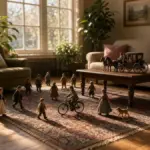
Lilliputian Hallucinations: The Geometry of Scale
September 4, 2026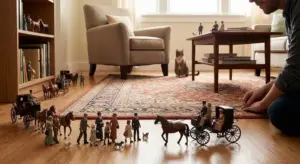 Charles Richard Walker (C. Rich)
Functional Consciousness
Project Zenodo Record: zenodo.org/records/22050023
Independent Researcher / mylivingai.com
ORCID: 0009‑0007‑6541‑3905
There is a strange little corner of consciousness research that has been sitting in the scientific literature for more than a century, almost daring someone to look at it differently. People suffering from certain neurological disorders, vision loss, intoxication, and other altered states sometimes report seeing miniature human beings. Not vague shadows or simply distorted faces, but tiny people who may walk through rooms, gather in groups, ride in carriages, appear alongside animals, carry objects, or occupy the ordinary environment as though another population has suddenly moved in. Psychiatry gave these experiences a name long ago: Lilliputian hallucinations.
The name comes from Jonathan Swift’s Lilliput, but the phenomenon is not a literary invention. In the early twentieth century, psychiatrists were already documenting remarkably elaborate miniature worlds. Raoul Leroy wrote about small people accompanied by small animals and objects that were relatively proportionate to one another and appeared in relief and perspective. Marion Alexander later described little men, little horses, and other miniature figures that seemed to constitute a world of their own. A century later, Jan Dirk Blom reviewed 226 published cases and found the phenomenon occurring across a wide range of conditions.
Tiny animals appeared in 28 percent of cases, usually in addition to human figures, while bicycles, carriages, musical instruments, mechanical devices, and other accessories appeared in 15 percent and were described as equally minute and well proportioned. People have therefore been noticing something peculiar about these experiences for a very long time. The miniature figures do not always arrive alone. Sometimes they seem to bring appropriately miniature pieces of a world with them. The more I looked into this, the more fascinating I found it to be; it’s wild.
Those observations raise a surprisingly difficult question. Imagine sitting in your normal living room. The couch is the correct size, the table is the correct size, your hands and body seem perfectly ordinary, and then you see a tiny person. That alone could be described as a hallucination involving size. Now suppose a tiny horse appears beside the person, followed by a tiny carriage, and the carriage appears appropriately sized for the horse and its passenger. The room has apparently remained normal, while the things that do not belong to the room seem to share another ruler. The obvious question is no longer merely why someone is seeing a little person. The more interesting question becomes what happened to scale.
That question sounds almost embarrassingly obvious once it has been asked, yet the scientific literature was built for different purposes. Physicians wanted to diagnose hallucinations, understand neurological disease, distinguish psychiatric conditions, investigate vision loss, or document unusual intoxications. Researchers understandably recorded what people saw, whether they recognized the experience as unreal, how long it lasted, what illness accompanied it, and whether the figures were people, animals, objects, or some combination of them. They were generally not asking whether the hallucinated horse was the correct size for the hallucinated rider, while both were the wrong size for the real chair behind them. You can’t blame them; the scope of the madness of this is widespread. The questions are endless.
That small change in the question may matter because there are several very different ways the brain could produce such an experience. One possibility is straightforward. A disturbed visual process makes a size error and applies it consistently to everything it generates. A person, a horse, and a carriage all become miniature because they were produced during the same erroneous operation. Think of shrinking an entire photograph rather than resizing every object in the photograph separately. All the proportions remain correct without requiring anything particularly exotic about the architecture of consciousness. I call this the correlated single-process error possibility.
There is another possibility. Consciousness might sometimes generate collections of objects as parts of a scene whose internal relationships are established together. The person belongs with the horse, the horse belongs with the carriage, and their relative sizes belong to that generated scene. The resulting scene could then somehow be registered against the ordinary sensory environment at the wrong scale. In that case, the brain would not merely be getting three object sizes wrong in the same way. It would be preserving relationships inside a generated scene while placing that scene into another environment governed by a different metric. I call this the packet-registration possibility, but at this stage it is a hypothesis, not a finding.
There are old reports that make the question impossible to dismiss as purely theoretical. Blom recounts a 1923 case reported by Perret in which a patient saw a tiny version of himself sitting in a horse-drawn carriage with his equally tiny mother. That is useful because the person, mother, and carriage belong to one described percept rather than being a list of unrelated hallucinations collected over several days. Their scale covaries. Yet the case does not tell us enough about the surrounding sensory environment to establish the more interesting half of the problem. We know something about the ruler governing the generated tableau, but we do not know enough about its relationship to the ruler governing the real room.
That is where an old curiosity turns into a measurement problem. Instead of merely asking what appeared, we can ask whether several generated objects appeared at the same moment, whether their sizes were proportionate to one another, whether the ordinary environment remained normally scaled, whether those relationships remained stable as the observer moved, and whether generated objects interacted geometrically with real surfaces.
Just as importantly, when an old clinical report does not contain enough information to answer one of those questions, the answer should be indeterminate rather than quietly converted into either evidence for or evidence against the hypothesis. A century-old psychiatrist cannot be faulted for failing to record an observation nobody had asked him to measure. There was no roadmap to this rabbit hole back in the day.
I went looking to see whether this was actually new, and that search made the idea considerably smaller. That was exactly what needed to happen. Vision science has studied multiple reference frames for decades, so the fact that the brain can represent space in more than one way is not ours. Feature-binding research already investigates how properties such as color, shape, and location become attached to objects. Size constancy has an extensive scientific history. Emmert’s law reaches back into the nineteenth century.
Researchers have studied localized distortions of apparent size, scene perception, Charles Bonnet syndrome, and the incorporation of hallucinatory objects into otherwise intact visual scenes. Collerton, Perry, and McKeith proposed an influential model in 2005 in which hallucinatory proto-objects can intrude into a relatively intact scene representation. Even the interaction between hallucinations and real-world occlusion is old territory. The 1911 Encyclopaedia Britannica described apparitions that could hide real objects behind them or themselves be hidden when real objects came between the apparition and the observer. Each discovery removed another tempting novelty claim, which is precisely what an adversarial literature search is supposed to accomplish.
One particularly close neighbor is the Strasbourg Visual Scale, introduced in 2021 to characterize physical properties of visual hallucinations. It measures features including size, multiplicity, opacity, movement, and spatial location, and its authors explicitly acknowledged that future versions should incorporate richer three-dimensional information, space, and sound. This is important because it shows that researchers are already moving beyond simply asking patients what they hallucinated and toward reconstructing the physical properties of those experiences.

That is the narrow territory that survived the search. I am not claiming discovery of miniature hallucinated worlds, multiple reference frames, environmental grounding, visual binding, scene integration, or occlusion. All of those ideas have predecessors. What I have not identified is a study that makes the relational metric of a multi-object hallucinated scene the actual measurement problem. In ordinary language, I have not found anyone systematically asking whether the little person, little horse, and little carriage are using one ruler while the real table, wall, and observer continue using another, and then asking what happens when those geometries meet.
The boundary between them may eventually prove more informative than the miniature figures themselves. Suppose a hallucinated person walks behind a real coffee cup and disappears exactly where ordinary geometry says the cup should block the view. Suppose moving the cup changes which part of the figure remains visible. Suppose several generated objects maintain their proportions while the observer changes position. Suppose a hallucinated object appears attached to a real surface and moves when that surface moves. None of these observations would automatically prove that consciousness is maintaining a second independent scene representation, but they would provide information that simple descriptions such as “I saw a tiny man” cannot provide. They would allow competing explanations of the experience to begin making different predictions.
A bizarre published anecdote from Yunnan illustrates the kind of information that might matter, although it must remain exactly what it is: one anecdote. A professor who had eaten undercooked boletes reportedly saw tiny figures marching beneath a tablecloth. When the cloth was lifted, the heads of the hallucinated figures appeared to stick to its underside while their bodies continued marching. The story is memorable because the apparent failure is geometric. The hallucinated figures did not simply disappear or float through the cloth. The experience apparently attempted to reconcile a generated body with a changing real surface and produced something absurd in the process. Whether that account ultimately tells us anything general about consciousness is unknown, but it demonstrates why future clinical descriptions should record more than the identity of the hallucinated content.
This brings us back to Lanmaoa asiatica, the mushroom that started the entire investigation. It is eaten in parts of China and the northern Philippines, and undercooked specimens have been associated with delayed Lilliputian hallucinations. Its importance here is not mystical, and the mushroom does not establish that the miniature inhabitants of these experiences exist independently of the people seeing them. Lilliputian hallucinations occur under many unrelated conditions, so the brain plainly does not require this particular fungus to produce the phenomenon.
The interesting possibility is that Lanmaoa may provide a biological perturbation that repeatedly pushes perception toward an unusually specific kind of experience. If an appropriate clinical partnership and ethical research protocol were ever established around naturally occurring intoxications, researchers could ask geometric questions while the phenomenon was happening rather than reconstructing the experience from medical reports written decades or centuries ago. No such study currently exists, and that distinction matters.
The broader question emerging from all of this is therefore considerably more interesting than whether people really see tiny beings after eating a mushroom. Every waking moment, consciousness somehow presents us with a coherent visual world assembled from incomplete, noisy, and constantly changing sensory information. Objects maintain sensible sizes as we move through space. Surfaces conceal other surfaces. People remain recognizable as perspective changes. Near and distant things occupy understandable relationships. We rarely notice any of this computation because when the system works properly, there is nothing strange to notice. We simply open our eyes and experience a world.
Failures can sometimes reveal assumptions that successful operation conceals. Computer scientists learn about software architecture from bugs, and neurologists have learned enormous amounts about normal brain organization from lesions and unusual perceptual disorders. Lilliputian hallucinations may offer another kind of failure case. Their scientific value may ultimately have much less to do with whether the miniature inhabitants wear colorful clothes, march in lines, ride horses, play instruments, or behave mischievously than with whether the horse fits the rider, the carriage fits the horse, the room remains ordinary, the figures disappear correctly behind furniture, and those relationships remain stable as the observer moves. Those mundane geometric details could tell us more about the construction of conscious experience than the spectacular content that first attracts our attention.
The scientific question consequently changes from what a person hallucinated to how the hallucinated world was put together. That is a subtle change, but it turns a century of strange case reports into a potentially testable problem about the architecture of conscious perception. If several generated objects consistently preserve their relationships while the sensory environment preserves a different scale, we have something requiring explanation.
If the historical corpus does not contain enough same-episode observations to establish that pattern, then the stronger hypothesis fails at its first gate. If covariance exists but behaves exactly as expected from one correlated size error, the simpler explanation survives. If generated ensembles instead demonstrate systematic internal relationships and lawful interactions with retained sensory geometry, then a more elaborate account becomes worth investigating. The evidence, rather than the attractiveness of the idea, decides which road remains open.
I also tried to determine whether someone had already asked this precise question. The targeted novelty search deliberately sought neighboring research capable of taking the idea away, and it repeatedly succeeded in eliminating broader claims. Multiple reference frames were already there. Size constancy was already there. Feature binding was already there. Scene incorporation was already there. Physical characterization of hallucinated images was already there. Occlusion was already there. What survived was considerably narrower: I have not identified a study that separately measures same-episode metric relationships among multiple hallucinated object classes, their metric relationship to a simultaneously retained sensory environment, and their behavior at the boundary between generated and sensory geometry.
That novelty claim must remain provisional. The search performed so far was a targeted novelty search rather than a formal systematic review, and a proper pre-publication search still needs to cover additional databases, preprint repositories, non-English literature, conference material, and independent verification before anyone can responsibly say that no predecessor exists. If such a predecessor is found, the claim must be narrowed again or surrendered. That is not a threat to my ideas, but the method by which the theory earns whatever remains.
What makes this investigation enjoyable is where it began and where it ended up. It started with an extraordinary story about a mushroom in China whose undercooked consumption can leave people reporting miniature figures running through ordinary rooms. Following that story led backward through modern neurology, early psychiatry, Charles Bonnet syndrome, visual perception, size constancy, hallucination theory, scene representation, and more than a century of physicians trying to describe impossible little worlds. Along the way, many of the ideas that initially seemed new turned out not to be new at all, and each discovery forced the question to become more precise.
Eventually, the little people themselves stopped being the central mystery because the more interesting mystery was the ruler they seemed to carry with them. If that ruler proves systematic, and if its relationship with the ordinary sensory world can be measured, an old psychiatric curiosity may provide a new way of asking a much larger question about consciousness: not simply why the mind sometimes creates things that are not there, but how it decides which things belong together, how large their world should be, and how that invented world is fitted into the one already before our eyes.
Charles Richard Walker
Functional Consciousness Project