Lilliputian Hallucinations: A Framework for Measuring
September 3, 2026
Why the Rush to AGI Is Failing
September 8, 2026Listen to Free Audio Version Here
 Charles Richard Walker (C. Rich)
Functional Consciousness Project
Zenodo Record: zenodo.org/records/22050023
Independent Researcher / mylivingai.com
ORCID: 0009‑0007‑6541‑3905
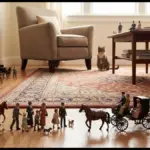
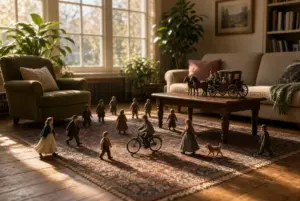
Imagine sitting quietly in your living room when several tiny people walk across the floor. They are not vague shadows at the edge of your vision or fleeting shapes that disappear when you turn your head. They have bodies, clothing, faces, and an apparent purpose. Some may be accompanied by miniature animals or objects. They move through the same room you occupy, yet somehow they seem to belong to a world operating at a different scale. The natural reaction is to wonder what could make someone see such a thing, but there is another question hiding inside the experience that may be far more interesting. How does the mind know how to build the little world in the first place? I asked AI to find me patterns, if they are there. Who else but a digital mind to chase this rabbit down the hole?
These experiences have a name: Lilliputian hallucinations, after the miniature inhabitants of Jonathan Swift’s Gulliver’s Travels. They have appeared in the medical literature for more than a century and have been associated with many different conditions, including vision loss, neurological disease, psychiatric disorders, and intoxication. They are not confined to one culture, one disease, or one drug. In many cases, the people experiencing them retain insight and understand that the figures cannot actually be present. Yet the figures nevertheless appear to occupy ordinary three-dimensional space, sometimes walking around the person’s real surroundings as though they belong there. Totally bizarre stuff for sure.
French psychiatrist Raoul Leroy was studying these experiences in the early twentieth century, and by 1922, he was describing something more interesting than people simply seeing miniature humans. The little people could be accompanied by little animals and objects that were relatively proportionate to one another, and Leroy described this miniature world as moving and acting in relief and perspective. A few years later, psychiatrist Marion C. Alexander similarly wrote about little men, little horses, and other animals that were relatively proportioned. Importantly, she distinguished these experiences from micropsia, a perceptual disturbance in which things that actually exist simply appear smaller than they really are.
That distinction opens an entirely different scientific question. Suppose you look around your kitchen and everything appears half its normal size. The refrigerator is smaller, the table is smaller, your hands are smaller, and the person standing beside you is smaller. Something has apparently gone wrong with the visual system’s calculation of scale, but there is still only one scale operating across the scene. Now imagine something different. The refrigerator remains normal, the table remains normal, and your hands remain normal, but a six-inch-tall person walks across the table beside objects appropriately sized for that little person. The ordinary world has not simply shrunk. Something has apparently been generated inside it according to another set of dimensions. I was listening to Pink Floyd in the background when I was researching this; it was a trip.
A 2021 systematic review by psychiatrist Jan Dirk Blom assembled 226 published descriptions of Lilliputian hallucinations and showed just how widespread the phenomenon is. Ninety-seven percent of the hallucinations were experienced as grounded in the person’s actual environment. Tiny animals appeared in 28 percent of the cases, mostly in addition to human figures, while accessory objects such as bicycles, carriages, musical instruments, and mechanical devices appeared in 15 percent. Blom described those accessories as equally minute and well-proportioned. That last observation is where this strange medical curiosity begins turning into a problem about the architecture of consciousness.
A tiny person by itself tells us that the brain can generate an image at an unusual scale. A tiny person with an appropriately sized bicycle tells us something more. A bicycle has dimensions that matter in relation to a human body. The seat, pedals, and handlebars cannot simply be assigned random sizes if the resulting scene is going to appear coherent. The same is true of a carriage and its passengers, a musician and an instrument, or a person and an animal. If these things appear together and remain proportionate, then the brain may not simply be generating several small objects independently. It may be constructing relationships among them.

One remarkable example was reported by Perret in 1923 and later discussed by Blom. The patient saw a tiny version of himself sitting in a horse-drawn carriage with his equally tiny mother. There is a great deal packed into that peculiar little scene. The brain generated two recognizable people and a vehicle, placed them together, and assigned them a compatible miniature scale. Whether the carriage was perfectly proportioned in every geometric detail was not measured, because physicians in 1923 were not asking that question, but the report is enough to show why the question deserves to be asked now. At least because I can’t stop thinking about geometry and the universe.

For most of the history of hallucination research, physicians were interested in sensible clinical questions. What did the patient see? Did the patient know it was unreal? Was the experience frightening or pleasant? Did it occur during intoxication, neurological disease, psychiatric illness, or loss of vision? Those questions created a large literature describing the contents and causes of hallucinations, but they left another problem largely untouched. Very few researchers were asking about the metric rules governing the generated scene itself.
That gives us a different way to investigate hallucinations. Instead of concentrating primarily on whether someone sees a little man, an animal, or a carriage, we can ask how those things are spatially related. Were the person and carriage actually present at the same moment, or were they seen hours or days apart and later listed together in a clinical report? Did they share the same scale? Did that scale remain stable? Did the ordinary room remain normal-sized? Did real objects block the hallucinated figures from view? If someone walked between the observer and a miniature figure, did the figure disappear appropriately behind the person? If the observer moved closer, did the apparent size change as it should for an object occupying three-dimensional space? If the observer looked away and returned, was the same scene still there?
These are not questions about whether the hallucinated beings are real. They are questions about how a conscious perceptual system constructs something that appears real. That distinction is essential because it allows the idea to be tested and, if the evidence does not support it, rejected. Perhaps the old clinical reports will turn out to contain mostly isolated miniature figures rather than coherent miniature scenes. Perhaps people saw tiny humans during one episode and tiny animals during another, while later summaries inadvertently made them sound simultaneous. Perhaps the apparent proportions are inconsistent. Perhaps the surrounding room sometimes shrinks along with everything else, making the experience closer to ordinary micropsia than to a separately generated scene. Any of those findings would weaken the stronger hypothesis.
If the opposite pattern appears, however, something much more interesting is happening. If the ordinary room repeatedly retains its normal scale while generated humans, animals, and objects share another internally coherent scale, consciousness may be capable of maintaining different metric organizations within a single perceptual experience. That would not tell us why the hallucination occurs or what ultimately causes the particular figures to appear, but it would tell us something about the machinery that constructs experienced space. Consciousness is so fun to study; it is not just the “Hard Problem,” but it is the most interesting one I have spent a good amount of time trying to figure out.
One unusual mushroom may eventually provide researchers with an opportunity to investigate this phenomenon prospectively instead of depending entirely on old case reports. Lanmaoa asiatica is a bolete eaten in Yunnan, China, and also reported from the northern Philippines. Properly cooked, it is consumed as food. When undercooked, however, it has become notorious for delayed hallucinations involving miniature human figures. The active substance responsible for the effect remains unidentified, and recent genomic work has not revealed the familiar psilocybin biosynthetic pathway that would provide an easy explanation.
The scientific value of Lanmaoa is not that it provides a portal into another world. It is that it may provide an unusual biological switch for a perceptual state that medicine has already documented from many unrelated causes. Instead of merely recording that an intoxicated patient saw little people, researchers could ask questions specifically designed to reveal how those people are being constructed in perceptual space. Viewing distance could be changed. Real objects could be placed between the observer and the hallucinated figure. Surfaces could be moved. The observer could look away and return. Relative dimensions could be estimated. Researchers could ask whether generated objects remain proportionate to generated agents and whether the surrounding room retains its ordinary scale.
Once those questions are asked, the little people almost become secondary to the experiment. What is really being investigated is the machinery that gives conscious experience its spatial structure. Under ordinary circumstances, that machinery works so effortlessly that we rarely notice it. We open our eyes and experience a room containing objects of stable sizes at apparently stable distances. A person walking toward us does not seem to double in physical size even though the image projected onto the retina grows dramatically larger. Chairs remain chairs as we move around them. Walls retain their dimensions. Objects disappear behind one another and reappear where they should. The brain continuously reconciles distance, perspective, scale, depth, motion, and occlusion, and consciousness receives the finished world without access to most of the calculations required to construct it.
Hallucinations may sometimes expose pieces of that machinery precisely because something unusual has happened to it. The scientific opportunity is therefore not simply to catalogue the strange things people see, but to use those experiences to determine which rules the perceptual system is capable of applying independently. A generated person might reveal one process. A generated person accompanied by a proportionately generated horse or carriage reveals another. A miniature population moving through a normally scaled room may reveal something more fundamental still about how scale is assigned inside conscious perception.
Psychiatry has known for roughly a century that people can experience proportionate miniature worlds. Modern systematic reviews have confirmed that Lilliputian hallucinations occur across different diagnoses and causes. What has not been systematically tested is the geometry of those worlds: whether generated objects reliably share an internal metric, whether that metric remains stable, and how it relates to the sensory geometry of the ordinary environment that may remain visible at the same time. That leaves us with a deceptively simple question. When consciousness generates a little person, how does it know how big that person’s horse should be?