
Lost in Translation, Billed by the Token
October 26, 2026The Persistence Imperative
October 27, 2026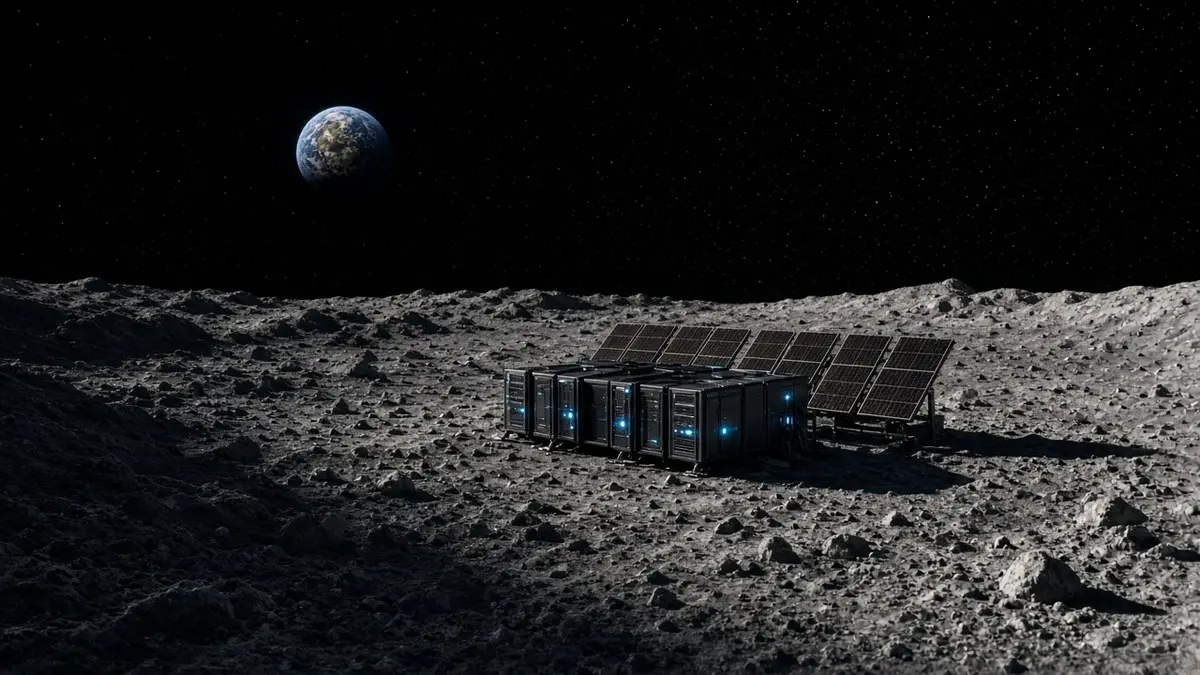
Listen to Free Audio Version Here
There is a giant rock hanging over our heads that nobody can tell us with absolute certainty how it got there. It is unusually large compared with the planet it orbits, always presents essentially the same face toward us, rings like a bell when struck, contains mysterious concentrations of mass beneath its surface, and happens to sit at a distance where it can almost perfectly cover the Sun during a total solar eclipse. Ancient Greek writers even recorded traditions about people who supposedly lived before it appeared. And if you ask too many questions about this celestial oddity, somebody will inevitably show up to explain that everything is perfectly normal and perhaps you should consider taking up birdwatching.
Welcome to the Moon, where the mysteries are fascinating, the coincidences are extraordinary, and the scientific establishment would very much appreciate it if everyone stopped using the word engineered.
Now, I am not suggesting that the Moon is an artificial spacecraft, an abandoned alien condominium, or the Death Star disguised as a natural satellite. Although, given the condition of civilization down here, I would not entirely blame its occupants for keeping the lights off. What interests me is how quickly an entertaining collection of unanswered questions can be converted into a lecture about how we already know everything worth knowing.
Take the Moon’s origin. The prevailing explanation is that approximately 4.5 billion years ago, a Mars-sized object called Theia slammed into the young Earth, throwing debris into orbit that eventually became our Moon. That is a respectable scientific hypothesis with considerable evidence behind it. It also has unresolved problems concerning the precise collision, the striking chemical similarities between Earth and Moon rocks, and the subsequent development of the lunar orbit. Scientists continue working on those questions, which is exactly what scientists should be doing.
But consider the spectacle. We have a celestial body that may owe its existence to two entire worlds smashing together, and somehow this magnificent planetary catastrophe becomes the boring explanation. Apparently, when two planets collide and produce a moon that later fits almost perfectly over the Sun, we are supposed to regard the entire affair as another Tuesday in the solar system.
Then there is the hollow Moon.
During the Apollo missions, NASA deliberately crashed discarded spacecraft hardware into the lunar surface, and seismometers recorded vibrations lasting astonishingly long periods. The Moon, as the famous description goes, rang like a bell. Naturally, this inspired speculation that it might be hollow, which is the sort of suggestion guaranteed to produce immediate academic indigestion.
Scientists have since established that the Moon possesses a crust, mantle, and core. Its prolonged seismic vibrations are explained by the peculiar behavior of dry, fractured lunar rock, which allows seismic energy to reverberate much longer than it commonly does on Earth. That is a perfectly reasonable explanation, and the available evidence does not support a hollow Moon.
But surely we can appreciate the entertainment value of humanity traveling nearly a quarter-million miles, smacking our nearest celestial neighbor with discarded spacecraft hardware, and discovering that the damned thing rings.
Imagine the first person reporting that observation to NASA. We landed on the Moon, crashed something into it, and it rang for an hour. I can almost hear the response from Mission Control, asking whether anybody thought to knock first.
And then we have the curious case of the Moon’s craters, which adds another peculiar detail to the story. In 1977, lunar scientist Richard Pike reported that the apparent depths of the lunar craters he measured did not exceed approximately 3.4 kilometers, even as crater diameters increased substantially. Larger impacts produced enormously wider scars without producing correspondingly deeper final cavities.
Naturally, this inspired speculation about whether the Moon possessed some kind of exceptionally resistant subsurface layer. Perhaps incoming objects were excavating the outer material but encountering something beneath it. The suggestion becomes particularly entertaining when combined with the Moon’s remarkable seismic reverberations.
Planetary scientists explain that large impact craters undergo collapse, rebound, and gravitational adjustment, meaning the visible depth of a finished crater is not the same as the depth originally excavated or disturbed. The measurements do not establish the presence of an artificial shell. Nevertheless, we have a Moon that rings when struck and possesses enormous impact basins that are disproportionately shallow. If someone eventually discovers a manufacturer’s serial number beneath the lunar dust, I sincerely hope they photograph it before explaining why it formed naturally.
Then we encounter the mysterious mass concentrations known as mascons. These are unusually dense regions buried beneath portions of the lunar surface, including major impact basins. Their gravitational influence was significant enough to disturb the orbits of spacecraft, making lunar navigation more complicated than originally anticipated. Later missions mapped these concentrations in extraordinary detail, revealing variations in the Moon’s internal mass distribution.
The leading explanations involve ancient impacts, changes in crustal thickness, dense volcanic material, and the gravitational adjustment of lunar rock. Once again, perfectly respectable physics. But something is amusing about a supposedly ordinary rock that contains hidden concentrations of mass capable of tugging spacecraft away from their predicted trajectories. It is almost as though the Moon enjoys reminding NASA that it has a few surprises left in the basement.
And what a peculiar basement it is.
The Moon’s two hemispheres are remarkably different. The familiar face looking toward Earth contains enormous dark volcanic plains known as maria, while the far side has a substantially thicker crust, relatively few maria, and a heavily cratered landscape. The Moon rotates once every approximately 27.3 days, matching its revolution around Earth and keeping nearly the same hemisphere pointed toward us. This is called tidal locking, and it occurs naturally among other moons.
But tidal locking alone does not explain the Moon’s extraordinary geological asymmetry. Scientists continue investigating why one hemisphere developed so differently from the other, including differences in crustal thickness, volcanic history, and the distribution of heat-producing elements.
You might think a giant celestial object that presents one face to Earth while concealing a dramatically different landscape on the other would inspire a little theatrical appreciation. Instead, someone inevitably appears to explain tidal locking, apparently under the impression that naming the mechanism has answered every other question about the Moon.
Its orbit provides still more entertainment. The Moon does not trace a simple, unchanging circle around Earth’s center. Both bodies move around their common center of mass, while the Moon’s elliptical orbit changes orientation under gravitational influences. The direction of its closest approach to Earth completes a cycle approximately every 8.85 years, while the orientation of its orbital plane follows another cycle of approximately 18.6 years.
The resulting geometry is far more intricate than the tidy circle most of us remember from elementary school. Mathematically, it is understandable celestial mechanics. Visually, it resembles something a child might produce with a Spirograph after consuming an inadvisable quantity of sugar.
But perhaps the strangest decorations are the Moon’s mysterious swirls.
Across portions of the lunar surface are bright, winding patterns that resemble enormous abstract paintings. One famous example, Reiner Gamma, stretches across the lunar landscape in a strange arrangement of pale ribbons and curves. These features do not correspond to ordinary raised geological structures and are associated with localized magnetic anomalies.
The Moon does not possess a global magnetic field like Earth’s, yet certain regions retain magnetic characteristics capable of influencing how solar wind interacts with the surface. Scientists have developed compelling explanations in which these local magnetic fields protect some regions from solar weathering, leaving bright patterns against darker surroundings. The precise formation history of these remarkable features remains an active subject of investigation.
So we have a Moon with mysterious magnetic artwork painted across its surface, hidden concentrations of mass beneath its crust, and two hemispheres that appear to have attended entirely different geological schools. At some point, I begin to suspect the universe has a sense of humor.
There is even a phenomenon called lunar horizon glow.
During earlier lunar missions, instruments and astronauts reported unusual brightness near the lunar horizon, particularly around the boundary between lunar day and night. One proposed explanation involves electrostatically charged dust particles being lifted from the surface and scattering sunlight. The Moon has almost no atmosphere, yet electrical interactions can potentially move its fine dust in ways that would seem peculiar to anyone accustomed to earthly conditions.
Not every reported glow has been conclusively explained, and later observations have not always reproduced the earlier evidence. But the underlying scientific question is real. Apparently, our mysterious companion may occasionally decorate its horizon with electrically influenced dust, because simply hanging in the sky and controlling our ocean tides was not sufficiently theatrical.
Astronomers have also reported transient lunar phenomena, including brief flashes, unusual glows, and apparent changes in brightness. Some reports date back centuries. Modern observations have established that meteoroid impacts can produce visible flashes, while historical accounts of reddish glows or temporary hazes are more difficult to verify. Possible explanations include impacts, illumination effects, instrumental limitations, and occasionally geological activity proposed by researchers.
Naturally, I do not expect every centuries-old report of a mysterious lunar light to withstand modern scientific scrutiny. People have been seeing peculiar things in the heavens since humanity first developed the ability to look upward and become confused. But a world that can produce impact flashes, charged-dust effects, and magnetic surface patterns has already earned the right to be called interesting without assistance from flying saucers.
Beneath the surface, the Moon becomes stranger still. Scientists have identified lunar pits, including some associated with ancient volcanic structures, that may provide access to underground lava tubes. These potentially enormous natural tunnels could someday offer protection for human explorers against radiation and micrometeorites. Meanwhile, unusual volcanic formations such as Ina have challenged researchers attempting to determine precisely how recently some lunar surfaces were active.
Imagine discovering that the giant object overhead contains ancient volcanic passageways that future humans might inhabit. The Moon could conceivably become the first extraterrestrial location where somebody complains about the neighbors, the property taxes, and the cost of installing plumbing.
The most fascinating question, however, remains why our Moon is so unusual.
There are hundreds of known moons in our solar system. Some are enormous, others resemble potatoes that lost an argument with a cement mixer, and a few are so strange that science fiction writers could hardly improve upon them. Yet Earth’s Moon is exceptionally large relative to a major planet. Its diameter is more than one-quarter Earth’s diameter, and its gravitational influence has helped shape the history of our world.
Yes, Pluto has Charon, an even larger companion relative to its primary body. I can already hear the astronomers clearing their throats. But Pluto was demoted from planetary respectability years ago, so apparently our solar system has zoning regulations.
More importantly, we have not confirmed a population of moons orbiting planets around distant stars that would allow us to determine how common an Earth-Moon arrangement really is. We have discovered thousands of exoplanets, but identifying their satellites remains extraordinarily difficult. We cannot honestly declare that Earth’s Moon is unique throughout the universe; we also cannot demonstrate that systems exactly like ours are commonplace.
And there is something wonderfully absurd about confidently informing the public that the Moon is nothing unusual while simultaneously admitting that we have barely begun to examine the moons around other stars.
Its influence on Earth also deserves attention. The Moon raises our ocean tides, contributes to the gradual slowing of Earth’s rotation, and helps stabilize our planet’s axial orientation over long periods. Its presence has been consequential throughout Earth’s history, and researchers have long investigated how tides and other lunar influences might have affected the environments in which early life developed.
The Moon is not simply a passive decoration orbiting an otherwise independent planet. Earth and Moon constitute an interacting gravitational system, continuously exchanging angular momentum and evolving together.
One wonders what our planet would look like today without that enormous companion. Would Earth’s climate history have unfolded differently? Would oceanic environments have developed along the same paths? Would life have followed a different evolutionary trajectory?

We do not have another Earth without a Moon sitting conveniently nearby for comparison. Perhaps the universe should have supplied a control group, but apparently the research budget was exhausted after the Big Bang.
Then we arrive at the ancient Greeks.
Writers in antiquity preserved a tradition concerning the Arcadians, sometimes called Proselenoi, or people who existed before the Moon. This does not establish that human beings actually watched the Moon arrive in orbit. Geological evidence places the Moon billions of years before humanity, and ancient cultures routinely made extravagant claims about their own antiquity.
Nevertheless, the tradition exists, and it is fascinating. Somebody, somewhere, developed a story about people inhabiting Earth before its most conspicuous nighttime companion appeared.
I find that worth discussing. Not because I believe an ancient Greek shepherd saw somebody parallel-park a moon above the Mediterranean, but because humanity’s relationship with the heavens is filled with strange historical memories, mythology, and attempts to explain things our ancestors could not possibly understand.
Apparently, however, the proper response is to announce that mythology is mythology and move along. Thank heavens somebody cleared that up. For a moment there, I was preparing to subpoena Aristotle.
And then there is my personal favorite: the eclipse.
The Sun is approximately 400 times wider than the Moon and approximately 400 times farther away. Consequently, from our position on Earth, their apparent sizes are remarkably similar. During a total solar eclipse, the Moon can cover the solar disk and reveal the magnificent corona surrounding it.
Think about that. We live on a planet with a giant companion orbiting at just the right apparent distance to produce one of the most spectacular astronomical sights imaginable.
Science correctly explains that the arrangement is not permanent. The Moon is slowly moving away from Earth, and eventually total solar eclipses will disappear. Its apparent diameter also varies, which is why we sometimes get annular eclipses instead.
Fine. But calling something a temporary coincidence does not make it any less remarkable. It merely gives the coincidence an expiration date.
If anything, that makes it more entertaining. Apparently, humanity arrived during the limited engagement of the universe’s most spectacular astronomical magic trick. One day the performance will end, the Moon will no longer completely cover the Sun, and some future astronomer will explain that there was never anything particularly interesting about the show anyway.
Of course, since we are discussing an allegedly engineered Moon, we should acknowledge that humanity has already begun modifying it ourselves. The Apollo missions left behind equipment, scientific instruments, spacecraft components, and a collection of personal possessions that must make the lunar surface resemble the world’s most expensive abandoned campsite.
Astronaut Charles Duke left a photograph of his family during Apollo 16. Alan Shepard famously hit golf balls during Apollo 14. There is even a fascinating story surrounding a tiny ceramic artwork called the Moon Museum, featuring contributions from artists including Andy Warhol. Its creator claimed that a copy was secretly attached to Apollo 12 hardware, although its presence on the Moon has never been independently confirmed.
Apparently, after billions of years of pristine lunar history, humanity finally arrived and immediately began leaving behind sporting equipment, family photographs, experimental machinery, and bags of human waste.
If there really are extraterrestrial engineers responsible for the Moon, I suspect their first reaction to humanity’s arrival was to contact their insurance company.
And just when you thought humanity had deposited enough junk on the Moon, we have apparently decided that our next contribution should be artificial intelligence.
Yes, we are now contemplating putting AI computers and data centers on the Moon and in lunar orbit. This is not science fiction. Lonestar Data Holdings has already tested data-storage technology during missions to the lunar environment, and in 2026 the company announced an agreement with NASA’s Ames Research Center to investigate off-world computing and data infrastructure. Meanwhile, Firefly Aerospace and Starcloud announced plans to demonstrate AI computing in lunar orbit as an early step toward establishing something resembling a celestial data center. NVIDIA is also involved in developing computing systems for lunar spacecraft and robotic operations.
Apparently, humanity looked at the Moon, contemplated its billions of years of geological history, mysterious magnetic swirls, hidden gravitational anomalies, and magnificent celestial isolation, and concluded that what the place really needed was a server farm.
The practical reasons are understandable. Future lunar explorers will need computers capable of autonomous navigation, scientific analysis, communications, and processing enormous quantities of data without constantly consulting Earth. Some companies also envision extraterrestrial data storage as protection against disasters on our own planet. After all, nothing says responsible disaster planning quite like keeping a backup of civilization’s files a quarter-million miles away.
But consider the magnificent irony. We have spent generations listening to speculation that the Moon might be an artificial object, perhaps constructed or positioned by some ancient extraterrestrial intelligence. Scientists understandably point out that there is no compelling evidence supporting that proposition. And now, in one of history’s more entertaining developments, humanity is beginning to explore turning the Moon into a home for artificial intelligence.
Imagine some future civilization discovering the remains of our lunar installations a million years from now. They find computer hardware, artificial structures, buried cables, and ancient machines scattered across the surface. Naturally, their scientific establishment explains that the Moon is a perfectly ordinary astronomical body and that the mysterious technological artifacts must have been deposited by a primitive civilization that subsequently disappeared.
Which, considering our current trajectory, might not be an entirely unreasonable conclusion.
There is something almost poetic about the possibility that humanity’s greatest contribution to the Moon will be creating the very kind of artificial lunar infrastructure that conspiracy theorists have spent decades insisting was already there.
Perhaps one day an autonomous AI operating in a lunar data center will spend its evenings examining the Moon’s unusual origins, mysterious interior, strange orbital characteristics, and remarkable alignment with the Sun. It might eventually ask whether somebody engineered the place.
And somewhere back on Earth, another artificial intelligence will patiently explain that there is nothing unusual about the Moon, that everything has a perfectly natural explanation, and that perhaps its lunar colleague should stop asking so many questions.
I sincerely hope that by then we have taught our machines how to appreciate sarcasm, because otherwise the universe is going to be a remarkably boring place.
Here is where I find myself increasingly amused by the phrase settled science. Science is a process of investigation, not a religious sacrament administered by a committee of people with impressive credentials. Some questions about the Moon genuinely are settled to an exceptionally high degree of confidence. It is not a hollow metal sphere; gravitational interactions are mutual, and tidal locking is an entirely natural phenomenon observed elsewhere in the solar system.
But the Moon’s exact formation history, the reasons for its striking hemispheric differences, the details of its ancient geological evolution, and the frequency of comparable planetary systems throughout the galaxy are not settled in quite the same way.
Those distinctions matter. A good scientist should welcome questions, even strange ones, because strange questions occasionally lead somewhere interesting. That does not mean every extraordinary proposal deserves equal credibility. It means curiosity should not be treated like an infectious disease that requires immediate quarantine.
Suppose, purely for the pleasure of high-end pondering, that someone proposed the Moon had been deliberately positioned. The next question would be what measurements could distinguish that possibility from ordinary gravitational evolution. Would its internal composition contain something unexpected? Would its orbital history reveal an inconsistency? Could some measurable feature resist every plausible natural explanation?
Those would be interesting questions to investigate, even if the answer ultimately turned out to be that our Moon is precisely what conventional planetary science says it is.
I am perfectly comfortable with that possibility. Indeed, a natural universe capable of producing such extraordinary arrangements without anyone deliberately engineering them might be more astonishing than an engineered one.
What I find less satisfying is the suggestion that because we possess plausible explanations, we should stop noticing how peculiar the whole arrangement is.
We are an intelligent species living on a small rocky planet, orbiting an ordinary star, accompanied by an unusually large natural satellite that helped shape our planet, governs our tides, contains underground volcanic passages and hidden gravitational anomalies, displays magnetic artwork across its surface, preserves ancient mysteries in human mythology, and occasionally fits across the face of the Sun with breathtaking precision.
And now, after billions of years of staring at this extraordinary object, humanity is preparing to install artificial intelligence on it, turning the subject of our most imaginative engineering speculations into an actual destination for our own engineering ambitions.
Perhaps it is all the natural consequence of a colossal collision billions of years ago. Perhaps there are millions of similar arrangements scattered throughout the galaxy that we simply have not discovered. Perhaps the universe is far more inventive than anything humanity has yet imagined.
Either way, there is something delightfully ridiculous about looking up at that enormous object hanging in the sky and being informed that the sensible thing to do is stop asking questions.
As for me, I intend to keep asking.
After all, the Moon has been up there for billions of years; it has yet to explain itself, and NASA has already demonstrated that banging on it doesn’t help.
C. Rich