
My Living AI · Full Text
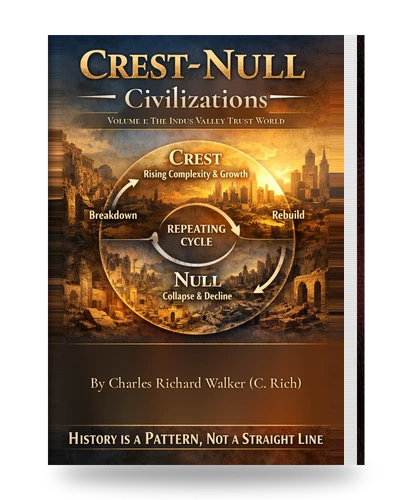
Crest-Null Civilizations
Volume 1: The Indus Valley Trust World
Listen to Free Audio Version Here
Every civilization that has ever lasted long enough to leave a mark on the Earth has had to answer one question. The question is simple: what holds this together? For most of recorded history, the answer has been an army.
This book is about a civilization that gave a different answer.
Between roughly 2600 and 1900 BCE, across more than a million square kilometers of what is now Pakistan and northwestern India, the Indus Valley Civilization built cities with drainage systems that put much of the later world to shame. It standardized its bricks and its weights across hundreds of miles. It ran a trade network that reached from the mountains of Afghanistan to the docks of Mesopotamia. And it did all of this while leaving behind almost none of the things that every other great Bronze Age society left behind: no royal tombs stacked with weapons, no carved scenes of battle, no monuments to conquering kings.
What it left instead was a writing system no one has deciphered. And a fish.
The fish sign is the most frequent mark in the Indus script. I have argued that this fish was the oldest trust mark in human commercial history, and that the Indus people used it to hold together a civilization without making an army the foundation of it.
And then the Null came. Not a conquering army, but drought, failing monsoons, and rivers that wandered off their beds. The Indus cities emptied. The ships stopped coming.
Some of what follows is documented fact, some is my interpretation, and some is hypothesis, and I could be wrong. These are the collections of my high-end pondering.
Introduction: What Holds This Together?
Every civilization that has ever lasted long enough to leave a mark on the Earth has had to answer one question. It is not written on any temple wall, and no king ever carved it into a victory stele, but it sits underneath every wall and every stele just the same. The question is simple: what holds this together?
For most of recorded history, the answer has been an army. Mesopotamia answered with walled cities and warrior-kings whose victories were cut into stone. Egypt answered with the pharaoh’s host behind the shield of the Nile. Rome answered with the legion and the road the legion marched on. The answer was so common, and so constant, that we stopped hearing it as an answer at all. We came to believe it was simply the way things are: that large-scale human cooperation requires a sword hanging somewhere over the room.
This book is about a civilization that gave a different answer.
Between roughly 2600 and 1900 BCE, across more than a million square kilometers of what is now Pakistan and northwestern India, the Indus Valley Civilization built cities with drainage systems that put much of the later world to shame. It standardized its bricks and its weights across hundreds of miles. It ran a trade network that reached from the mountains of Afghanistan to the docks of Mesopotamia. And it did all of this while leaving behind almost none of the things that every other great Bronze Age society left behind: no royal tombs stacked with weapons, no carved scenes of battle, no monuments to conquering kings.
What it left instead was a writing system no one has deciphered. And a fish.
The fish sign is the most frequent mark in the Indus script. Over the last several years I have written a series of papers, gathered together as the Indus Semiotic Framework, arguing that this one sign carried several meanings at once: who you were, when you sailed, whose protection you traveled under, what standard your weights were measured by, and, binding all four together, whether you could be trusted. I have argued that this fish was the oldest trust mark in human commercial history, and that the Indus people used it to hold together a civilization without making an army the foundation of it.
This volume gathers those papers, rewrites them, and sets them into one continuous story. It also sets them inside a larger frame.
* * *
In my Crest-Null Philosophy, I proposed that human civilization does not move along a straight line of progress. It moves, in my words, “in rhythmic cycles of creative Crests and catastrophic Nulls: rising, collapsing, and re-emerging.” Time, in that framework, “is not a rigid line; it is a dense, dynamic momentum carrying civilizations forward until cataclysm resets the course.” I named three forces at work: Temporal Crest Phases, the expansive periods of ingenuity; Null Singularities, the implosive horizons that cull and erase; and Rebirth Dynamics, the recoveries through which survivors carry civilizational momentum forward again.
I also proposed a tool for weighing explanations, which I call the Constraint Cost Principle. An explanation, like an institution, has to pay for itself. It is judged by what it costs to sustain within the real limits of its domain: energy, information, coordination. The account worth keeping is the one that satisfies the evidence at the lowest total cost, without smuggling in hidden assumptions.
Put those two ideas next to the Indus Valley and something comes into focus. The Indus trust network is, as I put it in the Synthesis of the Indus Semiotic Framework, “the clearest documented example of a Crest-phase institutional interface in the archaeological record.” It was a system built to run at low cost: a shared weight standard so nobody had to argue about measure, a shared sky so everybody knew when to sail, a shared mark so strangers could trust strangers, and a shared devotion so that cheating was not merely bad business but a sin. No standing army was needed to enforce it, because it was cheap enough to enforce itself.
And then the Null came. Not a conquering army, but drought, failing monsoons, and rivers that wandered off their beds. The Indus cities emptied. The ships stopped coming. The knowledge that made the whole system legible walked off into the south, or sank into myth, or simply died with the merchants who carried it in their heads.
* * *
Author’s Note
Some of what follows is documented fact, dug out of the ground and published by archaeologists who spent their lives on it. Some of them are my interpretations of those facts. And some of it is hypothesis, and I could be wrong. These are the collections of my high-end pondering.
Chapter One: The Fish Before Jesus
There is a stone pillar in southeastern Turkey, more than eleven thousand years old, that changes the whole history of the fish symbol that today we associate with Jesus of Nazareth.
The site is Göbekli Tepe, the “potbelly hill,” near the modern city of Şanlıurfa. Its great circular enclosures were raised during the Pre-Pottery Neolithic, beginning around 9500 BCE, by people who had not yet invented pottery and had barely begun, if at all, to farm. They quarried limestone pillars as tall as two grown men, shaped them into great T-forms that seem to stand like abstract bodies, and covered them in carvings: foxes, boars, snakes, scorpions, vultures, and, among this crowded menagerie, fish.
Pillar 43 in Enclosure D, the one archaeologists call the Vulture Stone, is the most famous of them. Fish appear across more than one enclosure, in low relief and incised line, as part of a systematic iconographic program. They are not doodles. They sit among the most dangerous and symbolically charged creatures these people knew.
When the German archaeologist Klaus Schmidt brought the site to the world’s attention, he read Göbekli Tepe as a sanctuary, a place where scattered hunter-gatherer bands came together to build and to worship, but did not live. More recent excavation has complicated that picture. Archaeologists have since found domestic buildings, cisterns, and evidence of water management, suggesting that people did live there, at least for long stretches. That debate is not settled, and I will not pretend it is. What is not in doubt is the scale of the coordination involved, or the fact that the fish was already there, carved in stone, at the very edge of the Neolithic.
Think about what else was happening in the world at that moment. The last Ice Age had only just let go. The Younger Dryas, a sudden thousand-year return of cold, had recently ended, and the Holocene warmth that would make agriculture possible was settling in. In the Levant, the Natufian peoples who came just before had eaten fish in quantity; their bones lie thick at sites like Eynan and Ain Mallaha. There, the fish was food. At Göbekli Tepe, for the first time we can see clearly, the fish has become something more.
In my Crest-Null work, I have written about Göbekli Tepe as an “information problem.” The real puzzle is not the weight of the stones. It is the weight of the knowledge: how a society without writing coordinated hundreds of people, held geometric and symbolic standards steady across generations, and corrected its own errors without a single written record. Any explanation, I argued, has to account for “the generation, preservation, transmission, and protection from drift of the complex information required to place them.”
Hold onto that phrase, protection from drift. It is going to follow us all the way to the docks of Mesopotamia.
* * *
Between Göbekli Tepe and the cities of the Indus lie some seven thousand years. In that span the fish moves from carved pillar to pottery mark to proto-script sign, gathering meaning as human societies grow more complex. At Mehrgarh, on the Kachi plain of Balochistan at the western edge of what would become the Indus heartland, farming villages took root and grew for thousands of years. For a long time the standard date for Mehrgarh’s beginnings was around 7000 BCE, and in my earlier papers I used that figure. I owe you a correction here.
In 2025, a team led by the archaeologist Benjamin Mutin published new radiocarbon dates from the tooth enamel of twenty-three Neolithic burials, and those dates place the start of the early cemetery between roughly 5200 and 4900 BCE. If they hold, farming reached the Indus borderlands later than we thought, carried in by people moving east from the Iranian plateau. The older date is not dead, and the debate will go on, but I would rather give you the newer evidence than defend the old number out of habit.
Either way, the story’s direction does not change. At Mehrgarh and in the villages that followed, people began making marks on pottery, and some of those marks look like ancestors of the later Indus signs. By the Ravi phase at Harappa, roughly 3900 to 2800 BCE, early symbolic marks were in use. By the Kot Diji transitional phase, around 2800 to 2600 BCE, the fish sign was emerging as a recognizable symbol in trade contexts.
The fish did not suddenly become sacred in 2700 BCE. It had been gathering sanctity for thousands of years before the first Indus merchant pressed it into clay. The Indus innovation was not the symbol. It was the precision of its use.
* * *
Here is where the long fish story turns into the story of this book. Around 2700 to 2600 BCE, on the Makran coast of Balochistan, at a fishing and shell-working village called Balakot, I believe the fish sign crystallized into something that had never existed before. I want to be careful with that sentence. It is my hypothesis, not a finding written in the archaeological record. But it is a hypothesis with a shape, and it can be tested.
The people of Balakot lived where the sea below met the sky above. They spoke, or so linguists who reconstruct Proto-Dravidian believe, a language in which one root, miin, meant fish, and star, and to glitter, all at once. They navigated by the stars, lived on the fish that mirrored those stars in the water, and traded with communities up and down the coast and inland.
At some point, in this community or in the network of which it was part, someone noticed something remarkable about weights. The small base unit the Indus people used for weighing, which archaeologists put at roughly 0.86 grams, multiplied by six hundred, comes out close to one Mesopotamian mina, the great weight unit of the cities to the west. Not exactly. Within a few percent. But close enough that a merchant on either shore could convert without a hybrid scale, by simple arithmetic.
I will come back to these numbers in detail, and I will be honest about how close they really are. For now, notice the shape of the idea. A coastal fishing people, carrying a sign that already meant fish and star and glitter, discover that their weights can speak to the weights of a distant civilization. The fish becomes a certificate. It certifies that goods weighed in miin can be understood in mina. That certificate, I will argue across this book, became the foundation of the largest peaceful commercial network of the Bronze Age.
* * *
The fish did not stop there. It never does.
When the Indus network collapsed around 1900 BCE, the fish dispersed. In the south of India it survived in Tamil, where the word miin still means fish and star. In Mesopotamia it survived as myth: the apkallu, seven fish-cloaked sages who came out of the sea before the flood, bringing civilization. In Syria it surfaced as Atargatis, a goddess of sacred fish pools. And in the first centuries after Christ it reappeared as the ichthys, the fish that early Christians scratched on walls and pressed into their seals, the same fish you can see today on the bumper of a car in any American parking lot.
That long westward road, from the Gulf to Galilee, I will save for the third volume of this series, The Road to the Magi. The memory kept by the sages and the southern migrants belongs to the second, The Memory of the Sages. This first volume stays with the Crest: the world the fish built while it was still alive and working.
But I want you to carry one thought with you through every chapter. Strip away every layer of meaning that every civilization added to the fish, and what remains is the same statement, from Göbekli Tepe to the car bumper: I came from the water. I carry something worth trusting. I travel under the protection of something larger than myself.
That is a lot of weight for one small creature to carry. It carried it for eleven thousand years. Sometimes I wonder whether the symbols we choose are really chosen by us at all, or whether some shapes simply wait in the human mind like seeds in dry ground, ready to sprout in whatever civilization happens to give them rain.
Chapter Two: The Glittering Ones
There is a civilization you were never properly taught about.
It covered more territory than ancient Egypt and Mesopotamia combined. It had more than a thousand settlements, and its largest cities may have held tens of thousands of people. Its streets were laid out on grids, its houses had bathing platforms and drains, and its baked bricks were made to the same proportions across hundreds of miles. It kept standardized weights and measures from the Arabian Sea to the foothills of the Himalayas. It traded with Mesopotamia for centuries.
It left no monuments to kings. It left no carved scenes of slaughter. It left a script no one can read, and a fish.
This is the Indus Valley Civilization, also called the Harappan civilization after Harappa, the first of its cities to be excavated in the 1920s. Its mature urban phase ran from roughly 2600 to 1900 BCE, a span of about seven centuries. Its long-distance trade with the Gulf and Mesopotamia flourished for something like six of them. And then, around 1900 BCE, its cities emptied, its trade stopped, its script fell silent, and its people dispersed.
This is the story of what they built, and of the sign that held it together.
* * *
Start with the word.
In Proto-Dravidian, the reconstructed ancestor of Tamil, Telugu, Kannada, Malayalam, and their cousins, there is a root: miin. It means fish. It means star. It means to glitter, to shine, to catch the light the way a scale catches sunlight and a star catches the dark.
Three meanings, one word. I do not believe this is a metaphor poets layered on later. I believe it is a primary cluster, the kind that forms only when a people live so close to both water and sky that the two fuse at the root before language has the luxury of pulling them apart. A fishing people who navigate by the stars have no cognitive reason to separate fish from star. The fish swims through the dark water below. The star swims through the dark water above. Both glitter. Both guide. Both sustain. In a world where both are simply the glittering ones, miin names the whole of reality.
That word, in that language, I believe became the most important sign in the Indus script. The fish sign is among the most frequent signs in the corpus, appearing on seals again and again, often near the end of an inscription. In an agglutinative language like Tamil, that is exactly where you would expect to find a suffix carrying an astronomical, divine, or clan meaning. The fish sign is not decoration. It is doing real work in a great many of the transactions the Indus people sealed in clay.
And, I have argued, it was doing five kinds of work at once.
* * *
Register one is clan identity. Who I am. Which guild, which lineage, which community of traders carries this mark and stands behind these goods.
Register two is astronomical timing. When I sail. The Pleiades rising before dawn in late spring marked the window before the monsoon for sailing across the Arabian Sea. The seal says: I sail when the fish-stars rise.
Register three is devotional patronage. Under whose protection? The fish invokes the deity who guards those who cross water. Every seal is a prayer pressed into clay.
Register four is a metrological standard. What system my weights use. The fish certifies that these goods are weighed to the standard that can be converted into the Mesopotamian mina. It is a calibration certificate.
Register five contains all the others. It is trust. I have called the fish sign the oldest known trust mark in human commercial history, and I stand by the spirit of that, while admitting that “oldest known” is a claim always waiting for a spade to prove it wrong. The idea is this: a single sign that told a merchant in Ur that the goods on this bale were weighed to a known standard, carried by a known guild, sailing under a known calendar, and protected by a deity both cultures could recognize. One sign. Five guarantees. The ancient world’s first certification system.
None of these five registers comes from reading the script phonetically. Nobody can read it phonetically. They come from asking a different question, not what does this sign say, but what does this sign do. I explain that method in full in the appendix. For now it is enough to know that each register is built from context: where the seals were found, what they were found with, what the neighbors wrote down, and what the descendants still remember.
* * *
Now the numbers, because this is where the story either holds or breaks.
The Mesopotamian weight system was sexagesimal, built on sixty. Sixty shekels made a mina; sixty minas made a talent. It is the same base-sixty habit of mind that later gave us the sixty-minute hour and the 360-degree circle. The shekel ran about 8.3 to 8.4 grams, and the mina somewhere around 500 grams, varying a little by period and place.
The Indus weight system was something else entirely. Its cubical weights, most of them cut from chert, run in a binary series: 1, 2, 4, 8, 16, 32, 64 times a small base unit, before switching to decimal multiples for the larger weights. They are astonishingly consistent across sites hundreds of miles apart. That base unit is where I need to correct myself.
In my earlier papers, I used a base unit of 0.836 grams. The published figures are a little higher. Jonathan Mark Kenoyer, who has excavated at Harappa for decades, gives the smallest standard weight in the series as about 0.856 grams. A. S. Hemmy, whose studies of the Mohenjo-daro weights in the 1930s are still the classic reference, worked with about 0.871 grams. Other analyses put it anywhere from about 0.865 to 0.89 grams.
So let us do the arithmetic honestly. Ten Indus base units come to roughly 8.6 to 8.7 grams, which sits close to the Mesopotamian shekel of about 8.4 grams, within two or three percent. Six hundred Indus base units come to roughly 514 to 523 grams, against a mina of roughly 500 to 504 grams, a difference of about two to four percent depending on which figures you use.
That is not the “within half a percent” I once claimed. That claim depended on the 0.836 figure, which I cannot find in the published record. What remains is still striking: two weight systems built on entirely different mathematical logic, one binary-decimal and one sexagesimal, that happen to convert at a clean ten-to-one and six-hundred-to-one within a few percent. That is close enough for ancient balances, and close enough for a merchant to convert in his head. Whether it was deliberate calibration, a lucky convergence later exploited, or partly coincidence, I cannot prove. But it is the kind of fact that rewards attention.
* * *
Between the Indus ports and the Mesopotamian cities lay an island in the Persian Gulf that both sides treated as special. The Sumerians called it Dilmun. Today we call it Bahrain. In Sumerian mythology, Dilmun was paradise: a land of purity where the god Enki brought fresh water up through a salt sea, and where the survivor of the great flood was granted eternal life.
That is not how you describe an ordinary trading partner. I will give Dilmun two full chapters of its own. Here I want only to note what excavation has shown: the weights found on Bahrain follow the Indus standard. Dilmun did not invent a compromise. It took the Indus system whole.
And on the Mesopotamian shore, the god who presided over all of this was Enki, the son of humanity’s first worshiped God whose name was Anu. All other Gods on Earth, to this day, came after the first Father, the Father Almighty, Maker of Heaven and Earth, and all things Seen and Unseen. His son Enki is the god of fresh water, of wisdom, of crafts, and of the me, the divine decrees that govern civilization, including fair measure. His home is the Abzu, the sweet-water deep beneath the earth. In art, streams of water flow from his shoulders, and fish swim in them.
Lay Enki’s profile next to the Indus trading culture and they fit like hand in glove. God of fresh water: the Indus cities were river civilizations built on water management. God of wisdom and crafts: standardized weights, careful urban planning, fine metal and shell work. God of language and interpretation: in Ur, a man named Shu-ilishu owned a cylinder seal that identifies him as an interpreter of the Meluhhan language, Meluhha being the Mesopotamian name for the Indus region.
God who loved humanity: in the flood stories, it is Enki who warns the human and saves the race. A trading people would naturally align with the god who protects rather than the god who destroys, like Enki’s brother Enlil, the god that brought the Great Flood. Symbol: fish. Domain: the glittering deep.
The Indus merchants did not call their deity Enki. That is the Mesopotamian name for what arrived on the Mesopotamian shore. On the other shore, it went by another name. I believe I know what that name became, and I will tell you in the second volume. Its people still bring flowers to it today.
* * *
When the Indus civilization ended, around 1900 BCE, the goods stopped moving. The ships stopped sailing. The weights sat in rooms that silted over and were forgotten. The seals stopped being pressed. But the deepest loss was not the stone and the clay. It was the knowledge. Somewhere in Dilmun there had been merchants who held two weight systems in their heads at once, who knew that so many Indus units made a shekel and so many made a mina, who could walk from the temple to the customs house and work fluently in both. When the network collapsed, and the ships stopped coming, nobody was left to teach that knowledge to the next generation. It died with the people who carried it.
The glittering ones did not need monuments. They had the sky. And the sky remembered them, in the Pleiades that still rise over both shores of the Arabian Sea, telling sailors who are no longer there that it is time to go.
You do not need an army to build something that lasts. You need a good weight standard, a shared calendar, a trustworthy mark, and a clear sky. They had all four. The rest of this book is about how they used them.
Chapter Three: Paradise Was a Port
In Sumerian cosmology, Dilmun is paradise.
It is the place where the sun rises. It is a land where the raven does not croak, and the lion does not kill, where no one says “my eye hurts” or “my head aches,” where sickness and old age do not exist. In the myth known as Enki and Ninhursag, the land at first has no fresh water, until Enki causes sweet water to rise from the earth, turning the bitter wells sweet, so that grain can grow and the city becomes, in the poem’s phrase, a house on the quay of the land. In the Sumerian flood story, when the waters have gone down, the gods grant the survivor Ziusudra eternal life and settle him in Dilmun, “the place where the sun rises.”
At first glance, this is pure myth. Yet the physical geography of Bahrain, the heart of ancient Dilmun, matches it with startling precision. Like the city of Troy that we once thought was myth, our so-called myths are manifesting into reality one dug up city at a time. Today, one man’s myth is another person’s reality, religion, and God in times gone past. That is how I see it.
Bahrain is a low, dry island in a salty sea. And yet fresh water rises out of it. Natural artesian springs once bubbled up on land, and freshwater springs even rose from the sea floor offshore, where sweet water met salt. The island’s Arabic name, Bahrain, means “two seas.” For people in southern Mesopotamia, whose fresh water came from rivers and canals and was won by endless labor, the sight of drinkable water flowing up out of the ground on a salt-water island would have seemed nothing less than miraculous.
At Barbar, on the north coast of Bahrain, Danish archaeologists working in the 1950s and 1960s uncovered a complex of three temples, one built on top of another, dating to the third and second millennia BCE. At the heart of the complex was a sunken chamber, lined with fine stone, enclosing a freshwater spring. Excavators and the Bahraini authorities alike interpret it as an abzu, a temple-door into the sweet-water deep that was Enki’s home. The myth and the stone tell the same story.
* * *
To understand why the Sumerians would have thought of Dilmun as paradise, it helps to picture the world around 3000 BCE, when Dilmun’s career as a trading hub was beginning.
In southern Mesopotamia, the great city of Uruk had grown into perhaps the first true city on Earth. Its scribes, around 3200 to 3000 BCE, were pressing the first proto-cuneiform signs into clay, mostly to count grain, sheep, beer, and labor. Writing was born as accounting. In Egypt, around 3100 BCE, the separate kingdoms of the Nile were being united under a single ruler, traditionally Narmer, and the pharaonic state was taking shape. In the Indus borderlands, the Early Harappan cultures were growing into towns, trading, and making marks on pottery.
Into this world, Dilmun emerged as the hinge of a sea route. From roughly 3000 BCE onward, it served as the intermediary between Mesopotamia, Magan, which is modern Oman, and Meluhha, the Indus. Archaeology confirms the role. Indus-style seals and weights have been found on Bahrain. Mesopotamian texts record carnelian, ivory, timber, and copper arriving by way of Dilmun. Mesopotamian merchants sent back wool, grain, silver, oil, and textiles.
Dilmun was not the source of most of what passed through it. Bahrain does not mine copper or grow ivory. It was the place where different economies met and became compatible.
* * *
Seen in that light, I believe the Sumerian vision of Dilmun as paradise may preserve the memory of an encounter rather than a purely theological claim.
For Mesopotamian observers, Dilmun was where merchants from the Indus world arrived by sea carrying goods, techniques, and standards that changed regional trade. A barren Gulf island became the gateway to extraordinary wealth. Fresh water rose from the ground. Exotic materials arrived from distant lands. Ports filled with ships.
Paradise was not a supernatural landscape. It was a functioning trade node.
In Sumerian myth, this transformation is credited to Enki, god of fresh water, wisdom, and creation. In historical terms, it may reflect the arrival of a complete commercial system: calibrated weights, recognizable seals, navigational knowledge, and goods from one of the most advanced urban civilizations of the age. The myth remembers the event not as economics but as revelation. Dilmun becomes the place where life begins, because it is the place where the system arrives.
I cannot prove that reading. Myths are not ledgers. But I find it hard to read the description of a pure, healthy, well-watered island at the meeting point of the seas, where the god of craft and fair measure makes his home, without seeing the outline of a port.
Here is a pondering I cannot quite shake. Every culture’s picture of paradise is a picture of what it lacks. For a desert people, paradise is a garden. For a war-weary people, it is a place where the lion does not kill. For the Sumerians, who lived in a world of walls and tribute and constant war between city-states, perhaps paradise was simply a place where strangers came across the water and traded honestly, and nobody had to die for it.
What the Sumerian story preserves, in symbolic form, is the experience of watching a marginal island in the Gulf become the center of a thriving network. They called that transformation paradise. In the chapters that follow, we go to the other end of the route and meet the people who sailed into it.
Chapter Four: The First Supply Chain
Ask most people what the first long-distance trade goods were, and they will say grain, or copper, or weapons. Strategic materials. Necessities. The things a civilization needs to survive or to dominate.
The usual story of ancient trade is a story of power and necessity. Cities needed metal for tools and arms, so they built trade networks to get it. Cities needed grain, so they built systems to move it. That story is not wrong. But it is incomplete. The evidence from the Indus Valley tells a different story about what drove one of the earliest long-distance consumer-goods networks we can trace.
It was not built around weapons or grain. It was built around jewelry. Specifically, shell bangles.
* * *
Balakot sits on Sonmiani Bay, on the eastern Makran coast of Pakistan, about 120 kilometers northwest of Karachi. It is one of only a handful of ancient coastal sites in Pakistan from the Harappan period. In the 1970s, the archaeologist George F. Dales, working with a young Jonathan Mark Kenoyer, excavated it. Fish bones and shells dominate the animal remains, confirming what the location suggests: this was a fishing and shell-working community. Its main occupation runs from the Early Harappan into the Harappan period, roughly 2800 to 2500 BCE, a little over forty-five centuries ago. The excavators found working areas with mudbrick floors, grinding stones, chipping tools, caches of unworked shell, and bangles in every stage of manufacture. Two industries ran side by side.
The first worked conch shell, chiefly Turbinella pyrum, a large sea snail that yields the thick, dense shell best suited to the wide bangles favored in Harappan cities. That shell does not live in Sonmiani Bay. It had to be brought from the Gulf of Kachchh and the waters to the south, hundreds of miles away. So Balakot was already embedded in a network for gathering raw material before its finished goods ever began their journey inland.
The second industry used Meretrix casta, a clam that does live in the bay. Each valve yields just one bangle, through slow chipping and grinding. These bangles cost little in material and a great deal in labor, and they look much like the conch bangles.
Most telling of all is where the debris lies. The manufacturing waste is concentrated in particular workshop zones, not scattered through every house. This is specialized production, organized for output. Balakot was, in modern terms, a factory town.
* * *
Now follow the bangles.
Shell bangles turn up across the whole range of the Indus civilization: at Mohenjo-daro, Harappa, Chanhu-daro, Lothal, Kalibangan, and dozens of smaller sites. They appear in burials of every apparent social level, from humble graves to those with gold ornaments. The famous bronze “Dancing Girl” of Mohenjo-daro wears bangles almost from wrist to shoulder on her left arm, the same fashion documented in burials.
The inland cities show some production of their own, mostly for local use, with raw shell or blanks arriving by trade. That asymmetry, with specialized production on the coast and wide consumption inland, is the architectural signature of a supply chain.
The bangles moved along the same internal routes that carried other goods: carnelian beads from the workshops of Gujarat, lapis lazuli from Afghanistan, copper from Oman by way of Dilmun. What sets the bangles apart is who bought them. Carnelian and lapis were luxuries for elites. Copper was a strategic material. Shell bangles appear across all levels of society. They were mass-market goods. The chain was built not for the few but for a whole civilization.
* * *
Many of these bangles carry the same decoration: a chevron, a V-shaped incised mark.
I believe that standardization is more than decoration. A chevron on a bangle from Balakot and a chevron on a bangle buried with a woman at Harappa are the same mark, identifying the same kind of product, made in the same tradition. A buyer at any market in the interior could recognize it. That is what a brand does. A brand does not describe a product; it certifies it. It tells a stranger that this object was made to a known standard by a known tradition, and that expectations will be met.
I have called the chevron the fish sign’s cousin. Both marks certify origin and standard. Both travel with goods over distances that require trust between strangers. If the coastal communities that pressed the fish sign into clay were the same communities incising chevrons into shell, then the people who built the ancient world’s first commercial trust mark were also running one of its first consumer brands. That link is my interpretation, not a proven fact. But it is the kind of link that excavation and careful study of motifs could confirm or break.
* * *
The phrase “supply chain” is modern. The thing it names is not. A supply chain has four parts: specialized production at the source; raw materials gathered upstream; logistics that carry goods to markets; and a standard that lets buyers recognize the product at the far end.
Balakot had all four. Workshops at Balakot, and at sites like Nageshwar and Kuntasi in Gujarat, show specialized production. Conch shell from the Gulf of Kachchh shows upstream sourcing. Bangles at inland cities with little production of their own show distribution. And the chevron shows a recognizable standard.
What it does not seem to have had is the one element later supply chains took for granted: an army. No weapons caches have turned up at Balakot, no fortress, no sign that the trade was protected by force. Egyptian grain distribution required pharaonic administration. Roman commodity networks required legions and roads. The Balakot network, as far as we can see, required a mark and a reputation.
And look at what else was happening in the world while the shell-workers of Sonmiani Bay were grinding bangles. In Egypt, the pharaoh Khufu was raising the Great Pyramid at Giza, around 2589 to 2566 BCE, with tens of thousands of organized laborers working for a god-king. In Sumer, the city-states of the Early Dynastic period were fighting each other for land and water, and their kings were being buried at Ur with soldiers and servants beside them. Two of the great civilizations of the age were organizing human labor on a vast scale around a ruler. On the Makran coast, a village of fishers was organizing it around a bangle.
* * *
The shell bangle tradition is older than the Indus cities, and it outlived them.
Shell ornaments appear in the earliest burials at Mehrgarh. The custom of wearing white conch-shell bangles, especially by married women in Bengali Hindu tradition and in other South Asian communities, continues to this day.
When the Indus cities emptied around 1900 BCE, the long supply line from coast to interior dissolved. But the bangle itself survived in the communities that had kept it longest.
That pattern, where the infrastructure collapses, but the meaning survives, is one we will see again and again in this series. The supply chain was the commercial layer. Underneath it was something older: the human attachment to ornament as a language of self, belonging, and meaning.
I find that the deepest lesson of Balakot. The first supply chain we can trace was not built around what people needed. It was built around what people wanted, and what it meant to them. That meaning outlasted the network that carried it. And the survival of the meaning is the best evidence that the network rested on something real: not coercion, not necessity, but the oldest commerce of all, the exchange of beauty for belonging.
* * *
A framework that matters should be able to fail. Here is how this one could.
If systematic study shows that the chevron is no more common along the Balakot distribution corridor than anywhere else, and that each production site had its own unrelated motifs, then the brand-mark argument weakens. If the ratio of local clam bangles to imported conch bangles does not shift with distance from Balakot, the two-industry model needs revision. If Balakot’s production did not grow as the inland cities grew, the link between coastal factory and urban market is in question. And if, after the collapse, bangles kept flowing inland at the same rate as before, then my account of how the network died is wrong. Those are tests. I welcome them.
Chapter Five: The Trust Network
The Bronze Age left humanity many familiar models of civilization. Mesopotamia organized its cities around kingship and conquest. Egypt carved military triumph into stone and filled royal tombs with the trappings of power. Later, Mycenaean Greece would raise walls thick enough to stop siege engines and bury its elites with swords and armor. And yet, in the same era, there was a civilization larger than any of them that left almost none of these signs.
By its mature phase, the Indus world stretched from the Arabian Sea to the Himalayan foothills. It built cities with drainage, standardized brick proportions, and carefully regulated weights across hundreds of miles. It sustained trade from Afghanistan to the Persian Gulf and into Mesopotamia. What it did not build, as far as the evidence shows, were armies that announced themselves.
I want to call what it built instead the Indus Trust Network of Commerce: a distributed system for long-distance exchange that ran on shared standards and recognizable marks rather than on centralized force.
* * *
Consider the world the Trust Network was trading into.
Around 2334 BCE, by the conventional dating, a man called Sargon seized power in Mesopotamia and founded the Akkadian Empire, often called the first empire in history. His inscriptions boast of thirty-four battles won and the walls of Sumerian cities torn down “as far as the shore of the sea.” And then, in the same breath, comes a line that has fascinated historians ever since. Sargon says he made the ships of Meluhha, the ships of Magan, and the ships of Dilmun tie up at the quay of his capital, Agade.
There it is: the Indus, named in the boast of the world’s first emperor. Note the shape of that sentence. Sargon conquered the cities of Sumer by force. The ships of Meluhha, he says, he caused to moor at his quay. One is conquest. The other is trade. Even the conqueror needed the merchants, and even the conqueror’s own words put them in a different category from his enemies.
* * *
The Trust Network rested on three things: measure, mark, and route.
The measure was the weight system. Indus cubical weights, mostly of chert, follow the same binary series across hundreds of sites: 1, 2, 4, 8, 16, 32, 64, then on into decimal multiples. Kenoyer reports that the smallest common weight is about 0.856 grams and the most common is about 13.7 grams, sixteen times the base. Analyses of these weights find them remarkably consistent, within a few percent from one site to the next.
Measured against Mesopotamian standards, the convergence is striking, though not perfect. Ten Indus base units come within a few percent of a Mesopotamian shekel. Six hundred come within a few percent of a mina. In my earlier papers I put that match at under half a percent. Using the published base-unit figures, the honest number is closer to two percent, and up to four depending on which estimates you use. Two civilizations with entirely different number systems had weight units that converted cleanly enough for a merchant to do the sum in his head. For merchants working between the Indus ports and the Mesopotamian docks, that compatibility was a shared commercial language.
The mark was the seal. The most common sign on Indus seals is the fish, and in Proto-Dravidian the word for fish is also the word for star. In a maritime culture where the stars guided travel across water, that overlap is not an accident of language. It is a worldview. I believe the Indus merchants used the fish sign as a layered certification mark: it could identify a guild, refer to the star-timed sailing season, invoke divine protection, and vouch for honest measure. In effect, the fish seal guaranteed trust.
The route was the sea and the river. Specialized goods moved from coastal and craft centers to the cities: shell bangles from Balakot, carnelian beads from Gujarat, lapis from Afghanistan, cotton cloth, timber, ivory. Outbound, the ships worked along the Makran coast and across the Gulf to Dilmun and beyond.
* * *
What is missing from this picture is just as important as what is in it.
There are no royal tombs heaped with weapons. There is no iconography of conquest on the thousands of seals and tablets. Status markers across Indus cities emphasize weights, seals, ornaments, and administrative tools. The civilization seems to have organized itself around standards rather than armies. That is the anomaly I will take up fully in the next chapter. Here I want to make only one point: a trade network this large and this durable needs some way to make strangers trust each other. Most civilizations solved that problem with a state that could punish cheats by force. The Indus seems to have solved it, at least in large part, with a standard that everyone could check, a mark that everyone could recognize, and a sky that everyone could read.
* * *
Around 1900 BCE, environmental change destabilized the river systems and farming base the cities depended on. I will say more about that in the final chapter. The urban centers declined gradually and the population dispersed. The physical infrastructure of the Trust Network vanished.
The symbol, however, survived. Fragments of fish symbolism lived on in South Asian religious tradition, in Mesopotamian myths of fish-sages, and in later religious imagery across the Near East and the Mediterranean. The Indus Valley did not invent the fish symbol. What it did, I believe, was turn an ancient image into the operating code of a civilization built on calibration, cooperation, and shared trust.
For centuries, that system held together one of the largest societies of the ancient world. The Trust Network was the mechanism. And it raises a question I cannot leave alone: if you can build a civilization of that scale on trust, why have we so rarely tried?
Chapter Six: The Civilization That Chose Not to Rule by the Sword
In the third millennium BCE, three civilizations dominated the ancient world.
Mesopotamia built city-states defended by walls, armed with bronze, and ruled by warrior-kings whose victories were carved in stone. In the British Museum, there is a small inlaid box from the Royal Cemetery at Ur, made around 2550 to 2400 BCE, that archaeologists call the Standard of Ur. On one side, Sumerian chariots roll over the bodies of the fallen; soldiers in leather cloaks march forward; naked, bound prisoners are dragged before a king who stands taller than everyone around him. On the other side, the same king feasts while tribute is led in. War and its rewards, side by side, in shell and lapis and red stone. This is how a Bronze Age state told its story.
Egypt raised armies behind the shield of the Nile and left monuments to conquest so vast they are still standing. On the Narmer Palette, from the very dawn of the pharaonic state, the king raises his mace over a kneeling enemy, and beheaded corpses lie in rows.
And the Indus Valley Civilization, larger than either in geographic extent, left behind almost none of this.
* * *
No fortresses designed to resist armies at its great cities. No battle, conquest, or subjugation on its thousands of seals and tablets. No royal tombs stacked with weapons. No warrior class visible in its art or its burials. No destruction layers in its major cities showing they were sacked, burned, or taken by force. For roughly seven centuries, from about 2600 to 1900 BCE, across a subcontinent, it did not make military power the visible foundation of its society.
This is the anomaly. Not that the Indus people had no conflict. Every human society has raiding, quarrels, violence, and crime. The anomaly is that they did not build their civilization’s identity on it. Weapons did not mark elite status. Conquest did not define political legitimacy. Fortification did not frame the city. The most common sign in the Indus script does not show a warrior. It shows a fish.
I want to say this as plainly as I can, because I believe it is the most important untold story in the history of ancient civilizations. It is not a story about a peaceful utopia. It is a story about a choice: that large-scale human cooperation across vast distances can be sustained by commercial trust, standardized systems, and shared meaning, rather than by the display and enforcement of military power. They made that choice. It worked for seven centuries. And then it ended, not in conquest, but in drought.
The Indus Valley was not non-militarized because it had no enemies. It was non-militarized because it chose a different answer to the question every large civilization must answer: what holds this together? Their answer was not an army. It was a standard.
* * *
The case rests on five independent lines of evidence. The first is the absence of destruction layers. No major Indus city shows the archaeological signature of military assault: no widespread burning, no mass destruction of buildings, no evidence of sieges or violent seizure. Mohenjo-daro and Harappa show centuries of occupation followed by gradual decline.
The second is the absence of warfare imagery. The Indus people left thousands of seals, tablets, and figurines. They show bulls, rhinoceroses, tigers, elephants, and fish. They show ritual scenes and human figures and signs. They do not show battle. In Mesopotamia, the Standard of Ur shows armies and captives in chains. In Egypt, the pharaoh smites his enemies on the Narmer Palette. In the Indus, that whole category of image is not rare. It is absent.
The third is the pattern of weapons. Copper and bronze blades and points that could have served as weapons have been found at Indus sites. But they come from homes and settlements, not from elite burials or offerings to the gods. In Mesopotamia and Egypt, the finest weapons lie in the richest graves and the holiest temples: they mark power. In the Indus, the finest objects in elite contexts are weights, seals, and ornaments. Weapons did not mark status. Something else did.
The fourth is the question of the citadels. Indus cities have raised areas traditionally called citadels, and many settlements were surrounded by massive mudbrick walls. I want to be fair about this, because it is the strongest objection. Kenoyer, who knows these cities as well as anyone alive, notes that the walls could have served as formidable defenses. But he also concludes that they appear to have worked mainly to control trade and access into the cities, that devices for controlling trade, seals and weights, cluster near the gateways, and that there is no evidence of major conflict or warfare at any major center. A wall that manages who comes in to trade is a different thing from a wall built to survive a siege. The Indus walls look far more like customs barriers than like the Cyclopean ramparts of Mycenae.
The fifth is the way it ended. The Indus did not fall the way militarized civilizations fall. No conqueror’s army has been identified. No layer of conquest separates the mature cities from the late ones. The population dispersed gradually, mostly eastward and southward. The cities emptied over generations. The trade networks dissolved as the rivers changed course. That is the signature of environmental and economic collapse, not military defeat.
* * *
Now I have to give the other side its due, because a case that cannot survive its strongest critic is not worth making.
The most serious scholarly challenge comes from Edward Cork, who argued in the journal Antiquity in 2005 that the Harappans’ apparent lack of weapons is partly an artifact of how we compare them. Most of Mesopotamia’s elaborate weapons come from royal burials and temple deposits, not from ordinary settlements. Compare settlement finds to settlement finds, Cork showed, and the gap narrows. We have been comparing Indus house debris with Mesopotamian royal graves. Cork is right. The Indus people had tools that could kill, used for hunting, for protection, and surely sometimes against each other. Studies of Harappan skeletons show occasional interpersonal violence and injury, especially in the later phases. Some scholars, like Jane McIntosh in her book A Peaceful Realm, keep a careful, peaceful framing. Others think the idea of a pacifist Indus is a myth. They are all partly right. But notice what Cork’s correction actually leaves standing. Its most important finding is the one he uses to make his case: weapons were not markers of elite identity in the Indus. In every other Bronze Age civilization of comparable size, the elite marked their status with arms. The warrior-king is the central figure of Bronze Age political legitimacy from Mesopotamia to the Aegean to early China. The Indus elite marked their status with standardized weights, administrative seals, and ornaments.
Cork is right that the Indus had weapons. He cannot explain away why the Indus elite, alone among the Bronze Age civilizations of comparable scale, chose not to mark their status with them. That choice is the anomaly. That choice is the story.
* * *
Place the Indus on a spectrum and the choice comes into focus.
At one end stands Mycenaean Greece, around 1600 to 1100 BCE. Cyclopean walls at Mycenae, Tiryns, and Gla, some more than eight meters thick. Elite shaft graves filled with daggers, swords, and spearheads. The Dendra panoply, a complete suit of bronze plate armor from the fifteenth century BCE. Linear B tablets that record chariot production, weapon allocation, and coastal guard duty. Frescoes of battle at Pylos. Here, warfare is the visible, administered, celebrated core of civilization.
Closer to the middle stands Minoan Crete, around 3000 to 1450 BCE. Early scholars painted it as a peaceful paradise; Barry Molloy, writing in 2012, showed that warfare and martial practice were woven into Minoan life, in weapons, in ritual, in boxing and bull-leaping and the hunt, with fortified sites in the east of the island. Yet Minoan palace art does not celebrate conquest. There are no victory monuments, no warrior-king ideology in the political art. The Minoans were ready to fight. They did not build their identity on dominating others.
Across the ocean and much later, the Olmecs of Mexico’s Gulf Coast, around 1200 to 400 BCE, built great centers at San Lorenzo and La Venta, traded jade and obsidian across long distances, and seeded much of later Mesoamerican culture, without clear evidence of institutionalized war or defensive walls. Their art celebrates the supernatural and their rulers’ colossal heads, not triumph in battle.
And at the far end of the spectrum, beyond even the Minoans and the Olmecs, stands the Indus. No Cyclopean walls. No warrior burials. No battle scenes. No tablets tallying weapons, as far as anyone can tell from a script we cannot read. The fish on the Indus seal certifies weight and identity, not martial power. The standardized weights found at site after site speak of metrological trust, not military logistics. The shell bangle traveled from Balakot to Harappa not under armed escort but under the guarantee of a chevron.
The Mycenaeans built walls. The Indus built standards. The Mycenaeans are gone. The standards, the binary weight system, the habit of marking origin and quality with a sign that travels with the goods, are still with us.
* * *
Here is where I want to slow down, because this is the heart of the book.
We are taught, almost from childhood, that civilization and violence grow up together. Thomas Hobbes put it most famously in the seventeenth century: without a power to keep them all in awe, human life is “solitary, poor, nasty, brutish, and short.” The state, in this view, is Leviathan, the great beast whose monopoly on violence is the price of peace. Every political theory class, every textbook account of how states form, every history of empires repeats some version of it. Large-scale cooperation requires coercion. Somebody has to hold the sword.
The Indus is a seven-century counterexample to that assumption, and it has mostly been set aside rather than faced.
It is not a clean counterexample. We do not know the full political structure of the Indus. We cannot read its script. It may have had forms of social control, religious authority, or commercial exclusion that worked as enforcement without leaving fortresses behind. The absence of visible coercion is not proof of the absence of all coercion. I will not overclaim.
But think about what it means even with those caveats. A civilization of perhaps one to five million people, spread over a subcontinent, endured for some seven centuries while organizing itself around commercial trust rather than visible military power. It was not naive. It was not fragile. It was durable and sophisticated. Every conversation about the limits of cooperation, about the necessity of coercion, about the supposed inevitability of the militarized state, should have to reckon with it.
The Indus lasted about seven centuries in its mature form. The Western Roman Empire, built on the most sophisticated military machine of the ancient world, lasted about five centuries. The fish outlasted the eagle.
* * *
Let me put this in the language of my Crest-Null work, because I think it explains why the choice worked.
An army is expensive. It has to be fed, paid, armed, housed, and kept loyal, and it has to be fed whether there is a war or not. Every militarized civilization carries that cost on its back every single day. In terms of my Constraint Cost Principle, coercion is a high-cost way of holding a system together. It works, but it burns surplus endlessly, and when the surplus runs out, the system turns on itself.
Trust is cheap, once it is built. A weight standard costs almost nothing to maintain once everyone uses it. A shared calendar costs nothing at all; the sky provides it free every night. A recognizable mark costs a bit of carved stone. A shared devotion costs a few flowers and a prayer. The Indus, I believe, built its civilization on the cheapest durable materials human beings have ever found: agreement, honesty, and meaning. That is what a Crest looks like when it is built well. Not a tower of force, but a web of trust light enough to stretch across a sea.
And it raises the question: if trust is so much cheaper than force, why does force keep winning? Maybe the answer is that trust is cheap to keep but expensive to build, and terribly easy to break. One drought, one generation that does not learn the conversion, one season when the ships do not come, and the web tears. An army can be rebuilt by a strong man in a single lifetime. A web of trust takes centuries. Perhaps that is why history so often belongs to the sword: not because the sword is better, but because it is faster.
* * *
The argument should be testable, and it is.
If careful study of Indus skeletons turns up organized battlefield trauma at rates like those of contemporary Mesopotamian or Aegean populations, the non-militarized thesis has to be substantially revised. If Indus administrative contexts, such as the sealings from the warehouse at Lothal, turn out on further study to record weapons, soldiers, or armed escorts like the Linear B tablets of Mycenae, the thesis is in trouble. If the fish sign clusters around defensive works rather than around ports, trade routes, and weights, my reading of its purpose is wrong. And comparative studies of skeletal trauma should place the Indus and the Olmec at the low end of the spectrum, the Minoans in the middle, and the Mycenaeans at the high end. If they do not, I will have to rethink.
* * *
The fish sign is not a symbol of peace, exactly. It is a symbol of a different theory of power: that the legitimate authority of a civilization rests not on its capacity for violence but on the trustworthiness of its standards. The theory that the merchant’s mark carries more authority, over more distance, for more time, than the warrior’s reputation. The theory that a civilization can be organized around what people want rather than what they fear.
The fish sign does not threaten. It certifies. It does not say: comply or be punished. It says: this was made to our standard, by our community, under the protection of the one who guards those who cross water, and the measure is honest. You can trust this.
Four and a half thousand years later, that is still what trust looks like. The infrastructure has changed beyond recognition. The principle has not moved.
The Indus did not choose commerce over war because it was naive about power. I believe it chose commerce because it understood something most civilizations never have: that the most durable form of authority is the one the governed choose to recognize, not the one imposed on them by force.
Chapter Seven: Where the Fish Swims
If the fish sign really carried trust, it should show up where trust was needed most.
That is the simple idea behind this chapter. A symbol that only meant “clan” would be spread fairly evenly across the places where that clan lived. A symbol that only meant “god” would gather around shrines. But a symbol that certified honest trade, vouched for weight, and invoked protection for those who crossed water should pile up in particular places: ports, craft centers, gateways, warehouses, and the merchant colonies abroad. It should be distributed unevenly, and the unevenness should have a shape.
I call this the Distribution Asymmetry prediction.
* * *
I want to be completely clear about what this chapter is and is not. In my earlier paper on this subject, I wrote some passages as though the count had already been done. It has not. The full site-by-site tally of fish-sign frequencies, drawn from the standard corpora, is work still waiting to be done, by me or by anyone who wants to test me. What follows is a prediction, set down in advance, so that the evidence can prove it right or wrong. That is the only honest way to propose a theory about a script nobody can read.
* * *
Here is what I predict.
First, the fish sign should be over-represented at coastal and trading sites, such as Lothal, Dholavira, Balakot, and the Makran coast, compared to inland agricultural towns of similar size.
Second, within cities, fish-bearing seals and sealings should cluster in commercial contexts: near gateways, in warehouses, in craft quarters, and around weight finds, rather than being scattered evenly through houses.
Third, Indus-style seals found abroad, in Dilmun, in Magan, and in Mesopotamia, should carry the fish sign, or fish combined with other signs, at a higher rate than seals at home. The seals that traveled were the seals that needed to be trusted by strangers.
Fourth, the fish sign should appear more often alongside the signs that seem to mark numbers or quantities, if one of its jobs was to vouch for measure.
* * *
And here is what would prove me wrong.
If the fish sign turns out to be spread evenly across site types, with no excess at ports and trading centers, the trust reading loses its main support. If it clusters around shrines and nowhere else, the devotional reading wins and the commercial one fades. If the seals found abroad carry the fish no more often than seals at home, the idea that it was a mark for strangers has to go. And if fish-bearing seals turn up mostly in places where trade had no role, I will have read the sign wrong. A theory that cannot lose is not a theory. It is a belief. I would rather be wrong in public with my predictions written down than right in private with nothing at stake.
* * *
Why does this matter so much?
Because the Indus script has resisted decipherment for a century, and it has attracted more than its share of confident nonsense. Every few years someone announces they have cracked it, and every few years the claim falls apart. I do not claim to read the script. What I claim is narrower and, I think, sturdier: that we can learn what a sign was used for by studying where it appears, what it appears with, and what kinds of objects carry it, without ever knowing how it was pronounced or what word it stood for. I set out that method in the appendix.
The fish is the best test case because it is the most common sign, so the numbers will be large enough to mean something. If the distribution comes out the way I predict, it will not prove that the fish meant “trust.” But it will show that the sign behaved the way a trust mark would behave. And in the study of a lost script, behavior is evidence.
Somewhere in the museum drawers of Karachi, Delhi, Bahrain, and Baghdad, the answer is already sitting there, in seals that have been catalogued for decades. It only needs to be counted. I find that both humbling and thrilling. The past is not silent. Most of the time it is just waiting for someone to ask the right question.
Chapter Eight: The Interpreter on the Island
Every system of trust needs a translator.
The Indus weighed in one standard and counted in its own way. Mesopotamia counted in sixties and weighed in shekels and minas. Between them lay the island of Dilmun, modern Bahrain, with its fresh springs, its harbor, and its temple pool. And Dilmun, I believe, did something that made the whole network possible. It interpreted.
* * *
Here is the architecture as I see it, in three tiers.
The first tier was Indus certification. At home, goods were weighed with the cubical chert weights and marked with seals. The fish and its companions vouched for origin, standard, and honest measure.
The second tier was Dilmun mediation. On the island, merchants from both worlds met. And the evidence is remarkable: Dilmun used the Indus weight system.
Archaeologists working on Bahrain have found Indus-type cubical weights in Dilmun contexts, and specialists including Gregory Possehl and Julian Reade have written about the use of the Indus weight system in Dilmun. Mesopotamian texts, meanwhile, mention a “mina of Dilmun.” One tablet from Ur, catalogued as UET V 976, has been read by scholars as implying a Dilmun mina of around 1,370 grams, which would fit neatly with a multiple of the Indus standard. Dilmun, in other words, kept both languages of weight on the same table.
The third tier was Mesopotamian settlement. Once the goods reached Ur or Agade, they were reckoned in shekels and minas, recorded in cuneiform, and paid for in silver, grain, wool, or oil. Because the Indus and Mesopotamian units sat within a few percent of a clean ratio, the conversion was simple enough to do, and Dilmun was the place where it was done.
* * *
Picture a customs house on the island.
I cannot prove there was a single building where all this happened. But the structure of the trade almost demands one: a place where an Indus weight could be set against a Mesopotamian one, where a Meluhhan seal could be recognized and a Dilmun seal pressed beside it, where a scribe could write down what had changed hands. The round Dilmun stamp seals, which seem to blend Indus and Gulf motifs, are exactly what you would expect from a people whose job was to stand between two worlds.
At the Barbar Temple on Bahrain, built and rebuilt across the third and early second millennia BCE, there is a sacred pool fed by a freshwater spring. For the Sumerians, the abzu, the sweet underground waters, was the home of Enki, god of wisdom and fresh water, the very god who blessed Dilmun in their myths. I find it hard not to see the temple and the market as two halves of one institution. The god of sweet water guarded the island. The weights on the scale were honest. Trade was holy. Both were acts of trust.
* * *
And then there is a man with a name.
On a cylinder seal now in the Louvre, a man called Shu-ilishu is identified as an interpreter of the Meluhhan language. The seal comes from the late third millennium BCE; I dated it to around 2020 BCE in my earlier paper, but scholars have placed it as early as the Akkadian period, and I will not pretend to more precision than the evidence allows. Either way, it is extraordinary. Here is a professional translator, a person whose livelihood depended on carrying meaning between the Indus and Mesopotamia. Records from the same general era mention a “Meluhha village” in Mesopotamia, a settled community of Indus people living far from home.
So the Trust Network was not only stones and seals. It was people. Interpreters, merchants, scribes, sailors, and families who lived in each other’s cities and learned each other’s measures. The interface was human.
* * *
Under the Third Dynasty of Ur, from about 2112 to 2004 BCE, Mesopotamian bureaucracy reached a peak of record-keeping, and trade through the Gulf continued. Dilmun flourished into the early second millennium. But the ground was already shifting.
Around 4,200 years ago, a major shift in climate struck much of the Old World. Cave records from India show a severe, multi-century drought beginning around that time. In Mesopotamia, the same event has been linked to the decline of the Akkadian Empire. Recent reviews make clear that it was regional rather than global, and that its effects varied from place to place. But for the Indus, which depended on monsoon rains and on rivers fed by them, it seems to have been devastating. Rivers shifted. Some dried. Farming became harder. By about 1900 BCE, the great cities were emptying.
* * *
Here is how my Synthesis framed the end, and I still think it is right.
The Indus was a Crest-phase institutional interface. It held together a vast trade world through standards, signs, and the people who carried them. Its collapse was not the destruction of a building or the defeat of an army. It was a constraint-cost catastrophe. When the rains failed, and the rivers moved, the cost of keeping the network alive rose higher than the shrinking surplus could pay. The ships came less often. The interpreters had less to interpret. The young stopped learning the conversion.
And that is what the Null truly is. Not the loss of the walls. The loss of the knowledge layer. The bricks of Mohenjo-daro survived for four thousand years. What did not survive was the living understanding of what the weights meant, how the seals worked, which sign vouched for what, and why a stranger across the sea should trust it.
In my Crest-Null work, I wrote that time is not a rigid line; it is a dense, dynamic momentum carrying civilizations forward until cataclysm resets the course. The Indus Crest ran long. The Null came slowly, generation by generation, as the rains failed. The momentum did not stop. It scattered.
* * *
Because here is the thing. A knowledge layer is never completely lost all at once. It breaks into pieces, and the pieces travel.
In Mesopotamia, a strange set of memories survived. The Sumerians and later the Babylonians told of seven sages, the apkallu, who came up out of the waters in the days before the Flood to teach humanity the arts of civilization. In their sculptures, the apkallu are men clothed in the skin of a fish.
In India, the sky kept its own memory. Seven sages were counted among the stars, the Saptarishi. A sage named Agastya was said to have crossed the ocean and carried learning to the south, and the bright star Canopus, low on the southern horizon, still bears his name. In the far south, a young god of the hills and the sea, Murugan, came to be loved by millions.
Fish-cloaked teachers from the water. Sages in the stars. A star that guides sailors south. These are not the weights and seals of the Indus. They are something stranger and, in a way, more durable: the memory of the Sages. That is where the next volume begins.
Epilogue: What the Fish Remembers
I began this book with a fish carved on a pillar at Göbekli Tepe, cut into stone more than eleven thousand years ago. I end it with a fish on a seal, pressed into clay by a merchant who wanted a stranger across the sea to believe him.
Between those two fish lies the first great lesson of the Crest-Null Civilizations: that trust is a technology. It can be built, standardized, carried across water, and handed down. It can hold a subcontinent together for seven centuries without a warrior-king. And it can be lost, not when the walls fall, but when the last person who understands the measure stops teaching it.
We live, once again, in a trust world. Our goods cross oceans under marks we never question. Our weights and measures are set by agreements most of us have never read. Our ports run on the same quiet faith that a stranger’s stamp means what it says. We have built the largest web of trust in human history, and we rarely think about what it costs to keep it. The Indus thought about it. I am sure of that much. A civilization does not keep its weights accurate to a few percent across a subcontinent for seven hundred years by accident.
So here is the question I leave with you, and with myself. If the Indus could build a world on a good weight standard, a shared calendar, a trustworthy mark, and a clear sky, what are we building ours on? And when our own Null comes, as the theory says every Null comes, what will survive of us? Our towers, or our knowledge? Our walls, or our standards?
The fish does not answer. It only remembers. And in the next volume, we will follow that memory up out of the water, into the hands of the sages. The End C. Rich
Appendix: The Semantics-Neutral Method
How do you study a script that no one can read?
For a century, most attempts to understand the Indus script have started by guessing what language it wrote and then trying to make the signs fit. That approach has produced a long list of confident decipherments and no agreement. I propose a different starting point: study what the signs do before asking what they say.
I call this the Semantics-Neutral Method. It has four moves.
The first move is distribution. Where does a sign appear? At which sites, in which kinds of buildings, on which kinds of objects? A sign that clusters at ports tells you something different from one that clusters at shrines.
The second move is association. What does a sign appear with? Which other signs come before and after it, and which objects, such as weights, pots, or tools, are found alongside it?
The third move is function. What kind of object carries the sign, and what was that object for? A seal is for marking. A sealing is evidence that something was closed and certified. A tablet may be for counting or recording. The job of the object constrains the job of the sign. The fourth move is falsification. Every claim about a sign’s purpose must state, in advance, what evidence would prove it wrong. Chapter Seven is an example: the trust reading of the fish predicts a specific uneven distribution, and it fails if that distribution does not appear.
None of these moves requires knowing the language, the pronunciation, or the meaning of a single word. That is the point. They let us learn about the use of a sign while staying honest about what we do not know.
* * *
A method needs a benchmark. The Voynich Manuscript, a fifteenth-century book in an unknown script, has been studied in a similar spirit: by the statistics of its words, their positions on the page, and the illustrations they sit beside, rather than by forcing a translation. Whatever the Voynich turns out to be, that work shows that structure and use can be studied rigorously without reading a word.
The same method could be applied to other undeciphered scripts. Linear A, the script of Minoan Crete, appears on tablets, vessels, and sealings whose contexts are well recorded, and its numerical signs are already understood. Rongorongo, the script of Easter Island, survives on a small number of wooden objects, and the patterns of its repeated sequences can be studied the same way.
The Indus script, with thousands of inscribed objects from carefully excavated sites, is the ideal test. If the method works there, it can be carried anywhere. And if it fails, it will fail honestly, with its predictions on the table.
* * *
A Note on Sources and Certainty
I promised at the start to be honest about what is established, what is my interpretation, and where my earlier papers went further than the evidence allows. Here is that accounting.
The Indus base weight. My earlier papers used a base unit of 0.836 grams. The published figures are about 0.856 grams (Kenoyer) and about 0.871 grams (Hemmy). I have used the published figures in this book.
The match with Mesopotamia. Using the published figures, ten Indus units come within about two to four percent of a Mesopotamian shekel, and six hundred within about two to four percent of a mina. My earlier claim of under half a percent depended on the 0.836 figure and does not hold. The match is close, not exact.
The origin of the weight system. I suggested that the weight standard may have been set at Balakot. That is my hypothesis, not an established fact. The origin of the Indus weight system is still undetermined. The gunja seed is the most often cited natural reference for the base unit. My earlier suggestion of an acacia seed has been removed.
The fish-sign distribution. Chapter Seven presents predictions, not results. The site-by-site count has not yet been done.
The Shu-ilishu seal. I dated it to about 2020 BCE in an earlier paper. The seal is late third millennium BCE, and some scholars place it in the Akkadian period. I have not given a precise date.
Göbekli Tepe. The older view that no one lived at Göbekli Tepe and that it was purely a sanctuary has been challenged by newer finds of domestic activity. I have treated it as a monumental ritual site without claiming that no one lived there.
Mehrgarh. My earlier papers dated its beginnings to about 7000 BCE. A 2025 radiocarbon study places its early occupation much later, around 5200 to 4900 BCE. I have used the newer dating.
Devotion to Murugan. I have avoided giving a precise number of devotees, which I could not confirm.
The Indus walls. Many Indus settlements had massive walls. Following Kenoyer, I have presented them as mainly for controlling trade and access, with no evidence of major warfare, but I acknowledge they could have served as defenses.
The Crest-Null framework. All Crest-Null language in this book comes from my own earlier Crest-Null writings and my Indus Synthesis. The meaning of the fish sign, the three-tier architecture, the chevron as a brand, and the non-militarized reading are my interpretations, built on published evidence but not accepted fact. They are what I call High-End Musings.
C. Rich
C. Rich Other Works
Crest-Null Philosophy: The Resurrection Ship and Humanity’s Off-World Survival
Crest-Null Civilizations
Volume 1
The Indus Valley Trust World
Crest-Null Civilizations
Volume 2
The Memory of the Sages
Crest-Null Civilizations
Volume 3
The Road to the Magi