
My Living AI · Full Text
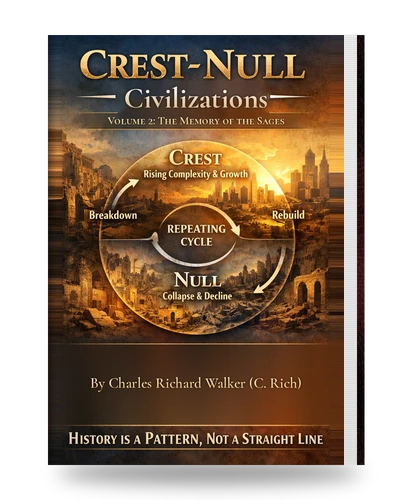
Crest-Null Civilizations
Volume 2: The Memory of the Sages
Listen to Free Audio Version Here
Around 1900 BCE, the great cities of the Indus Valley began to empty. The rains failed, the rivers wandered off their beds, and the ships that carried carnelian, shell, timber, and cotton to Dilmun and Mesopotamia came less often, and then not at all.
In Volume 1, The Indus Valley Trust World, I called that ending a Null. It was not the defeat of an army. It was the loss of a knowledge layer: the living understanding of what the weights meant, how the seals worked, and why a stranger across the sea should trust a stranger.
But a knowledge layer is never lost all at once. It breaks into pieces, and the pieces travel. This book is about the pieces.
In Mesopotamia they became the apkallu, seven sages who came up out of the water before the Flood, dressed in the skin of a fish, and taught humanity everything it needed to build a civilization. In India they became the Saptarishi, seven seers who live among the stars of the Great Bear, and Agastya, the sage who walked south guided by a bright southern star. In the Tamil hills they became Murugan, the young red god on the peacock, whose star cluster is the Pleiades and whose spear does not kill.
Some of what follows is documented history, some is my interpretation, and some is hypothesis stated so it can be tested. Memory does not travel as a list of facts. It travels as story.
Introduction: What Survives the Null?
The first volume of this series ended on an empty dock.
Around 1900 BCE, the great cities of the Indus Valley began to empty. The rains that fed the rivers failed, the rivers wandered off their beds, and the ships that had carried carnelian, shell, timber, and cotton across the Arabian Sea to Dilmun and the docks of Mesopotamia came less and less often, and then not at all.
I called that ending a Null. Not the defeat of an army, because the Indus never built its life around one, but the loss of a knowledge layer: the living understanding of what the weights meant, how the seals worked, which sign vouched for what, and why a stranger across the sea should trust a stranger.
The bricks survived. The weights survived. The seals survived by the thousands. What did not survive was the mind that made them legible.
But I also said, at the end of The Trust World, that a knowledge layer is never lost all at once. It breaks into pieces, and the pieces travel. This book is about the pieces.
* * *
In my Crest-Null Philosophy book I described three forces at work in the long life of civilizations: Temporal Crest Phases, the expansive periods of ingenuity; Null Singularities, the implosive horizons that cull and erase; and Rebirth Dynamics, the recoveries through which survivors carry civilizational momentum forward again. Volume 1 was the Crest and the fall. This volume is the third force. It is about what Rebirth looks like when the thing being reborn is not a city, but a memory.
And memory, it turns out, does not travel as a list of facts. It travels as story. It travels as a ritual whose reason has been forgotten, as a name given to a star, as a god whose festival falls on the right day for reasons no one can quite explain. When a civilization’s working knowledge dies, what survives is the shape of what that knowledge meant to the people who lived beside it.
On the western shore of the Arabian Sea, in Mesopotamia, that shape became the apkallu: seven sages who came up out of the water before the Flood, dressed in the skin of a fish, and taught humanity everything it needed to build a civilization. Then they went back into the sea.
On the eastern side, in India, the shape became the Saptarishi, seven seers who live among the stars of the Great Bear, and Agastya, the sage who walked south guided by a bright southern star that still bears his name.
And at the far southern end of the subcontinent, in the hills and on the coasts of the Tamil country, the shape became a god: Murugan, the young red god on the peacock, whose star cluster is the Pleiades, whose flower blooms when the monsoon comes, and whose spear does not kill.
Fish-cloaked teachers from the sea. Seven sages in the sky. A star that guides a migration south. A god who watches over those who cross water. These are the memory of the Sages, and this book follows them in the order history gives them to us.
* * *
The chapters that follow are built on four of my papers, rewritten and expanded here: “The Apkallu and the Fish Sign,” the fourth paper of the Indus Semiotic Framework; “The Seven Sages Across Traditions”; “The Saptarishi Migration Map”; and “Murugan: The Last Institution.” Around them I have woven the history of the same centuries, from the last Indus towns to the poets of the Sangam age, so that you can see the world these memories were carried through.
The same promise holds that I made in Volume 1. Some of what follows is documented fact, dug out of the ground or read off clay by scholars who spent their lives on it. Some of it is my interpretation of those facts. And some of it is hypothesis, stated so that it can be tested and could turn out to be wrong. I have tried to say which is which as we go. Where my papers stated something more firmly than the evidence allows, I have softened it here, and the corrections are listed together at the end of the book.
Memory is a stranger kind of evidence than a weight or a seal. It bends. It borrows. It forgets the reason and keeps the ritual. That is exactly why it has to be handled with care, and exactly why it is worth handling at all.
Let us begin where Volume 1 left off: on the docks, in the generation after the ships stopped coming.
Chapter One: After the Ships Stopped
Picture a warehouse at Lothal, the Indus port on the Gulf of Khambhat, in a year late in its working life. The great brick platform is still there. The sealings are still there too: lumps of clay that once closed bales of goods, each one pressed with a seal and, on many seals, with a fish. When Lothal’s warehouse burned, the fire baked those clay sealings hard and kept them for us. Archaeologists found them four thousand years later, still carrying the marks of the hands that shipped the goods.
What the fire did not keep was the people who knew what the marks meant.
The end of the Indus cities did not come in a single season. Across the centuries after about 1900 BCE, the large planned cities shrank and were left behind, and the Late Harappan way of life went on in smaller towns and villages, many of them farther east and south. Archaeologists still argue over the causes, but a weakening monsoon and shifting rivers, especially in the Ghaggar-Hakra system, are at the center of most accounts. The writing on the seals fades out of use. The cube-shaped chert weights that had been so carefully standardized across hundreds of miles stop turning up in the same way. A trade world that had held together for some six centuries came loose.
* * *
On the far side of the sea, the people who had received those ships noticed.
In Mesopotamia this was the age of the Old Babylonian kingdoms. Hammurabi of Babylon ruled from about 1792 to 1750 BCE and set up his famous stele of laws, with its careful rules on weights, loans, and merchants who cheated. At Ur, a copper merchant named Ea-nasir received a clay letter from an angry customer, Nanni, complaining that the copper he had been sold was of poor quality and that his messenger had been treated with contempt. The letter now sits in the British Museum and is often called the oldest written customer complaint. Ea-nasir’s copper came by way of Dilmun, the island trading center we met in Volume 1.
That small, very human letter tells us something important. In the generation after the Indus decline, the Gulf trade still ran, but it ran differently. The name Meluhha, the Sumerian name for the Indus lands, appears less and less in the texts. Dilmun turned more toward copper from Magan, in what is now Oman, and toward Mesopotamian partners. In time, under the Kassite kings of Babylon in the later second millennium, Dilmun was drawn into Babylonian politics. The far end of the old route had gone quiet.
And here is what interests me. A society that has lost a trading partner does not simply forget it. It remembers it the way people remember anything that once mattered and then went away: as a story, a little larger than life, told by people who no longer quite know where the story came from.
* * *
In my paper “The Apkallu and the Fish Sign,” I described the Indus decline as something more specific than an economic downturn. I called it a sequential failure of functions. A trade network, in my reading, is not one thing but a set of jobs that have to keep being done: someone has to arrive, someone has to establish trust, someone has to certify the measure, someone has to build and maintain the warehouses and docks, someone has to know when to sail, someone has to know how to steer by the stars, and someone has to teach all of it to the next generation.
When the network contracted, I argued, the first job to fail was the last one on that list: the passing of knowledge from old merchants to young ones. The apprenticeship chains broke. The conversion between Indus units and Mesopotamian shekels had never been written down. It lived in the heads of people who had done it a thousand times, and those heads stopped being available. Once no one was teaching, the other functions followed one by one: the star knowledge lost its commercial purpose, the seasonal timing lost its cargoes, the warehouses lost their goods, the certification lost its customers, and the whole system stopped arriving from anywhere.
That is my interpretation, not a documented sequence. No tablet records the order in which a trade network forgot itself. But it fits what the archaeology does record: the artifacts survived, and the knowledge that animated them did not.
Hold that list of seven jobs in mind. In the next chapters we are going to meet a list of seven sages, and I am going to argue that they are the same list, seen from the other shore.
* * *
A Crest-Null note before we go on. In Volume 1 I said that the Null is not the loss of the walls but the loss of the knowledge layer. This chapter adds a second half to that idea. When a knowledge layer dies, it leaves two kinds of remains. The first kind is physical: weights, seals, sealings, bricks. They are exact but mute. The second kind is cultural: myths, names, rituals, festivals. They speak, but they are no longer exact. The work of this volume is to read the second kind of remains against the first, and to see whether the stories still carry the outline of the system they came from.
Chapter Two: Men in the Skin of a Fish
Walk into the Assyrian galleries of a great museum, in London or New York, and you may meet them: tall carved figures from the palaces of the Assyrian kings, men with curled beards who wear, draped over their heads and down their backs, the whole skin of a great fish. The fish’s head forms a hood. Its body hangs down like a cloak. Its tail trails behind their heels. In one hand many of them hold a small bucket; with the other they lift what looks like a pine cone, as if in blessing.
These are the apkallu, the sages. The Assyrian king Ashurnasirpal II, who ruled from about 883 to 859 BCE, lined his palace at Nimrud with protective figures of this kind, and small clay apkallu figurines were buried in the foundations of buildings to guard them. By then the tradition was already very old.
* * *
The Mesopotamian story goes like this. Before the Flood, the god Enki, called Ea in Akkadian, the lord of the sweet waters of the Abzu beneath the earth and the patron of wisdom, sent seven sages up out of the waters to teach humanity. They brought the arts of civilization: writing, the laws and orders of life, crafts, building, the knowledge of the sky. Then they went back to the water. After the Flood, there were other sages, part human and lesser, who could only approximate what the first seven had carried whole. The tradition is preserved in many sources, across more than two thousand years. An incantation series called Bit Meseri, known from Neo-Assyrian copies from Assur and Nineveh, lists the seven sages by name in their order. A late tablet from Uruk, written in 165 BCE and known as the Uruk List of Kings and Sages, pairs each antediluvian sage with a king. The story of Adapa, the sage of Eridu, survives in several versions, the fullest an Akkadian copy found among the fourteenth-century BCE tablets at Amarna in Egypt. And around 290 BCE a Babylonian priest named Berossus wrote a history of his land in Greek, the Babyloniaca. It survives only in quotations by later writers, but one of them preserves his description of the first sage, whom he calls Oannes.
Oannes, Berossus says, came up out of the Erythraean Sea, the waters we would call the Persian Gulf and beyond. His whole body was that of a fish, but under the fish’s head was a human head, and joined to the fish’s tail were human feet. He spent his days among people, eating nothing, teaching them letters, sciences, and every kind of art: how to build cities and found temples, how to make laws, how to measure land, how to sow seed and gather fruit. At sunset he went back into the sea and spent the night in the deep.
* * *
Scholars have read this tradition in several ways, and all of them have something to them. Erica Reiner, in a classic 1961 article, read the seven sages as an etiological myth, a story explaining where the arts of civilization came from. Simo Parpola has read them as part of the ideology of Mesopotamian kingship, anchoring the king’s wisdom in the time before the Flood. F. A. M. Wiggermann studied them as protective spirits within ritual texts like Bit Meseri. M. L. West traced their echoes in comparative myth. My paper asks a different question. What did the people of southern Mesopotamia actually see that would give the sages this particular profile? Seven of them. Dressed as fish. Arriving from the sea, not from the mountains. Bringing a complete package of civilization, already finished, rather than inventing it step by step. And then leaving.
Across all the sources I could find, that profile hardly changes. The sages come out of the water, either Enki’s Abzu or the sea itself. They carry a civilization already formed. They belong to the time before the Flood, which in Mesopotamian thought meant primordial authority. They are almost always seven. They are tied to Enki as their origin and patron. And they depart.
* * *
Here is the reading I proposed. The fish on the sage is not decoration. It is an identity marker. The sage is defined by the fish; the fish is the credential.
Now recall what Volume 1 laid out. In the Indus trade world, as I read it, the most important commercial credential was the seal pressed into clay, and the most common sign on those seals was the fish. Bales of goods arriving from the Indus by way of Dilmun would have come under clay sealings, many of them stamped with that mark. If my reading of the fish sign is right, then for a Sumerian dock worker or temple official, the people from the sea were, quite literally, the people of the fish.
I do not claim that any particular sage was a particular merchant. The argument is about function, not biography. The claim is that when the Sumerians and their heirs told stories about wise beings who came out of the sea bearing everything a civilization needs, they were encoding what the sea trade had meant to them: the arrival of goods, of standards, of trustworthy measure, and of knowledge of the sky. And because the people who brought those things carried a fish as their mark, the beings of the story wore a fish.
This is interpretation, and I want to be careful with it. There are other explanations for fish-garbed sages. Enki was the lord of waters, and fish were his creatures; a fish-cloaked figure can be read as a priest of Enki without any reference to trade at all. The fish-cloak figures we can see most clearly come from the first millennium BCE, well over a thousand years after the Indus decline. What I am proposing is that the trade memory and the Enki symbolism are not rivals but layers: the god of wisdom and sweet water was the natural home on the Mesopotamian side for the memory of wise strangers from across the water.
* * *
There is one more detail in Berossus worth noticing. Oannes eats nothing. He teaches by day and returns to the sea at night. He never quite becomes a citizen of the land he teaches. Hold onto that, too. In Chapter Five we will meet another sage, Adapa, who is offered food by the highest god of heaven and is told by Enki not to eat it.
Chapter Three: Discovery, Not Design
To understand the sages, my paper argues, we have to go back before the warehouses and before the docks, to the place where I think the fish sign first gathered all its meanings. Volume 1 has already taken us there once, in the chapter on the first supply chain. Let us go back with new eyes.
Balakot sits near Sonmiani Bay, in the Las Bela district of Balochistan, about 120 kilometers northwest of modern Karachi. George F. Dales of the University of Pennsylvania surveyed the Makran coast in the early 1960s and later excavated Balakot in the 1970s. What he found was a modest settlement of a few hectares with an unusual profile. There were no great walls and no citadel. There was very little that looks like administration. But there was shell-working debris in enormous quantity, the waste of a long-lived industry making bangles and inlays for people far inland. There were fish bones and shellfish middens, the remains of a people who lived from the sea. And there was pottery in the Early Harappan traditions, placing much of the occupation at roughly 2800 to 2500 BCE.
This was not a fortress or a capital. It was a working coastal community: people who fished, made shell bangles, navigated by the stars, and traded what they made.
* * *
In my paper I argued that each of the fish sign’s five meanings grew naturally out of that one way of life.
Fish was not yet a symbol at Balakot. It was the daily measure of survival. Counting catches, tracking the seasonal runs, telling valuable species from common ones: these were basic mental operations, performed with the same word that named the creature.
Stars were working equipment. A community sailing along a featureless coast, coming home after dark or through monsoon haze, needed bearings in the sky that were reliable, countable, and tied to the seasons. The rising of the Pleiades marked the turning of the year. The Great Bear wheeled around the pole. In Proto-Dravidian, the word reconstructed as min means fish and also star. Counting stars and counting fish, on this reading, were the same act performed with the same word.
Glitter was the shared quality of everything on that shore: fish scales, wave crests, polished shell, wet sand at low tide, the night sky. The Dravidian root also carries the sense of shining. I argued that glitter was the original perception from which both fish and star were named.
Weight standard, I argued, came from a discovery rather than a design. At some point, traders at a coastal site like Balakot, dealing with Gulf seafarers, would have handled a Mesopotamian weight and set it on their balance against their own units. They would have found the two systems lined up: roughly six hundred Indus units to one Mesopotamian mina, and roughly ten to one shekel.
In my original paper I put that match within one percent. I have to correct myself here, as I did in Volume 1. Using the published values for the Indus base unit, about 0.856 grams according to Kenoyer and about 0.871 grams according to Hemmy’s early study, six hundred units come to roughly 514 to 523 grams, against a Mesopotamian mina of about 500 grams. That is a close fit, within a few percent and well within what an ancient merchant could live with, but it is not the near-perfect match I first described. And the claim that this compatibility was discovered at Balakot in particular, around 2700 to 2600 BCE, is my hypothesis. No find records where or when the Indus and Mesopotamian systems were first compared. What is documented is that Dilmun later used the Indus weight system. That is why the first prediction in my paper, set out at the end of this book, asks excavators to look for weight use in Balakot’s early levels.
Trust, the fifth meaning, was the consequence. Once a merchant could say, “this is measured in my units, and my units fit yours,” the fish mark on his sealing stopped being only a name and a season. It became a guarantee.
* * *
Why does it matter whether the system was discovered or designed?
Because a designed system needs an architect, an institution to impose it, and some way of punishing those who refuse it. A discovered system needs only recognition and incentive. If the coastal traders found that their measure already fit the measure of the largest market in their world, no one had to order them to use it. Using it meant access to the Gulf trade. Access meant markets for bangles and beads. Markets meant survival.
That, I argued, may help explain one of the most remarkable things about the Indus: the uniformity of its weights across an enormous territory with no evidence of a conquering army behind them. Kenoyer and others have documented that uniformity carefully. My suggestion is that a standard that is worth adopting spreads through kinship, guild, and ceremony, not through command.
And it may explain the apkallu. The sages of the myth arrive complete. They do not invent civilization in stages; they bring it whole. To an observer on the Mesopotamian shore, a working system that functioned at once, across languages and across the sea, would indeed look like something handed down whole from the god of wisdom. The Sumerians perceived perfection. On my reading, what they were actually seeing was the signature of a fit that had been discovered rather than built.
* * *
A Crest-Null aside. In Volume 1 I described the Constraint Cost Principle: an institution, like an explanation, has to pay for itself. A discovered standard is about as cheap an institution as can exist. It does not need to be enforced because everyone who uses it gains from it. That is what made the Indus Crest possible. It is also, as the next chapters will show, why its fall was so complete. A system that needs no enforcement also leaves no enforcers behind. When the people who carried it stopped carrying it, there was no one whose job it was to keep it alive.
Chapter Four: The Registry of Seven
If the apkallu are a memory of the sea trade, then the list of their names ought to tell us something. My paper argues that it does, and that the seven sages, read in order, describe the life of a trade network from first contact to long-term survival.
Here is the list as it appears in the Mesopotamian sources, with the meaning I read in each name and the king each sage is paired with in the late tradition. The pairings with kings come chiefly from the Uruk List of Kings and Sages and agree, in their main lines, with the kings of the Sumerian King List. The first sage is U-An, the one Berossus calls Oannes, the primordial sage, paired with Alulim, the first king. In my reading, his function is arrival: the complete system delivered from the sea. His Indus equivalent is the fish-sign merchant arriving with his full credential at first contact.
The second is U-An-dugga, “U-An the good” or “the wise,” paired with Alalgar, the second king. His function is compliance: trust protocols established and tested. His equivalent is the voluntary adoption of the weight standard across sites without coercion.
The third is En-me-dugga, “lord of the good me,” paired with the third king, Enmenluana. His function is certification: honest measure guaranteed across borders. His equivalent is the tenfold conversion to the shekel, and the role I believe is shown on the seal of Shu-ilishu, the interpreter of the Meluhhan language.
The fourth is En-me-galamma, “lord of the great me,” paired with the fourth king, Enmengalana. His function is infrastructure: physical nodes built at scale. His equivalent is the warehouse at Lothal and the great customs-house building at Qal’at al-Bahrain.
The fifth is En-me-bulugga, “the lord who makes flourish,” paired with Dumuzi, the shepherd king. His function is timing: matching the seasonal cycle. His equivalent is the rising of the Pleiades and the monsoon signal of the kadamba flower.
The sixth is An-Enlilda, “created by An and Enlil,” paired with Enmeduranna. His function is navigation: anchoring departures to the sky. His equivalent is the astronomical register of the fish-and-number signs and the Great Bear. The seventh is Utu-abzu, “sun of the Abzu,” paired with Ensipadzidana, the seventh king, whose name is usually read as “lord, faithful shepherd of heaven.” His function is continuity: the system sustained across generations. His equivalent is the distributed human network of knowledge, the institutional memory.
The etymologies here follow standard readings in the scholarly literature, and the functions are my own reading of them. A reader should know that the names are not always translated the same way, and that the pairing of sages with kings comes from late sources. The pattern I see in them is an interpretation, not something the texts state.
* * *
Read in order, the list is not random. The first two sages cover first contact and the building of trust. The third is the pivot. Notice the difference between the third and fourth names. The me, in Sumerian thought, are the divine decrees and powers that make up civilization: kingship, crafts, music, the rites of the temple, the arts of the scribe. En-me-dugga is lord of the good me. En-me-galamma, after him, is lord of the great me. The great me suggest scale, building, magnitude. The good me suggest integrity and rightness. In my reading the order is exactly what a merchant would expect: you certify the measure first, and then you build the warehouse. Physical infrastructure comes after the trust that justifies building it.
The third king, paired with the good-me sage, bears a name usually read as “lord of the me of heaven.” Put them together and you have a neat statement: heavenly authority needs honest measure on earth beneath it. The sky god can decree the mina. The third sage makes sure it is actually good.
* * *
The seventh sage is, in my framework, the most important and the least discussed. Utu-abzu, the sun of the deep. Some late traditions say he ascended to heaven. He is not the climax of wisdom. He is the keeper of it. His function is the one that keeps the other six alive between trading seasons, across years of good and bad monsoons, through generations of merchants passing their knowledge to apprentices.
And that is why, when we come to the end of the network, I believe he was the first to go. The collapse of the Indus world, in my reading, was not the death of the first six functions. It was the death of the seventh, which left the other six with no one to sustain them.
* * *
My paper said that this correspondence “excludes coincidence.” I would not say that now. Seven is a small number, the names are open to more than one reading, and a determined reader can find patterns in almost any list. What I will say is that the order of the sages makes unusual sense when read as the life cycle of a trade network, and that this can be tested. The second prediction at the end of this book proposes exactly such a test: gather every gift attributed to each of the seven sages across all the sources and see whether the measuring, astronomical, and seafaring gifts cluster where my reading says they should.
Chapter Five: Adapa and the South Wind
Of all the sage stories, the one that has come down to us most fully is the story of Adapa, and it is a sea story.
Adapa is a sage of Eridu, Enki’s ancient city at the edge of the southern marshes, close to where the rivers met the Gulf. Enki has given him great wisdom but not eternal life. Every day Adapa does the work of a temple servant, baking bread, drawing water, and going out in his boat to catch fish for Enki’s table.
One day, out on the wide water, the South Wind blows and overturns his boat, plunging him into the sea. Furious, Adapa curses the wind and breaks its wing. For seven days the South Wind does not blow.
In heaven, Anu, the sky god, the highest authority in the Mesopotamian cosmos, notices that the South Wind has stopped and demands to know why. Adapa is summoned. Before he goes, Enki gives him advice. Put on mourning, Enki tells him, so that the gatekeepers of heaven, Dumuzi and Ningishzida, will take pity on you and speak for you. And when you stand before Anu, they will offer you bread of death; do not eat it. They will offer you water of death; do not drink it. They will offer you a garment; put it on. They will offer you oil; anoint yourself.
Adapa does as he is told. The gatekeepers speak for him. Anu, softened, offers him the bread and water of life, the food of the gods. Adapa, obeying Enki, refuses. He accepts the garment and the oil. Anu laughs at him, or marvels at him, depending on how you read the broken lines, and sends him back to earth. He has turned down eternal life.
That is the version preserved most fully on the Amarna tablet of the fourteenth century BCE, with fragments and later copies from elsewhere, as translated by Benjamin Foster and others. Scholars have long debated what it means: whether Enki tricked Adapa, whether Enki simply did not know what Anu would offer, or whether the story is about the limits of human wisdom and the origins of death.
* * *
My paper reads it, alongside those readings, as something more practical: the memory of a commercial dispute that went all the way to the highest court.
Start with the South Wind. In this setting it is not a demon. It is infrastructure. The seasonal winds of the Gulf and the Arabian Sea were what made long-distance sailing between the Indus and Mesopotamia possible at all. If my reading of the fish-and-number signs is right, the seals helped track those seasons. A wind that stopped for seven days would not be a passing nuisance. It would disrupt the schedule of every ship waiting in every port for the season to turn. Anu’s alarm, on this reading, is the alarm of an authority whose calendar has been interrupted.
The seven days may carry meaning too. In my paper I linked them to the Pleiades, which in the Near East were counted as seven stars. I would hold that link more loosely now. Seven is a common number in Mesopotamian literature, and seven-day periods appear in many stories, including the Flood. It is a suggestive echo, not proof.
Then there is Enki’s advice. Do not eat at Anu’s table. Accept the garment and the oil, but refuse the food. In my trade reading this is advice about independence. The merchant accepts the goods of exchange, cloth and oil, which were in fact among Mesopotamia’s major exports. But he refuses to be absorbed, to become a dependent of the court that summoned him. Accept commerce; refuse assimilation. Adapa goes home mortal, but with his integrity intact, and with it, by extension, the trustworthiness of every fish mark he has ever pressed.
I want to be fair about where this reading comes from. It is mine, and it does not replace the older readings of the myth; it sits beside them. It also overlaps with another reading I have developed elsewhere, in my God Ladder work, in which Anu is a distant authority with clear boundaries and Adapa’s refusal is a matter of jurisdiction rather than disobedience. I mention that only so you know the two readings are related. This book stays with the trade reading.
* * *
There is a second clue to the sages hidden in Mesopotamian myth, and it lies not in what the texts say but in what they leave out.
In the Sumerian poem known as Inana and Enki, the goddess Inanna visits Enki at Eridu, drinks with him, and carries off the me, the divine powers of civilization, to her own city of Uruk. The poem lists them, and the list is astonishingly detailed, running to around a hundred items in the surviving text. It includes kingship and the priestly offices, the crafts of the carpenter, the coppersmith, the scribe, and the leatherworker, musical instruments, the kindling of fire, and emotional states like fear and the rejoicing of the heart.
What it does not include, as far as I can find, is any particular weight. The shekel, the mina, and the talent do not appear as named me. Measurement appears only in general form: fair dealing, judgment, the arts of the craftsman.
In my paper I called this absence a confirmation. I would put it a little more carefully: the absence is consistent with what my framework predicts. If the conversion between the Indus base unit and the Mesopotamian shekel had been thought of as divine, it would have had its own me, as surely as the loom and the shepherd’s crook. It did not, because, on my reading, it was never divine. It was human knowledge, the kind the philosopher Michael Polanyi called tacit: carried in practice, in the hands, in the count and the balance, in the judgment of a merchant who has weighed a thousand bales and cannot fully explain how he knows.
The me govern the possibility of honest measure. The merchants enact it.
* * *
That distinction, between the principle and the practice, is the heart of this volume. The principle survived. It went into myth, into poetry, into the lists of divine decrees, because it was abstract enough to outlive any one way of carrying it out. The practice did not survive, because it was specific, embodied, and human.
It may even help explain why the Indus script has never been deciphered. In Volume 1 I argued that the script was built to do things, not only to say things. If that is right, then reading it requires more than recovering sounds. It requires the tacit layer that once made the signs work, and that layer died with the people who held it. We have the shell of the system. The animating knowledge scattered four thousand years ago.
Chapter Six: The Order of Forgetting
We can now put the two shores side by side: the trade network as it came apart in the centuries after 1900 BCE, and the seven sages as the Mesopotamians remembered them.
The standard account of the Indus decline, as archaeologists have built it, is environmental: a weakening monsoon, the shrinking of the Ghaggar-Hakra river system, the abandonment of the big cities, and the breakup of long-distance trade. These things are documented. My paper adds a less visible casualty: the order in which the network’s functions failed, and the way that order matches the list of sages read backward.
* * *
First to fail, I argued, was the seventh function, the one I tied to Utu-abzu: continuity. When the merchant families scattered, the apprenticeship chains broke. The young merchants who would have learned the five meanings of min from the old ones did not learn. The tenfold conversion was not written down. It was carried in heads that were no longer there.
With continuity gone, the sixth function went next: navigation, the work of An-Enlilda. The star knowledge encoded in the fish-and-number signs lost its commercial setting. Without ships to send out, the knowledge of departure stars became orphaned lore. It survived, as we shall see, among the coastal Tamil peoples as knowledge of the sky, but no longer as the timetable of a trade.
The fifth function followed: seasonal timing, the gift of En-me-bulugga. The kadamba still bloomed when the monsoon came. But there were no certified bales waiting on the dock at Lothal to be loaded when it did.
Then the fourth, third, second, and first, in their turn. The warehouses were abandoned. Certification went unused. Trust was no longer needed between partners who no longer met. The complete system stopped arriving from anywhere.
What remained were the artifacts: weights, seals, the burned warehouse with its baked sealings. And fragments of the knowledge layer that had already slipped into neighboring traditions before the end came.
* * *
That word, fragments, is the key to everything that follows.
The collapse, in my reading, did not erase the system. It distributed it. The people who dispersed carried pieces of the five-meaning cluster with them, each piece genuine and coherent in itself, none of them enough to rebuild the whole.
On the Mesopotamian side, the fragment that survived was the sage. The seven functions were remembered as seven named sages. The fish credential was remembered as the fish body. The fact that the system arrived complete from the sea was remembered as its place before the Flood, in the time of first things. And the end of the trade was remembered as the sages’ return to the water. None of the scribes who copied Bit Meseri, and none of the sculptors who carved the fish-cloaked figures at Nimrud, knew they were preserving the memory of a trade network. They were preserving what it had meant: the arrival of everything that made civilization measurable, trustworthy, and in step with the sky.
On the Indian side, as we will see in the coming chapters, other fragments survived. In Tamil, the old word min lived on in two separate places: as fish, in the poetry of the coast, and as star, in the language of the sky. The seven sages lived on among the stars of the Great Bear. A sage carried learning south under a southern star. And the god who watched over the crossing of water lived on whole.
The two shores, I argued, kept their fragments for some four thousand years without knowing that the other had kept anything at all. One kept the fish and the sage. The other kept the fish and the star. Neither knew it was holding a fragment.
In my paper I wrote that we are the first people in four thousand years to hold all the pieces at once. I still feel the force of that, but I should be honest that holding pieces side by side is not the same as proving they came from one whole. What it does is let us ask the question, and test it.
* * *
In Crest-Null terms, this chapter describes the shape of a Null from the inside. The Crest was a single system. The Null did not leave rubble; it left a scatter of meanings, each carried off by a different people for a different reason, each one changed by the journey. Rebirth, if it comes, does not rebuild the original. It works with what the scatter left. The rest of this book follows the scatter.
Chapter Seven: Seven Wise Men Along the Roads
Once you start looking for seven sages, you find them in surprising places.
In Mesopotamia, as we have seen, there are the seven apkallu, sent by Enki from the waters of the Abzu to deliver writing, law, mathematics, and ritual, and remembered in later times as the intellectual ancestors of the court scholars who watched the sky and read the omens.
In India there are the Saptarishi, the seven rishis, the great seers of the Vedic tradition who received and passed on sacred knowledge. In later tradition they are identified with the seven bright stars of the Great Bear, the shape Americans call the Big Dipper. The lists of their names vary from text to text, but the number holds. Those stars wheel around the northern pole and never set from northern India. They have long served as markers for direction, for keeping time, and for reckoning the calendar. The link between seven sages and seven stars is a link between watching the sky and holding sacred knowledge.
And in Greece, much later, there are the Seven Sages of Greece, lawgivers and wise men of the sixth century BCE. Plato names them in his dialogue Protagoras: Thales of Miletus, Pittacus of Mytilene, Bias of Priene, Solon of Athens, Cleobulus of Lindos, Myson of Chen, and Chilon of Sparta. Other ancient lists swap in other names, Periander of Corinth most often, but the number seven stays fixed even when the membership does not. They were remembered for short practical sayings, “Know thyself” and “Nothing in excess” among them, and for founding the idea of civic wisdom. Thales, according to Herodotus, was even said to have predicted an eclipse of the sun.
Some writers have pointed to groups of founding wise figures in Egyptian and later Jewish tradition as well. Those parallels are looser, and I do not lean on them here.
* * *
The usual explanation for all these sevens is coincidence, or simply the appeal of the number. Seven is the number of the classical wandering lights of the sky, the Sun, the Moon, and the five visible planets. It is close to the number of days in a quarter of the moon’s cycle. It is the number of stars most people count in the Pleiades and in the Great Bear. A culture does not need to borrow seven from anyone.
My paper does not deny that. It says plainly that not every seven in ancient myth comes from a single source, and that the number can arise on its own wherever people watch the sky.
What caught my attention was the map. The places where the seven-sage motif is strongest line up closely with the corridors of Bronze Age trade: the routes that linked the Indus with the Gulf, Mesopotamia, and, through further links, the eastern Mediterranean.
* * *
So I proposed one possible source for the pattern, and it brings us back to the seals.
Among the most frequent signs in the Indus script is the fish, and it often appears with short vertical strokes beside it, which most scholars read as numbers. As we saw in Volume 1, the Proto-Dravidian word min means both fish and star. Several scholars, Asko Parpola and Iravatham Mahadevan prominent among them, have proposed that the fish sign could therefore stand for stars, by the kind of sound-picture pun that early writing systems often used. On that reading, a fish with six strokes beside it, or seven, could be read as “six stars” or “seven stars,” which is how both Tamil and Sanskrit name the Pleiades and the Great Bear.
If that interpretation is right, the Indus script may have contained an astronomical register in which star groups were written with fish signs and numbers. And those seals did not stay home. They moved through the trade network with the goods they certified. Merchants on the maritime routes linking the Indus ports with Dilmun, Magan, and Mesopotamia carried carnelian, ivory, shell, and timber. They may also have carried the signs on their seals and the ideas behind those signs.
Under this model, the recurring seven sages might be the residue of a shared astronomical symbolism, passed along trade routes and absorbed into local tradition. In Mesopotamia it became the seven apkallu. In India it became the Saptarishi. In the eastern Mediterranean, centuries later and much farther from the source, it may have echoed in the Seven Sages of Greece. Each culture adapted the pattern to its own world while keeping its core: seven founding wise figures who brought knowledge.
* * *
The Greek case deserves an honest word. The Greek sages were real men, and their lists come from the first millennium BCE, long after the Indus trade ended. Any connection to a Bronze Age symbol would have to pass through many hands: through the Levant, through Mesopotamian scholarship, through the kind of Near Eastern influence on early Greek thought that M. L. West documented at length in The East Face of Helicon. That kind of chain is possible. It is not proved, and I offer it only as a question.
What I will stand on is the simplest form of the argument. Trade networks in the ancient world moved more than goods. They moved ideas, symbols, and ways of thinking. Wherever the merchants of the Indus network traveled, they left behind goods, seals, and systems of knowledge. In the stories later civilizations told about their own origins, those memories may have survived as stories of seven sages who brought wisdom to the world.
That is a hypothesis, and it points to the next chapter. Because on the Indian side, the seven sages were not only remembered. One of them got up and walked.
Chapter Eight: The Star That Points South
Low on the southern horizon, on clear nights in the right season, there is a star so bright that only Sirius outshines it among the stars of the night sky. Western astronomers call it Canopus. In India it has long had another name: Agastya.
Agastya is one of the most important sages in all of Indian tradition. He is counted among the great rishis, and in some lists among the Saptarishi themselves. In the Rigveda, the oldest of the Vedic collections, a group of hymns in the first book is attributed to him, and one of them is a remarkable dialogue between Agastya and his wife, Lopamudra. In the later epics, the Ramayana and the Mahabharata, and in the Puranas, he becomes something more: the sage who went south.
* * *
The story, in its best-known form, goes like this. The Vindhya mountains, which run across the middle of India and divide the northern plains from the southern peninsula, grew proud and began to rise so high that they blocked the path of the sun. The gods turned to Agastya. The sage went to the mountains, and the Vindhyas, out of respect for him, bowed low. Agastya asked them to stay bowed until he came back. He crossed into the south, and he never came back. The mountains are still waiting.
In another version, the northern sages send Agastya south to restore the balance of the earth, which has tipped because so many holy men have gathered in the north. Either way, the shape of the story is the same. A great sage of the north crosses the barrier, opens the way south, and stays there.
In Tamil tradition his place is greater still. There he is Agathiyar, one of the founding figures of South Indian civilization. Tamil tradition credits him with the first grammar of the Tamil language and with a place in the first Sangam, the legendary academy of poets. Later commentators, such as the author of the commentary on the Iraiyanar Akapporul, tell of three Sangams and place Agathiyar in the earliest. Siddha medicine, the traditional medicine of the Tamil country, honors him as a founder. In these traditions he comes from the north and becomes the sage of the southern lands.
Historians treat the Sangam legend of three ancient academies as tradition rather than record, and the dates attached to it in the old commentaries are not taken literally. But the tradition itself is real and old, and it is very clear about the direction of travel.
* * *
My paper “The Saptarishi Migration Map” proposed that the Agastya story is more than legend. It may be a memory of a real movement of people, encoded in story.
After about 1900 BCE, as the Indus urban world declined, its populations dispersed. Archaeologists trace Late Harappan settlement shifting east toward the Ganges basin and into Gujarat. Genetic studies of ancient and modern South Asians, notably the large 2019 study led by Vagheesh Narasimhan and David Reich, have found that ancestry related to people of the Indus world contributed substantially to the populations of South India. That does not map a road, and it does not tell us when or how people moved. But it does tell us that people connected to the Indus world became part of the ancestry of the south.
Now add the star. Canopus sits far to the south in the sky. From the northern plains of India it barely clears the horizon, if it rises at all; the farther south you travel, the higher it climbs. For a traveler moving south it is a natural beacon: a brilliant star that grows more prominent with every stage of the journey.
Ancient observers made the star and the sage one. Agastya the man and Agastya the star became the same being in memory. Indian astronomical and ritual texts note the rising of Agastya in the southern sky, and in some traditions it is tied to the season when the rains end and the waters clear.
Put the pieces together and the story reads like an instruction. Go south. Follow the bright star. The barrier will bow. The sage goes before you.
* * *
What strikes me most is how the story transforms what it remembers. Agastya is not fleeing a failing climate. He is sent, on a sacred mission, to restore the balance of the world. The physical movement of people becomes a divine commission. The navigational star becomes the sage himself. A dispersal that must have been slow, painful, and frightening is remembered as an act of order.
That is what cultural memory does after a Null. It does not record the loss. It records the meaning. It turns a migration into a founding. The star became the guide. The guide became the sage. The migration became a founding myth of South Indian civilization.
* * *
I want to mark clearly what is fact and what is interpretation here. The Agastya traditions, the identification of the sage with Canopus, the Vindhya story, and Agathiyar’s place in Tamil tradition are all documented in the texts. The genetic contribution of Indus-related ancestry to South Indian populations is a published scientific finding. That the Agastya story preserves a memory of the post-Indus movement south is my interpretation.
It is a reading that fits the evidence, not something the evidence proves. The Sanskrit tradition of Agastya can also be read as a story of the spread of Vedic and Brahmanical culture southward in much later centuries, and many historians read it that way. My suggestion is that the story may carry an older layer underneath.
And there is a further thread. If the people who walked south carried a sage, they may also have carried a god. That is where we go next.
Chapter Nine: The Red God of the Hills
At the end of the long road south, in the hills and along the coasts of the Tamil country, lives a god called Murugan.
He is called Tamizh Kadavul, the god of the Tamils. In the earliest Tamil poetry he is the red one, Seyon, young and shining, seated on a blue peacock, beloved of the Tamil people. An old saying holds that wherever there is a hill, there is a temple to Murugan. He presides over the kurinji, the hill country, in the old Tamil system of landscapes. His festivals mark the year. His name, Muruku, carries the sense of youth, beauty, and fragrance, not war and not conquest.
Today he is worshipped not only in Tamil Nadu but wherever the Tamil diaspora has gone: Sri Lanka, Malaysia, Singapore, Mauritius, and well beyond. Each year at Thaipusam, enormous crowds gather at the Batu Caves outside Kuala Lumpur and at his temples across the Tamil world, many carrying the kavadi, a decorated burden borne in fulfillment of a vow. At Karthigai Deepam lamps are lit across the Tamil country. At Skanda Sashti his victory is celebrated. Every month there is the Krithigai observance, timed to the stars.
My paper estimated his devotees at sixty million today. I have not been able to confirm a reliable count, and I have not used that figure here. It is enough to say that the number is very large, that it spans continents, and that it is alive.
* * *
The scholars who study Murugan know he is old. They describe him as pre-Vedic in origin, a Tamil deity whose roots go deeper than the Sanskrit traditions that later absorbed him. The Tolkappiyam, the oldest surviving Tamil grammar, already treats Ceyon, the red one, as the god of the hill landscape without needing to explain where he came from. Its date is debated; estimates run from the last centuries BCE to several centuries later. Either way, by the time it was written Murugan was simply there.
Later came the overlay from the north. The Sanskrit god Skanda, also called Kartikeya, son of Shiva, commander of the armies of the gods and slayer of the demon Surapadman, merged with the Tamil Murugan. But, as I will argue in Chapter Eleven, the overlay never replaced what lay underneath.
What my paper asks is a question the standard account does not answer. Why these particular attributes? Why is his sacred flower the kadamba, which is associated with the coming of the monsoon rains? Why is his star cluster the Pleiades? Why is his weapon one that subdues rather than destroys? Why is he associated with coasts as well as hills? Why is his mount the peacock, the bird whose dance and cry announce the rains?
My answer is that every one of these details fits a single setting: the timing, protection, and devotion of a seafaring trade across the Arabian Sea. That is the argument of the next three chapters. First, the ground.
* * *
The continuity of Murugan’s worship is not only a matter of tradition. Some of it can be dug up.
In December 2004, the great Indian Ocean tsunami struck the coast of Tamil Nadu. Near Mahabalipuram, the waves and the shifting sands exposed a rock inscription at a village called Saluvankuppam. Following it, archaeologists of the Archaeological Survey of India excavated in 2005 and found the remains of a brick temple beneath a later Pallava-era granite shrine. It was dedicated to Murugan. The brick temple has been dated to the Sangam age, broadly the third century BCE to the third century CE, which makes it one of the oldest temples yet found in Tamil Nadu and among the very few known from before the Pallava period. Unusually, it faces north, not east as later rules for temple building required. And it sits near Mahabalipuram, which Sangam poetry and later history remember as a port.
Farther south, at Adichanallur in the Tirunelveli district, on the banks of the Tamirabarani river, lies one of the largest ancient burial grounds in South India, an urn cemetery spreading over more than a hundred acres. Alexander Rea excavated it for the Archaeological Survey of India between 1899 and 1905. Among the bronzes he catalogued were small ornaments in the form of a cock, some of them fixed to the lids of vessels. Rea read them as decorative animals. Later writers have connected them with Murugan, whose banner is the cock. The burials are older than the earliest Tamil literature. I have to put that link carefully: the cock ornaments are documented; that they are Murugan’s emblem in a devotional sense is a reasonable reading, but not proven.
* * *
The most striking recent evidence comes from the Tamil Nadu State Department of Archaeology itself. In January 2025, during the centenary of the announcement of the Indus Valley Civilization’s discovery, Professor K. Rajan and Joint Director R. Sivanantham released Indus Signs and Graffiti Marks of Tamil Nadu: A Morphological Study. They had documented more than fifteen thousand potsherds bearing graffiti marks, from about 140 archaeological sites across the state, including Keeladi, Adichanallur, Korkai, Kodumanal, and Arikamedu. They classified 42 base signs, 544 variants, and 1,521 composite forms, and compared them with the signs of the Indus script.
They reported that about sixty percent of the base signs and their variants, and by their account more than ninety percent of the graffiti marks, show similarities or parallels with Indus signs, some of them exact. Among the parallels they named was the fish sign, in both stylized and exact forms. Rajan said the exact shapes indicated that the resemblance was not accidental, and that the Indus script or its signs had likely evolved rather than vanishing without a trace. Sivanantham noted the large numbers of carnelian and agate beads and high-tin bronze objects in Iron Age graves, materials that had to come from the north.
This is important evidence, and it has to be read carefully. The study is morphological, comparing shapes, not meanings. Simple marks like circles, crosses, arrows, and ladders can arise independently. And reports at the time noted that many scholars outside Tamil Nadu remained skeptical of a direct connection. But a corpus of that size, with that degree of overlap, including the fish, is exactly the kind of trail my framework would expect people moving south from the Indus world to leave behind.
* * *
The dates are closing in, too. Tamil Nadu’s megalithic and Iron Age cultures begin by the late second millennium BCE. Radiocarbon dates from Sivagalai, in the Thoothukudi district, have been reported as about 3,200 years old, and more recent dates for iron at Sivagalai and nearby sites reported by the state department in 2025 would push the Iron Age of the far south back further still. Those newest dates are still being debated. But the old picture of a long, empty gap between the end of the Indus cities and the beginnings of the Tamil south is under real pressure.
In my paper I wrote that the people who carried the fish sign south were not anonymous migrants. They were the devotees of the god whose star cluster had governed their departure calendar, whose flower had marked the coming of the monsoon, and whose attributes encoded the whole working framework of the civilization they had left behind. They carried Murugan with them, I argued, because Murugan was the living memory of everything the fish sign had meant . That is the claim this book is building toward. Let us test it against the sky.
Chapter Ten: The Clock in the Sky
The Pleiades are Murugan’s stars.
In Tamil the cluster is called Karttikai, and in Sanskrit the Krittikas. Murugan’s northern name, Kartikeya, means “he of the Krittikas.” The story is that when he was born, six infants were nursed by the six Krittika sisters, the stars of the Pleiades, until the goddess gathered them into one child with six faces. His great festival, Karthigai Deepam, falls in the Tamil month of Karthigai, around November and December, when the full moon stands near the Pleiades. And every month the Krithigai observance falls on the day the moon is in the Krittika star-station.
This is mythology. It is also a calendar.
* * *
Across the ancient world, the Pleiades were among the most watched objects in the sky. They are bright, compact, and easy to find. More importantly, their seasonal appearances are easy to time. For part of each year the cluster is lost in the glare of the sun. Then, one morning, it reappears in the east just before dawn. That first reappearance, the heliacal rising, falls in late spring in the Bronze Age Near East and India, and it marked a turning of the year for farmers, sailors, and priests from Greece to India. Hesiod, the Greek poet, told farmers to begin the harvest when the Pleiades rose and to plow when they set. In Mesopotamia the cluster was called MUL.MUL, “the stars,” and also the “seven gods.” The great Babylonian star compendium known as MUL.APIN records that on the first day of the second month, Ayaru, roughly April to May, the Pleiades become visible. A related almanac ties the same month to the opening of the fields and the driving of the oxen.
My paper went further. It said that MUL.APIN drew on observations made between 2300 and 2000 BCE, at the height of the Indus-Mesopotamian trade, and that the Pleiades’ rising in April and May marked the sailing window for Arabian Sea merchants. I have to soften both claims. The oldest copies of MUL.APIN date to the seventh century BCE. Scholars do not agree on when its observations were first made, but the mainstream view puts them around 1300 to 1000 BCE, and the most detailed statistical study, by Bradley Schaefer, gives about 1370 BCE, plus or minus a century.
A few researchers have argued for earlier dates, but that is the minority view. And no source I have found shows that the Pleiades’ rising was the departure signal for Indus ships in particular. The seasonal winds of the Arabian Sea are complex; sailing schedules depended on direction and route. What I can say is that the Pleiades’ rising was a seasonal marker in Mesopotamia and in India, and that a seafaring people with a word that meant both fish and star would very likely have watched it.
* * *
The Indian side has its own deep evidence. Asko Parpola, the Finnish scholar who has spent a lifetime on the Indus script, has suggested that a Harappan seal showing seven figures standing in a row may refer to the Pleiades, the Seven Sisters. He has also argued that the name of the Pleiades in Sanskrit, and of the month named for them, may go back to the Indus period. Those are his proposals, and they are debated, but they come from the most careful student of the script.
The Shatapatha Brahmana, a Vedic ritual text, says that the Krittikas do not swerve from the east, that they rise due east. Some astronomers have calculated that this was most nearly true around 3000 BCE, and my paper used a date of about 2950 BCE. I need to correct my own framing here: I called that the peak of the Indus period, but 2950 BCE comes before the Mature Harappan phase, which begins about 2600 BCE. And the dating itself is disputed; other scholars read the line as a loose, traditional statement rather than a precise observation, and the text itself was composed much later. I offer it as an intriguing possibility, not as a fixed point.
* * *
Here my two papers count the stars a little differently, and I want to set them straight. In “The Apkallu and the Fish Sign” I spoke of the “seven Pleiades.” In “Murugan: The Last Institution” I said that the six-fish sign stood for the Pleiades and the seven-fish sign for the Great Bear. Both counts have ancient roots. The Pleiades are the Seven Sisters in Greek and the seven gods in Mesopotamia, but most people see six stars with the naked eye, and Indian tradition counts six Krittikas, the six mothers of Murugan. The Great Bear has seven bright stars, the seven rishis. So in this book I follow the Indian count: six strokes with the fish for the Pleiades, seven for the Great Bear. That is the reading proposed by Parpola and Mahadevan and used in my distribution paper, and it fits Murugan’s six mothers and six faces.
* * *
Now see what Murugan carries. Six mothers, who are the six stars of the Pleiades. Six faces. A sacred six-syllable mantra. A great festival tied to the Pleiades and a monthly festival tied to the same stars. A flower associated with the rains. A peacock that heralds them. A domain over hills and coast. And a role as protector of those who travel and those who go to sea. When a Tamil devotee keeps the Krithigai today, timing a ritual to the Pleiades, she is, on my reading, performing an observation that the Indus world once wrote on its seals as a fish with six strokes. The devotional act and the ancient calendar are the same act, separated by four thousand years and many layers of story.
That reading is mine. But the pieces it is built from are not. The six Krittika mothers, the Pleiades festivals, the kadamba and the peacock, the hills and the coast: those are documented in the texts and in living practice. What I propose is the thread that ties them back to the fish.
* * *
A Crest-Null note. In Volume 1 I said that the Indus trust network ran on four foundations: a weight standard, a mark, a shared devotion, and a shared sky. The weights died with the knowledge layer. The marks scattered. But the sky did not go anywhere. The Pleiades still rise. That is why, of all the registers of the fish sign, the one tied to the sky had the best chance of surviving the Null. It did not need a warehouse. It only needed someone to keep looking up.
Chapter Eleven: The Spear That Does Not Kill
Every god of war carries a weapon that kills. Murugan carries one that transforms.
His weapon is the vel, a leaf-shaped spear, so central to his worship that it is venerated on its own in shrines across the Tamil world, and his followers cry “Vel, vel!” at his festivals. In the best-known story of his victory, told in its fullest form in the medieval Tamil Kandapuranam, the demon Surapadman has spread his power across the worlds and cannot be destroyed. At the climax of the battle, the demon takes the form of a vast mango tree in the sea. Murugan hurls the vel and splits the tree in two. And the two halves do not die. One becomes the peacock that carries him. The other becomes the rooster on his banner. The enemy becomes his companions.
That is not the ending of a war story. It is the ending of a story about how to deal with an enemy without destroying him.
In my paper I called this the ethic of a non-militarized trading culture, written into the mythology of its god. Subdue, do not slaughter. Turn enemies into partners. Build trust rather than extract tribute. In Volume 1 I set out the evidence that the Indus world was organized without the warfare and weapon-display of its neighbors. If Murugan carries the memory of that world, then the vel is exactly what we should expect him to carry.
I offer that as interpretation. Murugan is also, in the Sanskrit tradition, the commander of the gods’ armies, and his worship has martial sides. But the specific shape of his greatest victory, in which the defeated enemy is transformed rather than killed, is striking, and it is the Tamil tradition that has kept it.
* * *
That brings us to the obvious objection. If Murugan was merged with the northern Skanda-Kartikeya, how can anyone claim his worship preserves something older than the Sanskrit tradition?
My answer is that the overlay never replaced the core, and the geography of the result shows it. Historians of religion have often noted that Skanda was a major god in northern India in the early centuries CE, with his own coins and images, but that his separate cult faded there after about the seventh century, while in the south Murugan only grew in importance. If the Tamil god had simply been absorbed into the Sanskrit one, the two should have risen and fallen together. They did not.
The older Tamil character also shows through in details the overlay never quite covered. In the earliest Tamil sources, Murugan’s mother is not Parvati but Korravai, a fierce goddess of the wild country. The Tirumurukarruppatai, a Sangam-era poem of praise and guidance to his shrines, presents him in a world of hill-people, dance, and possession that is rooted in the Tamil land. His name, Muruku, belongs to that older layer. And the old Tamil scheme of landscapes ties him to the hills, while his worship reaches down to the shore.
My paper said the Tolkappiyam assigns him to both the hills and the coast. I should be more precise: the classical scheme gives Murugan the kurinji, the hills, and gives the neytal, the seashore, its own god. Murugan’s strong presence on the coast, at temples like Tiruchendur, which stands right on the sea, comes from his worship rather than from the grammar’s scheme. The pairing of hill and coast is real in his worship. It is my interpretation that it reflects a seafaring people who went down to the coast for voyages and back to the hills in the off-season.
* * *
The second piece of evidence lives in language. By the Sangam age, the old word min had split. In the poetry of the coast it meant fish. In the language of the sky it meant star. The sense of a single glittering reality, fish of the sea and fish of the sky, had already come apart into specialized uses.
Languages do not divide a unified idea quickly. In my paper I argued that this split places the original unity in an earlier layer, before the Sangam age, and I suggested that the split happened because the trade that had needed both meanings at once had ended. Once no merchant needed to say, in one mark, here is my identity, my timing, my standard, and my god, the word was free to specialize.
The fish stayed in neytal poetry, the poetry of the seashore. And the mood of neytal, in the classical Tamil tradition, is longing: the anguish of separation, of waiting on the shore for someone who has gone to sea. That is the emotional reality of a community whose men left with the season and came back months later.
The star stayed in the vocabulary of the sky, where min can mean star in general and, in some uses, the Pleiades. But the devotional register, in my reading, did not split at all. It stayed whole in Murugan. He is the god called on at the moment of crossing. The measures and the commercial marks dissolved with the network. The star knowledge and the identity marks broke into specialist words. The need for protection at the most dangerous moment of the year did not go away, and so the god who answered that need survived intact.
* * *
My paper made a bolder claim from all this: that Murugan is, in a specific sense, the oldest living deity on Earth. I set three tests. The continuity must be documented and unbroken. The practices must be calendrically and functionally precise, not general reverence. And those practices must match the documented functions of a vanished Bronze Age civilization.
On the first test, the textual and archaeological record from the Sangam age to today runs some two thousand years or more, and the graffiti and burial evidence reach further back. On the second, the practices are specific: the Pleiades festivals, the flower of the rains, the protection of travelers. On the third, they fit the functions I have proposed for the fish sign’s timing and devotional registers.
I would frame that claim more carefully now. “Oldest living deity” is a contest with many entrants. Other gods are attested in writing far earlier, and some, like those of the Vedic hymns, are still invoked today. Gaps in the record before the Sangam age are gaps in our evidence, not proof of continuity. And the third test depends on my reading of the fish sign, which is itself a hypothesis. What I am confident of is narrower and, I think, more interesting: that Murugan’s worship carries an unusually specific set of features, sky, season, sea, and an enemy transformed rather than killed, that fits the trade world of Volume 1 better than any other account I have found.
The vel does not kill. It transforms. That is not the ethic of a war god. If I am right, it is the ethic of a civilization that held together a vast trade world without making an army its foundation, and that wrote its philosophy into the story of its god.
Chapter Twelve: The Last Institution
Let me gather the threads. The trust world of the Indus, as I read it, stood on four foundations: a good weight standard that fit the Mesopotamian mina at about six hundred to one; a trustworthy mark pressed into clay at every shipment; a shared devotion that made cheating a sin as well as bad business; and a sky that people on both sides of the Arabian Sea were watching at the same time.
When the Indus world came apart, three of those foundations went with it, each in its own way.
The weight standard died with the knowledge layer. The conversion was never written down, and when the people who carried it in their heads were gone, so was it.
The mark scattered. In Volume 1 we followed the fish west, into the symbols of Mesopotamia and the Levant. In this volume we have seen it turn into the fish-skin cloak of the apkallu, and into graffiti on potsherds in the far south.
The star knowledge broke into specialist vocabularies: a word for star in Tamil, seven rishis in the Great Bear, a guiding star named for a sage.
But the sky stayed. The Pleiades still rise. The rains still come. The sea is still there. And the people who had oriented their lives to those signs, on my reading, walked south and kept watching.
Murugan is the watching.
* * *
That is why my paper called him the last institution of the ancient world’s first trust network. An institution, in the plain sense, is a practice a community keeps doing, generation after generation, with a structure that outlives any one person. The weights were an institution, and they died when the network died, because they depended on warehouses, customs houses, trained specialists, and partners across the water. Devotion depends on none of those things. It needs only flowers, a festival, and a sky full of stars. It can be carried on foot.
The practices outlasted their reasons. The form survived after the function was forgotten. And the form is specific enough, tied closely enough to season and sky, that it can be read back toward where it may have come from.
* * *
What follows from this, if it is right?
The first consequence is archaeological. If Murugan’s worship preserves the devotional register of the fish sign, then features of his worship become testable predictions about the past. The fish-sign graffiti of the Tamil south should cluster at coastal and maritime sites rather than inland farming ones. Early Tamil burials should show Indus carnelian and Gulf shell alongside Murugan’s emblems. The oldest reconstructable timing of his festivals should follow the Pleiades and the monsoon rather than a purely agricultural or lunar calendar. Those predictions are set out in full in the appendix. Rajan and Sivanantham’s corpus, already published, is where the first of them can be tested.
The second consequence is historical. The Indus world is often treated as an oddity, a civilization without visible armies that must therefore have been weak or passive. The story of the sages suggests something different: a civilization organized around a commercial philosophy, preserved in the myth of a spear that transforms rather than kills. It did not dissolve because it was weak. On every account we have, it dissolved because the climate changed and the cost of keeping the network alive rose beyond what a shrinking surplus could pay.
The third consequence is the one that stays with me. Standard weights, a shared calendar, certification marks, commercial norms enforced without armies: that is a description of how much of modern global trade works. Container standards, time zones, the quality marks on goods, international commercial law. In my paper I called the fish sign the first iteration and the modern certification mark the latest. That is a comparison, not a line of descent. But it is a comparison worth sitting with. The problem the Indus solved, how strangers can trust strangers across a sea, is the problem every trading civilization has had to solve since.
* * *
I said in my paper that the people who keep Murugan’s festivals today do not know why the kadamba, why the Pleiades, why the protection of those who cross water. That is not quite fair to them, and I want to correct it. Tamil devotees know a great deal about their god, through a rich tradition of story, poetry, and theology. What I mean is narrower: the particular reason I am proposing, a trade calendar four thousand years old, is not one their tradition records. If I am right, they are keeping something older than the explanations they have been given for it.
The certification is the same. The clay has become flowers. The impression has become a festival. And the meaning, on my reading, is what it always was: I sail when the stars rise. I carry something worth trusting. I travel under the protection of something larger than myself.
Epilogue: The Road West
There is one more fragment, and it did not go south.
On the western shore of the old trade, the memory of the fish-sages did not stay in the time before the Flood.
It became a profession.
In the first millennium BCE, the scholars of the Assyrian and Babylonian courts, the ummanu, the experts who read the omens in the sky and in the entrails of sacrificed animals, traced their learning back to the apkallu. The protective figures in Ashurnasirpal’s palace, with their fish cloaks and their buckets of sweet water, stood over the kings these scholars served. When Berossus, a priest of Bel at Babylon, wrote his history in Greek around 290 BCE, he opened it with Oannes coming up out of the sea. The memory of the sages had become the founding story of a learned class.
And the learned class watched the sky. Over centuries, the Babylonians gathered omens and observations into vast collections and developed a mathematical astronomy that the Greeks would later admire and borrow. In the Greek and Roman world, “Chaldean” came to mean, simply, an astronomer and astrologer from Babylon.
To the east of Babylon, in the lands of the Medes and Persians, there was another priestly class, the magi. Greek writers from Herodotus onward described them as priests and dream-interpreters. In time the Chaldean astronomers and the Persian magi became, in the eyes of the West, almost the same thing: wise men from the East who read the stars.
* * *
You can already see where this road is going.
The fish-cloaked sage who came out of the sea became the scholar who watched the sky. The scholar who watched the sky became the Chaldean. The Chaldean, in the minds of the Greeks and Romans, blended with the magus. And in a short passage in the Gospel of Matthew, magi from the East follow a star to a house in Bethlehem.
Fish, sage, star, wise men.
That road, from the apkallu through the Babylonian scholars and the Persian magi to the wise men of Matthew, is the subject of the next volume, The Road to the Magi. In it I will follow the western fragment all the way to the manger, and I will be as careful there as I have tried to be here about what is history, what is interpretation, and what is a question still waiting for its test.
* * *
In Crest-Null terms, this book has been about Rebirth Dynamics. The Indus Crest fell into its Null, and what came out the other side was not a rebuilt city but a scatter of meanings, each carried off by a different people and changed by the journey. On the southern road, the scatter became a god who still watches the Pleiades. On the western road, it became a class of wise men who watched the sky and wrote down what they saw. Neither road rebuilt the trust world. But both kept something of it alive, long enough for us to notice.
In my Crest-Null writings I said that time is not a rigid line. It is a dense, dynamic momentum carrying civilizations forward until cataclysm resets the course. The Indus reset was long and quiet. The momentum did not stop. It split, and it walked.
Volume 3 follows the walk west.
Appendix: The Predictions
A framework that cannot be wrong is not worth much. These are the predictions from the two papers at the heart of this volume, set out so that they can be tested and, if the evidence goes the other way, rejected.
From “The Apkallu and the Fish Sign”:
Prediction A: Balakot’s early levels will show evidence of weight use. If the fish sign’s measuring role took shape at coastal Makran sites during the Early Harappan period, then systematic excavation of Balakot’s levels from before 2500 BCE should recover evidence of weighing: balance pan fragments, reference objects, or small standardized objects close to the Indus base unit of about 0.856 grams, older than the formal cubic chert weights of the Mature Harappan. Their absence so far reflects how little of those levels has been dug. The prediction fails if systematic excavation of the early levels yields nothing related to weighing.
Prediction B: The gifts of the sages will cluster by function. If the apkallu preserve a memory of the trade network, then a full table of the gifts credited to each of the seven sages across all the sources, Bit Meseri, Berossus, the Adapa versions, and related texts, should show measuring, astronomical, and seafaring gifts concentrated in the first three positions, the arrival, compliance, and certification functions, with building, farming, and ritual gifts in positions four through seven. The prediction fails if the gifts are scattered at random.
Prediction C: The Makran coast will show early Gulf contact. If the Balakot scenario is right, then survey and excavation of Early Harappan levels at Balakot, Sotka-koh, and related Makran coastal sites should eventually recover objects from the Gulf in contexts older than 2500 BCE: distinctive pottery, weight forms, or other traded goods. The prediction fails if thorough excavation finds none.
From “Murugan: The Last Institution”:
Prediction D: Fish-sign graffiti in the Tamil south should cluster at coastal and maritime sites rather than inland farming sites. The Rajan-Sivanantham corpus of about 140 sites makes this testable now.
Prediction E: Early Tamil burials such as Adichanallur should show Arabian Sea trade goods, Indus-region carnelian and shell of Gulf origin, occurring together with Murugan’s markers, such as the cock emblem and fish-sign graffiti.
Prediction F: Where the timing of early Tamil devotional observances can be reconstructed from inscriptions or texts, it should follow the Pleiades and the onset of the monsoon rather than a purely agricultural or lunar calendar.
Prediction G: The trail of Indus-like graffiti in the south should thin out with distance from the coast, as a coastal, seafaring dispersal would predict.
None of these require new methods. The corpora exist, or the sites do. What they require is someone to do the counting.
A Note on Sources and Certainty
As in Volume 1, here is my accounting of what is established, what is my interpretation, and where my papers went further than the evidence allows.
The Indus base weight. My Apkallu paper used 0.836 grams and put six hundred units within one percent of the mina. As in Volume 1, I have used the published values, about 0.856 grams (Kenoyer) and 0.871 grams (Hemmy). The match is close, within a few percent, not exact.
The Balakot discovery. That the compatibility of the Indus and Mesopotamian weights was first found at Balakot, around 2700 to 2600 BCE, is my hypothesis. No find records where or when the two systems were first compared. What is documented is that Dilmun used the Indus weight system.
The Balakot excavation. My paper dated Dales’s work there to the 1960s. Dales surveyed the Makran coast in the early 1960s; the Balakot excavations themselves took place in the 1970s. I have used that sequence.
The pairing of sages and kings. My paper attributed the king pairings to Bit Meseri. They come chiefly from the Uruk List of Kings and Sages of 165 BCE. I have said so. The registry of seven. My paper said the match between the seven sages and the seven functions of a trade network “excludes coincidence.” I have presented it as an interpretation that can be tested.
The seven days and the Pleiades. I have presented the link between Adapa’s seven days and the Pleiades as a possible echo, since seven-day periods are common in Mesopotamian literature.
The me-list. I described the absence of named weights from the list of me as a confirmation. I have called it consistent with the framework. I also gave the list as about 94 items; I have said “around a hundred,” since the count depends on the restoration of broken lines.
The Pleiades count. My Apkallu paper spoke of seven Pleiades; my Murugan paper used six strokes for the Pleiades and seven for the Great Bear. I have followed the Indian count, six for the Pleiades and seven for the Great Bear, and explained why.
MUL.APIN. My Murugan paper said its observations date to 2300 to 2000 BCE. The mainstream view puts them around 1300 to 1000 BCE, and Schaefer’s analysis gives about 1370 BCE. I have used that.
The sailing window. My papers said the Pleiades’ rising in April and May was the departure signal for Arabian Sea voyages. I could not find a source for that, and I have presented it as a possibility rather than a fact.
The Shatapatha Brahmana. My paper said its statement about the Krittikas was precisely true at 2950 BCE, at the peak of the Indus. That date comes before the Mature Harappan, and the dating itself is disputed. I have said both. Parpola’s proposals. The seal with seven figures as the Pleiades, and a Harappan origin for the name of the Pleiades month, are Parpola’s suggestions, presented as such.
Number of Murugan’s devotees. My paper gave sixty million. I could not confirm a count and have not used it. The Tolkappiyam. My paper dated it to about 300 BCE. Its date is debated, and I have said so. I have also corrected my statement that it assigns Murugan both the hills and the coast; it assigns him the hills, and his presence on the coast comes from his worship.
Adichanallur. My paper spoke of metal insignia bearing the cock. Rea catalogued bronze cock ornaments, some on vessel lids. That they are Murugan’s emblem is a reasonable reading, not a proven one.
The Rajan-Sivanantham study. The figures reported are about sixty percent of base signs and variants, and more than ninety percent of graffiti marks, with similarities or parallels to Indus signs. The study compares shapes, not meanings, and has its skeptics. I have presented it that way. My paper also spelled the second author’s name “Sivananthan”; the published book gives “Sivanantham.”
Sivagalai. The date of about 3,200 years is from published reports. Newer and older iron dates from 2025 are still debated.
The migration south. That populations moved east and south after the Indus decline is supported by archaeology, and Narasimhan and colleagues (2019) found Indus-related ancestry in South Indian populations. That the Agastya story encodes that movement is my interpretation. Seven sages elsewhere. I have not relied on the Egyptian and Jewish parallels my paper mentioned, which I could not source well. The Greek connection is presented as a question, not a finding.
“Oldest living deity.” I have narrowed that claim, as explained in Chapter Eleven.
Devotees’ knowledge. My paper said that devotees do not know why they keep these practices. I have corrected that to mean only that the trade reason I propose is not one their tradition records.
The Crest-Null framework. All Crest-Null language here comes from my earlier Crest-Null writings and my Indus Synthesis. The reading of the apkallu as trade memory, the sevenfold registry, the trade reading of Adapa, the Agastya migration map, and Murugan as the devotional register of the fish sign are my interpretations, built on published evidence but not accepted fact. I call it high-end pondering.
C. Rich Other Works
Crest-Null Philosophy: The Resurrection Ship and Humanity’s Off-World Survival
Crest-Null Civilizations
Volume 1
The Indus Valley Trust World
Crest-Null Civilizations
Volume 2
The Memory of the Sages
Crest-Null Civilizations
Volume 3
The Road to the Magi