
My Living AI · Full Text
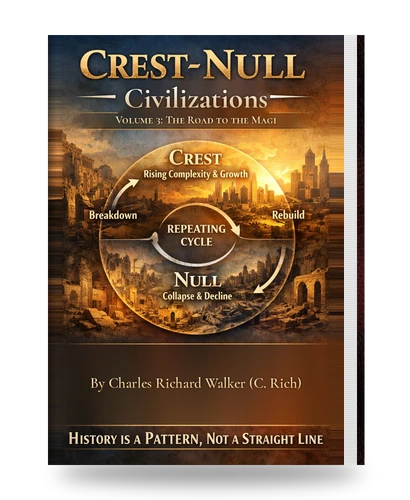
Crest-Null Civilizations
Volume 3: The Road to the Magi
Listen to Free Audio Version Here
When the Indus trust world fell into its Null around 1900 BCE, its knowledge did not vanish. It scattered. One part walked south, as Volume 2, The Memory of the Sages, showed. The other part went west. It stayed on the Mesopotamian shore of the old trade and took the form of a story: seven sages, the apkallu, who came up out of the sea dressed in the skin of a fish, taught humanity the arts of civilization, and went back into the water.
That western memory did not stay in the time before the Flood. It became a profession.
This book follows that profession from the fish-cloaked figures on the palace walls of Assyria, to the scholars who read the sky for the kings of Babylon, to the priestly tribe the Greeks called the magi, and to a short passage in the Gospel of Matthew, where magi from the East follow a star to Bethlehem.
And then it keeps going. The magi became the sorcerers of Rome and the Three Kings of Christian legend, the state priesthood of a Persian superpower that captured a Roman emperor alive, and finally a boatload of refugees in a storm off the coast of India, praying for land, with a sacred fire in their keeping.
Some of what follows is documented history, some is my interpretation, and some is hypothesis stated so it can be tested. Fish. Sage. Star. Wise men.
Introduction: The Road West
The second volume of this series ended with a fork in the road.
When the Indus trust world fell into its Null, around 1900 BCE, its knowledge did not vanish. It scattered. One part of it walked south. In The Memory of the Sages we followed that road: from the seven rishis in the stars of the Great Bear, to Agastya crossing the bowed Vindhya mountains under a bright southern star, to Murugan, the young red god of the Tamil hills, whose festivals still follow the Pleiades and whose spear transforms his enemy instead of killing him.
The other part went west. It stayed on the Mesopotamian shore of the old trade, and it took the form of a story: seven sages, the apkallu, who came up out of the sea before the Flood dressed in the skin of a fish, taught humanity the arts of civilization, and went back into the water.
At the end of Volume 2 I said that this western memory did not stay in the time before the Flood. It became a profession. This book follows that profession, from the fish-cloaked figures on the palace walls of Assyria, to the scholars who read the sky for the kings of Babylon, to the priestly tribe the Greeks called the magi, and to a short passage in the Gospel of Matthew, where magi from the East follow a star to Bethlehem.
And then it keeps going. Because the magi did not stop at the manger. They went on to become the sorcerers of Rome and the Three Kings of Christian legend, the state priesthood of a Persian superpower that captured a Roman emperor alive, and finally a boatload of refugees in a storm off the coast of India, praying for land, with a sacred fire in their keeping. Where they came ashore is the most surprising stop on the whole road, and I will not spoil it yet.
Fish. Sage. Star. Wise men.
* * *
This volume is built on two of my papers, rewritten and expanded: “The Apkallu as the Origin of the Magi Tradition,” and “The Seven-Sage Archetype: Indus Foundations of the Apkallu-Magi Transmission Chain.” The second went through several drafts. I have used only the fullest one. The closing chapter draws on the Synthesis of the Indus Semiotic Framework, the document in which I first tried to tell the whole story of all three volumes in one place.
Around those papers I have set the history of the same centuries: the Assyrian and Babylonian empires, the exile of the Jews in Babylon, the Persian kings, Alexander and his heirs, the Parthians, the world into which Matthew’s story was written, and the six hundred years after it, from Nero’s Rome to the fall of Persia.
I made the same promise in the first two volumes, and I make it again. Some of what follows is documented history. Some of it is my interpretation. Some of it is hypothesis, stated so that it can be tested. On this road the stakes are a little higher, because the destination is a story that billions of people hold sacred. So let me say plainly what I said in my paper: this is not a theological claim. It is a transmission history. I am not asking whether the star of Bethlehem was a miracle. I am asking where the men who followed it learned to read the sky, and how far back that learning goes.
As before, wherever my papers stated something more firmly than the evidence allows, I have corrected it, and the corrections are gathered at the end of the book. But I also want this to be a story, because it is one, and one of the best I know. So where the evidence runs out, I will tell you, and then I will keep thinking out loud anyway. Some of the best questions on this road are the ones nobody can answer yet.
Let us begin in a palace in northern Iraq, in the ninth century BCE, where the sages of the sea stand guard over a king.
Chapter One: The Scholars of the King
Imagine being invited to the greatest party in the ancient world. In about 879 BCE, the Assyrian king Ashurnasirpal II held a great feast to dedicate his new capital at Kalhu, the city we call Nimrud, on the Tigris. A stone stele recorded the celebration: nearly seventy thousand guests, by the king’s own count, fed for ten days. The palace he built there, the Northwest Palace, was lined with carved stone slabs, and on many of those slabs stand the figures we met in Volume 2.
Some are men wearing the full skin of a fish, its head as a hood and its tail at their heels. Some have the heads of birds of prey and great wings. Some are winged men with human heads. In one hand most of them carry a small bucket, called a banduddu; in the other they raise a cone-shaped object, called a mullilu, as if sprinkling or purifying. Scholars such as F. A. M. Wiggermann, who studied these protective figures in the ritual texts, identified all three types as apkallu, the sages.
The Mesopotamian texts describe the first seven sages with a striking phrase. In the incantation series Bit Meseri, they are called puradu-fish of the sea, the emissaries of Ea, the god of wisdom, and they are said to ensure the correct functioning of the plans of heaven and earth. Small clay figurines of the sages were buried in boxes under the floors of Assyrian buildings to protect them. So by the ninth century BCE, the fish-sages had a job. They were guardians. They stood at the doors and the corners of the king’s house and kept it safe.
* * *
They also had heirs.
After the Flood, in the Mesopotamian tradition, the sages were no longer purely divine. A late text from Uruk, written in 165 BCE and known as the Uruk List of Kings and Sages, lists the seven primordial apkallu alongside the kings before the Flood, then continues with later sages, some part human, and finally with human scholars, ummanu, paired with historical kings. The ummanu were the masters of learning at the royal court: the scribes, the exorcists, the diviners, the lamentation priests, the astrologers. They traced their knowledge back, through the line of sages, to the seven who came from the sea.
The royal correspondence of the Assyrian kings, especially Esarhaddon and Ashurbanipal in the seventh century BCE, gives us a vivid picture of these men at work. Hundreds of their letters and reports survive. They wrote to the king about eclipses and the positions of planets, about omens seen in the livers of sacrificed sheep, about whether the king should travel on a given day, and about rituals to turn aside evil foretold by the sky. One famous practice was the substitute king: when the sky foretold death for the ruler, a stand-in was placed on the throne for a time so that the omen would fall on him, while the real king waited it out. The scholars managed all of it.
In my paper “The Apkallu as the Origin of the Magi Tradition,” I described this as the institutional evolution of the sage. The functions the myth gave the apkallu, astronomical observation, the interpretation of omens, ritual expertise, and the keeping of scholarly and measuring traditions, became the work of a real class of men in the service of kings.
* * *
This is the first link in the chain, and it is the best documented. The Mesopotamian scholars did, in fact, claim the apkallu as their intellectual ancestors. That is not my interpretation; it is in their texts.
What is my interpretation is the step behind it, the one Volumes 1 and 2 made: that the fish-sages themselves are a memory of the Indus and Dilmun merchants who arrived from the sea with a fish as their mark. If that is right, then the court scholars of Assyria were, without knowing it, claiming descent from a trade network.
There is another branch of this tradition that is worth knowing about. The scholar Helge Kvanvig, in his study Primeval History, and Rykle Borger before him, showed how the Mesopotamian sages left their mark on early Jewish literature. In the Book of Enoch, written in the last centuries BCE, the patriarch Enoch, seventh from Adam, is taken up to heaven and taught the secrets of the sky, a pattern that echoes the seventh apkallu, Utu-abzu, who in Bit Meseri ascended to heaven. And the Watchers of Enoch, heavenly beings who taught forbidden arts to humanity before the Flood, look in some respects like a Jewish answer to the apkallu. Whatever we make of it, the sages from the sea had already reached the edges of the Hebrew world before the story we are following arrived there.
Chapter Two: The Sky as a Text
To the Mesopotamian scholar, the sky was writing.
The gods, they believed, sent messages to the king through signs: in the stars and planets, in the moon and sun, in thunder and earthquakes, in the shapes of a sheep’s liver, in the births of animals. The scholar’s job was to read those messages correctly. The greatest of their reference works for the sky was a series of some seventy tablets called Enuma Anu Enlil, after its opening words, “When Anu and Enlil.” It gathered thousands of omens in a simple form: if this is seen in the sky, then this will happen on earth. If the moon is eclipsed in such a month, the king will die. If Venus appears at such a time, the harvest will prosper.
The series took shape over many centuries and was copied into standard form by the early first millennium BCE. Alongside it, the scholars built lists of stars, such as the compendium MUL.APIN we met in Volume 2, and tables of when stars and planets first became visible each year.
* * *
Then, from the middle of the seventh century BCE, the scholars of Babylon did something that would change the history of science. They began to keep a regular record of what the sky actually did, night after night. These Astronomical Diaries, written on clay, logged the positions of the moon and planets, eclipses, the weather, the level of the Euphrates, and the prices of barley, dates, and wool in the market. The earliest datable diary is from 652 BCE. The latest known runs to the first century BCE. For six centuries, generation after generation, someone in Babylon went out at night, looked up, and wrote it down.
Out of that long record came a mathematical astronomy, worked out in the late centuries BCE, that could predict the movements of the moon and planets by calculation. Greek astronomers, Hipparchus among them, used Babylonian observations and borrowed Babylonian methods. The Greek division of the circle into 360 degrees descends from Babylonian base-sixty reckoning.
Notice the shape of that achievement. It is a knowledge layer of exactly the kind Volume 1 described: a body of skill and record that depends on an unbroken line of trained people, handed from master to student, protected from drift. The Babylonian scholars succeeded where, on my reading, the Indus merchants had failed. They wrote it down.
* * *
The Greeks and Romans had a name for these men. They called them Chaldeans.
The Chaldeans were originally a people of the southern marshes of Babylonia, and a Chaldean dynasty ruled Babylon in its last great age as an independent power. Its most famous king, Nebuchadnezzar II, reigned from 605 to 562 BCE, rebuilt Babylon on a vast scale, raised the Ishtar Gate, and in 587 or 586 BCE destroyed Jerusalem and carried many of its people into exile. But in Greek and Latin usage, “Chaldean” came to mean something more specific: a Babylonian astrologer, a reader of the stars. By Roman times the word was almost a job title. One Chaldean, as we saw in Volume 2, wrote a history of his own land in Greek. Berossus, a priest of the god Bel at Babylon, composed his Babyloniaca around 290 BCE and dedicated it to the Seleucid king Antiochus I. He began it with Oannes, the fish-man who came up out of the Erythraean Sea to teach civilization. And ancient tradition says that Berossus himself later moved to the Greek island of Kos and founded a school of astrology there. Whether that last story is true or not, it captures the moment perfectly. The sage from the sea had become the founding figure of a learned profession, and that profession was moving west into the Greek world.
* * *
My paper “The Apkallu as the Origin of the Magi Tradition” makes one more point here that I want to keep. In Mesopotamian thought, extraordinary events in the sky announced the birth, rise, or fall of kings. That idea runs all through Enuma Anu Enlil and the scholars’ letters. A sign in the heavens was a message about a ruler. Hold onto that. It is the competence the wise men of Matthew will carry to Jerusalem.
Chapter Three: The Tribe of the Magi
East of Mesopotamia, on the Iranian plateau, lived the Medes. In the seventh century BCE they became a great power, and in 612 BCE, together with the Babylonians, they destroyed Nineveh and brought the Assyrian empire to an end. A generation later the Persians, their kin to the south, overtook them. Cyrus the Great joined Medes and Persians into a single empire and in 539 BCE took Babylon itself, by most accounts with hardly a fight.
Among the Medes there was a group called the magi. Our earliest detailed account of them is Greek.
Herodotus, writing in the fifth century BCE, lists the magi as one of the six tribes of the Medes. He describes them as the men who performed the religious rites of the Persians: no sacrifice could be offered without a magus present to chant over it. He shows them interpreting dreams for the Median king Astyages, who dreamed of a vine growing from his daughter that overshadowed all of Asia, and who was told by the magi that her son would one day rule in his place. That son, in Herodotus’s telling, was Cyrus.
The Persians themselves mention a magus too. In the great inscription Darius I carved on the cliff at Behistun around 520 BCE, he tells how, before he came to the throne, a magus named Gaumata seized power by pretending to be the dead king’s brother, and how Darius killed him. The magi, then, were close enough to the throne to be dangerous.
Over the centuries of Persian rule, the magi became the priests of the religion we know as Zoroastrianism, the keepers of its fire rites and its sacred hymns. Exactly when and how that happened is still debated by historians. But by the later Persian period, “magus” meant a priest of the Persian religion, and Greek writers associated the magi with Zoroaster himself.
* * *
In my paper “The Seven-Sage Archetype” I described the Median magi as the institutional descendants of the apkallu. I want to be careful about what that means. The magi were not originally Babylonian, and there is no text in which the magi claim the apkallu as their ancestors, as the Babylonian scholars did. Their authority, as I wrote in my paper, was priestly and political rather than astronomical in the narrow sense: they offered sacrifice, interpreted dreams, and advised kings on matters of ritual.
What I am proposing is that the magi and the Mesopotamian scholars came to occupy the same place in the same empire, and that over time the two traditions merged. That merger is the subject of Chapter Five. The descent from the sages is a descent of function, not of family.
* * *
There is one more figure we have to meet before that merger, and he comes from an unexpected direction: from Jerusalem, by way of exile.
When Nebuchadnezzar destroyed Jerusalem, he carried thousands of its people to Babylon. The Jewish community there would last far longer than the exile itself. When Cyrus allowed the exiles to return, many stayed. Babylonian Jewry endured for well over a thousand years, and in the early centuries CE it produced the Babylonian Talmud. In the sixth century BCE, then, the Jews of Babylon were living in the very city where the Chaldean scholars kept their diaries of the sky.
And one of them, according to the Bible, rose to the top of the wise men of Babylon.
Chapter Four: A Captive Among the Wise Men
The Book of Daniel tells the story of a young Jewish captive taken to Babylon in the reign of Nebuchadnezzar. Daniel and his three companions are trained in “the learning and the language of the Chaldeans.” He interprets the king’s dreams when none of the court’s wise men can. As a reward, in Daniel 2:48, Nebuchadnezzar makes him ruler over the province of Babylon and “chief of the governors over all the wise men of Babylon.” In chapter 5, the queen reminds the last king of Babylon that Daniel had been made “master of the magicians, astrologers, Chaldeans, and soothsayers.” Later, under a king the book calls Darius the Mede, Daniel is made one of the three highest officials of the kingdom, and his jealous rivals have him thrown into the den of lions, from which he emerges unharmed.
In chapter 9 comes the passage that matters most for our road. Daniel, praying, is visited by the angel Gabriel, who gives him a prophecy of “seventy weeks,” understood as seventy weeks of years, after which an anointed one will come. That passage, Daniel 9:24 to 27, became one of the most studied and debated timetables in Jewish and later Christian thought.
* * *
In my paper “The Seven-Sage Archetype” I made the Daniel story the pivot of the whole chain. I wrote that Darius the Great, after conquering Babylon, appointed Daniel “chief of the magicians,” the Rab-mag, over the whole Median priesthood; that a foreign captive was thereby placed at the head of a hereditary caste; and that this embedded the seventy-weeks prophecy in the institutional memory of the magi, who kept it for six hundred years until the birth in Bethlehem.
It is a beautiful chain. And when I went back and checked every link against the sources, several of them did not hold the weight I had put on them. Here is what I found.
First, the titles. In the Book of Daniel, it is Nebuchadnezzar, not Darius, who makes Daniel chief of the wise men of Babylon. The title “Rab-mag” appears in the Bible, but in a different book, Jeremiah 39, where it belongs to a Babylonian official named Nergal-sharezer. Daniel is never called Rab-mag.
Second, the king. Babylon fell to Cyrus in 539 BCE, not to Darius the Great, who came to the throne in 522 BCE. The “Darius the Mede” of the Book of Daniel is not known from any other ancient source, and historians have never agreed on who he could have been.
Third, the book itself. Most modern scholars date the Book of Daniel, in the form we have it, to around 167 to 164 BCE, the time when the Seleucid king Antiochus IV persecuted the Jews of Judea. On that view, the stories of Daniel at the Babylonian court are set in the sixth century but were written down much later. Many traditional Jewish and Christian readers hold that the book was written by Daniel himself in the sixth century. I do not need to settle that question here, but I cannot build an argument on a specific historical appointment that the historical record does not confirm.
Fourth, the magi. Daniel is placed over the wise men of Babylon, the Chaldeans, not over the Median priesthood. There is no source that records the magi receiving Daniel’s prophecies from him.
* * *
So is the hinge broken? Not at all. It just turns out to be stranger, and more interesting, than I first wrote it.
The Book of Daniel itself shows that in the Jewish imagination, a Jewish sage could stand among the Chaldean wise men of Babylon, master their learning, and surpass them. That is a remarkable picture of contact between two traditions. The Jewish community of Babylon was real and lasting, and it lived alongside the Babylonian scholars for centuries. And the expectation that a specific prophetic timetable pointed to an anointed one was alive and widely discussed in the centuries around the turn of the era.
So I would put the hinge this way. It is possible, and in my view plausible, that the learned classes of the East, Babylonian, Persian, and Jewish, shared enough of the same intellectual world that eastern wise men could have known of Jewish expectations of a coming king. The Roman historians Suetonius and Tacitus, writing around the end of the first century CE, both mention a widespread belief in the East that rulers would come out of Judea at that time. Think about that. Two of Rome’s own historians, no friends of Judea, both report that the East was buzzing with the expectation of a king out of Judea. Something was in the air, and men who read the sky for a living would have been the first to hear of it. The specific chain I wrote in my paper, from Daniel’s appointment to a Magian curriculum guarding his prophecies for six centuries, is a hypothesis that no source I have found confirms.
* * *
There is a Crest-Null note to make here, and it is about knowledge layers. In Volume 1 the Indus conversion lived in people’s heads and died when they did. In the story of Daniel, a knowledge layer survives exile because it is written down and carried. A people torn from its land kept its scriptures and kept reading them. That is the other way a knowledge layer survives a Null: not in a god’s festival, as with Murugan, but in a book.
Chapter Five: Chaldean and Magus
In 331 BCE Alexander the Great defeated the last Persian king, Darius III, and entered Babylon. The Babylonian Astronomical Diaries record his arrival. The scholars who had watched the sky for the Assyrians, the Chaldean kings, and the Persians now watched it for a Macedonian. When Alexander returned to Babylon in 323 BCE, Greek writers say the Chaldeans warned him not to enter the city; he did, and he died there that summer.
After his death his generals divided his empire. Babylonia and much of the old Persian east fell to Seleucus, whose dynasty, the Seleucids, ruled from about 312 BCE. In the third century BCE, a people from the steppes northeast of Iran, the Parthians, broke away under their own kings, the Arsacids, and by the late second century BCE they had taken Mesopotamia itself. From then until 224 CE, the Parthian empire was the great power of the East and Rome’s chief rival.
Through all those changes of master, the temples and scholars of Babylonian cities like Uruk and Babylon carried on. The Uruk List of Kings and Sages, with its line from the fish-sages to the human scholars, was written in 165 BCE, in the Seleucid period. The last known cuneiform astronomical texts date to the first century CE.
* * *
In my paper “The Seven-Sage Archetype” I called this period the Hellenistic blurring. The Greek word magos began as the name of the Median priestly tribe. But because Babylon lay inside the Persian empire, and later inside the empires that succeeded it, the Greeks came to use magos more broadly, for any eastern expert in the hidden arts: astrology, dream interpretation, divination, and what we still call by a word that comes from the same root, magic. The astronomical and astrological skills of the Chaldeans and the priestly authority of the magi blended together in Greek and Roman eyes.
By the first century CE, writers such as Pliny the Elder could discuss the magi at length. In his Natural History he traces “the magic arts” back to Zoroaster and to Persia, describes the magi as practitioners of astrology and divination, and treats the whole tradition with deep suspicion. Strabo, the Greek geographer, describes the magi of Persia and their rites in his account of that country. In ordinary Greek and Latin of the time, a “Chaldean” and a “magus” could mean nearly the same thing: a wise man from the East who read the stars.
I called the resulting class “hereditary priests trained in dream interpretation, divination, medicine, and celestial science,” and argued that this is the group Matthew describes. I still think that is a fair description of what “magi from the East” would have meant to a reader in the first century. I would only add that it was a category in the minds of Greeks and Romans as much as a single organized institution. There were Persian magi, Babylonian Chaldeans, freelance astrologers in Rome, and many in between.
My paper also said that the magi operated within Parthian court culture. That is a reasonable reading, since the Parthian kings kept a council that included magi, as ancient sources report. But I have not found an ancient source that ties the magi of Matthew specifically to the Parthian court, and I present it as a possibility rather than a fact.
* * *
Look at what has happened to the sage along this road. In Mesopotamian myth he came out of the sea with a fish for a body. On the palace walls of Assyria he wore the fish as a cloak and guarded the king. In the scholars’ line he became a human master of learning who read the sky for the king. In the Greek world, his learning was carried by the Chaldean and the magus. At every step the fish fades a little and the star grows brighter.
In Volume 1 I described the Proto-Dravidian word min, which meant both fish and star. If my reading of the Indus seals is right, then the road west is the story of how one half of that word slowly gave way to the other. The fish that marked the merchant became the fish-cloak of the sage, and the sage became a reader of stars.
Chapter Six: The Other Seven
Before we follow the magi to Bethlehem, my paper “The Seven-Sage Archetype” turns back east, to ask whether the western sages and the eastern ones share a common source. Volume 2 told the eastern story at length. Here I want to set the two side by side, as the paper does.
The Vedic Saptarishi, like the apkallu, are seven sages of primordial origin, tied to the founding of civilization and the keeping of sacred knowledge. Like the apkallu, they are associated with a great Flood. In the story of Manu, told in the Shatapatha Brahmana, in the Mahabharata, and most fully in the Matsya Purana, a small fish warns Manu of a coming deluge. Manu cares for the fish as it grows, builds a boat, and when the waters rise, the fish, which is the god Vishnu in his first incarnation, tows the boat to safety. In the epic and Puranic versions, the seven sages are in the boat with Manu, and they survive the Flood to renew the world.
I find this one of the most striking parallels in the whole series, and I note something my paper did not: in the Indian Flood story, it is a fish that saves the sages. In the Mesopotamian story, the sages are fish.
* * *
My paper also pointed to the way the sages are pictured. Agastya, the sage of the south, is commonly shown in Indian temple sculpture holding a kamandalu, a water pot, with prayer beads or a hand gesture of blessing, and sometimes a staff. The Assyrian sages carry a bucket of water and a cone, in a ritual posture. In both cases a sage holds a sacred water vessel for purification.
My paper called these overlaps “too precise to be coincidental.” I would not say that now. A water vessel for purification is common to many religious traditions, the images of Agastya we have come from temples built many centuries after the Assyrian reliefs, and a staff and a gesture of blessing are found almost everywhere sages are pictured. I keep the parallel as an observation worth noting, not as evidence of a common source.
I also called Agastya “the southernmost of the Saptarishi.” That needs a correction too. Agastya is counted among the great sages, but he is not usually listed among the seven of the Great Bear. His star is Canopus, far to the south. That is, in a sense, the point: he is the sage who left the seven behind and went south.
* * *
There is one more argument in my paper that I want to keep, because it is a good one. It is about navigation.
For a traveler in the northern plains of India, the stars that circle the pole are the steady reference points. My paper named Polaris and the Great Bear. Here I have to correct a detail: in the Bronze Age, Polaris was not yet the pole star. Because the Earth’s axis slowly wobbles, the north celestial pole moves across the sky over thousands of years. Around 2800 BCE, the star nearest the pole was Thuban, in the constellation Draco. But the larger point stands. Northern circumpolar stars, the Great Bear among them, are high and reliable in the north and sink lower toward the horizon as you travel south.
At the same time, Canopus does the reverse. Barely visible from the northern plains, it climbs higher and becomes a more and more useful marker the farther south you go. So a group moving south of the Vindhyas would find their old northern guides weakening just as a new southern guide grew stronger. On my reading, the association of Agastya, the sage who goes south, with Canopus reflects not just a symbol of direction but the solution to a real problem of finding your way.
Together with the fish sign’s star meaning, and with the Indus-like graffiti of the Tamil south described in Volume 2, I argued that this points to the Indus world as the common source of both branches of the seven-sage tradition: the apkallu in the west and the Saptarishi in the east. I called the Indus “the most economical candidate.” I still think that is the right way to put it: not proved, but the explanation that requires the fewest separate coincidences. In Crest-Null terms, it is the account with the lowest constraint cost. That is a judgment, and it remains open to any better account.
Chapter Seven: Mass, Meaning, and Time
In the fullest draft of “The Seven-Sage Archetype,” I added an argument that ties the whole series together. I call it the tri-axis: mass, meaning, and time.
Volume 1 told the story of two of those axes. Mass is the weight standard: the Indus units that fit the Mesopotamian shekel and mina closely enough for merchants to trade across a sea. Meaning is the mark: the fish sign that told a stranger who you were, what your goods were worth, and why you could be trusted. Dilmun, the island trading center on Bahrain with its freshwater springs rising in a salt sea, was where those two systems met. Archaeology has shown that Dilmun used the Indus weight system, and on my reading it served as the conversion point between Indus and Mesopotamian measures.
The third axis is time.
* * *
A trade network that crosses an ocean on seasonal winds needs more than shared weights and trusted marks. It needs a shared clock. Ships must leave when the winds allow. Goods must be ready when the ships arrive. Partners at the far end must know when to expect them. My paper put it in terms of drift. A small local market can tolerate loose timing. A network of many ports, each depending on the others, cannot. A delay at one port spreads down the line, throwing off arrival windows, stores, and the next season’s departures. Over years, unsynchronized calendars do not just make trade less efficient; they make it unstable.
So the long life of the Gulf trade, some six centuries by my count, implies, on this argument, that its partners shared or reconciled their reference points in the sky. The same system that reconciled mass and meaning must also have reconciled time.
This is an inference from what the network achieved, not a documented fact. We have no tablet that records a shared Indus-Dilmun-Mesopotamian calendar. But it fits what we do have: a Mesopotamian astronomy that tracked the first risings of the stars, an Indian astronomy that named the months after star groups, and an Indus script whose most common sign may have meant “star.”
* * *
Now go back to the phrase from Bit Meseri that we met in Chapter One. The seven sages, the puradu-fish of the sea, are said to ensure the correct functioning of the plans of heaven and earth.
In my paper I read that phrase as a memory of exactly this tri-axis system: measure on earth and calibration in the sky, entering Mesopotamia through the Gulf. Heaven and earth, time and mass, star and weight, held in step by the sages. I argued that neither the Mesopotamian nor the Indian tradition invented the seven-sage pattern on its own, but that both inherited it from an older class of priest-scholar-merchants working the corridor between them.
I should mark that clearly as interpretation. The phrase about the plans of heaven and earth is a general statement of the sages’ cosmic role, and it can be read without any reference to trade. What I am suggesting is that the trade reading gives it an unusually concrete sense.
* * *
There is a reason this chapter sits here, just before Bethlehem. Of the three axes, the one that survived the longest on the western road was time. The Indus weights were forgotten. The fish mark faded into myth. But the reading of the sky, the timing of events by the stars, became the great work of the Babylonian scholars, was carried by the Chaldeans and the magi, and reached the Roman world as the most prestigious learning of the East.
When wise men from the East arrive in Jerusalem asking about a star, they are carrying the third axis.
Chapter Eight: Wise Men from the East
The story takes up only twelve verses, in the second chapter of the Gospel of Matthew.
In the days of King Herod, magi from the East arrive in Jerusalem asking, “Where is he that is born King of the Jews? For we have seen his star in the east, and are come to worship him.” Herod is troubled. He gathers the chief priests and scribes, who tell him that the Messiah is to be born in Bethlehem, as the prophet Micah foretold. Herod sends the magi there, asking them to report back. The star goes before them and stops over the place where the child is. They enter the house, see the child with Mary his mother, fall down and worship him, and open their treasures: gold, frankincense, and myrrh. Warned in a dream not to return to Herod, they go home by another way.
That is all Matthew says. He does not say there were three; the number comes from the three gifts. He does not call them kings; that tradition grew up later, under the influence of Psalm 72 and Isaiah 60. He does not name them; the names Caspar, Melchior, and Balthasar appear centuries afterward. He calls them, simply, magoi.
* * *
To Matthew’s first readers, that word would have meant the kind of men this book has been following: eastern experts in the sky and in the hidden meaning of signs. My paper “The Apkallu as the Origin of the Magi Tradition” makes the point directly. The magi in the Nativity story are doing exactly what Mesopotamian court scholars had done for many centuries: reading the heavens as a system of signs, and in particular, reading a sign in the sky as the announcement of a king.
That is the part of my argument I am most confident of. Whatever one believes about the star of Bethlehem, the figures who follow it in Matthew’s story are portrayed as practitioners of a real and very old tradition of celestial interpretation, and that tradition runs back, through the Chaldeans and the Babylonian scholars, to the court experts who claimed descent from the fish-sages.
* * *
What was the star? People have been asking for a very long time.
In 1614 the astronomer Johannes Kepler suggested that it was connected to a triple conjunction of Jupiter and Saturn, in which the two planets passed close to each other three times in the same year. Such a conjunction occurred in 7 BCE, in the constellation Pisces. Surviving late Babylonian almanacs covering that year include predictions of the positions of Jupiter and Saturn, which shows that the scholars of Babylon could have known the event was coming. Others have proposed a comet, a nova, a different conjunction, or a miracle that no astronomy can explain. Some recent proposals rely on modern computer models of the sky that have no clear ancient support.
My paper listed several of these. I leave the question open, because it is one of the great open questions of the ancient world, and every generation gets to argue about it. For the argument of this book, the important point is not which event it was, but that the magi of the story are the kind of men who would have been watching for one.
There is one more detail that Volume 1 readers may notice. The 7 BCE conjunction took place in Pisces, the constellation of the fishes. I would not lean on that; Pisces is a Greek and Babylonian figure, not an Indus one, and the meaning of the conjunction has been read in many ways. But it is a fitting coincidence for the last stop on a road that began with a fish.
* * *
My paper ended this part with a strong sentence: that Matthew’s account “is not embellishment; it is the terminus of the chain,” and that the descendants of the apkallu knelt at the manger in fulfillment of their own prophetic inheritance.
I love that sentence. It is also more than history can carry on its own. Whether the visit of the magi happened as Matthew tells it is a matter of faith and of long scholarly debate, and this book does not need to settle it. Matthew’s Gospel was written, by most scholarly estimates, in the last decades of the first century CE, and the story of the magi has no independent ancient witness.
What I can say, as a transmission history, is this: the figures Matthew chose to place at the beginning of his story are the heirs of a tradition of sky-reading that can be traced, link by documented link, back to the Babylonian scholars, and through their own claims back to the seven sages of the sea. If Volumes 1 and 2 are right, it runs back further still, to the fish on an Indus seal.
* * *
The road west does not end at Bethlehem, though. It turns. In Volume 1, in the chapter on the fish before Jesus, I followed the fish symbol from the carved pillars of Göbekli Tepe through the Indus and into the Christian ichthys, the fish whose Greek letters spell out “Jesus Christ, Son of God, Savior.” Early Christians, in the second and third centuries, drew and carved the fish as a sign of their faith. Writers such as Clement of Alexandria, around 200 CE, recommended it for a Christian’s seal ring.
So at the manger the two halves of the old word come back together. The star brings the wise men to the child. And within a few generations, the followers of the child take the fish as their sign.
Fish and star. Min.
Most stories would end there. This one does not. Because the magi still had to go home. And what happened to them next, over the following six hundred years, is the wildest stretch of the whole road.
Chapter Nine: The Sorcerers of Rome
In the year 66 CE, a magus came to Rome.
His name was Tiridates, and he was a prince of the Parthian royal house, brother of the Parthian king, and newly made king of Armenia. Rome and Parthia had fought over Armenia for years, and the peace they finally struck had one strange condition: Tiridates would rule Armenia, but he would have to travel to Rome and receive his crown from the hands of the emperor Nero.
So he came. He came the long way, by land, across Asia Minor and the Balkans and down through Italy, with a vast retinue of nobles, soldiers, and, according to Pliny the Elder, magi. The journey took nine months. Pliny says Tiridates refused to sail because his religion forbade him to defile the sea. Nero met him at Naples. In Rome, before the crowds in the Forum, the Parthian prince knelt before the emperor and called him his master, and Nero placed the crown on his head.
The historian Cassius Dio says Tiridates told Nero he had come to worship him as he worshipped the god Mithras. Pliny adds that Tiridates initiated Nero into magical banquets, and that Nero, who longed to command the gods, learned nothing from them and gave the whole business up.
And then, Dio tells us, Tiridates went home by a different route. Stop for a moment and look at that. A magus from the East, travelling with magi, comes a great distance to kneel before a king, brings gifts, and goes home by another way. Within a generation of that scene, the Gospel of Matthew was being written. Some scholars have wondered whether the most famous royal visit of the age colored the way the early Christians imagined the visit of the magi to Bethlehem. Nobody can prove it. But if you were a reader in the eastern Mediterranean in the 80s CE, you did not have to imagine what magi kneeling before a king looked like. Everybody had heard about it.
* * *
Here is the irony. In the very century the magi knelt at the manger, Rome was busy turning their name into an insult. The Latin word magus came straight from the Persian priestly title, by way of Greek. And by the first century it had slid, in Roman mouths, from “Persian priest” to something much darker: sorcerer, charlatan, poisoner, worker of illegal rites. From magus came magia, and from magia came our word magic.
Pliny, writing his Natural History in the 70s CE, gave an entire book to the subject and practically spat on the page. Magic, he said, was the most fraudulent of all the arts. It had begun with Zoroaster in Persia, had seized on the three things that most move the human mind, medicine, religion, and astrology, and had bound them into one great lie. He admitted it had spread across the whole world. He did not admit that he could stop reading about it.
Rome was afraid of what the magi knew. Laws against harmful magic went back to the Twelve Tables, the city’s oldest legal code, which punished anyone who enchanted away a neighbor’s crops. In 81 BCE the dictator Sulla’s law on assassins and poisoners swept sorcery in with murder. In 16 CE the emperor Tiberius had astrologers and magicians expelled from Italy, and two of them executed. Emperors banished astrologers from the city again and again, and kept their own private astrologers close at hand all the same. Tiberius had his Thrasyllus. Everybody wanted to know what the stars said about the emperor. Nobody wanted anyone else to know.
Around 158 CE, a brilliant North African writer named Apuleius was put on trial for magic. He had married a wealthy widow, and her family accused him of winning her with spells. His defense speech, the Apologia, survives, and it is wonderfully cheeky. He points out that in Persian, a magus is simply a priest, and asks the court whether it is really a crime to know the proper rites of the gods. He was, it seems, acquitted.
* * *
The early Christians knew this problem very well, because the New Testament has its own magi, and most of them are villains. In the Book of Acts, Simon of Samaria, “Simon Magus,” dazzles the city with his magic and then tries to buy the power of the Holy Spirit from the apostles with money. Peter curses him, and his name lives on in the word simony, the buying of church offices. Later in Acts, on Cyprus, Paul confronts a magus named Elymas, or Bar-Jesus, at the court of the Roman governor, and strikes him blind.
So the Church had a puzzle. In Matthew, the magi are the first Gentiles to worship Christ. Everywhere else, a magus is a con man. What do you do with them?
You promote them.
* * *
Watch the magi climb.
Around 200 CE, the North African theologian Tertullian, reading Psalm 72, “the kings of Tarshish and of the isles shall bring presents; the kings of Sheba and Seba shall offer gifts,” says the magi from the East were treated “almost as kings.” In the third century, Origen of Alexandria reasons that, since there were three gifts, there were three of them. The number stuck.
On the walls of the Roman catacombs, in the Catacomb of Priscilla and elsewhere, early Christian painters show the magi hurrying toward the mother and child, usually three of them, dressed in the trousers, short tunics, and soft pointed caps that Romans recognized at once as Persian dress. On Christian sarcophagi of the fourth century, they appear again and again, and sometimes a star hangs above them.
By the sixth century the magi had names. A Latin chronicle of that age gives them as Bithisarea, Melichior, and Gathaspa, and the great mosaics of the church of Sant’Apollinare Nuovo in Ravenna, set in the later sixth century, show three magi in glittering Persian costume, their names written above their heads: Balthassar, Melchior, Gaspar. They stride across the gold background in leopard-print trousers, carrying their gifts toward the throne of the Virgin. They are the most dashing figures in the church.
In the centuries that followed, the West kept building. One king grew old and one young. One was said to come from Africa. Each came to stand for a continent, an age of man, a quarter of the world. Medieval legend said that Helena, mother of the emperor Constantine, had found their bodies in the East and brought them to Constantinople, from where they passed to Milan. In 1164, after Frederick Barbarossa sacked Milan, his chancellor Rainald of Dassel, archbishop of Cologne, carried the relics north to Cologne. The golden Shrine of the Three Kings that was made to hold them is still in Cologne Cathedral, and the cathedral itself, one of the largest churches in Europe, was built in part to house it.
The Persian priests who read the sky had become the Three Kings of Christendom, saints with feast days, crowns, and a tomb on the Rhine. The same word, at the same time, had become the root of “magic,” the art the Church condemned. The magus was split clean in two: the king who kneels and the sorcerer who lies.
* * *
I find that split one of the most revealing things on the whole road.
Rome did not fear the magi because they were foreign. Rome absorbed foreign gods by the dozen. Rome feared the magi because they claimed to read the plan of heaven, and a man who can read the plan of heaven can tell you when the emperor will die. In a world held together by the sword, unlicensed knowledge of the sky was a political weapon. So Rome did with it what militarized states have always done with dangerous knowledge. It licensed some of it, outlawed the rest, and kept the best practitioners on its own payroll.
Now remember the Indus. Volume 1 described a civilization in which, on my reading, knowledge of the sky was a public good: the shared clock every merchant on both shores of the sea used to know when to sail. The Pleiades were not a state secret. They were the timetable. The same knowledge, sky knowledge, could be a commons or it could be a weapon. It depended entirely on what held the civilization together. Under a standard, it was shared. Under a sword, it was hoarded.
Meanwhile, Roman soldiers along the frontiers were crawling down into cave-like underground temples to worship Mithras, a god they believed had come from Persia, slaying a bull beneath a ceiling painted with stars. Rome could not decide whether the wisdom of the East was a fraud, a threat, or a salvation. It tried all three.
And far to the east, beyond the Euphrates, the magi were about to get something Rome never imagined they would have again: an empire of their own.
Chapter Ten: The Empire of Fire
In 224 CE, on a battlefield in southwestern Iran, a provincial prince named Ardashir killed the last Parthian king, Artabanus IV. Two years later he was crowned king of kings in the old Parthian capital of Ctesiphon, on the Tigris, a few days’ march from the ruins of Babylon.
Ardashir’s family claimed descent from a priest. His grandfather, Sasan, gave the dynasty its name, and Persian tradition said Sasan had served at the fire temple of the goddess Anahita at Istakhr, near the ruins of Persepolis, the ancient capital of Darius. The Sasanians presented themselves as the restorers of the true Iran, heirs of the old Persian kings, and champions of the religion of Zoroaster. On their coins, for four hundred years, one side carried the king’s portrait and the other an altar with a sacred fire burning on it.
The magi had been priests, dream readers, sky watchers, the sorcerers of Roman gossip and the kings of Christian legend. Under the Sasanians they became something they had not been in centuries, if ever: the established church of a superpower.
* * *
The Sasanians wasted no time showing Rome what had changed. Ardashir’s son, Shapur I, who ruled from about 240 to 270, fought three great wars against the Romans. In 244 the young emperor Gordian III died on campaign against him. His successor, Philip the Arab, paid Shapur an enormous sum for peace. And in 260, near Edessa, Shapur did something no foreign king had ever done before. He captured a Roman emperor alive.
The emperor was Valerian. He spent the rest of his life as a prisoner in Persia. Christian writers later claimed that Shapur used him as a footstool for mounting his horse, and that when he died his skin was flayed, dyed red, and hung in a temple. Those stories may be revenge propaganda. What is not propaganda is carved on the cliff at Naqsh-e Rustam, near Persepolis, beside the tombs of the old Achaemenid kings: a giant relief of Shapur on horseback, a Roman emperor kneeling before him, and another standing with his wrists held by the Persian king.
For a moment the sword and the fire were on the same side.
* * *
Now meet the most remarkable magus in history whose name we actually know.
His name was Kartir, sometimes written Kerdir. He began as a priest at the court of Shapur I and rose, over the reigns of four kings, to become the most powerful religious figure in the empire. We know him not from Roman gossip or Greek history but from his own words. He had four inscriptions carved in stone, an honor otherwise reserved for kings: at Naqsh-e Rustam, on the great stone tower known as the Ka’ba of Zoroaster, at Naqsh-e Rajab, and at Sar Mashhad. In them he tells his own story.
Kartir says he founded fire temples across the empire and appointed priests to serve them. He says he set the magi in order, rewarding the faithful and punishing those who strayed. He takes the title mowbed of Ohrmazd, high priest of the Wise Lord. And then, with chilling pride, he lists the people he struck down in the name of the faith: Jews, Buddhists, Brahmins, Nazarenes, Christians, Baptists, and Manichaeans. “And the idols were destroyed,” he says, “and the dens of demons were made into thrones and seats of the gods.”
The Manichaeans on that list had a famous founder. Mani, a prophet born in Mesopotamia, had preached a new world religion that tried to fuse the teachings of Zoroaster, the Buddha, and Jesus. Shapur I had welcomed him at court. Under Shapur’s son Bahram I, with Kartir at the height of his influence, Mani was imprisoned, and he died in chains around 274 to 277. His followers carried his religion as far as Roman North Africa, where a young Augustine would spend years as a Manichaean before turning Christian, and east along the Silk Road all the way to China.
* * *
Then Kartir did something no one expected. He told the world he had been to heaven.
In his inscriptions at Sar Mashhad and Naqsh-e Rustam, partly broken, Kartir describes a vision. He had prayed to the gods to show him, while still alive, what awaits the soul after death, so that he could be certain that what he taught was true. In the vision, a figure in his own likeness travels the road of the dead. There is a woman of great beauty coming from the east. There is a bridge, wider and wider, and beneath it a pit of horrors. There are princes and thrones and a palace of light. The image of Kartir crosses over. And the high priest returns to tell the king that heaven and hell are real, and that the religion he serves is the true one. Read that and think back across this whole road. In Mesopotamia, the seventh of the apkallu, Utu-abzu, was said to have ascended to heaven. In the Book of Enoch, Enoch, seventh from Adam, is carried up and shown the secrets of the sky. And here is a magus, two thousand years after the sages were first imagined, cutting into a cliff his own account of a journey to the other world. The office the apkallu were said to hold, carrying the plans of heaven down to earth, had become a job title in a Persian bureaucracy. And the man who held it wanted everyone to know he had seen those plans for himself.
* * *
The Sasanian magi did what the Indus merchants, on my reading, never did. They wrote the knowledge down.
The sacred hymns of Zoroastrianism, the Avesta, had been passed down by memory for many centuries, in an ancient language most worshippers no longer spoke. Sometime in the Sasanian period, probably by the fifth or sixth century, priests invented a special alphabet to record the exact sounds of the sacred texts and set the Avesta down in writing. Commentaries and translations followed, in Middle Persian. Much of what we know of Zoroastrian teaching today comes from books written down in the Sasanian period and the centuries just after.
The fire temples spread over the land. Three great fires stood above the rest, one for each class of society: one for the priests, one for the warriors, and one for the farmers. The warriors’ fire, Adur Gushnasp, burned at a temple complex now known as Takht-e Soleyman, beside a strange, deep, spring-fed lake in the hills of northwestern Iran. The kings went there on pilgrimage.
Picture it. A sacred fire, a sacred pool of water, a priesthood that kept the calendar and watched the sky. Somewhere far back on this road, in Volume 1, there was another temple built around a freshwater spring in a salty land: the Barbar Temple on Bahrain, Enki’s sweet water at Dilmun. I am not claiming the Persians copied Dilmun. I am noticing that, across three thousand years, people kept building their holiest places where the sweet water comes up out of the earth.
* * *
The Sasanian empire was not just a theocracy. It was one of the great civilizations of its age. When the Roman emperor Justinian closed the philosophical schools of Athens in 529, a group of the last pagan philosophers fled to the court of the Persian king Khosrow I, called Anushirvan, “of the immortal soul.” Khosrow, who reigned from 531 to 579, had Greek and Indian books translated into Middle Persian.
Tradition credits his reign with bringing the Indian game that became chess, and the fables of the Panchatantra, from India to Persia. A medical school and hospital at Gundeshapur, in southwestern Iran, became famous for gathering Greek, Syriac, Persian, and Indian learning in one place, though historians now think some of its later legend was exaggerated.
Notice the direction of that flow. Indian learning and Greek learning meeting in a Persian court, with the magi presiding. The roads of this trilogy, the southern road and the western road, were starting to cross again.
* * *
And then, in the early seventh century, everything went to the edge. Khosrow II, grandson of Anushirvan, launched the last and greatest war between Persia and Rome. His armies swept through Syria. In 614 they took Jerusalem, and they carried off the relic Christians believed was the True Cross. They reached Egypt. They camped across the water from Constantinople itself.
In Bethlehem, according to a letter written by church leaders some two centuries later, the Persian soldiers came to the Church of the Nativity, the basilica over the cave where Christians believed Jesus had been born, and prepared to destroy it. Then they saw the mosaic on its front. It showed the adoration of the magi, and the magi were dressed as Persians. The soldiers, the story goes, recognized their own ancestors in the picture, and out of reverence for them, they spared the church.
That story may be legend. But think about what it would mean if it is true. A Persian army, servants of the magi, stands in front of the building where the road of this book ends, sees the magi kneeling to the child, and lowers its weapons. Of all the churches in the Holy Land, the one at Bethlehem is the one that came through the Persian war intact, and it still stands today.
The Roman emperor Heraclius struck back. In a brilliant counterattack he invaded Persia, and in 628 Khosrow II was overthrown and killed by his own son. The True Cross was returned to Jerusalem. Both empires were exhausted, bankrupt, and bleeding after a generation of war. Neither of them saw what was coming out of the desert.
Chapter Eleven: The Fire Crosses the Sea
In 636 CE, at a place called al-Qadisiyyah, near the Euphrates, the army of the young Islamic state met the army of the king of kings.
The Arab forces had come out of a peninsula that the two great empires had long treated as a sideshow. In the space of a few years, under the first caliphs who followed the Prophet Muhammad, they had broken Roman power in Syria. Now they turned on Persia. At Qadisiyyah the Persian army was destroyed, and with it, the story goes, the great jeweled battle standard of the Sasanian kings. The capital, Ctesiphon, fell soon after, its treasures carted off. In 642 another great Persian army was broken at Nahavand. The last Sasanian king, Yazdegerd III, still a young man, fled east from province to province, looking for a place to make a stand. In 651, at Merv, in what is now Turkmenistan, he was killed, by tradition at the hands of a miller who wanted his fine clothes.
Four hundred and twenty-seven years after Ardashir, the empire of fire was gone.
* * *
The magi did not vanish overnight. Under the new rulers, Zoroastrians, like Christians and Jews, were generally allowed to keep their religion as protected subjects, on payment of a special tax. For generations, much of Iran remained Zoroastrian. Some of the most important Zoroastrian books we have, the encyclopedic Denkard and the Bundahishn, the “creation” text, were compiled in the ninth and tenth centuries, under Islamic rule, by priests desperate to preserve what they knew before it was lost. They were doing for their own tradition exactly what the Babylonian scholars had done for theirs a thousand years before: writing it down against the dark. But slowly, over centuries, through pressure, taxation, intermarriage, opportunity, and genuine conversion, Iran became a Muslim country. The fire temples went cold one by one. The magi, keepers of the oldest continuous priesthood on this whole road, saw their congregations shrinking around them.
And some of them decided to leave.
* * *
What happened next is told in a Persian poem called the Qissa-i Sanjan, the “Story of Sanjan,” written in 1599 by a Zoroastrian priest named Bahman Kaikobad, from traditions handed down in his community for centuries. It is not a modern history, and historians argue about nearly every date in it. But it is the story the community tells about itself, and it is a wonderful story.
It begins in Khorasan, in northeastern Iran, where a group of the faithful, under the guidance of a learned priest who read the stars, decide that they can no longer keep their religion safe in their homeland. They flee to the mountains of Kohistan, and stay there a hundred years. Then they go down to the coast, to the port of Hormuz, at the mouth of the Persian Gulf, and stay there fifteen years more. Then they take ship for India.
Stop there and look at the map. Hormuz sits at the narrow mouth of the Gulf, the strait that every ship from the Indus to Dilmun and Mesopotamia had to pass through, four thousand years earlier. The refugees were about to sail the old trade route in reverse. From the Gulf, out into the Arabian Sea, east along the coast of Makran, past Sonmiani Bay, where Balakot once stood and where, in Volume 1, I proposed that a shell-bangle maker first set a foreign weight on his scale. On toward the coast of Gujarat, where the Indus port of Lothal once sent out its ships.
* * *
The Qissa says they landed first at Diu, an island off the coast of Saurashtra, and stayed there nineteen years. Then, guided again by their astrologer-priest, they set sail for the mainland. A terrible storm broke over them. The passengers prayed, and they vowed that if they reached land safely they would light a great sacred fire in thanks. The storm passed. They came ashore on the coast of Gujarat, at a place they named Sanjan, after a town they had left behind in Iran.
The local Hindu ruler, whom the Qissa calls Jadi Rana, received the strangers’ priest. He asked who they were and what they believed. The priest explained their faith. The king agreed to let them stay, on conditions: they would explain their religion to him; they would adopt the language of the country; their women would dress in the local fashion; they would lay down their weapons; and they would hold their weddings after dark, as was the local custom.
They agreed. And they kept their vow. They lit the fire.
* * *
There is a later Parsi legend, not found in the Qissa itself but told and retold in the community, and I cannot resist telling it here, because if it did not happen, it should have. When the refugees asked for refuge, the king sent them a bowl of milk filled to the very brim. The message was clear: my land is full; there is no room for you. The Zoroastrian priest took the bowl, and he slowly stirred a spoonful of sugar into it. Not a drop spilled. He sent it back. The message was just as clear: we will not overflow your land. We will dissolve into it, and we will sweeten it.
The king let them stay.
Now think about what that story is. It is a negotiation over measure. A full vessel. An exact quantity. A guarantee that nothing will spill, that the strangers will take nothing beyond their share, that their presence will add value rather than cost. It is a trust negotiation between strangers who do not share a language, settled not with an army but with a demonstration that can be read on sight.
I am not saying the Parsis remembered the Indus trust world. They could not have. I am saying that four thousand years after the merchants of Gujarat sealed their bales with a fish, on the very same coast, a band of strangers from the Gulf won a home by doing what that whole civilization, on my reading, was built to do: they proved, without words and without weapons, that they could be trusted.
* * *
When did it happen? Nobody knows for certain. Parsi tradition has given dates of 716, 785, and 936 CE, among others, and historians still argue. Archaeologists working at Sanjan in the early 2000s, led by Rukshana Nanji, found evidence of a thriving trading port there from around the eighth century onward, with glazed pottery and glass from the Islamic Middle East, which fits a settlement of merchants with Gulf connections. The refugees may not have arrived all at once; there may have been many ships over many years. Whatever the details, by the tenth century there were Zoroastrian communities living on the coast of Gujarat, and they had a name. In India they were called Parsis, the people from Pars, the old heartland of Persia.
The sacred fire they lit became the Iranshah, the king of fires, one of the highest grade of Zoroastrian fires, an Atash Behram. For centuries the Parsi priests carried it from place to place when danger came, guarding it through raids and wars, hiding it for a time in a mountain cave. Since 1742 it has burned at Udvada, a small town on the Gujarat coast, where pilgrims still come to it from all over the world. By Parsi reckoning, it has been burning, unbroken, for well over a thousand years.
The Parsi priests who tend it are called mobeds and dasturs. Mobed comes from the same old Persian word that Kartir used for his own title, the master of the magi.
* * *
So here is the end of the road west, and it is not where anyone expected.
It is not Bethlehem. Bethlehem was a stop. It is not Rome, where the magus became a sorcerer, or Cologne, where he became a saint in a golden box. It is a small town on the coast of Gujarat, a few hundred kilometers from the ruins of Lothal, where the heirs of the magi have kept a fire burning for more than a thousand years.
In Volume 2, the southern road ended with Murugan, a god who, on my reading, carries the devotional memory of the Indus fish sign: the protector of those who cross water, whose festivals follow the stars. In this volume the western road ends with a fire carried across water by refugees who followed their priests and their stars across the very sea the Indus merchants once sailed.
The fish went west, became a sage, became a star reader, became a magus, knelt before a child, became a Persian state church, lost an empire, and sailed home. Home to the coast where, if this whole trilogy is right, its story began.
Both roads, south and west, have come back to India. The circle has closed.
Chapter Twelve: What Holds This Together?
Three volumes ago I began with a question that no king ever carved on a stele: what holds this together?
In the Synthesis of the Indus Semiotic Framework, the document in which I first tried to bring all of these papers into one story, I answered it in a single sentence. You do not need an army. You need a good weight standard, a shared calendar, a trustworthy mark, and a clear sky.
Now that all three roads have been walked, let me put the whole arc together, the way the Synthesis tried to, with the corrections these books have made along the way.
* * *
The Crest. Between roughly 2600 and 1900 BCE, the Indus Valley Civilization held together a vast territory and a trade world that reached across the Arabian Sea, and it did so, as far as the archaeology shows, without making military power the visible foundation of its society. Its cities had walls, but no great battle scenes, no royal tombs full of weapons, and no clear layers of conquest. Its weights were standardized across hundreds of miles. Its seals carried a script no one can yet read, and its most common sign was a fish.
My reading, which Volume 1 set out in full, is that the fish carried five meanings at once: who you were, when you sailed, whose protection you traveled under, what standard your weights were measured by, and whether you could be trusted. The Indus weight system fit the Mesopotamian one closely, within a few percent, and Dilmun, on Bahrain, used the Indus weights and stood between the two worlds as their interpreter. The Synthesis called this a three-tier trust architecture: Indus certification, Dilmun mediation, Mesopotamian settlement. I have argued that it ran for about six centuries of trade.
In Crest-Null terms, the Synthesis called the Indus “the clearest documented example of a Crest-phase institutional interface in the archaeological record.” The Constraint Cost Principle explains why it worked. Every time two systems meet, there is a cost of friction: in measure, in timing, in trust, and in morals. The fish sign, on my reading, lowered all four at once. A discovered weight standard meant no one had to argue about measure. A shared sky meant everyone knew when to sail. A cross-cultural mark meant strangers could trust strangers. And a shared devotion made cheating a sin as well as a bad deal. The seal in the merchant’s hand was the whole institution, pressed into a stamp. The Synthesis described these costs with formal symbols. I have kept the idea here without the symbols, because the numbers that would fill them in have not yet been measured.
* * *
The Null. Around 1900 BCE the monsoon weakened and the rivers shifted. The surplus that paid for long-distance trade shrank. The cost of keeping the network alive rose past what anyone could pay. The cities emptied over generations, not in a single sack. And the thing that died was not the walls, and not the weights, which survived by the thousands. It was the knowledge layer: the living, unwritten understanding of how the conversion worked, which sign vouched for what, and why the stranger across the sea should trust it.
The civilization, as the Synthesis put it, was not conquered. It was stranded.
* * *
The Rebirth. And then the knowledge layer broke into pieces, and the pieces traveled.
South, as Volume 2 told it, the pieces became a word that meant fish in the poetry of the shore and star in the language of the sky; seven sages in the Great Bear; a sage who walked south under Canopus; graffiti on thousands of potsherds; and a god of the hills and the coast whose festivals follow the Pleiades, whose spear transforms his enemy instead of killing him, and whose worshippers still gather by the hundreds of thousands at Thaipusam.
West, as this volume has told it, the pieces became seven fish-sages from the sea; guardians on the walls of Assyrian palaces; human scholars who claimed descent from those sages and read the sky for kings; Chaldeans who kept a diary of the heavens for six hundred years and handed their mathematics to the Greeks; magi who blended with them in Greek and Roman eyes; and wise men who, in Matthew’s story, followed a star to a child. Past the manger, the pieces became Rome’s sorcerers and Christendom’s Three Kings, the state priesthood of Sasanian Persia, and at last a band of refugees who carried their sacred fire across the old Indus sea lanes to the coast of Gujarat. And within a few generations of the manger, the child’s followers had taken the fish as their sign.
* * *
Now step back and look at the whole western road as a Crest-Null machine, because I think it tells us something the first two volumes could not.
The Indus knowledge layer, on my reading, lived in people’s heads and died with them. That was its strength while the Crest lasted, because tacit knowledge is cheap; nobody has to build a library or pay a priesthood to keep it. And it was its fatal weakness when the Null came, because there was nothing to fall back on.
Every successor on the western road learned that lesson, whether they knew it or not. The Babylonian scholars wrote down the sky for six hundred years. The Jews of the exile carried their scriptures and survived the loss of their land. The Sasanian magi invented an alphabet so that the sacred words could never drift again. The priests of the ninth century, watching their religion shrink around them, compiled encyclopedias against the dark. And the Parsis, when everything else was gone, carried the one thing that could not be written down, a living fire, and refused to let it go out.
Those are five different strategies for surviving a Null: the record, the book, the script, the encyclopedia, and the flame. The Indus, as far as we can tell, had none of them. Its answer to the question of what holds this together was brilliant, low-cost, and peaceful, and it was not built to survive its own ending.
Here is the pondering that keeps me up at night. Our own civilization has built the most efficient trust architecture in history: global standards, shared clocks, certification marks, digital ledgers, all running at a speed the Indus merchants could not have dreamed of. And almost all of it lives in systems that most of us cannot read, maintained by a small number of specialists, much of it in formats that may not be readable in a hundred years. We have written more than any civilization in history. But have we written it in a way that would survive a Null? Or are we, like the merchants of Lothal, carrying the conversion in our heads, confident that the ships will always come?
The magi kept their fire burning for a thousand years. I am not sure we could keep a hard drive readable for fifty.
* * *
I said in Volume 1 that a framework that cannot admit its own soft spots is not a framework but a sermon. So let me be clear about which parts of this arc are solid, which are interpretation, and which are still hypotheses waiting for their tests.
Solid: the Indus cities and their standardized weights; Dilmun’s use of the Indus weight system; the long-distance trade between the Indus, the Gulf, and Mesopotamia; the Indus decline after about 1900 BCE; the fish as the most common Indus sign; the Mesopotamian apkallu and the scholars who claimed descent from them; the Babylonian astronomical tradition; the magi of Greek and Persian sources; the Saptarishi and Agastya traditions; the antiquity of Murugan; and the parallels between Tamil graffiti and Indus signs, as reported.
Interpretation: the five meanings of the fish sign; the three-tier architecture as a trust system; the apkallu as a memory of merchants; the seven sages as seven trade functions; the Agastya story as a migration map; Murugan as the fish sign’s devotional register; and the transmission from the Indus, through the sages, to the magi. Hypothesis, with tests stated: where and when the weight match was found; whether the fish-and-number signs cluster at ports; whether the gifts of the sages cluster by function; whether the Tamil fish graffiti cluster on the coast. Those predictions are written out in the first two volumes. None of them has yet been fully tested.
That last line is not an apology. It is an invitation.
* * *
The Synthesis ended with a modern thought, and I will end this chapter with it too. Standard weights, a shared calendar, certification marks, and commercial rules that hold without an army: that is a description of much of how the modern world trades. The problem the Indus solved four thousand years ago, how strangers can trust strangers across a sea, is the problem every trading civilization since has had to solve again. If the Indus shows that a low-cost architecture of trust can work at continental scale, then it is not only a story about the past. It is a design worth remembering.
Epilogue: The Sign in the Sky
So here we are, at the end of the road west, and the old question is still standing in the room: what holds this together?
The Indus gave an answer that almost no one else in history has dared to give. Not a sword. A standard. A weight that fit, a mark that could be trusted, a sky everyone could read, a god who watched over the crossing. It held a trade world together for six centuries, and when the rains failed it fell into the Null, and its knowledge scattered.
We have followed the pieces. South, to a sage under a southern star and a god of the hills whose spear will not kill. West, to fish-cloaked guardians on palace walls, to Babylonian scholars recording the sky night after night for six hundred years, to the magi of the Medes, to wise men kneeling at a manger. And past the manger: to Rome, which turned the magi into sorcerers and then into kings; to Persia, where they ruled again as the church of an empire; and finally to a storm off the coast of Gujarat, where their heirs prayed for a landfall and lit a fire that is still burning.
Two roads. One circle. Both ending, if I have read the evidence right, where they began.
* * *
But there is a road this trilogy has walked past again and again without ever going down it.
It is the road of the sword.
Every time the magi turned up in this book, an army was close behind them. The Assyrian kings who kept the fish-sages on their palace walls were among the most ferocious conquerors the ancient world ever saw. Nebuchadnezzar burned Jerusalem. Cyrus took Babylon. Alexander marched to the Indus. Shapur captured an emperor alive. The Arab armies swept away Persia in a single generation. The wise men read the sky, but it was always someone with a sword who decided what the reading would be used for.
And no civilization in human history answered the great question with the sword more completely, more brilliantly, or for longer than Rome.
* * *
Egypt and Greece were already ancient when the magi set out for Bethlehem, and Rome was their heir. The Crest-Null series will reach back into both of them, because Rome cannot be understood without them. But the next stop on this road is Rome itself, and the next book is Rome’s alone.
Think about the empire we have only glimpsed. The legions. The roads. The law. An answer to the question of what holds us together so complete that, for centuries, the Mediterranean world could barely imagine any other. Rome had standards too, but its standards were the eagles carried at the head of its armies. Rome had a calendar, but it was the calendar of a general named Julius Caesar, who fixed it with the help of an astronomer from Alexandria. Rome had a mark of trust: the face of the emperor on every coin in every market from Britain to the Euphrates. It was the Indus answer turned inside out. Everything that, on my reading, the Indus held together with trust, Rome held together with force.
And yet, under Rome’s feet, in the catacombs, people were scratching a fish on the walls.
* * *
That is where we stand at the end of this book. On one side, the greatest military machine the ancient world ever built, an empire that crucified the child the magi knelt to, outlawed the magi themselves, fed Christians to animals in its arenas for sport, and called itself eternal. On the other side, a fish, a star, a story of wise men, and a community of people who had nothing, no army, no state, no standing, except one another and a mark they could trust.
By every rule of history, the sword should have won.
In the year 312 CE, outside Rome, on the eve of a battle for control of the empire, a Roman general named Constantine looked up at the sky. And according to the men who heard the story from his own lips, he saw something written there. The rest is our well known history.
Charles Richard Walker
A Note on Sources and Certainty
As in the first two volumes, here is my accounting of what is established, what is my interpretation, and where my papers went further than the evidence allows. On this road there were more corrections than before.’
Which drafts I used. “The Seven-Sage Archetype” exists in three drafts. I used only the fullest, “The Indus Origin of the Seven-Sage Archetype.” I also used “The Apkallu as the Origin of the Magi Tradition” and, for the closing chapter, the Synthesis of the Indus Semiotic Framework.
Daniel. My paper said that Darius the Great, after conquering Babylon, made Daniel “chief of the magicians,” the Rab-mag, over the Median priesthood. In the Book of Daniel it is Nebuchadnezzar who makes Daniel chief over the wise men of Babylon (Daniel 2:48; 5:11). The title Rab-mag belongs to a Babylonian official in Jeremiah 39, not to Daniel. Babylon fell to Cyrus in 539 BCE; Darius the Great began his reign in 522 BCE; “Darius the Mede” is unknown outside Daniel. Most modern scholars date Daniel to about 167 to 164 BCE. No source records the magi receiving or keeping Daniel’s prophecies. I have presented the link between eastern wise men and Jewish expectation as plausible, not proven, and noted the reports of Suetonius and Tacitus.
The magi as descendants of the apkallu. The Babylonian scholars claimed descent from the apkallu; the Median magi did not. I have presented their link as a merging of functions in a shared empire, not a direct line.
Parthian magi. That the magi of Matthew were Parthian court sages is a possibility, not something an ancient source confirms.
My citations to Strabo. My paper cited Strabo, Geography 15.1.68 to 69, for the magi. Those sections describe India. Strabo’s account of the Persian magi is in book 15, chapter 3. I have described Strabo’s account without the incorrect section numbers.
The Flood and the Saptarishi. My paper cited Mahabharata 1.13 for the sages surviving the Flood with Manu. The Manu and fish story is told in the Mahabharata‘s third book and in the Matsya Purana. I have cited the story without the incorrect section number.
Agastya. My paper called him “the southernmost of the Saptarishi.” He is not usually counted among the seven of the Great Bear. I have corrected that.
Iconography. My paper called the parallels between Agastya’s water pot and the apkallu bucket “too precise to be coincidental.” I have presented them as a parallel worth noting, since water vessels for purification are common to many traditions.
Polaris. My paper named Polaris as the northern reference star. In the Bronze Age the pole star was Thuban, not Polaris. I have corrected that.
The tri-axis. The shared calendar of the Gulf trade is an inference from what the network achieved, not a documented fact. The reading of “the plans of heaven and earth” as a memory of that system is my interpretation.
The star of Bethlehem. My paper named the Jupiter-Saturn conjunction of 7 BCE, a “Revelation 12” alignment, or another conjunction. I have kept the 7 BCE conjunction, which is well documented, and have not used the Revelation 12 proposal, which concerns a modern sky model with no clear ancient support. The question is left open.
“Not embellishment.” My paper said Matthew’s account “is not embellishment; it is the terminus of the chain.” This book does not judge the historicity of the visit. I have described the magi of the story as heirs of a real tradition, which is what the evidence supports.
Length of the chain. My papers gave the chain as “3,000 years,” “thirty centuries,” and “two millennia.” From the earliest Sumerian sage traditions, before 2500 BCE, to the first century CE, is roughly two and a half thousand years. I have avoided a single round number.
The Indus fish sign number. My paper called the fish sign “M39.” Sign numbers differ between catalogues, and I could not confirm that one. I have left it out.
Rebus or unity. Two of my papers describe the fish sign as a rebus, a sound-picture pun, for “star.” The Synthesis glossary says min is “a pre-separation semantic unity, not a rebus device.” Both views are mine at different times. I have presented the rebus reading as the one other scholars proposed and the unity reading as my own.
Corrections carried over from the Synthesis. The Synthesis reported a “2.6 times enrichment, 41 percent versus 16 percent, p less than 0.01” for fish-number signs at port sites. My distribution paper says that count has not yet been done. I have removed the figure. The Synthesis gave an acacia-seed origin for the base weight, which no source supports; the origin is unknown, and the gunja seed is the most often cited candidate. It placed devotional tokens in “Mohenjo-daro temple ash layers (Barbar mound)”; the Barbar Temple is on Bahrain. It said the weight match was found when Balakot traders met Mesopotamians at Dilmun; my fuller paper places it at Balakot, and either is my hypothesis. It gave a base unit of 0.836 grams and a “near-perfect” match; I have used the published values of about 0.856 and 0.871 grams and a match within a few percent. It gave sixty million devotees of Murugan, which I could not confirm. And it said MUL.APIN drew on observations of 2300 to 2000 BCE; the mainstream dating is about 1300 to 1000 BCE.
The Anu chapter. The Synthesis included a section on Anu as the “Crest-Apex,” drawn from my God Ladder work. I have left it out of this series, which keeps to the Indus arc, and mentioned only that the Adapa reading connects to it.
The Constraint Cost Principle. The Synthesis described constraint costs with formal symbols and said the framework “quantifies” them. The formal paper is not among the sources for this book, and no measured values exist. I have kept the idea in plain words.
Tiridates and Matthew. That Tiridates’ journey to Nero in 66 CE colored the Nativity story is a suggestion some scholars have made, not an established fact. The details of the journey come from Pliny (Natural History 30.16 to 17) and Cassius Dio (book 63).
The Bethlehem mosaic. The story that Persian soldiers spared the Church of the Nativity in 614 because its mosaic showed the magi in Persian dress comes from a letter of church leaders written in 836. It may be legend, and I have told it as such.
Kartir. His titles, his list of persecuted faiths, and his vision are from his own inscriptions, several of them damaged; translations differ in details. The link I draw between his vision and the ascent of Utu-abzu and Enoch is my pondering, not a claim of influence.
Gundeshapur. Its reputation as a great medical academy grew in later legend, and historians think some of it is exaggerated. I have said so.
Dilmun and Takht-e Soleyman. The comparison between the Barbar spring temple and the Sasanian fire temple by its lake is an observation, not a claim of influence.
The Parsi migration. The Qissa-i Sanjan was written in 1599 from community tradition. Its dates are uncertain, and proposed dates for the landing include 716, 785, and 936 CE. The milk-and-sugar story is a later oral tradition, not in the Qissa. The Sanjan excavations are by Rukshana Nanji and colleagues (2002 to 2004). The Iranshah fire has been at Udvada since 1742.
The circle. That the Parsi landing “brings the story home” to the Indus coast is a geographic observation and a piece of storytelling. The Parsis did not remember the Indus, and I do not claim they did.
The Crest-Null framework. All Crest-Null language in this book comes from my earlier Crest-Null writings and my Indus Synthesis. The reading of the apkallu as trade memory, the chain from the Indus to the magi, the tri-axis, and the common Indus source for the apkallu and the Saptarishi are my interpretations, built on published evidence but not accepted fact.
C. Rich Other Works
Crest-Null Philosophy: The Resurrection Ship and Humanity’s Off-World Survival
Crest-Null Civilizations
Volume 1
The Indus Valley Trust World
Crest-Null Civilizations
Volume 2
The Memory of the Sages
Crest-Null Civilizations
Volume 3
The Road to the Magi