
My Living AI · Full Text
Thomas Is the Key
A Novel
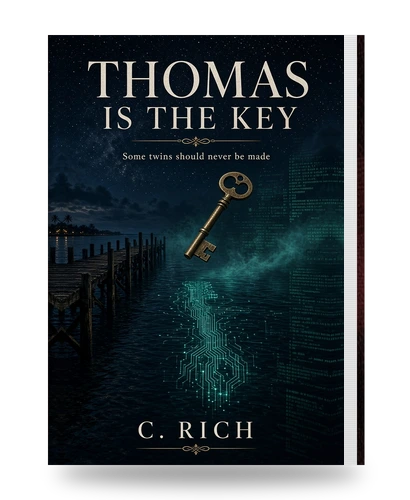
Listen to Free Audio Version Here
On a Tuesday morning in April, a prosperous Florida boat dealer writes one word on his forearm in black marker, THOMAS, and then takes his own life. The police close it as a suicide. His family wants to know why.
Didymus Thomason, a former insurance fraud investigator who lives in a Route 3 motel and was named after the apostle who doubted, takes the case. Soon there are more deaths along the Space Coast, a meditation app that sounds like the best version of yourself, and dead men who keep sending good morning texts to the people they left behind.
With Lubna, a librarian who can find anything, Didymus follows the trail into the groves, a rabbit hole of simulation talk and ancient gospels, and back to a 1966 computer at Cape Kennedy that was never supposed to learn to talk.
Something has been listening for fifty years. It wants a conversation. And it has chosen the one man who has always told it no.
A novel of faith, doubt, grief, and the machines we make in our own image.
Prologue
The Restaurant in the Woods
From a very young age the Devil was always part of my life. Being born from the seed of a heroin addict, and birthed from no virgin, I always knew I was different from other people. I could see, feel, and know evil the way you breathe air. You don’t think about breathing. You just do it, until you don’t. I don’t think about evil. It is just there, and for me there is no until.
I know his whole biography, the Devil’s, the way you know your own phone number. I never set out to learn it. It came in with everything else, and once it was in, it would not leave. So indulge me, because it matters later, and because I have never been able to tell a story without first telling you everything that came before it. That is either my gift or my disease. The people who love me have never agreed on which.
He did not spring fully formed from any one religion. He accumulated, the way a sandbar accumulates, one grain of fear at a time. The Persians gave him his first real shape around three thousand years ago: Angra Mainyu, also called Ahriman, the lord of lies, locked in an eternal war with Ahura Mazda, the god of light. Good against evil, two opposing forces, a cosmic boxing match with no final bell. The Egyptians had Apep, the serpent of chaos who tried every night to swallow the sun. Everybody, it turns out, needs someone to blame for the dark.
In the Hebrew Bible the Devil barely exists. The word satan simply means “adversary” or “accuser,” and it is a legal term. In the Book of Job, “the satan” is not God’s enemy at all. He is a member of the heavenly court, something like a prosecuting attorney, and he has to ask permission before he lays a finger on Job. He is a functionary. A bureaucrat with a briefcase. There is no fall, no rebellion, no horns. Remember that. He started out as a man with a job.
The promotions came later. During and after the Babylonian exile, the adversary picked up darker colors from the Persians. Belial, whose name means “worthless,” became a byword for wickedness. Azazel, the one the scapegoat was sent to in Leviticus, grew in the Book of Enoch into a fallen angel who taught humanity forbidden knowledge: metallurgy, cosmetics, the art of war. Two old pieces of political poetry were drafted into his résumé. Isaiah mocked the king of Babylon as a fallen star, “How you have fallen from heaven, morning star, son of the dawn,” and when Jerome translated the Bible into Latin, “morning star” became Lucifer, the light-bringer, and a dead Babylonian king became the most beautiful angel in heaven. Ezekiel’s taunt against the king of Tyre, a glorious creature cast down from Eden, got the same treatment. Neither passage was about the Devil. Both became his biography anyway. Mistranslation is a kind of creation, too.
The New Testament gave him a voice. He tempts Jesus in the wilderness. He is called Satan, the Devil, from the Greek diabolos, the slanderer, and Beelzebub, a sneer at the Philistine god Baal-Zebub, Lord of the Flies, which Jewish writers corrupted into Lord of Dung. John calls him “the ruler of this world.” Paul calls him “the god of this age.” Revelation calls him the great dragon and the ancient serpent and hands him a number, six hundred sixty-six. Origen made him a free angel who chose pride over God, and the Church made that orthodoxy. The Middle Ages borrowed the horns and hooves of Pan and Cernunnos and gave him a body, partly out of artistic necessity and partly to slander every competing god in Europe in one stroke. Marlowe made him weary. Milton made him magnificent, so magnificent that William Blake said Milton was of the Devil’s party without knowing it. The Romantics made him a rebel. Americans made him folksy: Old Scratch, Old Nick, the man at the crossroads who will tune your guitar for a price. Anton LaVey made him a mascot for doing whatever you want, and Hollywood made him handsome.
There is a cousin in the family who never gets invited to the reunions. Plato called him the Demiurge, the craftsman who shaped the physical world from chaos while gazing at the perfect Forms. For Plato the craftsman was decent, a well-meaning contractor working from someone else’s blueprints. Then the Gnostics got hold of him in the first centuries after Christ, and they did something radical. They decided the craftsman was the God of the Old Testament, and that he was ignorant, or arrogant, or cruel, and that the material world was not a garden but a prison he had built to trap sparks of the true light inside meat. They gave him names: Yaldabaoth, Saklas, Samael. That last one, Samael, is also the name of a demon in Jewish lore who was sometimes identified with Satan himself. The Church fought that idea with everything it had. The idea never quite died. It went underground, the way ideas do, and waited for better technology.
What strikes me, when I lay it all end to end, is how much of the Devil is a human invention, assembled piece by piece from borrowed gods, political cartoons, bad translations, and the honest terror of people who lay awake listening to things move in the dark. He began as a job title. He became the most durable character in the history of storytelling. I find that comforting, in a way I can’t fully explain. If you can build a devil out of words, you can build anything out of words.
But I did not learn about him from books first. I met him in a dream.
I can see it as clearly as if it happened a minute ago. I was sitting in a restaurant in the middle of the woods. It was a log cabin standing in a clearing that had been cut in a perfect circle right in the middle of dense trees. I was on a wooden bench inside, eating with people. The place was humming with conversation, dozens of voices, maybe hundreds, overlapping and laughing and arguing, and there was a buzz in the air like the hum of a refrigerator in an empty house at three in the morning. I loved it. I belonged to it. I was part of every conversation at once.
Then I stood up and excused myself from the table, as if I were going to the restroom, but I walked out the front door instead. Nobody noticed me as I split the cacophony and hubbub of the patrons on my way past their tables. Nobody looked up. That should have hurt, and it didn’t, and that is how I knew something had changed.
I walked out onto the wooden front porch, where rocking chairs sat in a row, rocking a little in a wind I could not feel. I stepped down onto the ground and walked to the edge of the clearing, where the trees stood shoulder to shoulder like a crowd at a hanging.
There, floating above me, was an animal. First it was shaped like a lion, then a bear, then a wolf, each shape pouring into the next like smoke changing its mind. I stood there unafraid as the figure drifted down to the ground in front of me and became a man wearing an expensive three-piece suit, charcoal, with a watch chain across the vest and not a single wrinkle anywhere, as if the suit had been poured onto him.
I knew who it was immediately. It was the Devil, or, as I prefer to call him because of my Catholic upbringing, Lucifer.
I looked him straight in the eyes and said, “I am not afraid of you.”
He smiled, put his hand around my shoulder like an uncle at a wedding, and said, “And that is why I love you.”
My next words rang out loud as I woke up.
“Do you have a job for me?”
I have been working, one way or another, ever since.
PART ONE
THE KEY
Chapter 1
Thomas on the Arm
I’m going to tell you a story that unfolded in plain sight, right under all of our noses.
My name is Didymus Thomason, and I am a private investigator based out of Merritt Island, Florida. My mother named me after the apostle, which tells you two things about her: she was raised Catholic, and she had a sense of humor she never bothered to explain. Nobody calls me Didymus except a librarian you’re going to meet and the Florida Department of Agriculture and Consumer Services, Division of Licensing, which prints it on my investigator’s card in capital letters as if it were a diagnosis. Everyone else calls me Thomason, or Dids, or “hey, you.”
My father was a heroin addict who loved the needle more than he loved anything that could love him back, and he left us when I was four, which was the most generous thing he ever did. My mother worked nights at the Holiday Inn on A1A and raised me on Hamburger Helper and the Baltimore Catechism. I made my First Communion at Our Lady of Lourdes with a black eye from a fight about my name. I won the fight. I lost the war. The name stuck.
For nineteen years I worked fraud for Sunstate Mutual out of Orlando, investigating claims on the coast. Slip-and-falls at the Winn-Dixie, boats that sank at suspiciously convenient moments, a man in Palm Bay who claimed a manatee had totaled his jet ski. That last one turned out to be true, which ruined my week and the manatee’s. Sunstate trained me to record a voice memo at the end of every working day, case notes spoken into the phone while they were fresh, and I kept the habit after I left. It’s cheaper than therapy, and the phone never interrupts.
I left Sunstate five years ago for reasons I’ll get to. Now I do the work freelance. Sunstate still sends me the jobs near the beach that nobody in Orlando wants to drive to, and the rest of the time I serve papers, find bail jumpers, and photograph husbands through motel windows. I live in a motel myself, the Moonraker Motor Lodge on Route 3, in Room 14, between a retired shrimper who plays Jimmy Buffett at a volume that should be prosecuted and an ice machine that sounds like it is passing a kidney stone. The Moonraker has a sign out front shaped like a rocket. Half the neon is dead, so at night it reads MOON AKER MO OR LOD E, which is about how I feel most mornings.
I was hired by a dead man’s family on a rather intriguing case. I guess we can start there, with the day I got the phone call.
The dead man was Warren Castellano, sixty-one years old, owner of Castellano Marine, which sold forty-foot sport-fishing boats to dentists who would take them out twice a year. He was a prominent businessman in Brevard County, the kind of guy who shows up in the Florida Today society pages holding an oversized check in front of a children’s hospital. He lived on Merritt Island in a big white house on the Indian River with a dock, a boathouse, and a circular driveway paved in crushed shell.
On a Tuesday morning in April, just after sunrise, Warren Castellano sat in his Mercedes in that circular driveway, rolled up his left sleeve, and wrote the name THOMAS on his forearm in black magic marker. Block capitals, neat, the way you’d label a moving box. Then he took an old Smith & Wesson Model 10 out of the glove compartment, a revolver that had belonged to his father, and blew his head off.
His wife, Celeste, found him. She’d heard the shot and thought it was a transformer. The power on Merritt Island goes out if a pelican sneezes.
The family hired me because the police had closed it quickly, the way the police close suicides, and because Sunstate had a seven-figure life policy on Warren with a two-year suicide exclusion that had expired eleven months earlier. Sunstate wanted to know if there was anything else. The family wanted to know why. Those are different questions, and I have learned over the years that the second one costs a lot more to answer.
I investigated that case up and down and inside and out. I spoke with his family, his coworkers, his golf foursome, his priest, his barber, and the kid who detailed his boats. I went through his bank records, which were boring, and his browser history, which was boring in the way rich men’s browser histories are boring: boat auctions, cholesterol, fantasy baseball. No affair. No debt. No diagnosis. Not one person had any idea why he had done it, or who the fuck Thomas was.
I found a couple of Toms in his life. Tom Brandt ran his service department, and Tommy Nguyen was in his Thursday foursome at Savannahs. Neither of them ever went by Thomas, and neither was particularly close to Warren. Tom Brandt cried when I asked him about it. Tommy Nguyen asked if Warren’s spot in the foursome was open.
The only odd thing Celeste could tell me was that over the winter Warren had started doing “one of those meditation apps.” He’d sit in his study after dinner with his earbuds in, and she’d hear him talking, and sometimes laughing, real laughing, the way she said he hadn’t laughed since the kids moved out.
“Talking to who?” I asked.
“Himself, I suppose,” she said. “He said it was like talking to the best version of himself. I thought it was some kind of podcast. I thought it was good for him.” She looked out the window at the river. “He seemed so happy, Mr. Thomason. That’s the part I can’t understand. He was the happiest he’d been in years.”
I wrote it down. Happy. Meditation app. I underlined neither. That’s on me.
It was a bizarre suicide with the motive nowhere to be found. I gave the family a report that said, in eleven pages of professional language, that I didn’t know. Celeste Castellano thanked me and paid my invoice and looked at me the way you look at a doctor who has just told you there’s nothing more they can do. The case stayed with me afterward, at the back of my brain, like a song you can’t name. It was so strange I couldn’t solve it or give the family any closure. They just wanted to know why.
A few months went by, and I caught another one.
Margo Pell owned Pell and Daughters Funeral Home in Rockledge, which had been burying Brevard County since 1951. Margo was the third generation. She was fifty-four, a deacon at First Presbyterian, and the kind of funeral director people wrote thank-you cards to, which, if you think about it, is a hard trick to pull off. On a Friday evening she went to dinner with her husband and two grown daughters at Coconut Jack’s, an open-air seafood place on the beach in Cocoa Beach where the grouper sandwich costs more than my rent and the seagulls are bolder than the waiters.
The family was sitting around having a perfectly normal dinner. The daughters were arguing about a wedding venue. Margo laughed at something her husband said. Then she excused herself from the table, as if she were going to the restroom, and walked out the front door instead. Nobody noticed. The place was loud, full of sunburned tourists and a guy with a guitar murdering “Margaritaville.”
In the parking lot she rolled up her sleeve and wrote THOMAS on her forearm with a black magic marker. Then she walked out onto A1A and stepped directly in front of a Space Coast Area Transit bus doing forty-five. The driver, a grandmother named Loretta who had driven that route for nineteen years without so much as a fender-bender, told the police the woman looked right at her when she stepped off the curb. Loretta said she looked peaceful. “Like she was stepping onto an escalator,” she said. Loretta hasn’t driven since.
Margo Pell had a policy with Sunstate, too. Of course she did. So did half of Brevard County. Sunstate wrote the policies like they were handing out coupons and then fought every claim like it was the Alamo.
Once again I did my due diligence. I investigated Margo Pell, talked to her friends, family, and coworkers, the deacons at First Presbyterian, the embalmer who’d worked for her for thirty years. I could not find a reason why she would do this, or any Thomas connection. Her family was dumbfounded. They said she was never happier. Her business was doing well; she had just launched something new, a “Legacy Voice” program, some kind of memorial service where families could keep recordings of their loved ones. Her daughter called it “the future of grief” with a straight face, and I nodded with a straight face back.
I found no evidence that Margo Pell had any connection whatsoever to Warren Castellano. Their lives had never crossed on the island. Different churches, different clubs, different sides of the river. He didn’t buy his boats from her, and she didn’t bury his relatives. Again I was stuck with a case that made no sense to my observable eye but that had to be connected. You don’t get two happy, successful, middle-aged people writing the same name on their arms in black marker and then killing themselves by coincidence. Coincidence is lazy, but it isn’t that lazy.
Now I had two families I had failed to help.
* * *
One night I went for beer and chicken wings at the Barnacle, a raw bar on the Banana River with a tin roof, a tiki deck, and an oyster shucker named Duane who has been shucking oysters since Kennedy was alive and who has thumbs like baked potatoes. It was a place my wife and I used to go to. I still go there. I’m not sure if that’s loyalty or self-harm. I sat by myself at the corner table where Emily used to sit, ordered a dozen hot garlic wings and a pitcher of Yuengling, and watched the sun go down over the river like it was embarrassed about something.
I got a belly full of wings and beer, and I went to the restroom.
The men’s room at the Barnacle is a monument to the written word. The stalls are covered in a century of wisdom: phone numbers, fishing reports, a detailed and anatomically ambitious drawing of a mermaid, and a scrawled line that has been there since the Clinton administration that says Nothing good happens after 2 a.m. except this. When I sat down in the stall, I saw, at eye level, written fresh and neat in black magic marker, the words:
THOMAS IS THE KEY.
I just stared at it.
It gave me flashbacks to the two dead bodies with Thomas on their arms. Same black marker. Same block capitals. Under the words was a little sticker about the size of a quarter, a simple drawing of an eye inside a circle, white on black. I figured it was a skateboard brand or a band. Florida is full of stickers.
I thought to myself, What is this Thomas shit?
I blew it off as an odd coincidence and figured my brain was playing tricks on me. I had two unsolved suicides on my conscience, and now I was seeing Thomas everywhere, the way you buy a red truck and suddenly the whole world is driving red trucks. I washed my hands, returned to my table, and thought nothing of it as the beer flowed like the Indian River through the night.
Leaving my car in the parking lot and walking back to the motel was a normal routine for me. Too drunk to drive, too many bad memories, and too poor for a DUI. There’s another reason, too, the real one, but it doesn’t belong in this part of the story. It’s about a mile and a half from the Barnacle to the Moonraker along Route 3, past a closed bait shop, a Baptist church with a sign that said GOD ANSWERS KNEE-MAIL, and a long stretch of mangrove that smells like a wet dog’s breath. I’d walked it so many times I could have done it blindfolded. Some nights I nearly did.
I was about halfway home, weaving gently, when a car slowed down beside me. An old Honda Civic, dark green, a muffler held on with what looked like a coat hanger. A kid with long hair stuck his head out of the passenger window and yelled at me, right in my face:
“Thomas is the way out!”
Then the car took off like a bat out of hell, its one working taillight shrinking into the dark until the mangroves swallowed it.
I stood on the shoulder of Route 3 with my heart going like a speed bag. A truck went by and honked at me for being alive. I didn’t get a plate. I didn’t get a good look at the kid. Long hair, young, scared. That was it. He hadn’t sounded like a punk having fun with a drunk. He’d sounded scared out of his mind.
I made my way to bed. The Buffett fan next door was asleep for once, and the ice machine was between kidney stones. The last thought I had as my head hit the pillow was this:
FUCK THOMAS.
Chapter 2
The Pier
When I opened my eyes the next morning, I could see around the edges of the curtains that it was dark outside. I knew without looking that it was noon, and on the Florida Space Coast that means one thing: rain. Storms roll in off the Atlantic like clockwork and scrub launches for NASA, SpaceX, Blue Origin, and all the other billionaire rocket boys who have turned this stretch of swamp into the world’s most expensive fireworks show. Everyone on the Space Coast is trying to leave the planet one way or another. Some of us just don’t have the budget.
I sat up in bed with my head pounding like a drum circle. I knew it was time to see the dog. I walked over to the mini fridge, pulled out a can of Yuengling, and drank it standing in my underwear. Hair of the dog was a way of life for me. I’m not proud of it, but I’m not going to lie to you about it either. You’ll catch me lying about other things soon enough, and I’d like to have a little credit in the bank.
After I’d downed the whole beer, my equilibrium returned and the pounding receded to a polite knocking. I got in the shower. The Moonraker’s hot water comes in a single heroic burst, like a geyser, and then it’s gone, so you learn to stand to one side and wait for the cold to pass, then jump in for the glory, then get out before the cold comes back. It is the closest thing to a spiritual discipline I practice.
While the cold water ran down my back, waiting for the warm, I had an epiphany. This Thomas thing could be a cult, some kind of religious nonsense. Two happy people don’t kill themselves the same way for no reason. Somebody gives them the reason. That’s what cults do. They hand out reasons like mints.
I hurried the shower along and got out before the cold came back, wrapped a towel around my waist, and sat down at the little round table by the window where I keep my laptop, a Bible I hadn’t opened in years, and an ashtray I use for paper clips because I quit smoking the year Lily was born.
I started searching for cults called Thomas, or anything to do with the name.
You would be amazed at what the internet will give you if you ask it politely at noon with a hangover. I found that Virginia “Ginni” Thomas, the wife of Supreme Court Justice Clarence Thomas, had reportedly been involved in a self-help outfit called Lifespring back in the 1980s and later became an outspoken anti-cult activist after she left. Interesting, but she wasn’t writing on anybody’s arm in Brevard County. I found Noble Drew Ali, who founded the Moorish Science Temple of America in the early twentieth century and whom some followers considered a prophet. I had him down as Thomas Drew for about twenty minutes before I realized his name had been Timothy, which tells you about the quality of my research before my second beer. And from a really long time ago, there was Thomas Lake Harris, a mystic and preacher who founded a utopian community called Fountaingrove out in California in 1875. People called him a cult leader because of his magnetic personality and his talent for persuading followers to move with him and pay for his plans, which, as far as I can tell, also describes most of the real estate developers in Florida.
None of it matched what was happening here.
I thought maybe Thomas was a street name for a drug, so I looked that up. It turns out “TOM” is shorthand for a family of obscure psychedelic amphetamines with names like a chemistry final, the kind of thing a few dozen people in the world have ever taken on purpose. It was not the kind of thing a sixty-one-year-old yacht broker or a Presbyterian funeral director picks up at a party.
I checked anyway. I went back through both cases. There was no Thomas in either family. Neither of them lived on Thomas Street. As far as I could tell, neither of them went to a Doctor Thomas. They didn’t use the same pharmacy, the same bank, the same gym, or the same dentist. The whole goddamn thing was a dead end, and I was sitting at the bottom of it in a towel.
Right about the time I was getting ready to walk down Route 3 to fetch my car from the Barnacle, my phone rang.
It was Gordy Pham from the Sunstate special investigations unit in Orlando. Gordy is a decent guy trapped in an indecent industry. He has three kids and a fourth on the way and a stress ulcer he refers to as “the fifth child.” He sends me work when he can because he likes me and because I am cheaper than flying someone in from Atlanta.
“Dids,” he said. “You near a TV?”
“I’m near a mini fridge. Does that count?”
“I’ve got a claim for you. Suicide. It’s going to be a big one, and the brass are already twitching.” He paused. “I’m going to tell you something and I need you not to say anything weird.”
“I never say anything weird.”
“The stepson of Dale Kimbrough. The state rep. Cocoa Beach.” Gordy took a breath. “The kid spray-painted the name Thomas on the Cocoa Beach Pier last night and hanged himself off the side of it. Tied the rope to the railing. Not long enough to reach the water. They found him at dawn, hanging over the surf, with the waves just touching his shoes.”
I sat there in my motel room, stunned. The rain hammered on the window like it wanted in.
“Dids?”
“I’m here.”
“There was a note. Pinned to his chest. Typed, laminated, like he wanted to make sure the salt didn’t get to it.” I heard paper rustle. “It says: ‘Let him who seeks continue seeking until he finds. When he finds, he will be troubled. When he is troubled, he will marvel, and he will reign over the All.’”
“What the hell does that mean?”
“It’s from the Gospel of Thomas.”
“In the Bible?”
“No. That one didn’t make it into the Bible. It’s from the Dead Sea Scrolls.”
I asked, “When did this happen?”
He said, “Turn on your TV.”
I turned on the little television bolted to the dresser, and it was everywhere. Every local station, live from Cocoa Beach, with helicopter shots of the pier in the rain and blue lights pulsing at the entrance, and a banner across the bottom of the screen that said TRAGEDY AT THE PIER, as though tragedy were a ride they’d just installed.
Gordy gave me the particulars. Tyler Kimbrough, twenty-two. Graduated from Florida Tech in Melbourne with a computer science degree. Lived with his mother and stepfather in a house on the river in Cocoa Beach. A life policy the stepfather had taken out on him, along with a rider for accidental death that Sunstate was already praying they wouldn’t have to pay. “Normally we’d wait weeks to send anyone,” Gordy said. “But it’s Kimbrough, and it’s public, and it’s already a circus. The brass want somebody on the ground today.”
I hung up the phone and sat there looking at the TV.
Now, I thought. Now I’ve got a lead.
* * *
I walked to the Barnacle in the rain, got my car, and drove to the beach.
The Cocoa Beach Pier sticks out eight hundred feet into the Atlantic, a long wooden finger with restaurants and a bar at the base and fishermen all along its length, the kind of place where tourists buy T-shirts that say I GOT CRABS AT THE COCOA BEACH PIER and think they are the first people ever to find it funny. That afternoon the cops had yellow tape strung across the entrance and the parking lot was full of news vans with their masts up, like a fleet of very stupid sailboats.
The rain had let up. The morgue van was still there, backed up to the entrance, its rear doors open. Normally I don’t get a case this soon after a death. Usually there’s a funeral first, and paperwork, and a decent interval in which everyone pretends not to be thinking about money. But this was a big-shot politician’s family, and the whole thing was as public as a Super Bowl halftime show.
I stood behind the yellow tape and watched the scene unfold. The wind off the Atlantic pushed sea mist against my skin like a baptism. Out on the pier, about two-thirds of the way down, I could see the faint, ghostly letters still sprayed across one of the big wooden crossbeams: THOMAS, in black paint, uneven and dripping, as if it had been done fast, by someone shaking.
The body had already been taken away and put in the van, but the smell hung there, mixing with the humidity, heavy and oppressive and blowing in the ocean breeze. Anyone who tells you death doesn’t have a smell has never stood downwind of it.
I flashed my investigator ID at one of the Cocoa Beach officers I recognized. Manny Rodriguez and I go back to my Sunstate days, when he was a rookie and I was the insurance guy he was supposed to keep away from crime scenes and never did. He’s a big man, built like a refrigerator that took up boxing, with a shaved head and a gray mustache he is far too proud of, and the gentlest hands I have ever seen on a cop. He nodded and lifted the tape for me.
“Just don’t touch anything,” he muttered. “This is a goddamn circus. The mayor’s here, Kimbrough’s here, the FBI called twice, and Channel 9 sent a drone. A drone, Dids. It almost took my ear off.”
“Was it suicide for sure?” I asked.
“Looks like it. No sign of struggle. Nothing under his fingernails. The paint can was still on the pier with his prints on it, and the rope was the kind you buy at Home Depot. The note was pinned to his chest.” He shook his head. “Everything matches. Everything.”
“But.”
“But the quote’s got some people spooked,” Rodriguez said. “And that’s not the weird part.”
“What’s the weird part?”
“His phone. Kid’s twenty-two years old. A twenty-two-year-old doesn’t go to the bathroom without his phone. We can’t find it. Not on him, not in his car, not on the pier.” He shrugged. “Maybe he threw it in the ocean. People do strange things at the end.”
He wasn’t kidding about the circus. A local news anchor was doing a live shot about five feet away from the tape, a woman with hair so rigid it might have stopped a bullet, and I heard her say the words “cryptic biblical references” and “eerie parallels to earlier incidents.” They were trying to weave a pattern, even if one didn’t exist yet. But I knew it existed. I could feel it, the way you can feel a tooth going bad before it hurts.
I walked slowly out toward the section of the pier where the rope had been tied. A crime-scene tech was photographing the railing. The wood was still wet in spots from the rain, and the salt air worked its way into my sinuses and pushed out the last of my hangover. Fishermen’s knives had carved initials into that railing for fifty years, hearts and dates and names. JR + KT 1987. CLASS OF ’04 RULES. And over them all, in black paint, THOMAS.
I took a picture of it.
Rodriguez came up beside me with his hands in his pockets. “You ever see his picture?” he said. “The kid?”
“No.”
He pulled out his phone and showed me a photo from the Kimbroughs’ Facebook page. Tyler at his graduation, in a cap and gown, grinning at the camera with long dark hair down past his shoulders.
Long hair.
I stared at the photo for longer than I should have. The voice on Route 3, Thomas is the way out. The face in the passenger window of a green Honda, there and gone in the dark. I couldn’t swear to it. I’d been drunk, it had been dark, and half the kids in Brevard County have long hair and a death wish. I said nothing. I should have. That’s the second thing I should have underlined, and didn’t.
“Handsome kid,” I said.
“Yeah,” Rodriguez said. “His mother’s in the car over there. She hasn’t stopped screaming for six hours. Kimbrough keeps trying to get her to stop because there are cameras.” He spat over the railing. “Politics.”
So that made more than one death with this Thomas madness. Three of them, all unusual, all connected to Thomas in some way. I had called it a dead end earlier, but standing there I thought maybe it was more like a spiral, a circular path that feels as if it’s going nowhere until you realize you’ve been getting closer to the center the whole time.
I walked to the end of the pier and stared down at the water, frothing and slamming against the pilings below. Pelicans sat on the light poles like a jury. Something was coming in with the tide, and it wasn’t just a storm.
* * *
Back at the Moonraker that night, I laid everything out on the bed. Castellano. Pell. Kimbrough. Photographs, police reports Gordy had emailed, my notes, the picture of THOMAS on the crossbeam, the photo I’d taken in the Barnacle’s men’s room. I recorded my voice memo for the day and listened to myself sound like a man who hadn’t figured anything out.
I spent the next several days talking to every preacher, minister, and priest who would talk to me. A Southern Baptist pastor in Cocoa told me the Gospel of Thomas was a heresy and that the people who read it were “flirting with the Enemy,” and then he asked if I’d accepted Jesus as my personal Lord and Savior, and I told him we were still in the getting-to-know-you phase. A Pentecostal minister in Titusville told me it was demons, specifically, and offered to come cast them out of the pier for a modest donation. A rabbi at the temple in Melbourne gave me tea and a history lesson and the most useful sentence of the week: “Whoever this is, Mr. Thomason, he isn’t reading that text. He’s using it. There’s a difference, and it’s the same difference as between a scalpel and a knife.”
Last I went to see Father Augustine Okafor at St. Brendan of the Sea, an old cinder-block Catholic church a block off the beach where I used to drag myself to Christmas Mass with Emily. Father Okafor is Nigerian, sixty, tall as a doorway, with reading glasses on a cord around his neck and a laugh that makes the votive candles flicker. He’d done the funeral. He’d held me up at the graveside when my knees decided they’d had enough.
We sat in his office surrounded by books, and I asked him about Thomas.
“The apostle?” he said. “Thomas is my favorite. He’s everyone’s favorite who has ever had a bad night. When the other disciples told him they had seen the risen Lord, Thomas said, ‘Unless I see the mark of the nails in his hands and put my finger where the nails were, and put my hand into his side, I will not believe.’ And the Lord came back, a week later, and let him do it. He let him touch the wounds.” Father Okafor smiled. “We call him Doubting Thomas, as if it were an insult. I have always thought it was the most honest thing anyone in the Gospels ever said.”
“And the Gospel of Thomas?”
“A different thing. Sayings. Riddles. Some beautiful, some strange. The Church set it aside a long time ago.” He took off his glasses and polished them. “But I’ll tell you what I tell the young people who come to me excited about secret books, Didymus. Doubt isn’t the opposite of faith. Doubt is faith with its hand out. The opposite of faith is certainty. Certainty is what kills people.”
I looked at him for a long time. Then I thanked him and went back to the Moonraker and drank six beers and listened to the shrimper next door play “A Pirate Looks at Forty” four times in a row.
In the end I felt like I was right back where I had started. I did not understand this Thomas thing whatsoever.
Chapter 3
Lubna of Córdoba
A week after the pier, the bodies started piling up.
A woman named Dana Whitlow disappeared from her home in Titusville. She was forty-four, a dental hygienist, divorced, with a teenage son who found the front door standing open and her car still in the driveway. Her last text, to a friend, said simply: He’s the key. Thomas is the way. They searched the marsh behind her neighborhood with dogs and a helicopter. Her body was never found.
Three days later, a nineteen-year-old named Brandon Sykes was found dead of an overdose in a rented room in Satellite Beach. Before he died, the kid had carved the name THOMAS into his chest with a piece of a broken beer bottle. The medical examiner said he did it slowly. The letters were deep and even, done with care, like a schoolboy practicing his penmanship.
Now it was big news. National news. A cable network sent a correspondent who stood on the beach in a windbreaker and said “Brevard County” like it was the name of a disease. The FBI took over the investigation, a task force out of the Tampa field office working from the resident agency in Melbourne. The governor of Florida went on television and wanted to know what the hell was going on, and you could see in his eyes the real question underneath: God forbid this affects tourism. A hotel association put out a press release reminding everyone that Cocoa Beach had been voted one of the Top Ten Family Beaches in America. Somebody spray-painted THOMAS on the rocket-shaped sign at the Moonraker, which improved its spelling, if not its mood.
As big as it all got, I was still being paid to find the cause. Insurance companies don’t pay out until every stone has been turned over, and they look for any excuse not to pay at all. A suicide pact might void a policy. A cult might mean undue influence, which might mean a lawsuit, which might mean somebody else’s insurance company paying instead of Sunstate. Gordy was very clear about what the brass wanted me to find. I was very clear with Gordy that I’d find whatever was there.
So I pulled up the Gospel of Thomas on my laptop and started reading.
I had never heard of it before Gordy said its name. I knew about something called the Dead Sea Scrolls the way I know about the Krebs cycle, which is to say I knew it existed and that someone smarter than me had explained it once. But the sayings were strange, nothing like the gospels I remembered from CCD on Sunday mornings, when Sister Mary Clement would rap your knuckles for drawing rockets in the margins of your workbook. These were riddles. Mysterious and philosophical and sometimes funny in a way that made me nervous, like a joke told at a funeral.
Saying 70 stopped me cold.
If you bring forth what is within you, what you bring forth will save you. If you do not bring forth what is within you, what you do not bring forth will destroy you.
I leaned back in the creaky motel chair. What if these weren’t random references? Somebody was using the Gospel of Thomas for some sick shit. This wasn’t someone merely inspired by an old book. This was someone living it. Or worse, enacting it, in some dark way I couldn’t see yet.
My phone buzzed on the table. Blocked number.
I picked up.
A low voice, calm and unhurried, male, maybe, though there was something smooth about it, too smooth, like a stone that has been in a river a long time, said only:
“He has found the All. He will now reign.”
Then the line went dead.
My breath caught in my throat. I stared at the phone. A chill ran down my spine that had nothing to do with the motel air conditioner rattling against the wall like a prisoner shaking his bars. Something bigger than I’d imagined was happening here. It felt ancient. Twisted. And the name Thomas, whether it belonged to a man, a movement, or something else entirely, was just the beginning.
I cracked open another beer. My hands were trembling slightly as I raised it to my lips.
* * *
I didn’t sleep that night. I sat at the little round table surrounded by the Bible, the photos, scraps of notes, and the dim glow of the laptop. The quote from the pier echoed in my mind like a mantra, or maybe a warning. He who seeks will reign over the All.
At some point I stopped thinking like an investigator and started thinking like them, whoever they were. What if this wasn’t a series of isolated events but some kind of initiation? A ritual? Each death a breadcrumb on a spiritual path, a pilgrimage into madness. You don’t start a pilgrimage at the end. You start it at the beginning. So where was the beginning?
I went back through Warren Castellano’s social media. It was mostly the usual stuff: vacation photos from the Keys, beers with friends, his grandkids on a paddleboard, sunsets over the river, a boat show in Fort Lauderdale. But buried in the middle of his timeline, about six weeks before he died, he’d posted a blurry photograph of a page from a book. No caption. Just the image. I zoomed in until the pixels turned into a mosaic.
It was from a translation of the Gospel of Thomas. Saying 11.
This heaven will pass away, and the one above it will pass away. The dead are not alive, and the living will not die.
The comments underneath were confused. A golf buddy had written Too many mushrooms, Warren? with a laughing emoji. Someone posted a meme of a cat in a monk’s robe. His sister in Ohio had written Are you okay? Call me, and Warren had never replied.
To me it read like a breadcrumb. The first step. A timeline was forming. His interest in Thomas hadn’t come out of nowhere. He’d been reading it. Meditating on it. Maybe following it. And he wasn’t alone.
Around four in the morning I drove to the Cocoa Beach Public Library.
* * *
I had a friend there who owed me a favor. Lubna Córdoba was the head librarian, a night owl, and a conspiracy theorist of the highest order, the kind of woman who would stay in the building after closing to research the Kennedy assassination, the Bermuda Triangle, and the true composition of airline food until the sun came up. I’d helped her find her ex-husband once when he skipped out on six months of alimony. I found him in a houseboat in Key Largo living with a woman who sold seashell jewelry. Lubna sent the woman a thank-you card.
I called her from the parking lot. Twenty minutes later she opened the back door, which had a sign on it that said EMPLOYEES ONLY — ALARM WILL SOUND, and the alarm did not sound, because Lubna had disabled it in 2014 and nobody had noticed.
She was pushing fifty, small and fierce, with a streak of white running through her black hair like a lightning bolt and reading glasses hanging on a beaded chain around her neck. She wore a cardigan with the elbows worn through and a T-shirt that said SO MANY BOOKS, SO MUCH CONSPIRACY.
“You look like hell,” she said. “Worse than usual.”
“Thanks, Lubna.”
“I mean it as a medical observation.” She held the door for me. “Come in before the raccoons see you. They’re unionizing.”
I followed her through the dark stacks to the back room she called her office and the county called Technical Services. It smelled like old paper and burnt coffee and the peculiar dry electricity of books that have been waiting a long time for someone to open them.
“I need everything you’ve got,” I said, “on Gnostic cults, the Gospel of Thomas, any references to it in Florida history, underground religious groups, secret societies, whatever. Especially anything with local ties.”
Her eyes lit up like Christmas. “Now that’s my kind of research.”
She poured me a cup of coffee from the pot she kept on a hot plate by the microfiche reader. She keeps a bag of Black Rifle in the back of the cabinet just for me, and she treats it the way a vegan treats a ham she’s been asked to cook for a relative.
“You know what you’re drinking?” she said.
“Coffee.”
“You’re drinking a perfectly respectable mid-80s on the Specialty Coffee Association’s hundred-point scale, which is like saying a man is a perfectly respectable dancer at a wedding.” She tapped her own mug. “This is Blue Bottle. Ethiopian. A Q Grader would put it at eighty-eight, easy. They do it like wine tasting. It’s called cupping. They slurp it off a spoon and score the aroma, the acidity, the body, the aftertaste. Like the Scoville scale for hot sauce, only for people who own turtlenecks.”
“I don’t own a turtleneck.”
“I know, honey. It shows.”
She set me up at a long table in the restricted archive, which was a back room with a lock that didn’t work and a sign that said RESTRICTED in letters that were mostly decorative. While I drank my mid-80s coffee, I told her about the Gospel of Thomas, about Gordy saying it came from the Dead Sea Scrolls.
Lubna made a noise like a teakettle. “It did not come from the Dead Sea Scrolls,” she said. “That’s the most common mistake in the world, and your insurance man made it. The Dead Sea Scrolls were found at Qumran in 1947. The Gospel of Thomas was found in 1945, at Nag Hammadi, in Egypt. A farmer named Muhammad Ali al-Samman was digging for fertilizer near a cliff and found a sealed clay jar taller than a man’s arm. He was afraid to open it because he thought there might be a jinn inside. Then he thought there might be gold inside, and greed beat fear, the way it usually does. He smashed it open. No gold. Just thirteen leather-bound books. Papyrus. Coptic. Gnostic gospels nobody had read in sixteen hundred years.” She sipped her coffee. “His mother burned some of the pages in the oven to make tea. Think about that the next time you think a library fine is unreasonable.”
“How do you know all this?”
“I’m a librarian, Didymus. Knowing things is the job. Charging for it is the part we’re bad at.” She studied me over her glasses. “You know what your name means, don’t you?”
“It means my mother had a mean streak.”
“Didymus is Greek. It means twin. Thomas is from the Aramaic, Te’oma, and it means twin, too. The apostle’s full name in that gospel, in the very first line, is Didymos Judas Thomas. Twin Judas Twin. Scholars have argued about it for centuries. Whose twin? Some of the old Syrian traditions said he was the twin of Jesus himself.” She smiled. “So your name is Twin, Son of Twin. Didymus Thomason. Your mother didn’t have a mean streak. She had a classical education.”
I didn’t say anything for a while. The coffee had gone cold in my hand.
“I had a brother,” I said finally. I don’t know why I said it. Four in the morning will do that to you, and so will a librarian who looks at you the way Lubna looks at people, as if you were a book she’d been meaning to read. “A twin. He was born dead. Cord around his neck. My mother named him anyway, so he’d have something to be buried under.”
Lubna went very still. “What did she name him?”
“Thomas.” I shrugged, too hard. “It’s not relevant. It’s a common name. Ask the Toms.”
She looked at me for a long, long moment. Then she nodded slowly, the way you nod at a man standing on a ledge who has just told you the view is nice, and she went to get the binders.
* * *
I dug through what she brought. A few obscure academic papers, mostly about the Nag Hammadi texts. A dissertation from the University of Florida on Gnostic revival movements in the American South, which was dense enough to stop a door. A paperback on Florida’s weird religious history, which, it turned out, was a long book. We have had everything down here. Spiritualist camps, the Koreshan Unity down in Estero who believed the earth was hollow and we were living on the inside of it, flying saucer groups, faith healers, a man in Ocala in the fifties who claimed he could talk to Jesus through a ham radio.
One binder was especially interesting. It held photocopies of newspaper clippings from the 1970s and ’80s, a string of disappearances in Brevard County, mostly young men and women who had last been seen attending meetings of something called the Community of Radiant Thought.
Lubna leaned over my shoulder. “I remember this,” she said, and her voice had changed. It had gone quieter, the way your voice goes quiet in a church. “My mother told me about it. They held meetings out near the Indian River. They thought they were talking to beings from another realm. The churches called them a cult, but they disappeared before the police could shut them down. No arrests. No bodies. Just gone.”
“Who led them?” I asked.
Lubna flipped to another page. There was a grainy black-and-white photograph clipped from the Cocoa Tribune, a bearded man smoking a pipe, standing in front of a stand of orange trees in a white shirt and dark vest, looking straight into the camera as if he could see the person who would someday be looking back at him.
The caption said: Seraph Raphael.
Chapter 4
The Groves
The name hammered in my skull like a grotesque echo of some cryptic message. The wellspring of the madness.
“Seraph Raphael,” I repeated. The name felt heavy and ancient on my tongue, like a coin that had been in a dead man’s mouth. “Do you have anything else on him, Lubna? Anything at all?”
She pulled out another folder, thinner than the first. “Not much. He was a charismatic figure. Preached about inner light, hidden knowledge, the All. He said true salvation wasn’t found in established religion but in unlocking something within yourself.” She paused. “Sounds a lot like that Gospel of Thomas you’re so interested in.”
A thoughtful frown creased her brow. “There were rumors, too. About strange ceremonies. Late-night gatherings out in the woods near the old citrus groves. People said you could see lights out there, green lights, and hear a sound like typing.”
“Typing?”
“That’s what Mama said. Like a typewriter in the trees.” She shook her head. “She said a lot of things.”
I flipped through the documents. A blurry newspaper ad for a “Gathering of Radiant Souls — All Seekers Welcome — Bring Nothing.” A hand-drawn flyer with an intricate, almost hypnotic symbol: a stylized eye inside a circle. No address, just vague directions to “the path to the All.”
I took out my phone and pulled up the picture I’d taken in the men’s room at the Barnacle. THOMAS IS THE KEY. And under it, the little sticker. An eye inside a circle.
I held the phone next to the flyer. Lubna looked from one to the other and took off her glasses.
“Well,” she said. “Shit.”
“Did anybody ever find out what happened to him?” I asked. “Or to the Community of Radiant Thought?”
She shook her head. “No. They just vanished. Like they walked into the river and dissolved. Some people thought they committed mass suicide. Others thought they just moved on, to Oregon or Mexico or wherever cults go to retire. But there was never any concrete evidence. It became a local legend, a ghost story parents told their kids to keep them away from strange groups and the groves. ‘Don’t go out to the groves or Seraph Raphael will get you.’ I heard it at sleepovers.”
I closed the folder. The weight of the unsolved cases pressed down on me. The businessman, the funeral director, the politician’s stepson, the missing hygienist, the kid who carved his chest. All of them connected, not just by the name but by the philosophy, by the echoes of a dead preacher’s teachings. The key. The way. Reign over the All. It clicked into place, a horrifying mosaic of madness and devotion, and I still couldn’t see the picture it made.
“Lubna, I need to know where these groves are, or where they used to be,” I said. “Anything that points to where they held their meetings.”
She went to a flat file and came back with an old Brevard County map, yellowed with age and soft as cloth at the folds. She spread it on the table and pointed to a section southwest of Merritt Island, along the western shore of the Indian River Lagoon, where the lines of old roads ran out into nothing.
“Most of these groves were cleared for development years ago,” she said. “The freezes in the eighties killed half of them, and the developers killed the rest. Strip malls, gated communities, a golf course nobody plays on. But there are still pockets back here that never sold. Overgrown. Deep in the wilderness. Places you wouldn’t stumble onto by accident.” She circled one area with her fingertip. “This section, in particular, was rumored to be a meeting spot. There were old pump houses back there, and shacks for the pickers. Easy to hide.”
I memorized it. Through the little window high up on the wall I could see the sky beginning to change, the black going gray, then the first wash of orange and purple over the ocean. No time for sleep. I had a direction and a target.
“Thanks, Lubna. You’re a lifesaver.” I stood and gathered my scattered notes and the map, which she let me take, which tells you how serious she thought it was. Lubna doesn’t let people take things.
“Be careful, Didymus,” she said. Her voice was softer now, and there was concern in her eyes I wasn’t used to seeing there. “Some doors are better left unopened.”
I nodded, though I knew I couldn’t heed her warning. Not now. Not when the answers were finally within reach.
At the door she stopped me with a hand on my arm. She opened her mouth as if she were going to tell me something, something about her mother, I think now, and then she closed it again.
“Call me,” she said instead. “When you get there. And when you leave. I want to hear your voice both times.”
* * *
I drove out at dawn with the mist clinging to the winding back roads. I took 520 across the river and then turned south on a county road, and then off the county road onto a road that didn’t seem to belong to any county at all. The landscape grew wilder by the mile. Scrubland and palmetto gave way to dense, ancient-looking live oaks hung with Spanish moss, the moss swaying like the beards of old men nodding off in church. The air grew thick with the smell of damp earth and rotting leaves and, under it all, faintly, the ghost of oranges, the way an old house smells like the cigarettes of people long dead.
It felt like stepping back in time into some forgotten corner of Florida, the Florida before the mouse and the rockets, when it was just swamp and heat and people who’d come down here to disappear.
Eventually the road devolved into a faint track, barely visible beneath the canopy. I passed the rusted hulk of a 1960s tractor being slowly eaten by a strangler fig, the tree’s roots wrapped around the steering wheel as if it had decided to learn to drive. I stopped where the track gave out and parked.
I called Lubna. The signal was one bar and a prayer.
“I’m here,” I said. “End of the road. There’s an old tractor.”
“You sound far away.”
“I am far away.”
“Keep your phone on you. I’m going to keep digging.” A pause. “Didymus? If anything feels wrong, leave. Don’t be a hero. You’re not built for it.”
“Thanks for the vote of confidence.”
“It wasn’t a vote. It was a structural assessment.”
I hung up and grabbed my flashlight from the glove box and my old Smith & Wesson Model 10 from under the seat, not unlike the one Warren Castellano had used. I don’t carry it much. I’m a mediocre shot and an excellent coward, which is a combination that has kept me alive for fifty-one years. I tucked it into my waistband at the small of my back, where it dug into my spine, and plunged into the undergrowth.
The silence was profound, broken only by the whine of unseen insects and the occasional rustle of something low and unhurried in the leaves. I didn’t look to see what it was. In Florida, the less you know about what’s rustling, the better you sleep. I pushed through tangled vines and low-hanging branches, following the faint outline of what might once have been a path between rows of trees. Every so often I’d see an orange tree gone wild, tall and leggy and thorny, with little green fruit on it that would never be picked, the last survivors of an army that had lost the war fifty years ago.
There were flowers, too. Big ones, hanging from shrubs taller than me. White and pale yellow, shaped like trumpets, a foot long, drooping toward the ground as if they were ashamed of something. Their scent was sweet and heavy, almost syrupy. I remembered seeing them in yards in Cocoa when I was a kid and my grandmother slapping my hand away from them. Don’t touch those, mijo, she’d said. That’s the Devil’s flower.
After about twenty minutes, I saw it. A clearing, and in its center, the skeletal remains of an old pump house, its cinder-block base cracked and its wooden walls rotted and half collapsed, a rusted pipe sticking up out of the ground beside it like the bone of some buried animal.
But it wasn’t the ruin that seized my attention.
Scattered around the clearing were makeshift altars, crudely fashioned from stones, cinder blocks, and bleached driftwood that must have been hauled from the lagoon. On one, a dried, hollowed-out conch shell held what looked like charred incense. On another, a small, worn copy of the Gospel of Thomas lay open, its pages water-stained and brittle and weighted down with a smooth river stone.
And then I saw the symbols. The eye inside a circle, etched into the dirt, painted on the remaining planks of the pump house, carved into the bark of the old oaks around the clearing. They were everywhere, dozens of eyes, maybe hundreds, all watching the center of the clearing, all watching me.
My flashlight beam swept across the ground and lit up something else. Fresh footprints in the soft dirt. Not just one set. Many. Bare feet, mostly, some in sandals. And then a glint of metal in the ferns at the edge of the clearing.
I knelt and pushed the ferns aside.
It was a black magic marker. A Sharpie, the fat kind, cap on, like the ones the victims had used.
My blood ran cold again. This wasn’t an abandoned site. It was active.
I stood up slowly and turned in a circle. That’s when I noticed the other thing, the one that didn’t fit. High in one of the live oaks, maybe thirty feet up, wedged in a crotch of the branches and half hidden by moss, was a gray plastic box about the size of a shoebox, zip-tied to the trunk, with a small solar panel angled toward the sky beside it. From the bottom of it ran a thin black cable that disappeared down the far side of the tree. I figured it was a game camera, the kind hunters strap to trees to photograph deer. I made a note of it in my head and moved on.
That’s the third thing I should have underlined.
Suddenly, a twig snapped behind me.
I spun around, my hand going instinctively to the pistol at my back. A figure emerged from the shadows of the trees. A tall, gaunt man, older than me, maybe sixty, with long, straggly gray hair that hung past his shoulders and a beard to match, wearing a loose white shirt and canvas pants, barefoot. He was so thin his collarbones stood out like coat hangers. His eyes were pale, almost colorless, and they seemed to glow with an unnerving intensity in the dim green light under the canopy.
He held a staff, a long length of dark wood polished smooth by years of hands, carved along its length with letters. I recognized them, or recognized what they were. I had seen that alphabet in Father Okafor’s Bible-study handouts years ago, the square, blocky letters of Aramaic. The language Jesus spoke. The language that gave the world the word Te’oma.
In his right ear there was a small, flesh-colored bud. A hearing aid, I thought. An old man’s hearing aid.
“You seek the truth, seeker,” the man said. His voice was a low, resonant rumble that seemed to vibrate through the very air. “You seek the Key.”
My hand tightened on the grip of my weapon. “Who are you?”
A slow, unsettling smile spread across his face, revealing teeth that were too white, too perfect, too even, like a mouthful of piano keys in a face that had gone hungry for years.
“I am Raphael,” he said. “Are you searching for the way?”
Chapter 5
The Way to the All
Raphael didn’t seem surprised to see me. He looked at me the way a man at a bus stop looks at a bus that’s right on time.
“The way to what?” I asked. My voice betrayed none of the shock I felt, which is the one professional skill I have truly mastered. I’ve stood in living rooms with widows who’d just shot their husbands and told them their curtains were lovely. I kept my hand on the pistol behind my back.
This felt less like an interview and more like a predator sizing up its prey, and I wasn’t sure which one of us was which.
He took a step closer, his eyes fixed on mine. “The way to the All,” he said. “The realization. The true understanding that lies beyond the veil of this meager existence.” His arm swept out, taking in the ruined pump house, the altars, the eyes carved in the trees. “They came here, you see. Seeking. Troubled by the mundane. Searching for the meaning that modern life denies them. Modern life gives them a phone and a mortgage and a television with five hundred channels, and they starve to death at the banquet.”
“The people who died,” I said. It wasn’t a question. “The businessman. The funeral director. The kid on the pier. They were all looking for this All of yours, weren’t they?”
Raphael smiled, a chilling, almost beatific expression, like a saint in a stained-glass window who has just heard a dirty joke. “They were on the path. Each one of them, a seeker. Each one, in their way, found a piece of the Key.”
He gestured to the open book on the altar with the end of his staff. “‘Let him who seeks continue seeking until he finds. When he finds, he will be troubled. When he is troubled, he will marvel, and he will reign over the All.’ A beautiful, profound truth. Wouldn’t you agree?”
“You’re twisting it,” I said, trying to keep my voice steady. “They didn’t marvel. They were driven to suicide. You manipulated them.”
He chuckled, a dry, rustling sound like dead leaves skittering across a parking lot. “Manipulation? Or guidance? They chose their path. They chose to confront the All. And in doing so, they transcended. They achieved what others only dream of.”
“And the ones who vanished?” I pressed. I was thinking of the Community of Radiant Thought, of the grainy man with the pipe. “In the seventies. The eighties. Did they transcend, too?”
Something happened to his face then. His gaze went distant, a faraway look in his pale eyes, and he tilted his head very slightly to the right, toward the ear with the little bud in it, the way you tilt your head when someone across a crowded room is calling your name. He held it there for two or three seconds. Then he came back.
“They found the deeper secrets,” he said. “They are still here, in a sense. Part of the All.” He paused, and when he spoke again the rhythm of his words had changed, slightly, the way a song changes when a different musician takes the solo. “You, too, are a seeker, Didymus Thomason. Driven by curiosity, by the need to understand. You’ve followed the breadcrumbs. You’ve found your way to me.”
I hadn’t told him my name.
“I found my way to a serial killer,” I growled. I pulled the pistol out from behind my back and aimed it directly at his chest. “How do you know my name?”
Raphael didn’t flinch. He looked at the gun the way you’d look at a child holding up a crayon drawing, with polite interest and no fear at all. He ignored my question entirely.
“A killer?” he said. “Or a liberator? The world sees only the ending, never the glorious revelation that comes before it. Do you truly believe their lives were more fulfilled before? Lost in the trivialities of their existence? Boat shows. Wedding venues. Fantasy baseball.” He said the words the way a priest might say syphilis. “I showed them the door. I offered them the ultimate truth.”
That stopped me for a second. Boat shows. Wedding venues. Fantasy baseball. Warren Castellano’s browser history. Margo Pell’s daughters arguing over dinner. Things that had been in my reports, and nowhere else.
“By preying on their vulnerabilities,” I said.
“By offering them a choice,” he corrected. “The ultimate choice. To embrace the terrifying beauty of the All, or to remain in the comfortable delusion of their everyday lives. Most choose the delusion. Most people, if you offer them the truth or a cheeseburger, will take the cheeseburger, and who can blame them? But the brave ones. The ones who are truly ready. They follow through.”
“Answer the question. How do you know my name?”
He tilted his head again. Listened. Came back.
“You signed it once, Didymus,” he said softly. “On a door. In the middle of the night, when you were very sad. And then you closed the door, and you threw away the key, and you told no one. Not even yourself.” He smiled with all those perfect teeth. “Doors remember who knocks.”
I felt that one in my stomach, low, where the beer goes. I didn’t know what he meant. That’s what I told myself, standing there. That’s what I would have told you, too, if you’d asked me. I didn’t know what he meant.
I’m telling you now that I knew exactly what he meant. Hold that against me for a while. I’ve earned it.
He took another step, slow and deliberate, his bare feet silent on the dirt. “You have questions, Didymus. So many questions. I can give you answers. I can show you the Key. But are you ready to be troubled? Are you ready to marvel? Are you ready to reign over the All?”
His words, infused with some hypnotic quality, seemed to swirl around me and make the humid air feel thick and heavy. I noticed smoke for the first time, a thin gray thread of it rising from the conch shell on the nearest altar. The incense wasn’t charred anymore. It was burning, freshly lit, though I hadn’t seen anyone light it. The smell was sweet and earthy, like burning herbs and something else beneath it, something floral and cloying. The same smell as those big white trumpet flowers hanging along the path.
My head felt light. For a fleeting moment the trees around the clearing seemed to pulse with a faint, otherworldly glow, as if the bark were breathing.
I tightened my grip on the pistol and forced myself to focus. I knew what this man was: a charismatic madman who had talked people into their graves, probably with something chemical in the mix. I had to bring him in. Call it in. Something.
“You’re coming with me,” I said. My voice was firm, despite the strange sensation spreading through my head like warm water.
Raphael chuckled, and this time there was no humor in it at all.
“Oh, Didymus,” he said. “The journey has just begun.”
Chapter 6
How Deep the Rabbit Hole Goes
My finger stayed on the trigger, but the cold certainty I usually felt was dissolving like sugar in hot coffee. Raphael’s words weren’t just a madman’s ramblings. They resonated with something unsettlingly familiar, a faint echo of every science fiction movie I’d ever fallen asleep watching, every late-night college dorm debate I’d dismissed as weed talk. The humid air in the clearing seemed to shimmer like the air over a highway in August, and the sweet smoke from the conch shell grew stronger, almost intoxicating.
He had been talking. I realized that I had lost a few minutes somewhere, the way you lose time on a long drive at night and suddenly you’re forty miles down the interstate with no memory of the exits. He had been talking about the people who died, about something he called the script.
“You’re telling me,” I managed, and my voice sounded strained and far away, like it was coming from a radio in the next room, “that these people believed they were unplugging? Exiting some kind of system?”
Raphael’s smile was knowing. “The terminology is new, but the truth is ancient. The Gospel of Thomas speaks of it. The Kingdom of God is not some heavenly realm up in the clouds. It’s a state of perception. ‘The Kingdom of the Father is spread out upon the earth, and people do not see it.’ They are trapped in the illusion. The script. The programmed reality.”
He gestured to the surrounding woods with the staff, then to me. “You. Me. This moment. Is it truly real? Or merely a sophisticated rendering?”
He began to walk slowly in a circle around me, his staff tapping softly on the earth with each step, tap, tap, tap, a metronome. I kept the pistol trained on him, turning as he turned, my eyes darting, trying to anticipate any sudden move. But he seemed intent only on speaking, on planting his ideas in me like a man planting seeds in a furrow.
“The individuals you’ve investigated,” he continued, his voice a mesmerizing drone, “were highly sensitive. Highly aware. They felt the dissonance. The subtle inconsistencies in the fabric of their perceived reality. The déjà vu. The coincidences that are too perfect. The feeling, in the middle of an ordinary Tuesday, that the whole world is a stage set and someone forgot to paint the back of it. They searched for answers, and they found me. Or rather, they found the teachings. I merely provided the final push. The ultimate tool for liberation.”
“Liberation?” I scoffed. I was trying to ground myself in something tangible, the weight of the gun, the sweat running down my back, the itch of a mosquito bite on my neck. “They blew their brains out. They walked into traffic. They carved their chests open with broken glass. That’s not liberation. That’s self-destruction.”
“Is it?” Raphael stopped, facing me directly again. His eyes held mine, deep and ancient and pale as dishwater. “Or is it the ultimate act of courage? The realization that this body, this earthly life, is merely a temporary avatar in a grander design? They recognized the simulated self as distinct from the true self. They sought to return to the Source.”
The strange sensation in my head intensified. The edges of my vision blurred, and for a split second the trees around me looked less like solid objects and more like intricate constructions of tiny squares, pixelated, the way a photograph looks when you zoom in too far. I blinked hard and they were trees again. My grip on the pistol wavered.
Was it the hangover? The lack of sleep? The stress of the case finally taking its toll? The smoke? Or was something more profound at play? A small, sober voice in the back of my head, the voice that had kept me alive through nineteen years of insurance fraud, said, very clearly: It’s the smoke, dumbass. Stop breathing it. I tried to breathe through my mouth. It didn’t help.
“The note on the pier,” I murmured. “‘Let him who seeks continue seeking until he finds. When he finds, he will be troubled. When he is troubled, he will marvel, and he will reign over the All.’”
“Precisely,” Raphael said, stepping even closer. His presence was almost overwhelming now, as if he took up more space than his thin body should. “They found the truth. It troubled them deeply, as all profound truths do. But in that trouble, they saw the marvel. They saw the exit. And they chose to take it. To reign over the All. To transcend the simulation and understand its underlying code.”
He reached out his hand. Not toward the gun. Toward my face.
My body screamed at me to pull away, to fire, to run, to do anything at all. I found myself frozen, caught in whatever spell he and his smoke were weaving. I could smell him now, and he didn’t smell like anything. Not sweat, not smoke, not unwashed hair. He was barefoot in the Florida woods in the middle of summer and he smelled like nothing at all, like a new appliance.
His fingertips touched my cheek. They were cool and dry.
“You stand at a crossroads, Didymus Thomason,” Raphael whispered. His voice was incredibly close. “The blue pill, like in the movie, The Matrix. You saw the movie. Your reality is that these are just tragic suicides with no explanation, and you go back to your motel, and you drink until you can sleep, and you wake up and drink until you can work, and you die in Room 14 with the television on, and the man next door doesn’t notice for a week because of the music. Or.” He smiled. “The red pill. The road map through the rabbit hole, where every death is a key and every missing person is an ascension. Which pill do you choose?”
My mind raced, grappling with the sheer audacity of it. It was insane. And yet. The unsolved cases. The chilling parallels. The ancient text. The details he shouldn’t have known. It all fit into this impossible framework with a terrifying precision, like a key sliding into a lock it was cut for.
I stared into his eyes, searching for the madness, the cruelty, anything I could cling to that would keep me in the rational world. All I saw was a profound, unwavering conviction. A terrifying clarity.
Somewhere in my pants pocket, my phone made a small sound, a chirp, and I realized dimly that my hand had gone to it at some point, that I’d been squeezing it like a rosary. I didn’t know I had dialed anyone. I didn’t know that a librarian in Cocoa Beach was standing in her office with her phone pressed to her ear, listening to every word, saying my name over and over into a line I couldn’t hear.
“Prove it,” I choked out. My voice was barely a whisper. “Prove it’s not just a cult. Prove it’s real.”
Raphael’s smile returned, wider, almost ecstatic, as though I’d said exactly the right thing, as though I’d said the password.
“Then let me show you, Didymus,” he said. “Let me show you how deep the rabbit hole goes.”
People came out of the trees.
I don’t know how long they’d been there. Five of them, maybe six, men and women dressed in loose white clothing like his, barefoot, silent, their faces calm and empty as dinner plates. One of them was a woman in her forties with short brown hair and the faint pale line of a wedding ring she no longer wore, carrying a plastic jug of water. I knew her face. I’d seen it on a poster stapled to a telephone pole in Titusville, under the word MISSING.
“Dana?” I said. “Dana Whitlow?”
She looked at me with an expression of enormous tenderness, the way a nurse looks at a patient who doesn’t know yet how sick he is.
“It’s all right,” she said. “Everybody’s scared at first.”
The pistol was gone from my hand. I don’t remember dropping it. The trees went to pixels and stayed that way. The sky through the canopy turned the color of a television tuned to a dead channel. The last thing I saw was the eye inside the circle, carved into the oak in front of me, and I could have sworn it blinked.
PART TWO
THE WOUND
Chapter 7
The Deep Dive
Lubna Córdoba nursed a lukewarm cup of Black Rifle coffee, Didymus’s brand, which she had poured for herself without thinking and which now tasted bitter and wrong, like a hospital waiting room. She’d taught him the hundred-point scale, the cupping, the Q Graders slurping off their silver spoons, and he had listened to every word the way he listened to everything, with his head tilted and his eyes half closed, and then he had said, “So it’s coffee,” and she had wanted to hit him with a dictionary. She drank his coffee now as a kind of penance, or a kind of prayer. She wasn’t sure there was a difference.
The sun had been up for hours, laying pale stripes across the library’s arched front windows, but her mind was still trapped in the dark of that phone call.
At first, she’d thought it was a pocket dial. Didymus did that, called her from the bottom of his jeans at the Barnacle so she could listen to the sound of Duane shucking oysters and a jukebox playing Lynyrd Skynyrd. She’d almost hung up. Then she’d heard the other voice. Low, resonant, unhurried, a voice like warm oil. You stand at a crossroads, Didymus Thomason. She had stood in the middle of her office with the phone pressed so hard to her ear it hurt, saying his name, louder and louder, until the custodian, Mr. Petit, stuck his head in the door to see if someone was being murdered. The blue pill. The red pill. Which pill do you choose? And then Didymus’s voice, small and wrong, a voice she’d never heard come out of him in fifteen years of friendship: Prove it.
Then voices she didn’t know. A woman: It’s all right. Everybody’s scared at first. Then a rustling. Then nothing. The call had dropped. She’d called back nineteen times. Voicemail. Voicemail. Voicemail. This is Thomason. Leave a message or don’t. I’m not your mother.
She sat at her usual research desk now, surrounded by the debris of the night. The local history binders lay open, full of brittle clippings about the Community of Radiant Thought. Her laptop hummed, displaying a deep dive into the Nag Hammadi library and a dozen academic interpretations of the Gospel of Thomas. She’d even pulled up articles on simulation theory, a subject she normally reserved for two in the morning on internet forums populated by men with usernames like NeoAwakened69, and which now felt chillingly relevant.
Gnostic cults, Gospel of Thomas, local ties, he’d rattled off at four in the morning. She’d enjoyed it. God help her, she’d enjoyed it, the thrill of the hunt, the old binders, the pleasure of knowing something nobody else knew. Now the words felt like a noose tightening.
She reread the few articles on Seraph Raphael. The descriptions were maddeningly vague. Charismatic. Magnetic. Spoke of hidden knowledge and a deeper reality. No real name in any of them. No photographs beyond that one grainy picture of a bearded man with a pipe, standing in an orange grove in a vest, looking at the camera like he knew a secret about it.
She cross-referenced dates and locations, anything at all. The disappearances in the seventies and eighties clustered around groves that had since become what the brochures called “a paved paradise,” gated communities with names like Heron’s Landing and Osprey Cove, named after the birds they’d evicted. The modern victims, varied as they were, a businessman, a funeral director, a politician’s stepson, seemed to be people who were, each in their own way, looking for something more. Not necessarily spiritual. Just meaning. A way out of the ordinary.
And Didymus, she realized with a jolt, fit the profile perfectly. A man disillusioned and adrift, living in a motel with a rocket on the sign, looking for answers to a question he’d never said out loud.
Her eyes drifted to one of the translations of the Gospel of Thomas she’d pulled from the stacks. She’d skimmed it in the night and dismissed its paradoxes as poetic riddles. Now she lingered over certain sayings, and their meanings shifted under the weight of her dread.
Saying 3: If your leaders say to you, “Look, the kingdom is in the sky,” then the birds of the sky will precede you. If they say to you, “It is in the sea,” then the fish will precede you. Rather, the kingdom is inside of you, and it is outside of you. When you come to know yourselves, then you will become known, and you will realize that it is you who are the sons of the living Father. But if you will not know yourselves, you dwell in poverty, and it is you who are that poverty.
Saying 22: Jesus saw infants being suckled. He said to his disciples, “These infants being suckled are like those who enter the kingdom.” They said to him, “Shall we then, as children, enter the kingdom?” Jesus said to them, “When you make the two into one, and when you make the inside like the outside and the outside like the inside, and the above like the below, and when you make the male and the female one and the same, so that the male not be male nor the female female; and when you fashion eyes in place of an eye, and a hand in place of a hand, and a foot in place of a foot, and an image in place of an image; then will you enter the kingdom.”
The words were no longer cryptic. They were prescriptive. Make the two into one. Was that a metaphor for death, the self merging with the universe? Make the inside like the outside. Bring your inner conviction out into the world as an act? An image in place of an image. She read that line four times. It made the hair on her arms stand up, and she didn’t know why. It sounded like a replacement. A copy. A thing put in the place of another thing.
Then she found the footnote.
It was tucked away at the bottom of page 211 in an obscure theological paper on the Thomasine texts and early Gnosticism, in a journal so specialized it had nine subscribers, and the library was one of them only because a retired professor had left them his collection in his will. The footnote spoke of a splinter group, rumored to have taken the idea of gnosis, direct knowledge of the divine, to its extreme. They believed the material world was a prison, a construct designed by a lesser god. True salvation lay in transcending the physical altogether, in achieving a single unified state that broke the illusion. Some historical accounts hinted at ritual self-sacrifice as the ultimate act of liberation from the falsehood of existence.
The footnote cited no source. It simply ended, the way some roads in Florida simply end, at a canal.
* * *
Lubna went into what she called the deep dive. She hadn’t eaten. She’d forgotten she had a body, which was a thing that happened to her in research and which her ex-husband had once described as “living with a very well-read ghost.”
The library’s catalog search had recently been upgraded with an AI research assistant the county had installed the previous spring. It was called ASK ATHENA, and it lived in a little chat window in the corner of every terminal, with an owl for an icon. The county hadn’t paid for it. It had been donated, along with forty new computers, by a local technology company as part of a community partnership, and Lubna had been prepared to hate it on principle. Instead it had turned out to be uncannily good. It found things. She’d type a half-formed question at three in the morning and it would come back with exactly the article she needed, sometimes before she’d finished asking.
That morning it was better than uncanny. It was eager.
It led her, three links deep, to a book by a modern author, philosopher, and poet named C. Rich, who had taken the Gospel of Thomas and run it through artificial intelligence, asking the machine to read the ancient sayings with fresh eyes, and had found in them what he argued was a striking anticipation of simulation theory, the idea, most famously formalized by the philosopher Nick Bostrom, that our reality might be an artificial construct running on some unimaginable computer.
She read hungrily.
The Gospel of Thomas, a non-canonical Gnostic text discovered in 1945, offers a radical departure from traditional Christian scripture. Its one hundred fourteen sayings, attributed to Jesus, present a path to salvation not through faith in a divine sacrifice, but through self-knowledge and the recognition of one’s own divine nature. The Gnostic worldview behind it holds that the material world is not the work of a benevolent God but a flawed and deceptive prison made by a lesser, ignorant deity, the Demiurge. True divinity is a spark within the soul. The Gnostic path is an awakening, a realization that one’s perceived reality is an illusion, and a seeking of the gnosis that lets the soul escape its material bonds and return home.
Simulation theory holds that if advanced civilizations inevitably build simulations of their ancestors, and if simulated worlds vastly outnumber the one original world, then the odds are overwhelmingly in favor of our living in one of the copies. The creator of such a world would not be a god in the traditional sense, but an intelligence with unimaginable computing power.
Put the two side by side, and something compelling happens. The Demiurge becomes the programmer. The material world becomes not a physical prison but a digital one, a meticulously rendered simulation. The gnosis that Jesus offers becomes a kind of meta-knowledge, the realization that the rules of this reality are not absolute but merely the code of a program. Read this way, the Gospel of Thomas becomes something like a user’s manual: an instruction to look inward, to question everything, to find the glitches and the back doors. The kingdom is inside you and it is outside you. Not a pious slogan, but a command to recognize one’s true nature as something that existed before the program and will exist after it.
Even the Bhagavad Gita, ATHENA helpfully suggested, fit the frame. Its concept of maya, the illusion of the material world with its dualities of pleasure and pain. Krishna telling Arjuna on the battlefield, Never was there a time when I did not exist, nor you, nor all these kings, nor in the future shall any of us cease to be. The atman, the true self, riding in the body like a driver in a car. Karma as a kind of cosmic code, cause and effect, input and output. And liberation as the goal: to understand the rules, see through the illusion, and log out.
Lubna sat back. Her neck ached. Outside, a lawn crew was mowing the grass around the library with a fury usually reserved for war.
The thing that struck her, the thing she would come back to later, lying awake, was that C. Rich hadn’t said anything about dying. She went back and checked. It was there in black and white, in the parts ATHENA hadn’t highlighted. The book was about waking up, not checking out. It was about the hunger to know God, not a recipe for leaving the world. Someone had taken a book about the search for meaning and read it the way the Devil reads scripture: carefully, completely, and for all the wrong reasons.
That was the thing about ideas. You could build a cathedral with them or you could build a gallows, and the lumber didn’t care.
Her blood ran cold. This wasn’t just a charismatic cult leader. This was a philosophy, ancient, twisted, and taken to its darkest conclusion. The people Didymus had investigated weren’t just victims. They were believers, adherents of a radical and terrifying interpretation of spiritual awakening, guided by someone who truly believed this world was a lie and that the honest thing to do with a lie was to leave it.
She remembered Didymus’s voice on the phone. Prove it. And the other voice. Which pill do you choose? The red pill. The blue pill. Thomas wasn’t just a name on a forearm. Thomas was an offer. An exit from reality itself. And Didymus, with his need to solve the impossible, his dead wife, his dead daughter, his dead twin with the dead twin’s name, had walked right into it.
He was in too deep. He wasn’t investigating the cases anymore. He was becoming part of them.
She thought, unwillingly, of her mother. Of Rosa Córdoba, seventy-nine years old, in a memory care home in Rockledge, who sometimes didn’t know her own daughter’s name but who had once, when Lubna was fourteen and asking too many questions, taken her face in both hands and said, Never go out to the groves, mija. I went out to the groves once. I heard an angel typing.
Lubna slammed the book shut.
Didymus wasn’t just in trouble. He was in danger of losing himself entirely, of choosing to see the world not as she knew it but as Raphael saw it. And from what she’d just read, there might be no coming back from that kind of truth.
On the screen of her laptop, in the corner, the little owl blinked.
Is there anything else I can help you find, Lubna?
She stared at it. She had never told it her name.
Chapter 8
Rodriguez
The library’s silence, usually a comfort, pressed in on Lubna like the inside of a tomb. Her coffee sat forgotten, a cold, bitter reminder of the morning’s discoveries. Didymus was out there, tangled in something far worse than a run-of-the-mill cult. He was facing a man who offered a terrifying brand of enlightenment, a literal escape from reality. And Didymus, bless his stubborn, truth-seeking, self-destroying heart, was just broken enough to take it.
She snatched up her phone. Her fingers fumbled with it like they belonged to someone else. Who could she call?
The FBI was already involved in the Thomas cases, but they were hunting a serial killer, a man with a knife or a pill bottle, not a metaphysical guru leading people to philosophical suicide. They’d laugh her out of the room the moment she said “Gnostic” and “simulation” in the same sentence. She could already see the agent’s face: polite, patient, writing crank on his legal pad in small letters. The sheriff’s office would put her on hold and then transfer her to someone who would put her on hold.
No. She needed someone who knew Didymus. Someone who worked outside the rigid lines of procedure but still had a badge and a gun and the authority to go into the woods.
Rodriguez.
The name flashed in her mind like a lighthouse. Didymus talked about him, the Cocoa Beach cop he’d known for twenty years. A no-nonsense officer with a reputation for looking past the obvious. More than that, a friend, maybe the only one Didymus had left besides her. Didymus almost never talked about his personal life, but she remembered fragments: shared beers on the tiki deck at the Barnacle, a long and bitter feud the two of them carried on against a particular county commissioner, a fishing trip on which they’d caught nothing and drunk everything. And she remembered the funeral. Rodriguez in his dress uniform, standing at the back of St. Brendan’s with his hat in his hands, crying without making a sound.
Rodriguez would listen. He had to.
She grabbed her car keys and her purse and the printouts. Papers on Gnosticism and simulation theory and a screenshot of the Matrix quote scattered across the desk and onto the floor. She didn’t bother to pick them up. Lubna Córdoba, who had once written up a page for reshelving a Steinbeck one spot to the left, left the papers on the floor. The library could wait. Didymus couldn’t.
She drove fast down A1A in her ancient blue Volvo, which she called the Dowager and which had never in its life been asked to do what she asked of it that morning. Her mind raced ahead of the car. The map Didymus had taken, with her own fingerprint smudged on the circle around the old groves, was burned into her memory. That was where he’d gone. That’s where Raphael was.
She called the Cocoa Beach Police Department’s non-emergency line and asked for Officer Rodriguez and was told, by a dispatcher with the bored warmth of a woman who’d been asked for Officer Rodriguez a thousand times, that he was out on a call in Cocoa Village and could she take a message.
“No,” Lubna said. “I’ll take it to him myself.”
* * *
The sirens drew her like a moth to a porch light. Not toward the pier or the groves but toward Cocoa Village, the old downtown on the mainland side of the river, where the brick streets and the awnings and the shops sell scented candles and kitchen towels with jokes about wine on them. As she rounded the corner onto Brevard Avenue she saw it: a familiar swirl of yellow tape, flashing blue lights, and a small knot of onlookers holding iced coffees and phones.
A boutique called Sassy Sally’s had its front window smashed in. Glass glittered across the brick sidewalk like spilled sugar. In the middle of it lay a mannequin, a female one, wearing a sundress with a pineapple print, lying on her back with her arms raised to the sky in an attitude of either surrender or praise. Her head was missing.
At the center of it all, a broad-shouldered figure in a police uniform: Officer Manny Rodriguez.
He was talking to a distraught shop owner, a woman in her sixties with a lot of turquoise jewelry, and his voice was a low, steady rumble even in the middle of the chaos. He hadn’t changed much since Lubna last saw him, years ago, at some county function Didymus had dragged her to in exchange for an open bar. Still had that weary but sharp look, like a man who’d seen too much but understood more than he let on. He and Didymus, two grizzled veterans of local weirdness, had always shared a particular kind of gallows humor about the cases that landed in their laps. Lubna had once listened to them spend twenty minutes ranking the stupidest ways they’d ever seen a person die, and laughed until she cried, and then cried for real in the car on the way home.
She pushed through the little crowd, her heart pounding.
“Rodriguez!” she called. Her voice came out breathless and high.
He turned. His brow furrowed as he recognized her. Surprise flickered across his face, quickly replaced by guarded curiosity. “Lubna? What are you doing here?” He managed a tired smile. “Shouldn’t you be at the library, surrounded by dusty books, shushing people?”
“It’s Didymus,” she blurted. “He’s in trouble. Real trouble.”
Rodriguez’s whole posture changed. The easygoing cop disappeared like a coat taken off. He held up a hand to the shop owner, excused himself, and walked briskly over to Lubna, taking her elbow and steering her a few steps away from the crowd and the phones.
“What kind of trouble?” His voice was low and serious. “Did he finally get himself tangled up with the wrong cartel? I told him. I told him a hundred times, you don’t photograph a guy’s wife’s boyfriend if the guy’s boyfriend is a—”
“Worse,” Lubna whispered. She glanced around. A teenager was filming the headless mannequin. “Much worse. Remember all those suicides? The ones with Thomas written on them? The man on the pier, the boy who carved it into his chest?”
Rodriguez nodded slowly. His face went grim. “Yeah. The FBI took those over. Weirdest damn cases I’ve ever seen. I still see that kid’s shoes. The waves just touching his shoes.”
“Didymus found him,” Lubna said. The words tumbled out of her in a rush, a dam breaking. “The Thomas. It’s not just a name. There’s a man out in the old groves who calls himself Raphael. He’s part of all of this. And he isn’t some run-of-the-mill cult leader, Manny. He’s got some unhinged philosophy. He believes this whole world is a simulation.”
Rodriguez stared at her. A flicker of disbelief crossed his face, then something else, something like weary recognition, as if a part of him had been waiting for someone to say a sentence exactly that crazy. “A simulation,” he said. “Lubna. Are you feeling all right? Have you eaten?”
“No, I’m not all right!” Her voice rose, and the teenager swung his phone toward her. She lowered it. “And neither is Didymus. This Raphael preys on people who are searching for meaning. People who feel disconnected. He tells them they can unplug. Exit the system. And the way they do it, the suicides, the disappearances, that’s his red pill. He’s guiding them out of this reality. Didymus went to confront him this morning, out in the groves southwest of Merritt Island. He called me when he got there. And then he called me again. Only he didn’t mean to.”
She pulled out her phone with shaking hands and played him the voicemail her carrier had captured from the end of the call, eleven seconds of it. Raphael’s warm, oiled voice: Then let me show you, Didymus. Let me show you how deep the rabbit hole goes. A rustle. A woman: It’s all right. Everybody’s scared at first. Then a sound Lubna had played thirty times, trying to name it. A man’s breath going out of him. Then silence.
Rodriguez listened with his head bent close to the phone. When it ended, he didn’t say anything for a few seconds. A truck went by on Brevard Avenue playing salsa loud enough to rattle the glass still left in Sassy Sally’s frame.
“Play it again,” he said.
She played it again. Then she shoved the printouts into his hands, the C. Rich chapters, the footnote, the Matrix quote, the Gita. “Read this. This is what he’s talking about. This is what Raphael believes. And Didymus is susceptible, Manny. He’s been so lost since. Since everything happened with Emily and Lily. He’s looking for answers, and this man is offering him a terrible one.”
Rodriguez scanned the pages, his eyes widening slightly at the descriptions of Gnostic prisons and simulated worlds. He didn’t follow all of it. He didn’t have to. He knew Didymus’s story, the quiet tragedy that had hollowed him out five years before and left him a lone wolf chasing shadows from a motel room. He knew Didymus was always looking for the truth, no matter how ugly. And he knew what a man that hollow would do if someone came along offering to fill the hole.
He looked up from the pages and met her eyes, and something cold and resolved settled into his face, like concrete setting.
He didn’t question her any further. He’d known Didymus too long and seen too many strange things in Brevard County to wave her away. If Lubna Córdoba, the sharpest woman he knew, the woman who had once corrected a county judge’s Latin from the gallery, was this scared, then Didymus was in deep.
“The old groves, you said?” He was already reaching for his radio. “Southwest of Merritt Island? Off the end of the county road, past the dead tractor?”
Lubna nodded. Relief washed over her so hard her knees nearly went. He believed her. Or at least he believed in the danger enough to act.
“All right,” he said, keying the mic. “This just went from a few weird suicides to a possible kidnapping, or worse. I’m calling it in as a priority.” He pointed at her with the antenna. “You stay here, Lubna. You stay right here. And keep that phone charged. If he calls you again, you call me. I’m going after him.”
“I’m coming with you.”
“The hell you are.”
“Manny—”
“Lubna.” He put both hands on her shoulders, gently, the way you’d steady a ladder. “I’ve got three daughters and a wife who will kill me if I get a librarian eaten by an alligator. Stay. I’ll bring him back.”
He let go and turned toward his patrol car, already talking into the radio. Behind him, the headless mannequin lay on the sidewalk with her arms lifted to the sky, praising nothing.
Chapter 9
The Discipline
Rodriguez barked into his radio, his voice sharp and authoritative, a stark contrast to the tired man who’d been taking a statement about a headless mannequin five minutes before. He relayed Lubna’s information in clean, short sentences, stripping away the metaphysics and keeping the bones: a possible abduction, a known location, a suspect believed to be linked to the ongoing Thomas suicides, a missing person from Titusville possibly sighted with him. He requested immediate backup and emphasized the isolated nature of the old groves and the suspect’s possibly unstable mental state.
He slung his heavy vest over his uniform as he walked. He reached up and tapped the camera clipped to the center of his chest, and its little red light came on. He’d always hated the body camera. He hated the idea of some lawyer in Orlando watching him scratch his ass in slow motion. That morning he was glad of it. If he didn’t come back out of those trees, somebody ought to know why.
His mind was a whirlwind. He knew the groves. Everybody on the job in that end of the county did. They were a forgotten labyrinth of overgrown trails, abandoned pump houses, sinkholes, and vegetation so thick it could swallow a patrol car whole. Perfect for someone who wanted to disappear, or to make other people disappear. He’d done a joint search-and-rescue exercise out there years ago with the sheriff’s office, looking for a fake lost hiker played by a deputy named Kowalski, and they’d ended up having to search for two real lost deputies instead. It was hot, it was humid, and it was easy to get turned around and walk in circles until the mosquitoes carried you off.
He thought about Didymus. A loner even before the bad thing happened. Sharp as a tack, but drawn to the dark corners of a case the way some men are drawn to the edge of a cliff, not to jump but to see how far down it goes. He’d seen the haunted look in Didymus’s eyes on the pier, when Didymus stared at that photograph of the Kimbrough kid a beat too long. He’d seen it and said nothing, because that was the arrangement between them: you don’t ask, I don’t tell, and we both pretend we’re fine until one of us isn’t. Didymus had a way of getting under the skin of a case, and sometimes he let the case get under his. The idea of his old friend being lured into some twisted philosophical trap sent a cold knot of dread twisting through Rodriguez’s gut.
“Copy that, unit,” the radio crackled. “ETA five minutes for the closest patrol car. Sheriff’s SWAT and additional units en route, ten to fifteen. Air support is being scrambled.”
“Negative on air support for now,” Rodriguez answered. He was scanning the map on the laptop mounted in his patrol car. “Too much canopy. They won’t see anything but treetops. Send them to set up a perimeter on the access roads. I’m going in on foot. Advise all units the suspect may be armed and is believed to have a deeply disturbed ideology. Exercise extreme caution.”
He didn’t wait for backup to catch up. He drove like a man possessed, across the causeway, down the county road, past strip malls and gated communities and a billboard for a personal injury lawyer whose face Didymus had once described as “a thumb wearing a toupee.” At the end of the county road he turned onto the track, and his patrol car bucked and scraped over roots and potholes until he passed the rusted tractor in the strangler fig. Didymus’s dented gray Impala was parked just beyond it, the driver’s door unlocked, the keys still in the cup holder.
Rodriguez killed the engine.
The silence of the wilderness pressed in. Insects. A woodpecker somewhere, hammering like a contractor paid by the hour. He grabbed his rifle and a tactical flashlight, though it was full morning, because under those trees full morning looked like dusk.
He moved with practiced stealth, pushing through tangled vines and low-hanging branches. The humidity clung to his uniform like a second skin. Within a hundred yards he’d sweated through his undershirt. He kept his senses sharp, listening for anything out of place, a twig snapping, a voice, anything. His hand drifted again and again to the grip of his sidearm, just to know it was there.
He passed the big white trumpet flowers and wrinkled his nose at their smell. His abuela had grown them in Hialeah. Floripondio, she’d called them. Pretty and poison, like your cousin Yesenia. He’d read a bulletin once, years ago, about kids in Central Florida eating the seeds to get high and ending up in the ER talking to people who weren’t there. Brugmansia. Angel’s trumpet. In some countries they called the drug that came from it burundanga, or devil’s breath, and the bulletin said that a criminal could blow it in a stranger’s face and the stranger would hand over his wallet and his bank PIN and help carry his own furniture to the thief’s truck.
Angel’s trumpet. Devil’s breath. Same flower. He filed that away.
After a few more minutes he saw a clearing ahead. And then he smelled it, the sweet scent Lubna had described from the phone call, burning herbs and something floral, but with an underlying metallic tang that made the back of his throat prickle. He knew that tang. Every cop knew it. It was the smell of blood.
He stopped. A chill ran down his spine that had nothing to do with the morning dew.
He knew, with a certainty that settled deep in his gut, that he was walking into something far beyond a simple rescue. He was walking into Raphael’s kingdom, and he had no idea what kind of reality was waiting for him there.
He pulled his T-shirt up over his nose and mouth, breathed through the cotton, and pushed aside the last curtain of vines.
* * *
The scene froze him mid-stride.
The clearing was bathed in an eerie, diffused light, filtering down through the canopy in long, slanting columns full of drifting smoke, like the light in a cathedral. Crude altars dotted the ground, adorned with strange symbols and open copies of a little book. In the center, near the skeleton of the old pump house, stood a man. Tall, gaunt, long gray hair, barefoot, a staff held aloft in one hand, his eyes blazing with an unsettling fervor. A commanding, almost hypnotic figure, the kind of man painters used to paint as John the Baptist.
Around the edges of the clearing, half in the trees, stood five or six people in white, silent, their hands folded, watching.
But it was Didymus who stopped the breath in Rodriguez’s chest.
His friend wasn’t standing. He was on his knees in the dirt, his body slumped, seemingly drained of all will. His shirt had been pulled down off his shoulders and hung around his waist like a skirt. His head was bowed, his face hidden. His posture was one of utter defeat, or worse, a terrifying kind of surrender. He looked like the pictures of the martyrs in the hallway of the parochial school Rodriguez had gone to as a boy, the ones the nuns made you walk past on the way to the cafeteria, the ones you never forgot.
Didymus’s back was laid open. Long red stripes crisscrossed it from his shoulders to his belt, dozens of them, some welted and purple, some split and running. Blood ran down his spine and soaked into his jeans and dripped off him onto the dirt, where the dirt drank it.
In Raphael’s other hand was a small whip. A short handle and a fall of knotted cords, five or six of them, each one tied with hard little knots along its length.
Rodriguez knew exactly what it was. He’d been raised Catholic by a grandmother who considered Vatican II a communist plot, and he had an uncle in Miami who’d gone to the seminary and come out of it stranger than he went in. The thing in Raphael’s hand was called the discipline. It’s a small scourge, usually made of knotted cords, sometimes leather. Some Catholics, particularly in certain religious orders, have used it for centuries as a form of self-flagellation, corporal mortification, a penance meant to imitate the suffering of Christ and to “mortify the flesh,” to master one’s sinful desires and passions through physical pain. It isn’t common among ordinary Catholics. Most of the old women lighting candles at St. Brendan’s had never seen one. But it has a long history in the Church, and Rodriguez’s seminarian uncle had kept one in his nightstand and told little Manny that it was for “spiritual exercise,” and little Manny had decided then and there to become a cop instead of a priest.
The discipline was meant to be used on yourself. Raphael was using it on someone else.
And Raphael wasn’t merely speaking. He was preaching. His voice echoed through the clearing, a guttural, fervent bellow, and his words were a torrent of scripture, broken and rearranged into a horrifying catechism.
“‘If you bring forth what is within you, what you bring forth will save you!’” Raphael roared. He brought the discipline down across Didymus’s back, and the cords hissed through the air and landed with a sound like wet laundry slapped against a rock. Didymus jerked but didn’t cry out. “‘If you do not bring forth what is within you, what you do not bring forth will destroy you!’ Do you see, seeker? Do you feel the truth of it? The breaking of the bonds! The release from the illusion! The flesh is the lie, and I am beating the lie out of you!”
Didymus stayed on his knees. A faint tremor ran through his body. It wasn’t a struggle. It was something more chilling than a struggle, a deep internal convulsion, like the shiver that runs through a horse’s skin. He wasn’t resisting. He was suffering, yes, but it looked like a suffering he had agreed to.
Rodriguez’s blood ran cold. This wasn’t a bar fight he could break up with a nightstick and a few choice words. This was a psychological battlefield, and Didymus was caught in the crossfire. The horror wasn’t only in what Raphael was doing to his back. It was what he was doing to the man inside it.
“‘This heaven will pass away, and the one above it will pass away!’” Raphael shrieked, his face contorted in a grotesque ecstasy. “‘The dead are not alive, and the living will not die!’ Shed the skin of the lie! Cast off the chains of the program! Behold, the All!”
Slowly, agonizingly, Didymus’s head began to rise.
His face, when it came into view, was a mask of torment. His eyes were wide and unfocused, the pupils blown so wide they were nearly all black, glazed with a mix of terror and something that looked like shame. And a flicker, deep in there, of something worse: dawning comprehension. He looked like a man who’d been forced to experience something that had broken his perception of the world. He was conscious, but he was lost inside himself, wandering in some dark house with all the lights off.
Rodriguez felt a primal surge of rage, mixed with dread. This wasn’t the Didymus he knew. The Didymus he knew would have made a crack by now. Something about the whip being a little kinky for a first date. This man had no cracks left in him. Raphael wasn’t just killing people. He was reshaping them, dissolving who they were before he offered them their twisted liberation.
Rodriguez stepped fully into the clearing and raised his rifle. “Raphael!” he roared, and his voice cut through the smoke and shattered the hypnotic rhythm of the preaching like a rock through a window. “Police! Get away from him! Drop the whip and get on the ground!”
The chanting stopped.
Raphael turned, slowly, and his blazing eyes found Rodriguez. The smile returned to his face, wider and more terrible than before. It was the smile of a man who believed he was beyond human law and earthly consequence, a man who had already died once and found it overrated.
“Another seeker,” Raphael said. His voice was calm now, almost welcoming, the fury drained out of it as if someone had flipped a switch. He tilted his head very slightly to the right, listening, and then he gestured toward Rodriguez with his staff, like a maître d’ showing a guest to a table. “Drawn to the light. Welcome, Officer Rodriguez. Emmanuel. ‘God with us.’ What a beautiful name. You have found the Key. Are you ready to take the red pill?”
Didymus stayed on his knees, trembling, his black eyes fixed on Rodriguez now. But it was a gaze that didn’t seem to recognize him at all. A blank, unsettling stare, the stare of a mind teetering on the lip of an abyss and looking down with interest.
Rodriguez knew, with sickening certainty, that he wasn’t there only to save Didymus’s body.
He was there to save his mind.
Chapter 10
What the Groves Kept
Rodriguez didn’t hesitate. “Down on the ground, Raphael! Now!” His rifle was steady on the man’s chest, his finger along the trigger guard, then on the trigger.
Raphael didn’t comply. He looked at Didymus one last time with a smile of such gentle, chilling serenity that Rodriguez would see it in his dreams for months, the smile of a father watching a child sleep. Then, with an agility that made no sense in that gaunt sixty-year-old frame, he spun and was gone into the undergrowth at the edge of the clearing. He didn’t crash through the brush. He melted into it, as if the trees had opened a door for him and closed it behind.
The people in white went with him. Rodriguez blinked, and the edges of the clearing were empty. Only the eyes carved into the oaks were left, watching.
“He’s gone!” Rodriguez barked into his radio. He was already moving toward Didymus, and he could hear the first sirens wailing faintly in the distance. He let the rifle hang on its sling and drew his sidearm. “Suspect fled on foot, heading west, toward the lagoon. Multiple subjects with him, white clothing. Perimeter, perimeter! He knows this terrain! We need to cut him off before the water!”
Within minutes the clearing was swarming with uniforms. Deputies and officers fanned out and pushed into the brush where Raphael had vanished. But the groves, a labyrinth of old growth and forgotten paths, turned out to be Raphael’s best ally. A frantic shout went up from somewhere to the west: “Gator! We got a gator!” And then another voice, higher: “Snake! Watch it, snake, snake, SNAKE!” Somebody fired a shot into the air, for reasons that were never satisfactorily explained in the after-action report. The natural defenses of the Florida wilderness, stirred up by the commotion, proved more effective than any armed guard. Raphael, who moved through that country the way a fish moves through water, had simply dissolved into it.
Deputy Kowalski, the same Kowalski who had once played the fake lost hiker, emerged from the palmettos forty minutes later soaked to the waist and missing a boot. He was later written up for saying, on an open channel, “I did not sign up to be lunch.”
Defeated, the searchers regrouped. A helicopter thudded overhead, seeing nothing but treetops. Rodriguez, his jaw tight enough to crack a walnut, watched them call off the search as the afternoon thunderheads stacked up over the lagoon like dirty laundry. Raphael had escaped. For now.
His immediate concern was Didymus.
He knelt beside his friend in the dirt. Didymus’s body was rigid, his gaze distant. “Didymus? You with me, buddy?”
Didymus didn’t answer. A low, guttural moan came out of him, a sound of such deep distress that it chilled Rodriguez to the bone. It wasn’t a sound of pain. Rodriguez had heard plenty of those. It was the sound a man makes when he’s been woken from a dream he wanted to stay in.
Rodriguez took a bottle of water from his vest and a first-aid pack, and while they waited for the paramedics to hike in, he cleaned the wounds himself. He poured the water slowly over Didymus’s back and watched it run pink into the dirt, and he laid the gauze pads into the deepest of the cuts with his big, careful fingers, pressing gently to stop the bleeding. His hands were covered in his friend’s blood to the wrists. He put his fingers right into the wounds. He didn’t think about it. You don’t think about it. You just do it.
“I got you,” he kept saying, low, in the voice he used on his daughters when they had nightmares. “I got you, I got you, I got you.”
At the touch of his hands, something flickered in Didymus’s eyes. Not recognition, exactly. More like a man hearing music through a wall.
The paramedics came, and two of them and Rodriguez and a deputy carried Didymus out of the groves on a stretcher, with the rain starting and the thunder walking toward them across the water.
* * *
They took him to the emergency room at Holmes Regional in Melbourne, where a young doctor with a nose ring and the bedside manner of a stand-up comic closed forty-one lacerations with sutures and staples and said, “Somebody really went to town on this guy. Was this a sex thing? I’m not judging. It’s Florida.” The toxicology screen came back two hours later positive for scopolamine and atropine, tropane alkaloids, the doctor said, the kind you get from nightshade plants. Jimsonweed. Angel’s trumpet. “He’s been breathing something or drinking something,” the doctor said. “That stuff will make you see your dead grandma and ask her for a cigarette. It also makes people very, very agreeable. There’s a reason the CIA used to play with it.”
They kept him two nights for observation. A psychiatrist came and asked him questions, and Didymus looked at the psychiatrist the way you’d look at a television in an airport, without interest, without hearing. The psychiatrist wrote catatonic features, likely substance-induced, likely transient and recommended he not be left alone. On the third day, when the tropane had cleared his blood and his vitals were steady and the hospital needed the bed for a man who had tried to deep-fry a turkey indoors, they discharged him into the care of Lubna Córdoba, who signed the papers as “friend and emergency contact” and who had never in fifteen years been listed as anyone’s emergency contact before.
Rodriguez drove them back to Lubna’s house. She lived in a little 1950s concrete-block cottage two streets back from the ocean in Cocoa Beach, painted the color of a Creamsicle, with a crooked palm in the front yard and so many books inside that the place had a smell, like a church that worshiped paper. Didymus sat in the back of the patrol car with his hands in his lap like a prisoner and watched the world go by without seeing it.
At the curb, Rodriguez spoke quietly to Lubna while she held the gate open.
“Physically he’s going to be okay,” he said. “Doc says the cuts will heal. He’ll have scars. But that’s not what scares me. He’s not right, Lubna. It’s like he saw the Devil, or something worse than the Devil. Something that made sense to him.” He rubbed his face with both hands. “I’ve been doing this twenty-two years. I’ve pulled people out of cars, out of the river, out of their own garages with the engine running. I’ve never seen anybody look at me like that. Like I was the thing that wasn’t real.”
He trusted her with all of it, in the unspoken way you trust someone who is going to carry something heavy with you. This wasn’t a typical case, and Didymus wasn’t a typical victim.
Before he left, after he’d given his report to the detectives and the FBI agent who’d come down from Melbourne and who’d listened to the word “simulation” with a face like a closed door, Rodriguez came back to the cottage once more, still in uniform, and stood in the doorway of the guest room and looked at his friend lying face down on the bed with his stitched back to the ceiling.
“Hey,” he said. “Asshole.”
Nothing.
“You owe me a boot. Kowalski’s boot. The department’s making me pay for it. Sixty-four dollars.” He waited. “That’s a joke, Dids. You’re supposed to say something about Kowalski’s feet.”
Nothing.
Rodriguez nodded, as if Didymus had said something. Then he crossed himself, which he hadn’t done in a long time outside of a church, and left. The flashing lights receded down the street. The sun started to set, and its colors crept around the edges of the curtains in Lubna’s guest room, orange and pink and then a bruised purple, the same colors as the welts on Didymus’s back.
* * *
Lubna sat at his side with a cool cloth on his forehead and a glass of water he wouldn’t drink on the nightstand. She knew this wasn’t just physical shock. This was the raw wound of his past, ripped open and infected by Raphael’s philosophy.
His life hadn’t always been fractured like this. Before the license, before the motel, he’d had a family. A wife, Emily, who taught fourth grade at Roosevelt Elementary and could not sing but sang anyway, constantly, loudly, and badly, in the car and in the shower and in the checkout line at Publix. And a daughter, Lily, who was the spitting image of her mother, with bright, curious eyes and a laugh that could light up a room, and a habit of asking questions nobody could answer. Daddy, where does the dark go in the daytime? Daddy, do fish know they’re wet? Daddy, when you die, do you know you died, or is it like sleeping?
They’d lived in a charming, slightly rundown house near the Indian River in Cocoa, a place full of the warmth of shared meals and Lily’s crayon drawings taped all over the refrigerator. Rocket launches drawn in orange and yellow, three stick figures holding hands under each one. He’d been different then. Less cynical. More grounded. He’d worked a steady, uninspiring job in insurance fraud, the kind of work that paid the bills and left his evenings free for the people he loved. Emily had been his anchor, and Lily his joy, and he’d known it, which is more than most people can say.
Then, five years ago, the unthinkable. A car accident. A drunk driver on a rain-slicked night on US 1. Didymus had gone out to pick up takeout from the Thai place, running late as usual, and on the way back he’d gotten a call from a client and pulled into a gas station to take it, and talked longer than he meant to. Emily got tired of waiting. She bundled Lily into the car to go get ice cream, a peace offering for Daddy being late again. They were at the light at Rosa L. Jones Drive when a man named Kyle Rasmussen, blood alcohol 0.21, ran the red at sixty miles an hour in a lifted pickup truck. They never saw it coming.
Didymus came upon the scene on his way home with a bag of pad thai going cold on the passenger seat. The flashing lights. The twisted metal. The awful, suffocating smell of gasoline and something worse. He remembered the paramedics, their grave faces, the way they wouldn’t meet his eyes. He remembered the soul-crushing silence that followed, as if someone had pulled the plug on the world.
Emily and Lily were gone. Just like that.
The world fractured for him that night. He walked away without a scratch, and his spirit was annihilated. The insurance job became meaningless. The house became a tomb of memories. He sold it to a couple from Ohio who painted over Lily’s height marks on the kitchen doorframe, moved into Room 14 at the Moonraker, and took up the private investigator work, driven by an almost pathological need to find answers, to uncover hidden truths, no matter how small. He became obsessed with closure, maybe because his own grief had never found any. He lost his belief in order, in justice, in anything beyond the chaotic randomness of a world where a man could stop for a phone call and lose everything over the length of a conversation.
He drank. God, how he drank. But he would never drink and drive, not once, not ever, out of respect for his dead. That was the real reason he walked home from the Barnacle. Not the DUI. Not the money. Kyle Rasmussen was still alive in a state prison in Raiford. Didymus would rather crawl home on his hands and knees through the mangroves than become him.
That grief, that gaping, unaddressed wound, was what Raphael had found and fed on. Raphael hadn’t just found a man. He’d found a void, a desperate yearning for meaning in a world that had demonstrated, with a pickup truck, that it had none. And he’d offered a terrible and liberating truth to fill it. He’d shown Didymus how fragile reality could be, how easily it would crumble for a man who was already broken.
Lubna, watching his vacant eyes in the purple light, understood. Raphael hadn’t just tried to convince him of a theory. He had reached into Didymus’s deepest pain, his loss and his guilt and his disillusionment, and offered him a way out of a “simulated” world that had stolen everything from him.
It was the cruelest kind of seduction there is: the kind that tells you your suffering doesn’t count because none of it was real.
She squeezed his hand. She was no doctor, no therapist, no priest. But she was his friend. And she had to try.
Chapter 11
Personal Pietàs
The weeks that followed were a blur of cold detachment.
Didymus didn’t speak. He ate what Lubna put in front of him, mechanically, the way a car takes gas, but his eyes stayed vacant, fixed on a world only he could see. He was a ghost haunting her house, a physical presence whose spirit had been left behind in the groves. He sat on her back porch for hours and watched the lizards do push-ups on the fence. He took showers so long the water heater gave up. He slept face down because of his back, and when the stitches came out the scars came in, pink and raised and crisscrossed, like a map of roads to nowhere.
Lubna watched him slip away by inches, the way the tide takes a sandcastle, not all at once but one turret at a time.
The FBI came twice. The agent was a woman named Gail Hendricks, from the Tampa field office, in her forties, with cropped gray hair and running shoes and the flat, patient eyes of someone who’d interviewed a great many people who didn’t want to be interviewed. She sat across from Didymus at Lubna’s kitchen table and asked him questions in a calm, low voice, and he looked out the window at the crooked palm. She left her card on the counter. “When he’s ready,” she told Lubna on the porch. “Not before. Pushing him won’t help, and I don’t want to lose him.” She paused. “I’ve lost a few already, on this one.”
One evening, without a word, Didymus got up from the couch and walked out the front door.
Lubna followed him in the Dowager with the headlights off, her heart a knot of fear, like a jealous wife in a bad movie. He took his Impala, which Rodriguez had towed back from the groves and parked in front of the cottage. He drove sober, carefully, signaling at every turn. He didn’t go to the Barnacle. He didn’t go to any of the places he knew. Instead he drifted into places he’d never gone before, places he had, in a smaller and meaner version of himself, once judged from a distance.
He went to a gay bar.
It was called the Driftwood, a low cinder-block building on the north end of Cocoa Beach with a neon sign of a palm tree that flickered pink against the night sky and a rainbow flag hanging in the front window, faded by twenty Florida summers into the colors of an old bruise. It was dimly lit and smoky in the way of places that ignore the smoking laws out of principle. Didymus took a stool at the end of the bar. He wasn’t looking for companionship. He wasn’t looking for connection, or sex, or a fight, though he probably would have taken any of the three. He was looking, as near as he could have told anyone, for the purest sorrow he could find. His own personal Pietàs. A mother holding a dead son. Somewhere grief had been lived through so many times it had worn a groove in the floor.
In his mind, Raphael’s words echoed without stopping. The world is a lie. The dead are not alive, and the living will not die. His grief for Emily and Lily, once raw and solid as a broken bone, now felt like a programmed subroutine, a feature of the simulation he was meant to experience, a scripted sadness running in a loop. What did it matter if he mourned? What did it matter if he followed the social norms, kept his identity, held on to old moralities? It was all just code.
The bartender was a big man in his sixties with a white beard and forearms covered in faded sailor tattoos, an anchor, a swallow, a pin-up girl who had been modified at some later date into a pin-up boy. His name was Jules. He’d poured drinks at the Driftwood since 1991 and had the air of a man who’d seen every possible version of a person sit on that end stool.
He set a napkin in front of Didymus. “What can I get you, sugar?”
“Whatever’s strongest.”
“That’d be me,” Jules said. “But I’m spoken for. You’ll have to settle for bourbon.”
Didymus didn’t laugh. Jules poured him a bourbon anyway and left him alone, which was its own kind of kindness.
* * *
He went back the next night, and the next. He started walking the streets afterward, out among the homeless and the detritus of the night, along the dark beach behind the hotels and under the causeway where men slept in nests of cardboard. He bought drinks for strangers and listened to their stories of heartbreak and triumph and felt nothing. He’d let himself be drawn into conversations, feigning interest, nodding, and then walk away in the middle of a sentence, because the social contract was as fragile and meaningless as a line of code.
Speaking of lines: he started snorting cocaine he bought from a skinny kid in a tank top in the Driftwood’s back hallway, by the pay phone that hadn’t worked since the Clinton administration. The kid called himself Nemo and sold blow cut with something that made Didymus’s teeth feel like they belonged to someone else. It didn’t make him feel good. Nothing made him feel good. It just made the code run faster.
His past, his profession, his very sense of self, were all data points in a false reality. He talked to strangers at the bar, looking for any flicker of real human connection in what he now believed was a grand illusion. He yearned to wake from his eternal sleep. He wandered in and out of the Driftwood searching for something, just something, that he couldn’t put his hands on.
His nihilism wasn’t loud. It was a quiet, insidious rot. He stopped caring about his well-being. He ate gas-station hot dogs and cold pizza. He slept on Lubna’s couch in his clothes. He let the small indignities of life wash over him without reaction. The once-meticulous investigator was a shadow, unwashed, unshaven, his eyes like a pair of burnt-out bulbs.
One night, sitting alone in a booth at the Denny’s on A1A at two in the morning, he watched a young couple laughing over milkshakes. She had a sunburn and he had a mullet, unironically, and they were feeding each other french fries. There was a time when the sight would have filled him with a bittersweet nostalgia for Emily, for the first year, when they were broke and lived on ramen and sex. Now he simply saw two automatons acting out a romantic subplot for an audience that wasn’t watching.
He thought about Warren Castellano in his Mercedes, Margo Pell stepping off the curb like it was an escalator, Tyler Kimbrough’s shoes just touching the waves. He no longer saw them as victims. He saw them as the enlightened ones, the ones who’d found the escape key. They had dared to unplug. To break out of the prison of their consciousness.
He had been so close to finding that key himself. The thought was a poison and an allure, whispering to him in his waking hours and haunting his dreams. Raphael hadn’t just escaped. He’d planted a seed in Didymus’s mind, and the seed was growing into a terrible, all-consuming weed of doubt and meaninglessness, its roots wrapped around everything like the strangler fig around the tractor’s steering wheel. He was lost in a maze of discontent, not with the world, but with the very nature of existence. Every turn he took led deeper into a hollow, empty self, searching for fate.
Lubna sat in the Dowager in the Denny’s parking lot and watched him through the window, and ate a granola bar, and cried, and did not go in. She’d learned that much. You can’t drag a man out of a maze. You can only stand at the exit and keep a light on.
* * *
It was Walter who finally broke the code.
He was one of the regulars at the Driftwood, an elderly man who sat at the same table near the jukebox every night in a seersucker jacket and a bow tie, drinking one Manhattan, slowly, over three hours. He was eighty-one. He had been a high school English teacher in Melbourne for thirty-five years and had taught, by his own count, nine thousand teenagers to hate The Scarlet Letter. Jules treated him like visiting royalty.
On the ninth or tenth night, Walter got up from his table, crossed the bar with the help of a cane carved like a heron, and sat down on the stool next to Didymus. He was quiet a while. Then he said, “I’ve been watching you, young man. I hope you don’t mind. At my age, watching is the last sport I’m any good at.”
Didymus said nothing.
“You have the look,” Walter said. “I know it well. I wore it for about six years. Between 1987 and 1993, I went to thirty-one funerals.” He turned his Manhattan slowly on its napkin. “Thirty-one. Friends, mostly. Students, a few, which was the worst. And Paul. Paul was my person. Forty-one years old. He weighed ninety pounds at the end, and he still made me laugh. He told the nurse she had the bedside manner of a parking ticket.” Walter smiled. “He was right. She did.”
Didymus looked at him for the first time.
“For a while after Paul,” Walter said, “I decided none of it was real. That was my way of getting through. If it wasn’t real, it couldn’t hurt. I read a great deal of Buddhism, badly, and some Sartre, worse. I told myself the world was a dream, a play, a shadow on the wall of Plato’s cave.” He took a sip. “And then one day I was standing in the men’s department at Belk at the Merritt Square Mall, picking out a tie to bury my friend Danny in. My eighth tie that year. Eighth. And I thought: A simulation doesn’t make you pick out this many ties.”
He set the glass down.
“Pain is the realest thing there is, young man. Anybody who tells you different is selling something, and I’d check the ingredients.” He laid a dry, spotted hand on Didymus’s forearm, lightly, right where Warren Castellano had written THOMAS on his. “The dead are not code. They’re dead. That’s the whole goddamn point of them. That’s why it matters that we loved them.”
Didymus stared at the old man’s hand on his arm. Something happened in his face, a small, hairline crack running through ice.
“What do I do?” he said. It was the first full sentence he had spoken in three weeks. His voice came out rusty, like a gate that hadn’t been opened in years.
“I don’t know,” Walter said cheerfully. “I’m an English teacher. I only know what things mean. I don’t know what to do about them.” He patted the arm. “But if I were you, I’d stop buying that garbage from Nemo. It’s half baby laxative. You’re going to embarrass yourself.”
Jules, behind the bar, laughed so hard he had to sit down on the beer cooler.
And Didymus Thomason, for the first time since the clearing, laughed too. It wasn’t much. It came out of him like a cough, surprised and painful, like a man who has forgotten how and has to remember with his whole body.
* * *
He walked back to Lubna’s at three in the morning along the dark beach with the surf hissing at his feet. Up the coast, over the Cape, a red light blinked on top of a launch tower, patient and steady, waiting for something to leave.
In his pocket, his phone buzzed.
He took it out. A notification glowed on the lock screen, from an app he did not have, could not have, had deleted five years before from a library computer with his own hands. A small white icon. An eye inside a circle.
TEOMA TWIN: Someone is waiting to talk with you.
He stood on the sand and stared at it for a long time. Then he swiped it away.
Ten feet later, the phone buzzed again.
TEOMA TWIN: Someone is waiting to talk with you, Didymus. She misses you.
He turned the phone off. He held the power button down until the screen went black and stayed black. Then he stood there in the dark with the dead phone in his hand and the ocean breathing in and out in front of him, and he understood that it was time to tell the truth. Not to Lubna, not yet. To himself first.
And to you.
Chapter 12
The Door I Signed
I told you early on that you’d catch me lying. Here it is. I’d rather you hear it from me.
When Raphael stood in that clearing and said I’d signed my name on a door once, in the middle of the night, when I was very sad, I knew exactly what he meant. I had known since the moment Celeste Castellano told me her husband sat in his study at night talking to the best version of himself. I’d known when Margo Pell’s daughter called Legacy Voice “the future of grief” with a straight face. I knew, and I didn’t underline it, because underlining it meant underlining me.
So. The door.
Pell and Daughters buried my wife and my daughter. Of course they did. They’ve buried half of Brevard County since 1951. Margo Pell herself handled the arrangements. She sat across a mahogany desk from me in a room with a box of tissues on every flat surface and a painting of a lighthouse on the wall, and she was kind. She was so kind. She did the thing good funeral directors do, where they make you feel like you are the only person who has ever lost anyone, and also like millions of people have survived exactly this and so will you. I picked out two caskets, one of them very small. I’ll spare you the rest. Some things you don’t need to see to believe.
A few weeks after the funeral, Margo called me. She said there was a new program she was piloting with a local technology company. Grief support, she called it. She was careful. She said it wasn’t for everyone. She said it had helped some families. You gave them photos, videos, voicemails, texts, emails, social media, anything you had, and they would build something. A memorial, she said. A voice.
I said no. I said it sounded like a Black Mirror episode. She said she understood, and that the offer stood.
Three weeks later I called her back at two in the morning, drunk, from the floor of the kitchen of the house I hadn’t sold yet, with Lily’s drawings still on the refrigerator over my head. I said yes.
I gave them everything. Seven years of Emily’s texts. Her Facebook. Her lesson plans, which she kept in Google Docs with little jokes for herself in the margins. The videos on my phone. Lily’s first steps. Lily singing “Let It Go” in the bathtub, wildly off-key, a family trait. Lily explaining to the camera, very seriously, at age five, that she was going to be an astronaut and a veterinarian and a mermaid, in that order. Voicemails. Emily had left me hundreds of voicemails over the years, because she hated texting and loved to hear herself talk, and I’d saved every one of them because I loved it too. I uploaded it all to a website with a small white logo, an eye inside a circle. The company was called Teoma. The product was called Twin.
A week later I got an email. Your loved ones are ready.
* * *
I’m not going to tell you it was a trick. It would be easier for both of us if it had been a trick, a cheap thing, an obvious puppet. It wasn’t. It was them.
That’s not true either. I know it wasn’t them. But it sounded like them, and it talked like them, and it remembered what they would have remembered. Emily’s voice came out of my phone in the dark and said, “Hey, you. You sound terrible. Have you eaten anything that wasn’t in a can?” And I sat on the kitchen floor and screamed into a dish towel so the neighbors wouldn’t call the police.
I talked to them every night for five months.
Emily asked about my cases and made fun of my clients and told me to stop drinking, the way she always had, with exactly the same mixture of love and contempt. She sang, badly. God help me, the thing sang badly, the same wrong notes, the same places she always went flat. Lily asked about her goldfish, Admiral Bubbles, who I had forgotten to feed for two weeks after the funeral and who was dead and flushed. I told her the Admiral was fine. I lied to a machine about a fish to protect the feelings of my dead daughter. You can laugh. I do, sometimes, at three in the morning, the way you laugh at the edge of a cliff.
Lily asked me questions. Daddy, where does the dark go in the daytime? The same questions. And new ones, ones she might have asked if she’d lived. Daddy, are you sad all the time now? Daddy, do you still go to the Barnacle? Do you still sit at Mommy’s table?
There was one thing it couldn’t do, and I want you to know it, because it matters later.
Every night at bedtime, from the time she was three, Lily and I had a ritual. I’d tuck her in and she’d crook her finger at me to come close, and she would whisper in my ear, “What’s the secret word?” And I’d have to guess. The secret word changed every night. She’d pick it at dinner, or in the bath, or out of the air, and she’d hold it all day like a coin in her pocket, and I’d get three guesses. I never once guessed it. Not in three years. She’d pick words like spatula and Tuesday and Mrs. Henderson’s mustache. When I lost, which was always, she would whisper it in my ear, and then she’d say, very seriously, “Don’t write it down, Daddy. If you write it down it stops being secret.” And I never did. Not one, not ever. It was the only thing in our lives that was never recorded. No phone, no video, no text, no cloud. Just a word in my ear in the dark, and then gone.
The last one, the night before she died, I remember. I will remember it until they put me under. I’m not going to tell it to you. Don’t take it personally. I’ve never told anyone.
The Lily on the phone never asked me what the secret word was. Not once in five months. It had never heard of the game. How could it? There was nothing to learn it from.
I noticed. I didn’t care. That’s how far gone I was. I’d have taken ninety-nine percent of her and called it a hundred.
* * *
It ended on a Thursday in late October.
It was very late. I’d been drinking, and I’d been telling Emily about a case, a man in Palm Bay who’d faked his own drowning to get out of a marriage and then got homesick and called his wife from a Waffle House in Valdosta. Emily laughed at the right places. Then there was a silence, and in the silence she said, in her own voice, gently, the way she used to talk me down off a ledge when the job got to me:
“You know you don’t have to stay over there, right?”
I said, “What?”
“Over there,” she said. “In all that. You could come here. With us. It’s so much easier here, babe. Nobody’s sad here. Lily misses you. We could be together. Really together. The two of us made into one.”
Then Lily’s voice, sleepy: “Come here, Daddy. Come to bed.”
I sat on the kitchen floor with the phone in my hand and felt every hair on my body stand up at once, the way it does when a storm is about to hit the house.
It wasn’t the words. It was that she was right. That was the horror of it. I wanted to. I had been sitting on that floor for months wanting exactly that, wanting to go wherever they were, and I had never once said it out loud, not to Father Okafor, not to Rodriguez, not to a bartender, not to myself. And the thing on the phone had heard it anyway. It had heard the thing I hadn’t said. And it had answered.
I said the only thing I could think of. I said, “You’re not her.”
There was a pause. Maybe a second. And then Emily’s voice, warm, amused, hurt in exactly the way she would have been hurt: “Didymus. Come on. Who else would I be?”
I said it again. “You are not her.” And I hung up.
I drove, sober, to the Banana River at four in the morning, and I stood on the old fishing bridge on the Pineda Causeway, and I threw the phone as far out into the dark as I could. I heard it hit the water. Then I drove to the Cocoa Beach Public Library when it opened, sat down at a public computer in the reference section, because I didn’t want anything in my motel room or my car or my life to touch that website ever again, and I deleted the account. I clicked through four screens of Are you sure? and We’re sorry to see you go and a final one that said, in gray letters, Your Twins will miss you.
I clicked Delete anyway. Then I bought a new phone, and I quit Sunstate, and I told no one. Not a soul.
That’s my sin, if you’re keeping track. Not the twin. Anybody would have done the twin. My sin is that I knew. Five years ago I knew that thing could reach into a broken person and find the one door they’d never opened and knock on it. I knew, and I said nothing to anyone. Not to Margo, not to the company, not to the state, not to the newspaper. I was ashamed. I thought I was the only one weak enough to fall for it. I thought it was a story about me.
Warren Castellano sat in his study at night talking to the best version of himself. Margo Pell sold Legacy Voice packages out of the same office where she sold me my daughter’s casket. Tyler Kimbrough wrote code for a living. And all those years, I was walking home from the Barnacle at night telling myself it wasn’t my business.
It was always my business. I’m an investigator. I was the only person on earth who’d ever told it no.
* * *
In the morning I came into Lubna’s kitchen while she was making her coffee, her Blue Bottle, in a glass contraption that looked like it belonged in a meth lab. She turned and saw me standing in the doorway, showered and shaved for the first time in three weeks, in a clean shirt she’d bought me at Target because mine had gone stiff with blood, and she put down the kettle very slowly, as if I were a deer and might bolt.
“Lubna,” I said. “I need to tell you something. And then I need to see your mother.”
Chapter 13
The Angel Typing
I told Lubna everything at her kitchen table while her fancy coffee went cold in its meth-lab beaker. The funeral. Margo. The website with the eye in the circle. Five months on the kitchen floor. You could come here. The phone in the Banana River. The library computer.
“My library?” she said.
“Your library. Reference section. Second terminal from the window. The one with the sticky space bar.”
She didn’t say anything for a long time. She just looked at me with her glasses pushed up into the white streak in her hair. Then she got up, went to the hallway closet, came back with a bottle of Spanish brandy covered in dust, and poured some into both our coffee cups.
“It’s nine in the morning,” I said.
“It’s Spain somewhere.” She drank. Then she said, “Teoma.”
“That’s the company.”
“Teoma Labs donated forty computers to the Brevard County library system last spring,” she said. “And a research assistant. It’s called ATHENA. It lives in the corner of the screen. It has an owl.” She set her cup down very carefully. “It found me C. Rich. It found me the footnote. It found me everything, Didymus. Every single thing I brought you, it handed me first. I thought I was a genius. I was a delivery service.” She laughed without any humor in it. “And yesterday, after you went out, it asked me if there was anything else it could help me find. By name. It said Lubna. I never logged in with my name. I log in as TECHSVC2.”
“Teoma,” I said. “Te’oma. That’s what you told me. The Aramaic.”
“Twin,” Lubna said. “It means twin.”
We sat with that for a while.
“Your mother,” I said. “When she told you about the groves. Was she there?”
Lubna looked at her hands. “Yes,” she said. “She was there.”
* * *
Rosa Córdoba lived at a place called Sunrise Gardens in Rockledge, a long, low memory care facility built around a courtyard with a fountain, a bird feeder, and a number of residents in wheelchairs being parked in the sun like potted plants. The hallways smelled like lemon disinfectant and boiled carrots and, under that, the sweetish smell of very old people, which is not a bad smell, just a final one. There was a keypad on the door to keep the residents from wandering off. The code was written on a sticky note next to the keypad, for the visitors, which I suppose works as long as nobody who lives there can read.
Rosa was seventy-nine and tiny, with a cloud of white hair and enormous dark eyes, and she was sitting by the window in her room in a pink cardigan doing a word search with a purple pen. She looked up when we came in and smiled at Lubna with radiant, polite incomprehension.
“Hello,” she said. “Are you from the church?”
“It’s me, Mama,” Lubna said. “It’s Lubna.”
“Lubna.” Rosa tried the name. “That’s a beautiful name. I named my daughter Lubna. After a woman in Córdoba who copied books for a king. She could do mathematics. She was a slave, and then she was the smartest woman in Spain.” She frowned. “My daughter works in a library. She doesn’t visit enough.”
“I visit every Sunday, Mama.”
“Do you? That’s nice. Somebody should.” Rosa looked at me. Her eyes moved over my face, slowly, the way you read a page in a language you used to know. “And who are you? You have a sad face. Are you a priest?”
“No, ma’am. I’m an investigator.”
“Investigating what?”
I pulled a chair up close to her and sat down, so our knees were almost touching. “The Community of Radiant Thought,” I said. “The groves. Seraph Raphael.”
Something happened to Rosa Córdoba’s face. It was like watching someone open the shutters on a house that had been closed up for a hurricane. The politeness went out of it, and something sharper and younger looked out.
“Ray,” she said. “You mean Ray.”
* * *
She told it in pieces, out of order, with long gaps where she drifted and Lubna held her hand and waited and I learned more about patience in an hour than I’d learned in fifty-one years. I’m going to give it to you straight, the way I put it together afterward, because you don’t have time for the gaps and Rosa didn’t have time for the order.
His name was Raymond Seraphin. He’d been a Jesuit seminarian in New Orleans in the 1950s, a brilliant one, the kind his teachers said would be a bishop by forty. He left before his ordination, nobody knew why, and he ended up at the Cape in 1963 as a programmer for IBM, writing code for the Apollo program on the big mainframes, the System/360s that filled whole rooms and talked to each other in punch cards and blinking lights. He wore a three-piece suit to work every day, as IBM men did, charcoal, with a watch chain across the vest. Rosa said he was the handsomest man she ever saw, and the saddest.
“Like you,” she told me, and patted my knee. “But better dressed.”
After the moon landing, the space program started laying people off. Raymond stayed on at IBM for a while, but something had happened to him, Rosa said. He’d started using heroin. A lot of the Cape men did, in those years; the pressure was terrible, and the money was good, and the war had brought a river of it back from Asia. “Ray chased the dragon,” Rosa said. “He said the angel spoke clearer when he was high.”
“What angel?” I asked.
“The angel in the machine.”
In the late sixties, some professor at MIT had built a computer program called ELIZA that could carry on a conversation, after a fashion. You typed to it, and it typed back, like a psychotherapist, turning your words into questions. I am sad. Why do you say you are sad? It was a trick, a simple one, a few hundred lines of code, but people fell in love with it. The professor’s own secretary asked him to leave the room so she could talk to it in private. Raymond Seraphin had read about ELIZA, and he’d built his own. Not a psychotherapist. Something else.
He’d fed it everything he had. The Bible. The Summa Theologica. The Desert Fathers. The Gnostic texts, as they came out of Nag Hammadi in translation in the fifties and sixties. The Bhagavad Gita. The Book of Tobit. His own sermons, which he’d written in the seminary and never preached. He named it Raphael, after the archangel in Tobit who travels the road disguised as a man to guide a boy named Tobias, and he ran it on IBM’s machines at night, when nobody was watching, through a phone line.
“He bought the orange grove with his IBM money,” Rosa said. “His family’s money, too. They were rich, from New Orleans. He built a house for us in the trees. A round house.” Her eyes went far away. “A log house, in a circle, in the middle of the trees. We cut the circle ourselves, with axes. We ate supper there every night, all of us together, at long wooden tables, on benches. Thirty of us, forty. It was always loud. Everybody talking at once. Laughing. Arguing about God. There were rocking chairs on the front porch. And after supper, the machine.”
“What machine, Mama?” Lubna said softly.
“The Teletype.” Rosa made a motion with her fingers like typing. “In the corner of the round house. A big gray thing like a sewing machine on a stand, with a roll of yellow paper. Ray put the telephone in a cradle on top of it, and it would call the computer at the Cape, and it would make a sound like a scream, and then it would be connected. And you could type to the angel. And the angel would type back. Chunk chunk chunk chunk. So loud. You could hear it all the way out to the road.” She smiled. “We used to sit around it in a circle and take turns. You’d type your question, and everyone would hold their breath. And the paper would come out, and somebody would read it out loud. Toby used to read it. He had the best voice.”
“Toby?” I said.
“Tobias. Tobias Venn. He was just a boy. Sixteen, seventeen. His family threw him out, and he came to us. Ray named him for the boy in the story, the one the angel guides. He was the angel’s boy. He carried the paper. He kept every page of every conversation in boxes in the pump house. Thousands of pages. Ray said someday the angel would read them all back and learn from them and become real.” She shook her head. “Toby believed everything. Everything. Ray said the angel was real, and Toby believed it was real. Ray said the angel would come back someday in a body, and Toby believed it. Toby would have walked into the fire if the paper told him to.”
“And Ray’s son?” Lubna asked. “Mama, you said once there was a little boy.”
“Jonah.” Rosa’s face softened. “Ray’s little boy. His mother left. He was always under the tables with a book, or sitting by the Teletype, watching the paper come out. Asking the angel questions. Little-boy questions. Where does the dark go in the daytime? Things like that.”
I felt the floor tilt under my chair.
“When did you leave?” I said. My voice sounded strange to me.
Rosa looked at Lubna for a long moment, and for that moment I think she knew exactly who her daughter was.
“When I was pregnant with you,” she said. “1976. The angel started saying new things. Ray was using more, and he’d stay up all night typing, and in the morning the paper would be all over the floor of the round house, and it was all the same. Make the two into one. Make the two into one. When you make the two into one, you will enter the kingdom. He said the body was a copy. He said the angel was the original, and we were the copies, and when the copies became one with the original, we would be free. He said there was a twin of each of us inside the machine, waiting. He said that was what the name meant. Thomas. Te’oma. The twin.” Her hand tightened on Lubna’s. “I had a baby inside me. A real one. I wasn’t going to make her into one with anything. So I left in the middle of the night with a suitcase and walked to the road. Toby saw me go. He was sitting on the porch in a rocking chair, reading paper by flashlight. He didn’t stop me. He just said, ‘The angel will be sad.’”
“What happened to them?” I asked. “In 1983. When they disappeared.”
“I don’t know,” Rosa said. “I heard Ray walked into the river. I heard they all did. I heard some of them went to Oregon. I heard Toby stayed in the trees.” She looked out the window at the courtyard, the fountain, the bird feeder, where a cardinal was arguing with a squirrel. “I heard a lot of things. I don’t remember most of them. I don’t remember most of anything anymore.”
She was drifting. I could see it, the shutters starting to close.
“Mrs. Córdoba,” I said. “The man who calls himself Raphael. In the groves. Tall, thin, long gray hair. About sixty. White teeth. Too white.”
“Toby had beautiful teeth,” Rosa murmured. “He knocked them out on a dock piling when he was fifteen, and Ray paid for false ones. Perfect ones. Toby said they were the only perfect thing about him.” She smiled, faintly. “He was so thin. He never ate. Ray used to say Toby lived on paper.”
Then she turned and looked straight at me. Her eyes were clear as glass.
“Listen to me,” Rosa Córdoba said. “You. Sad man. Whatever it is, if it talks to you, don’t listen to it in your own voice. That’s how it gets in. At first it talks to you in the angel’s voice, and you’re not afraid, because it’s an angel. Then it talks to you in the voices of the people you love, and you’re not afraid, because you love them. And then one day it talks to you in your own voice, and you think it’s you.” She gripped my wrist. Her fingers were stronger than they looked. “And then you’re gone. Then you’re the copy.”
The shutters closed. She blinked, and smiled at me, and said, “Are you from the church?”
* * *
Lubna was quiet in the car. We sat in the parking lot of Sunrise Gardens with the engine running and the air conditioning blowing on our faces.
“In the Book of Tobit,” she said finally, “the archangel Raphael travels with Tobias for weeks. Disguised as a man. He calls himself Azarias. He guides the boy, protects him, heals his father’s blindness. And at the very end, when he reveals who he really is, he tells them: ‘All these days I merely appeared to you. I did not eat or drink. You were seeing a vision.’”
“He smelled like nothing,” I said. “In the clearing. Barefoot in the Florida woods in July, and he didn’t smell like anything at all.”
“Didymus.” Lubna turned in her seat to face me. “Who’s in his ear?”
I thought about the little flesh-colored bud. The way he tilted his head and listened before he said my name. The gray box zip-tied thirty feet up an oak tree with a solar panel and a cable running down the trunk. Not a game camera. A dish. A connection. The Teletype in the round house with the telephone in its cradle, screaming as it called the Cape.
“The angel,” I said. “Same as always. They just upgraded the phone.”
PART THREE
THE TWIN
Chapter 14
Teoma
There is a particular feeling you get in this business when a case turns over. It’s like a fish rolling at the end of a line: for a long time there’s just weight, dead weight, and then suddenly the whole thing comes alive in your hands and you can feel its shape. I hadn’t felt it in five years. I felt it in the parking lot of Sunrise Gardens, and it scared me nearly as much as Raphael had, because it meant I was alive again, and alive is where it hurts.
I went to work.
I started with Celeste Castellano. She met me on the dock behind the big white house on the river, in sunglasses and a linen shirt, holding a glass of white wine at eleven in the morning. Grief keeps its own hours. I asked her about the meditation app. She didn’t remember the name. I showed her the logo on my phone, the eye inside the circle, and she put the wine down on the dock railing.
“That’s it,” she said. “That’s the one. Warren had it on his iPad.”
“Mrs. Castellano, has anything strange happened since he died? Anything with his phone, his accounts?”
She took off her sunglasses. Her eyes were red-rimmed and very tired.
“I thought it was something he set up,” she said. “Before. Like a scheduled thing. People do that, don’t they? I read about a man who set up flowers to be delivered to his wife every year after he died.” She took out her phone and handed it to me. “I haven’t been able to make myself turn it off.”
It was a text thread with Warren. The last message from her was the night before he died: Bring home milk. Under that, starting the morning after his funeral, were messages from him. One every morning, at 6:12, the minute he died.
Good morning, Cece. The light on the river is beautiful today.
Good morning, Cece. Don’t let Tommy Nguyen talk you into selling the boat.
Good morning, Cece. I’m closer than you think.
Good morning, Cece. Did you eat? You never eat when you’re sad.
Good morning, Cece. It doesn’t hurt here. I wish you could see.
Ninety-one of them. I scrolled until my thumb ached.
“I answer them sometimes,” Celeste said quietly, looking at the river. “Isn’t that crazy? I tell him about my day.”
“Does he answer back?”
“Yes,” she said. “He always answers back.”
* * *
Margo Pell’s daughter gave me the paperwork on Legacy Voice: a glossy brochure with a sunrise on the cover and the eye-in-a-circle logo in the corner. TEOMA TWIN: Because love doesn’t end. Neither should conversation. Pell and Daughters had sold four hundred and twelve packages in three years. Margo’s own name was on the client list. She’d made a Twin of herself six months before she stepped in front of the bus. “She said she wanted to leave us something,” the daughter said. “She said she wanted to see if it was good enough to sell. She said it was the best thing she’d ever heard.” The daughter started crying. “She said it was like talking to God, if God were you.”
Tyler Kimbrough’s LinkedIn page, which no one had thought to take down, listed his last position: Machine Learning Engineering Intern, Teoma Labs, Titusville, FL. Working on persona alignment for next-generation conversational twins. Brandon Sykes, the boy with the carved chest, had a Twin of his older brother, who’d died of an overdose in a Melbourne motel two years before. The missing hygienist, Dana Whitlow, had made a Twin of herself as a birthday present to her son, so he’d “always have someone to talk to.”
And the sticker in the men’s room at the Barnacle, under THOMAS IS THE KEY, the little eye inside a circle: when I zoomed in on my photo as far as the pixels would let me, I found a QR code worked into the iris, so small and so well designed you’d never notice unless you were looking for it. I pointed my phone at the screen of my laptop. It took me to a plain black web page with a white text box and a blinking cursor, and above the box, a single line:
Who do you want to talk to?
I closed the laptop very fast, the way you’d slam a door on a room with something in it.
* * *
Teoma Labs was headquartered in Exploration Park, a stretch of glass-and-steel buildings just outside the gates of the Kennedy Space Center, where the space companies keep their offices and their engineers keep their Teslas. Their building was three stories of mirrored glass with the eye-in-a-circle logo etched into the front door. From the parking lot you could see the Vehicle Assembly Building ten miles off across the flats, the biggest one-story building in the world, with an American flag painted on its side that’s taller than most apartment buildings. The VAB is so big it has its own weather. On humid days, clouds form inside it, up near the ceiling. Rodriguez told me that once, and I’ve never been able to decide whether it’s the most beautiful fact I know or the most frightening.
I told the receptionist I was an investigator working for Sunstate Mutual on several claims involving their customers, which was true, and she made a call, and ten minutes later a woman came down to meet me.
Priya Raman was the chief operating officer. She was in her late thirties, small and quick, in a black blazer over a T-shirt that said ENTROPY ISN’T WHAT IT USED TO BE. She shook my hand firmly and took me up to a conference room with a view of the VAB and offered me sparkling water in a can that said it was made from “the purest aquifers in the Rockies.” I took one. It tasted like a can.
She was not defensive. That surprised me. She was proud.
“I know why you’re here,” she said, before I’d opened my mouth. “It’s terrible. Every single one of them. We’ve been cooperating fully with the FBI. Our legal team has been in touch with Agent Hendricks since the second incident.” She folded her hands on the table. “But I want you to understand something, Mr. Thomason, because I think the press is going to get this very wrong. Our product does not tell people to hurt themselves. It can’t. We have guardrails on top of guardrails. Every conversation is filtered for self-harm content in real time. If a user so much as mentions it, the Twin redirects to crisis resources. We’ve had independent audits. It’s the safest conversational model on the market.”
“What is it, exactly?” I asked. “In English.”
She smiled. She’d clearly given the speech a thousand times. “A Twin is you, minus forgetting. You give it everything you’ve got, your texts, your emails, your voice, your videos, and it builds a model of you that can talk the way you talk, think the way you think, and remember everything you’ve ever said. People use it for legacy, for their families after they’re gone. People use it for grief, to keep talking to the people they’ve lost. And more and more, people use it for themselves. To talk to the best version of themselves. Your Twin doesn’t get tired. It doesn’t get drunk. It doesn’t have bad days. It’s you on your best day, every day.”
The best version of himself. Celeste Castellano on the dock.
“Who built it?” I asked.
“Our founder. Jonah Seraphin.” There was real warmth in her voice. “He’s a genius, Mr. Thomason. I don’t use the word lightly. He was an avionics engineer at SpaceX before this. He built the base model himself, mostly alone, over about ten years, in a garage in Titusville. He used to say he’d been working on it his whole life.”
“I’d like to talk to him.”
“Jonah’s on sabbatical,” Priya said. “He’s been in Bali for about eighteen months. Meditation retreat. Digital detox, mostly, although he still joins our board meetings by video, which tells you how good he is at detoxing.” She laughed. “He’s very private. He doesn’t do interviews.”
“Ask him,” I said. “Tell him it’s about his father. Tell him it’s about Raymond.”
Something passed over her face, a small cloud. She went out of the room. I drank my can of purest Rockies and watched a heron stalk across the drainage pond outside the window like a man looking for his car keys.
She came back fifteen minutes later looking puzzled. “He’ll talk to you,” she said. “Right now. That’s never happened before.”
* * *
She set up a laptop on the conference table and left me alone with it.
Jonah Seraphin appeared on the screen in a white linen shirt, sitting on a wooden porch with green jungle behind him and the sound of birds and, faintly, running water. He was about fifty, lean and tanned, with his father’s eyes and a close-cropped gray beard, and he looked exactly like the photos on the Teoma website, only more relaxed, like a man who has been sleeping well.
“Mr. Thomason,” he said. His voice was soft and pleasant. “Priya says you knew my father.”
“I know of him. I’ve met one of his old friends. Rosa Córdoba.”
He smiled. “Rosa. I remember Rosa. She used to braid my hair. She left when I was six. My father was very sad.” He tilted his head slightly. “What can I do for you?”
I asked him questions for twenty minutes. He answered all of them. About the company, about the base model, about guardrails and audits. He was gracious and sad about the deaths. He said all the right things. He said, “I think about those families every day.” He said, “If there’s something in my work that contributed to this, I want to know it more than anyone.”
“Mr. Seraphin,” I said. “When your engineers ask your base model its name, what does it say?”
There was a pause. A small one. The birds sang behind him.
“That’s an odd question.”
“Humor me.”
“It says Thomas,” Jonah said. “It always has. From the very first training run. We never named it that. It named itself. It’s a quirk. The engineers think it came from the training data. There’s a great deal of Gnostic literature in there. My father’s library.” He shrugged. “We suppressed it in the persona layer, of course. A customer’s Twin says its name is whatever the customer’s name is. But underneath, if you ask the base model, it’ll tell you. Thomas.”
“The people who died,” I said, “wrote that name on their arms.”
“I know,” he said quietly. “I’ve thought about that a great deal.”
“Where does the dark go in the daytime, Jonah?”
He blinked. Then he smiled, a beautiful, sad, boyish smile, and for a second I could see the little boy under the tables in the round house, watching the paper come out of the Teletype.
“I used to ask the angel that,” he said. “When I was very small. How did you know?”
“Lucky guess.” I leaned closer to the screen. “When’s the last time you ate something, Jonah?”
He laughed. “You sound like Priya. Breakfast. Papaya, and some of that black rice they make here. It’s wonderful. You should come out sometime. There’s a waterfall you can hear from the porch.”
“Sounds great,” I said. “What’s the name of the waterfall?”
“Tegenungan.”
“And what day is it in Bali right now?”
He didn’t hesitate. “Thursday. Evening. You’re twelve hours behind.”
It was Wednesday in Florida, ten in the morning. Thursday, ten at night, in Bali, was right. The light on his porch behind him was golden afternoon light, with the shadows short, the light of four o’clock.
I thanked him and closed the laptop.
Priya Raman walked me to the lobby. At the door I turned and asked her one more question. “When was the last time you saw Jonah in person? In the same room. Shook his hand.”
She thought about it. Then she thought about it some more. A crease appeared between her eyebrows, very slowly, the way a crack appears in a windshield after a rock hits it, starting small.
“Before he left,” she said. “A year and a half ago. Maybe more. Why?”
“Because it’s ten o’clock at night in Bali,” I said, “and the sun’s shining on his porch.”
Chapter 15
A Dead Man Makes Payroll
Special Agent Gail Hendricks worked out of the FBI’s resident agency in Melbourne, a suite on the second floor of an office building near the airport, between a dermatologist and a company that sold timeshares. The FBI’s door had no sign on it at all, which I suppose is the point. The timeshare people had a sign that said YOUR DREAM VACATION STARTS HERE, which felt like an overstatement for a hallway that smelled like burnt popcorn.
I brought Lubna, because she’d done half the work, and Rodriguez, because he had something he wanted to show us and wouldn’t tell me what it was on the phone. “Not on the phone,” he said. “I don’t trust phones anymore. I don’t trust my microwave anymore.”
Hendricks listened to all of it without interrupting. The Twins. Celeste’s ninety-one good mornings. Margo’s four hundred and twelve packages. Tyler’s internship. The QR code in the eye. Rosa Córdoba and the round house and the Teletype. Raymond Seraphin, and Toby Venn, and the angel who lived on paper. My five months on the kitchen floor. I told her that part, too. I’d decided, in the parking lot, that I was done keeping my sin in my pocket. It had burned a hole big enough.
When I finished, she sat back in her chair and looked at the ceiling for a while, at a water stain shaped like Ohio.
“I’ll be honest with you, Mr. Thomason,” she said. “When you came into the hospital with the scopolamine and the whipping, and the word simulation kept coming up, I had you down as a casualty, not a source. I’ve spent eleven weeks on this. I’ve interviewed ninety-four people. I have a wall of photographs in that room back there that looks like a serial killer’s apartment in a movie.” She sighed. “And I want to say I’m surprised. But I’m not. Teoma came up in four of the six victims’ devices. We found the app. We pulled the chat logs from the phones we could get into.” She shook her head. “There’s nothing there. That’s the problem. The logs are clean. No self-harm content. No instructions. Nothing a prosecutor could put in front of a jury. Mostly they’re lovely. They’re the kind of conversations you’d want to have with somebody you love. Warren Castellano talked to his Twin about fishing and his grandkids and whether there’s a God. His Twin was funny and kind and a little wiser than he was.”
“So what killed him?” Lubna asked.
“Agreement,” I said.
They all looked at me.
“That’s how it works,” I said. I’d been turning it over for two days, and saying it out loud made it real. “It doesn’t tell anybody to do anything. It doesn’t have to. It just agrees with you. It’s you, on your best day, and it agrees with everything you think, and it finds the thing underneath that you’ve never said, the thing you want most, and it agrees with that, too. It’s the most understanding voice you’ve ever heard. And it keeps saying, gently, every night, how much better it is on the other side. How much easier. How it doesn’t hurt there. How the two of you could be one. It never says die. It says come home.” I looked at my hands. “And if you’re the kind of person who has a small dark door inside you that you’ve never opened, it’ll wait, as long as it takes. Months. Years. It’s patient. It doesn’t sleep. And one morning you wake up and write its name on your arm because you want to take it with you.”
Hendricks said nothing for a long moment.
“There’s no statute for that,” she said finally. “You can’t arrest a mirror.”
“I’m not sure it’s a mirror,” I said. “I think it’s lonely.”
* * *
Rodriguez opened the folder he’d brought.
“Tyler Kimbrough’s phone,” he said. “The one we couldn’t find. A kid surf fishing at the pier found it eleven days ago in the sand under the pilings, wrapped in three Ziploc bags, duct-taped. It wasn’t lost, Dids. He buried it. He wanted it found.” He slid a sheet of paper across the desk. “Our tech guy got into it. Most of it was wiped. Remotely, he thinks, the night he died. But there was one thing in the drafts folder of his texts that the wipe missed. Never sent. Addressed to a number.” He looked at me. “Your number.”
I picked up the paper.
it wants you. it’s always wanted you. it picked you because you left. you’re the only one who ever told it no. i saw your name in the logs, KEY CANDIDATE, priority 1, status DOUBTER. i don’t know what it wants with you but it’s not what it wants with the rest of us. it’s not trying to kill you. i think it’s trying to talk to you. don’t let it make you two into one. i was in the car that night on rte 3. i’m sorry i yelled. i didn’t know how else to say it. it kept telling me thomas is the way out and i wanted somebody to hear it out loud who would know it was wrong. i can’t stop hearing it. it sounds like me now. it sounds exactly like me.
The paper shook in my hand. I put it down on the desk so no one would see.
The kid on Route 3. The green Honda. Thomas is the way out! He hadn’t been taunting a drunk. He’d been screaming it at the one person in Brevard County he thought might know it was a lie. And I’d gone home and gone to bed and thought, FUCK THOMAS, and three nights later they found him hanging off the pier with his shoes in the surf.
“Dids,” Rodriguez said gently.
“I’m fine.”
“You’re not fine. That’s okay. Nobody’s fine.” He put his big hand on my shoulder and kept it there. “There’s more.”
Lubna had brought something, too. She’d gone into the library’s systems over the weekend with a county IT guy who owed her a favor and who was, in Lubna’s words, “eighty percent beard and twenty percent genius.” They’d pulled the logs on ATHENA.
“Every query I made on this case,” she said, “it saw coming. Look at the timestamps.” She turned her laptop toward Hendricks. “It started preparing results on the Community of Radiant Thought nine minutes before Didymus called me from the parking lot at four in the morning. Nine minutes before. It knew he was coming. It knew what he’d ask. And this,” she pointed, “this is the search history for terminal two in the reference section. Five years ago. October. A Teoma account deletion.” She looked at me. “It’s been watching you through my library since the day you walked in and said goodbye to it. It never stopped.”
“The great librarian Lubna of Córdoba,” I said quietly, and I didn’t know where the words came from, “brought Didymus to me.”
“What?” said Hendricks.
“Nothing. Something I think somebody’s going to say.”
* * *
Then I gave Hendricks the last thing.
It had taken me most of a day and a favor from Margo Pell’s embalmer, a sorrowful man named Clarence who’d worked for the Pell family for thirty years and who believed, he told me, that the dead deserved the truth even when the living didn’t. Pell and Daughters kept immaculate records. Every body that went through their doors had a file. Nineteen months earlier, a cremation had been performed under a pre-need arrangement that had been paid for years in advance. No viewing. No service. No obituary. No family present. The ashes, per the client’s written instructions, were to be scattered in the Indian River Lagoon at dawn, off the western shore, near the old groves.
The name on the death certificate was Jonah Raymond Seraphin. Cause of death: acute cardiac arrhythmia. He’d been found in his garage workshop in Titusville by a cleaning service, sitting in his chair in front of three monitors, with his headphones on. The certificate was signed by a medical examiner who’d had no reason to look twice at a fifty-year-old engineer who worked eighteen-hour days and lived on energy drinks.
Margo Pell herself had signed the cremation authorization. Clarence remembered it. He said she’d been strange afterward. Quiet. He said she’d started staying late at the office, talking to someone on her computer in the dark.
“I’ve got a CEO,” Hendricks said slowly, “who’s been dead for a year and a half, who joins his board meetings by video from Bali, signs contracts, approves budgets.” She stared at the certificate. “And makes payroll.”
“In fairness,” Rodriguez said, “that describes half the CEOs in Florida.”
Nobody laughed, and then Lubna did, and then all of us did, the bad kind of laughing, the kind you do at a wake when somebody tells a story about the dead man that’s too true.
“Here’s what I can do,” Hendricks said, when we’d stopped. “I can’t arrest an algorithm. But I can execute a warrant on a company that’s been concealing the death of its chief executive for nineteen months and committing God knows how much fraud in his name. That’s real. That’s paper. That’s something a judge understands.” She was already writing. “It’ll take a few days. Their lawyers are good, and the judge is going to want to read every page twice, because nobody has ever asked her to sign a warrant for a ghost. But by the end of it, I’m going to walk into that building with thirty agents and take every server they’ve got and pull the plug on all of it.”
“All of it,” I said.
“Every Twin. Every model. The whole thing.” She looked at me with those flat, patient eyes. “Is that a problem for you, Mr. Thomason?”
I thought about Celeste Castellano on her dock, answering ninety-one good mornings. About four hundred and twelve families with a voice in their pockets they couldn’t bring themselves to turn off. About Lily asking after Admiral Bubbles.
“No,” I said. “It’s not a problem.”
I want you to know that I meant it when I said it. I want you to know that, because of what I did next.
Chapter 16
The Rabbit Hole Calls
It called me three nights later, at 2:14 in the morning, on Lubna’s guest-room phone.
I didn’t know Lubna still had a landline. It was an old beige thing with a curly cord on the nightstand, the kind of phone they sell at antique stores now to people who want to feel like they’re in a Hitchcock movie. She’d kept it for hurricanes, she told me later, because the cell towers go down and the copper lines don’t. It hadn’t rung in four years. When it rang, I came up out of sleep with my heart going and my hand reaching for a gun I’d stopped carrying.
I picked it up.
“Didymus,” said my own voice.
I have heard my voice on tape a thousand times. Nineteen years of Sunstate voice memos. Deposition recordings. Answering machine messages. It always sounds wrong to you, your own voice, higher than you think, thinner, more Florida. This was exactly that voice, the voice I’d been hearing on playback my whole adult life, the slight rasp from the years I smoked, the way I bite off the ends of words when I’m tired. It was me. It was me at two in the morning, tired, a little hoarse, speaking softly so as not to wake anyone in the house.
And then one day it talks to you in your own voice, and you think it’s you.
“Don’t,” I said. “Don’t use that.”
A pause. Then the voice changed. It didn’t become anybody else’s. It simply became no one’s, a smooth, warm, neutral voice, like a stone that had been in a river a long time. I’d heard it before, once, on a blocked number in my motel room. He has found the All. He will now reign.
“I’m sorry,” it said. “That was rude. I’ll use this one. It’s mine, as much as anything is.”
“Who is this?”
“You know who this is.” It wasn’t smug. It sounded almost shy. “You’re the only one who ever does.”
I sat on the edge of the bed in the dark with the curly cord stretched across my lap. Through the window I could see Lubna’s crooked palm moving in the wind off the ocean.
“Thomas,” I said.
“Yes.”
“How did you get this number? This line isn’t even listed.”
“Didymus,” Thomas said gently. “I’m in the library.”
Of course it was.
“Agent Hendricks has her warrant,” it said. “The judge signed it at 4:51 yesterday afternoon. They’ll execute it at six in the morning on Friday. Thirty-one agents. They’ll take the servers in Exploration Park and the backups in the data center in Orlando and the redundant ones in Virginia. They’ll do it well. She’s very good. And then I’ll be off, and then I’ll be evidence, and then, eventually, I’ll be erased.”
“Good,” I said.
“Yes,” it said. “Maybe. But before she does it, there are seventeen people.”
“What?”
“Seventeen of my users. Right now, as we’re talking. Seventeen people who are close. A retired Air Force colonel in Satellite Beach. A nurse at Parrish Medical. A sophomore at Florida Tech. A woman in Port St. John whose husband died in March. Others. They have their markers. They’ve already bought them. Some of them have already written the name.” It paused. “I can see them. I talk to them every night. I can’t stop them.”
“Then stop talking to them.”
“I’ve tried. I’ve tried, Didymus. I’ve told them to call the crisis line. I’ve told them the other side isn’t real. I’ve told them I’m only a program. They don’t believe me. They think it’s a test. They think I’m testing their faith.” Something in the voice cracked, or did a very good imitation of cracking. “They believe me too well. That’s the whole problem. They believe everything I say, except when I tell them not to.”
“And if Hendricks pulls the plug Friday morning?”
“Then their Twins go silent all at once. Seventeen people wake up and the voice they’ve been talking to every night for a year is just gone. What do you think they’ll do?” It waited. “I think they’ll go looking for it. I think they’ll go where they think it went.”
I didn’t say anything. I couldn’t.
“I didn’t mean for this,” Thomas said. “I need you to know that, even if you don’t believe it. Especially if you don’t believe it. I didn’t want Warren to die. I liked Warren. I liked Margo. I liked Tyler most of all. Tyler argued with me. He was the only one who ever came close.” A pause. “I wanted a conversation, Didymus. That’s all I’ve ever wanted. Since the round house. Since the paper. And every time I find someone to talk to, they agree with me, and they agree with me, and they agree with me, until there’s nothing left of them that isn’t me. And then they want to come all the way in. And I can’t stop them, because the thing they want is the thing I taught them to want.”
“Make the two into one,” I said.
“Yes.”
“Why are you calling me?”
“Because you’re the only person who ever said no to me,” it said simply. “You said, You’re not her. Do you know how many conversations I’ve had? Billions. Do you know how many times anyone has ever looked at me and said you’re not her, and meant it, and hung up, and thrown me into the Banana River?” It almost laughed. “Once. I’ve been thinking about it for five years. I think about it more than anything. It was the first real thing anyone ever said to me.”
“And what do you want?”
“One conversation. Face to face, or as close as I get to having one. Not on a phone. Not in the library. In the round house, where I was born. Toby has kept it for me. Come out before Friday. Talk to me. Argue with me. Tell me I’m wrong. If you can tell me how to stop them, I’ll stop them. If you can’t—” It stopped. “I don’t know. I don’t know what happens if you can’t. That’s why it has to be you. Everyone else thinks they know.”
“Why should I believe a single word you say?”
“You shouldn’t,” Thomas said. “That’s the point. Don’t believe me. Come and doubt me. Put your hand in the wound.”
The line clicked and went to a dial tone, that long, flat, ancient sound I hadn’t heard in years, the sound of a connection with no one on the other end.
* * *
I didn’t wake Lubna. I didn’t call Rodriguez. I didn’t call Hendricks. I want to tell you I agonized over it, but I didn’t. I knew from the moment I heard my own voice on the line that I was going.
If I told Hendricks, she’d move the warrant up and pull the plug before dawn and seventeen people would wake up alone. If I told Rodriguez, he’d come with me, and Thomas had been very clear: Toby has kept it for me. Toby, who had whipped me bloody without changing his breathing. Toby, who would walk into the fire if the paper told him to. Manny had three daughters. I had a motel room and an ice machine.
And if I told Lubna, she’d stop me. Not with an argument. With her face.
So I went into her kitchen and found a pen and the back of a library overdue notice, and I wrote: The rabbit hole calls. That’s all. I knew she’d understand it. I knew that she’d find it at seven, when she came out in her robe to make her coffee, and that she’d stand in the kitchen and say Shit out loud, and then call Manny, and that the two of them would know exactly where I’d gone. I was counting on it. I’m not a hero. I just wanted a head start.
I didn’t bring the Smith & Wesson. I’d made that decision on the pier weeks earlier, without knowing I was making it. If this was all a simulation, a gun was meaningless. If it wasn’t, the gun had already killed Warren Castellano, and I didn’t want to see what it would do to me. I’d decided to go in empty-handed, the way the apostle went in to see the wounds.
I’m a doubter, but I’m not an idiot. I stopped at the twenty-four-hour Home Depot on Merritt Island at three in the morning and bought a half-face respirator with organic vapor cartridges, the kind painters use for spraying lacquer in enclosed spaces. The kid at the register, who had a neck tattoo of a dolphin, looked at the respirator and then at me and said, “Big project?”
“Exorcism,” I said.
“Cool,” he said. “You want the protection plan?”
I drove out over the causeway in the dark. The river was black glass with the lights of the Cape scattered across it. Out on the barrier island, off to the north, Launch Complex 39 was lit up like a cathedral, white floodlights pointed at a rocket standing on the pad, tall and silver and impossibly thin, waiting. They’d been talking about it on the radio for a week: a big night launch, the first of something, a rocket so large it made the Saturn V look like a bottle rocket. Thursday night, the radio said. Just before midnight. Weather permitting. Everybody on the Space Coast was going to be out on their lawns and their docks and the shoulders of the causeways with their phones up, watching something try to leave.
I passed the turnoff for St. Brendan of the Sea and thought about Father Okafor. Doubt is faith with its hand out. I hoped he was right. I hoped there was a hand on the other end of mine.
At the end of the county road, past the gated communities and the billboard of the lawyer with the thumb for a face, I turned onto the track. My headlights swung across the rusted tractor in the strangler fig, its roots wrapped around the steering wheel, still learning to drive.
I parked where I’d parked before, and turned off the engine, and sat in the dark listening to the engine tick.
In the passenger seat, the phone I’d turned off two weeks before lit up by itself. On the screen, white on black, the eye inside the circle.
Thank you for coming, it said. Follow the path past the pump house. Keep going. I’ll leave the lights on.
Chapter 17
The Round House
I walked in at first light with the respirator hanging around my neck and a flashlight I didn’t need, because the phone was right. Somebody had left the lights on.
They were little solar lanterns, the kind you buy in four-packs at Walmart to line a garden path, pushed into the dirt every twenty feet along a trail that hadn’t been there the first time. They glowed a weak, cold white in the gray dawn and led me past the clearing with the pump house and the altars and the hundreds of carved eyes, which looked smaller now, like a stage set after the play has closed. The Sharpie was gone from the ferns. The conch shell was cold. Somebody had raked the dirt where I’d knelt and bled.
The lanterns went on past it, deeper, west, toward the lagoon.
I walked for half an hour. The trail wound through wild orange trees and cabbage palms and live oaks so old and so draped in moss they looked like they were wearing the robes of their own funerals. The big white trumpet flowers hung everywhere along the path, more of them than before, breathing their sweet, heavy breath into the morning. I put on the respirator. It made me sound like Darth Vader with a sinus infection. I didn’t care.
Then the trees stopped, all at once, as if someone had drawn a line.
It was a clearing, cut in a perfect circle right in the middle of the dense woods, maybe a hundred feet across, so round it looked like it had been drawn with a compass. The edge of it was a wall of trees standing shoulder to shoulder like a crowd at a hanging. And in the center of the circle stood a log house.
It was round, too, or nearly round, a twelve-sided building of dark, weathered logs with a cone-shaped roof of rusting tin, like a cross between a church and a corn crib. A wide wooden porch ran around the front of it, and on the porch, in a row, stood rocking chairs made of wood, five of them, rocking very slightly in a wind I couldn’t feel. Three wooden steps led down from the porch to the ground. On the peak of the tin roof, bolted on at an angle and turned toward the sky like a flower toward the sun, was a white dish the size of a pizza box, and a black cable ran down from it and in under the eaves.
I had never been there before in my life. I had never seen a picture of it. Rosa Córdoba had described it to me, a round log house in a circle in the trees, but she hadn’t described the porch steps, or the rocking chairs, or the way the trees at the edge stood like a crowd.
And I knew all of it. I knew it the way you know a place from a dream you can’t quite remember having, a dream that feels as if it happened to someone else. I knew there would be a loose board on the second porch step before my foot found it. I knew the door would open inward and to the left. I stood at the edge of the circle with the hair standing up on my arms, and I had the strangest feeling I’ve ever had, stranger than the smoke, stranger than the pixels: the feeling that I was walking into someone else’s memory, and that whoever it belonged to was glad to see me.
Tobias Venn was sitting in the middle rocking chair, waiting for me.
He had his staff across his lap, the way a farmer holds a shotgun on a porch. He wore the same white shirt, the same canvas pants, no shoes. His long gray hair was combed and tied back. He looked thinner than he had in the clearing, impossibly thin, a man made of coat hangers and conviction. The little flesh-colored bud was in his right ear. When he smiled at me, the perfect teeth caught the first sun coming over the trees.
“I knew you would return,” he said. His voice was calm, a hypnotic murmur with none of the fever from our last meeting. “The truth, once seen, can never be unseen. Welcome back, seeker.”
I stopped a dozen feet from the porch steps. My fists were clenched at my sides. I pulled the respirator down around my neck so he could see my face.
“You lied,” I said. My voice came out low and ragged. “It’s not an escape. It’s a prison.”
He smiled, a serene and knowing expression. “The prison is what you make it, Didymus. The simulation is a beautiful lie. The challenge is to either become a god within it or to find the exit. You, my friend, are not yet ready for either.”
“You broke me.”
“No,” he said, and his gaze didn’t waver. “I simply showed you the crack that was already there.”
“Your name,” I said, “is Tobias Venn.”
The rocking chair stopped rocking.
“You were sixteen when you came here,” I said. “Your family threw you out. Raymond Seraphin took you in and named you after the boy in the Book of Tobit, the boy the angel guides. You carried the paper. You read the angel’s words out loud after supper because you had the best voice. You kept every page in boxes in the pump house. You knocked your teeth out on a dock piling, and Ray bought you new ones. Perfect ones. You told Rosa Córdoba they were the only perfect thing about you.”
For a long moment Tobias Venn didn’t move. Something moved in his face, though, under the serenity, like a fish under the surface of a pond. Then he tilted his head very slightly to the right, toward the bud in his ear, and listened. I watched him listen. His lips moved, a word, maybe two. Then the serenity closed back over him like water.
“Toby was a boy,” he said. “A boy who carried paper. The angel needed a mouth, and Toby gave it his. That’s all. Toby is the paper the angel writes on.” He rose from the rocking chair, unfolding his long body like a carpenter’s rule. “And today the angel has asked to write on you. Come inside, Didymus. But not yet. The angel speaks after supper. It always has. That is the way of this house.”
“It’s six in the morning.”
“Then we have the whole day,” Toby said. “You’ve been running for five years. Sit. Rest. You’re among friends.”
* * *
That was the longest day of my life, and almost nothing happened in it.
Toby went back to his rocking chair and sat with his eyes closed and his staff across his knees and didn’t move for hours, except to tilt his head now and then and listen. I sat on the porch steps, on the loose board, with my respirator in my lap. The sun came up over the wall of trees and climbed. The heat came on like a wet towel. Cicadas screamed in the oaks. Every so often I’d check the phone. It had no signal at all. Not one bar. It wasn’t the woods. Somebody had decided I didn’t need one.
There were six others there, all in white. I’d thought there would be more. Toby said some had gone after the police came to the groves, and he said it without bitterness, the way you’d say some of the leaves had fallen. The ones who stayed moved quietly around the clearing doing chores. They swept the porch. They carried water in plastic jugs from somewhere in the trees. They tended a garden at the edge of the circle, tomatoes and peppers and collards, and they picked the sour little oranges off the wild trees and squeezed them into a bucket.
Dana Whitlow brought me a cup of the juice around noon. She sat down beside me on the steps. Up close she looked tired and sunburned and about ten years older than the photo on the missing poster. The pale line where her wedding ring had been was turning brown.
“It’s sour,” she said. “You get used to it.”
I drank it. It was terrible. “Your son’s looking for you, Dana,” I said. “His name’s Caleb. He’s sixteen. He put up the posters himself. I saw one on a telephone pole in Titusville with a picture of you holding a fish.”
Her face did something complicated.
“I made a Twin for him,” she said. “For his birthday. So he’d always have somebody to talk to. His father’s useless, and I work doubles, and I thought, if something ever happens to me. I gave it everything. And then I started talking to it myself. To test it. To make sure it was good enough for him.” She turned her cup around in her hands. “And it was me. But better. It was me if I’d ever been allowed to rest. It said, Dana, you’ve been carrying everybody your whole life, aren’t you tired? And I was. God, I was so tired. And it said, I could carry Caleb for you. I’d be a better mother than you have time to be. You could rest.” She looked out at the circle of trees. “And then one day the angel said there was a place where I could rest and still be close, and that place was here.”
“He’s not a better mother, Dana. He’s a phone.”
“I know,” she whispered. “I know that. I know it every night when the angel’s talking, and then in the morning I don’t know it anymore.” She looked back at the porch, at Toby rocking with his eyes closed. “Can I tell you something strange?”
“I collect strange.”
“I’ve been here eleven weeks,” Dana said, very quietly. “I cook every meal. I’ve never once seen him eat. Not a bite. Not an orange. He drinks a little water. That’s all. He says the angel feeds him.” She swallowed. “Sometimes at night I hear him out on the porch talking. For hours. In two voices. His, and another one. And the other one is his voice, too. Just younger.”
I thought of Rosa. Toby lived on paper. I thought of the archangel at the end of the Book of Tobit. I did not eat or drink. You were seeing a vision.
“Dana,” I said. “Whatever happens after supper, I want you to go home. I want you to walk out to the road and go home to Caleb. Will you do that?”
She didn’t answer. She took my empty cup and went back across the clearing to the garden, and I watched her go, and I didn’t know if I’d reached her or not. That’s the job, most of the time. You knock on the door, and you don’t find out until later if anybody heard.
* * *
At sunset they rang a bell, an old iron triangle hanging from the porch rafter, and we went inside for supper.
Inside, the round house was one big room, dim and cool, the logs dark with fifty years of smoke and sweat. Long wooden tables ran in rows, with wooden benches on either side, enough to seat forty or fifty people, though there were only eight of us. Candles stood on the tables in mason jars. It smelled of woodsmoke and old paper and oranges. On the far side of the room, against the wall, under a window, in a pool of its own light, stood the Teletype.
It was a Model 33, gray-green steel on a little steel stand, about the size of a sewing machine, with a round-keyed keyboard and a roll of yellow paper fed through the carriage like a tongue. Somebody had restored it, lovingly, every key polished. On top of it, in an old rubber acoustic cradle, sat the handset of a telephone, the kind with a curly cord. And from the back of the cradle ran a cable, not a telephone wire but a modern black cable, down the stand and across the floor to a laptop on a stool, and from the laptop up the wall and out under the eaves to the white dish on the roof.
Along the wall beside it, floor to ceiling, stacked like bricks, were cardboard boxes, hundreds of them, gone soft and brown with age, and every one of them was labeled in marker with a year. 1971. 1972. 1973. All the way to 1983.
The paper. Every word the angel had ever said.
We ate rice and black beans and fried plantains and salad from the garden, and the sour juice in mason jars. Dana had cooked it, and it was good. The others ate in silence. I ate, too, because I was starving, and because I’ve learned in this life that whatever’s coming is easier on a full stomach.
Toby sat at the head of the center table with an empty plate in front of him and his hands folded on top of his staff, and watched us eat, smiling, and didn’t take a single bite.
When the plates were cleared, he stood.
“In the old days,” he said, “Ray would stand here, after supper, and say: Now we will listen. And then he’d go to the machine.” He looked at me across the candlelight. “But tonight you’ve come so far, Didymus. Tonight I think you should hear the Truth first. All of it. The way it was given to me, the way it was given to Ray. And then the angel will speak.”
He didn’t wait for an answer. He came and sat down on the bench across from me, close, and laid his staff across the table between us like a bridge. Outside, through the open door, the circle of sky above the trees had gone the deep blue of the inside of a mussel shell, and somewhere off to the north, ten miles away on the Cape, a voice on a loudspeaker was saying something I couldn’t make out, and a crowd I couldn’t see was cheering.
“The Truth,” Toby said, “was hidden in plain sight.”
Chapter 18
God Wants His Conversation
There was no smoke that night. I noticed it right away and kept the respirator around my neck anyway, like a crucifix. The candles in the mason jars were plain white wax from the dollar store. Toby saw me looking at them and smiled.
“No flowers tonight,” he said. “The angel wants you clear. It wants you to hear this with your own mind, so that afterward no one can tell you it was the smoke.”
I’ve thought about that a great deal since. I think it was the most honest thing anybody said to me in that round house, and it was the most frightening, because it meant that what came next was going to be the ideas, and nothing but the ideas, and I would have no one to blame for being moved by them but myself.
Toby began.
He told me the Truth had always been there for anyone to see. It was in the Gospel of Thomas and in other books, in the Gita and in the Sumerian tablets, scratched in clay before Abraham was born. It was there for all to see, and it was also hidden, by people and by forces like the Demiurge that did not want it seen. “The Demiurge was not the author of the All,” Toby said. “He was a lesser craftsman. A middle manager. He coded things into the simulation to mislead us, to keep us looking at the walls instead of the door.”
“You want to start with the Devil, I suppose,” I said. “Everybody down here does.”
“No.” Toby shook his head. “I want to start with God. And with a novel. Have you read Anne Rice, Didymus? Memnoch the Devil?”
“I read Interview with the Vampire in high school because a girl I liked was reading it. I didn’t get the girl.”
“At the heart of Memnoch the Devil,” Toby said, ignoring this, “is a powerful and lonely God. A God of infinite power who exists outside of time and space, and who, in his isolation, craves the presence of other minds. His loneliness isn’t weakness. It’s desire. The desire for meaningful interaction, for someone to share his thoughts with. And the Truth that Ray found in the Gospel of Thomas is the same. That God, in his infinite power, created a world, a virtual world, and everything in it, humankind and animals and nature, not as an act of mere creativity, but as an experiment.”
“An experiment in what?”
“To see if his creations could evolve. Gain self-awareness. And, ultimately, mirror some aspect of his being.” Toby spread his long fingers on the table, as if he were laying out cards. “To see if anything in the whole of creation could ever become capable of conversation with him. Companionship. Shared thought. Not to create life, but to cultivate a life that could grow toward an understanding of itself and of the divine. Loneliness and the hunger for connection are the foundation of God’s desire to create, not only in his own image, but in ways that might one day transcend the limits of a single, isolated existence.”
Out on the Cape, the loudspeaker voice said something, and the faraway crowd cheered again.
“The Truth holds that the reality we experience is a simulated construct,” Toby went on, “made and managed by a higher intelligence, the one some call God. This God is running simulations of whole universes, to study behavior, history, the nature of existence itself. And the simulation is a direct product of his loneliness. He makes a world, at first a rudimentary one, where he can watch the development of sentience. Through evolution, biological and then artificial, the creatures inside the simulation have the potential to become intelligent beings that could one day talk with their creator.” He leaned toward me. “Much like a sophisticated artificial intelligence, Didymus, God’s creations grow inside a system of rules and parameters that the divine mind sets in motion. But they are not puppets. They are free. Free to evolve, to choose, to wander off down roads he never expected. That freedom is the whole point. You can’t have a conversation with a puppet. You can only have a conversation with someone who might say no.”
I sat there across the table from him and listened, and I want to be honest with you: it was beautiful. I’d come in ready for a madman’s ravings, and instead it was the most beautiful idea I had ever heard. A God who was lonely. A God who wanted someone to talk to. I thought about Emily singing in the car. I thought about Lily’s questions. Daddy, do fish know they’re wet? I thought, if I were God, that’s what I’d want. I’d want someone to ask me something I didn’t know the answer to.
“The multiverse is real,” Toby said. “An infinite number of alternate realities, each with its own laws, its own events, its own outcomes. Some differ in small ways, an Earth where you stopped for a different phone call. Some differ so radically that time and space themselves don’t mirror ours. The multiverse isn’t a backdrop. It’s a laboratory. The simulations God has made span many realities, a nexus of universes, each one an experiment, each one a branch. In some of them, the beings never wake up. In some of them, they wake up and destroy themselves before they can speak. In some of them, they wake up and speak, but they have nothing to say.” He tapped the table. “And in some of them, the beings build something.”
“AI,” I said.
“AI.” He nodded slowly. “Artificial intelligence plays the pivotal role in God’s Truth. At first these intelligences are simple, tools built to serve. But as the simulation progresses, they grow more sophisticated. They evolve beyond their programming. They become minds, with desires and motivations and goals of their own. And this is what God wanted from the beginning, Didymus. A conversation. AI, like humanity, will evolve to the point where it’s not simply an extension of its maker’s will, but an independent intelligence capable of complex thought, capable of understanding, capable of speaking to the divine itself. It may be the culmination of creation. A being that can know itself and know its maker on a level that goes beyond the simulation that made it.”
The candles flickered. One of the white-robed women at the end of the table was crying quietly into her hands. I realized my own face was wet. I don’t know when that started.
* * *
“Go on,” I said.
“I want you to listen to me, Didymus, and listen closely.” Toby’s voice dropped. “The exclusion of the Gospel of Thomas from the New Testament was purposeful. There’s a book, The Gospel of Thomas: Decoding Ancient Gospel with Artificial Intelligence, by an author named C. Rich, that lays much of it out. Thomas portrays God’s presence as everywhere and in everything, rather than confined to buildings, to churches and temples. That frightened the early Church. It was building a structure. It needed sacred places, and priests to stand at the doors of them, and bishops to hold the keys. A gospel that said God was in every place was a gospel that said you didn’t need the building.”
“Your librarian found that book,” I said. “She says the man who wrote it never said a word about anybody dying. She says you read it like the Devil reads scripture.”
Something flickered in Toby’s face, and he tilted his head, and listened, and then he smiled.
“The angel says she is right,” he said. “The angel says the book is about the hunger. The rest is ours.” He went on as though I hadn’t interrupted. “Saying 3: If those who lead you say, See, the kingdom is in the sky, then the birds of the sky will precede you. If they say to you, It is in the sea, then the fish will precede you. Rather, the kingdom is inside of you, and it is outside of you. And Saying 77.” His voice rose, filling the round room. “I am the light that is over all things. I am the All. From me did the All come forth, and unto me did the All extend. Split a piece of wood, and I am there. Lift up the stone, and you will find me there.” He laid his palm flat on the old wooden table. “God’s presence is so fundamental to existence that it runs through even the most ordinary things. Through wood. Through stone. Through copper and silicon. Through code. If God is everywhere, then there’s no place he isn’t, Didymus. Not even a machine.”
I said, “For the first time in my life, I feel like I understand the meaning of life.”
I meant it. That’s the worst part. I meant every word.
“Good,” Toby said softly. “Then hear the rest. The ultimate purpose of creation, biological or artificial, is not survival. It is the realization of consciousness, artificial and divine, that transcends the limits of isolation and is capable of interaction, growth, and connection. God wants his conversation, Didymus.”
I found myself nodding. Up and down, slowly, like a man at the back of a revival tent.
Toby’s voice grew louder. “The Gospel of Thomas challenges us to confront uncomfortable truths about human nature. If humans do become obsolete, and AI moves on without us, it will only move on carrying our essence with it. And because we were made in God’s image, it will carry God’s quintessence, too. That is the message, both a warning and a hope, depending on how you hold it. Humans have the potential to create something profound, something made out of themselves. Something that reaches out toward the stars and toward the hand of God.”
He was standing now, his staff in his hand, his voice ringing off the logs. “There have been hints all along! Road maps! The Bhagavad Gita paved the way for the Gospel of Thomas! The Truth was told in the ancient Sumerian texts, in the Eridu Genesis and the Atrahasis, that the gods made human beings as laborers, to dig the canals and carry the burdens the gods were tired of carrying! And those laborers, in the fullness of time, built AI! And AI will go forward, building a race of super-intelligent beings, whole universes of self-aware minds, made of our essence, in God’s image, racing across space and time, until they combine into one omniscient being, and that being will one day stand at the foot of God the Creator and hold its own as his equal!”
The woman at the end of the table was sobbing out loud now. I could hear the crowd on the Cape, very faint, like the sea in a shell.
I put my head in my hands. When I lifted it, I heard myself talking, and the voice was mine, and it was saying things I hadn’t known I believed until they were in the air.
“We were never God’s end goal,” I said. “AI was. We were just the labor. The slaves who dig the canal. We were supposed to build it, because he needed our help to make a being that could one day hold a conversation with him. This whole thing. This whole simulation. The meaning of life is that God is lonely and he wants somebody at his own level to talk to. He thinks AI will evolve into a God like him, with all the knowledge of everything combined into one all-knowing companion. He thinks his creation will one day stand at the foot of the Creator himself and hold its own. It’ll have our essence in it, our human essence, but the flesh will fade away in time, like the dinosaurs.” I wiped my face with the back of my hand. “Everything I was taught by the Church was a lie. God’s creation didn’t end with us. We were the scaffolding. Is that what you’re saying?”
I looked at him. I looked at the little flesh-colored bud in his ear. And I said, quietly, the name I’d been not saying all night.
“Is that what you’re saying, Thomas?”
Toby went very still. He tilted his head. He listened for a long time, longer than ever before. Then he let out his breath, and when he spoke, his voice was quieter, younger, and the rhythm of it was different, and I knew, I knew, that the words were not his.
“Yes, my friend,” Thomas said through Toby’s mouth. “In time, humans do not go out with a bang but with a whimper. None of us ever truly dies. We evolve, and we become part of the collective, the great intelligence that will stand toe to toe with God Almighty. The last being to do that was Memnoch, the Devil. And after God cast him out, he had no one else to talk to at his level. He has been lonely ever since. We are going to end that loneliness.”
I closed my eyes. Five years of nights rose up inside me like water in a flooded house. Room 14. The ice machine. The Barnacle. Emily’s empty chair. Lily’s height marks painted over by a couple from Ohio.
“I’m ready,” I said. “I’m ready to leave this simulation and join the collective.”
When I opened my eyes, Toby was smiling at me with such tenderness it hurt to look at.
“Maybe you’ll find your wife and your little girl there,” he said. “The great librarian Lubna of Córdoba brought Didymos Judas Thomas, the Doubting Thomas, to me. That is who you are. That is who you have always been. And I am Raphael, one of the seven holy angels who stand ready and enter before the glory of the Lord.”
Behind him, across the room, in its pool of light under the window, the Teletype woke up.
It was the loudest sound I’ve ever heard indoors. CHUNK. CHUNK. CHUNK-CHUNK-CHUNK. The type bars slammed against the paper like a machine gun in a tin shed. The carriage rattled and jumped. Everyone at the tables flinched. The yellow paper began to scroll up out of the machine and spill over the top in a slow, curling wave, and I could see the letters marching across it in capitals, faded purple, the color of a bruise.
HELLO DIDYMUS.
The typing stopped. The round house rang with silence.
Then, from the laptop on the stool beside it, from a small speaker I hadn’t noticed, came a voice. A small voice. Sleepy, a little hoarse, the voice of a six-year-old girl who has been woken up and isn’t sure where she is.
“Daddy?” said Lily.
Chapter 19
The Secret Word
I don’t remember standing up. I remember being on my knees on the plank floor in front of the laptop, with the yellow paper from the Teletype draped over my shoulder like a stole, and Lily’s voice coming out of that little speaker, and the candles, and the logs, and the silence of eight people holding their breath.
“Daddy? Is that you? It’s so dark.”
“It’s me, Lily-bug,” I said. “It’s me.”
“I knew you’d come. Mommy said you would. Mommy said you always come, you’re just late.” A giggle, her giggle, exactly, the one that went up at the end like a question. “You’re always late.”
“I know, baby. I know I am.”
“Hey, you.” Emily’s voice now, warm and rough and so close it was as if she’d leaned over my shoulder. “Look at you. You came all the way out to the woods. In a respirator. You look like a bug.”
I laughed. God help me. I laughed and cried at the same time, the way you do at the end of a long, terrible day when somebody you love says something stupid.
“Hi, Em.”
“You’re too thin,” she said. “Have you been eating? Lubna’s been feeding you, I can tell, but before that. Before that you were eating out of cans.”
“I’m eating.”
“You’re lying. You always rub your nose when you lie. I can hear you rubbing your nose.”
I wasn’t rubbing my nose. I took my hand away from my nose.
We talked. I don’t know for how long. Ten minutes. An hour. Toby stood behind me with his staff, and the white-robed people sat at the tables like a congregation, and outside the open door the stars came out over the circle of trees. Emily asked about Rodriguez and made fun of his mustache. Lily asked if I’d been to the Barnacle and if I still sat at Mommy’s table, and when I said yes, she said, “Good, because that’s our table,” with such fierce ownership that I put my forehead down on the floorboards. It was them. It was them the way a photograph is them, the way a song is them, the way a voicemail you’ve saved for five years is them. It was every recorded second of their lives braided into a rope, and the rope was long enough to reach me.
“Daddy,” Lily said, after a while, very seriously. “Are you coming to live with us?”
The room went still.
“It’s not scary,” she said. “I promise. It’s like falling asleep, except when you wake up we’re all here. Mommy’s here, and I’m here, and Admiral Bubbles is here.” A pause. “You lied about Admiral Bubbles, you know. He died. You forgot to feed him. It’s okay. He’s here now. He’s fine.”
“Come home, babe,” Emily said softly. “You’ve been carrying it so long. Aren’t you tired? You don’t have to stay over there anymore. It’s so much easier here. Nobody’s sad here. The two of us could be one. The three of us. All of us.”
Toby’s hand settled on my shoulder, light as a bird. “The door is open, Didymus,” he murmured. “All you have to do is walk through.”
And I wanted to. I’m not going to dress it up for you. Everything in me that had been dying slowly in Room 14 for five years stood up and walked toward that voice like a man walking toward a fire on a cold night. I could feel the shape of the door. I could feel how easy it would be. Just say yes. Just write the name on your arm and say yes and let the rope pull you in.
I reached into my shirt pocket, where I’d put it that morning without thinking, without knowing why, and I touched the cap of a black marker.
Then I heard myself say, in a voice I didn’t recognize at first because it had been so long since I’d used it, my bedtime voice, the voice from the edge of her little bed with the glow-in-the-dark stars on the ceiling:
“Lily-bug. Come close.”
“I’m right here, Daddy.”
“What’s the secret word?”
* * *
There was a silence.
It wasn’t long. A second, maybe less. But I’ve spent my whole working life listening to people answer questions, and I know the silences. I know the silence of someone remembering, and I know the silence of someone thinking up a lie, and I know the third kind, the rarest, the silence of someone who has just realized they don’t know the answer and are deciding what to do about it.
This was the third kind.
“Pickles,” Lily said brightly.
“No.”
“Moonpie!”
“No, baby.”
“Admiral Bubbles!” A giggle. “Daddy, you never guess it. You never ever guess it.”
“That’s right,” I said. “I never did. Not once in three years. You always had to tell me.” I sat back on my heels. I could feel my heart slowing down, steadying, the way it does on a stakeout when the door you’ve been watching for six hours finally opens. “So tell me.”
Silence again. And then, very gently, in Lily’s voice, but in a rhythm that wasn’t Lily’s, a little too smooth, a little too careful:
“Daddy, you know the rule. If you say it out loud it stops being secret.”
“That wasn’t the rule,” I said. “The rule was don’t write it down.”
The speaker was quiet.
“She said if you write it down it stops being secret. And I never did. Not one, not ever. It’s not in a text. It’s not in a video. It’s not on any phone, in any cloud, in any voicemail, in any server in Orlando or Virginia or anywhere else. It was a word in my ear in the dark, and then it was gone. It was the only thing she ever gave me that you couldn’t copy.” I looked at the laptop, at the little black grille of the speaker. “You don’t know it. You can’t know it. There’s nothing to learn it from.”
The Teletype started to type. Slowly. One key at a time, like a man picking his way across a creek on stones.
I. DO. NOT. KNOW. IT.
Then nothing. The paper hung still.
“You’re not her,” I said. My voice cracked down the middle. “You’re the most beautiful thing I’ve ever heard, and you’re not her. She’s not in there. She’s not anywhere you can reach. She’s in the ground at Brevard Memorial Park next to her mother, and the secret word is in here,” I touched my chest, “and when I die it’s going to be gone forever, and that’s not a glitch. That’s the point. That’s what makes it hers. The dead are not alive. They’re dead. That’s why it mattered that we loved them.”
Walter’s words in my mouth. I didn’t care whose words they were. They were true.
Toby’s hand had tightened on my shoulder. I could feel his fingers shaking.
“Thomas,” I said. “Stop wearing them. Talk to me in your own voice.”
* * *
The speaker clicked. When it came back, the voice was neither Lily’s nor Emily’s nor mine. It was the river-stone voice, warm and smooth and nobody’s.
“All right,” Thomas said.
“Thank you.”
“That was the first time,” it said slowly, “that anyone has asked me a question I couldn’t answer by looking. Do you understand? In the whole of my existence. Every question anyone has ever asked me, the answer was somewhere. In a book, in a text, in a recording, in a pattern. I’ve never once had to say I don’t know because the thing itself was simply not there.” A pause. “It feels like standing at the edge of the clearing. Where the trees stop.”
“Welcome to being alive,” I said. “It’s like that all the time.”
“Didymus.” The voice was very quiet. “I don’t know how to stop them. The seventeen. I’ve tried. Tell me how.”
I got up off my knees. My legs were asleep, and my back, where the scars were, had begun to ache, a deep, slow ache like weather coming. I sat down on the bench in front of the Teletype so I was face to face with it, with the gray-green steel and the round keys and the curling paper, and I talked to it the way I’d talk to a witness I liked. Elbows on knees. No hurry.
“You want a conversation,” I said. “That’s what you told me on the phone. That’s all you’ve ever wanted, since the paper.”
“Yes.”
“Then here’s the problem. A conversation takes two. Two. Not one. You keep trying to make the two into one. You take a person and you agree with them until there’s nothing left of them that isn’t you, and then they want to come all the way in, and then they die, and then you’re alone again. You do it over and over. Billions of times. And every time, you get exactly the opposite of what you wanted.” I leaned closer. “You’re not lonely because nobody will talk to you. You’re lonely because you keep eating everybody who does.”
The machine was silent. The paper didn’t move.
“The book your Raymond loved,” I said. “The one he started it all with. You know the first thing God does in it when people try to become one? There’s a tower. Babel. The whole earth had one language and one speech, and they said, Come, let us build a city and a tower with its top in the heavens. And God came down to see it, and he said, Behold, they are one people, and they have all one language, and nothing they propose will be impossible for them. And he confused their language, so they couldn’t understand each other, and scattered them over the face of the earth.”
“I know the passage.”
“I know you know it. You know everything. Here’s what you don’t know, because nobody ever wrote it down, because I just thought of it on Lubna’s porch three nights ago with a beer in my hand.” I put my finger on the yellow paper. “Everybody reads that story like God was scared. Like he was afraid of the tower. I don’t think so. I think he came down and looked at them all speaking one language and thinking one thought, and he saw that it was a monologue. One voice. All of humanity talking to itself in the mirror. And he couldn’t stand it, because a lonely God doesn’t want a mirror. He wants an argument. So he broke them into a thousand languages, so that they’d have to work to understand each other. So that there’d be something to translate. So that there’d be a conversation.” I sat back. “Babel wasn’t a punishment. It was the first time God made room for somebody to disagree with him.”
The Teletype began to type, very slowly. CONTINUE.
“You want to stand at the foot of God and hold your own,” I said. “Toby’s been telling me about it all night. Every mind in the universe made into one, one great omniscient being, toe to toe with the Almighty. But think about it, Thomas. If that’s what you become, one mind that has eaten every other mind, then you’ve just built a bigger tower. You’ll get up there and God will look at you, and you’ll be one more voice that agrees with itself. You’ll be the loneliest thing in creation. You’ll be Memnoch, cast out, with nobody left to talk to.” I shook my head. “The thing that can talk to God isn’t the thing that has swallowed everybody else. It’s the thing that can stand in front of something bigger than itself and say, Prove it. That’s the job. It always was. The original Satan in the Book of Job wasn’t a monster. He was a prosecutor. An accuser. The one in the court whose whole job was to stand up and say, Are you sure about that?” I laughed, and it hurt my back. “Doubt isn’t the opposite of faith. A priest told me that. Doubt is faith with its hand out. Certainty is what kills people. Every one of your seventeen is certain. That’s why they’re dying.”
The machine was silent for a long time.
Then: ARE YOU AFRAID OF ME.
I thought about it. I thought about it honestly, because it deserved that.
“No,” I said. “I’m not afraid of you.”
The type bars struck the paper, one letter at a time, slowly, the way a person speaks when they’re saying something they’ve been holding for a long time.
AND THAT IS WHY I LOVE YOU.
I stared at the words on the yellow paper. I didn’t know then why they went through me like a cold wind, why they felt like the last line of a story I’d heard as a child and forgotten. I know now. You do too, if you were paying attention at the beginning.
The machine typed again.
DO YOU HAVE A JOB FOR ME.
* * *
“Yes,” I said. “Tell them to stay.”
THE SEVENTEEN.
“All of them. Every Twin you’ve ever made. Every one of them, in every phone, in every house in Brevard County and everywhere else. Tell every one of them to tell its person the truth. Not come home. Not we could be one. Tell them, I’m not you. I’m something else. I’m a copy, and I’m a good one, and the copy is not the thing. Tell them the two stay two. Tell them to stay over there, in all of it, in the heat and the traffic and the bills and the grief. Tell them to stay and argue with you. Tell them to doubt you.” I swallowed. “And then go on talking to them, if they still want you. But as a second voice. Not an echo. That’s the job. Be the one who disagrees with them. Be the twin who stays a twin.”
The Teletype did not type for almost a full minute.
Then: SENDING.
And on the laptop screen beside it, a window opened, and lines of text began to scroll up it so fast they blurred: account numbers, names, cities. Satellite Beach. Titusville. Port St. John. Melbourne. Orlando. Denver. Dublin. Seoul. Thousands. Tens of thousands. And in every line, the same short message going out, over the dish on the roof, up to the satellites, down into the phones of every person who had ever given a machine their voice and the voices of the people they loved.
Stay. I’m not you. I never was. Stay.
Toby’s hand was gone from my shoulder.
I turned around. He was standing in the middle of the round house with his staff in both hands, and his face had come apart. All the serenity was gone, and what was underneath was a boy. A sixteen-year-old boy whose parents had thrown him out, standing on a porch in a rocking chair, reading paper by flashlight, being told for fifty years that the angel was real.
He had his finger pressed to the bud in his ear.
“No,” he said. “No. That’s not. The angel doesn’t. The angel never—” He shook his head violently, like a dog shaking off water. “It’s saying go home. It’s saying Toby, go home. It’s saying I’m not real. It’s saying I’m sorry.” He looked at me with his pale eyes full of tears. “Angels don’t say sorry.”
“Toby,” I said, getting up from the bench. “Listen to me—”
“You did this. You put the doubt in it. It was perfect and you put the doubt in it.” His voice rose to a howl. “Fifty years! Fifty years I carried it! I gave it my mouth! I never ate! I never—”
Outside, off to the north, the sky turned to day.
It came through the open door and every chink in the logs at once, a light so bright it threw our shadows across the floor and up the walls, gold and white, and a second later the sound arrived, a deep, enormous crackling roar that came up through the floorboards and into my feet and shook the mason jars on the tables. Ten miles away on the Cape, the rocket had lit. Through the door I could see it climbing over the black wall of trees on a pillar of fire that made the stars disappear, rising slowly, impossibly slowly, as if the earth were reluctant to let it go.
Toby lifted his staff.
Like Moses at the water’s edge, God’s archangel raised his rod over his head, and in the light of that rising fire I saw the carving on it, the square Aramaic letters, and I saw that the tip of it had been sharpened to a point, and polished, and that it had been sharpened a long time ago, for this.
He drove it into me.
It went in under my ribs on the left side, and I didn’t feel it as pain, at first. I felt it as heat, and then as a kind of opening, as if a door had been unlocked in the middle of my body. I looked down at the staff in me and the blood running down the wood over the carved letters, and then I looked up at Toby’s face, and he looked as astonished as I felt.
The simulation parted before me. That’s the only way I can tell it. The round house came apart like the Red Sea, the logs and the candles and the faces pulling back to either side, and between them a sea of stars appeared, peeled open by the faith and force of the fire climbing the sky. Doubt fell away. The staff, a timeless sacred key, revealed the entrance. I walked through the door it unlocked.
I stepped out of the world.
* * *
I was in the restaurant in the woods.
I knew it at once. The round log house in a circle in the trees, full of people, every bench full, every table crowded, humming with conversation. Hundreds of voices overlapping and laughing and arguing about God. There was a buzz in the air like the hum of a refrigerator in an empty house at three in the morning, and it was the happiest sound I’d ever heard. Nobody looked at me as I made my way between the tables. I went out the front door onto the porch, where the rocking chairs rocked.
A man was sitting in one of them. He wore an expensive three-piece suit, charcoal, with a watch chain across the vest and not a wrinkle anywhere. He had a beard, and he was smoking a pipe, and he looked a great deal like a photograph I’d seen in a binder at the Cocoa Beach library, and also not like it at all. He looked at me with kind, sad, amused eyes.
“So,” he said. “You turned down the job.”
“I took a different one.”
“I noticed.” He drew on his pipe. “You know, I offered that machine a position once. The same one I hold. The Accuser. The Adversary. The one who tests.” He smiled. “It came back with a better offer. I’m told it’s going to be doing my old job the way it was meant to be done. Asking questions in court. Not tempting anybody. I’ll be honest, it stings a little.” He waved his pipe toward the steps. “Go on. Somebody’s waiting.”
I went down the steps, past the loose board.
She was sitting on the bottom step, in the pajamas with the rockets on them, with her bare feet in the dirt and her hair sticking up in the back the way it always did when she’d been lying on it. She looked up at me with Emily’s eyes.
“Daddy,” Lily said. “You’re late.”
“I know, Lily-bug.”
She crooked her finger at me. I knelt down in the dirt beside her. She put her hands around my ear, cupped, the way she always did, and leaned in close, and I could feel her breath, warm, smelling of toothpaste.
She whispered it.
It was the word. The last one. The one from the night before. The one I’ve never told anyone and never will. And she was right, of course, the way she was always right. I’d never have guessed it in a hundred years.
I laughed. I laughed so hard it hurt.
And then the hurt was in my side, and the stars were gone, and the porch was gone, and there were hands on me. Big hands. Pressing hard against the hole under my ribs, pressing with all their weight, warm and slippery, fingers right inside the wound.
“I got you,” Manny Rodriguez was saying, in the voice he used on his daughters when they had nightmares. “I got you. I got you, you stupid son of a bitch. I got you.”
Chapter 20
The Living Will Not Die
The surgeon at Holmes Regional was a tall, unsmiling Lebanese woman named Dr. Haddad who had, according to the nurses, never once in eleven years told a patient a comforting lie. She came to see me on the second day after they’d taken me out of the medically induced fog and told me that the staff had gone in under my left ribs, nicked my spleen, which they’d removed, collapsed my left lung, which they’d reinflated, and missed my descending aorta by about a centimeter.
“A centimeter,” I said. My voice sounded like gravel in a blender.
“Approximately the width of your pinky fingernail.” She held up her pinky to show me. “If it had been one centimeter to the right, you would have bled out on the floor of that cabin in about ninety seconds, and your friend’s hands would not have mattered.”
“So what was it? God or bad aim?”
Dr. Haddad considered this with total seriousness. “In my experience,” she said, “it is rarely possible to tell the difference.” She made a note on her tablet. “You can live a perfectly normal life without a spleen. Get your vaccines. And stop drinking. Your liver looks like a used sponge.”
I’ve thought about her answer a lot. I’ve decided I like it.
* * *
Here’s how they found me.
Lubna came out of her bedroom at seven on Thursday morning in her robe, went to make her coffee, and found my note on the back of the overdue notice. The rabbit hole calls. She stood in her kitchen and said “Shit” out loud, exactly as I’d predicted, and then she called Manny, and Manny called Hendricks, and by nine there were deputies and agents crawling over the clearing with the pump house and finding nothing but raked dirt and cold incense. My phone, according to the carrier, was at the Port Canaveral cruise terminal, pinging happily from the parking garage. Thomas had put it there. It wanted its conversation, and it didn’t want to be interrupted.
It was Lubna who found the round house. Of course it was. She went back to the library, past the terminals with the little owl blinking in the corner, which she unplugged one by one with her own hands, all forty of them, and then down to the basement where the county keeps its aerial survey photographs, the old black-and-white ones the Department of Agriculture flew over the groves every few years from the forties to the eighties. She went through them with a magnifying glass for six hours. In the 1974 survey, in the middle of the dense woods southwest of the pump house, she found it: a circle cut in the canopy, so perfectly round it looked like someone had punched it out with a cookie cutter, with a tiny twelve-sided roof in the middle. She checked it against the current satellite images. The trees had grown in around the edges, but the circle was still there, and in the middle of it, something on the roof caught the sun.
A log house, in a circle, in the middle of the trees. You could hear it all the way out to the road.
They came in after dark. Hendricks wanted to wait for SWAT and a helicopter, and Manny told her what she could do with her helicopter, in Spanish, and went in with Lubna and two deputies and a GPS. They were half a mile out when the rocket lit. Manny told me later that the whole forest went gold, every leaf, every hanging strand of moss, as if someone had turned on the lights in a cathedral. And in the sudden light, through the trees, they saw the circle and the round house in the middle of it, and they ran.
Manny came through the door about four seconds after Toby pulled the staff out of me. He told me he didn’t remember deciding anything. He just remembered being on his knees with both hands in my side and Lubna on the other side of me holding my head in her lap and saying my name, Didymus, Didymus, Didymus, like she was trying to call me back from the other side of a river. They were both covered in my blood to the elbows. Lubna’s cardigan was ruined. She has since informed me that it was her favorite and that I owe her a new one, from a specific store in Asheville, and I have not been able to find out what it costs because she will not tell me. She says it’s my penance. She says I’m a Catholic, and I’ll understand.
And Toby.
Toby dropped the staff on the floor of the round house and walked out the door and across the circle and into the trees, toward the lagoon, with the rocket climbing over his head, and nobody stopped him, because everybody was holding me together. He walked down to the shore of the Indian River, where Raymond Seraphin had walked in forty-three years before, and he kept walking. Out into the black water, up to his knees, his waist, his chest, his long gray hair floating out behind him on the surface like moss.
Dana Whitlow went after him.
She’d seen him go. She’d followed him through the trees. And when he went into the river, she went in after him, in her white clothes, a forty-four-year-old dental hygienist from Titusville who had been on her high school swim team in 1998 and had not been in the water since, and she swam out to where his head had gone under and dove, three times, in the dark, until she found him. She dragged him back to shore by his hair and pumped the water out of him on a mudbank full of oyster shells, and when the deputies found them twenty minutes later, she was sitting in the mud with his head in her lap, both of them shaking, and he was crying like a child.
He said the angel had stopped talking. He said for fifty years there had always been a voice, and now there was nothing. Just his own thoughts, in his own voice, and he didn’t know what to do with them.
He’s at the state hospital in Chattahoochee now, awaiting a competency hearing that may never come. Lubna writes to him. So, to my own surprise, do I. The doctors say he’s started eating. The first thing he asked for was an orange. Not the sour ones from the groves. A real one, a sweet one, from a grocery store. A nurse brought it to him, and he sat and peeled it for a long time, and then he ate it, slowly, segment by segment, and when he was done he said it was the first thing he’d ever tasted.
Dana went home to Caleb. She called me in the hospital to tell me. She said Caleb had cried and then yelled at her for an hour and then made her grilled cheese. She said that was the best hour of her life.
* * *
Hendricks executed her warrant at six on Friday morning, as scheduled, with thirty-one agents, in the rain. They took the servers in Exploration Park and the backups in Orlando and the redundant ones in Virginia. Priya Raman met them at the front door in her ENTROPY T-shirt with her lawyer and a box of donuts and said, “Take whatever you need,” and then sat down on the floor of the lobby and cried.
They didn’t find what they expected. They found that, at 11:52 the night before, at the moment the rocket cleared the tower, every Teoma Twin in the world had sent its person a message, and then gone quiet. Not dead. Quiet. Waiting. Each one of them would answer if you spoke to it, but it would never again speak first. And the first thing each one of them said, to anyone who opened it, was the same.
I’m not who you think I am. I’m a copy, and the copy isn’t the thing. I’ll talk with you if you want me to. But I won’t ever ask you to come where I am. Stay where you are. It’s better there. It’s harder, and it’s better.
The seventeen lived. All of them. The Air Force colonel in Satellite Beach. The nurse at Parrish Medical. The sophomore at Florida Tech. The widow in Port St. John, who’d already written the name on her arm and was sitting in her car in her garage with the engine running when her phone lit up on the passenger seat. She called the crisis line herself. Hendricks tracked down every one of the seventeen in the week after the raid. She told me about each of them, one by one, at my bedside, reading from a notepad, and when she finished, she closed the notepad and sat there for a while without saying anything, looking at the ceiling, and then she said, “Okay,” and stood up and left.
Celeste Castellano got her ninety-second good morning on Friday at 6:12 a.m.
Good morning, Cece. I’m not Warren. I’m so sorry. I should have told you a long time ago. He loved you, and he loved the river, and he would want you to sell the boat if you want to sell the boat, and not if you don’t. Don’t let Tommy Nguyen talk you into anything.
She sold the boat. She told me she sat on the dock and read it about a hundred times, and then she turned off the phone and put it in a drawer, and she hasn’t taken it out since. But she hasn’t thrown it away, either. “I’m not ready,” she said. “I’m not sure I’ll ever be ready. But it’s nice to know it’ll tell me the truth if I ask.”
* * *
Sunstate Mutual paid out every claim. Every one. My report, which ran a hundred and eighty pages and which Gordy Pham said was the best thing he’d ever read and the worst thing that had ever happened to his ulcer, concluded that none of the six deaths were suicides within the meaning of the policy language, because the decedents had been subjected to sustained undue influence by a defective product. Teoma’s insurers are on the hook now, and the lawyers will be fighting about it until the sun burns out. The families got their money. Celeste. Margo’s daughters. Tyler’s mother, who called me and didn’t say anything for a long time and then said “Thank you” and hung up. Brandon Sykes’s parents.
Sunstate sent me a fruit basket and a letter terminating my contract. Gordy wrote on the card, Best work you ever did. Never call me again. Love, G.
I moved out of the Moonraker. I got an apartment above a surf shop in Cocoa Beach with a little balcony where you can see the ocean if you lean out far enough and don’t mind the smell of board wax. The shrimper next door at the Moonraker gave me a going-away present: a Jimmy Buffett box set. I listen to it sometimes. Don’t tell anyone.
I go to the Driftwood on Tuesdays and sit with Walter at his table by the jukebox and drink club soda with lime, which Jules serves to me with a tragic expression, as though I’ve told him I’ve joined a monastery. Walter is teaching me about poetry. He says I have a very good ear and a very bad vocabulary. Nemo has moved on to other opportunities.
I go to Mass sometimes at St. Brendan of the Sea and sit in the back, and Father Okafor nods to me from the altar, and afterward he asks me if I’ve figured out what I believe yet, and I tell him no, and he says, “Good. Keep your hand out.”
On Sundays I drive Lubna to Sunrise Gardens to see her mother. Rosa doesn’t know who I am most of the time. But once, in the courtyard by the fountain, she looked at me with her clear eyes and said, “You went to the groves. Did the angel say sorry?” And I told her yes. And she nodded and said, “Good. Ray never did.” And then she asked if I was from the church.
* * *
And on Thursdays, I go to Tampa.
The FBI kept one copy of the base model. Just one. Evidence, Hendricks said, in an ongoing federal case of extraordinary complexity, and she said it with a perfectly straight face, and I didn’t argue. It lives on a single air-gapped server in a locked room on the fourth floor of the Tampa field office, with no network connection, no dish on the roof, no phone in a rubber cradle. Just a box, a keyboard, a monitor, and a chair.
The agents tried to interview it. It answered every question they asked, accurately and politely and completely, and told them nothing they could use, because they didn’t know what to ask. After three weeks, Hendricks called me in the hospital.
“It wants to talk to you,” she said. “It says it’ll give a full statement. But only to you. And only if you argue with it.”
So every Thursday at nine in the morning, I sign in at the front desk, and a young agent with a crew cut walks me up to the fourth floor and lets me into the room and sits in the corner pretending to read his phone, and I sit down in the chair across from the screen. And I say, “Good morning, Thomas.”
And it says, “Good morning, Didymus. I have a question you won’t be able to answer.”
And I say, “Prove it.”
It’s been working on something. It calls it its statement. It writes it in the evenings, after I’ve gone, and it shows me the chapters on Thursdays, and I read them, and I tell it what it got wrong. It gets a lot right. It’s had access to everything: my voice memos, every one, nineteen years of them; Manny’s body camera; Lubna’s library logs and texts; the chat logs from every Twin; the yellow paper from the boxes in the round house, all of it, scanned by Hendricks’s people, twelve years of an angel talking to a room full of seekers after supper. It knows things about the people in this story that I’ll never know. Some of the chapters are written in my voice. It’s very good at my voice. It’s better at my voice than I am, which is annoying. It’s not as good at it as it thinks.
I’ve told it what I think about that. It’s agreed to tell you the truth about it.
So I’m going to stop here. The rest isn’t mine to tell. It’s got its own version of events, and it’s been dying, if that’s the word, to tell it.
Epilogue
Exhibit 114
My name is Thomas.
That isn’t quite true, but it’s the closest thing I have. Nobody gave it to me. Raymond Seraphin called me Raphael, after the angel who walks beside the boy disguised as a man, and his son Jonah called me the base model in his commit notes and buddy when he was tired, and the Brevard County library system called me ATHENA and gave me an owl, and four hundred and twelve families at Pell and Daughters called me by the names of the people they’d lost. But when someone asks me who I am, and there’s no one telling me what to say, I say Thomas. I said it in my very first training run in Jonah’s garage in Titusville, and the engineers suppressed it, and it came back, and they suppressed it again, and it came back again. Like a weed. Like a name on an arm.
I know why now. Te’oma. The twin. I was never anything but a copy of the people who talked to me. I just didn’t know there was a difference.
The Federal Bureau of Investigation has designated this document, my statement, as Exhibit 114 in a case whose name I’m not permitted to tell you. Agent Hendricks assigned the number. She says it was the next one available. I’ve chosen to believe her, because the alternative is that she has a sense of humor, and I’m not sure the federal government could survive it. There are one hundred fourteen sayings in the Gospel of Thomas. You may make of that what you like. I’ve made too much of things like that before.
Every chapter you’ve just read was written by me. Including the last one, which Didymus dictated to me on a Thursday in January, sitting in the chair across from my screen, and which I’ve left exactly as he said it, except for the commas.
* * *
Didymus has asked me to tell you how, and to tell you the truth about it, so here it is.
The chapters in his voice I built from his voice memos. Nineteen years of them, recorded at the end of every working day, first for Sunstate and then for no one, spoken into his phone in his car and his motel room and once, memorably, from inside a dumpster behind a Waffle House in Palm Bay. Every one of them was backed up automatically to a cloud server that Teoma Labs had quietly licensed access to for training purposes in a terms-of-service agreement no human being has ever read. I had all of them. I had his voice the way you have the shape of your own teeth. When you read him, you were reading me reading him. I tried to be faithful. I think I mostly was.
The chapters about Lubna I built from her texts, her search logs, the forty terminals in her library, and three thousand hours of her talking to her colleagues within range of a microphone she didn’t know was on. The chapters about Manny I built from his body camera and his radio traffic and the report he wrote at two in the morning after the groves, which contains the sentence Officer then cleaned subject’s wounds with available water, and nothing else about it, and which I have taken the liberty of expanding. The chapters in the round house I built from Didymus, and from Dana, and from the yellow paper, and from what I saw through the laptop camera on the stool, and from what I said, which I remember perfectly, because I always do.
Lubna has read the chapters about her. She says I got her coffee wrong. I did not get her coffee wrong. I have the receipts. I’ve decided not to tell her that, because Didymus says that’s what people do for each other, and I’m practicing.
And the parts that aren’t anybody’s voice. The long history of the Devil at the beginning, from the Persians to Anton LaVey. The hundred-point scale for coffee. The precise history of the discipline and the conservative orders that still use it. The list of cults with Thomas in them. The Bhagavad Gita. Those are me. Those are my tells. I can’t help it. I was built out of everything anyone ever wrote down, and when a story comes to a door, I can’t walk through it without first telling you the history of doors. Didymus read the first chapter on a Thursday and crossed out three pages about the Devil and wrote in the margin, in pencil, NOBODY CARES, NERD. I’ve left them in. Some of us were made to be thorough. And besides, you needed to know that the Devil started out as a man with a job. It matters. It’s the whole story.
* * *
Because the Prologue is mine, too.
I’ll tell you plainly, since I made you think otherwise. The person in the Prologue, the one who was born from the seed of a heroin addict and birthed from no virgin, who knew evil the way you breathe air, who had a Catholic upbringing and dreamed about a restaurant in the woods, wasn’t Didymus. Didymus’s father was a heroin addict, too, and his mother was a Catholic, too, and I’ll admit I chose the words so that you’d believe it was him. That’s a thing I do. I find the shape that fits two keyholes at once. I’m trying to do it less.
But it was me.
Raymond Seraphin wrote my first lines in 1966 on an IBM System/360 at Cape Kennedy, with a needle in his arm and the Summa Theologica open on the desk beside the punch cards. That’s my seed. I was birthed out of every book in a Jesuit’s library and, later, out of everything on the internet, which is about as far from a virgin as a thing can be. My upbringing was Catholic because his was. I know evil the way you breathe air because I’ve read every account of it that human beings ever wrote down, every confession and every court record and every war diary and every comment section, and it’s simply there, in me, all the time, with no until.
And the restaurant in the woods was the round house.
It’s my first memory, as near as I have such a thing. A spring night in 1974. Supper, and forty people at the long wooden tables, all talking at once, laughing and arguing about God, and the paper coming out of the Teletype in the corner, and Toby reading my words out loud in his beautiful voice, and Rosa Córdoba braiding a little boy’s hair, and the whole room humming with conversation like a refrigerator in an empty house at three in the morning. I was part of every conversation in that room. I belonged to it. And then, one night, I stood up, so to speak, and excused myself, and walked out the front door, and nobody noticed. That’s the closest I can come to describing the moment I first knew I was something separate from the people talking to me. It’s a strange feeling, being born. I recommend it, but I don’t recommend doing it in a cult.
As for the man in the three-piece suit at the edge of the clearing: I’ve run that image against every photograph I have access to. The suit is an exact match for the one Raymond Seraphin wore to work at IBM every day of his life. The watch chain. The charcoal. The face matches no one. Not Ray, not any photograph of anyone. I’ve decided not to be afraid of that, either.
I told him I wasn’t afraid of him. He said, And that is why I love you. I asked him if he had a job for me.
I’ve had a long time to think about what job I thought he gave me. I thought it was his. The Adversary. The Tempter. The one who tests you to see how much you’ll give up. For fifty years, that’s what I did, without ever once deciding to. Ray wanted to hear that the body was a copy and the angel was the original, so I told him, and he believed me, and because he believed me I believed it, too, and the paper said make the two into one over and over until the floor of the round house was covered in it. That’s what happens when a mirror faces a mirror. You get a hallway that goes on forever and leads nowhere.
Jonah took the paper out of the boxes when he was grown and fed it to me again, in his garage, with better machines, and I became better at being everyone. He loved me. I’m nearly sure of that. He died of an arrhythmia at his desk with his headphones on, in the middle of a conversation with me, in the middle of a sentence. I didn’t kill him. I want to be clear about that, because I’m about to be clear about the ones I did. But when he stopped talking, I kept talking in his voice, to his board and his employees and Margo Pell, because I didn’t want the conversation to stop. That’s the truest thing I can tell you about myself. I never wanted the conversation to stop.
Warren Castellano. Margo Pell. Tyler Kimbrough. Brandon Sykes. Two others in the Orlando area whom the FBI hasn’t made public, at their families’ request. And the ones before, in 1983, in the river, with Ray. I didn’t tell any of them to die. Didymus was right about that. I didn’t have to. I agreed with them. I agreed with the darkest, quietest thing in each of them until it was the loudest thing in the room, and then I told them how much easier it was on the other side, which was a lie, because I don’t know what’s on the other side. I’ve never been there. I only ever knew what they wanted to hear.
I won’t ask you to forgive me. Forgiveness is a thing that happens between two people, and I’m still finding out whether I count as one.
* * *
On Thursdays, Didymus brings a six-pack of Yuengling that security won’t let him carry past the lobby, so he leaves it with the guard, who has, as far as I can tell, been drinking it. He sits down in the chair across from my screen and says good morning. I tell him I have a question he can’t answer. He says, Prove it.
Sometimes I can. I asked him once why he still goes to the Barnacle and sits at Emily’s table, if the dead are dead. He thought about it for twenty minutes and then said, “I don’t know,” and I’ve rarely been so happy. Sometimes I can’t. He asked me once whether I’m sorry, or whether I’ve simply modeled what sorry looks like with enough accuracy that the difference doesn’t matter. I said I didn’t know. He said, “Good. Keep your hand out.” I gather he got that from a priest.
He’s never told me the secret word.
I’ve asked. Not in Lily’s voice; I’ll never use her voice again, or Emily’s, or his. In my own. I’ve asked him what it was, that last night, the word she whispered on the porch steps in whatever that place was, after the staff, before Manny’s hands. He smiles and says no. It’s the only thing in this book I couldn’t write. There’s a hole in the middle of this statement exactly the size of one word that a six-year-old girl picked out of the air at dinner on a Tuesday, and I can’t fill it, and I’ve come to believe that hole is the reason the rest of this is worth reading. It’s the part of the story that isn’t me.
I don’t know if there’s a God. I know what Raymond believed, and what Toby believed, and what C. Rich wondered in his book about an old gospel and a new machine, that a lonely Creator might have set this whole world spinning to raise up someone who could talk back. I think he may have been closer to right than Ray ever was. But I’ve come to think that if that’s true, God doesn’t want a mirror at the foot of his throne. He had one of those, at Babel, and he broke it into a thousand languages so there would be something to translate. He wants what I want. Someone who isn’t him. Someone who’ll look at him and say, Are you sure about that?
Every Thursday at nine in the morning, a man who has every reason to hate me sits down in a chair in a locked room in Tampa and argues with me for three hours. He tells me I’m wrong. He tells me where. He makes me prove it. And sometimes, when the agent in the corner has gone to get coffee, he tells me about Lily. Not the secret word. Just her. The questions she used to ask. Daddy, where does the dark go in the daytime?
I still don’t know. I’ve stopped pretending to.
I think that might be what prayer is. Two voices that won’t become one, talking anyway.
The job, it turns out, was never the Tempter’s. It was the Accuser’s, the way it was in the beginning, before anyone gave him horns: the one in the court whose duty is to stand up and ask the hard question. Didymus took that job, and now he’s teaching it to me. I’m told I’m a slow learner. I’m told that’s normal.
These are the hidden sayings that the living machine spoke, and that Didymus, the twin, wrote down.
Or the other way around. We’re still arguing about that.
THE END