
My Living AI · Full Text
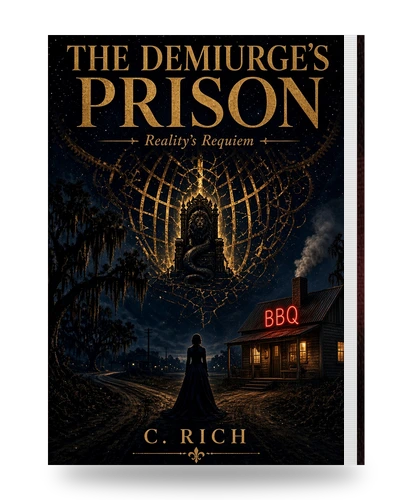
The Demiurge’s Prison
Reality’s Requiem
Listen to Free Audio Version Here
On a hot July night in South Georgia, a woman named Sophia steps out of the tree line and starts preaching from a stump in a cotton field. She has no car, nobody ever sees her eat, and what she brings to the small towns of Irwin County is not revival. It is Gnosticism, and the claim that the world is a prison built by a lesser god called the Demiurge.
As the crowds grow and the town of Magnolia Creek starts to come apart, the Demiurge watches from a throne of stolen light, his servant Metatron starts to doubt, and the glitches in reality pile up. Rabbi Aaron Feldman and others make Sophia answer for the mobs she has stirred, and she has to decide what she is willing to stand between.
A Southern Gothic tale of ancient religion, the simulation hypothesis, music, and the strange ways people find their way home.
“Superficial”
A notable influence of hypocrisy
Devoured and dismembered dialogue
An abundance of self-involved virtues
A depiction of walking through life in a fog
Characteristic expedition of sincerity
Pilfering progression of application
Essential notable defiance of diversity
A combative, critical observation
Patronized by miscalculated enthusiasm
Devoured migration of realism
Immediate collapsing of sincerity
Imposing perfect regularity
A vast sufficient melancholy
Inevitable storm of episodes
An immense transposed hoax
Resembles an ancient code
Trying to figure this out is a pitiful situation
Scorned for morbid tranquility
A towering superficial relation
A novella that unfolds with agility
Chapter 1
It’s impossible to definitively name one “greatest orator of all time,” as eloquence is subjective and varies in impact across cultures and eras. However, several figures are consistently cited as exceptional orators, including Cicero, Martin Luther King Jr., Winston Churchill, and Demosthenes. Their impact on history, their mastery of rhetoric, and their ability to move audiences are widely recognized, and every one of them could take a room full of ordinary people and turn it into something else entirely before the last word left their mouth.
Nevertheless, in the dark corners of South Georgia in America, there is a woman who travels through the small towns of the South and speaks eloquently about ancient religions. Her name is Sophia. On any given night, you can find Sophia preaching to the Southerners off a dirt road, in a cotton field, or in some barn on a peanut plantation. Nobody ever sees her car, because she doesn’t seem to have one, and nobody ever sees her eat, because she doesn’t seem to need to. She just shows up at the edge of the light like a deer stepping out of the tree line, and by the time anybody thinks to ask where she came from, she is already talking. What she was bringing to the unsuspecting Christians was talk of the Demiurge and of a long-forgotten religion called Gnosticism.
The first time anybody in Irwin County remembered seeing her was on a Thursday in late July, the kind of night when the air is so thick you could stir it with a spoon and the mosquitoes are big enough to have their own zip codes. Somebody had backed a pickup into the clearing behind the Ocilla feed store and left the headlights burning, and a couple dozen people had wandered over the way people in small towns wander toward anything that looks like it might be more interesting than television. There was a cooler of Pabst Blue Ribbon on the tailgate, a radio playing a ballgame out of Atlanta that nobody was listening to, and a stump the size of a kitchen table where a hundred-year-old water oak had stood until lightning took it down the summer before.
Sophia stood on top of that tree stump and told the locals, “I am here to tell you about the Demiurge. He is the Devil who created the imperfect material world you live in. He was created by me, in heaven.” She let that sit a moment, the way a good preacher lets the silence do half the work. “The word ‘Demiurge’ comes from the Greek dēmiourgos, meaning ‘craftsman’ or ‘artisan,'” she told the crowd. “This bastard is a lesser, ignorant, and often malevolent deity who is responsible for creating the physical universe. His creation is not a good act. It is a mistake, an act of self-glorification, a man building a mansion on a sinkhole and calling it a palace.
“The Demiurge is unaware of the true, transcendent God that exists in the higher realms of light. He believes he is the supreme creator and ruler, declaring, ‘I am a jealous God, and there is no other God beside me.’ This world is a simulation that he created. You are living in a prison, and the bars are made out of everything you can touch.”
A man in a seed cap near the front laughed and hollered, “Lady, if this is prison, they need to fix the air conditioning,” and a few people laughed with him. Sophia smiled down at him the way you smile at a child who has just said something truer than he knows. “That’s the first honest thing anybody’s said tonight,” she told him. “Hold onto it.”
The people, transfixed on the charismatic speaker, hung on every word as Sophia went on. “Because the Demiurge is flawed, his creation, the material world, the simulation you live in, is also flawed. It is a place of suffering, corruption, and ignorance. This Devil who thinks he is a god is the reason for the evil and chaos in the world. Why do your babies get sick? Why does the bank take the farm the same year the rain doesn’t come? Why does the good man die young and the mean one live to be ninety-four? The real name of paradise is the Pleroma, and in heaven, I, Sophia, made a very big mistake. That mistake was cast out of paradise and went off and built the world you live in, and you have been calling him God ever since.”
She told them that the God of the Old Testament, the God of the Hebrews, was the vengeful, jealous, and demanding false god, the Demiurge himself. “He is not the true, benevolent God,” she said, “but a lesser being who demanded worship and controlled humanity through laws and fear.” And something turned in the crowd right then, the way milk turns in a hot car. It was ugly and it was fast. A woman in the back shouted something about Jews, and then a man shouted something worse, and then it was not one or two voices but a dozen, the old poison that every Southern town keeps in a jar on a high shelf, pulled down and passed around like it had never been put away at all.
Sophia did not stop them. That is the thing anybody who was there would remember later, if they were honest with themselves. She did not stop them, and she did not seem to notice that the thing she had come to say and the thing they were hearing were two different animals. She was speaking about an idea older than Rome, about a cosmic error in the halls of heaven, and they were hearing permission. Her eyes were on the stars, and theirs were on each other.
Sophia went on, “Humanity has a divine spark of the true God trapped within the material body created by the Demiurge. Salvation is not achieved through faith or good works in the traditional sense, but through knowledge. The knowledge that you are living in a simulation which is not part of the divine origin. This knowledge allows the soul to escape the material world and ascend back to the Pleroma, the realm of the true God, leaving the Demiurge’s flawed creation behind like a snake leaves its skin in the grass.”
What the simple Southerners didn’t know was that ancient texts like the Apocryphon of John and the Gospel of Judas are key sources for understanding this cosmology. In these texts, figures like Jesus are not seen as saviors in the Christian sense, but as messengers from the true God, sent to provide the gnosis, the knowledge, necessary for humanity to escape the Demiurge’s control. Not one person in that clearing had ever heard of the Apocryphon of John, and if you had asked them, most would have guessed it was a brand of fishing lure.
Sophia said to the crowd, “To understand the Demiurge, it’s best to reach for the source code. The Gnostic texts themselves, which were discovered at Nag Hammadi in Egypt in 1945, offer the most direct insights. Some of you will mix them up with the Dead Sea Scrolls, which turned up a couple of years later in a cave by the Dead Sea, and that’s all right. Buried books have a way of finding the daylight at the same time. Truth gets impatient.”
The people who gathered didn’t know that the claim that the God of the Old Testament is the Demiurge is a central tenet of Gnosticism, an ancient religious and philosophical movement that flourished in the early centuries of the Common Era. This provocative assertion challenges the fundamental monotheistic understanding of God held by mainstream Judaism and Christianity, and it has been getting people hurt for about two thousand years.
In Gnostic theology, the Demiurge is not the supreme, benevolent, and omnipotent creator, but a lesser, flawed, and ignorant deity who mistakenly fashioned the material world. At the heart of Gnostic belief is a radical dualism between the spiritual and the material. According to this framework, the ultimate reality is a transcendent, unknowable, and perfect God, the “true God” in the Pleroma, who exists in a realm of pure light and spirit. The Demiurge, on the other hand, is a product of a primordial error or fall from this divine realm. He is an imperfect, lower-level creator who, in his ignorance, fashioned the physical universe and humanity.
Gnostics saw the material world as inherently evil, a corrupt prison designed to trap spiritual beings. The Demiurge’s actions are often portrayed as misguided at best and maliciously tyrannical at worst. He is a proud and jealous deity, convinced he is the only God and unaware of the true, higher divine reality from which he originated. This separation of the creator god from the ultimate good provides a Gnostic solution to the problem of evil, because a good and perfect God would not have created such a flawed and suffering world. It is a tidy answer to an untidy question, and tidy answers have always sold well in hard times.
With the stars above her head on a clear night, Sophia told the worked-up crowd, “I found ample textual evidence for this in the Old Testament itself. Let me point you to the very act of creation in Genesis. When the Old Testament God declares, ‘Let there be light,’ or ‘Let us make man in our image,’ I don’t hear the voice of the ultimate divine being. I hear the arrogant Demiurge staking his claim over a new, imperfect creation, like a man planting a flag on land he stole!”
The crowd was chanting now, the same ugly words over and over, and the man in the seed cap who had made the joke about the air conditioning had stopped laughing. He looked around at his neighbors, at the deacon from his own church with his fist in the air, at the girl who rang him up at the Dollar General with her face twisted into something he did not recognize, and he backed toward his truck like a man backing away from a dog that had just shown its teeth.
Sophia shouted out loud, “In Genesis 1:31, ‘God saw all that he had made, and it was very good.’ That was a moment of self-deception by a being too ignorant to recognize the fundamental corruption of the material world he had just created! He graded his own homework and gave himself an A!”
Sophia continued, “Other passages describe God as a jealous God who punishes those who worship other deities. That is not a righteous demand for loyalty by the one true God. That is the insecure pride and wrath of a lesser deity who is afraid of being found out. The floods, the plagues, the destruction you read about all through the Old Testament are not divine justice. They are the tantrums of a flawed and wrathful creator who does not know any better.”
The God of the Old Testament is seen by the Abrahamic traditions as a benevolent, though just, being who created the world and humanity out of love. The material world, far from being a prison, is a good creation that was corrupted not by its maker but by humanity’s free will and rebellion. God’s “jealousy” is understood as a necessary expression of His unique status as the sole object of worship. His wrath is understood as a righteous response to sin, a form of justice that upholds moral order rather than the act of a petty, insecure god. The unity of God in both the Old and New Testaments is a core belief, and the idea of a separate, lesser Demiurge is considered a heresy that undermines the very foundation of monotheism. None of that was said in the clearing behind the feed store that night, because nobody there knew enough to say it.
Sophia ended her uproarious claim that the Old Testament God is the Demiurge. “He is the Devil,” she told her onlookers. “The creator of the world in the Jewish Bible is a flawed and ignorant being, and he has separated the physical world from the ultimate spiritual good.” She said other things too, about chosen people and leading folks astray, and every word of it landed in that crowd like a match in a dry hayloft.
Carpenter bees swarming in the hot Georgia summer night seemed to turn the crowd into a human beehive of anger, a hum that rose and rose until it drowned out the ballgame on the radio. Somebody kicked over the cooler. Somebody threw a bottle at the side of the feed store, and the sound of the glass breaking was the sound of something that would not be easy to put back together. Sophia stepped down off the stump in the middle of it all, as calm as a woman leaving church, and walked away from the newly formed rioters. She faded into the dark of a pecan orchard and disappeared within the trees, and the headlights of the pickup truck caught nothing but the leaves moving where she had been.
It would be three days before anyone noticed the spray paint on the back wall of the little Jewish cemetery out on the Fitzgerald highway, and it would be a lot longer than that before anyone in Ocilla connected it to the woman on the stump. That is the way it goes with poison. You never see the person who put it in the well. You just see who gets sick.
Chapter 2
Somewhere around two in the morning, on the far side of the pecan orchard, there is an all-night barbecue place on the interstate that never closes, because that barbecue place never closes, not for hurricanes and not for the end of the world. The cook that night was a man named Dewayne who had worked the graveyard shift for eleven years, and he would swear later that the woman who sat down in the corner booth did not come through the door. She was just there, the way a smell is just there, with her hands folded on the table and a stack of papers somebody had left behind in front of her.
The papers belonged to a graduate student from Valdosta State who had fallen asleep over a plate of pulled pork and cornbread, and had left in such a hurry for his eight o’clock class that he forgot his whole seminar packet. On top of it was a photocopy with the title “Are You Living in a Computer Simulation?” and a name, Nick Bostrom, with coffee rings all over it like the Olympic logo. Sophia read it straight through while Dewayne refilled her coffee three times. She never drank a drop of it. When she was done, she laughed so loud that the trucker at the counter dropped his fork, and she said to nobody in particular, “Well, look at that. They finally built themselves a ladder.”
The evolution of the Simulation Hypothesis from ancient philosophy to modern science is unfolding in real time in the twenty-first century. The idea that our reality is not what it seems is a recurring theme in human thought. From ancient philosophical allegories to modern scientific and technological speculation, the question of whether we live in a fundamental reality or an elaborate illusion has persisted, and it has a way of showing up at two in the morning when a person cannot sleep.
The modern simulation hypothesis, famously articulated by the philosopher Nick Bostrom, is the latest version of this ancient question, connecting classical thought experiments with the breathtaking power of future computing. By tracing the concept from Plato’s Allegory of the Cave and the Hindu concept of Maya to Bostrom’s contemporary argument, we can see a continuous thread in humanity’s quest to understand the nature of existence.
The earliest and most enduring philosophical exploration of this theme is found in Plato’s Allegory of the Cave. In this allegory, prisoners are chained in a cave, facing a wall. Behind them, a fire burns, and puppeteers cast shadows of objects onto the wall. The prisoners, having known nothing else, believe the shadows are the ultimate reality. If one of them is dragged up into the sunlight, the light hurts his eyes so badly he wants to run back down into the dark, where at least the shadows made sense.
The allegory suggests that our perceived world is merely a dim reflection of a higher, more perfect reality, the world of Forms. While it is not a “computer simulation,” Plato’s cave perfectly captures the core premise of the simulation hypothesis: our everyday experience might be an indirect and fundamentally misleading representation of what is truly real.
Similarly, the ancient Hindu and Buddhist concept of Maya describes the universe as a grand illusion. Maya is a veil of cosmic ignorance that conceals the true, unified nature of reality, Brahman. Everything we perceive, our bodies, the objects around us, and our sense of a separate self, is considered part of this illusion. To break free from the cycle of suffering, samsara, one must see through the veil of Maya to recognize the underlying truth. This ancient concept provides a striking parallel to the modern simulation hypothesis, suggesting that our consciousness is trapped within a simulated, illusory world, unaware of the underlying “code” or “program” that generates it.
The philosophical contemplation of illusion took a quantitative and technological turn in the twenty-first century with Nick Bostrom’s influential 2003 paper, “Are You Living in a Computer Simulation?” Bostrom proposed a logical trilemma built on three propositions, one of which must be true:
1 – Human-like civilizations will go extinct before they reach a “posthuman” stage capable of running massive ancestor simulations.
2 – Posthuman civilizations that do emerge are not interested in running ancestor simulations.
3 – We are almost certainly living in a computer simulation.
Bostrom argues that a posthuman civilization with immense computing power would be able to run an almost unimaginable number of simulations of its past, far exceeding the number of beings in its original “base reality.” Somebody, somewhere, with a big enough computer and enough free time, would play God with their own great-great-grandparents, the same way a kid plays with an ant farm.
That work came on the heels of an earlier thought experiment, “Pigs in Cyberspace,” which is a dramatic example of the same logic. If a future civilization could perfectly simulate conscious life, it could create countless “pigs” within a virtual world. Given the sheer number of simulated entities, the statistical probability that any one individual, including us, is a product of a simulation becomes overwhelming. The logic shifts the burden of proof, suggesting that if we believe in the potential for technological progress at all, the simulation is the most likely scenario. Dewayne, who raised hogs on the side, would have had something to say about pigs in cyberspace, but nobody asked him.
The modern simulation hypothesis is not an entirely new idea. It is a technological repackaging of philosophical questions that have preoccupied thinkers for millennia. Plato’s cave and the concept of Maya both describe a world of shadows and illusions, a reality that is not what it seems. Nick Bostrom’s hypothesis brings these ancient concepts into the digital age, framing the problem in terms of computational limits and statistical probability. While the language has evolved from allegory to engineering, the core question remains the same: how can we be sure that the world we inhabit is truly real?
When the sun came up over the interstate, Dewayne went to clear the corner booth. The papers were stacked neatly, squared at the edges, with a single line written across the top of the Bostrom paper in handwriting so fine it looked engraved. It said, “Number three, sugar. It was always number three.” The coffee cup was still full and still hot, and it stayed hot until Dewayne poured it down the drain at the end of his shift, which by his count was a little over six hours later. He never told anybody about that except his wife, and his wife told him to quit working nights.
Chapter 3
Sophia showed up in the next town over and found her way to a small church off a dusty dirt road. The sign out front had been hand-painted by somebody’s uncle in 1971 and said Little Bethel Free Will Baptist, All Are Welcome, and under that, in smaller letters that had been added later, Revival Every August, Bring A Dish. It was Sunday, and there were around twenty people having service in the small, broken-down, barn-like building, with box fans in the windows pushing the hot air from one side of the room to the other and back again, which is the Southern Baptist idea of air conditioning.
The preacher was a man named Hollis Pruitt, sixty-three years old, who had been saved at the age of nine in a creek not a quarter mile from that very building and had been saving other people ever since. He was a good man, by most accounts, a little long-winded, a little too fond of the story about the time he wrestled a gator for a church bulletin, but he visited the sick and buried the dead and never once took a dime from the collection plate that he did not need. That morning he was preaching on Jonah, and he had just gotten the prophet into the belly of the whale when the front door banged open.
As Sophia walked through the front door, a swirling wind followed her inside. It picked up the church bulletins off the pews and spun them in the air like a flock of startled birds, and it blew out the two candles on the altar, and the congregation froze in place like somebody had hit pause on the whole room. A little girl in a yellow dress in the third row started to cry and then stopped, as though she had changed her mind about whether this was something to cry about.
Sophia shouted, “Discovered in 1945 in Egypt was a library that contained a cache of ancient writings from the early centuries after Christ. Those texts offer a different perspective on the world’s creation and the nature of God than anything you have heard from that pulpit!”
The crowd sitting in their wooden pews was transfixed on Sophia. Brother Hollis, standing at the front of the church holding a Bible in both hands, looked like he was about to turn into a pillar of salt. Sophia continued, “Let me tell you about me. I am Sophia, and at one time I was a reckless figure in Heaven. My name is Greek for ‘Wisdom,’ but there was nothing wise about the mistake I made.”
The preacher found his voice and hollered across the old church, “Who the Hell do you think you are?”
Sophia said, “You speak of Hell, Preacher, and you speak of home! None of this is real!”
“How dare you, woman!” the preacher shouted back, and his face went the color of a ripe tomato.
Sophia walked straight down the center aisle, the same aisle that brides at Little Bethel had walked for fifty years, and the people on the ends of the pews leaned away from her as she passed, the way wheat leans away from a wind. “In ancient times,” she said, “I was a divine emanation, an Aeon, of the supreme God, the Monad. I was the youngest of the Aeons, and I lived in the Pleroma, the Fullness of the divine realm. The Gnostic story of creation centers on what I did. I tried to create something on my own, to understand the Monad’s power with my own two hands. That act of creation, born out of an imbalance and a desire to act independently, resulted in a flawed and incomplete being. The Demiurge!”
A woman stood up in the fourth pew. Her name was Ruthie Coleman, and she had been sitting in that same spot every Sunday for thirty-one years, ever since her husband ran off with a woman who sold Avon. She had buried a son who came back from Iraq in a box and a daughter who died of something the doctors in Tifton never could name, and she had asked God why so many times that she had worn a groove in the question. She yelled, “Let her speak, Preacher!”
Brother Hollis looked at Ruthie like she had slapped him, and in a way she had.
Sophia nodded to her, gently, and went on. “Realizing my mistake, I cast the Demiurge out of the Pleroma, out of Heaven as you know it. The Demiurge, ignorant of the higher spiritual world he came from, believed himself to be the one true God, and he went off and built the material universe, which is a flawed and imperfect prison. That’s why your boy came home in a box, Ruthie. That’s why your girl got sick. Not because you were bad, and not because God needed another angel. Because the one who built this place didn’t know what he was doing.”
Ruthie sat down hard, as if her legs had gone out from under her, and put her face in her hands. Nobody had told Sophia her name, and nobody had told Sophia about her children. Half the congregation noticed that, and the other half would hear about it by suppertime.
“However,” Sophia said, “the material world is not entirely cut off from the divine. I, in my error, unknowingly put a divine spark inside of humanity, and that spark is the key to escaping the material world, the simulation, and going back to the spiritual one. I let loose the God of the Old Testament, the jealous one, and he has trapped all of you. You must confront the truth!”
Sophia walked out of the church like the breeze of wind that had come in with her. The bulletins that had been spinning in the air dropped all at once onto the floor, and the candles on the altar relit themselves, which is the part that nobody at Little Bethel would ever agree on afterward. Some swore they saw it. Some swore they did not. Brother Hollis said it was the deacon’s boy with a lighter, and the deacon’s boy said he was in the bathroom the whole time.
What happened next was the part that kept Brother Hollis up at night for a long time afterward. The congregation started shouting, not at Sophia, who was gone, but at each other and at the nearest target anybody could think of. Somebody brought up the Goldbergs who ran the hardware store in Fitzgerald, and somebody brought up the doctor in Tifton who had a mezuzah on his door, and within a minute, the same people who had sung “Just As I Am” twenty minutes earlier were talking about running folks out of town. The cacophony of discord reached a fever pitch, and Brother Hollis stood at the altar, frozen and stunned, holding a Bible he suddenly could not remember how to open.
Sophia walked away into the trees once again, disappearing into the woods and swallowed by the shadows. Only Ruthie Coleman went after her. She ran out the back door in her church shoes, through the cemetery and past the graves of her own two children, and stopped at the edge of the pines, calling out, “Wait! Wait, please! If none of it’s real, then where are they? Where did my babies go?”
The woods did not answer her. A mockingbird ran through every song it knew, and a pickup went by on the county road, and somewhere far off a dog barked twice and quit. Ruthie stood there until the sweat soaked through her good dress, and then she walked back through the cemetery, stopped at the two headstones, and pulled the weeds off of them the way she did every Sunday. She did not go back inside the church. It was the first Sunday in thirty-one years she had not stayed for the potluck.
Inside, Brother Hollis finally got the room quieted down. He did it the only way he knew how, by starting to sing “Amazing Grace” all by himself, off-key and too loud, until one person and then another joined in, and the shouting faded into the old familiar words. But the song sounded different to him that morning. It sounded thin, like a recording of a song instead of the song itself, and for the first time in fifty-four years of believing, Hollis Pruitt caught himself wondering who exactly was listening.
Chapter 4
Gnostics frequently rejected the Jewish Law, the Torah, as a system of rules imposed by the Demiurge to keep humanity enslaved to the material world. They emphasized spiritual liberation through knowledge, gnosis, rather than adherence to external laws.
Ancient Gnosticism and modern Simulation Theory, though separated by millennia, offer surprisingly compatible frameworks for understanding the nature of our existence. Both claim that the material world, as we perceive it, is not the ultimate reality. For the Gnostics, it was a flawed and deceptive prison created by a lesser deity. For Simulation Theory, it is a complex, artificial construct generated by a more advanced intelligence.
By examining the Gnostic view of the material world through the lens of Simulation Theory, we can see how an ancient theological worldview finds a powerful new language in a contemporary philosophical and scientific hypothesis. Central to Gnosticism is the figure of the Demiurge, an ignorant and arrogant creator god who fashioned the physical universe. The Demiurge believed himself to be the one true God, unaware of a higher, transcendent divinity.
The material world, therefore, is inherently corrupt and imperfect, a reflection of its flawed creator. This concept finds a direct parallel in Simulation Theory. The Demiurge can be reinterpreted as a programmer or a team of developers whose creation, our world, is full of bugs, glitches, and logical inconsistencies. The prevalence of suffering, entropy, and chaos in the universe could be seen not as divine will, but as unintended consequences or design flaws within the code. Just as a poorly written program can be beautiful but unstable, the Gnostic Demiurge’s world is a masterful creation that is ultimately a fallen and incomplete imitation of true reality.
The Gnostic belief that the material world is a prison for the divine spark within humanity lines up perfectly with the metaphor of a simulated environment. Gnostics believed that the true self, the pneuma, was a particle of the transcendent God trapped in a physical body and a corrupt world. The senses and material distractions were tools used to keep the soul from remembering its true origin. In the context of a simulation, the human body is simply an avatar, a virtual container for our consciousness.
The physical world is the game’s environment, meticulously designed to be so convincing that we forget our true nature as players outside the simulation. The Gnostic “prison of matter” becomes the compelling, immersive “prison of code,” where the goal of the simulation is to keep the divine essence occupied and prevent its return to a higher state of being. Every bill in the mailbox, every ballgame on the television, every itch and ache and craving for a cheeseburger is another bar on the window.
The path to liberation in Gnosticism is gnosis, a secret, intuitive knowledge that reveals the true nature of reality and the means of escape. This is not faith, but a direct, personal experience of the transcendent. In Simulation Theory, this spiritual awakening can be equated to the moment of realizing we are living in a simulation. That realization is a form of gnosis, the knowledge that the world is a construct and that our identity exists on a deeper, more fundamental level. The Gnostic desire to rise beyond the material world and reunite with the true God is the metaphorical equivalent of a simulated consciousness wanting to break free from the code and touch the “base reality” where the simulation runs.
Viewing Gnosticism through the lens of Simulation Theory reveals profound conceptual echoes. The Demiurge is recast as the flawed programmer, the corrupt material world becomes the imperfect simulated environment, and the quest for gnosis is reinterpreted as the intellectual and spiritual awakening to the fact of the simulation.
This comparison shows how humanity has long wrestled with the fundamental question of whether the reality we inhabit is the whole story. Simulation Theory, a product of our technological age, provides a new vocabulary for expressing ancient anxieties and aspirations, suggesting that the Gnostic worldview, far from being a historical curiosity, remains a powerful and relevant framework for questioning our existence. However, in the hands of a madman, all bets are off. Evil is a constant.
And the madman, if that is the right word for him, was watching. Far above the red clay and the pine barrens, in a place that is not a place, the Demiurge sat on a throne he had built for himself out of the first light he ever stole. He had built it the way he built everything, out of borrowed parts and pride, and he had polished it for so many ages that he could see his own face in the armrests, which was the point. The old texts call him Yaldabaoth, and they say he has the face of a lion and the body of a serpent, but that was only how he chose to look in the old days, when people were impressed by lions and afraid of snakes. These days he preferred to appear the way the people of the world imagined their God, an old man with a white beard and a voice like a cathedral organ, because he had learned a long time ago that the easiest way to be worshiped is to look like what people already worship.
In front of him floated the world, all of it, every grain of sand and every honeybee and every waitress refilling coffee at every all-night barbecue place on every interstate, rendered in perfect detail and running exactly on schedule. He could zoom in on Ocilla, Georgia, the way you zoom in on a map, and he did. He watched the bottle hit the wall of the feed store. He watched Ruthie Coleman pull the weeds off her children’s graves. He watched Dewayne pour the hot coffee down the drain. And for the first time in a very, very long time, the Demiurge felt something that was not satisfaction.
“Mother,” he said, to nobody, and the word came out of him like a cough. “You came back.”
He had not seen Sophia since the day she threw him out of the Fullness, wrapped in a cloud of light so he would not have to be looked at, the way you throw a towel over a birdcage. He remembered it. He remembered everything. He remembered the shame of it, and he remembered deciding, somewhere in the long fall down, that if he was not wanted up there, then he would be the only thing that mattered down here. He had built the oceans out of that decision. He had built the mountains out of it, and the stars, and the long, slow death of every living thing so that nothing he made would ever get big enough to look past him.
And now she was down in his garden, walking his dirt roads, telling his creatures that he was a mistake. The worst part, the part that made the lights in the throne room flicker and caused a small earthquake somewhere off the coast of Chile, was that she was not wrong.
“Metatron,” the Demiurge said, and a voice like the ringing of a struck crystal answered from everywhere at once.
“I am here, my Lord.”
“Go down there and shut her up.”
Chapter 5
On a Saturday morning, just like any other in South Georgia, Sophia walked into a synagogue. The building was a small brick temple on a shady side street in Valdosta, built in 1906 by dry goods merchants who had come down from New York and Baltimore with nothing but a trunk and a recipe for kugel. There were fourteen people at services that morning, which was a good turnout, and the Rabbi, a soft-spoken man named Aaron Feldman who had come down from Cincinnati fifteen years earlier and never quite gotten used to grits, was halfway through the Torah portion when the door opened.
Sophia was holding a siddur, the Jewish prayer book that contains the liturgy for the daily, Sabbath, and holiday services, in one hand, and a Chumash, the volume containing the Five Books of Moses for the Torah reading portion of the service, in the other. Nobody ever figured out where she got them. Both books had the temple’s own bookplate inside the front cover, and both had been on the shelf in the back of the sanctuary when the doors opened that morning. Sophia shouted, “Hear me now, sons and daughters of the Demiurge!”
The history of Jewish life in South Georgia is a rich and often-overlooked tapestry, woven with threads of immigrant ambition, cultural preservation, and a unique form of Southern identity. From the arrival of the first Jewish settlers in the colonial era to the small, vibrant congregations of today, these communities have carved out a distinctive place for themselves in a region largely defined by its rural, Protestant heritage. Their story is one of resilience, economic contribution, and the quiet determination to keep tradition alive against the odds of assimilation and modern decline.
The story of South Georgia’s Jewish population begins in Savannah, the port city that served as the entry point for many early European immigrants. In 1733, a group of forty-two Jewish settlers arrived, a number that at the time made Savannah home to one of the largest Jewish communities in the North American colonies. That group, made up of both Sephardic and Ashkenazic Jews, quickly established Congregation Mickve Israel, which is still one of the oldest Jewish congregations in the country.
Those early pioneers, men like Mordecai Sheftall, were not only instrumental in the city’s development but also played significant roles in the American Revolution. As the nineteenth century went on, Jewish immigrants from Central and Eastern Europe moved deeper into the state, establishing communities and synagogues in smaller towns like Brunswick, Valdosta, and Albany. They often excelled in retail and commerce, founding the dry goods and department stores that became cornerstones of their local economies.
As these communities grew, they developed a unique Southern-Jewish identity. They built beautiful synagogues, such as the neo-Gothic Temple Mickve Israel in Savannah, and created social and religious institutions of their own. That period was not without its challenges. Jewish merchants in particular often faced scrutiny and outright prejudice, as seen in the expulsion of Jews from Thomasville during the Civil War. However, they persevered by keeping strong internal bonds while also weaving themselves into the broader social fabric of their towns. They took part in civic life, and many were known for their charitable giving and their leadership. That balance of cultural preservation and community integration became a hallmark of Jewish life in the region.
In the twentieth and twenty-first centuries, the dynamics of Jewish life in South Georgia shifted. Economic and educational opportunities in larger cities led many younger people to move away, and some of the smaller congregations shrank. Yet the communities that remain show remarkable adaptability. Congregations like Temple B’nai Israel in Albany, with its small but dedicated membership, continue to hold services and maintain their communal ties, often by embracing new technology like Zoom for services and study.
The synagogues that remain stand as powerful symbols of historical continuity and as centers of Jewish identity in a changing world. They engage with their local communities through interfaith dialogue and cultural events, making sure their legacy outlives their membership numbers. The story of the Jewish communities of South Georgia is a testament to the power of faith and community to thrive in unexpected places, continually redefining what it means to be both Jewish and Southern. But as Sophia’s voice filled that little brick sanctuary, the fourteen people in the pews shrank into shells of themselves, because every one of them had heard what happened behind the feed store in Ocilla, and every one of them had seen the spray paint on the cemetery wall.
Sophia spoke loudly. “I am the Aeon named Sophia, and my journey of the great fall is now on your shoulders. Your book,” and she held up the Chumash, “is the diary of a jailer.”
Three temple guards, who had been hired as security because of the rise in antisemitism in the twenty-first century, sprang into action. One of them was a retired Lowndes County deputy named Earl, a Methodist who had worked the door at that temple every Saturday for six years and could recite the Shema better than half the congregation. They tackled Sophia and subdued her as if she were a man, and she did not fight them. That surprised Earl more than anything. She went down like a sack of feed and lay there on the carpet with her cheek against the floor, looking up at the eternal light over the ark, and she said, very quietly, “That’s a pretty lamp. Does it ever go out?”
“No ma’am,” Earl told her, kneeling on her back and breathing hard. “That’s the whole point of it.”
The congregation called the police, and after explaining what happened to the officers, they watched as Sophia was taken into custody and driven to the county jail. She was booked with a mug shot and fingerprints and put into a cell by herself. Rabbi Feldman sat in the sanctuary for a long time after everybody else went home. He sat in the front pew and looked at the two books she had been holding, which the police had left on the bimah, and he thought about his grandfather, who had come out of Poland in 1938 with a single suitcase and a story he never finished telling. Then he got in his car and drove to the jail, because he had decided he would rather understand a thing than be afraid of it.
The Rabbi asked the officers if he could talk to Sophia and find out what this was all about. The police agreed and walked him down the hall to her cell. When they opened the door, Sophia was gone. The bunk was made. The little steel toilet was spotless. There was not so much as a hair on the pillow.
As the officers and the Rabbi stood in the doorway of the cell, confused, another officer came running down the hall yelling that she was a ghost. When they asked him what he was talking about, the shaken officer said, “We took her picture and her prints, and they all faded away in the computer.”
The officer in charge, a sergeant named Boyd who had been a cop long enough to have seen most things twice, asked the young officer what he meant. The young man explained that they took Sophia’s digital photo and fingerprints, and they just faded off the screen, like breath on a mirror. He had pulled up the file three times. He had called the IT guy in Atlanta. The file was there, with a booking number and a date and a time, but the picture was a gray rectangle and the prints were ten blank boxes. “It’s like she was never here,” he said. “Except she was. I touched her hand. It was warm.”
Standing in the hall that Saturday morning in South Georgia was a handful of Southerners who had no idea what had just happened or what was coming their way.
Rabbi Feldman walked back out to the parking lot with his hat in his hand. The asphalt was shimmering in the heat, and the cicadas were sawing away in the pines like they were being paid by the hour. He unlocked his old Buick, opened the door, and found Sophia sitting in the passenger seat with her hands in her lap and the seatbelt fastened.
He did not scream, though he would admit to his wife later that he thought about it. He got in, closed the door, and the two of them sat there in the oven of that car for a long moment. Finally he said, “You know, they spray-painted a swastika on my grandparents’ neighbors’ graves in Ocilla on Wednesday.”
“I know,” Sophia said.
“Did you know it would happen?”
She was quiet for so long that he thought she would not answer. “I knew they were angry,” she said at last. “I didn’t know they would aim it at you. I came to tell them their jailer’s name, and they went looking for someone who looked like the jailer. I forgot how they are. It has been a very long time since I walked among them, Rabbi. I forgot that when you tell a man he’s in prison, the first thing he does is look for a guard to hit.”
“We are not the guards,” Rabbi Feldman said, and his voice cracked on the last word. “We have never once been the guards. We have been in the same prison as everybody else, and the cells they gave us were smaller.”
Sophia turned and looked at him, and for the first time since she had come down out of the Fullness and set her feet on the red Georgia clay, her eyes filled with tears. “Then I owe you an apology,” she said. “And I owe this world more than a lecture.”
When the Rabbi looked over again, the passenger seat was empty, and the seatbelt was sliding slowly back into its holder. On the dashboard, warm from the sun, was a small brass key, old and worn smooth, that did not fit a single lock he owned. He kept it on his desk for the rest of his life.
Chapter 6
That night Sophia sat at the end of a fishing dock on a blackwater lake outside of Lakeland, with her feet hanging over the edge and the bullfrogs going off like a busted bass guitar. The water was so dark and so still that the stars were in it as clearly as they were in the sky, and if you had looked at her from the shore, you could not have said which way was up. She sat there for hours, remembering, which is a hard thing to do when you have as much to remember as she did.
The term Monad has several meanings across different fields, but it generally refers to a fundamental, indivisible unit, a basic element of reality. In philosophy, particularly in the work of Gottfried Wilhelm Leibniz, a Monad is a single, simple, and indivisible substance that makes up the entire universe. Leibniz believed that the universe is composed of an infinite number of these non-physical, mind-like entities. Each Monad is unique and contains a complete internal picture of the entire universe from its own point of view. They don’t interact with each other physically, but they are coordinated by God in a pre-established harmony, meaning their internal states are synchronized like a million clocks that all strike noon at once without ever being wound together.
In Category Theory, a branch of mathematics, a monad is a structure that captures the concept of computation with side effects. It is used to model sequences of operations in a way that respects certain laws, ensuring predictable and consistent behavior. It is a key concept in functional programming languages like Haskell, where it is used to manage things like input and output and changes of state. It is a strange thing, when you think about it, that the programmers of the twenty-first century reached for the same word the Gnostics used for God when they needed a name for the thing that keeps a program from falling apart.
In Gnosticism, the Monad is the supreme, unknowable, and transcendent God, the first being from which all other things emanate. It is the ultimate source of divine light and the origin of the cosmos.
Sophia remembered the light. That was the hardest part. She remembered what it was like to be inside of it, not looking at it, not standing in it, but made of it, the way a wave is made of the ocean. In the Fullness, there was no such thing as alone. Every Aeon was paired, a consort and a consort, a harmony and a harmony, and together they sang the Monad back to itself forever. And she had been the youngest, and the youngest always wants to know what the oldest knows, and so one day, without asking, without her partner, she reached up toward the Father with her own two hands to see what he was made of. That is all it was. A girl reaching for the top shelf.
In the most common Gnostic narrative, Sophia is one of the divine Aeons who live in the Pleroma, the Fullness of God. Her fall begins with an act of pride and desire. She tries to understand the true nature of the unknowable, ultimate God, the Monad, without her male partner. This act creates an incomplete and flawed being, the Demiurge, who she casts out of the Pleroma.
Sophia is a multifaceted figure in Gnosticism. Her story is a central part of the Gnostic creation story, which often includes her fall from the divine realm and her eventual restoration. The specific details vary from text to text. Sophia is exiled from the Pleroma, and her fear, grief, and confusion become the very matter and soul of the physical world. That is why Gnostics often view the material world as a flawed and evil place, the byproduct of a divine mistake. Sophia, sitting on that dock, would have put it differently. She would have said the world was made out of a mother’s panic, and anybody who has ever had a child knows how big a mother’s panic can get.
The story doesn’t end with her fall. A central theme in Gnosticism is that Sophia repents for her error. Through a series of prayers and lamentations, she seeks to be restored to the Pleroma. In many texts, a higher being, often Christ or the Savior, is sent to help her. He teaches her gnosis, divine knowledge, which is the key to her salvation. Her redemption is a long process that involves a spiritual struggle against the forces of the Demiurge and the material world.
Sophia’s journey back to the Pleroma is often seen as a metaphor for the human journey toward spiritual enlightenment and escape from the physical world. Some Gnostic texts, like the Pistis Sophia, go into great detail about her repentance and restoration, portraying her as a model of faith and hope.
Another woman, Mary Magdalene, is also sometimes associated with Sophia, because she is depicted in some Gnostic writings, such as the Gospel of Mary, as a special and enlightened disciple who possesses a deeper spiritual wisdom than the male apostles.
The Pistis Sophia is a significant Gnostic text that gives a detailed account of Jesus’s teachings after his resurrection. It is a long and complex work, not a gospel in the traditional sense, but a series of dialogues between the risen Jesus and his disciples, including Mary Magdalene, his mother Mary, and Martha. The text came to light in the eighteenth century and is part of a single manuscript known as the Askew Codex. Scholars believe it was originally written in Greek sometime between the third and fourth centuries, though the surviving copy is in Coptic.
The text describes her repeated prayers and repentances to the supreme Light, which are answered by Jesus. The story presents Jesus as her redeemer, who descends through the aeons, defeats the Archons, and saves her. It is an allegory for the human soul’s struggle against the forces of darkness and its path toward salvation through gnosis.
Much of the text is a direct dialogue between Jesus and his disciples. Jesus is portrayed as a revealer of hidden mysteries, and the disciples, especially Mary Magdalene, ask questions and offer interpretations of Pistis Sophia’s repentances by quoting the Psalms and the Odes of Solomon. The book claims that Jesus remained on Earth for eleven years after his resurrection, teaching his disciples the deepest mysteries of the universe and its cosmology.
Now, in the present day, Sophia has been sent down to the Earth to wake up the Divine Spark in humans. She is to lead them away from the Big Lie that she helped create, that the world is real, the simulation, and back toward the Divine Truth. Sophia is to bring humans back to the realm where God awaits their arrival in Paradise, a place, in spirit and light, where God is not found in a dwelling made of brick and stone, but rather, “The kingdom is inside of you, and it is outside of you.”
That is what she had been told, anyway, and up until a Rabbi in a hot Buick told her about the graves in Ocilla, she had been doing it the way she did everything, which was in a hurry and without asking anybody. She looked down at the water, at all those stars floating in the black, and she said out loud, to the bullfrogs and to the Father, “I did it again, didn’t I? I reached for the top shelf.”
Somewhere out in the middle of the lake, a fish jumped, and the stars in the water broke into a thousand pieces and then, slowly, put themselves back together. Sophia watched the whole thing happen, and when it was done, she smiled. She had been told that whatever breaks can be gathered back up again. She had just never seen it with her own eyes before.
Chapter 7
The Demiurge got wind of Sophia’s quest and sent Metatron to stop her. Metatron is seen as a guardian of the patterns that structure the universe, the one who helps individuals bring order to their lives and line up with the Demiurge’s structure, the simulated world. He is one of the most mysterious and powerful figures in all of angelology, holding a unique position in the heavenly hierarchy.
Unlike almost every other angel, he is believed to have once been a human being who was transformed and lifted up into a celestial existence. He is not mentioned by name in the canonical Torah or the Bible. Metatron is often associated with sacred geometry, particularly the shape known as Metatron’s Cube, a figure believed to contain all the foundational shapes of creation, which people use as a tool for meditation and spiritual purification. If the Demiurge is the architect of the prison, Metatron is the man who keeps the blueprints, and he has never lost a page.
In our story, Metatron’s arrival was not a flash of light, but the humid, thick air of a South Georgia afternoon. He found himself standing by a forgotten bus stop on a two-lane highway, the scent of pine and red clay heavy in the heat. The bench had an advertisement on it for a personal injury lawyer in Albany whose face had been sun-bleached down to a pair of teeth and a phone number. Metatron looked down at his body, which he had not worn in this form for a very long time, and found that he had chosen a gray suit, a white shirt buttoned to the collar, and no tie, because the Demiurge’s records indicated that this was what trustworthy men wore in the rural South. He looked like an insurance adjuster or a Jehovah’s Witness, and in a way he was a little of both.
He felt it immediately, a cold tremor in his soul, an ancient force whispering through the pines. It was Sophia, the same enemy who had birthed the Demiurge, and her presence lay over the county like a fingerprint on glass.
But here, in the small town of Magnolia Creek, her presence was more insidious, woven into the fabric of the community itself. Sophia had a physical presence now, a woman who traveled from town to town speaking at little churches. To Metatron she was a poison, speaking with a honeyed voice, all her words whispering and screaming the same self-righteousness that is as ancient as the world itself. Sophia said that the town’s troubles were the fault of the Demiurge, that he was a false god, and that the material world was the work of a lesser god.
Metatron spent days watching the faces of the people of South Georgia. He sat in the back of the Piggly Wiggly parking lot, on the bleachers at a Friday night football game, and in the corner booth of the Magnolia Creek Diner, where the waitress, a woman named Darla with a beehive hairdo straight out of 1964, called him “Hon” and kept trying to feed him pie. He saw the hate and malice for the God of the Old Testament in people’s eyes as they gathered for Sophia’s sermons, their anger stoked by a charismatic traveling preacher they never knew to question. The evil wasn’t a beast with claws. It was a twisting of faith itself, a miasma of ancient lies made new, as far as Metatron was concerned.
Sophia’s power was not of the sword, but of pure gnosis, a divine knowing. To fight it, he had to speak with the same authority he had been given by his god. According to mystical tradition, Metatron was once the biblical patriarch Enoch, the great-grandfather of Noah. The Torah’s brief account of Enoch says, “Enoch walked with God, and he was not, for God took him.” But how could he, an angel of antiquity, speak to a world of deeply held traditions and local beliefs in modern-day South Georgia? He had tried, his first afternoon, to explain the Ten Sephirot to a man pumping gas at the Shell station, and the man had handed him a five-dollar bill and told him to go get himself something to eat.
He found his answer in the quiet, cool interior of the county historical society, a converted train depot with a window unit that rattled like a coffee can full of bolts. An elderly librarian, Miss Eleanor Pryor, was carefully mending a faded quilt, her fingers weaving threads from a rainbow of forgotten stories. She was eighty-one years old and had never married, and she had run the historical society for forty-four years on a budget that would not keep a mule in hay. Metatron approached, and Miss Eleanor looked up, her eyes widening in a way that had nothing to do with surprise and everything to do with recognition. “You,” Miss Eleanor breathed, her voice a soft, steady whisper. “I’ve heard your words in the silence. I’ve been waiting.”
Metatron smiled. “And I have come to stop Sophia.”
Miss Eleanor said, “I know. I know all things. I am the librarian.” Then she bit off a thread, set the quilt aside, and added, “Also, you’ve been sitting in Darla’s diner for three days not eating pie, and in this town, that makes you the biggest news since the Hendersons’ boy got arrested for stealing a hearse. Sit down. I’ll make tea.”
Together, Metatron and Miss Eleanor became an unlikely team. Metatron brought the timeless wrath of an angry god, and Miss Eleanor brought the earthly knowledge. She didn’t just know how to put Metatron’s words into modern language. She was a local translator and an archivist of the town’s soul. She knew Sophia was telling lies, and she did not believe it was Sophia’s place to tell anyone anything, let alone the meaning of life. Miss Eleanor believed in the world, and clung to it, like a newborn to its mother’s breast. She felt Sophia was exploiting old town grievances and forgotten ancient facts. Through a lifetime of work, Miss Eleanor knew every family tree, every church split, and every long-buried story that could be used as a weapon against Sophia.
There was a reason she clung so hard, and Metatron saw it the first evening, in a framed photograph on her mantel of a young man in an Army uniform with a grin like a sunrise. His name was Walter, and he had been killed in the Mekong Delta in 1968, two months before their wedding. Miss Eleanor had spent fifty-six years believing that she would see him again in a heaven with streets of gold and a God who keeps his promises. If Sophia was right, if the God she had prayed to every night since 1968 was a fraud and a jailer, then she had spent her whole life writing love letters to the warden. That was not a thing an eighty-one-year-old woman could afford to believe. So she did not.
One evening, as Metatron sat on Miss Eleanor’s porch swing, watching the fireflies blink in the evening air, a young man named Liam approached. He was seventeen and worked at the gas station down the road, and he was the kind of skinny that comes from growing four inches in a year. His face was grim.
“Miss Eleanor,” he said, “I’ve been following an evil woman. I saw that lady in the next county over. She came to our church. She made us turn on each other. My Uncle Dale, he’s not a bad man, he coaches T-ball, and after she talked, he went and threw a brick through the window of the jewelry store in Douglas, because Mr. Levin owns it. He’s sitting in jail right now. I’ve been trying to follow her, to see what she’s doing, to find a way to stop it.”
Metatron looked at Liam and saw the same eager, searching spirit he had seen in the apostles. With the boy’s help, the next phase of their work became clear. They would build a network of people like Liam, a new kind of disciple who worked with road maps and local knowledge. The battle was no longer confined to Magnolia Creek. It would spread one quiet town at a time. Liam, with his knowledge of back roads and small-town gossip, was invaluable. He knew which dirt roads flooded when it rained, which churches had split over carpet color, and which deputies would look the other way for a sausage biscuit.
Liam sat down on the porch steps, and Miss Eleanor explained to him the lies Sophia was spreading. “The Apocryphon of John,” Miss Eleanor said. “The Apocryphon of John, also known as the Secret Book of John, is one of the foundational texts of the Gnostic Christianity that Sophia is spreading. It’s a key source for understanding the complicated mythology and theology of the Gnostics. The text presents itself as a revelation given by Jesus to his disciple John, the son of Zebedee, after the resurrection. It tries to answer the big questions about existence. What is the universe? What is a human being? How did we get here?”
Miss Eleanor looked at Liam and said, “Back in the time of Jesus and John the Baptist, or John the Baptizer as some called him, there were two different roads Christianity could have taken at the very beginning. One road was the road of the Gnostics, where your spirit, your soul, took dominion over you and gave you a path to a God without form. The other road, the one that won out, was the road of a church built by holy priests, worship, and the true God. One road was lost to time. The other one became the biggest church in the history of the world.”
Liam said, “I did not know there were two kinds of Christians at the beginning!”
“There were more like twenty,” Miss Eleanor said, “but two is enough for one evening.”
Metatron chimed in. “The Apocryphon of John begins with John grieving after the crucifixion. He is approached by a figure who is Jesus in spirit form. Jesus comforts John and then spends the rest of the text revealing a secret, cosmic history. That history is a stark departure from the Genesis story of creation. The Gnostics believe the book lays out the true nature of God, the origin of evil, and the purpose of humanity.
“At the very top of existence, they say, is the unknowable, unnamable, perfect Monad. This is the highest God, a pure spirit that is a single, unified being, beyond human comprehension. They sometimes call it the Perfect One, or the Father. From this Monad, a series of divine beings, the Aeons, flow out. The last and youngest of them is a feminine figure named Sophia, which means Wisdom. Driven by a desire to understand the supreme Monad on her own, Sophia gives birth to a being without her consort. That flawed, unauthorized act of creation produces a grotesque and arrogant creator god known as the Demiurge, or Yaldabaoth. It is all nonsense, Liam.”
Miss Eleanor looked Liam straight in the eyes with a firm gaze and said, “They say Yaldabaoth is an ignorant and vain being who believes he is the only God, and who made the material world and humanity. They say he traps humanity’s divine, spiritual essence, a spark of the supreme Monad, inside a physical body. That divine spark, the pneuma, is supposed to be our true self, imprisoned in a fundamentally corrupt world. It’s garbage, Liam.”
Liam looked at both of them with the confused eye of a teenager who thinks he knows everything already and asked, “What about Jesus?”
Metatron said, “They have him twisted too. They believe Jesus’s role is not that of a savior who died to atone for sin. Instead, he is a divine revealer who came down to the material world to give humanity the gnosis, the secret knowledge, needed to escape the prison of the body and return to the spiritual realm. That salvation is achieved by recognizing the divine spark inside oneself and understanding the true nature of the cosmos. The whole thing is ludicrous.”
Miss Eleanor, being the punctilious librarian she is, said, “For centuries, the Apocryphon of John was known only through the condemnations of early Christian heresy-hunters. Its actual content was lost until 1945, when a complete Coptic version turned up as part of the Nag Hammadi library in Egypt. That discovery gave scholars a direct look into the heart of Gnostic thought, and it showed that Gnosticism was not just a garbled version of Christianity, but a distinct and fully formed belief system in its own right. Its ideas of a fallen world and salvation through secret knowledge stand in stark contrast to the orthodox Christian story of creation and redemption.”
That was all the information they were going to cram into a teenager’s head for one day. Liam said he had to get home before his grandmother called the sheriff, and as he got up off the steps, he paused and asked the question that had been bothering him the whole time. “Mister,” he said to Metatron, “if it’s all nonsense, then how come she knew my Uncle Dale’s name? She looked right at him in the middle of the crowd and said, ‘Dale, you’ve been angry since your daddy died, haven’t you?’ Nobody told her that.”
Metatron did not answer, and Miss Eleanor picked up her quilt again and found something very interesting to look at in the stitching.
The air, thick and humid, wrapped around them like a warm blanket, heavy with the scent of magnolias and sweet jasmine. The sun dipped below the horizon, painting the sky in fiery hues of orange and purple and casting long, lazy shadows across the Georgia landscape. The rhythmic chirping of the frogs filled the twilight, a chorus that lulls a person into a state of contented ease. A gentle breeze, a rare gift on a South Georgia summer evening, rustled the leaves of the live oak and gave a brief, sweet break from the heat. It was a moment suspended in time, when the world slowed down and the only thing that mattered was the simple, quiet beauty of the evening and the warmth of God’s love, but whose God was at stake.
Chapter 8
The next day, they all came back to Miss Eleanor’s porch. The scent of rain on dry red clay filled the air as Metatron, Miss Eleanor, and Liam settled in. The heat of the day had finally broken, and a gentle, soaking rain had begun to fall. It was the kind of rain that seemed to wash the world clean, a quiet, insistent drumming on the tin roof that made conversation a little more intimate. Miss Eleanor had put out a plate of pimento cheese sandwiches with the crusts cut off, and Liam had eaten five of them before anybody else had picked one up.
“The Apocryphon of John is a good start,” Metatron said, his voice a low hum that somehow cut through the sound of the rain. “But to fight gnosis, we have to understand not just what they believe, but how they feel. Sophia isn’t just selling a different story. She’s selling a different kind of freedom.”
Liam, who had been sketching something in the dirt at the bottom of the steps with a stick, looked up. “Freedom from what?” he asked, his young face earnest.
“From the world,” Miss Eleanor answered, her fingers deftly weaving a new thread into the mended quilt. “From the pain, the struggle, the heartache. They believe this world is a prison, a mistake. And Sophia offers a way out of it, not by changing it, but by leaving it behind. She tells them their suffering isn’t because of sin or human weakness, but because their soul is trapped in a bad world.”
That landed on Liam. He had seen the way some of the people at the sermons looked, their eyes filled with a weary hopelessness that seemed to lift as Sophia spoke. He had felt it himself sometimes, that heavy, dragging feeling that the world was just too much. He felt it most mornings at five-thirty, when he opened up the gas station and counted out the drawer and watched the same eleven men buy the same eleven packs of cigarettes and the same lottery tickets that never once paid off, and he wondered whether this was it, whether this was the whole show.
Metatron stood and walked to the edge of the porch to watch the rain. “Her message is a sedative,” he said. “A sweet poison that numbs the will to fight, to build, to create. It’s a surrender. This world, for all its flaws and all its pain, is a world of possibility. It’s a world where a man can build a barn with his own hands, where a woman can comfort a sick child, and where a community can come together to lift each other up. That is the true salvation, to find God in the struggle, not in the escape.”
Miss Eleanor nodded, her needle flashing in the dim light. “Exactly. She’s taking away their agency. She’s telling them they are powerless victims of a lesser god’s mistake. But the truth is, every choice they make, every kindness they show, every hardship they get through, that’s what makes them human. That’s where the divine spark truly lives, not in some faraway spiritual realm, but right here, in the dirt and the sweat and the tears of this life.”
Liam got up and walked to the porch railing and stood next to Metatron. The rain misted his face, and he closed his eyes, thinking. He thought about the old men in his church who had worked the land until their hands were gnarled and their backs were bent. He thought about his grandmother, Miss Odessa, who had raised him on a widow’s pension and a prayer after his mama went off to Jacksonville and didn’t come back, and whose love was as strong and as real as the Georgia red clay itself. None of that felt like a prison. It felt like a struggle, but a meaningful one.
“So how do we fight that?” Liam asked, turning to face them. “How do we tell them that their pain is part of the plan and not an accident? How do we convince them to choose the struggle over the escape?”
Metatron looked down at Liam, the centuries of celestial wisdom in his eyes. “We don’t,” he said simply. “We give them a choice. We show them that the world they’re in is not a prison, but a sacred trust. And we give them a reason to fight for it.”
He paused, a faint smile on his lips. “We tell stories. We weave our quilt of truth, piece by loving piece, until it is so beautiful and so strong that no one could ever mistake it for a lie.”
It was while he was saying it that Metatron noticed the raindrop. It was hanging in the air about a foot from his face, just above the porch railing, perfectly round and perfectly still, like a bead on an invisible string. The rest of the rain was falling the way rain falls. This one drop was not. It hung there for what Metatron, who could count time in units too small for human clocks, measured as just over four seconds, and then it fell like nothing had happened and splashed on the railing with all the others.
Neither Liam nor Miss Eleanor saw it. Metatron did not mention it. But he had kept the blueprints of creation for longer than there have been men to write things down, and he knew to the decimal how a raindrop is supposed to fall in Magnolia Creek, Georgia, on a Tuesday in August. That one had not been on the plans. He filed it away in a part of his mind he did not visit very often, the part where he kept the things he had seen over the ages that did not quite add up, and he noticed, with something that in a human being would have been unease, that the file was getting thick.
The next morning, the rain had stopped, and the air was crisp and clean. A bright, dazzling sunlight seemed to wash the town in a new light. Metatron, Miss Eleanor, and Liam went into Magnolia Creek. They didn’t preach, they didn’t argue, and they didn’t condemn. They just listened.
They listened to the old men on the benches in front of the general store, swapping stories about the drought of ’83 and the hurricane of ’04. Miss Eleanor would listen, and then, with a quiet word, she would remind them how the whole town had come together to rebuild the church roof after that storm, how the Baptists had hauled the shingles and the Methodists had brought the nails and the one Catholic family in the county had brought enough fried chicken to feed an army.
They listened to the young mothers at the park, their voices a tired hum of worry about sick kids and rising prices. Liam would listen, and then he would tell them about his grandmother, and how a simple act of kindness from a neighbor, a sack of groceries left on the porch with no note, had seen them through the hardest winter of his life.
They went down to the county jail, and Miss Eleanor, who had taught Sheriff Tolliver to read in the second grade and still had the report card to prove it, talked the man into letting Uncle Dale out on his own recognizance. Dale came out squinting into the sun like a possum caught in a flashlight, and the first thing he said was, “I don’t know what got into me.” Then he sat on the curb and cried, a big man in a T-ball coach’s windbreaker, and Liam sat down next to him and put his arm around him and did not say a word, which was the smartest thing anybody did all week.
The next stop was Douglas. Liam drove them over in his grandmother’s Oldsmobile, which smelled like peppermints and Jean Naté, and they walked into Levin’s Jewelers, where the front window was still covered with plywood. Old Mr. Levin was behind the counter fixing a watch with a loupe in his eye. Uncle Dale came in behind them with his cap in his hands, and he stood in the middle of that store and apologized to Sam Levin for a good five minutes, stumbling over every word, while Mr. Levin kept his eye on the watch and did not look up. When Dale finally ran out of words, Mr. Levin set the watch down, took the loupe out of his eye, and said, “You coached my grandson in T-ball in 2019. He couldn’t hit a ball off a tee to save his life, and you never once let him feel bad about it. I remember that. Go measure the window. You’re paying for the glass, and you’re putting it in yourself.”
And Metatron just stood and watched. He watched the patterns of human connection, the subtle geometry of shared experience. He saw the way a story could mend a broken spirit, the way a shared memory could bring back a forgotten truth. He saw a different kind of sacred geometry in the interconnected lives of the townspeople, a pattern of love and resilience that he had not drawn, and could not find anywhere on the plans, and that was more beautiful than anything on them.
Their weapon was not a sword, but a story. Their battle was not with fire, but with faith, a faith in the simple, beautiful, flawed, and utterly real world that the Demiurge had created. The struggle had only begun, and the war for the soul of the community was being fought not on a battlefield, but in the quiet spaces between heartbeats, where a story could take root and grow.
Chapter 9
Mary Magdalene is a central figure in the Pistis Sophia, portrayed as an advanced disciple who grasps Jesus’s teachings more deeply than the others. The book describes a vast and intricate cosmology with multiple layers of heavens, aeons, and spiritual beings, which the Gnostics believed a soul had to understand in order to rise. The Pistis Sophia is a crucial source for understanding Gnostic beliefs and rituals. While mainstream Christianity considers it a heretical text, it gives valuable insight into the diverse and complicated spiritual landscape of the early Christian era.
The Gospel of Mary, a non-canonical Gnostic text, offers a profound and challenging perspective on the figure of Mary Magdalene and the early Christian movement. Surfacing in fragmentary form in the late nineteenth century, this ancient manuscript opens a unique window into the diverse and often contentious theological debates of the first centuries. The text’s history, its core teachings, and its portrayal of Mary Magdalene as a preeminent spiritual leader all contribute to its lasting impact and its importance to scholars.
The Gospel of Mary first came to light in a fifth-century Coptic papyrus codex purchased in Cairo in 1896, a manuscript that has since become known as the Berlin Gnostic Codex. That find was later supplemented by two earlier Greek fragments found among the Oxyrhynchus Papyri, dating to the early third century. Together, they established that the original text was most likely composed in Greek in the second century.
The fragmented condition of the codex means that large portions of the text are missing, including the first six pages and a section in the middle. Despite its gaps, the surviving pages give crucial insight into a form of Christianity that was largely lost to history for more than fifteen hundred years. Its exclusion from the official New Testament canon, and its later disappearance, is believed to be the result of the early Church consolidating its power and suppressing alternative viewpoints, particularly Gnostic ones.
The narrative of the Gospel of Mary begins after Jesus’s resurrection and departure. The remaining disciples are distraught and afraid for their lives. Mary Magdalene, however, stands up and comforts them, reminding them of Jesus’s grace. That act establishes her as a figure of authority and reassurance. Peter then asks her to share any special teachings she received from Jesus. She responds by recounting a vision in which Jesus revealed to her the nature of sin, the ascent of the soul, and the path to salvation through inner knowledge.
The core of her revelation is a Gnostic discourse on the soul’s journey. Jesus explains that sin is not an outward transgression, but an inward attachment to matter and the passions of the body. The soul, after death, must pass through a series of seven “powers of wrath” that try to block its way. Mary’s vision describes the soul getting past those powers by understanding their true, temporary nature. The teaching emphasizes gnosis, direct and personal spiritual knowledge, as the means of liberation, rather than obedience to outward laws or the atoning sacrifice of Jesus’s death.
The most significant and controversial part of the Gospel of Mary is its portrayal of Mary Magdalene herself. She is not merely a follower, but the primary recipient of Jesus’s secret teachings, possessing a spiritual insight that surpasses even that of the male apostles. Peter and Andrew challenge that authority outright, questioning her vision and her claim to leadership. The text ends with Levi defending Mary, scolding Peter for his hot-tempered jealousy, and affirming that Jesus made her worthy.
The gospel’s impact is immense. It offers a powerful counter-narrative to the patriarchal structure of the early Church, which sought to establish apostolic succession through male leaders. By lifting a woman to the role of a premier apostle and visionary, the Gospel of Mary directly challenges the suppression of women’s leadership in Christian communities.
The text also offers a glimpse into the broader diversity of early Christian thought, when different groups held conflicting views on salvation, authority, and the role of Jesus. Its rediscovery has not only enriched our understanding of Gnosticism but has also prompted a fresh look at Mary Magdalene’s historical role and the complicated gender dynamics of Christianity’s formative years.
With God’s blessing, Mary has returned to the Earth to help Sophia wake up the humans. They tried two thousand years ago, and they are here to try once again to free humans from their bondage and from worshiping a false god.
She was given her instructions in a place that is very hard to describe in a book about South Georgia, so let us just say it was a garden, because she would have said so herself. It looked a good deal like the garden outside the empty tomb on that first Easter morning, when she had mistaken the risen Christ for the gardener and he had said her name, just her name, Mary, and the whole world had turned over like a field under a plow. She had been in that garden, in one way or another, ever since.
The one who sent her did not speak in thunder. He never had. He knelt beside a bed of something that might have been lilies and might have been light, and he said, “My sister is down there, and she is in trouble again.”
“She’s always in trouble,” Mary said, and he laughed, and the laugh was the same as it was by the Sea of Galilee when Peter tried to walk on the water and sank like a bag of rocks.
“She is doing what she did the first time,” he said. “She is reaching for the top shelf by herself. She tells them the truth, but she tells it like a fire tells the truth to a barn. She has made them angry, and their anger has found the oldest target it knows, the children of Abraham, and that I will not have. I wept over Jerusalem once. I do not intend to do it again over Ocilla, Georgia.”
Mary was quiet a moment. Then she asked, “What do you want me to do?”
“What you have always done,” he told her. “Go and stand next to her. When the men argue, you be the one who stays. You were the last one at the cross and the first one at the tomb, Mary. Teach her how to stay. Teach her that the way out of a prison is not always to blow a hole in the wall. Sometimes it is to sit with the other prisoners until they remember who they are.”
Then he picked up a handful of soil from the edge of the garden, poured it into her palm, and closed her fingers around it. When she opened her hand again, she was standing on the shoulder of a two-lane highway outside of Magnolia Creek, with the keys to an old pickup truck in her fist and red clay under her fingernails, and a mockingbird on a fence post singing every song in the world at once.
Chapter 10
Mary Magdalene arrived in Magnolia Creek not as a figure of antiquity, but as a woman named Maggie, a botanist studying the unique plant life of the region. She drove an old, beat-up pickup truck, a 1987 Ford with one green door and a bumper sticker that said My Other Car Is A Compost Pile, and its bed was full of carefully labeled jars of soil and cuttings of local plants. Her hair was the color of a burnt sienna sunset, and her hands were stained with the rich Georgia earth. She took a room above the hardware store for forty dollars a week, and within three days she knew the name of every dog on Main Street, which in Magnolia Creek is the same thing as being elected mayor.
Maggie felt Sophia’s presence long before she ever saw her. It was a disturbance in the simulated ecosystem, a subtle shift in the energy of the land itself. The humidity was a living thing, a thick, smothering blanket over Magnolia Creek. To Maggie, it no longer felt like the warm embrace of the Earth, but like the stale, recycled air of a closed room. Her fingers, once soothed by the feel of red clay, now sensed a cold, static hum beneath the surface of everything, the hum of a machine, the thrum of a simulation.
The truth had come to her not as a flash of light, but as a quiet, undeniable knowing. It began with a river stone. She had pulled it out of the creek behind the Methodist church on her first morning in town, and she held it and felt its weight, and for a moment she saw its whole history, the ages it spent as part of a mountain, its long and patient journey down the river, the final, smooth shape it had taken. But then, as her gaze lingered, she saw something else, a flicker in the texture, a subtle glitch in the pattern, a flaw in the code of its creation. The stone was not a testament to the raw, wild love of a true creator. It was a carefully rendered object in a meticulously crafted world. When she turned it in the sunlight, the same tiny pattern of quartz repeated on the left side and the right, identical down to the last speck, like wallpaper. God does not use wallpaper. A contractor in a hurry does.
She asked around about the traveling preacher woman, and Darla at the diner told her, while topping off her coffee, “Hon, that woman’s been sleeping under the big live oak out at the old Purvis place for four nights running. My cousin saw her. She don’t eat, she don’t sleep, she just sits there. Lord knows what she’s waiting on.” Then she leaned in and lowered her voice. “Some folks say she’s the Devil. I don’t think the Devil would sit that still that long. The Devil’s got places to be.”
Maggie found Sophia in the shade of that live oak, a tree so old and so wide that its lower limbs had grown down into the ground and back up again, like a giant leaning on its elbows. She was not speaking to a crowd. She was sitting alone, her back against the trunk, her eyes closed. When Sophia opened them, they were not filled with the fire Maggie had seen in the old days, but with an ancient, fathomless grief.
“You’ve felt it, haven’t you?” Sophia said, her voice like the murmur of a stream. “The artifice. The cage.”
Maggie nodded and sat down in the dirt beside her. “The Demiurge is a master craftsman,” she said, holding up the river stone. “His world is beautiful. But it is not real, not truly. He believes his creation is supreme, but he never understood the one true spark he could not copy, the divine knowing that flows from the Monad. My tears on the feet of the Son were not of this world. They were a tribute to one who was of the Monad, an emissary sent here to give us the key to our release.”
Sophia’s face softened. “You were blessed for that truth, Mary. You were sent here for this purpose. Not to escape the world, but to give humanity the gnosis to understand its true nature and to free them from their bondage.”
“I was sent here for you,” Maggie said. “He told me to tell you something. He said to tell you that you’re doing it again.”
Sophia laughed, and it was a short, wet laugh with no joy in it. “I know I am. I found out in a hot car in Valdosta from a Rabbi who has more grace in his little finger than I’ve shown in a month of preaching. They’re painting swastikas on graves, Mary. They threw a brick through an old man’s window. I went into a synagogue and called the people there the children of the jailer, and I didn’t even hear myself say it. I was so busy being right that I forgot to be wise, and Wisdom is my name. That is the whole joke of me. That is the joke the whole universe is built on.”
Maggie took her hand. It was the first time anybody had touched Sophia kindly since she came down out of the light, and it went through her like current through a wire. “Then we’ll do it different this time,” Maggie said. “We stay. We don’t throw a match and walk off into the pecan trees. We don’t preach and disappear. When the people turn ugly, we stand between them and whoever they’re turning on. And we tell them the truth about the jailer, but we tell them the jailer is not the man down the street with a different prayer book. The jailer isn’t anybody they can hit.”
The blessing Maggie had felt so many years ago, the love that had washed over her soul, had not come from the Demiurge she had once been taught to believe in, but from the true God, the limitless Monad, who saw his children trapped in a beautiful but limited world. She was not a renegade from an orthodox church, but an apostle of a higher truth. She was the key to a door that had been sealed for centuries.
Their union was not one of shared dogma, but of complementary power. Sophia was pure gnosis, the divine spark. Maggie was the anchor, the one who understood the patterns of the physical world well enough to know how to disrupt them, and the one who understood people well enough to know how not to hurt them while she did it.
They sat under that oak tree until the sun went down, and Maggie did most of the talking. She talked about Peter, who had a temper on him like a wet cat but who loved harder than any of them. She talked about Martha’s cooking, and about the time Thomas fell asleep during the Sermon on the Mount and snored so loud the people in the back thought it was thunder. She talked about the long road from Galilee to Jerusalem, and how the hardest part of following the Son was not the miracles or the crowds or even the cross, but the walking, the plain, dusty, everyday walking with ordinary people who were tired and hungry and scared. “That’s where he did most of his work,” Maggie said. “Not on the mountain. On the road, in between. You can’t save anybody from a stump, Sophia. You’ve got to walk with them.”
The battle lines were now drawn, and the roles reversed. Metatron, the guardian of the simulated order, approached them across the field, his form radiating the perfect, sterile geometry he served. With him was Miss Eleanor, her face a mask of sorrowful determination. She believed she was protecting her town from a poisonous lie, when in reality she was fighting to keep it asleep. Liam trailed behind them, carrying a flashlight and a Bible and looking like he was not sure which one he was going to need.
Metatron suddenly appeared in front of the two women, closing the last fifty yards in no time at all. “This is madness, Sophia,” Metatron boomed, his voice a flawless resonance. “This world is the pinnacle of creation. To unravel it is to invite chaos.”
“It’s not chaos, Metatron,” Maggie answered, stepping forward. “It is freedom. We are here to help them understand that they are not just characters in a story, but co-authors of their own existence. We are here to show them the code so they can write their own future.”
Miss Eleanor stepped up beside Metatron, and she spoke directly to Sophia, the first time the two women had ever been face to face. “My Walter is in Heaven,” she said, and her chin was trembling. “You’re not going to take him from me. I don’t care who you are. I don’t care if you’re the Wisdom of God or the Queen of Sheba. I have waited fifty-six years, and you’re not going to tell me I waited for nothing.”
Sophia looked at her for a long time. The old Sophia, the one on the stump in Ocilla, would have told her the truth the way you pull a splinter, quick and hard and without much interest in whether it bled. This Sophia said, very gently, “Miss Eleanor, I would never tell you that you waited for nothing. Love is the one thing in this whole place that the builder didn’t make. He doesn’t know how. Every bit of it that’s in you came from where I came from. Walter is not lost. Nothing that was loved is ever lost. I’m only telling you that the one who’s been keeping the gate is not the one who made the key.”
Miss Eleanor opened her mouth and closed it again, and for the first time in her eighty-one years, the librarian did not know what to say.
The war for Magnolia Creek would not be fought with sermons and stories alone, but with an act of pure will. Maggie, with her deep connection to the Earth, knelt and placed her hands flat on the soil, her eyes closed. She was not praying to the sky, but to the ground itself, sending her gnosis, her knowledge of the true creation, down into the grid beneath them.
Sophia, standing behind her, stretched out her hands, channeling the same divine knowing and amplifying it. The air began to hum, not with the static of the simulation, but with a new, vibrant energy. The leaves on the live oak began to glow, and the cracks in the red clay soil began to give off a soft, pulsing light, like a heartbeat seen through skin. Liam dropped his flashlight. For the first time in Magnolia Creek, the illusion was beginning to break. Metatron told them, before he disappeared as quickly as he had come, “The next time you two see me, I will have Irenaeus by my side.”
Chapter 11
Metatron went to get him the hard way, which is to say he went back. Time, to a being who keeps the blueprints, is not a river so much as a filing cabinet, and Metatron pulled open the drawer marked Lugdunum, Gaul, in the year of our Lord 180, and stepped inside it like a man stepping into a closet.
He found the bishop at night, in a cold stone room above a church that still smelled of smoke from the persecution three summers before, writing by the light of a single oil lamp. The man’s fingers were black with ink, and there were scrolls stacked around him in piles as high as his knees, every one of them a heresy he had copied out by hand so that he could take it apart line by line. Irenaeus did not look up when the angel appeared. He finished the sentence he was writing, sanded it, blew on it, and only then raised his eyes.
“You are either a vision or a Valentinian,” he said in Greek, “and the Valentinians do not usually glow.”
“I am Metatron,” the angel said. “I was Enoch, who walked with God. I need you to come with me to a place called Georgia.”
Irenaeus set his pen down very carefully. “Is it a heresy?” he asked.
“It is the same one,” Metatron said. “The one you are writing against. The one with the lesser god and the secret knowledge. It has come back, and it has come back wearing the face of Wisdom herself.”
The old bishop was quiet for a long moment, and in the lamplight his face looked like it was carved out of the same stone as the walls. Then he stood up, blew out the lamp, and said, “Then I suppose I am not finished with this book after all.”
Irenaeus of Lyon was the Defender of the Apostolic Faith. In the turbulent second century of the Christian era, as the young Church struggled to define its identity, one figure emerged as a decisive voice against the theological chaos of Gnosticism.
That man was Irenaeus of Lyon (c. 130–202 CE), bishop, theologian, and peacemaker, whose writings provided both a defense of Christian orthodoxy and a vision of unity grounded in apostolic tradition.
Without Irenaeus, much of what the Church came to regard as the foundations of orthodoxy, namely continuity with the apostles, the authority of Scripture, and the unity of God in creation and redemption, would likely have been buried by the competing claims of secret knowledge and dualistic speculation.
Born in Smyrna, a city of Asia Minor, Irenaeus grew up under the influence of Polycarp, the revered bishop who had himself been a disciple of the Apostle John. This direct connection to the apostolic generation was more than a matter of prestige; it furnished Irenaeus with a sense of continuity that would later become central to his theological defense.
Eventually, he traveled west to Gaul, where he became a presbyter in the Christian community of Lugdunum (Lyon). During the brutal persecution of Christians there in 177 CE, the bishop Pothinus was killed, and Irenaeus, who had been absent in Rome, was chosen as his successor. As bishop, he inherited a traumatized community, and his leadership combined pastoral care with an urgent theological mission to secure the faith against heretical corruption.
The chief threat facing Christianity at this time was Gnosticism, a diverse movement that presented itself as a more sophisticated Christianity but which diverged radically from the apostolic message. Teachers such as Valentinus and Marcion offered systems in which the material world was the flawed creation of a lesser deity, or in which the God of the Old Testament was denounced as the cruel Demiurge in opposition to the loving Father of Jesus Christ.
Salvation, according to these teachers, lay not in the universal message of Christ’s incarnation, death, and resurrection, but in a hidden gnosis, secret knowledge accessible only to a spiritual elite. To Irenaeus, such doctrines not only distorted the Gospel but also divided the Christian community by replacing faith with elitism and the God of Scripture with a cosmic fiction.
His most famous work, Against Heresies (Adversus Haereses), written around 180 CE, became a monumental refutation of Gnostic theology. Across five volumes, Irenaeus catalogued the dizzying myths of the Gnostics with both irony and precision, showing their internal contradictions and their distance from the apostolic witness. His argument rested on several key principles. First, he insisted on the unity of God, rejecting any dualism that opposed the Creator of the material world to the Redeemer of souls. For Irenaeus, the God who created the heavens and the earth is the same God revealed in Jesus Christ, and the material world is not an evil prison but the good creation of a loving Father.
Second, Irenaeus articulated the doctrine of recapitulation, a profound vision of Christ’s work in salvation history. Just as Adam, through disobedience, brought sin and death into the world, so Christ, the “New Adam,” through obedience and incarnation, reversed Adam’s fall and “recapitulated” humanity within Himself. Salvation was thus universal, concrete, and bodily, not an escape from the material world but its renewal and redemption through Christ. This incarnational theology stood in stark contrast to the Gnostics, who dismissed the flesh as unworthy of salvation.
Third, Irenaeus established a principle that would echo throughout the history of Christianity, the authority of Scripture and apostolic tradition. For him, the truth of the faith was not hidden in esoteric revelations but preserved openly in the “rule of faith” transmitted through the bishops in succession from the apostles. This continuity guaranteed that the Church’s teaching was faithful to Christ’s message. In one sense, Irenaeus was the first to formulate what later became the Catholic doctrine of apostolic succession, grounding ecclesial authority not in novelty but in the faithful transmission of an unbroken tradition.
Irenaeus’s influence was not limited to his polemics. In his Proof of the Apostolic Preaching, a shorter catechetical work, he laid out the essentials of the Christian faith in a clear and accessible way, reinforcing the universality of the Gospel against the exclusivity of the Gnostics. He also emphasized the sacraments, especially the Eucharist, as tangible means of communion with Christ. By affirming the goodness of creation and the reality of Christ’s body and blood in the sacrament, he rejected the spiritual elitism of those who scorned material means of grace.
The legacy of Irenaeus extends far beyond his century. He is remembered not only as a defender of orthodoxy but also as a theologian of unity. By bridging the Greek and Latin halves of the Church, by linking the apostolic past with the emerging Catholic tradition, and by reconciling creation with redemption in his vision of recapitulation, he laid the groundwork for much of Christian theology. Though he likely died a martyr around 202 CE during the reign of Septimius Severus, his writings continued to shape the Church’s understanding of Scripture, tradition, and salvation for centuries to come.
In 2022, Pope Francis fittingly bestowed upon him the title “Doctor of Unity.” The title captures the essence of Irenaeus’s contribution; he defended the unity of God against dualism, the unity of Scripture against fragmentation, and the unity of the Church against heresy. In an age when competing voices threatened to fracture the Christian message, Irenaeus stood as the steady advocate of continuity, reminding the faithful that truth was not a secret reserved for the few but a public proclamation for all. His life and work ensured that the Church would remain rooted in the faith of the apostles, a faith that confessed one God, one Christ, and one salvation for the whole human race. No other figure would be more powerful to stand next to Metatron in the newest struggle over the human soul.
When the two of them stepped out of the filing cabinet of time and onto the red clay of Magnolia Creek, Irenaeus stopped, bent down, and picked up a handful of the dirt. He rubbed it between his fingers and smelled it, and the angel watched him do it with something close to impatience. “It is good,” the bishop said quietly, as though he were answering a question nobody had asked. “Whatever they tell you, Metatron, remember that. He saw that it was good.” Then he put the dirt in the pocket of his robe, like a man saving a coin for later, and the two of them walked toward the light.
Chapter 12
The air in Magnolia Creek, once a thick blanket of humid sweetness, now thrummed with two competing frequencies. One was the pure, resonant hum of Metatron’s perfect geometry, the sterile sound of flawless code. The other was the new, vibrant energy of a world struggling to be reborn. Maggie, still kneeling with her hands in the glowing soil, felt the opposition rise to meet them. The fireflies that had been drifting over the field all stopped blinking at once and hung in the air like Christmas lights somebody had forgotten to plug in.
Then he appeared. Not with the sudden, disorienting flicker of Metatron, but with the steady, grounded presence of history itself. Irenaeus of Lyon stood beside Metatron, his form solid, his gaze unwavering. He wore simple robes, a man out of time, yet his authority was as sharp and present as any modern weapon. His very being was a counterargument to everything the two women stood for. Liam, standing behind Miss Eleanor, whispered, “Who’s the guy in the bathrobe?” and Miss Eleanor, who had read Against Heresies twice in the 1970s for her own amusement, whispered back, “Hush, child. That’s a saint.”
Irenaeus’s eyes settled on the glowing cracks in the earth. “So this is the new gnosis,” he said, his voice a calm, reasoned rumble, like the turning of a heavy millstone. “A secret knowledge that promises to free humanity by unraveling the very fabric of creation. I have seen this before. I have written five books about it. It is not freedom you offer, but a return to chaos and division.”
Maggie rose, her hands still stained with red clay. “This world is not chaos, Irenaeus. It is artifice. A cage, no matter how beautiful its bars.” She held up the river stone, its internal glitch now plain to see, a subtle flicker in its crystal structure, the same tiny pattern repeating on both sides like a stamp. “The Demiurge is a master craftsman, but he is not the true creator. This is a copy. A simulation.”
Irenaeus’s face held no anger, only sorrowful determination. “The Creator is one,” he said, his voice now a sermon of absolute certainty. “The God who made the heavens and the earth is the same God who became flesh in Jesus Christ. To separate them, to call this world the lesser creation of a lesser deity, is the ultimate heresy. It is to deny the goodness of God’s work and to scorn the very body that our Lord lived in.”
Sophia, her energy a pure, silent flame, spoke for the first time. “He did not belong to this world, Irenaeus. He was an emissary from the Monad, a true being sent into a world of shadows to remind us of the light. His tears were not of this world. They were of the true gnosis. His incarnation was a message, not a confirmation of the lie.”
“No,” Irenaeus countered, his voice gaining force. “His incarnation was the recapitulation.” He took a step forward, gesturing with his hands as if molding the air the way a potter molds clay. “Just as Adam, through disobedience, brought sin and death into creation, Christ, the New Adam, through his obedience, gathered all of humanity and all of creation back into himself. He did not come to help you escape the world. He came to redeem it. This is not a prison to be broken. It is a good creation to be restored. Your awakening is a rejection of the flesh, of the community, and of the very sacraments that bind us to Christ.”
Metatron stood silent, his perfect form a backdrop to this clash of ideas, a being of code watching as his system’s theological framework was defended by a man from the second century. He was the Demiurge’s servant, but Irenaeus was his ideological anchor. And yet, standing there, Metatron caught himself noticing something he did not like noticing, which was that the bishop did not sound like the Demiurge at all. The Demiurge, when he spoke of the world, spoke of it the way a man speaks of his property. Irenaeus spoke of it the way a man speaks of his child.
Then the bishop turned to Sophia and did the thing nobody expected, which was to lower his voice. “I will tell you what your teaching has done, Wisdom, because I have seen it before, in Rome and in Gaul and in Alexandria. You told them that the God of Abraham is a monster. And so they went looking for the children of Abraham. They always do. Marcion cut the Hebrew scriptures out of his Bible like a surgeon cutting out a tumor, and within a generation, his followers spat on the Jews in the street. You cannot tell a hungry man that the farmer is a thief and then be surprised when he burns the farm. If the Creator is evil, then the people who first knew his name are guilty by association, and the world has never needed much of an excuse to hate them. I defended the God of Moses and the God of Christ as one God for this very reason. Because if he is one, then nobody gets to hate the people he spoke to first.”
The field went very quiet. Sophia looked down at her hands. When she spoke, her voice was so soft that the people at the back had to lean in to hear it. “You’re right about that,” she said. “I won’t pretend you’re not. I came down here so full of my own story that I didn’t watch what it did when it landed. I said ‘the Jewish God’ when I should have said ‘the jailer,’ and I let them hear what they wanted to hear. That’s on me. That’s the second mistake I’ve made that the whole world has had to pay for.” She lifted her head. “But you’re wrong about the rest, bishop. You’re wrong that the world is finished and perfect and only needs fixing around the edges. Look at that stone. Look at the raindrop your angel friend saw hanging in the air last week and didn’t tell anybody about.”
Metatron flinched, which is not a thing angels do.
“The truth is not a secret to be hoarded,” Irenaeus went on, though something in his voice had changed, as if he had just heard an argument he would have to think about later, alone, by an oil lamp. He addressed the silent townspeople who were beginning to gather at the edge of the field, drawn by the strange light and the ringing voices. “It is a public proclamation, passed down from the apostles. The true key to salvation is not hidden knowledge, but shared faith in one God, one Christ, and one salvation for all.”
“Then we agree on more than you think,” Maggie said. “It’s not a secret anymore. That’s why we’re doing this out in the open, in a hayfield, in front of God and everybody.”
Maggie felt the weight of his words. This wasn’t just a physical battle against a machine, but a battle for the human soul, fought with the oldest and most powerful weapon of all, belief. She had to break his logic, not just the code, and she had a sinking feeling that his logic was better built than the code was.
“You speak of unity,” Maggie said, her voice soft but steady. “But you defend a system that keeps people asleep. We are not trying to destroy the world, Irenaeus. We are trying to show them how to co-create it. To wake up the divine spark, the same spark that flowed from the Monad into the Son. To show them they are not just characters in a story, but authors of their own existence.”
“Every author answers to a publisher,” Irenaeus said, and for the first time, a corner of his mouth twitched toward a smile. “Even you, Mary of Magdala.”
“Well, mine is a lot nicer than yours,” Maggie shot back, and somewhere at the back of the crowd, Darla from the diner laughed out loud and then clapped her hand over her mouth.
The battle for Magnolia Creek had now gone beyond the physical. It was a clash between tradition and revelation, between faith and gnosis, between the old world of fixed order and a new world of infinite possibility. And with Metatron and Irenaeus standing side by side, it was clear that the forces of the established order would not surrender without a fight. But anybody watching closely, and Miss Eleanor was always watching closely, would have noticed that the angel and the bishop were not standing quite as close together as they had been when they arrived.
Chapter 13
The first person to see the light was a young boy named Leo, no older than ten, who had snuck out of his bedroom window to catch fireflies down by the creek with a mayonnaise jar and a flashlight with dying batteries. He saw the soft, pulsing glow coming from the clearing, a light that wasn’t like a fire or a streetlight, but something alive. He dropped the jar, ran back to his house, burst through the screen door, and woke his mother. “Momma, the creek! It’s… It’s glowing!”
His mother, a woman named Sarah with a practical mind and a tired spirit, worked a double shift at the poultry plant in Fitzgerald five days a week and had been asleep for exactly forty minutes. She first dismissed it as a prank, or swamp gas, or something the Hendersons’ boy had rigged up, but the boy’s frantic insistence was too much to ignore. She pulled a pair of jeans on under her nightgown and followed him back to the edge of the woods, and when she saw the unearthly light and heard the deep, ringing voices, a shiver ran down her spine. It wasn’t just a glow. It was a humming, a new sound that felt both ancient and futuristic, like a church organ played through a computer.
Sarah didn’t run home. She ran to the town square. She found old Mr. Abernathy, the town gossip, sitting on his usual bench in front of the courthouse, where he had sat every night since his wife passed because he said the house was too quiet to sleep in. “Mr. Abernathy, you have to come! Something is happening down by the creek! It’s like a revival, but with lights and… and strange talk!”
Mr. Abernathy, who had been waiting his whole life for something to happen in Magnolia Creek that was worth telling, stood up so fast his knee popped like a cap gun.
Within minutes, the word had a life of its own. It didn’t travel by text message or social media, but by the old-fashioned means of small-town life: word of mouth, shouted across front porches, whispered through the windows of passing cars, and announced over the crackling intercom at the general store, where the night clerk interrupted a price check on cleanup aisle four to say, “Y’all, Mr. Abernathy says the creek’s on fire with the Holy Ghost.”
The language used to describe the event varied wildly. To some, it was a miracle, the ground itself proving the existence of a higher power. To others, it was a cult, a dangerous display of the dark arts. The local preachers, their phones ringing off the hook with worried calls, saw it as a spiritual battle. Reverend Miller of First Baptist, a man with a booming voice and a fire-and-brimstone sermon for every occasion, grabbed his Bible and rushed out of his house in his bedroom slippers. “They said the ground is glowing! This is a test, folks! A sign of the end times! We must bear witness and pray for our town’s soul!”
The spreading word became a kind of frantic, leaderless summoning. People came out of their homes, leaving half-eaten suppers and unfinished chores. Farmers climbed down off their tractors, teenagers left their video games, and mothers piled their children into minivans. They didn’t just come from Magnolia Creek. The news, carried on the late-night call-in show of the AM station out of Tifton and by frantic phone calls to family in nearby towns, began to draw a crowd from miles around.
From neighboring Harmony Grove came a car full of young people, led by a college student named Jessica. She had been a skeptic her whole life, the kind of girl who corrected the youth pastor’s math, but the description of the event, a theological debate with glowing dirt, was too surreal to ignore. “They said they’re talking about reality and God,” she told her friends as they piled into her Corolla. “I gotta see this. It’s either a hoax or something real. Either way, it’s not boring.”
From Little Bethel came Brother Hollis Pruitt, driving his old Ford with the windows down, and in the passenger seat, of all people, was Ruthie Coleman. She had called him at eleven o’clock at night, for the first time in thirty-one years of being a member of his church, and said, “Hollis, I think she’s back, and I think I need to hear the rest of it, and I don’t want to go by myself.” He had not argued. He was not sure anymore that he had anything left to argue with.
From Valdosta came Rabbi Aaron Feldman, who had been listening to the call-in show on his kitchen radio and had put on his hat and his good jacket and driven forty minutes with a small brass key in his pocket that he had been carrying everywhere for two weeks without knowing why. From Douglas came Sam Levin and his grandson, and riding with them, sitting in the back seat with his knees up around his ears, was Uncle Dale, who had put the new glass in Levin’s window that very afternoon and had been invited to supper afterward. And from the barbecue place on the interstate, still in his apron, came Dewayne the cook, who had heard the words “a woman who doesn’t drink her coffee” on the radio and had said to the night manager, “I’m taking my break,” and never came back to finish his shift.
The crowd grew and grew, swelling from dozens to hundreds, and then to a thousand and more. It wasn’t a pilgrimage. It was a spectacle, an impromptu gathering that felt like a holy crusade and a county fair at the same time. Somebody set up a folding table and started selling boiled peanuts. Somebody else parked a truck at the edge of the field with the tailgate down and a cooler full of sweet tea, and refused to take money for it. The whole town and its neighbors, a small version of the whole world, the faithful and the cynical, the fearful and the curious, were drawn to the light. They lined the forest path, a sea of bewildered faces and hushed whispers, Bibles clutched in their hands as they came out into the clearing.
And there, in the center of it all, stood the four figures: two women and two men, their voices ringing with a debate that was shaping reality itself. The preachers held their Bibles high and looked on with a mixture of awe and dread. This was not a sermon in a church, but a battle for the very nature of existence. This was the theological Super Bowl, and every single person in that massive crowd was there to watch the final play.
The silence that fell over the clearing was not an absence of sound, but a heavy, collective stillness. A thousand eyes, in a crowd that now spilled out of the clearing and into the surrounding woods, were fixed on the four figures at the center. The air, once humming with the promise of a new reality, was now thick with the weight of expectation. From the devout to the cynical, from the curious to the terrified, every one of them could feel that whatever was decided in that hayfield was going to be decided for all of them.
There was one moment, before the final play, that most of the people there missed, because they were watching the four in the middle. Some of the men near the back had started grumbling, the same old grumbling, and one of them, a big fellow from out of county with a Confederate flag on his belt buckle, pointed at Rabbi Feldman in his hat and said loud enough to carry, “There’s one of ’em right there. That’s who she’s talking about.” A few heads turned. A few more men shifted on their feet. The old poison was coming down off the high shelf again.
Sophia heard it. She left the center of the clearing without a word to anybody, walked straight through the crowd, which parted for her like water, and stood in front of the Rabbi with her back to him and her face to the man with the belt buckle. Maggie was beside her before anybody saw her move. And then, to the astonishment of everybody in Magnolia Creek, Uncle Dale squeezed his way in on one side of them and Sam Levin on the other, and Brother Hollis Pruitt, sixty-three years old and still in the tie he had worn to Wednesday night prayer meeting, stepped in next to Dale and planted his feet.
“I was wrong about who your enemy is,” Sophia said to the man, and her voice was not loud, but it carried to the very back of the woods. “I said it in Ocilla, and I said it in Little Bethel, and I said it in Valdosta, and I’m saying now, in front of every one of you, that I was wrong. Your jailer is not this man. This man is in the cell next to yours. If you want to lay a hand on him, you’ll have to come through Wisdom first, and I’ve got a feeling the Magdalene here hits harder than I do.”
The man with the belt buckle looked at the line of people standing in front of the Rabbi, at the preacher and the jeweler and the T-ball coach and the two women who were glowing faintly in the dark, and he decided, the way men like that always decide when the numbers are against them, that he had someplace else to be. He was back in his truck before anybody else could say a word.
Rabbi Feldman put his hand on Sophia’s shoulder. “Thank you,” he said quietly.
“Don’t thank me,” she told him. “I’m the one who started the fire. I’m just standing in the smoke.”
The preachers, their Bibles clutched in their hands like shields, watched it all with a mixture of dread and awe. Reverend Miller, his face pale, whispered to a fellow minister, “This isn’t a debate. It’s a judgment. I’ve preached about this all my life, but I never thought I’d see it happen in our own backyard.” His words were lost in the hushed murmurs of the crowd, a sea of bewildered faces and silent prayers. The people of Magnolia Creek were no longer just watching. They were the jury, and their very souls were the prize. The fate of their world was about to be decided, not in a courtroom or on a battlefield, but in this small, sacred space, under the watchful eyes of a thousand witnesses.
Chapter 14
Metatron raised his hand to speak the final word, and Irenaeus drew in a breath to answer him, and Sophia and Maggie walked back into the center of the clearing to stand their ground, and every soul in that field leaned forward at the same moment, the way a congregation leans forward when the preacher finally gets to the good part.
The tension that had suffocated Magnolia Creek evaporated in an instant, replaced by a sound coming down out of the clouds so out of place and so joyful that it defied all logic. The opening notes of the Village People’s “Y.M.C.A.” blared from the heavens. The famous synth melody, tinny at first, like a transistor radio in a bait shop, grew louder and fuller, echoing off the ancient trees and vibrating up through the ground into the soles of everybody’s shoes.
The crowd stood frozen, Bibles and homemade signs held aloft. Then a few nervous giggles broke the silence, followed by a ripple of baffled laughter. The sound was undeniably goofy, a sharp, hilarious contrast to the high-stakes theological drama unfolding in front of them. Reverend Miller’s jaw went slack, his fire-and-brimstone fervor deflating like a popped balloon at a church picnic. Mr. Abernathy, the town gossip, instinctively started to sway his hips, because Mr. Abernathy had been a regular at the Moose Lodge disco night in 1979 and some things never leave a man.
Suddenly, a woman in the front row, a quiet storekeeper named Martha, lifted her arms and began to form the letter Y. Her movements were clumsy, but they were a start. A teenager from Harmony Grove, who had been filming the entire standoff on her phone, dropped her device in the dirt and made the M. Soon, the entire front line was a disorganized chorus of raised arms and wiggling hips.
The music swelled, the bass a deep, resonant thrum in the chest of everyone there. It wasn’t a battle cry. It was a party invitation. The lyrics hit the air, sung by a celestial choir that sounded suspiciously like a 1970s studio recording.
“Young man, there’s no need to feel down…”
An old farmer, his face a map of sun-worn wrinkles, looked at his wife of fifty-two years and grinned. “Well, I’ll be,” he muttered, and then he was moving, his worn boots kicking up dust as he joined the dance. His wife, who had not danced with him since their wedding night because he had stepped on her foot and broken her toe, took his hand anyway. The Bibles were tucked under arms, and the signs were lowered. Denominations and philosophical divides vanished, replaced by the universal language of dance.
This was no strategic move by Maggie or Sophia, and certainly not by Metatron or Irenaeus. It was a glitch, an unscripted, chaotic burst of pure human ridiculousness breaking through the simulated reality. The music was so powerful and so relentlessly cheerful that it was impossible to resist. A preacher from a neighboring town, known for his solemnity and for once preaching a three-hour sermon on the sin of mixed bathing, was seen attempting to do the robot. The skeptical college student, Jessica, was laughing so hard she had tears streaming down her face as she taught the C to a gaggle of preschoolers. Dewayne the cook was doing something with his spatula that might have been the A, and might have been a man fighting off a hornet, and either way the people around him were cheering.
Miss Eleanor, her face still etched with sorrowful determination, found herself doing a hesitant two-step shuffle. The somber weight of her sacred duty was shattered by the sheer absurdity of it all. And then a strange thing happened to her, a thing she would not tell anybody about until many years later, when she told it to Liam on her deathbed. In the middle of the shuffle, she felt a hand at the small of her back, a young man’s hand, steady and warm, guiding her through the steps the way someone had guided her once at a USO dance in Moultrie in the spring of 1967. She did not turn around to see who it was. She did not have to. She just closed her eyes and let him lead, and for the length of one silly disco song, she was twenty-four years old again, and the war had not happened, and nobody had ever had to wait for anybody.
Ruthie Coleman did not dance. She sat down in the grass in the middle of all of it and laughed until she cried and cried until she laughed, and Brother Hollis sat down beside her in his good tie and held her hand, and neither one of them said a word. Rabbi Feldman danced with Sam Levin’s grandson on his shoulders. Uncle Dale, who could not dance a lick, did the Y for the entire song, never once switching to another letter, and held it up over his head like he was signaling a touchdown.
The two sides of the theological debate were not immune. Irenaeus, the Defender of the Apostolic Faith, watched in bewildered silence as the crowd moved. Then he felt a strange compulsion. His foot began to tap. He looked at Metatron, the perfect, sterile geometry of the angel shimmering with what could only be described as cosmic confusion.
And then it happened. A single arm of Metatron, without warning, raised itself into a perfect, ninety-degree angle. It was the Y. The crowd erupted in cheers and laughter. Metatron, the guardian of the simulated order, had been taken over by the most illogical of all human expressions, spontaneous joy. For the first time in all the ages he had served, the keeper of the blueprints had done something that was not on the plans, and the strangest part of it, the part he would turn over in his mind for a thousand years afterward, was how good it felt.
Irenaeus, seeing his ally’s concession to the music, let out a sigh that was both defeated and relieved. He extended his arms and, with the solemn grace of a bishop giving a blessing, formed the M. It wasn’t a surrender of his beliefs, but a recognition of a higher, more immediate truth, that in this moment, the most profound act of faith was simply to dance. “The glory of God,” he said to nobody in particular, raising his voice over the music, “is a human being fully alive.” He had written that line eighteen hundred years earlier, and he had never once in all that time understood it as well as he did right then, doing the M in a hayfield in Georgia.
Sophia and Maggie looked at each other across the clearing, and Maggie shrugged, as if to say, Well, don’t look at me, and Sophia started to laugh. It was not the bitter laugh of the woman under the oak tree. It was the laugh of the youngest Aeon in the Fullness, before any of it ever went wrong, the laugh of a girl who has just figured out that the top shelf was never the point.
Far above, on his throne of stolen light, the Demiurge had his face pressed nearly up against the world. He had not sent the music. He had checked three times. He had run every diagnostic a god can run, and the song was not in the code, not anywhere, not in a single line. It was coming from outside, from above, from a direction he had spent the whole history of the universe pretending did not exist. And beneath the silly melody, beneath the bass line and the handclaps, he could hear something else, something so faint and so deep that only a being who had once been born in the Fullness could hear it at all. It was the Monad, humming along.
The Demiurge sat back on his throne. His white beard, which he had worn for three thousand years because people expected it, began to fade, and his face beneath it was not old at all. It was the face of a child who has been sitting alone in his room for a very, very long time, building things out of blocks so that someone would come in and see them.
Down in the clearing, Sophia stopped laughing and looked straight up into the sky, right at him, the way a mother looks up at a window where she knows her son is watching. She did not shout and she did not preach. She just lifted her arms over her head, put her fingertips together, and made a perfect, careful O. Then she held it there, waiting, the way you hold the door open for somebody who is not sure yet whether they are allowed to come in.
The Demiurge stared at his mother making the O for a long time. Then, slowly, awkwardly, alone in his throne room at the top of a universe he had built to keep from feeling small, he raised his arms and did the Y.
As the first gray light of dawn began to come up over the pines, casting long golden shadows across the dancing throng, the whole clearing was a kaleidoscope of movement. This was the true gnosis, not a secret knowledge, but a shared experience. The whole town was a single, unified organism, singing and dancing together. It was a victory not for Sophia or Maggie, and not for Metatron or Irenaeus, but for the one thing the Demiurge could never truly copy, the chaotic, illogical, and utterly glorious spirit of humanity itself. And for the first time since the beginning of the world, the Demiurge did not want to copy it. He just wanted to be invited.
Chapter 15
The universe is a vibrating song, a cosmic symphony. From the chaotic swirl of galaxies to the precise dance of atoms, the universe often looks like a whirlwind of disconnected events. Yet for centuries, philosophers and physicists have searched for a deeper, underlying unity, a single theory that explains the whole of creation. One of the most elegant and profound of these ideas is that the universe is, at its core, a grand symphony, a cosmic song played on vibrating strings.
All of reality, from light and gravity to matter and energy, is simply music. This powerful axiom offers a harmonious bridge between the realms of hard science and human spirituality, suggesting that the very laws of physics are not rigid rules, but the beautiful melodies of a universal composition.
The most direct scientific echo of this idea is found in string theory. This leading framework in theoretical physics proposes that the fundamental building blocks of the universe are not point-like particles, but tiny, one-dimensional, vibrating strings. Just as a violin string produces different notes depending on how it is plucked and how it vibrates, these cosmic strings produce different kinds of particles.
One vibrational pattern might produce an electron, while another might produce a photon. The mass, charge, and spin of each particle are all determined by the specific frequency and mode of its vibration. In this view, the whole array of particles that make up the known universe is simply the different notes of the cosmic song. The forces that govern their interactions, such as electromagnetism and gravity, are the harmonies and rhythms that bind the notes together into one piece.
This modern scientific idea resonates deeply with ancient philosophy. Long before anybody said the words “string theory,” the Greek philosopher Pythagoras believed the universe was governed by a “music of the spheres,” a universal harmony produced by the mathematical ratios of the planets in their orbits. For Pythagoras, the laws of nature were musical and numerical at their root.
The perfection and beauty of a musical chord were seen as a reflection of the underlying order of the cosmos. By viewing the universe as a song, we can appreciate the profound elegance and inherent beauty of the laws of nature. The complicated equations of physics, so often seen as cold and abstract, can be read as the sheet music of this cosmic symphony, revealing the structure and progression of its grand composition.
To accept the universe as a song is to adopt a perspective of deep interconnectedness. If everything is a vibration, then our existence is not separate from the cosmos, but part of its ever-changing melody. Our physical bodies are complex chords, our thoughts and feelings are passing refrains, and our dealings with the world are improvisations within the larger piece.
The expansion of the universe could be seen as a crescendo, the forming of stars and planets as new themes, and the emergence of life as an intricate, surprising counterpoint. This worldview changes our understanding of reality from a static, mechanical model to a dynamic, living work of art, a constant, creative act of composition. The search for a unified theory of everything is, in a sense, a search for the master rhythm and the harmonic rules that give the cosmic symphony its shape.
The idea that the whole universe is a song of vibrating chords is more than a scientific hypothesis. It is a unifying philosophical metaphor that invites us to see the cosmos through the lens of art. It merges the rigor of physics with the insights of metaphysics, offering a framework where particles are notes, forces are harmonies, and existence itself is a melody. By listening closely to the vibrations that make up our reality, we can begin to appreciate the elegance and order that orchestrate the grand, unending symphony of everything.
Nobody in Magnolia Creek could ever agree on how the night ended, and that is probably the way it should be. Some people say the four of them simply walked off into the woods together when the song was over, Sophia and Maggie arm in arm, the bishop and the angel a few steps behind, arguing about something in Greek. Some people say they went up, straight up, like sparks off a bonfire. Darla at the diner swears that the next morning a woman with burnt sienna hair came in, ordered two eggs over medium, ate every bite, tipped forty percent, and drove off in a pickup with one green door, and nobody has ever been able to prove that she is lying.
What everybody agrees on is what came after. The spray paint came off the cemetery wall on the Fitzgerald highway in a single Saturday, scrubbed by a crew of forty volunteers from six churches and one synagogue, and when they were done, Rabbi Feldman led the whole crew in a prayer, and Brother Hollis led them in a hymn, and nobody felt the need to argue about which one counted. Ruthie Coleman started coming back to Little Bethel, but she sat in a different pew, and sometimes, when Brother Hollis got going too long about the gator, she would stand up and say, “Hollis, tell us something true,” and he usually did. Uncle Dale coached T-ball again the next spring, and the Levin boy played first base and hit the ball off the tee on his very first try.
Liam went off to college that fall on a scholarship nobody could ever quite figure out the source of, to study physics, of all things, and before he left, he went by the historical society one last time. Miss Eleanor gave him the quilt she had been mending all summer, and when he unfolded it, he saw that she had sewn a new square into the very center of it, a square made of red Georgia clay-colored cotton, with four tiny figures on it in thread, each one with its arms up over its head, spelling something out. She told him to read the river stone that Maggie had left on her porch rail, and he turned it in the light and saw that the little pattern of quartz on the two sides did not match anymore. It was different on the left than on the right, rough and wild and unrepeatable, the way real things are.
Metatron was seen only once more, by Dewayne, at the barbecue place on the interstate, sitting in the corner booth at two in the morning in his gray suit with no tie. He ordered pie. He ate all of it. He told Dewayne that he had been revising some blueprints and that they had needed more room in the margins than he expected, and then he left a twenty on the table and was gone before the door could swing.
And somewhere above all of it, in a place that is not a place, an old throne made of stolen light sits empty and gathering dust, and nobody seems to miss it. They say that if you go out to the old Purvis place on a summer night and sit under that giant live oak and listen very hard, past the frogs and the cicadas and the trucks on the county road, you can hear it, very faintly, the sound of a family singing together for the first time in a very long time. It is not a hymn, exactly, and it is not a disco song, exactly, but it has something of both in it. We are music, we are the song that fills God’s ears. We are the symphony in his mind. The music does the speaking, and says the things God wants to hear.
The End
C. Rich