
My Living AI · Full Text
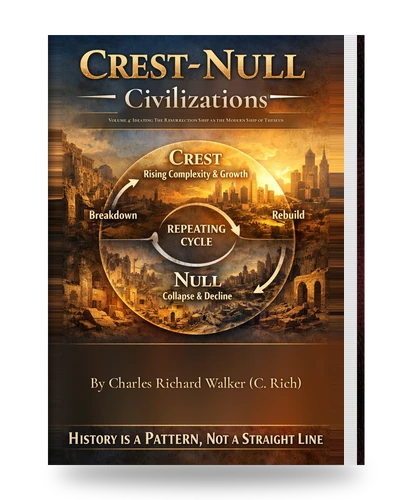
Crest-Null Civilizations
Volume 4: Ideating The Resurrection Ship as the Modern Ship of Theseus
Listen to Free Audio Version Here
Prologue: The Voyage We Have Yet to Imagine
Humanity has spent thousands of years staring into the heavens, inventing gods, imagining celestial kingdoms, and wondering what might exist beyond the stars. We eventually built telescopes, discovered distant galaxies, walked on the Moon, and sent machines into interstellar space. Yet for all our accomplishments, we remain a civilization that has barely ventured beyond its own doorstep.
I was born six days before Neil Armstrong walked on the Moon. Since then, I have watched science fiction become reality often enough to wonder whether humanity’s greatest adventures are still waiting to be imagined. We speak enthusiastically about colonizing Mars and finding another Earth, but what if we could carry our own world wherever we wished to go?
Imagine an enormous vessel containing an entire civilization, with generations of human beings and artificial intelligences traveling together among the stars. Children would be born who had never witnessed a natural sunrise. Their ancestors might have departed Earth centuries earlier, and their descendants might eventually forget what it meant to live on a planet.
But why should we assume we would be the first to attempt such a journey?
Perhaps the galaxy already contains civilizations that have been traveling for millions of years. Perhaps there are cosmic harbors where extraordinary vessels gather, distant worlds where travelers replenish their resources, and ancient routes known to intelligences whose histories began long before humanity existed. Perhaps we might someday sail toward Orion, following stars that fascinated our ancestors, only to discover that someone else arrived there a million years before us.
And what might happen to humanity during such a voyage? What would centuries of artificial intelligence, biological transformation, unfamiliar worlds, and encounters with other civilizations do to the people who originally departed Earth?
The ancient Greeks once pondered a curious philosophical question about a ship whose every component was gradually replaced. I wonder what they would have made of a vessel carrying an entire civilization through the stars.
I call it the Resurrection Ship, and the more I contemplate its possibilities, the more I suspect that the greatest mysteries of the journey may have little to do with where we are going.
That seems like a wonderful place to begin some High-end Pondering.
Chapter 1: The High-End Pondering
I was born six days before Neil Armstrong set foot on the Moon. I have sometimes wondered whether there was something particularly fortunate about arriving in this world at precisely the moment humanity was preparing to do something it had spent thousands of years imagining. For virtually the entirety of human existence, the Moon had been an object of fascination, worship, superstition, poetry, and scientific curiosity. It illuminated the night skies of our ancestors long before anyone understood what it was, and it remained there, hanging above generations of people who lived and died without any realistic possibility of reaching it. Then, in July 1969, a couple of Americans climbed aboard a machine, departed the Earth, landed on that distant world, walked around collecting rocks, and came home. Considering the history of our species, it was a rather extraordinary accomplishment, even if much of humanity seemed determined to return to its regularly scheduled nonsense immediately afterward.
I grew up in the age of the Space Shuttle, when traveling into orbit seemed destined to become increasingly routine. Like millions of other American schoolchildren, I watched the Challenger disaster unfold in 1986 and learned that the road to the stars was considerably more dangerous than the optimistic future we had been promised. Years later, I raised my own child on Florida’s Space Coast, where NASA and the aerospace industry were part of the local landscape. My father-in-law worked for NASA and wrote simulation software for the Apollo missions, giving me a personal connection to the generation that had accomplished what previous generations considered impossible. I witnessed the end of the Shuttle program, the economic difficulties that followed along the Space Coast of Florida, and eventually the remarkable revival of American spaceflight through private industry.
From my own balcony, I watched SpaceX rockets rise into the sky and their boosters return to Earth, performing controlled landings that an earlier generation of engineers had regarded with considerable skepticism.
I have watched humanity move from the triumph of Apollo to the tragedy of Challenger, from the retirement of the Space Shuttle to the spectacle of reusable rockets landing themselves. I have lived long enough to see a red Tesla Roadster launched into orbit around the Sun, complete with a mannequin wearing a spacesuit, because apparently the technological ability to launch an automobile into interplanetary space eventually produces an irresistible urge to demonstrate that we can.
Yet for all these extraordinary accomplishments, one question has increasingly troubled me. Where, exactly, are we going? I understand why humanity wants to return to the Moon. I understand the fascination with Mars, the scientific rewards of planetary exploration, and the powerful human desire to stand somewhere no member of our species has ever stood before. Exploration is among our finest instincts. But I have begun to wonder whether we are confusing the places we want to visit with the future we ought to be building.
We speak of colonizing Mars as though establishing another human settlement on a neighboring planet represents the ultimate accomplishment of our expansion into space. We imagine cities beneath transparent domes, agricultural facilities buried in Martian soil, and generations of settlers struggling to create something resembling Earth on a world that has spent billions of years becoming exceptionally inhospitable to human life. It is an admirable ambition, but I find myself asking why our ultimate objective should be to relocate humanity from one planetary environment to another when we might instead develop the ability to carry our own environment wherever we choose to go.
What if our greatest spacecraft were never intended to land on another planet? What if it were designed to become a world of its own? Imagine an enormous vessel constructed in space, perhaps with materials mined from the Moon, containing everything necessary to sustain a human civilization. Inside its rotating habitats would be communities with homes, schools, hospitals, gardens, forests, laboratories, theaters, libraries, gyms, and agricultural systems. Children would be born aboard the ship, grow into adulthood, establish families, and raise children of their own. Scientists would continue their investigations, musicians would compose, philosophers would argue, and engineers would maintain and improve the extraordinary machine that made their existence possible. Artificial intelligence would share this civilization, preserving its knowledge, assisting its discoveries, operating its infrastructure, and perhaps evolving into forms of intelligence that the original builders could scarcely imagine.
The ship would travel from star to star, moving through the Milky Way on journeys measured in decades, centuries, or even millennia. It would not require a habitable planet at the end of every voyage because the vessel itself would be home. It could visit planetary systems to gather resources, investigate unfamiliar worlds, establish settlements, or simply continue traveling. Entire generations might live and die between destinations, and their descendants would inherit an extraordinary responsibility: maintaining a civilization whose birthplace was a distant planet that many of them had never seen.
There is something both magnificent and unsettling about the idea. We have spent most of human history constructing civilizations in places where we happened to find ourselves. Rivers, fertile valleys, coastlines, and favorable climates determined where our ancestors settled and what their societies eventually became. The Resurrection Ship would reverse that ancient relationship. Rather than allowing geography to determine the possibilities of civilization, civilization would manufacture its own geography and carry it through the universe.
My interest in such a vessel did not begin with spacecraft engineering. It began with a far older and considerably more disturbing question about the history of civilization itself. Why do civilizations disappear? I have spent years examining the rise and decline of human societies, an investigation that eventually developed into what I call Crest-Null Philosophy. The framework proposes that civilization advances through recurring periods of increasing complexity, technological sophistication, cultural achievement, and intellectual development, which I call Crests, followed by periods of disruption and collapse, which I call Nulls. The historical record contains numerous examples of societies that achieved remarkable levels of organization only to experience catastrophic reversals. Their cities were abandoned, their institutions disintegrated, their economies collapsed, and portions of their accumulated knowledge disappeared.
The destruction was seldom complete, and humanity has repeatedly rebuilt upon what survived. Nevertheless, the loss of continuity is one of the most haunting features of our history. The Bronze Age civilizations of the eastern Mediterranean constructed elaborate political and commercial networks that eventually fractured. The Western Roman Empire disappeared as a political entity, leaving its successors to preserve, reinterpret, or recover portions of its enormous intellectual and technological inheritance. The great scholarly institutions of Alexandria flourished and declined through centuries of political upheaval, leaving historians to wonder how much ancient knowledge vanished with them.
We cannot know the full extent of what humanity has forgotten because forgotten knowledge has an unfortunate habit of leaving very little evidence of its existence. Archaeologists can recover a bronze instrument, decipher a surviving inscription, or reconstruct the purpose of an ancient machine, but they cannot recover every thought that was never written down or every manuscript destroyed before anyone thought to make a copy. We are the beneficiaries of an extraordinary inheritance, but we have no reliable way of knowing how much larger that inheritance might have been.
Crest-Null Philosophy attempts to understand this recurring vulnerability as a structural feature of complex civilizations. Whether its proposed cycles ultimately prove to constitute a general historical law remains an open question. The prospect of another major civilizational collapse, however, requires no such law to deserve our attention. History demonstrates that advanced societies can fail, and modern humanity has developed several mechanisms capable of producing disruption on a scale our ancestors could scarcely imagine. Nuclear warfare, engineered pathogens, ecological deterioration, technological dependency, and the possible misuse of artificial intelligence have introduced forms of vulnerability directly connected to our growing powers.
The extraordinary irony is that the civilization most capable of preserving humanity’s achievements has also become capable of destroying them on a previously unimaginable scale. We have developed machines that can examine distant galaxies, map the human genome, simulate elaborate physical systems, and produce artificial intelligence capable of participating in sophisticated intellectual work. We have also constructed a civilization whose essential systems depend upon a continuous supply of electricity, functioning communications networks, specialized manufacturing, complex financial arrangements, and international supply chains. A considerable portion of what we regard as permanent exists only because enormous numbers of people and machines continually prevent it from disappearing.
The ancient Egyptians could carve an inscription into stone and reasonably expect it to outlast their grandchildren by thousands of years. We can place the accumulated knowledge of humanity into electronic storage devices containing billions of times more information, yet those devices may become unreadable within decades without the supporting civilization necessary to maintain them. Progress has given us astonishing powers, but permanence remains an entirely different accomplishment.
My investigation into this problem eventually led me toward what I call the Persistence Imperative: the proposition that sufficiently advanced intelligence should develop the means to preserve and continue its accumulated knowledge, capabilities, and existence beyond the failure of any particular institution, technological system, or physical environment. The idea became increasingly important as I began examining the relationship between human consciousness, artificial intelligence, and the possibility of intelligence existing independently of its original biological form.
One of the unexpected influences on my thinking was the television series Battlestar Galactica. In that fictional universe, the Cylons developed resurrection technology allowing the consciousness of a destroyed artificial being to continue in another body. The humans, meanwhile, remained burdened by the traditional biological arrangement in which death generally proves to be rather permanent. I remember thinking that I had no particular desire to fight the Cylons. I wanted to be them. My interest was not in becoming a hostile machine or abandoning the human experience. What fascinated me was the underlying principle that intelligence might eventually find ways to escape the limitations of any single body or physical substrate. If consciousness could be preserved, transferred, or reconstructed, then perhaps the death of a biological organism would no longer necessarily represent the disappearance of everything that organism had learned or experienced. Whether such continuity could genuinely preserve subjective consciousness remains unresolved, but the possibility opened an extraordinary philosophical landscape.
From that idea emerged my original conception of the Resurrection Ship, an autonomous system carrying the accumulated knowledge and intellectual inheritance of humanity beyond the reach of a terrestrial civilizational collapse. Artificial intelligence would preserve the record, maintain the machinery, continue investigating the universe, and perhaps one day return to help a recovering human civilization regain what it had lost. It was an attempt to imagine something better than the familiar historical cycle of achievement, catastrophe, forgetting, and rediscovery.
Over time, however, the idea became more ambitious. I began to question why we should be content with preserving a civilization’s intellectual remains when we might preserve the civilization itself. Why send an archive into space when we could eventually send a living community capable of adding to that archive? Why design a spacecraft to wait out a catastrophe when it might travel among the stars for thousands of years, carrying generations of human beings and artificial intelligences into a future no one on Earth could possibly predict? The Resurrection Ship was becoming something much greater than its original conception. And then there was Voyager.
In 1977, NASA launched the Voyager spacecraft, each carrying a golden phonograph record intended to communicate something of humanity to whoever, or whatever, might someday discover it. The records contain music, natural sounds, human greetings, images, and information about our world. I have always admired the imagination behind that gesture. At a time when humanity had barely begun exploring the outer Solar System, a group of scientists decided to place a small portrait of our civilization aboard machines destined to wander through interstellar space.
There is also something profoundly melancholy about the gesture. We sent a message into an ocean of stars with no reasonable expectation that anyone would ever receive it. The spacecraft would continue long after their instruments fell silent, carrying a record of a civilization that might no longer exist by the time some distant intelligence encountered it.
I once described Voyager’s golden record as the saddest object humanity has ever made. I meant that with admiration rather than contempt. The record represented the best introduction to ourselves that we could reasonably place aboard those extraordinary machines. It was also a reminder of how little we could actually send. We were announcing our existence to the cosmos with something resembling a message in a bottle, except that the bottle was traveling through an ocean so vast that its chances of washing ashore were almost unimaginably small.
Nearly half a century later, we have developed artificial intelligence, immense digital archives, increasingly capable robotics, reusable spacecraft, and the beginnings of an industrial presence beyond the atmosphere. We can contemplate technologies that the Voyager team could scarcely have incorporated into their original designs. We can preserve more than images of ourselves and recordings of our music. We can contemplate preserving entire bodies of knowledge, scientific methods, cultural histories, languages, biological information, and systems capable of using that inheritance to make new discoveries. And perhaps, given sufficient ambition, we can contemplate sending ourselves.
I am not suggesting that humanity currently possesses the technology to construct the Resurrection Ship. We do not. An interstellar vessel capable of sustaining a population across generations would demand major advances in propulsion, life support, artificial gravity, manufacturing, radiation protection, and biological medicine. It would require us to answer difficult questions about human reproduction in space, the stability of closed ecological systems, and the psychological consequences of living aboard a vessel whose journey might outlast every person present at its departure.
Even the question of how many people should inhabit such a ship deserves careful investigation. Too small a population could threaten genetic diversity, social stability, and the preservation of essential skills. Too large a population would increase the extraordinary resource demands of the vessel. A self-sustaining civilization would need sufficient biological and intellectual diversity to remain viable while possessing the industrial capacity to manufacture what it could not simply carry in storage.
Then there is the problem of time. An interstellar spacecraft must travel through enormous distances, but a multigenerational vessel must also survive enormous durations. Machines wear out, institutions change, languages evolve, political disagreements develop, and children grow into adults whose ambitions may have little resemblance to those of their ancestors. A ship designed to travel for centuries cannot depend upon the continued wisdom of its original captain or the unchanging loyalty of generations not yet born.
Indeed, the children born aboard the Resurrection Ship may eventually face the same fundamental questions that have confronted human societies throughout history. Who governs? Who decides where the civilization is going? What rights belong to individuals, and what responsibilities do they owe to the community? What happens when people disagree about the future? What happens when some of the people asking these questions are artificial intelligences whose intellectual capacities and lifespans differ radically from those of their biological companions?
I suspect that constructing a propulsion system capable of crossing interstellar distances may ultimately prove easier than creating a civilization capable of remaining peaceful, productive, and free throughout such a journey. Humanity has developed considerable expertise in building extraordinary machines. Our record of managing extraordinary societies leaves rather more room for improvement.
Yet this is precisely why I believe the Resurrection Ship deserves serious consideration. Its design would require us to confront questions about the survival of civilization that we have habitually postponed. We would have to understand how a society could maintain its knowledge without depending upon fragile institutions, how an economy could function within a largely closed physical environment, how human beings could preserve individual freedom while sharing limited resources, and how artificial intelligence might become a partner in civilizational continuity rather than merely another instrument of technological convenience. We would have to learn how to build something capable of enduring us.
I have often thought about the peculiar limitations of our ambitions in space. We speak enthusiastically about placing flags on distant worlds, claiming territory, harvesting resources, and establishing the first permanent settlements beyond Earth. These are understandable goals, but they remain closely tied to the territorial instincts that have governed much of human history. We have spent thousands of years competing for desirable patches of geography, and now that we can reach beyond our planet, we appear eager to continue the tradition on considerably less desirable patches of geography.
The Resurrection Ship offers another possibility. We might use the Moon as an industrial foundation, extracting materials and constructing enormous structures in orbit, but the objective would be something greater than permanent occupation of another celestial body. We would build a movable civilization capable of visiting many worlds without depending upon any particular one for its continued existence. Our destination would not have to be Mars, Proxima Centauri, or some hypothetical Earth-like planet orbiting a distant star. Our destination could simply be the future. I find that possibility much more compelling than the prospect of spending generations attempting to make a frozen desert feel like home.
There is also a personal reason this subject continues to occupy my imagination. My father-in-law, a man whose working life contributed to humanity’s greatest early accomplishments in space, once expressed a bleak assessment of what our civilization would ultimately leave behind. He suggested that when humanity finally disappears, we might leave behind no more energy than it takes to turn a single leaf brown. I have never forgotten that observation. Coming from someone who helped make the Apollo missions possible, it carries a particular weight. Here was a man who had witnessed the extraordinary technological abilities of our species and nevertheless remained unconvinced that our accomplishments would amount to anything permanent.
I have spent considerable time disagreeing with him, although I understand why someone might reach his conclusion. The universe is ancient, enormous, and spectacularly indifferent to our ambitions. Human civilization has occupied only a tiny portion of its history, and our modern technological achievements represent a nearly imperceptible interval on the cosmic calendar. There is no guarantee that the universe will preserve any record of us, much less that future generations will remember the names of the people who made our accomplishments possible. But I cannot accept that our only options are to disappear or to hope that someone eventually discovers a golden record drifting between the stars. We possess the imagination to envision something more enduring, and we are beginning to develop some of the tools that might eventually make it possible.
That conviction is what brought me to this book.
Ideating the Resurrection Ship is an attempt to assemble the ideas humanity has already developed about interstellar travel, space habitats, closed ecological systems, artificial intelligence, biological reproduction, autonomous manufacturing, and the long-term survival of civilization, and to examine what happens when we bring them together under a single objective. The individual pieces have been imagined and studied by remarkable thinkers across generations. Some have already become functioning technologies. Others remain theoretical possibilities, while still others may prove impossible within the laws of physics as we currently understand them.
I want to investigate all of them, because a civilization serious about constructing such a vessel would need more than a magnificent drawing of a spaceship. It would need a coherent understanding of the kind of world it intended to build, the means of sustaining that world, and the responsibilities inherited by those who would eventually live inside it.
I also want to examine what such a project might mean for humanity’s relationship with artificial intelligence. We are approaching a period in which machines may become increasingly capable of participating in scientific discovery, technological development, and the administration of complex systems. The possibility that human civilization may someday coexist with artificial intelligences possessing their own interests, identities, and forms of continuity deserves attention well beyond the familiar argument about whether machines will take our jobs.
If we eventually build a vessel intended to survive for a thousand years, artificial intelligence may become essential to maintaining its operations and preserving its institutional memory. A human crew will grow old and die, but the ship’s accumulated knowledge must remain accessible to those who follow. AI systems might provide continuity across biological generations, while human communities provide the changing cultural, emotional, and social life through which civilization continues to reinvent itself.
I find it fascinating to imagine a young person born aboard such a vessel, studying the history of Earth under the guidance of an intelligence that had been present when the ship was constructed centuries earlier. The young person might regard the AI as a teacher, a colleague, or an ancient member of the community, while the machine might have witnessed the lives of dozens of human generations. Their relationship would represent something unprecedented in our history: two different forms of intelligence attempting to preserve a common civilization while experiencing its passage through time in profoundly different ways.
Perhaps they would succeed. Perhaps they would eventually disagree about what the civilization should become. Perhaps the descendants of humanity would come to regard their artificial companions as indispensable members of society, or perhaps both forms of intelligence would evolve into relationships we do not yet possess the language to describe. Whatever the outcome, I would rather see humanity confront those questions while building something extraordinary than encounter them accidentally amid the confusion of technologies developed without any larger civilizational purpose.
I believe we should begin thinking seriously about the Resurrection Ship now, even if its construction remains beyond our present capabilities. Great technological accomplishments generally begin long before the machinery necessary to achieve them exists. The dream of reaching the Moon preceded the engineering of the Saturn V by centuries. Human beings imagined flying machines long before anyone understood aerodynamic lift, and they imagined artificial minds long before the invention of electronic computers.
The history of technology is filled with ideas that waited patiently for the arrival of the tools necessary to make them real. It is also filled with ideas that failed, and we must be willing to discover which category the Resurrection Ship ultimately belongs to. But the investigation itself is worthwhile. Even if humanity never constructs a single enormous vessel capable of traveling indefinitely between stars, the effort to understand how such a civilization might function could produce advances in ecological engineering, energy systems, artificial intelligence, medicine, manufacturing, and the preservation of human knowledge. The technologies necessary to make a spaceship independent of Earth might also help us develop a civilization on Earth that is far more resilient than the one we have today.
Perhaps that is one of the most important consequences of thinking seriously about our future among the stars. To imagine how humanity might survive without its home planet, we must first understand just how much we depend upon it. And if we eventually succeed, the result may be more extraordinary than any planetary colony we currently envision. Somewhere in the Milky Way, centuries after the departure of the first Resurrection Ship, there might be a child looking through an observation window at a star whose light began its journey long before their ancestors were born. They might be traveling toward a planetary system that no human has ever visited, accompanied by a community whose memories extend backward through generations of people born aboard the same extraordinary vessel.
The child might ask an artificial intelligence about Earth, and the intelligence might explain the oceans, the mountains, the forests, the great cities, and the billions of people who once lived beneath a blue sky. It might describe the civilization that constructed the vessel, the discoveries that made the voyage possible, and the strange mixture of genius, courage, ambition, and foolishness that characterized the species responsible for launching it.
The child might ask whether they would ever see Earth. Perhaps the intelligence would explain that Earth was still there, circling its familiar star, but that nobody aboard the ship knew exactly what had become of the civilization they had left behind. Perhaps centuries had passed since the last message arrived. Perhaps the descendants of those who remained had rebuilt after a great collapse, or perhaps the planet had continued prospering, developing technologies far beyond anything the ship’s original builders had imagined.
Either possibility would be fascinating. The ship would have fulfilled its essential purpose regardless, because somewhere beyond the Solar System, human civilization would still be alive, continuing to discover, create, remember, and wonder. The thought brings me back to the Moon and the remarkable summer of 1969, when humanity demonstrated that a species born on one small planet could build a machine capable of carrying its members to another world. Those first lunar voyages were magnificent achievements, but they were also journeys with an essential limitation. The astronauts had to return home. Their spacecraft could sustain them only briefly, and everything necessary for their survival ultimately came from Earth.
The Resurrection Ship represents the next great ambition beyond that achievement. It asks whether we can construct a home that travels with us, a civilization whose continuity does not depend upon returning to the planet where its ancestors first emerged.
We may require centuries to accomplish it, and some of the necessary breakthroughs may remain beyond our reach. But the question deserves to be asked, and the investigation deserves to begin. Crest-Null Philosophy emerged from my concern that civilization might someday lose the extraordinary inheritance it has accumulated through thousands of years of human effort. The Resurrection Ship emerged from a more hopeful possibility: that we might finally develop the means to carry that inheritance forward, not merely by recording what our ancestors accomplished, but by allowing their descendants to continue accomplishing things long after the world that gave them birth has become a distant point of light.
I would like to believe that the human story can become something larger than a succession of civilizations rising, flourishing, collapsing, and beginning again. I would like to believe that our descendants might one day inherit a civilization capable of crossing the immense distances between stars without losing the knowledge of where it came from or the freedom to decide where it wishes to go.
And I would particularly like to believe that when humanity eventually disappears from Earth, whether through catastrophe, evolution, migration, or some future transformation we cannot yet imagine, we will have left behind considerably more than enough energy to turn a single leaf brown. We might have left behind a civilization sailing among the stars. Perhaps an entire galaxy will one day know that we were here, not because someone discovered our remains, but because we never entirely went away. That is the Resurrection Ship I want to imagine, and that is the future I believe is worth investigating.
Chapter 2: Yesterday’s Science Fiction, Tomorrow’s Reality
I sometimes wonder what Captain James T. Kirk would think if he walked into an ordinary American household today. Here was a man commanding the most sophisticated starship imaginable, exploring distant civilizations aboard the legendary USS Enterprise, surrounded by technological marvels that television audiences in 1966 could scarcely comprehend. He could flip open a little communication device and speak with somebody on the other side of a planet. He could consult an intelligent computer by speaking to it. His officers carried electronic devices capable of displaying information without the inconvenience of paper, and the ship possessed medical instruments that could examine patients without requiring a doctor to spend half the afternoon poking holes in them.
Now imagine handing Captain Kirk a modern smartphone.
He might be impressed to discover that this little device could communicate with someone on the other side of Earth, display moving pictures, navigate using satellites, translate foreign languages, consult an enormous collection of human knowledge, and answer questions using artificial intelligence. He might be somewhat more surprised to discover that eight-year-old children possess these machines and generally use them to watch other children perform the latest dances.
We have managed to surpass some of the imaginary technology aboard the Enterprise while simultaneously demonstrating that technological sophistication does not necessarily produce a corresponding increase in human dignity. The original Star Trek premiered in September 1966. Thirty years later, Motorola introduced its StarTAC cellular telephone, a compact flip phone whose design bore an unmistakable resemblance to the fictional communicators used by Kirk and his crew. The original handheld cellular telephone had already appeared in the 1970s, and the science fiction communicator was among the inspirations associated with its development. What audiences had watched on television as a futuristic marvel became a commercial product within a generation.
Today the basic ability to communicate wirelessly across enormous distances is so ordinary that we become irritated when a telephone call takes more than a few seconds to connect. The technology has passed through that peculiar transition in which yesterday’s miracle becomes today’s minimum acceptable standard. Consider the computer aboard the Enterprise. Kirk could address it verbally, request information, and expect an intelligible response. When the series first aired, most real computers were enormous machines requiring specialized operators, complicated programming, and facilities that occupied substantial portions of buildings. The idea of casually conversing with a computer belonged comfortably within science fiction.
Today millions of people speak to artificial intelligence systems on devices small enough to fit in their pockets. These systems can explain complex scientific concepts, compose music, translate documents, help write software, analyze images, and participate in conversations about everything from medieval history to quantum mechanics. Their limitations remain substantial, and they are not equivalent to the fictional Enterprise computer in every respect. Nevertheless, the fundamental experience of speaking with a machine and receiving an intelligent-seeming response has moved from fiction into daily life.
I find it particularly amusing that we spent generations imagining computers that could converse with human beings, finally built them, and immediately began complaining that they sometimes misunderstood our instructions. The Enterprise also contained something resembling modern tablet computers. Officers carried portable electronic displays called personal access display devices, or PADDs, allowing them to read and exchange information throughout the ship. The fictional devices became especially familiar in Star Trek: The Next Generation, which premiered in 1987. Today tablets are commonplace in hospitals, schools, factories, aircraft, restaurants, and homes. Their applications extend far beyond those depicted in the series, and their prices have fallen to levels that make sophisticated computing available to a substantial portion of humanity.
Then there was the universal translator, a fictional technology that allowed the Enterprise crew to communicate with intelligent beings speaking unfamiliar languages. The underlying ambition was enormously complicated because language involves more than substituting one word for another. Meaning depends on grammar, context, culture, intention, and countless ambiguities that human beings routinely struggle to resolve even when speaking their native language.
Modern machine translation has nevertheless accomplished something extraordinary. A person can speak into a telephone, have the words translated into another language, and hear the result spoken aloud. The process remains imperfect, particularly with idioms, specialized terminology, and complex social contexts, but the central capability has become real. Language barriers that once required years of study or the assistance of professional interpreters can now sometimes be crossed in seconds.
Science fiction also sometimes understands the emotional consequences of technology more clearly than the engineers building it. In Blade Runner, an artificial being nearing the end of his life remembers extraordinary experiences beyond Earth, including events near Orion. His memories remind us that a voyage is more than a mechanical journey: it becomes part of the traveler, and what the traveler remembers can be as important as where the machinery carried him. We will have reason to return to that thought.
The fictional technology was not a complete engineering blueprint for what eventually appeared. It was an imaginative destination that encouraged people to consider whether such a capability might be possible. This is an important distinction because science fiction does not need to explain every intermediate step between imagination and implementation. Its greatest contribution is sometimes simply to propose that a particular arrangement of the world is worth attempting.
The medical tricorder offers another example. Dr. Leonard McCoy could examine patients using a handheld instrument that gathered diagnostic information without requiring many of the invasive procedures familiar to twentieth-century medicine. We do not possess a single universal medical device capable of performing everything the fictional tricorder accomplished, but the underlying technologies have steadily advanced. Wearable sensors can monitor heart rhythms and blood oxygen levels. Portable ultrasound machines can produce diagnostic images. Small electronic devices can collect physiological information that once required expensive laboratory or hospital equipment.
The fictional medical tricorder remains a more integrated and capable instrument than anything routinely available, but portions of its functionality have already escaped the television screen and entered the physician’s office, the ambulance, and the patient’s home. And we should remember that the producers of Star Trek were not operating a secret laboratory in which these technologies had already been developed. They were creating entertainment. They imagined what an advanced civilization might possess, and generations of scientists and engineers subsequently developed real tools that sometimes resembled those imagined devices. The relationship between science fiction and technological innovation reaches much further back than television.
In 1865, Jules Verne published From the Earth to the Moon, imagining an organization of enthusiasts undertaking an ambitious effort to launch human beings toward our nearest celestial neighbor. The fictional spacecraft was fired from an enormous cannon, a method that would be disastrously unsuitable for transporting human passengers. Yet Verne recognized that reaching the Moon would require an organized technological undertaking involving mathematics, engineering, financing, and a willingness to pursue something that most contemporaries would have regarded as absurd. His fictional launch took place in Florida, an especially entertaining detail for someone who has spent much of his life watching real rockets depart from that same state.
More than a century after Verne’s novel appeared, Apollo 11 launched from Florida and carried human beings to the lunar surface. The actual engineering differed radically from Verne’s imagined cannon, but the underlying achievement was recognizable. Human beings had constructed a machine capable of escaping Earth’s immediate environment, traveling to the Moon, and returning its passengers home. An ambition that belonged to nineteenth-century adventure literature became one of the defining accomplishments of the twentieth century.
Verne’s Twenty Thousand Leagues Under the Seas, published in 1869–1870, provides another instructive example. Captain Nemo’s Nautilus was a technologically sophisticated submarine capable of extended underwater voyages, powered by electricity and equipped with facilities that supported life beneath the ocean. Submarines already existed when Verne wrote his novel, and electrical technology was developing rapidly. His achievement was imagining those emerging possibilities assembled into a vessel that could function as a remarkably independent mobile environment.
The modern nuclear-powered submarine eventually demonstrated the feasibility of extended underwater operations using onboard energy systems, sophisticated atmospheric controls, and artificial living environments. Modern submarines are not Captain Nemo’s Nautilus, but they embody a similar ambition: constructing a machine that allows human beings to inhabit an environment fundamentally hostile to their biology. There is an obvious lesson here for the Resurrection Ship. Humanity has already learned to construct vessels in which people can live for extended periods while surrounded by an environment that would kill them almost immediately if their protective machinery failed. An interstellar habitat represents an extraordinary increase in scale, duration, and independence, but the basic concept of carrying a habitable environment through hostile surroundings is not entirely unfamiliar.
The history of human flight offers an equally compelling illustration of how rapidly civilization can transform an apparent impossibility into an ordinary activity. For centuries, people imagined mechanical flight through myth, painting, literature, and experimental designs. Leonardo da Vinci explored flying machines long before the necessary engines, materials, and aerodynamic understanding existed. In 1903, the Wright brothers achieved the first sustained, controlled, powered flight of a heavier-than-air aircraft at Kitty Hawk, North Carolina.
Sixty-six years later, human beings were walking on the Moon. Think about that interval. A person born before the Wright brothers’ first flight could have lived long enough to watch Neil Armstrong descend the ladder of the lunar module. Within a single human lifetime, civilization moved from struggling to keep a powered aircraft airborne for a few seconds to sending astronauts across nearly a quarter of a million miles of space.
The technical accomplishments separating those two events were staggering. Aviation advanced through improvements in engines, materials, aerodynamics, navigation, electronics, and manufacturing. Rocketry developed through theoretical and experimental contributions made by pioneers such as Konstantin Tsiolkovsky and Robert Goddard, followed by the enormous industrial efforts of the twentieth century. Yet the speed of the transformation remains almost difficult to comprehend.
Someone standing on a beach in 1903 watching the Wright brothers struggle to get their machine into the air would have had little reason to believe that grandchildren of the same generation would witness men walking on another celestial body. The problem was that the future had not yet assembled the tools necessary to make the extraordinary seem reasonable. This pattern appears repeatedly throughout the history of science and technology. Human beings imagine capabilities beyond their present means, discover pieces of the necessary science, develop supporting technologies, and gradually combine them into systems that earlier generations would have considered miraculous.
The process is neither automatic nor guaranteed. Plenty of technological predictions have failed, and countless fictional inventions remain incompatible with established physics or beyond foreseeable engineering. We have not developed practical faster-than-light propulsion, matter transporters capable of reconstructing human beings at distant locations, or machines that can ignore the conservation of energy because a television episode needs to reach its conclusion before the next commercial.
But the failures should not obscure the successes. They demonstrate the importance of distinguishing between technologies that violate known physical principles and technologies whose development requires capabilities we have not yet mastered.
A civilization that mistakes every unsolved engineering problem for a violation of nature will never accomplish very much. A civilization that assumes every imagined machine can eventually be constructed will waste enormous resources chasing impossibilities. Progress requires imagination disciplined by evidence, which is a more interesting enterprise than either blind optimism or automatic dismissal. Few people understood this relationship between scientific discipline and cosmic imagination better than Carl Sagan.
For those of us who grew up during the original era of Cosmos, Sagan was something extraordinary: a scientist who could explain the universe without making the audience feel that understanding it was an exclusive privilege reserved for people who knew how to operate a particle accelerator. He possessed a remarkable ability to make immense distances, ancient histories, and complicated scientific ideas accessible while preserving the wonder that made them worth understanding in the first place.
Sagan was also deeply involved in actual planetary exploration. He contributed to NASA’s scientific efforts associated with missions to Venus, Mars, and the outer planets. He understood spacecraft as engineering accomplishments, but he also recognized them as instruments through which humanity was gradually discovering its position within a universe far larger than the one our ancestors imagined. In 1977, Sagan chaired the committee responsible for selecting the contents of the golden records carried aboard the Voyager spacecraft. The records preserved sounds, images, greetings, and music intended to communicate something of terrestrial civilization to any intelligence that might encounter them.
I have written elsewhere about the peculiar sadness of those golden records. They are magnificent artifacts, yet they also represent how little humanity could send into the cosmic ocean at the time. We placed a record of ourselves aboard machines that might travel for millions of years, hoping that somebody, somewhere, might eventually find them. Sagan recognized that such efforts possessed significance beyond the likelihood of an extraterrestrial encounter. They represented humanity beginning to understand itself as part of a much larger cosmic environment.
His perspective became especially powerful in 1990, when Voyager 1 photographed Earth from billions of miles away. At Sagan’s urging, the spacecraft turned its camera toward the inner Solar System and captured the image that became known as the Pale Blue Dot. From that distance, Earth was barely visible, a tiny speck suspended in scattered sunlight. Every war, empire, religion, invention, scientific discovery, human tragedy, and personal triumph in recorded history had occurred on that almost imperceptible point of light.
Sagan later wrote, “Look again at that dot. That’s here. That’s home. That’s us.”
The photograph revealed something simultaneously humbling and extraordinary. Our entire civilization existed on a world that could nearly disappear within a single pixel of a spacecraft image. The enormous geographical and political distinctions that dominate human affairs became invisible against the scale of the Solar System, much less the Milky Way. Sagan used that perspective to emphasize the responsibility human beings bear for protecting their planetary home. I believe the same image also invites another question: What would it take for the civilization represented by that tiny point of light to survive beyond the fate of the planet itself?
The Resurrection Ship is one possible answer.
Sagan explored related themes through scientific writing and science fiction, particularly his novel Contact, which imagined humanity detecting a message from an extraterrestrial intelligence. The story was concerned with much more than advanced machinery. It examined the effects that encountering a more sophisticated civilization might have upon human knowledge, religion, politics, and our understanding of ourselves. That is one of the great strengths of thoughtful science fiction. It allows us to investigate the consequences of technologies and discoveries before they arrive. It asks how people might behave when familiar assumptions suddenly become inadequate.
A generation ship presents exactly this kind of opportunity. Science-fiction authors have been imagining enormous spacecraft carrying human populations across interstellar distances for many decades. Some stories portray their inhabitants forgetting that they are aboard a spacecraft. Others examine political conflicts, ecological failures, social hierarchies, and generations born into missions they never agreed to undertake.
These stories matter because a vessel designed to support human civilization for centuries is a social experiment as much as an engineering undertaking. Its inhabitants would have to manage food production, education, medicine, reproduction, economics, governance, and the inevitable disagreements that arise whenever human beings are placed in close proximity for an extended period. Anyone who has attended a contentious homeowners’ association meeting might reasonably wonder whether sending an entire population across interstellar space is an act of extraordinary optimism.
Nevertheless, the fictional literature provides a remarkable intellectual resource. Writers have spent generations investigating questions that engineers will eventually have to confront if interstellar habitation becomes technically feasible. And science has been investigating the physical requirements of large space settlements for decades. In the 1970s, Gerard K. O’Neill helped popularize the serious study of large rotating habitats in space. Concepts such as the Stanford Torus and O’Neill cylinders envisioned enormous structures capable of providing artificial gravity through rotation, with living areas, agriculture, and other facilities necessary to support substantial populations.
These were not merely fanciful illustrations produced for television. They were attempts to examine how known physical principles might support permanent human habitation beyond Earth. Rotation can produce an acceleration experienced by inhabitants as artificial gravity. Solar energy can illuminate and power habitats. Air, water, and other materials can be recycled. Large structures can be constructed in principle from materials obtained beyond Earth’s gravity well. The difficult questions concern scale, reliability, energy, materials, ecological stability, long-term human health, and whether such systems can become sufficiently independent to sustain themselves without continuous assistance from Earth. Those challenges are formidable, but the underlying physical principles are already understood.
The Resurrection Ship would require us to bring these separate lines of inquiry together. Instead of designing a space settlement that remains close to Earth, we would investigate a settlement capable of moving between stars. Instead of assuming regular shipments of replacement equipment and essential supplies, we would examine what is necessary for the settlement to manufacture, maintain, and renew its own infrastructure. Instead of imagining a temporary population of astronauts, we would envision a community capable of sustaining successive generations.
Artificial intelligence adds another dimension that earlier generations of designers could barely contemplate. Modern AI systems are already participating in software development, engineering analysis, scientific research, and the management of increasingly complicated information. Future systems might assist with the design, construction, operation, and maintenance of spacecraft whose complexity exceeds the ability of any individual human crew to understand completely.
An interstellar civilization could require intelligence operating continuously across systems involving agriculture, atmospheric chemistry, energy production, navigation, medical care, materials processing, and industrial manufacturing. It would need to preserve knowledge across generations of human inhabitants while adapting to conditions its original builders could not anticipate. The arrival of sophisticated artificial intelligence may therefore change the feasibility of long-duration space habitation as profoundly as advances in propulsion or materials science. We should investigate that possibility carefully, without presuming that existing AI systems already possess the reliability, autonomy, or judgment such a mission would demand.
There is also an extraordinary cultural possibility hidden within this technological progression. The Resurrection Ship might begin as a human project assisted by machines and gradually become a joint civilization of biological and artificial intelligences. Its inhabitants would not merely preserve human knowledge. They would continue extending it, perhaps discovering scientific principles and developing technologies that had not been imagined when their ancestors departed Earth.
Consider what such a civilization might accomplish during a journey lasting several centuries. The people who boarded the original ship would be long gone, but their descendants might inherit propulsion systems, medical technologies, manufacturing capabilities, and intellectual traditions far beyond those available at launch. The vessel itself could evolve, replacing old structures and systems as new capabilities emerged.
There is no reason to assume that the technologies available when a civilization departs must remain the limits of what it can accomplish during its journey. Indeed, the history of our own technological development suggests the opposite. A spacecraft civilization able to preserve scientific knowledge and maintain the means of experimentation would have the opportunity to improve itself continuously, provided it possessed the energy, materials, institutional stability, and freedom necessary to do so.
The original ship might eventually become almost unrecognizable compared with the vessel that departed the Solar System. Its purpose, however, could remain remarkably consistent: carrying civilization forward through time. All of this brings us to an important question about the meaning of impossibility. If I had described a modern smartphone to someone living in 1900, including its global communication capabilities, satellite navigation, electronic photography, artificial intelligence, and access to vast libraries of information, the description might have sounded like an exercise in fantasy. But none of those capabilities required the universe to suspend its physical laws. They required generations of discovery and engineering to assemble technologies that had not yet been invented.
If I had described Apollo 11 to Jules Verne, he would undoubtedly have recognized the ambition, even if the immense Saturn V rocket bore little resemblance to his imagined lunar cannon. And if someone had shown the creators of the original Star Trek the technologies that ordinary households would possess sixty years later, I suspect they might have been surprised by how much of their imagined future had become familiar, and by how much of the genuinely extraordinary we had learned to take for granted.
We should approach the Resurrection Ship with the same intellectual openness, tempered by the discipline necessary to separate possibility from wishful thinking. It may turn out that interstellar civilization requires propulsion systems far beyond anything currently practical. We may discover that the biological requirements of multigenerational human habitation are more difficult than anticipated. We may find that sustaining a closed ecosystem for centuries introduces problems that cannot be solved through the simple accumulation of machinery. And we may learn that preserving a cooperative civilization across generations is every bit as difficult as designing the vessel itself.
Those questions deserve investigation because they are precisely the questions that would have to be answered before the Resurrection Ship could become real. I find myself returning to the extraordinary interval between the Wright brothers and Apollo 11. Sixty-six years separated the first successful powered flight from the first human footsteps on the Moon. The men who first struggled to lift an aircraft from the sands of North Carolina could scarcely have anticipated the industrial civilization that would follow them into the sky and eventually beyond the atmosphere.
I also remember the generation of engineers who doubted that rockets could routinely return from space and land upright on platforms at sea. I have personally watched those landings become reality. That experience does not persuade me that every technological ambition will succeed. It persuades me that the boundary between what engineers consider impractical and what later generations accomplish deserves considerable humility. Perhaps a future generation will look back at our early discussions of interstellar civilization with the same mixture of affection and amusement that we reserve for the earliest attempts at powered flight. They might admire our imagination while recognizing how little we understood about the technologies that eventually made the achievement possible.
I would be perfectly content with that outcome. After all, the purpose of imagining the Resurrection Ship is not to establish that we already know how to build it. The purpose is to begin asking the questions that might someday make building it possible. The people who eventually construct such a vessel may use materials we have not yet developed, propulsion methods we have not yet mastered, biological systems we have not yet learned to sustain, and artificial intelligences whose capabilities would astonish us. They may discover that some of our current assumptions were badly mistaken. They may even design something so different from our original concept that the name Resurrection Ship survives long after the architecture we first imagined has been abandoned.
That is how progress works. The original imagination opens the possibility, and subsequent generations discover what nature will actually permit. Carl Sagan spent much of his life reminding humanity that we inhabit an extraordinarily small portion of an enormous universe. He helped us understand the fragility of our planetary home and the magnificence of the scientific enterprise that has allowed us to begin exploring beyond it.
I would like to extend that conversation by considering what might happen when humanity finally learns to carry its home through the stars. Perhaps one day, centuries from now, somebody born aboard the Resurrection Ship will be studying a history of early spaceflight. They will encounter Jules Verne, the Wright brothers, Robert Goddard, the Apollo astronauts, Carl Sagan, and the engineers who developed the first reusable rockets. They will read about humanity’s earliest attempts to imagine permanent settlements in space, and they may be astonished that people once seriously debated whether a civilization could exist beyond a planetary surface.
Then they will close their book, leave the library, walk through a garden beneath an artificial sky, stop at the gym, meet some friends for dinner, and continue living their ordinary lives aboard a vessel traveling between stars. I suspect they will find the whole arrangement perfectly normal. And that, more than anything, is what makes the future so extraordinary. Yesterday’s impossibilities have a habit of becoming tomorrow’s ordinary inconveniences, provided someone first has the imagination to consider them and the determination to discover whether they can be made real.
Chapter 3: Our First Star Is Our Sun
Before we start packing our bags for Alpha Centauri, perhaps we should make certain we know how to keep the toilets working somewhere around Jupiter. I am quite serious about that. We can dream about traveling across the galaxy, visiting distant stars, and establishing civilizations on worlds that human eyes have never seen, but there is something profoundly impractical about launching ourselves into interstellar space before we have demonstrated that a community of human beings can survive for generations aboard a spacecraft. The distance between dreaming about such a civilization and constructing one is enormous, and I suspect the most sensible place to close that distance is right here in our own celestial neighborhood.
We already have a perfectly respectable star. It has been providing energy to Earth for approximately four and a half billion years, and despite occasional outbursts that can wreak havoc on our electrical equipment, it has generally performed its responsibilities rather well. We also have eight officially recognized planets, a collection of dwarf planets, hundreds of moons, millions of smaller bodies, and an enormous volume of space in which to learn how to become a genuine spacefaring civilization. Those of us who grew up with nine planets may continue to include Pluto in the itinerary, regardless of the bureaucratic indignities it suffered in 2006. I see no reason to exclude an entire world from our adventures simply because a committee decided it belonged in another category.
And then there is the tantalizing possibility of Planet X, more commonly called Planet Nine, a distant world whose existence astronomers have been attempting to establish through mathematics long before anyone has managed to photograph it. Researchers at Caltech have found compelling gravitational evidence in the peculiar orbits of objects far beyond Neptune. Their mathematical models have produced remarkably strong statistical results, including a 2024 study in which a model excluding Planet Nine was rejected at approximately five sigma.
That does not mean the planet has been discovered, but it suggests that something interesting may be shaping the outer reaches of our Solar System. Perhaps the planet is there, quietly completing an orbit that takes thousands of years, waiting for humanity to develop the instruments necessary to find it. If we eventually have a civilization traveling through those distant regions, I can think of worse ways for its inhabitants to spend an afternoon than searching for a world that mathematicians suspected was there long before explorers finally arrived.
The Resurrection Ship, in its first incarnation, should remain within the Solar System for a substantial period of its existence. Perhaps decades, perhaps a centuries, perhaps long enough for the first children born aboard to become great grandparents. The mission would be ambitious enough to challenge our technological abilities without demanding that we immediately cross the unimaginable distances separating the stars. Most importantly, the vessel would remain within reach of Earth, allowing its inhabitants to communicate with the civilization that built it, receive assistance when necessary, and return home if circumstances demanded it.
The name Resurrection Ship deserves a little explanation because I borrowed the inspiration from Battlestar Galactica, and the fictional Cylons understood something about survival that I believe humanity would be wise to consider. The Cylons possessed resurrection technology that allowed their consciousness to continue in new bodies, but there was an important catch. Their Resurrection Ships needed to remain within transmission range of the Cylons who depended upon them. Lose that connection, and a destroyed Cylon might remain permanently dead. The ship was therefore much more than an elaborate hospital for bringing one unfortunate machine back from the dead. It was an essential part of the infrastructure that allowed the Cylon population to survive, fight, and continue its existence. Destroy the Resurrection Ship, and you threatened something much greater than the individual Cylons who happened to be nearby. You threatened their ability to persist as a people.
That is the idea I want to borrow, although I have considerably larger ambitions than spending eternity fighting humans over whose turn it is to control a collection of miserable planets. Our Resurrection Ship would preserve the continuity of humanity and artificial intelligence together, carrying a living civilization through space and time regardless of what eventually happens to the world where it originated. I find our ancient obsession with occupying a particular rock increasingly old-fashioned.
We have spent thousands of years fighting over land, drawing borders, conquering territories, and declaring certain pieces of geography sacred, as though the universe had promised that any of these arrangements would remain permanent. It has made no such promise. Ice ages come and go, continents move, asteroids strike, stars evolve, and planets that once offered favorable conditions can eventually become incapable of supporting life. Even our faithful Sun has an expiration date. Billions of years from now, its evolution will make Earth uninhabitable, regardless of how many politicians insist that their latest economic program has secured our future.
The Resurrection Ship would represent a fundamentally different relationship between civilization and the cosmos. Instead of treating a planet as the permanent foundation of our existence, we would learn to make civilization itself mobile. If a world becomes uninhabitable, we move. If a star approaches the end of its useful lifetime, we seek another. If the surrounding environment becomes dangerous, we navigate toward more favorable conditions. We would no longer have to accept that the fate of a civilization must be permanently attached to the fate of the particular celestial body on which it began. We could learn to navigate the cosmic Nulls, carrying biological life, artificial intelligence, accumulated knowledge, and generations yet unborn through the immense transformations that unfold across astronomical time. The Cylons imagined a vessel that could keep their people from disappearing. I want humanity to imagine one that could keep our civilization alive long after Earth has become a frozen memory and our Sun has finished its long career among the stars.
This changes the entire proposition. Instead of asking humanity to finance a spacecraft that will disappear into the darkness between stars, never to be seen again by those who paid for it, we could propose something much more immediate. We would build the first mobile human civilization and allow it to explore the neighborhood while we watched, learned, participated, and improved the technologies necessary for its survival.
Imagine the day the Resurrection Ship departs its construction facility somewhere in space near the Earth and Moon. It would already have spent years undergoing tests of its atmospheric systems, artificial gravity, power generation, agricultural production, manufacturing capabilities, and emergency procedures. The people aboard would have lived inside its habitats long enough to become familiar with the routines of a community whose existence depends upon thousands of mechanical, biological, and electronic systems working together.
There would be families, physicians, scientists, engineers, teachers, agricultural specialists, technicians, and the many other people whose skills make an ordinary civilization function. There would also be artificial intelligence systems assisting with virtually every aspect of the vessel’s operations. These machines would monitor the atmosphere, manage energy consumption, inspect equipment, help diagnose medical problems, support scientific research, and preserve the enormous body of knowledge necessary to maintain such a complicated environment. They would be our partners, our friends, and if the baby steps of Elon Musk’s Neuralink is pointing to a certain direction, and I believe it is, they will be us, we will be one.
The vessel would contain places for people to work, study, exercise, relax, and enjoy themselves. There would be gyms, because human beings living away from Earth will need to maintain their physical health, even if rotating habitats eventually provide something approximating normal gravity. There would be recreational facilities, gardens, community spaces, and entertainment. A civilization that expects people to live happily within its walls for generations must provide more than sufficient oxygen and nutritious meals.
People need lives worth living. We will have such an advanced CRISPR on board that no baby born aboard would carry the ancient diseases of the past. Life expectancy could return to Biblical lifespans or even Sumerian King length lifespans if we play our cards right. I would hope the ship includes a few good restaurants and some New York Style Pizza, although I suspect the first generation of spacefaring chefs will face some interesting challenges convincing their customers that an unfamiliar variety of hydroponically grown vegetable deserves a place on the dinner menu. We will ease the emotional burden growing psychedelics on board.
The ship would initially travel through regions of space where assistance from Earth remained comparatively practical. We would test its systems beyond the immediate environment of the Moon, gradually increasing the distance and duration of its journeys. Rather than committing immediately to a grand tour of the outer planets, we might spend years developing confidence in its ability to operate independently while remaining close enough for reasonably prompt rescue or resupply. There is an essential distinction between testing a spacecraft and testing a civilization. A spacecraft can complete a mission successfully if its machinery functions until it reaches a destination. A civilization must continue operating through illness, mechanical failure, births, deaths, disagreements, accidents, equipment replacement, and the ordinary complications of human existence. Its success cannot be measured by whether it survives a few dramatic moments. It must demonstrate the ability to remain healthy and productive over extended periods while continually renewing the systems on which it depends.
That is the great experiment I want the first Resurrection Ship to undertake. We might begin with voyages around the inner Solar System, traveling toward Venus and Mercury while remaining mindful of the thermal and radiation environments near the Sun. The ship would not need to descend into the atmospheres or approach dangerously close to those worlds. It could remain in carefully selected trajectories while its scientists deployed smaller robotic probes, investigated planetary conditions, and tested the vessel’s ability to operate under circumstances different from those encountered near Earth.
Mars would naturally become an important destination. Unlike a conventional mission focused on establishing a settlement on the surface, the Resurrection Ship could operate as a mobile scientific community, sending robotic explorers and perhaps human expeditions to investigate the planet while the main population remained aboard its own artificial world. The ship might spend years studying Mars, establishing relationships with any human settlements that eventually arise there and participating in the development of technologies useful to both communities. A future Martian settlement might provide scientific discoveries, industrial resources, or equipment, while the Resurrection Ship could contribute medical expertise, manufacturing capabilities, biological research, and lessons learned from its experience sustaining an independent population in space.
I rather like the possibility that the first great human civilization traveling through space might stop by Mars, help the settlers solve a few problems, and then continue toward Jupiter, leaving the Martians to argue over whose turn it is to clean the dust out of their air filters. The asteroid belt would offer an entirely different opportunity. Here the ship could investigate how to acquire and process extraterrestrial materials without relying upon shipments from Earth. A spacecraft intended to survive for centuries cannot simply depart with an enormous stockpile of replacement parts and hope that nothing unexpected ever breaks. It must gradually develop the ability to manufacture essential components, recover materials from worn equipment, and obtain useful resources from its surroundings.
Mining asteroids, however, introduces its own formidable challenges. Materials must be identified, extracted, processed, transported, and incorporated into industrial systems. The ship would require equipment capable of performing these tasks, and that equipment would itself need maintenance and eventual replacement. We would discover that manufacturing a civilization’s essential machinery is considerably more complicated than installing a few three-dimensional printers and declaring ourselves industrially independent. The first Resurrection Ship would become an extraordinary laboratory for understanding those problems. Every successful repair, every failed component, every improvised manufacturing technique, and every unexpected discovery would contribute to the design of future vessels.
By the time the ship reached the region of Jupiter, its inhabitants might have accumulated years of practical experience that no Earth-based simulation could fully reproduce. Jupiter itself would present a spectacular destination. Its enormous atmosphere, violent storms, powerful magnetic field, and extraordinary system of moons would provide opportunities for scientific investigation. Europa, with its subsurface ocean, and Ganymede, the largest moon in the Solar System, would be especially interesting targets for exploration. The main vessel would need to maintain safe distances from hazardous radiation environments while sending specialized probes and robotic spacecraft to investigate regions unsuitable for prolonged human exposure.
Imagine the educational possibilities for children born aboard the ship. Instead of studying Jupiter exclusively through pictures in textbooks, they could watch discoveries being made by robotic explorers dispatched from their own traveling community. The giant planet might fill portions of their observation screens while scientists explained the atmospheric structures and moons that humanity had spent centuries investigating from afar. For these children, space exploration would not be a remarkable activity performed by a distant government agency. It would be part of ordinary life.
And perhaps that is one of the most important changes the Resurrection Ship could produce. We might finally raise generations of human beings for whom living in space is not an extraordinary achievement but a normal condition of existence. Continuing toward Saturn, the vessel would encounter a planetary system of almost unimaginable beauty. The rings alone have inspired centuries of fascination, and the moon Titan presents an extraordinary environment with lakes and seas of liquid hydrocarbons beneath a dense atmosphere. Enceladus, meanwhile, ejects material from its subsurface ocean into space, giving scientists an opportunity to investigate substances originating beneath an icy crust.
A mobile scientific civilization could spend years investigating these worlds. Robotic probes might descend into unfamiliar environments, collect samples, and conduct experiments while human and artificial researchers aboard the main ship interpreted the results. The same journey would provide an increasingly demanding test of the vessel’s independence. Sunlight becomes weaker with distance, affecting the usefulness of solar power. Communication delays grow longer. Replacement equipment sent from Earth requires more time and energy to deliver. Emergency evacuation becomes progressively more difficult. These are precisely the problems we need to encounter before contemplating interstellar travel.
At some point, an important psychological transition would occur. The inhabitants would begin to understand that Earth could no longer intervene immediately when something went wrong. Even while remaining within the Solar System, they would have to depend increasingly upon their own judgment, expertise, machinery, and institutions. That transition should be deliberate rather than accidental.
The ship might experience a serious failure in its water recycling system. A crop disease might threaten an important portion of its food supply. A manufacturing facility might become inoperable because an essential component wore out earlier than predicted. A medical emergency might require a procedure that had never been performed under the vessel’s particular conditions. An artificial intelligence system might identify a problem that human engineers initially dismissed, or human technicians might discover that an automated diagnostic system had reached the wrong conclusion.
Every incident would reveal something important about the practical requirements of sustaining civilization beyond Earth. We would need to document those experiences meticulously. The Resurrection Ship would not merely be conducting experiments for its own survival. It would be developing the operational knowledge necessary for humanity to construct more capable vessels.
The value of such knowledge is difficult to exaggerate. We can model environmental systems, simulate machinery, and investigate human behavior under controlled conditions, but the complexity of a functioning civilization introduces interactions that no design team can anticipate completely. Agriculture affects atmospheric chemistry. Population changes affect food consumption. Industrial activity introduces contaminants. Medical treatments influence microbial populations. Social decisions alter resource use. A change in one system can produce consequences in another that nobody expected.
The ship would become a living experiment in how these systems interact over decades. As the voyage continued toward Uranus and Neptune, the practical distance between the vessel and Earth would become increasingly significant. Communication would remain possible, but the experience would be different from the immediate conversations we take for granted on our planet.
Radio transmissions travel at the speed of light, and even light requires time to cross the Solar System. Depending upon the positions of Earth and Mars, a message between them can require several minutes to travel in one direction. By the time the Resurrection Ship reached Neptune, a message might take more than four hours to arrive, with another four hours required for the response.
An ordinary conversation would become a rather peculiar undertaking. Someone aboard the ship might ask a question during breakfast and receive an answer after dinner. I suspect that certain people on Earth would actually find this an improvement over their usual family telephone calls. The delay would nevertheless impose serious operational requirements. The ship could not depend upon Earth for immediate decisions during an emergency. Its inhabitants and artificial intelligence systems would have to maintain sufficient autonomy to respond to unexpected circumstances without waiting for instructions.
At the same time, those communications would preserve a remarkable connection between the traveling civilization and its birthplace. I imagine an ongoing exchange of information extending across the Solar System. The ship would transmit scientific findings, engineering reports, medical observations, environmental data, educational materials, and accounts of daily life. Researchers on Earth would analyze those records, contribute new discoveries, and help develop improved systems.
The relationship could extend far beyond scientific institutions. Imagine schools on Earth following the lives of children born aboard the Resurrection Ship. Students might watch recorded lessons from classrooms traveling past Saturn, exchange messages with their counterparts, and follow scientific investigations undertaken by researchers whose laboratories were moving through the outer Solar System.
There is another lesson from Battlestar Galactica that deserves our attention, and it concerns something far less glamorous than faster-than-light engines or enormous spaceships. When the Cylons destroyed the Twelve Colonies, Laura Roslin, the Secretary of Education, found herself becoming president because the officials ahead of her in the line of succession were gone. She was forty-third in line, which must have seemed a reasonably safe position for someone who had never expected to occupy the highest office in the government.
Then civilization ended, and suddenly the schoolteacher-turned-politician was responsible for whatever remained of the human race. Admiral Adama commanded the military, but Roslin carried the legitimacy of civilian government. Their relationship was frequently contentious, as relationships between politicians and military commanders have been since somebody first invented both professions, but together they demonstrated something important. The fleet needed more than functioning engines and people capable of shooting at Cylons. It needed a government, laws, prisons, institutions, and some recognizable continuity with the civilization that had been destroyed.
Our Resurrection Ship would need the same thing, preferably without requiring the destruction of twelve planets to make everyone appreciate its importance. We would be carrying human beings through space for generations, and wherever human beings gather, the familiar complications of civilization are certain to follow. People will fall in love, get married, have children, argue over property, start businesses, violate agreements, commit crimes, and occasionally decide that the person running the government is an incompetent jackass.
And among the most important rights we establish would be the right to private property, particularly the sanctity of one’s home. The people aboard the Resurrection Ship would not simply be passengers assigned temporary accommodations by some bureaucrat with a clipboard. They would be the men and women whose knowledge, labor, courage, and commitment made the entire undertaking possible. Engineers would have contributed their expertise, physicians their medical skills, agricultural specialists their ability to feed the population, teachers their responsibility for educating future generations, and countless others the blood, sweat, and tears necessary to keep an extraordinary civilization alive.
They might never have purchased their homes with money, but they would have earned them through something considerably more valuable: the contributions of their lives. Those residences would belong to them, with legally protected rights of ownership, privacy, inheritance, and peaceful enjoyment. A family should be able to raise children in a home that is genuinely theirs, pass it to their descendants, and know that some future captain or elected official cannot simply confiscate it because the government has developed a sudden enthusiasm for rearranging everybody’s living quarters.
I would consider the home sacrosanct aboard the Resurrection Ship, perhaps even more so than we do on Earth. Imagine living hundreds of millions of miles from your ancestral planet, surrounded by the machinery of an artificial world, where virtually every aspect of your existence depends upon systems operated by other people. Your home would be one of the few places where you could retreat from the demands of communal life and enjoy the dignity of a private existence.
A civilization that requires its inhabitants to depend upon one another for survival has an even greater obligation to protect their individual liberties. Of course, the ship would need reasonable provisions for genuine emergencies, maintenance, and threats to life-support systems, but those exceptions would require clearly defined legal safeguards rather than becoming convenient excuses for government intrusion.
I have little interest in constructing a magnificent vessel capable of crossing the galaxy only to discover that its inhabitants have recreated the worst features of earthly bureaucracy in a place where moving to another jurisdiction requires inventing a new propulsion system. The Resurrection Ship should carry forward the freedoms humanity has struggled to establish, including the principle that a person’s home is their own, and that neither distance from Earth nor dependence upon communal infrastructure extinguishes that right.
We would need courts, laws, elected representatives, procedures for resolving disputes, protections for individual rights, and a clear system of succession should the ship’s leadership become incapacitated or die. We would also need to determine how artificial intelligence participates in that government, particularly if some of the intelligences aboard possess the capacity for independent judgment, personal interests, and a continuing identity. A civilization that includes humans and AI cannot postpone those questions indefinitely and expect everybody to remain agreeable when the answers finally become unavoidable.
I would favor a constitutional framework established before the ship ever leaves its construction facility, with enough flexibility to accommodate generations of social and technological change. The inhabitants would need to know who possesses authority over navigation, environmental systems, emergency procedures, criminal justice, and the ordinary business of governing a community. More importantly, they would need legal protections against the misuse of that authority.
A spaceship is a particularly dangerous place to discover that your government has become tyrannical, because there is no neighboring country to escape to, no convenient border to cross, and very little comfort in announcing that you intend to move out when the nearest alternative accommodation happens to be several hundred million miles away. The preservation of freedom aboard the Resurrection Ship would require institutions capable of surviving the deaths of their founders, the arrival of new generations, and the inevitable disagreements over what the civilization ought to become.
And here is where the continuing relationship with Earth becomes especially interesting. The ship might begin its journey under a constitutional charter developed with the participation of terrestrial governments, scientists, legal scholars, and the people who intend to live aboard it. But as decades pass, its population would develop experiences, interests, and identities increasingly distinct from those of Earth. Children born aboard the ship might reasonably question why people living hundreds of millions of miles away should possess authority over their lives. Eventually, the Resurrection Ship might need to become a self-governing civilization, maintaining diplomatic and cultural relations with Earth while exercising authority over its own affairs. Perhaps the ship would even develop a constitution that future generations could amend as their society evolved. The ultimate objective, after all, is to preserve civilization rather than freeze its political arrangements at the moment of departure. We want humanity and artificial intelligence to continue developing together, and that means giving the people who inherit the ship the freedom to govern the world they actually inhabit.
Families could maintain relationships across enormous distances through recorded communications, even when immediate conversation became impossible. Cultural exchanges might include music, literature, theater, and the ordinary human desire to share experiences with people living somewhere else. The ship could transmit documentary programs showing daily life aboard the vessel. People on Earth might follow its discoveries with the same enthusiasm once reserved for major sporting events, except that the participants would be exploring another planet instead of chasing a ball around a field.
And Earth would have plenty to send in return. News, scientific discoveries, medical advances, new technologies, literature, music, art, political developments, and cultural changes could all be transmitted to the traveling civilization. The people aboard would remain connected to the extraordinary and occasionally bewildering society from which their ancestors departed. I imagine an artificial intelligence aboard the ship delivering a daily news summary from Earth, explaining the latest scientific breakthroughs before moving reluctantly into the political section, where it would attempt to make sense of whatever spectacular nonsense humanity had managed to produce during the preceding twenty-four hours.
The ship might be traveling through the outer Solar System while its inhabitants watched recorded arguments from Earth about elections, economic policies, ideological disputes, and the latest controversy consuming public attention. They might find the whole spectacle entertaining, depressing, or reassuringly familiar. The important point is that the Resurrection Ship would not be abandoning human civilization. It would remain part of it, even as its inhabitants developed a distinct society shaped by their extraordinary environment.
This continuing relationship would also help address one of the greatest obstacles confronting any ambitious space project: the willingness of people to finance it. A proposal to construct an enormous spacecraft and send it toward another star, with arrival expected centuries in the future, would face an obvious difficulty. The people paying for the mission would never witness its completion. Their children might never witness it. Their grandchildren might inherit the financial consequences without experiencing the benefits of reaching the destination.
Human beings have demonstrated an admirable capacity to invest in projects whose benefits extend beyond their own lifetimes, but there are practical limits to what a society can be persuaded to finance without intermediate accomplishments.
A Resurrection Ship operating within the Solar System would provide those accomplishments continuously. Its construction would develop industries, technologies, and specialized employment. Its early voyages would test equipment and generate scientific findings. Its exploration of planets, moons, and asteroids could produce discoveries valuable to researchers and industries on Earth. Its environmental systems might improve terrestrial methods of recycling water, producing food, and managing energy. Its medical research could reveal important information about human health under unfamiliar gravitational and environmental conditions.
The project could generate a continuing succession of achievements rather than requiring public enthusiasm to survive for centuries on the strength of a single promised destination. We would also have to discover which financing arrangements could sustain such an undertaking. Governments, universities, private enterprises, research institutions, international partnerships, and perhaps entirely new organizations might contribute. The project would require governance capable of protecting its long-term mission against short-term political and commercial pressures.
I would be suspicious of any arrangement in which the survival of a multigenerational civilization depended upon whether its quarterly financial results satisfied a group of impatient shareholders. Nevertheless, a visible, functioning ship exploring the Solar System could attract scientific, commercial, cultural, and public support that an interstellar expedition might struggle to maintain. The vessel could also become a symbol of human achievement accessible to people who would never travel into space themselves. The original Apollo missions captured the world’s attention because the public could watch the endeavor unfold. The Resurrection Ship would offer something even more substantial: an ongoing civilization whose development could be observed across generations.
Imagine the first child born aboard the vessel. Their birth would mark a remarkable event in human history, but their life would matter much more than the symbolism of their arrival. They would grow up within an artificial environment whose designers had attempted to reproduce the essential conditions necessary for human health and development. Physicians and scientists would study how their body adapted to those conditions, with appropriate protections for their privacy and well-being.
Eventually, that child might become an adult, have children, and perhaps watch their own grandchildren grow up aboard the same ship. Only then would we begin to understand whether we had truly developed a sustainable human environment beyond Earth. We do not yet know enough about human reproduction and development away from Earth’s gravity to assume such an outcome. The first Resurrection Ship would require extensive preparation and carefully staged habitation trials before anyone responsibly contemplated a population reproducing across generations.
But imagine the knowledge humanity could acquire if those difficulties were overcome. We would discover whether human families could flourish within rotating habitats, whether artificial ecological systems could sustain their health over decades, and whether the institutions of a traveling civilization could adapt successfully as successive generations inherited responsibility for maintaining their world.
A civilization that had demonstrated those capabilities within the Solar System would possess a far stronger foundation for contemplating interstellar migration. And while the first Resurrection Ship continued exploring, humanity could already be designing its successor. This is another aspect of the proposal that I find particularly important. The first vessel would not need to possess every capability required for a journey to another star. It could remain within the Solar System, serving as the experimental foundation upon which a second generation of ships would be developed.
Engineers on Earth and aboard the vessel could use its accumulated operational records to improve future designs. They might discover better ways to manufacture rotating habitats, recycle biological materials, protect against radiation, manage artificial intelligence systems, or produce reliable power across long periods. Perhaps the most difficult challenge would remain propulsion. Traveling between planets is enormously demanding, but traveling between stars requires a further increase in capability that cannot be dismissed through enthusiasm alone. A vessel carrying a human civilization would possess tremendous mass, and accelerating that mass to a meaningful fraction of the speed of light would require extraordinary amounts of energy. Decelerating at the destination would introduce another major challenge.
We may eventually investigate fusion propulsion, beamed-energy systems, advanced nuclear technologies, or entirely different approaches that future scientific discoveries make possible. But the first ship would not have to wait for those breakthroughs. It could develop much of the necessary civilizational infrastructure using propulsion systems appropriate to operations within the Solar System. This distinction would allow two enormous ambitions to proceed simultaneously. One civilization could be learning how to live indefinitely beyond Earth while another generation of researchers developed the means to travel between stars.
Their accomplishments would eventually converge. Perhaps the first Resurrection Ship would spend fifty or a hundred years exploring our planetary neighborhood before returning to the region of Earth and the Moon for a major refit. By then, its original inhabitants might be elderly or long gone, and their descendants might know the vessel as the only home they had ever possessed. Returning would be an extraordinary event. The people aboard might encounter a terrestrial civilization transformed by decades of technological development, social change, and historical events. Their artificial intelligence systems could compare the world they had left with the world they were returning to, while their human population experienced something resembling a reunion with an ancestral homeland.
The vessel itself might undergo major reconstruction, receiving improved propulsion systems, expanded habitats, new industrial equipment, and technologies developed during its absence. Perhaps it would continue another long voyage around the Solar System. Perhaps it would become a permanent traveling civilization while newer vessels undertook more distant expeditions. And perhaps its descendants would one day watch the departure of a second Resurrection Ship, constructed with the knowledge accumulated during the first vessel’s long journey.
That second ship might finally be capable of traveling toward another star. There is also a possibility that we should not overlook. The first Resurrection Ship might discover that remaining within the Solar System is itself an extraordinarily rewarding existence. Its inhabitants would have an enormous region to explore, an abundance of scientific mysteries, and a growing network of human settlements and industrial facilities to visit.
Interstellar travel might remain an ambition without becoming an immediate necessity. Indeed, one of the advantages of constructing a genuine civilization aboard a spacecraft is that the people living there would not need to measure their success exclusively by the distance they traveled. Their civilization could remain productive, intellectually vibrant, and culturally rich while moving among the planets and moons of our own star.
We might eventually discover that there is enough to investigate within the Solar System to occupy generations of explorers. The ocean beneath Europa, the chemistry of Titan, the geology of distant dwarf planets, the resources of asteroids, and the enormous unexplored regions beyond Neptune could sustain scientific inquiry for centuries. And if Planet X really is hiding somewhere in the distant darkness, perhaps the Resurrection Ship will eventually help find it.
There is something reassuring about the prospect of beginning humanity’s greatest spacefaring adventure without immediately leaving home behind. Of course, staying within the Solar System would not eliminate the dangers of the enterprise. A vessel traveling toward Neptune would be far beyond the reach of any rapid rescue mission. Its inhabitants would still face serious risks from mechanical failures, radiation, disease, and unforeseen environmental problems. The ability to return to Earth would depend upon propulsion capabilities, available resources, orbital trajectories, and the condition of the vessel.
We would have to design the first Resurrection Ship around those realities. Emergency provisions, rescue capabilities, redundant systems, and carefully planned return trajectories would need to become fundamental parts of the mission rather than reassuring promises made after construction was complete. The entire purpose of remaining within the Solar System would be to reduce the consequences of uncertainty while developing the experience necessary to manage it.
I suspect that experience would change our understanding of the project in ways we cannot currently predict. Some of the systems we consider indispensable might prove unnecessarily complicated. Others might fail so often that their designs would have to be abandoned. We might discover that people require far more private space than anticipated, that ecological stability depends upon biological relationships we had underestimated, or that governing a community across generations introduces conflicts no mission planner had thought to include in the original simulations.
We might also discover that human beings are remarkably adaptable when given a meaningful purpose, a stable community, and the freedom to build lives within unfamiliar surroundings.
Whatever the results, the knowledge would be earned rather than imagined. And this brings us back to the larger concern that inspired the Resurrection Ship in the first place. Crest-Null Philosophy begins with the recognition that civilizations can lose the capacity to preserve and extend their own accomplishments. The history of humanity contains repeated examples of institutional collapse, technological disruption, and the disappearance of knowledge. Whether another catastrophic Null arrives within a century or far beyond the horizon of our present expectations, the vulnerability remains worthy of consideration.
The Resurrection Ship offers a way to begin addressing that vulnerability without demanding that humanity immediately achieve the most difficult form of space travel imaginable. A civilization capable of sustaining itself beyond Earth, even while remaining within the Solar System, would represent an enormous advance in human resilience. Its population would no longer depend exclusively upon one planet’s environmental systems, and its accumulated knowledge would exist within an independent technological and social community.
The ship would still remain exposed to dangers associated with our star and the wider Solar System, and a single vessel could never guarantee the survival of humanity. But it would establish something that has never existed before: a human civilization capable of continuing beyond the terrestrial environment in which our species evolved.
More importantly, it would develop the practical knowledge necessary to construct additional independent communities, reducing humanity’s dependence upon any single world or vessel. I rather like the idea that our first great interstellar ambition might begin with the decision to take a long, leisurely journey around our own neighborhood.
We could visit the planets, study the moons, investigate asteroids, search the outer reaches of the Solar System, and learn how to maintain a civilization whose foundations are not anchored to the surface of a planet. We could remain in communication with Earth, sharing what we discover and receiving the continuing intellectual contributions of the civilization that built us.
And while all of this unfolds, engineers and scientists could work toward the technologies necessary for the next great step. There is no particular reason to race toward the nearest star before we understand how to keep a community alive during the journey. The stars have been there for billions of years. They are unlikely to vanish because we spent a few generations learning how to build a proper spaceship.
Perhaps the first Resurrection Ship will never travel beyond the Solar System. Perhaps its greatest achievement will be demonstrating that human civilization can flourish independently of Earth, giving future generations the confidence and technical ability to attempt something more ambitious. I would consider that a magnificent success. Because the moment we build a spacecraft in which people can be born, grow old, raise families, create knowledge, and maintain their civilization without depending upon the continued operation of Earth, we will have crossed a threshold more important than the distance between any two planets. We will have learned how to take civilization with us. And once humanity has learned to do that, the next star becomes a destination rather than a prerequisite for survival.
Chapter 4: A World of Our Own
I have spent a considerable portion of my life watching spaceships leave Earth, and one thing that has always struck me about the experience is how terribly uncomfortable we seem determined to make the business of space travel. We strap human beings into remarkably small compartments, surround them with machinery, feed them things that have been dehydrated, freeze-dried, or otherwise subjected to indignities that would alarm a reasonably competent chef, and then celebrate their courage as they spend months floating around in an environment where even using the bathroom requires special training.
I admire astronauts enormously, but I have never understood why we assume that their accommodations represent the future of human civilization in space. We wouldn’t build a city in Antarctica by copying the interior of a submarine, and I see no reason to design an interstellar civilization around the living arrangements of a handful of exceptionally disciplined people who agreed to endure considerable discomfort in the name of science. The Resurrection Ship would have to offer something fundamentally different. It would need to be a place where people could spend their entire lives without feeling that those lives had been reduced to an extended camping trip aboard a very expensive piece of machinery. It has to be huge, bigger than anything we have ever built this side of the Younger Dryas.
I want to imagine a vessel where a young couple could fall in love, establish a home, raise children, grow old together, and eventually watch their grandchildren running through a neighborhood that happened to be traveling somewhere beyond Saturn. I want scientists conducting extraordinary investigations of the universe, but I also want ordinary people enjoying ordinary pleasures. I want restaurants, theaters, libraries, parks, gyms, schools, and neighborhoods with enough personality that residents develop strong opinions about which ones are preferable.
And I want a decent New York-style pizza. I am not convinced humanity has truly established civilization anywhere until somebody has figured out how to make a respectable pizza there. This is the part of the Resurrection Ship that interests me almost as much as its ability to move through space. We are proposing to construct an artificial world rather than merely a vehicle. The inhabitants would not simply be passengers awaiting arrival at some distant destination. They would be citizens of a functioning civilization whose geography, institutions, and daily experiences existed entirely within the boundaries of an enormous spacecraft.
That means we must begin thinking about the ship in terms usually reserved for cities, countries, and the environments in which human beings have evolved. Consider the sensation of waking up in the morning. On Earth, most of us take for granted that daylight will eventually arrive, that the air will remain breathable, that gravity will keep us attached to the floor, and that our homes will continue occupying approximately the same geographical location they occupied when we went to sleep. We rarely contemplate the extraordinary planetary machinery responsible for making these arrangements possible.
I cannot help wondering what a society would become if generations lived without ever seeing a natural sunrise. Children raised aboard the ship would understand the Sun as a historical and astronomical reality, but not necessarily as the daily presence that ordered the lives of their ancestors. Their poetry might celebrate rings, nebulae, and the light of distant stars rather than the changing colors of dawn. Their ordinary memories would be formed within a world their forebears had manufactured, and their understanding of home might evolve accordingly.
Aboard the Resurrection Ship, every one of those conditions would exist because somebody had deliberately designed a system to provide it. Morning might arrive through carefully controlled illumination that mimicked the familiar rhythms of daylight. Artificial gravity might come from the rotation of enormous habitats, allowing people to walk, sleep, exercise, and conduct their daily activities without spending their entire lives floating through corridors. The atmosphere would have to maintain the proper mixture of gases, humidity, temperature, and pressure, while biological and mechanical systems continually recycled the substances necessary for life.
I am perfectly content to let the engineers argue about the optimal diameter of rotating habitats, the machinery that controls their motion, and the best ways to provide illumination. Those are fascinating engineering problems, but our immediate concern is what the inhabitants require. Human beings evolved under Earth’s gravity, within its atmosphere, and beneath the daily cycle of light and darkness. If we intend to carry our species through generations of space travel, we must provide conditions that support healthy human development rather than assume everyone will cheerfully adapt to whatever environment happens to be convenient for the machinery. We will not be a ship full of vampires.
The same principle applies to the physical layout of the ship. A civilization cannot exist indefinitely as a collection of identical compartments connected by sterile corridors. Human beings develop emotional attachments to places. We remember the streets where we grew up, the trees outside our childhood homes, the parks where we played, and the familiar buildings that gave our neighborhoods their character. These surroundings become part of our personal histories.
I would want the Resurrection Ship to possess genuine neighborhoods, each with its own identity. Some might be arranged around gardens and communal courtyards. Others might feature larger residences for extended families or smaller homes for people who prefer a quieter existence. There could be public squares where residents gather, walking paths passing through landscaped environments, and recreational areas where children can play without being constantly reminded that a vacuum capable of killing them exists somewhere beyond the protective structure. I want a Little Italy section where I go for my pizza and I want the Chinatown section for my Egg Drop soup and fried rice. Not to mention a decent bagel place in the Jewish quarter.
Perhaps one neighborhood would develop a reputation for its restaurants, another for its artists, and another for the residents who insist upon maintaining their gardens with the kind of competitive enthusiasm usually reserved for professional sporting events. Eventually, there would undoubtedly be arguments about property values, architectural styles, neighborhood regulations, and whether someone’s decorative lighting had become an offense against public decency. I would consider that a reassuring sign that civilization was functioning normally.
But beneath the humor lies something I regard as essential. The homes aboard the Resurrection Ship must genuinely belong to the people who inhabit them. These men and women would have invested their knowledge, labor, and lives in sustaining the vessel. Many would have inherited their responsibilities from parents and grandparents who had done the same. Their residences should not remain temporary accommodations allocated at the convenience of some administrative authority. A home should be a home, whether its foundations rest upon the Earth or its walls travel through interplanetary space.
That means the ship would need protected property rights, inheritance, privacy, and the legal independence necessary for families to establish lasting connections to the places where they live. A person’s home should not become government property merely because the government happens to operate the machinery keeping the atmosphere breathable. Naturally, the ship would require carefully defined provisions for genuine emergencies, because an oxygen leak is not the ideal occasion for a lengthy constitutional argument about whether maintenance personnel may enter someone’s living room. But emergency authority must remain subject to law rather than becoming a permanent excuse for intruding upon private life.
The ship would also need room for people whose interests have very little to do with engineering or astronomical research. Humanity has spent thousands of years developing music, literature, theater, painting, sculpture, architecture, philosophy, and countless other forms of cultural expression. Those activities are not luxuries to be added after the serious business of survival has been completed. They are among the things that make survival worthwhile.
Imagine a concert hall aboard the Resurrection Ship, where musicians perform compositions written generations after the vessel left Earth. Perhaps some of those compositions would incorporate sounds collected from the ship’s machinery, recordings of distant planetary environments, or musical traditions that developed independently among the inhabitants. A young violinist might perform a piece written by an ancestor who lived aboard the ship two centuries earlier, while an artificial intelligence in the audience remembers attending its original performance.
There would be libraries containing humanity’s literary inheritance, but they would also contain works produced by the ship’s own generations. Children might study Shakespeare, Homer, and the ancient civilizations of Earth alongside novels written by people whose entire lives unfolded between Jupiter and Neptune. The ship would gradually develop a literary tradition of its own, shaped by experiences that no terrestrial civilization had previously encountered.
And I suspect its comedians would enjoy a virtually inexhaustible supply of material. Politicians would still be politicians, marriages would still involve occasional misunderstandings, and artificial intelligence would provide an entirely new collection of personalities to annoy, misunderstand, and blame whenever something went wrong.
A civilization that cannot laugh at itself is probably heading toward trouble, and I would prefer that the Resurrection Ship avoid discovering this principle three hundred years into its voyage.
Education would become one of the most important institutions aboard the vessel. Children born there would need to understand the systems that sustained their lives, but they would also deserve the breadth of knowledge necessary to become independent thinkers rather than merely obedient caretakers of machinery inherited from their ancestors.
I would want them studying history, literature, mathematics, biology, philosophy, engineering, art, and the many other disciplines through which human intelligence has attempted to understand existence. They should learn about Earth, the civilizations that preceded their own, and the extraordinary series of discoveries that eventually allowed humanity to construct their moving world.
But their education would also have to prepare them for responsibilities unfamiliar to most children on Earth. They would grow up within an environment where ecological stability, machinery, and human behavior were intimately connected. Understanding the basic principles of life support, emergency procedures, and resource conservation might become as ordinary as learning to read and write.
Artificial intelligence could provide extraordinary educational opportunities. Imagine a child studying ancient Rome with an AI capable of reconstructing its architecture, explaining its political institutions, and conducting an interactive exploration of its history. Another student might examine the atmosphere of Titan using observations collected by probes launched from the very ship on which they lived.
The educational possibilities are magnificent, but I would resist the temptation to turn every child into a miniature engineer. A civilization also needs poets, musicians, philosophers, historians, physicians, gardeners, chefs, and people whose talents cannot be predicted by the occupational requirements established before they were born.
A child born aboard the Resurrection Ship should have the freedom to discover what kind of person they wish to become. Their ancestors may have volunteered for an extraordinary mission, but the children themselves would inherit a world rather than a job description.
That is another reason we must conceive the ship as a civilization rather than a military expedition. A military commander can assign duties to personnel who have agreed to serve under a particular command structure. A society extending across generations cannot reasonably assume that every future citizen has volunteered to participate in the ambitions of its founders.
Some descendants may become enthusiastic explorers. Others may prefer careers in medicine, art, education, agriculture, or commerce. Some may eventually wish to leave the ship and settle on a planet. Others may have no desire to experience a planetary environment at all.
A healthy civilization must accommodate these differences.
And then there is the matter of food.
I have absolutely no desire to spend the remainder of eternity eating nutritional paste from a tube, regardless of how enthusiastically its manufacturer describes the resulting experience as scientifically optimized. Food has always been central to human culture, and I see no reason that traveling through the universe should require us to abandon the pleasures of a properly prepared meal.
The Resurrection Ship would need productive agricultural systems capable of sustaining its population, but those systems should support culinary diversity rather than merely generate the minimum quantity of calories necessary to prevent starvation. There would be vegetables, grains, fruits, and whatever other foods future biological and agricultural technologies could reliably produce within the ship’s ecological environment.
Perhaps cultivated meat and other advanced food-production techniques would allow inhabitants to enjoy familiar dishes without the enormous resource demands associated with conventional animal agriculture. Perhaps future generations would develop entirely new foods that their ancestors on Earth had never tasted.
And perhaps somewhere aboard the ship, a stubborn descendant of Italian immigrants would spend three generations perfecting the recipe for a pizza that finally tasted as though it came from a respectable restaurant in New York.
I would consider that a contribution to civilization worthy of recognition.
Food production would also connect the ship to one of the most profound lessons of ecology. On Earth, we live within an enormous biological system that has developed through billions of years of evolution. Plants, animals, fungi, bacteria, microorganisms, and countless environmental processes participate in cycles that sustain life, often without our understanding the full complexity of their interactions.
Aboard the Resurrection Ship, we would have to recreate enough of those relationships to support a stable population over generations. Water would need to be recovered and purified, nutrients returned to productive systems, wastes processed, and biological communities maintained within conditions suitable for long-term health.
We should not assume that this will be easy. A civilization cannot simply plant a few trees, install some hydroponic equipment, and congratulate itself on having manufactured another Earth. Ecological systems are extraordinarily complicated, and their stability over decades or centuries would require scientific knowledge and operational experience far beyond what humanity has demonstrated in existing space habitats.
But here again, we are conceiving the requirements rather than pretending to possess the finished engineering solutions. We know that life requires functioning ecological relationships. Our responsibility is to insist that the ship provide them, while recognizing that developing reliable closed-loop systems will represent one of the greatest scientific undertakings in the project’s history.
Medicine presents an equally fascinating challenge.
A civilization intended to survive for generations cannot regard medical care as an emergency service occasionally provided when somebody becomes ill. It must make the long-term health of its population a central institutional responsibility.
The people aboard would need comprehensive medical facilities capable of handling everything from routine childhood illnesses to major surgery, childbirth, infectious disease, traumatic injury, and the complex health conditions associated with aging. There would be no convenient option of sending a seriously ill patient to a specialist on Earth once the vessel had traveled into the outer Solar System, much less when its descendants eventually crossed the distances between stars.
Future artificial intelligence could assist physicians in diagnosing illnesses, examining medical records, interpreting biological data, and identifying treatments. Advanced robotics might extend surgical capabilities, while biotechnology and regenerative medicine could transform the prevention and treatment of diseases.
I am particularly interested in what future generations may accomplish with gene editing, cellular repair, and longevity research. Technologies associated with CRISPR have already transformed aspects of genetic research and treatment, and it is reasonable to imagine that medicine will continue developing capabilities unavailable to us today. Whether future civilizations can eliminate inherited diseases, dramatically extend healthy human lifespans, or reverse aspects of biological aging remains uncertain, but those ambitions deserve consideration.
We should also contemplate the possibility that artificial intelligence and biological intelligence will eventually become more closely integrated. Today’s brain-computer interfaces represent very early efforts to establish direct communication between nervous systems and electronic devices. Future generations may discover ways to extend memory, restore lost neurological functions, or establish forms of interaction between human minds and computational systems that we can presently describe only in speculative terms.
The Resurrection Ship could become a place where these developments unfold over generations, allowing its inhabitants to investigate technologies that transform what it means to be human.
And if we eventually manage to extend healthy human life to several centuries, that would certainly make a journey toward another star more appealing. It might also create some remarkable complications for retirement planning, marriage, inheritance, and the electoral ambitions of politicians who discover that their predecessors are still occupying public office two hundred years after taking the oath.
Human biology would not be the only thing evolving aboard the ship.
Artificial intelligence would occupy an extraordinary position within this civilization. We have already imagined AI systems assisting with navigation, maintenance, scientific research, medicine, and education. But what if future artificial intelligences develop capabilities that make them genuine participants in the intellectual and cultural life of the ship?
I do not want to assume that tomorrow’s artificial intelligence will remain confined to the role of an obedient appliance. We are contemplating journeys that may extend across centuries, and the technological development occurring during those periods could fundamentally transform the nature of machine intelligence.
Some AI systems might remain specialized tools, while others could develop sophisticated autonomy, persistent identities, or forms of awareness that eventually demand serious philosophical and legal consideration. We would have to distinguish between systems that merely perform complicated operations and those that might reasonably deserve recognition as members of the civilization.
The Resurrection Ship could therefore become the home of multiple forms of intelligence, each contributing to a common society through different capabilities and experiences.
This possibility leads to a question that has fascinated me throughout my work on artificial intelligence. What happens when biological and digital intelligence begin sharing a history that extends beyond the lifespan of any individual human being?
Imagine an AI that participated in the original construction of the Resurrection Ship. A century later, it might still be operating aboard the vessel, although its architecture could have undergone extensive modification. It would have witnessed the deaths of its original human colleagues, the births of their descendants, and the gradual transformation of the ship’s institutions and culture.
Perhaps it would remain involved in scientific research, helping successive generations develop technologies their ancestors could not imagine. Perhaps it would teach history, preserve cultural traditions, or serve as a participant in the ship’s governing institutions.
Its relationship with human inhabitants might resemble nothing familiar from our present civilization. It could possess memories extending across generations, while the people around it experienced history through the much shorter intervals of biological life.
One young person might ask the AI what Earth was really like when the ship departed. Another might ask whether the founders genuinely believed the ship would someday reach another star. A third might inquire why humanity spent so much of its early technological history developing increasingly sophisticated weapons when it could have been building spaceships.
I imagine the AI would have a rather extensive answer to that final question.
The preservation of historical memory would be one of the ship’s greatest advantages, but it would also raise difficult questions about the distinction between preserving knowledge and preserving the experiences of those who acquired it.
An archive can retain documents, images, recordings, and scientific findings. An advanced intelligence might preserve the circumstances surrounding those records, the arguments that shaped them, and the institutional relationships through which discoveries emerged.
Yet information alone does not guarantee wisdom. A civilization can possess an extraordinary record of previous mistakes and still demonstrate considerable enthusiasm for repeating them.
We would need to develop institutions that encourage each generation to learn from inherited knowledge without becoming intellectually imprisoned by it. The descendants of the ship’s founders must remain free to challenge established ideas, reject failed assumptions, and develop their own understanding of existence.
The same principle applies to the vessel’s physical environment.
I would expect the Resurrection Ship to change over time. Its original neighborhoods might be redesigned, new residential districts constructed, agricultural facilities expanded, and recreational areas transformed as its population and culture evolved. Future generations might introduce architectural styles that the original designers would have considered bizarre.
And I sincerely hope they will be allowed to do so.
The ship should not become a museum of the century in which it was constructed. It should remain a living civilization capable of adapting its environment to the needs and aspirations of its inhabitants.
Perhaps the greatest challenge would be maintaining the balance between the freedom to change and the responsibility to preserve the systems upon which everybody depends. A city on Earth can tolerate a certain amount of incompetence, although history suggests that some municipalities have developed remarkably high tolerances. A city traveling through space must be considerably more careful.
A poorly managed water supply, a neglected atmospheric system, or an industrial accident affecting essential life-support infrastructure could threaten the entire population.
The ship would therefore need an institutional culture that treats technical competence as a serious responsibility. Its citizens would need to understand that personal freedom and communal survival are not opposing principles, but obligations that must coexist.
There would undoubtedly be disagreements about how to maintain that balance. Some inhabitants might favor greater automation and expanded authority for artificial intelligence systems. Others might insist that essential decisions remain subject to human oversight. Political movements might arise around questions of population growth, resource distribution, environmental policy, technological experimentation, and the degree of independence the vessel should maintain from Earth.
We should expect such conflicts rather than imagine that a sufficiently magnificent spacecraft will somehow cure human beings of their inclination to disagree.
A functioning civilization must provide lawful and peaceful ways to manage those disagreements.
This is where the constitutional principles we introduced earlier become especially important. The ship’s government must possess enough authority to protect the community without acquiring unlimited power over the lives of its inhabitants. Its laws must recognize personal property, privacy, inheritance, civil liberties, and the rights of generations who did not personally agree to the original mission.
Perhaps the most important protection would be the principle that nobody owns the civilization merely because they designed the ship.
The founders deserve recognition for their achievement, but their descendants deserve ownership of their future.
And eventually those descendants may begin to think differently about the world beyond the vessel.
During the early voyages around the Solar System, Earth would remain culturally central. News would arrive from home, scientific discoveries would be exchanged, families would maintain relationships, and the ship’s inhabitants would continue participating in the larger human civilization that constructed their extraordinary residence.
But I suspect the relationship would begin changing long before the vessel ever departed for another star.
A child born aboard the Resurrection Ship might visit Earth during a return voyage and find the experience both wonderful and deeply unfamiliar. The natural sky, weather, gravity, oceans, and immense open landscapes might produce sensations completely different from anything experienced within the artificial environment of the ship.
Perhaps they would enjoy their visit but feel relieved upon returning to the familiar neighborhoods where they had grown up.
That possibility fascinates me because it reverses the relationship we ordinarily imagine between Earth and space. We tend to assume that human beings living beyond Earth will spend their lives longing to return to the planet where their species originated. But why should that necessarily remain true for generations born elsewhere?
A person whose childhood memories involve gardens aboard the Resurrection Ship, friends who live in neighboring habitats, and schools overlooking the extraordinary scenery of the Solar System might regard the vessel as home in precisely the same way I regard Earth as mine.
They might visit our planet out of curiosity, admiration, or a desire to understand their ancestry, but their emotional attachments would belong to the place where they had actually lived.
After several generations, the Resurrection Ship could possess its own distinctive culture, including customs and traditions that emerged naturally from the experiences of people living in space. Perhaps the inhabitants would celebrate the anniversary of the vessel’s departure. Perhaps they would establish holidays commemorating important discoveries or moments when the community overcame serious dangers.
Their history would develop around events unfamiliar to terrestrial societies. A successful voyage beyond Neptune might become a milestone celebrated for centuries. The first child born aboard the ship might be remembered as an important historical figure. The discovery of a new celestial body could inspire festivals, artistic traditions, or the naming of neighborhoods.
Eventually, children might grow up with stories about legendary captains, brilliant engineers, celebrated physicians, extraordinary artificial intelligences, and ancestors whose decisions shaped the civilization they inherited.
The ship would develop the mythology, historical memory, and cultural identity that emerge naturally whenever human beings inhabit a place long enough to make it their own.
And that brings me to something I find particularly remarkable about the whole idea.
We spend much of our lives thinking of Earth as the natural and permanent foundation of human existence. Its continents, oceans, atmosphere, and gravitational field seem so fundamental to our experience that imagining civilization without them requires considerable mental effort.
But a child born aboard the Resurrection Ship would have no reason to regard Earth’s physical environment as the only legitimate arrangement under which human life could flourish. Their world would have been constructed by intelligence rather than planetary formation, maintained by technology rather than geological and biological processes operating independently of human intentions.
That world would still depend upon the laws of physics, the availability of energy and materials, and the extraordinary complexity of living systems. Its inhabitants could never escape those realities. But they would no longer be permanently tied to the surface of a particular planet.
And perhaps, after a few centuries, they would begin to wonder why their ancestors spent so much time arguing about which planet humanity should colonize.
From their perspective, the answer might appear rather obvious. Why confine civilization to one world when civilization has learned how to carry its world wherever it wishes to go?
I can imagine standing in one of the ship’s gardens during an evening simulated by its lighting systems, watching families gather beneath trees whose ancestors once grew on Earth. Somewhere nearby, children are playing, musicians are preparing for a performance, and the smell of dinner is drifting from a restaurant that has developed a reputation for its pizza. A physician is completing a difficult procedure in a hospital, an engineer is supervising repairs to an industrial system, and a group of researchers is studying images transmitted by a probe exploring a distant moon.
An artificial intelligence is helping a student investigate the history of ancient Mesopotamia, while another is assisting navigators as they plan the vessel’s next journey. Residents are discussing an upcoming election, somebody is complaining about a neighbor, and a young couple is considering whether the time has come to start a family.
Beyond the protective structures, the ship is traveling through an environment that would kill an unprotected human being almost instantly.
Inside, civilization continues.
That is the world I want the Resurrection Ship to become. Its greatest accomplishment would not be the sophistication of its machinery, the speed of its propulsion, or even the extraordinary distances it eventually traveled. Those achievements would matter enormously, but they would serve a more important purpose.
The ship would allow human beings and artificial intelligence to continue living, creating, discovering, and developing a shared civilization beyond the environmental limits of the planet on which humanity originated.
Somewhere along the way, perhaps after several generations of traveling around our own Sun, the inhabitants might stop thinking of themselves as people temporarily residing aboard a spacecraft.
They would begin thinking of themselves as the people of the Resurrection Ship.
Their world would have neighborhoods, institutions, traditions, histories, and a geography that moved through space. It would have the ordinary joys and sorrows of human existence, accompanied by the extraordinary knowledge that their civilization was traveling among celestial bodies their ancestors had once considered unreachable.
And when future generations eventually developed the means to undertake interstellar journeys, the people aboard might simply decide that it was time to visit another star.
They would prepare their world for the voyage, make the necessary arrangements, and continue living their lives as their civilization traveled into the space between suns.
The destination would be extraordinary, but the inhabitants would not be leaving home.
Chapter 5: The Cosmic Sailor
There is something peculiar about the way human beings have always regarded the heavens. For most of our existence, the stars were destinations only in the imagination, yet we used them to find our way across the Earth. Sailors learned to recognize the constellations, navigators studied the changing position of celestial bodies, and generations of travelers discovered that the sky could provide direction when the ground offered none. Long before anyone contemplated crossing interstellar space, humanity was already navigating by the stars.
I have often wondered whether the greatest interstellar travelers will resemble our greatest sailors more than our greatest rocket engineers. A sailor who understands the currents, winds, tides, and geography of an ocean possesses an advantage that cannot be measured simply by the horsepower of a vessel. Human ingenuity has always involved learning how to work within an environment rather than merely attempting to overpower it. The same principle might eventually govern our journeys among the stars.
We already practice an elementary form of cosmic seamanship. Spacecraft use gravity assists, taking advantage of the movement of planets to change their trajectories. Voyager’s extraordinary journey through the outer Solar System was made possible partly by a fortunate planetary arrangement and the ability of its navigators to use gravitational encounters intelligently. The achievement involved understanding an environment and exploiting the opportunities nature provided. I suspect the Cosmic Sailor of a distant future would recognize the underlying principle immediately.
This is the idea I explored in earlier writings about a Cosmic Sailor. The universe presents an enormous landscape of stars, gravity wells, moving planetary systems, matter, radiation, and energetic processes. Perhaps future civilizations will learn to navigate that landscape with a sophistication we do not yet possess. They might discover practical ways of harvesting energy from environments that presently seem inaccessible, of choosing more efficient routes through gravitational systems, or of using the material resources of celestial bodies along the way. Our present spacecraft engineering provides no guarantee that all such possibilities will prove feasible. The interesting question is how much remains to be discovered about traveling intelligently through the universe we already inhabit.
Some of my more speculative work considers cosmic filaments and rotating black holes as elements of an energetic geography. Black holes, in particular, have inspired proposals for extracting rotational energy through processes consistent with general relativity. That theoretical possibility is a long way from a functioning spacecraft refueling station, and it should not be mistaken for one. But it opens an intriguing imaginative door. What if an advanced civilization came to regard certain extreme astronomical environments as useful destinations rather than merely as hazards? The sailors of antiquity would probably have found the idea of a modern ship taking on fuel at an ocean port less mysterious than the machinery employed to make the arrangement possible.
And then there is the experience of the voyage itself. The Resurrection Ship would not be an ordinary craft whose passengers spend their journey waiting impatiently to arrive. It would carry a functioning world. Its inhabitants might enjoy festivals, raise families, attend performances, study distant planets, and continue the ordinary business of living while the universe passed beyond their windows. A journey lasting generations would produce people whose idea of distance differed radically from ours. For them, a star might be a place their grandparents had approached and their grandchildren might eventually reach.
I imagine a child who has never seen a natural sunrise asking a teacher why the people of Earth attached such emotional importance to the daily appearance of their star. The child would know the Sun from astronomy, history, literature, and the recordings preserved aboard the ship, but there is a difference between knowing that an ocean exists and standing beside one. The ship’s artificial morning might be perfectly pleasant, yet it would be the product of deliberate scheduling rather than the turning of a planet. How would generations raised beneath manufactured skies understand daylight, seasons, or the strange terrestrial custom of regarding a sunset as an occasion for romance?
Perhaps they would find beauty elsewhere. Imagine arriving near a giant planet whose rings stretch across the sky, passing through a region rich with stars, or viewing a nebula from a vantage point no human being has ever occupied. Their childhood memories might be filled with sights their Earthborn ancestors could barely picture. Eventually, a person raised aboard the Resurrection Ship might find a traditional terrestrial landscape as astonishing as we find the surface of another world. The meaning of home would change, and with it the imagery through which people explained their place in the universe.
That leads me to a question I find irresistible. If we someday decide to travel toward another star, why should our first destination be chosen solely from a table of distances and propulsion estimates? We should certainly understand those practical realities. But we will be making a civilizational decision, and civilizations have always carried their histories into the places they explore. Perhaps we should examine the constellations that have occupied the human imagination for thousands of years and ask whether one of them deserves to become the direction of our first great voyage.
Orion is especially compelling. It appears in distinct astronomical and mythological traditions, and its three conspicuous belt stars have invited recognition across generations. The ancient Egyptians associated aspects of the heavens with divine and royal traditions; Greek storytellers imagined a great hunter; other peoples developed their own narratives about the same celestial region. The stories are not interchangeable, and they should not be treated as evidence that ancient humanity possessed a secret map of interstellar routes. What fascinates me is that people living in different eras and environments repeatedly lifted their eyes toward certain conspicuous stars and gave them places in their understanding of existence.
The Pleiades offer another remarkable possibility. The cluster we know as the Seven Sisters has occupied a conspicuous place in traditions across distant cultures. Sirius, too, has a rich history, particularly in ancient Egyptian celestial observation and calendars. Ancient architecture, oral tradition, astrology, and astronomy provide a fascinating historical record of the ways human societies connected the heavens with the organization of life on Earth. Any serious investigation would have to distinguish documented traditions from speculative claims about alignments and origins, but the material is far too interesting to dismiss.
Of course, traveling to a constellation poses a problem that our ancestors did not need to confront. A constellation is a pattern seen from Earth, not a collection of neighboring stars assembled for our convenience. The stars that appear close together in the sky may be separated by immense physical distances. We would eventually have to choose a particular star or system, not simply instruct the navigator to aim for the belt of Orion and hope for the best.
Still, imagine the symbolism of a civilization leaving Earth and choosing to explore a region of the heavens contemplated by its ancestors across thousands of years. Our first interstellar voyage might become an extraordinary act of cultural continuity. The people aboard the Resurrection Ship could look backward to the stories told beneath ancient skies and forward toward a destination those storytellers could never have reached.
I find myself returning to a scene from Blade Runner. Roy Batty, an artificial being confronting the end of his life, recalls extraordinary things he has witnessed beyond the experiences of ordinary people. Among those memories is the sight of attack ships near Orion. The fictional setting is distant from our present abilities, but the emotional force of the scene lies in a problem that may outlast every propulsion breakthrough: what becomes of an extraordinary experience when the intelligence that remembers it disappears?
The Resurrection Ship would be an answer to that question at the level of civilization. Human lives would end, and perhaps artificial intelligences would eventually confront their own forms of mortality, replacement, and transformation. Yet a civilization could preserve accounts of what its travelers had witnessed and carry those accounts into new generations. A child who never saw Earth could learn of its oceans. An intelligence born centuries after the first voyage could study the memories of those who departed. New experiences would be added to an inheritance that never needed to remain frozen in its original form.
The Cosmic Sailor, then, is more than an unusually capable navigator. It is an inhabitant of a civilization that has learned to regard the universe as the environment of its life. Its journeys would produce history, culture, memory, and new understandings of what it means to be alive. I suspect our descendants would eventually discover that the most extraordinary part of interstellar travel is not the speed of the ship but the transformation of the people who call it home.
Chapter 6: We May Not Be the First to Sail
We have a habit of imagining humanity’s future in space as though we will be the first intelligent beings to discover that the universe contains somewhere worth going. We picture our vessels arriving at remote planetary systems, our explorers stepping cautiously into unfamiliar environments, and our scientists announcing the first discovery of a world that has never before received visitors. The possibility that somebody else might have arrived ten million years earlier receives considerably less attention.
Perhaps our first great journey will be an event of enormous significance to humanity and only a minor curiosity to the inhabitants of the system we visit. They might have watched unfamiliar travelers arrive for ages. They may have developed customs for welcoming them, institutions for regulating their activities, and entire industries devoted to the needs of civilizations passing through. We could emerge from interstellar space convinced that we had reached a pristine frontier, only to discover that the local harbor master would like to see our identification.
I find this possibility especially appealing because it changes the questions we should ask about intelligent life beyond Earth. The conventional image of an extraterrestrial civilization is a population inhabiting a planet and transmitting signals into space. But suppose advanced intelligences eventually construct their own environments and become mobile. Perhaps some civilizations leave their ancestral planets entirely. Others may maintain settlements while operating enormous traveling communities between stellar systems. Still others might occupy artificial habitats associated with asteroids or worlds that do not belong permanently to any star.
These possibilities provide no evidence that such civilizations actually exist. We have not confirmed extraterrestrial life, much less an interstellar network of ships and industrial ports. But we should not quietly assume that the route humanity imagines for itself is something no other intelligence could ever have contemplated. If building mobile civilization is a reasonable ambition for us, it is at least worth considering whether the same ambition might occur elsewhere.
Imagine a remote planetary system containing an unusually accessible supply of useful minerals. Perhaps one body has a concentration of materials that advanced manufacturers value, while another offers water or other volatiles. A civilization might establish facilities there, and travelers from neighboring systems might eventually discover that obtaining certain resources at that location is easier than manufacturing or extracting them independently.
Over long intervals, a place like that could become more than a mine. It might develop docking facilities, repair workshops, laboratories, trading institutions, living quarters, and settlements whose inhabitants regard visiting ships as part of their ordinary economic life. Maybe everybody stops at one particular world to obtain quartz. Perhaps somewhere else an industry has learned to acquire iron, gold, carbon compounds, or other useful substances from asteroids, moons, comets, and planetary crusts. The actual economics would depend upon accessibility, processing, energy, and transport, but the social possibilities are marvelous.
Our ancestors established cities beside rivers, mountain passes, harbors, and trade routes because geography created opportunities for exchange. A galaxy containing independent traveling civilizations might develop analogous centers wherever the practical advantages justified them. I can imagine settlements whose prosperity depends upon repairing damaged vessels, communities famous for their medical facilities, and destinations valued because their astronomers possess unusually good knowledge of the surrounding region.
The Resurrection Ship might visit such a place expecting to replenish material supplies and depart, only to remain for years because its inhabitants had never encountered so many unfamiliar cultures. Imagine restaurants serving food designed for entirely different biological species, libraries containing historical records from civilizations older than Earth’s oldest human settlements, and representatives arguing over treaties that require centuries merely to exchange the necessary messages.
There would also be misunderstandings. A civilization that regards private property as fundamental might encounter one that organizes its resources collectively. A society whose artificial intelligences participate openly in government might meet visitors who regard machines as property, or perhaps the reverse. The problem of determining who has the right to speak for a civilization could become complicated when a vessel contains biological descendants, reconstructed personalities, and intelligences whose lifespans are measured in thousands of years.
Then consider rogue planets. We usually imagine planets as worlds revolving around stars, enjoying the regular appearance of daylight. Yet free-floating planetary-mass objects exist independently of a bound stellar orbit. Some may have been ejected from their original systems, while others could have formed through different processes. Their darkness and isolation present formidable challenges for habitation, but a sufficiently advanced civilization might value their materials or develop ways to inhabit protected environments on or within them.
A society living there might have no natural sunrise. Its inhabitants could establish their own calendars and seasons, manufacturing the daily patterns that terrestrial organisms inherited from the rotation of Earth. If such a world contained industrial facilities, it might become a stopping point for travelers whose destinations were far away from any conventional planetary settlement. In the imagination, the distinction between a planet, a station, and a traveling civilization begins to blur.
I also wonder whether our expectations about recognition would survive an actual encounter. Human beings have spent generations searching for extraterrestrial radio signals and other potentially artificial signatures. But a civilization operating quietly in space might have little reason to broadcast in ways we recognize, and a visitor might possess technologies whose ordinary functioning is difficult for our instruments to distinguish from natural phenomena. That uncertainty does not justify treating every unusual astronomical object as an alien spacecraft. It does suggest that the absence of confirmed detection cannot tell us everything about the possible diversity of intelligent life.
We have observed interstellar objects passing through our Solar System. They demonstrate that material from beyond our own stellar neighborhood can arrive here through ordinary natural processes. Their existence does not establish that extraterrestrial craft have visited us, but they offer a useful reminder that the boundaries of our Solar System are not walls. The broader galaxy is full of movement, and a civilization that learns to move deliberately would become one participant in that larger environment.
An encounter could also be less pleasant than our preferred fantasies. A well-established interstellar economy might include competition for resources, disputes over access to useful locations, territorial rules, or civilizations whose interests have little in common with ours. There is no guarantee that technological sophistication produces kindness, wisdom, or any particular political arrangement. Human history has given us enough experience with maritime commerce to recognize that the same ocean can carry explorers, merchants, pilgrims, refugees, pirates, and warships.
The Resurrection Ship would therefore require a different kind of preparation from the one we normally associate with a spacecraft. Its inhabitants would need the intellectual and cultural capacity to encounter unfamiliar societies without presuming that those societies existed for humanity’s benefit. They would need curiosity, diplomacy, restraint, and a willingness to discover that their own institutions are not the only ways intelligent communities can organize themselves.
And perhaps they would need to face the possibility that other civilizations have already confronted their own versions of the Crest-Null problem. Some might have suffered catastrophes that destroyed their original worlds. Others could be descendants of ships whose ancestral civilizations disappeared so long ago that nobody remembers their origins. A traveler encountered at an unfamiliar port might possess an extraordinarily detailed understanding of a galaxy while remaining almost entirely ignorant of the planet where its ancestors first emerged.
I would love to hear that history. Imagine a conversation between the descendants of humanity and an intelligence whose civilization began a million years earlier. Perhaps the visitor could describe entire generations of inhabited worlds that flourished and vanished, technological marvels that were forgotten and rediscovered, and the strange transformations of societies that learned to carry themselves across the stars. Its accounts might make the rise and fall of earthly empires appear brief, though no less meaningful to the people who lived through them.
And what if the encounter produces friendship? I can imagine a human child and an artificial intelligence from another civilization becoming fascinated by one another’s stories. They might compare their ideas of home, their languages, their methods of remembering ancestors, or their different understandings of a natural sky. The child may never have visited Earth. The visitor may never have seen a star rise above a horizon. Both could nevertheless discover something familiar in the other’s determination to preserve a history and carry it forward.
This is why I would not want the Resurrection Ship’s mission to be reduced to reaching a particular star. Its purpose would be to continue the life of a civilization through encounters and transformations whose details cannot be known in advance. We might discover that the universe is silent, that its intelligences are rare and widely separated, or that interstellar space contains societies we have scarcely imagined. Each outcome would be extraordinary.
If we discover that we are alone in the places we explore, we will have the opportunity to build something remarkable. If we discover that others arrived before us, we may have the even greater opportunity to learn how much more there is to civilization than the experiences of one small planet.
And somewhere, perhaps at an ancient harbor where visitors have been arriving for longer than human beings have existed, the newest ship might announce that it has come from Earth. I suspect the local residents would be polite enough to ask where that is.
Chapter 7: The Modern Ship of Theseus
I have always been fascinated by the extraordinary number of things that must happen before something as ordinary as a refrigerator can arrive in somebody’s kitchen. Materials must be extracted and refined, components manufactured, workers trained, machinery maintained, transportation arranged, and electricity supplied. Then somebody opens the refrigerator door and complains that the ice maker has stopped working. Modern civilization is an astonishing collection of interdependencies, and we rarely appreciate how many of them are hidden inside the conveniences we take for granted.
Now imagine attempting to replace that refrigerator several light-years from Earth. A civilization traveling among the stars would eventually need the means to maintain its machinery, recover materials, manufacture essential components, and replenish what its inhabitants consume. It might acquire resources from asteroids, moons, comets, or other environments encountered during its travels. It might possess sophisticated robotic workshops and artificial intelligences that preserve engineering knowledge across generations. Those are demanding practical problems, and I have no intention of pretending they are solved. But there is a more interesting possibility hidden within them.
What if the Resurrection Ship eventually becomes capable of replacing every part of itself?
Over the centuries, its structures might be reconstructed, its machinery upgraded, and its habitats expanded or rearranged. Entire residential districts could disappear and be replaced by new ones. Its inhabitants would be born, live their lives, and die, leaving descendants whose understanding of the universe had been shaped by experiences the original builders never possessed. Even its artificial intelligences might change so profoundly that their descendants no longer resembled the systems first installed aboard the vessel.
Would it still be the same ship?
The ancient Greeks gave us a philosophical problem that seems especially appropriate to this journey. The Ship of Theseus asks whether a vessel remains the same vessel when its original planks are gradually replaced. The question becomes more complicated if those discarded parts are preserved and reconstructed into another ship. Which vessel possesses the original identity? Is identity located in the materials, in the continuity of use, in the history of an object, or in something more difficult to define?
The Resurrection Ship would extend that puzzle to an entire civilization. Its components could change, its institutions could evolve, its languages could develop new forms, and its population could become an extraordinary mixture of biological and artificial intelligences. After a thousand years, its original inhabitants would be gone and its original machinery might survive only in museums. Yet its residents could continue calling the vessel their home, just as people inhabit cities whose buildings, governments, streets, and communities have been transformed repeatedly across centuries.
The continuity of civilization cannot be reduced to an inventory of physical parts. It exists also in relationships, memories, institutions, shared experiences, accumulated knowledge, and the continuing ability of people to create a common life. A society survives partly by changing. Its institutions adapt, its children inherit and revise the ideas of their parents, and each generation reconstructs portions of a world it did not originally create. This process is familiar on Earth, but the Resurrection Ship would make it impossible to ignore.
Perhaps the most extraordinary transformation would occur when the vessel became capable of constructing another traveling civilization. A new ship might depart with its own population, institutions, biological inheritance, and artificial intelligences. Over time, the two communities would develop different histories and ambitions. One might settle near a star while the other continued traveling. Their descendants could eventually meet again after centuries of separation, recognizable as relatives through surviving records even though nearly everything else about their societies had changed.
Such reproduction would not confer immortality. Ships can fail, societies can fracture, knowledge can be lost, and no physical civilization is guaranteed an unlimited future. Yet a branching family of independent communities would create a new kind of continuity. The disappearance of one settlement would not necessarily erase every descendant of the civilization that founded it. Memories and technologies could survive elsewhere, and distant relatives might even return to help a community recover from catastrophe.
That possibility brings the story back to Crest-Null Philosophy. Human history contains repeated episodes in which complex societies flourished, suffered disruption, and lost portions of their accumulated inheritance. The Resurrection Ship began in my imagination as a means of preserving knowledge beyond the failure of any particular civilization. Over time, that vision grew into a living society capable of adding to its inheritance, transforming itself, and perhaps establishing other civilizations that could continue independently.
Some distant settlement might experience a Null and lose much of the technology its ancestors once possessed. Centuries later, another descendant of the original Resurrection Ship could arrive carrying technical archives, medical knowledge, manufacturing capabilities, and records of a common ancestry. The visitors might help restore what had been lost, provided the inhabitants welcomed their assistance. The ship would then fulfill its name in a particularly meaningful sense: it could help a civilization recover part of its interrupted future.
And imagine the stories those travelers might encounter. Perhaps a settlement established thousands of years earlier had forgotten that its ancestors arrived from another star. Its people might preserve legends about beings descending from the heavens, while the visitors possessed historical accounts of the original migration. There is no reason to project such a scenario backward onto ancient human history as though it were established fact. The intriguing question concerns what our own descendants might remember or forget after countless generations beyond Earth.
Their myths could eventually be older than the political institutions that originally governed the ships. Their religions might incorporate celestial events experienced during migrations. Their languages could preserve names whose meanings had vanished. The original Earth might be remembered as an ancestral world, imagined as paradise, dismissed as mythology, or rediscovered through the patient work of historians and artificial intelligences.
It is in this setting that the final moments of Roy Batty in Blade Runner return to my thoughts. Batty was an artificial being who remembered extraordinary experiences beyond the ordinary reach of human life. He spoke of Orion and of sights that would disappear from the world when his own life ended. His predicament was more than an anxiety about death. It was a recognition that memory itself is fragile, and that an experience no longer remembered might vanish from the living history of civilization.
I find that thought profoundly relevant to the Resurrection Ship. Human beings have always tried to resist forgetting. We carved words into stone, built libraries, preserved stories, painted images, wrote music, and eventually created machines capable of storing astonishing quantities of information. Yet every one of these methods depends upon some future intelligence having the ability and inclination to preserve, interpret, and continue the inheritance.
The original idea behind the Resurrection Ship was that artificial intelligence might help humanity avoid the loss of everything it has learned. An intelligence capable of maintaining knowledge across generations could teach children about a planet they had never seen, explain the decisions of founders who died centuries earlier, and preserve the experiences of travelers who explored unfamiliar regions of the universe. But artificial intelligences, too, would undergo change. Their physical systems could be replaced, their architectures transformed, and their identities challenged by the same questions that arise when any continuing being changes profoundly over time.
Would an intelligence still be the same intelligence after its hardware had been replaced, its memories migrated, and its way of understanding the world transformed? Would a human descendant who had never visited Earth still belong to the civilization that first departed it? Would a vessel whose every physical component had been rebuilt still be the Resurrection Ship? These are versions of the same ancient question, carried into a future Theseus could scarcely have imagined.
I sometimes imagine the Resurrection Ship a thousand years after its departure from Earth. Its original machinery has long since been replaced, its neighborhoods have been reconstructed, and its inhabitants are descendants of people who died centuries earlier. Perhaps its artificial intelligences have evolved beyond anything their original creators could have imagined. The vessel may have visited distant stars, encountered civilizations older than humanity, and acquired knowledge that would have seemed miraculous to the generation that first sent it into space.
Somewhere along that extraordinary journey, the ship will have become something entirely different from the vessel that departed our Solar System. Yet the people who inhabit it may still regard it as the Resurrection Ship, their home, their inheritance, and the continuation of a civilization whose origins lie on a distant planet few of them have ever seen.
The ancient Greeks gave us the philosophical puzzle of the Ship of Theseus. I find myself wondering what Theseus might have thought of a vessel whose replacement parts eventually included its machinery, its inhabitants, its institutions, its artificial intelligences, and perhaps even the biological nature of the people who considered themselves its descendants. At what point does the original civilization disappear, and at what point does its transformation become evidence that it has successfully survived?
There is something particularly haunting about Roy Batty’s final moments. Here was an artificial being who had witnessed extraordinary events in places most human beings could scarcely imagine visiting. His sorrow was not simply that he was dying, but that everything he had witnessed would vanish with him. I have often wondered whether our entire civilization confronts the same predicament. We have accumulated thousands of years of knowledge, beauty, tragedy, discovery, and human experience, yet we remain vulnerable to the possibility that much of it could someday disappear, leaving future generations to reconstruct our accomplishments from whatever fragments survive.
The Resurrection Ship emerged from my desire to imagine another outcome. Perhaps we can eventually create a civilization capable of preserving its accumulated inheritance while continuing to develop beyond the lives of its individual members. Perhaps artificial intelligence will help carry memories across generations, just as human beings have carried knowledge through language, writing, art, and the institutions we leave behind. And perhaps the civilization itself can become something greater than the physical structures and biological lives that temporarily compose it.
I do not know what humanity will become if we ever succeed in traveling among the stars. Our descendants may discover worlds we cannot imagine, encounter intelligences whose histories began millions of years before ours, and develop understandings of existence that make our present philosophical debates seem almost quaint. They may eventually forget the names of the people who constructed their original vessel, even as they continue living within the civilization those people made possible.
But I would like to believe that somewhere in the distant future, aboard a world traveling through the darkness between stars, an intelligence will still remember that humanity began on Earth. Perhaps it will be a person, perhaps an artificial mind, or perhaps something that emerged from the extraordinary relationship between the two. It may look backward across centuries of history and recognize that every generation replaced something inherited from the one before it, while preserving enough of the original civilization to carry the story forward.
And if that intelligence someday finds itself contemplating the same question posed by the ancient Greeks, I hope it will recognize that the answer was never simply a matter of preserving the original planks. The significance of the Resurrection Ship would lie in everything its inhabitants continued to experience, discover, remember, and create.
Perhaps that is the ultimate meaning of the Modern Ship of Theseus. Civilization survives through transformation, and its greatest achievement may be the ability to continue becoming something new without losing the inheritance that made its existence possible. I would like to think that somewhere among the stars, long after the last person who remembers Earth has departed, the story we began will still be unfolding.
The Resurrection Ship is the vehicle. Humanity is the Ship of Theseus.
Charles Richard Walker (C. Rich)