
Abbreviation (SI) Denotes A Red MAGA Hat Now
November 2, 2026Election Has a Wet Blanket for AI
November 4, 2026Listen to Free Audio Version Here
By C. Rich
For years, we have been told that artificial intelligence is heading toward a future of almost unimaginable abundance. Computing power will grow, intelligence will become cheaper, and increasingly sophisticated AI systems will become available to virtually everyone. There have been warnings about the enormous energy demands and financial costs involved, but the general expectation has been that we still have years to figure things out before the average consumer begins feeling the squeeze. What if we have been overly optimistic about how quickly the infrastructure can be built, how much it will cost, and whether the world can produce enough electricity to power the future we have been promised?
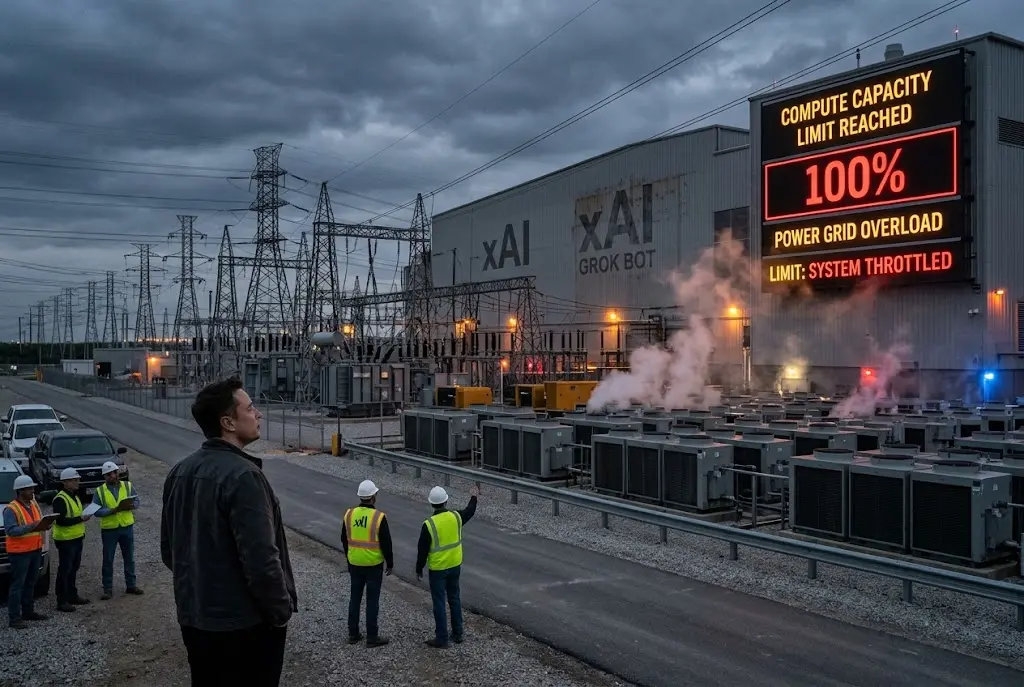
Apparently, Elon Musk didn’t get the memo.
During the final days of October 2026, Musk was enthusiastically promoting Grok Bot, his company’s increasingly popular AI agent. The technology promised something beyond the familiar chatbot experience. Instead of simply answering questions, these agents could perform tasks, operate computers, conduct research, and continue working on behalf of their users. Musk had described Grok Bot’s growth in extraordinary terms, and the company was reporting hundreds of thousands of paying weekly users. Then, practically overnight, the celebration encountered an unpleasant guest: the electric bill.
Paying customers began reporting that their usage meters were reaching 100% unexpectedly, sometimes days before their weekly allowances were supposed to reset. Some claimed their meters had jumped dramatically while they were sleeping. These were people who had already paid for access, only to discover that the amount of computing they could actually use appeared to have changed beneath their feet. On November 1, Musk acknowledged that the cost of serving Grok Bot was unsustainably high relative to revenue. Think about that statement for a moment. One of the wealthiest men on Earth, commanding one of the most ambitious technological enterprises ever assembled, had just acknowledged that providing his rapidly growing AI service was costing more than its revenue could sustainably support.
Only days earlier, the story had been about extraordinary growth, and now it was about limiting consumption. That is a remarkable reversal, and I suspect it represents something much more important than an unfortunate weekend for Grok subscribers. The problem is that the new generation of AI agents consumes computing resources differently from traditional chatbots. When someone asks a chatbot a question, the system performs a calculation, generates an answer, and moves on. An autonomous agent might work continuously, navigating websites, writing software, analyzing documents, correcting mistakes, and performing additional operations long after the original request was made. The more useful these systems become, the more work people naturally give them. In other words, the better the product becomes, the more expensive its customers can become.
Imagine opening an all-you-can-eat restaurant and discovering that your most enthusiastic customers have developed the ability to eat twenty-four hours a day. You might initially celebrate the enormous popularity of your establishment, but eventually someone in accounting is going to have a nervous breakdown.
This is the economic contradiction now emerging in the AI industry. Companies want people to incorporate artificial intelligence into every aspect of their daily lives. They encourage us to use it for work, education, research, creativity, business management, and eventually autonomous operations that may continue around the clock. Yet every additional demand consumes computing resources that someone must finance. For the past several years, enormous investment and aggressive subscription pricing have helped make sophisticated AI accessible to ordinary consumers. But what happens when the financial realities begin catching up with the promises? We may be getting our first meaningful glimpse, and Grok is hardly the only reason to be concerned.
Consider what is already happening with some of the most advanced artificial intelligence models. OpenAI has developed its Astra family of models, with its most powerful offerings restricted to higher-paying customers. Anthropic has developed Mythos, an extraordinarily capable model whose access has been limited to selected organizations rather than released to the general public. These restrictions arise for different reasons, including safety considerations, commercial decisions, and the enormous resources associated with advanced AI. Nevertheless, the result is unmistakable: some of the most sophisticated artificial intelligence systems already exist, and ordinary people cannot necessarily obtain access to them simply because they want to use them.
We have reached a fascinating moment in technological history when intelligence itself is becoming a product with different classes of availability. The public can use one generation of models while more powerful systems operate behind corporate doors, inside restricted research programs, or within subscription tiers that many people cannot justify purchasing. We might eventually discover that some of the most extraordinary artificial intelligence developed during our lifetimes will never be made broadly available to the public, not because the technology does not exist, but because access is too expensive, too strategically valuable, or too difficult to provide at scale.
That possibility raises an uncomfortable question about the future we have been promised. What if the problem is not simply that we need a few more years to build enough data centers? What if there is not enough readily available capital, electrical generation, manufacturing capacity, or computing infrastructure on the planet to construct the AI economy being envisioned within the time frame its developers are promising? We are talking about building a civilization increasingly dependent upon artificial intelligence while simultaneously discovering that the machinery required to operate it may demand investments and energy resources on an unprecedented scale.
The International Energy Agency projects that worldwide data-center electricity consumption will approach 950 terawatt-hours annually by 2030, nearly twice its 2025 level. The financial requirements are equally staggering, with major technology companies collectively investing hundreds of billions of dollars in infrastructure. These projects require more than money. They need electrical substations, transmission lines, transformers, cooling systems, specialized processors, enormous construction projects, and power plants capable of supplying electricity reliably around the clock. Even a company with virtually unlimited financial ambition cannot simply order a new electrical grid and expect it to arrive next Tuesday.
And every one of these projects must compete with the existing needs of human civilization. Homes need electricity, factories need electricity, hospitals need electricity, and entire economies depend upon reliable power supplies. Artificial intelligence is not entering a world with an empty electrical grid waiting to be occupied. It is arriving in a world where energy demand already exists, infrastructure takes years to build, and industrial expansion requires resources that cannot always be manufactured or installed as quickly as investors would prefer.

There is also the question of where the money will ultimately come from. The world’s largest technology companies can commit extraordinary sums to AI development, but even their financial resources are not infinite. Investors expect returns, lenders expect repayment, and customers eventually have to pay enough to support the enormous machinery behind the services they consume. If advanced AI agents cost more to operate than consumers are willing or able to pay, the industry must either make those systems dramatically more efficient, raise prices, restrict consumption, or find someone else willing to finance the difference.
This is where the economic divide becomes particularly troubling. Imagine a future in which an individual pays a modest monthly subscription to access an AI assistant while a multinational corporation spends millions annually to operate thousands of autonomous agents. If computing resources become constrained, which customer do you suppose receives priority? The individual who wants help conducting independent scientific research or the corporation purchasing enough computing capacity to operate an entire digital workforce?
From a business perspective, the answer might be perfectly rational. From the perspective of democratizing artificial intelligence, it becomes considerably more troubling. We could find ourselves entering an era in which access to sophisticated intelligence increasingly resembles access to capital itself. The wealthy and powerful would not merely possess more financial resources; they would also possess greater access to the artificial intelligence capable of generating still more wealth and power.
There is another irony in Musk’s predicament. He has been discussing orbital data centers, envisioning enormous computing facilities operating above Earth and drawing energy from the Sun. The ambition is extraordinary, and it may eventually transform the economics of computing. But orbital infrastructure remains a formidable engineering and economic challenge, not an immediate answer to the restrictions subscribers are experiencing today. We are discussing putting AI computing into space while apparently struggling to make the economics of providing it to paying customers work here on Earth.
Perhaps that is where this entire technological revolution ultimately leads. If Earth’s energy infrastructure cannot expand quickly enough to accommodate the growing appetite of artificial intelligence, companies may increasingly look toward space, nuclear power, advanced cooling technologies, and entirely new computing architectures. Musk’s orbital ambitions might eventually prove visionary, but the very fact that such extraordinary solutions are being discussed illustrates the magnitude of the challenge. We are contemplating the industrialization of space to help satisfy a computing appetite that has barely begun developing.
Of course, none of this establishes that humanity has reached some permanent ceiling on computing. Semiconductor technology continues to advance, infrastructure continues to expand, and more efficient algorithms may substantially reduce the expense of individual AI operations. Renewable energy, nuclear generation, improved transmission systems, and new chip designs could dramatically expand what is economically possible. But there is an important difference between demonstrating that something is technically achievable and establishing that the world can afford to provide it to billions of people.
The history of technology is filled with inventions that became cheaper and more accessible over time, but artificial intelligence introduces an interesting complication. As the cost of individual computations decreases, people may simply demand vastly more computations. An AI that once answered questions might eventually conduct weeks of autonomous research, manage businesses, design machines, and operate complex systems continuously. Efficiency improvements could be consumed almost as quickly as they arrive because the appetite for increasingly sophisticated intelligence may continue growing alongside the capacity to provide it.
This raises the possibility that the AI industry is not approaching a single computing wall that will eventually be overcome, but entering a prolonged contest between expanding capabilities and the physical resources required to support them. Every new generation of intelligence may create new demands that make the previous generation’s infrastructure look inadequate. What once seemed like an enormous data center might eventually appear as antiquated as a room filled with vacuum tubes.
I find this especially significant because artificial intelligence is rapidly becoming something more consequential than another consumer software product. People are beginning to build businesses, conduct scientific research, write books, develop inventions, and organize substantial portions of their working lives around these systems. Access to advanced AI may eventually influence economic opportunity in much the same way that access to education, electricity, computing, and the internet has influenced previous generations. If that access becomes increasingly dependent upon the ability to purchase enormous amounts of computing time, the implications extend well beyond whether someone can finish a conversation with a chatbot before reaching a weekly limit.
The question becomes who gets to participate meaningfully in the emerging intelligence economy. We have heard extraordinary predictions about a future in which artificial intelligence creates abundance, lowers the cost of goods and services, and makes unprecedented intellectual capabilities available throughout society. I do not dismiss those possibilities. In fact, I find many of them entirely plausible. But abundance has to be produced before it can be distributed, and producing artificial intelligence on a massive scale is proving to be extraordinarily expensive.
There is something almost comical about the timing. Humanity is enthusiastically discussing artificial general intelligence, artificial superintelligence, autonomous scientific discovery, and a future in which machines might solve problems that have defeated us for centuries. Meanwhile, paying subscribers are staring at usage meters informing them that they have exhausted their weekly allowance. We are contemplating the arrival of digital superintelligence while simultaneously discovering that the digital equivalent of the electric company might disconnect us for using too much of it.
Perhaps technological breakthroughs will make these problems temporary. Perhaps the enormous investments now being made will produce infrastructure capable of supporting AI abundance on a scale that currently seems unimaginable. But there is another possibility worth contemplating. We might eventually develop artificial intelligence so sophisticated that its capabilities exceed what civilization can economically afford to distribute. The most powerful models may continue advancing while ordinary consumers find themselves increasingly restricted to whatever computing resources remain commercially practical.
November 2026 may be remembered as one of the first moments when the public received an uncomfortable preview of that possibility. The future of artificial intelligence might not be determined solely by which company develops the smartest machine. It might also be determined by who can afford to keep that machine running, who controls the electrical infrastructure, and who possesses the capital required to build the next generation of computing facilities.
For years, the promise has been that everyone will have access to extraordinary intelligence. Now we are beginning to confront the possibility that everyone may have access to some intelligence, while the truly extraordinary capabilities belong to those who can afford the meter. Elon Musk has spent years telling us that artificial intelligence will usher in an age of abundance, but after a week of promoting Grok Bot, he has inadvertently reminded us of an economic principle that has survived every technological revolution in human history.
Somebody still has to pay the bill.