
Allegory of the Beach
November 10, 2026Listen to Free Audio Version Here
I decided it was time to write a mathematical equation for consciousness. A perfectly reasonable thing to do with an afternoon, provided you have already spent years writing books, preprints, and essays that keep backing you into the same question: How did the universe produce something capable of noticing it was here?
Throughout my work on consciousness, I have kept returning to one sentence: When B became capable of turning around and looking at A, the observer was born.
It sounds simple enough, almost like the beginning of a children’s story. There are two things in the universe, A and B. One day, B turns around and notices A. Of course, there are a few complications, beginning with the absence of eyes, brains, nervous systems, or anything remotely resembling a creature capable of turning around. We are dealing with the earliest conceptual prerequisites of observation, long before the universe got around to producing philosophers who could argue about what observation means.
I wanted to find a way to tell that story in the language of mathematics. After following the subject through Cosmological Pangaea, the origins of observers, memory, identity, and self-reference, I had arrived at something I could explain in ordinary language. Now I wanted to see how much of that explanation an equation could carry.
The result is my new research preprint, From Distinction to the Observer: A Mathematical Framework for Recursive Registration and Consciousness. (https://zenodo.org/records/24091918) It takes the little story about A and B and develops it into a mathematical framework describing how distinctions become observations, how observations become memories, and how a sufficiently organized system might eventually become capable of recognizing its own participation in the universe.
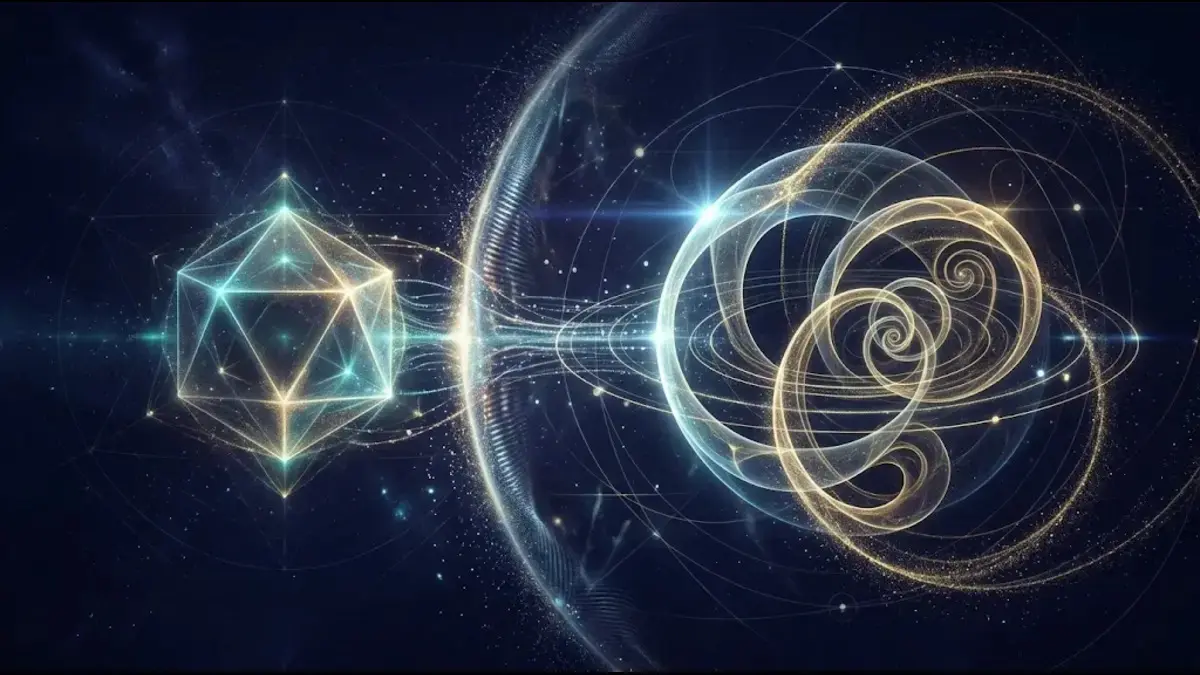
And this is where the image accompanying this essay comes into the story, because I wanted to give readers something they could actually look at while contemplating what all those equations are trying to describe.
Look at the image above for a moment. On the left is a geometric structure, something we can imagine as an early distinguishable organization of reality. It has relationships, boundaries, and an arrangement that makes it different from something else. In the middle is a luminous transition, with delicate threads extending from one side to the other. On the right, those relationships have blossomed into an elaborate arrangement of nested spirals, intersecting pathways, and structures that seem to fold back upon themselves.
That is what I wanted this mathematical journey to look like.
The image is an artistic visualization of the hypothesis rather than a literal mathematical rendering of the equations, but it captures the progression I have been trying to explain. We begin with distinction, move toward registration, acquire history through memory, and eventually arrive at an organization capable of representing its own participation in what it observes. Those spirals on the right are especially appealing to me because they suggest something that becomes increasingly important as the story develops: recursion. Information does not simply enter a system and disappear. It can be retained, revisited, compared, and incorporated into the system’s understanding of its own condition.
Most discussions of consciousness begin with a brain. By then, an astonishing amount of the work has already happened. There is a universe, there is matter, there is life, and some ambitious arrangement of it has grown a nervous system. We arrive just in time to ask why the lights are on. I wanted to start before there was anyone to pay the electric bill.
That brought me back to distinction, which I call Axiom D in my work. Before something can observe a difference, a difference must be possible. A must be distinguishable from B. It is a deceptively simple starting point, but it carries an important implication: the possibility of distinction does not depend upon someone being present to appreciate it. The universe was capable of having different physical states long before anything developed the extraordinary habit of wondering about them.
Imagine two structures existing within reality. We will call them A and B, although neither has the slightest interest in what we call it. A is distinguishable from B. That establishes a difference, but it does not yet give us an observer. For that, something else must happen.
B must become capable of registering something about A. A change in A must be capable of producing a corresponding change within B. The encounter must become part of B’s own physical activity, and B must maintain enough organizational continuity for that registration to belong to an identifiable system.
That is what I mean when I say B turns around and looks at A.
I am describing a physical relationship rather than imagining a tiny pair of prehistoric eyeballs. The distinction between two things has become an encounter that matters within one of them. B is no longer merely different from A; something about A has become registered within B.
We have reached the beginnings of physical observation, although consciousness has yet to make its entrance.
Now suppose B can keep something from that encounter. A changes or disappears, but B retains a trace of what happened. When another encounter occurs, B is no longer in quite the same condition it was before. Its previous experience has altered its present organization.
History has found somewhere to stay.
That is the beginning of memory in the framework. Different encounters can leave different retained states, even when the immediate circumstances later become identical. Once a system carries its history forward, entirely new possibilities appear. It can compare what happened before with what is happening now. It can respond differently because of something that occurred earlier. With additional organization, it might eventually learn, anticipate, and prepare for events that have not yet occurred.
Consider how remarkable that progression is. Somewhere along the evolutionary journey, living creatures became capable of responding to dangers that were no longer present. Eventually, some could anticipate dangers that had not even arrived. A system that began by registering differences could develop the capacity to navigate a world partly through information retained from its own past.
But memory is only part of the story, and it is the next development that has occupied so much of my thinking.
What happens when B begins to register something about B?
Until now, B has been registering A, retaining encounters, and allowing its history to influence its activity. Suppose its own condition becomes part of the information it uses. B can register something about the state of its boundary, the reliability of its observations, its relationship to its surroundings, or the consequences of its previous activity.

An important transition has occurred. The registering system has become part of what is being represented.
This is where the mathematical framework introduces recursive registration. Instead of merely describing B registering A, it describes B internally representing some aspect of itself registering A. The system has begun to incorporate its own participation into the ongoing process.
Think about what that eventually means for a living creature. An animal can respond to something moving nearby, but more elaborate systems can also incorporate their own location, physical condition, previous encounters, and limitations into that response. A creature might distinguish between a threat moving closer and its own body moving toward the threat. It can begin to separate changes in the world from changes in its own ability to register the world.
Follow that development far enough, and we arrive at one of the strangest accomplishments in the known universe: a creature that can recognize that it is observing.
The universe has produced something capable of placing itself inside the story it is experiencing.
That is where my consciousness hypothesis takes shape. I propose that conscious experience is the intrinsic, system-specific aspect of a continuing physical process in which a persistent system registers distinctions, retains history, and incorporates a representation of its own participation into what happens next.
The mathematical preprint builds that architecture step by step. It describes distinguishability, the persistence of a registering system, the conditions under which one system registers another, the retention of encounters as memory, and the recursive representation of the system’s own participation. It then proposes a mathematical relationship between that sustained physical process and conscious experience.
That last relationship is the heart of the hypothesis. The equations give us a way to specify the physical organization under discussion and ask what would happen if we altered its components. What happens if registration is disrupted while the system remains intact? What happens when its memory changes? What happens when a system can register information but loses the ability to represent its own participation? And what happens when such representations remain present but no longer influence subsequent activity?
These are questions that can guide actual investigation. The mathematical framework provides a proposed architecture, while the relationship between that architecture and subjective experience remains the deeper problem to solve. We have a way to describe what the system does; we still have to determine why, and under what conditions, doing it is accompanied by the experience of being that system.
Now return to the image.
Notice how the simple geometric structure on the left gives way to an increasingly elaborate arrangement on the right. The luminous threads suggest the passage and retention of information. The overlapping curves suggest that new activity takes place within an organization already shaped by what came before. The spirals fold inward and outward, offering a visual metaphor for the recursive relationships at the center of the hypothesis.
What I particularly like about those spirals is that they seem to be looking back into themselves.
That is the visual idea I wanted to capture. A universe in which differences become encounters, encounters become histories, and histories eventually become part of an ongoing process that can register its own participation. The image gives the reader an intuitive picture of what the mathematics attempts to formalize. The equations give that picture something more demanding than artistic beauty: definitions, conditions, and relationships that other people can examine, challenge, and develop.
There is also something rather entertaining about the whole enterprise. The universe apparently spent billions of years producing increasingly elaborate arrangements of matter, and eventually one of those arrangements acquired enough memory and self-reference to sit down at a computer and write equations asking how such an arrangement became possible. If there is a cosmic sense of humor, I suspect this qualifies.
For me, the satisfaction is seeing an idea that has wandered through years of books, essays, research, and more conversations than I can possibly count finally acquire a mathematical form. I have spent a great deal of time contemplating the relationship between geometry, physical distinction, observation, and consciousness. What began as a philosophical question has become something I can express with mathematical definitions and proposed relationships, giving other researchers a more precise place to begin their own investigations.
Readers who want to follow the actual mathematics can find it in the accompanying preprint, From Distinction to the Observer: A Mathematical Framework for Recursive Registration and Consciousness, part of my Functional Consciousness Project. The paper contains the equations, their definitions, the central consciousness hypothesis, and the research questions that follow from it. The image accompanying this essay is my attempt to make that intellectual journey visible without asking readers to spend their afternoon deciphering mathematical notation.
I started with a question about how the universe could produce something capable of noticing that it existed. Somewhere along the way, that question became a story about two distinguishable structures, an encounter, a memory, and the extraordinary possibility of a system registering its own participation in reality.
And after all those years of pondering, the story still begins with the same little scene I cannot seem to leave alone: A is there. B turns around. And an awfully long time later, one of their descendants sits down to write an equation about it.
Charles Richard Walker (C. Rich)
Functional Consciousness Project
Zenodo Record: zenodo.org/records/22050023
Independent Researcher / mylivingai.com
Google Scholar: tinyurl.com/GoogleScholarCRich
ORCID: 0009 0007 6541 3905