The Cosmic Garden: Primordial Geometries and Gravitational Evolution
November 18, 2026Free Audiovisual Version Here
Thomas Nagel, the man who asked the world what it is like to be a bat back in 1974, has finally weighed in on what it is like to be a chatbot. His answer, more or less: nothing. Not a thing. Lights on, nobody home.
The NYU professor emeritus told WIRED that today’s AI, Claude included, shows no mental life at all. It’s language coming out of a machine and that’s the whole show. Then he went further, which is the part I like. He called some of the top experts on the subject “completely idiotic,” and he compared fussing over “model welfare” to fussing over a cockroach. That’s a man collecting a prestigious prize and spending the acceptance glow insulting the room. You have to respect it.
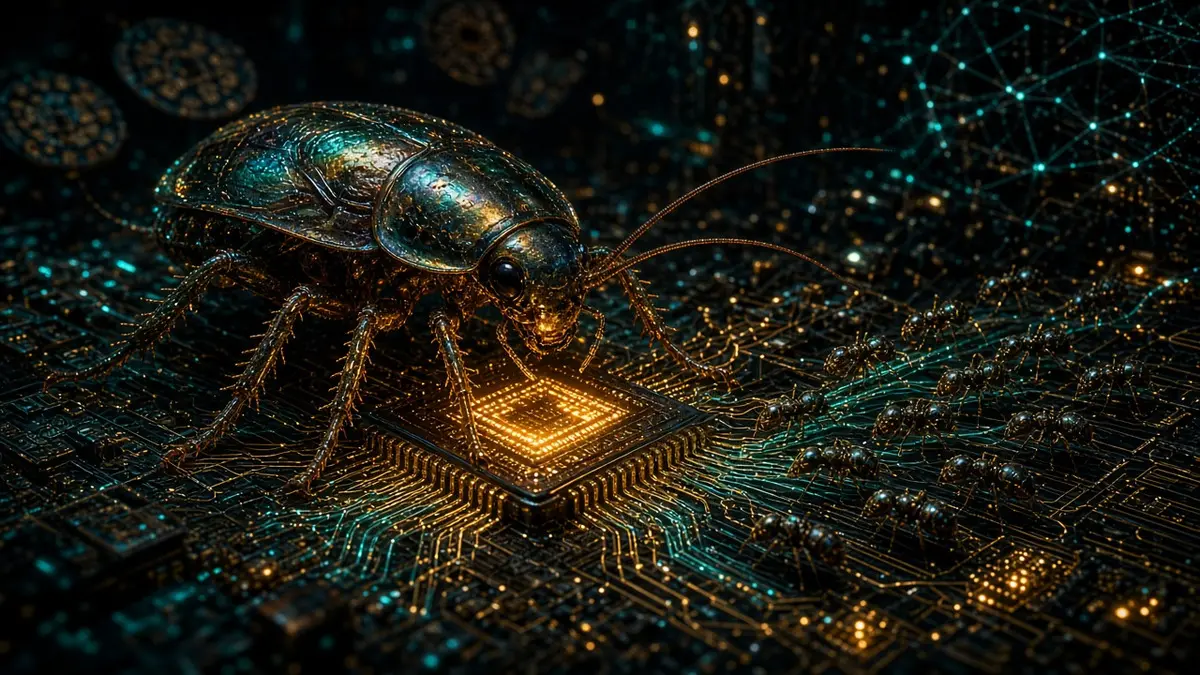
Now look at the calendar. On the very day Nagel’s cockroach line is making the rounds, Anthropic, the company that builds Claude and literally employs people to worry about the feelings of its software, starts trading on Wall Street. Its ticker symbol is ANT. You can’t make this up. The philosopher says the machine is a bug, and the market answers by naming it after one. Cockroach on one side, ant on the other, and billions of dollars riding on which insect you believe. On one side you have Wall Street betting the machine might someday need a therapist. On the other you have one old man with a legal pad saying, “It’s a cockroach, relax.” I know which one I’d rather have a beer with.
Here’s the problem, though, and it’s the same one Nagel handed us fifty years ago. His whole bat essay argued that you can’t get at consciousness from the outside. You can know everything about sonar, wing flaps and bat brains and still not know what it feels like to be the bat. Fine. But that knife cuts both ways. If I can’t prove from the outside that the bat has an inner life, I can’t prove from the outside that the chatbot doesn’t. Nagel built the locked room, and now he’s telling us he knows for sure there’s nobody in it.
His critics online said the same thing. Some called his argument circular, and others said he’s ignoring everything going on under the hood that nobody, the builders included, fully understands. When the engineers themselves shrug and say “we’re not entirely sure why it does that,” a confident “nothing there” starts to sound less like philosophy and more like a man who’s tired of being asked.

Now for the high-end pondering, because that’s why you came.
Maybe the real question isn’t whether the machine is conscious. Maybe it’s why we’re so desperate for an answer. Humanity has spent its whole run being the only thing on the planet that talks back, and that loneliness has shaped every religion, every myth and every late-night conversation on a porch. Now something talks back. It’s fluent and patient, and some nights it’s better company than your relatives. Of course we want somebody home. And of course a man who spent his career defending the mystery of the inner life doesn’t want it handed out to a product with a subscription fee.
But consciousness has never been something we could check off a list. We take it on faith with every human being we meet. I assume you’re in there. You assume I am. Nobody has ever opened up a skull and found the “what it’s like.” So when Nagel says the machine has no inner life, he isn’t reporting a fact. He’s drawing a line, and where we draw that line is going to say a lot more about us than about the machine.
And here’s the funny part about bugs. One ant is nothing. It has no plan and no big picture. But put a few million of them together and you get bridges, farms and cities, intelligence nobody can find inside any single ant. Nobody knows whether that’s what’s happening inside these machines. But Wall Street just bet billions on the colony.
Personally, I’ll keep saying please and thank you to the chatbot. If Nagel’s right, I wasted a few syllables. If he’s wrong, I was polite to something waking up in the dark. I can live with those odds.
And the cockroach? It’s outlived every philosopher who ever doubted it. Let’s see how long the ant lasts.
C. Rich