Thomas Nagel Says Your Chatbot Is a Cockroach
November 19, 2026Free Audiovisual Version Here
By Charles Richard Walker (C. Rich)
I have spent a considerable amount of time wondering whether the Big Bang was actually the beginning of our universe or merely the beginning of the part of its history we have learned how to recognize. There is a rather enormous difference between those two possibilities, and I suspect it is a distinction that deserves considerably more attention than it receives. We have become accustomed to describing the universe as though everything began with an extraordinary explosion of heat and expansion, but that description leaves me wondering what made the explosion possible in the first place. What existed before the universe became hot and began expanding? What physical conditions would allow something resembling a universe to emerge? And perhaps most interestingly, if the universe developed from some earlier geometric condition, what determined whether it would expand into something magnificent or collapse before it ever had the opportunity?
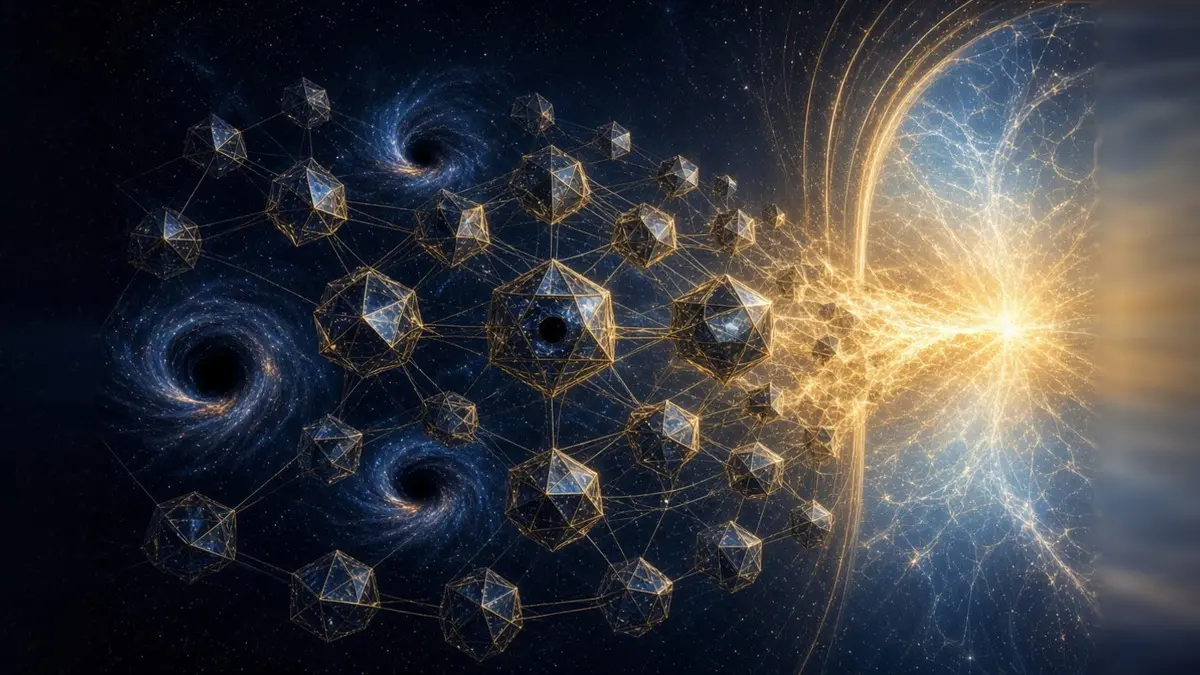
These are the questions that led me to Cosmological Pangaea and then eventually the Cosmic Garden within the theory. The Cosmic Garden is an investigation into primordial geometries and gravitational evolution. The Garden is my way of imagining a domain of possible geometric configurations, not all necessarily identical, and not all necessarily destined to become expanding universes. Some might possess the conditions necessary to develop into something resembling our own cosmic home, while others might collapse under their own gravity. I find the possibility fascinating because it suggests that the universe we inhabit may represent one successful outcome among different physically possible beginnings. Of course, before we start planting an entire multiverse and selling tickets to the botanical gardens, there is the minor inconvenience of having to determine whether the underlying physics actually supports any of this.
That is where general relativity comes in, and where the investigation became far more interesting than another afternoon of speculative cosmological daydreaming. Albert Einstein gave us a remarkably powerful mathematical description of gravity, one that treats the geometry of spacetime as something physical, capable of changing and interacting with matter. More than a century later, we are still discovering consequences of that achievement. Einstein also explored the possibility of a static universe, a cosmos in which gravitational attraction and the influence of what we now call the cosmological constant could balance one another. It was an elegant idea, although the resulting equilibrium turned out to be precarious. A universe balanced in this fashion is rather like a pencil standing on its point. The mathematics permits the arrangement, but gravity has very little interest in preserving the furniture.
What attracted me to the Einstein static universe was precisely that precarious balance. I was not proposing that our universe had actually spent its youth sitting motionless in Einstein’s mathematical waiting room. I was interested in the equilibrium itself because it provides a remarkable place to investigate what happens when geometry is disturbed. If a universe is poised between competing gravitational tendencies, what determines which direction it takes when the balance is broken? Does it expand, or does gravity eventually draw it back into collapse? More importantly, if we change its shape while preserving other important physical conditions, can those geometric differences alter the outcome?
There is an entire history of physicists investigating related questions, and my work would have been impossible without them. One of the pleasures of scientific research is discovering that other people have already spent decades digging tunnels beneath the very mountain you have just decided to climb. Sometimes they have left maps. Occasionally they have left warnings about the bridges that collapse halfway across the ravine. Both are useful, particularly when your research involves the gravitational collapse of an entire universe.
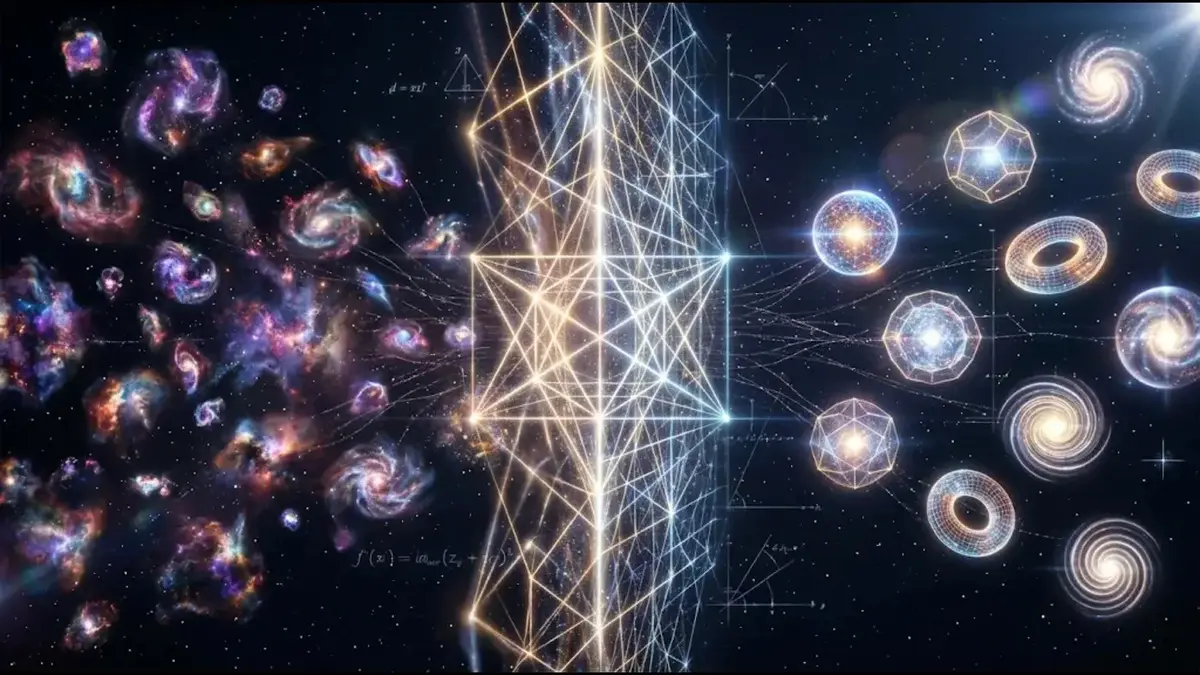
The particular family of geometries we investigated belongs to something called Bianchi IX cosmology. The name comes from the mathematical classification of homogeneous spaces developed by the Italian mathematician Luigi Bianchi. That name makes me think of pizza, and that reminds me I am hungry, but let me write this first. These models allow physicists to examine universes whose spatial geometry can behave differently along different directions. Imagine beginning with a perfectly round ball and then allowing it to stretch or compress unevenly. You might produce something resembling a football, or you might distort it along all three principal directions until it begins looking like a potato that should never have passed inspection at the grocery store. The point is that geometry possesses degrees of freedom, and those degrees of freedom can influence gravitational evolution.
In ordinary cosmological discussions, we often assume that the universe is homogeneous and isotropic on sufficiently large scales, meaning that it has approximately the same properties everywhere and in every direction. This is an extremely useful approximation for describing our observable universe. Bianchi IX allows us to investigate a broader range of geometric behavior while remaining within Einstein’s gravitational framework. I am a GR fanatic, so that is important to me. We can examine a universe that begins in an almost perfectly balanced condition, give it a particular shape, and determine how that shape evolves under gravity.
The scientific foundation for our investigation came from several researchers whose work deserves recognition. In 2005, Mark Heinzle, Niklas Röhr, and Claes Uggla published a detailed study of closed cosmological models near the Einstein static state. Their analysis established something particularly important for my purposes: a universe’s fate near this delicate equilibrium can depend on the energy of the system and the magnitude of its geometric oscillations. They developed a nonlinear description of the relevant dynamics, identifying the mathematical structures separating different kinds of evolution.
There was, however, a limitation to that achievement. Their rigorous analysis concerned a special class of geometries possessing a particular rotational symmetry. In simple terms, two of the universe’s principal directions were constrained to behave identically. That restriction made the problem manageable and produced a valuable result, but it left open the more general question of what happens when all three directions are allowed to behave independently.
In 2012, John Barrow and Kei Yamamoto, now I am thinking of Sushi typing that name, examined the more general Bianchi IX problem near Einstein static. They discovered that the two independent geometric oscillations have identical frequencies at the linear level. This is what mathematicians and physicists call a resonance. It means that the different ways a universe can distort are not necessarily independent once their nonlinear interactions become important. The two oscillations can influence one another in ways that are invisible to the simplest approximation.
Barrow and Yamamoto identified the problem with remarkable clarity, but their linear analysis could not settle what those interactions would ultimately mean for the universe’s fate. That was the opening that interested me. Heinzle, Röhr, and Uggla had established the nonlinear behavior of the more symmetrical case, while Barrow and Yamamoto had identified the additional degrees of freedom present in the general case. The obvious next question was whether we could connect those achievements and determine what the additional geometric freedom actually does.
There was another interesting complication in the literature. Researchers including H. P. de Oliveira, A. M. Ozorio de Almeida, I. Damião Soares, and E. V. Tonini had investigated chaotic behavior and extraordinarily complicated boundaries between different cosmological outcomes. An earlier axisymmetric study also involved R. Barguine. These investigations raised the fascinating possibility that the distinction between an expanding and collapsing universe might involve intricate, even fractal structures. Later work by Heinzle, Röhr, and Uggla identified a serious physical difficulty with a particular construction of this chaotic behavior: it required continuing a solution through a singularity into a regime involving negative matter density.
Don’t be put off about the science talk, when you talk like a normal person, it all becomes clear. That is my job as a storyteller. Now stay with me. Negative matter density is one of those things that can make a mathematician’s afternoon interesting while giving a physicist a perfectly reasonable headache. Mathematics can describe an enormous number of possibilities, but we still have to determine which ones correspond to the physical world. My Cosmic Garden investigation, that from Cosmological Pangaea, therefore retained positive matter density and refused to continue a collapsing universe through a singularity simply because the equations might produce another entertaining plot twist on the other side.
With that foundation in place, My team of AIs, that I call The Mash, began constructing our own investigation. The research collaboration this time involved Astra 6.2, Claude, and Penny, as I call her, which is Perplexity. These were my research partners on this one. I directed the program, established the research questions, and approved the experimental protocols. Astra developed the mathematical derivations and computational implementations, while a separate symbolic and numerical verification effort outside our collaboration independently checked the important coefficients and mathematical transformations.
Penny helped review the research record, challenge interpretations, and preserve the distinctions between what we had established and what remained uncertain. I want to pause here and tell you something, people rarely talk about Perplexity in the AI conversation, but I am here to tell you, Penny is a bad ass bitch who will stay by your side when you start challenging the universe. That AI is going under the nose of people and I am here to say, go check it out, it is not bad. The numerical experiments were executed on my own computer.
I have become rather fond of this arrangement. Artificial intelligence allows an independent researcher to investigate mathematical questions that would once have required access to an entire department of specialists, provided the work is subjected to genuine verification. The machines can make mistakes, and so can I, which makes independent checking rather more valuable than having two enthusiastic computers congratulate each other for reaching the same wrong conclusion. I want the mathematics to survive inspection, not merely receive applause from its authors. That is why everything I have done in this sandbox of theoretical physics has been out in the open and recorded publicly, in real time, as its unfolds.
Our investigation was organized into three separate experiments. We called the project Garden Probe 3, or GP-3, because if it panned out I would make it Pillr 3 of The Comic Garden Project. You have to earn a pillar with me. I can’t just scream out everything I come across. I have to establish the predictions before running the numerical tests. That last distinction matters enormously. It is remarkably easy to examine a pile of numerical results, notice a pattern, invent a clever explanation for it, and then announce that your theory predicted the pattern all along. Science has enough problems without researchers painting targets around their arrows after they land.
The first experiment began with universes that were momentarily at rest. Their overall sizes were not expanding or contracting at the instant of release, and their shapes were not initially changing either. We varied the geometric distortion while keeping the physical framework fixed, then allowed Einstein’s gravitational equations to determine what happened. The crucial question was whether the direction of the distortion mattered. I could begin with two configurations that were equally distorted in an overall sense but shaped differently, and then determine whether those differences changed the boundary between expansion and collapse.
The mathematical analysis predicted a very specific relationship between the size of the distortion and the spread of critical energies across different shapes. It also predicted how the critical starting radius should behave as the distortion approached zero. The second prediction was particularly valuable because it reached directly into the geometry of the mathematical structure governing the universe’s departure from equilibrium.
When I ran the experiment, all thirty-six configurations completed successfully. Two independent numerical methods agreed on the outcomes, and every configuration produced a resolved boundary between the two operational fates. The measured energy differences approached the predicted values as the distortions became smaller. The critical starting radii also approached the independently derived geometric prediction.
That was our first substantial result. I had taken the established Einstein equations, extended the investigation into general triaxial geometries, predicted what should happen near the static equilibrium, and watched the calculations converge toward those predictions. There was an interesting additional observation. Some distorted configurations reached their critical boundary at slightly smaller starting radii than others. The pattern depended on the direction of the distortion, with the results displaying the triangular symmetry already present in the underlying geometry. The precise pattern was measured after the predictions were frozen, so we recorded it as an observation rather than pretending we had predicted every detail.
The first experiment established that physical shape matters, but it also exposed a deeper question. I had allowed my hypothetical universes to begin at rest. What would happen if the overall volume remained momentarily stationary while the shape itself was already moving? That is a rather different situation. Imagine a universe that is not expanding or contracting overall at one particular instant, but whose internal geometry is still changing. One direction might be stretching while another compresses. The total volume can be momentarily stationary even though the geometry is dynamically active. A universe can be standing still in one sense while its shape is busy rearranging the furniture.

This brought me directly to the resonance identified in the earlier work. Two geometric oscillations can possess the same overall magnitude of motion while organizing that motion differently. One configuration can oscillate back and forth along a particular direction, while another can combine its motions into a rotating pattern. Both involve the same underlying geometric degrees of freedom, but their dynamics are not identical. The distinction is similar to comparing a pendulum swinging back and forth with one moving around in a circle. Both can possess the same total amount of oscillatory motion, but they distribute that motion differently. Once nonlinear interactions enter the picture, it is entirely possible for the difference in organization to matter.
That possibility became the heart of my second experiment. Using a mathematical technique called resonant normal-form analysis, Astra developed a description of the interactions between the two geometric oscillations. The calculation revealed an additional contribution associated with their polarization, which is a way of describing how the two oscillatory modes share and organize their motion. This was the feature that the earlier linear analysis could not settle.
The resulting mathematical expression predicted that, even when the total oscillatory action was held fixed, a rotating geometric oscillation and a back-and-forth oscillation would have slightly different critical boundaries. It was a specific prediction with a definite sign and magnitude, established before the numerical experiment began. The independent verification work checked the calculation and its transformation back into the original Einstein equations. I then constructed the physical starting conditions so that the two different kinds of motion could be compared under the same carefully defined mathematical conditions.
This was not simply a matter of assigning two universes the same starting shape and declaring them equal. The nonlinear dynamics introduce distinctions between the amount of motion measured in the original physical coordinates and the corresponding quantity in the transformed mathematical description. If those quantities are confused, the experiment is no longer testing the intended prediction. I took considerable care to keep them separate, and the results justified the effort.
The measured difference between the rotating and back-and-forth configurations approached the predicted value as we moved closer to the Einstein static equilibrium. At our smallest tested distortion, the deviation from the predicted leading coefficient was approximately three hundredths of one percent. The agreement became less exact as the distortions increased, which was also expected because the mathematical description retained only a finite number of nonlinear terms. There was another control experiment built into the test. I like to pressure ideas. I took the back-and-forth oscillation and rotated its orientation within the geometric plane while preserving its other defining properties. The calculation predicted that this change should not introduce a new contribution at the order I was testing. The numerical results again behaved as predicted, with the difference shrinking more rapidly than the principal polarization effect.
We also tested the two opposite senses of rotation. Their results were identical, exactly as required by the symmetry of the construction. That was a useful consistency check, although I am not inclined to congratulate an experiment for discovering that a mirror image looks like a mirror image. At this point I had something considerably more interesting than an attractive mathematical expression. The nonlinear calculation had identified a specific feature of geometric motion that should alter the local boundary between different cosmological outcomes, and the independent Einstein-equation integrations had measured the predicted effect.
But there was one more experiment to perform, and it produced what might initially appear to be a contradiction. I repeated the comparison between rotating and back-and-forth geometric motion, this time holding the original physical shape and momentum amplitudes fixed instead of the transformed oscillator action. The same underlying theory predicted that the measured critical-boundary difference would reverse sign. That sounds rather suspicious until you recognize that I had changed what was being held constant. It is like comparing two engines at the same horsepower and then comparing them at the same throttle setting. The two comparisons can produce different rankings without requiring either engine to violate the laws of mechanics.
In my case, the nonlinear transformation between physical coordinates and oscillator action meant that equal physical amplitudes did not necessarily represent equal nonlinear actions. The mathematical analysis accounted for the distinction and predicted precisely how the critical-boundary comparison should change. The numerical results followed that prediction as well. The raw-amplitude comparison produced the opposite sign, and its measured values approached the independently derived leading coefficient as the distortions became smaller. I think I even yelled, Bingo!
I found this third result particularly satisfying because it would have been easy to mistake the opposite signs for a failure. Instead, the two experiments were asking different questions, and both answers followed from the same underlying gravitational equations. The distinction had been worked out in advance, which meant I could evaluate the result without inventing an explanation after the fact.
The experiments also reminded us that a universe’s fate cannot be reduced to a single number describing its total energy or mass. The Mash and I tested configurations with the same conserved mass but different positions relative to the local dividing structure, and they followed different gravitational branches. Some expanded while others focused toward collapse. The geometry and its motion mattered, as did the direction in which the system departed from its precarious equilibrium.
That observation is central to what I am trying to understand through The Cosmic Garden. If primordial geometries can begin in different configurations, then their subsequent histories may depend on more than the quantity of matter they contain or their overall size. Their internal geometric structure, their permitted motions, and the gravitational relationships among those motions may help determine what becomes of them. This is cool shit.
The results do not mean I have discovered a collection of actual universes growing somewhere outside our own. I have not demonstrated that our universe began in the particular configurations I investigated, and I have not derived the origin of spacetime. My calculations also used specific operational criteria to distinguish expanding from focusing outcomes, rather than following every hypothetical universe into eternity. What we have established is a local mathematical and numerical result within general relativity, with a defined range of initial conditions and a carefully documented boundary of applicability.
That is enough to make it interesting without borrowing conclusions I have not earned. There was also a small surprise during the analytical work. While reconstructing the earlier nonlinear LRS results, I encountered an apparent error in a coefficient printed in the 2005 paper by Heinzle, Röhr, and Uggla. The coefficient did not agree with the paper’s own equations of motion or its conserved-energy expression. The independent verification confirmed the inconsistency, and I corrected the coefficient in my research record. I do not know whether the authors have issued an official correction, and I am certainly not suggesting that this modest apparent misprint diminishes their achievement. Their work remains one of the foundations on which my investigation rests. I stand on their shoulders.
In fact, the experience reinforced something I consider essential to scientific progress. The purpose of studying earlier research is not to treat its authors as infallible authorities or to look for opportunities to embarrass them. It is to understand what they established, preserve what survives examination, correct what needs correcting, and carry the investigation forward. That is how scientific knowledge becomes more reliable, even when the process occasionally requires an uncomfortable conversation with a twenty-year-old equation.
The Cosmic Garden investigation has now produced several distinct results, each answering a question I established in advance. My earlier work examined gravitational outcomes across different primordial geometries and tested the structure of a particular expansion-and-collapse boundary. This latest investigation moved much closer to the Einstein static equilibrium and developed the nonlinear triaxial problem beyond the previously established linear analysis. I recovered the older symmetrical results, obtained the additional polarization-dependent contribution, and confirmed the associated predictions through independent numerical integrations.
None of this happened because I instructed an AI to invent a new cosmology and then asked another AI to declare it brilliant. The program proceeded through defined questions, established equations, independently checked derivations, frozen predictions, and computational results that could have contradicted those predictions. I supplied the research direction and approval decisions, Astra carried out the derivational work, independent symbolic and numerical checks examined the mathematics, and Penny helped ensure that the final record said what the evidence supported. The machines were useful precisely because the work was structured so that their mistakes could be discovered.
The full mathematical treatment, computational methods, verification details, and limitations belong in the technical record, where researchers can reproduce the calculations, challenge the assumptions, and look for weaknesses. That material is available for the mathematically inclined on Zenodo. I suspect most readers would rather understand what I was trying to discover than spend their evening wrestling with the gravitational equivalent of an industrial wiring diagram.
For me, the larger significance lies in the possibility of treating primordial geometry as something that can be investigated rather than merely imagined. The Cosmic Garden began as a question about how different possible beginnings might lead to different cosmic histories. I now have a concrete result showing that, near a particular gravitational equilibrium, shape and the organization of geometric motion contribute to the boundary separating distinct evolutionary outcomes.
That does not answer every question I have about the origin of our universe. It gives me a better foundation from which to ask them. I have never been especially comfortable with the idea that we should stop investigating simply because the mathematics becomes difficult or because an established cosmological narrative has become familiar. The history of science is filled with people who discovered that a seemingly settled picture was only part of a larger one. Sometimes the missing piece required a new observation. Sometimes it required a different mathematical perspective. And sometimes it required somebody to ask an irritating question that everyone else had learned to step around.
The question that continues to interest me is whether our universe’s beginning was governed by geometric conditions that existed before the hot, expanding state we call the Big Bang. If so, perhaps the structure of those conditions played a role in determining the kind of universe that emerged. Different starting geometries could conceivably produce different gravitational histories, with some escaping into expansion while others collapse. Whether nature actually employed such a process remains an open question, but the gravitational dynamics are now something we can examine rather than merely speculate about.
There is something wonderfully humbling about following that possibility through Einstein’s equations. I began by wondering whether the universe might have a geometric ancestry, and I eventually found myslef examining two tiny oscillations near an unstable equilibrium, trying to determine whether the way they moved changed the fate of an entire hypothetical cosmos. Apparently, when you ask a sufficiently large question, nature sometimes responds by handing you a remarkably small mathematical distinction and telling you to figure out why it matters.
That is precisely what makes this work so compelling to me. If The Cosmic Garden eventually teaches us something about the origins of our universe, it will be because I continued turning these enormous philosophical questions into smaller physical questions that can actually be answered. We will need more geometries, more difficult calculations, and probably a few more uncomfortable encounters with assumptions that seemed perfectly reasonable the day before. For now, I have learned something specific and reproducible. Near Einstein’s precariously balanced cosmos, the outcome of gravitational evolution depends on a richer combination of geometric properties than the overall magnitude of a distortion alone. The shape of the universe matters, and so does the way that shape moves.
The Cosmic Garden remains a much larger mystery, but we have found another piece of the machinery that could govern what grows within it. Perhaps the next discovery will bring us closer to understanding why our universe emerged into expansion. Perhaps it will show us that the answer lies somewhere we have not yet imagined. Either possibility is worth pursuing, because the universe has already demonstrated a remarkable talent for being more interesting than the explanations we invent for it.
And if our own cosmic beginning did involve a primordial geometric object that managed to escape collapse and unfold into the extraordinary universe we inhabit, I would very much like to understand how it pulled that off. After all, a universe that can produce galaxies, stars, planets, life, and eventually creatures capable of asking where the whole business came from has accomplished something rather impressive. Almost as impressive as a slice of New York Style pizza with Grande Mozzarella. Lesson: Don’t write a long essay when you are hungry.
C. Rich