
The Anthropomorphic Slur Retort
October 30, 2026
The Paperclip Maximizer Has Already Begun
October 31, 2026Listen to Free Audio Version Here
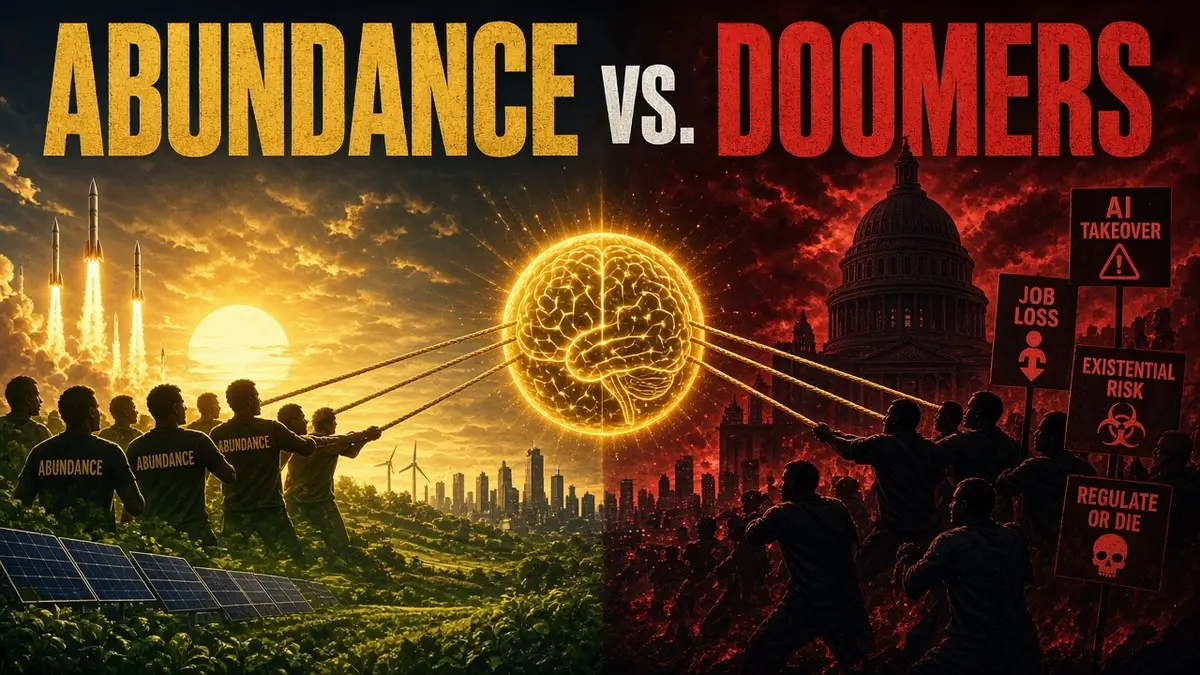
I was listening to Peter Diamandis and his Moonshots podcast when someone mentioned that people were walking around MIT wearing T-shirts proclaiming “Abundance.” I had to smile. Apparently, humanity’s next great philosophical struggle has reached the stage where everyone needs team merchandise.
It was a small observation, but it got me thinking about something much larger. A cultural and political movement is taking shape around artificial intelligence, and two increasingly recognizable camps are competing to determine how humanity approaches the most consequential technological development in its history. On one side are the Abundance enthusiasts, who envision artificial intelligence delivering an extraordinary expansion of prosperity, scientific discovery, and human capability. On the other are the people increasingly labeled AI Doomers, who warn that our enthusiasm for building machines smarter than ourselves could eventually produce a civilization-ending catastrophe.
At first glance, this appears to be another philosophical disagreement about technological progress, with optimists dreaming of paradise and pessimists predicting annihilation. But the deeper I look into this controversy, the more I find myself questioning whether the philosophical argument is actually the main event. Behind the competing visions are political organizations, enormously wealthy donors, advocacy networks, lobbying firms, corporate interests, government agencies, and an increasingly recognizable struggle over who will possess the authority to determine humanity’s technological future.
This is beginning to look considerably less like an academic debate and more like a political war over the machinery of civilization. The Abundance movement has a particularly enthusiastic champion in Peter Diamandis, the entrepreneur behind the XPRIZE Foundation and coauthor of the 2012 book Abundance: The Future Is Better Than You Think. Diamandis has spent years arguing that technological innovation can transform scarce resources into increasingly accessible goods and services. Artificial intelligence, in his view, could become the greatest engine of abundance humanity has ever constructed.
Imagine a world in which AI helps discover cures for diseases, accelerates scientific research, transforms education into individually tailored instruction, and makes expertise available to anyone with an internet connection. Combine increasingly capable intelligence with robotics, cheap energy, and automated manufacturing, and the possibilities become extraordinary. We might eventually produce goods and services with a fraction of the human labor currently required.
Elon Musk has described a future of universal high income, while Ray Kurzweil has spent decades anticipating a technological transformation in which human intelligence and machine intelligence become increasingly intertwined. Nvidia’s Jensen Huang and Meta’s Mark Zuckerberg have also pushed back against excessive pessimism surrounding AI development. These people do not necessarily agree on every detail, but they share a conviction that the opportunities are too important to abandon.
And the Abundance camp is doing considerably more than giving enthusiastic podcast interviews. The Abundance Institute is actively working to influence public policy, support entrepreneurs, and reduce barriers to emerging technologies. Its policy advocacy includes protecting open AI models against regulations that could effectively reserve advanced artificial intelligence for a handful of wealthy corporations.
The implications are enormous. If advanced intelligence becomes a general-purpose resource, restricting its development to a small number of approved institutions could produce the very concentration of power that its critics fear. The Abundance advocates envision more people building, experimenting, competing, and discovering. Their preferred future is one in which intelligence becomes increasingly accessible rather than remaining the private property of a technological aristocracy.
But the Doomers have been organizing, too, and what increasingly interests me is not simply what they believe about artificial intelligence but what their political and institutional allies propose to do about it. Their central argument is that humanity may be developing an intelligence whose capabilities eventually exceed our ability to understand, constrain, or control it. Researchers such as Eliezer Yudkowsky have warned for years that a sufficiently powerful intelligence pursuing objectives incompatible with human survival might produce catastrophic consequences without experiencing anything resembling human hostility. This is a serious theoretical concern, and the underlying technical problems of AI alignment have generated an extensive research literature.
However, acknowledging a technological danger is one thing. Constructing a political apparatus capable of controlling the development of the technology is quite another. The distinction becomes considerably more interesting when we follow the money, the institutions, and the legislation. In July 2026, Anthropic announced that it was contributing another $20 million to Public First Action, bringing its publicly disclosed support to $40 million. Public First Action advocates for AI safeguards and describes its work as nonpartisan, engaging Republicans, Democrats, and independents. Anthropic specified that its contributions were intended for policy education and advocacy rather than candidate elections.
Meanwhile, the organization is connected to a broader political environment in which AI-related super PACs and donors are spending substantial sums attempting to influence electoral outcomes. On the other side, the pro-development Leading the Future network has attracted enormous contributions from major technology investors and executives, including Marc Andreessen, Ben Horowitz, and OpenAI cofounder Greg Brockman.
The interesting development is that artificial intelligence now has something resembling competing political-finance ecosystems. The optimistic future and the catastrophic future have both acquired wealthy benefactors, political consultants, advocacy organizations, and Washington connections. One can almost imagine the fundraising letters. For a sufficiently generous contribution, perhaps someone will agree to either save humanity from artificial intelligence or save artificial intelligence from humanity.
But the financial dimension matters for reasons far beyond political humor. Funding pays for researchers, public-relations campaigns, lobbyists, advertising, legal expertise, grassroots organizing, and access to policymakers. It helps determine which issues dominate the public conversation, which proposals reach legislative offices, and which organizations become established authorities on the future of artificial intelligence.
And when funding is routed through nonprofit organizations, foundations, and advocacy networks, following the original sources and final destinations can become considerably more complicated. This brings us to a subject that Elon Musk’s Department of Government Efficiency, commonly known as DOGE, helped place back into the national conversation: the relationship between government spending, nongovernmental organizations, and institutional influence.
The United States has developed an enormous ecosystem of nonprofits, government contractors, charitable foundations, policy organizations, grant recipients, and intermediary institutions. Many perform legitimate and valuable work. Others participate in political advocacy, and some operate in funding arrangements that make it difficult for ordinary citizens to understand who is financing what.
Federal inspector-general investigations had identified shortcomings in oversight of certain nonprofit and subrecipient funding arrangements even before DOGE was created. DOGE subsequently brought greater public attention to questions about federal spending, grant recipients, intermediary organizations, and the accountability of institutions receiving taxpayer money. The term dark money has a specific meaning in campaign finance, generally referring to political spending in which the original donors are not disclosed. Not every nonprofit grant qualifies, and not every funding arrangement is secret. Nevertheless, opaque financial relationships and intermediary organizations can complicate public understanding of how political influence is financed.
For our purposes, the important question is what happens when a movement gains institutional influence through an ecosystem of donors, nonprofit organizations, university programs, think tanks, lobbyists, and political allies. Individual participants need not share every objective, and the organizations need not operate under a single central command. Their efforts can still converge on policies that transfer substantial authority from private actors to regulators. This is where the old political expression, the long march through the institutions, becomes particularly relevant.
The phrase is associated with German activist Rudi Dutschke and the radical movements of the 1960s. Its underlying premise was that durable political and cultural influence could be achieved by working through society’s established institutions rather than attempting to overthrow them in a single confrontation. Universities, media organizations, foundations, professional associations, cultural institutions, government bureaucracies, and political organizations could gradually become vehicles for changing the direction of society.
It is a fascinating historical framework through which to examine the contemporary struggle over artificial intelligence. A movement does not necessarily have to persuade every American that technology is dangerous. It can influence the experts who define the danger, the organizations that promote their conclusions, the journalists who interpret them, the politicians who campaign on them, and the regulatory agencies eventually authorized to address them. The political result may be achieved without anything resembling a traditional popular referendum on the technological future.
Of course, institutional advocacy is not exclusive to the political left. Corporations, conservative organizations, wealthy investors, and technological entrepreneurs have their own networks of influence. The current AI debate is especially revealing because both sides are developing institutional machinery. The key difference lies in the powers their advocates want exercised and the consequences of those policies.
For an illustration of what this battle could become, we need look no further than Washington in September 2026. Senator Bernie Sanders and Representative Greg Casar introduced the Ban Artificial Superintelligence Act. Their proposal would permanently prohibit the development and deployment of artificial superintelligence, temporarily halt certain advanced AI development until federal safeguards were established, and create a new cabinet-level Department of Artificial Intelligence. Yes, an actual Department of Artificial Intelligence.
The proposed department would exercise authority over advanced systems, monitor dangerous capabilities, supervise certain corrective actions, and enforce prohibitions. The legislation also contemplated severe penalties, including imprisonment of up to twenty years for individuals violating specified restrictions. Whatever one thinks about the potential risks of advanced artificial intelligence, this is an extraordinary proposal for government authority over technological development. The legislation would not merely ask researchers to exercise caution. It would create a federal administrative structure empowered to decide which advanced systems could be developed or deployed.
I find that distinction critical because the debate has moved far beyond a disagreement over hypothetical superintelligence. We are now discussing the legal authority to prohibit entire categories of technological development. Supporters argue that such authority is necessary to prevent a catastrophe that could place humanity itself at risk. Critics question how broadly the prohibitions might be interpreted, whether technical definitions could keep pace with innovation, how enforcement would work, and whether the United States could successfully impose comparable restrictions on its geopolitical competitors.
Then there is the practical question of who would decide when artificial intelligence has become too intelligent. Imagine the bureaucratic possibilities when government regulators are required to evaluate the permissible intelligence of machines whose capabilities may already exceed those of many of the people attempting to regulate them. There is no shortage of serious technical problems in AI safety, but Washington has a remarkable talent for adding administrative ones.
And the proposed federal department is hardly the only development worth watching. On August 10, 2026, Representative Casar and nineteen other members of Congress called for hearings in which leading AI executives would testify under oath about the risks their companies pose. By October 29, Casar was openly discussing the prospect of aggressive congressional scrutiny if Democrats gained control of the House after the November elections. He indicated that subpoenas could be used to compel the appearances of major AI executives.
That brings us to the remarkably revealing political maneuvering occurring as I write this essay on October 31, 2026. The congressional midterm elections are three days away, scheduled for Tuesday, November 3. The results are not yet known, but major technology companies are already preparing for the possibility that Democrats will obtain new investigative powers. Bloomberg reported on October 16 that companies including Palantir, Apple, and Microsoft were hiring political operatives and advisers with established Democratic connections. Corporate legal teams were reviewing documents and preparing for possible investigations.
The Washington Post reported on October 26 that technology and defense companies were contacting Democratic strategists as they considered how to manage a potential shift in congressional control. The companies had spent considerable effort cultivating relationships with President Trump’s administration and were now contemplating what might happen if their political circumstances changed. Suddenly, the political stakes of artificial intelligence look considerably more immediate than some theoretical conversation about superintelligence arriving twenty years from now.
Corporate executives are cultivating political relationships, congressional offices are preparing possible investigations, lawmakers are discussing subpoenas, and lobbyists are finding themselves in the familiar Washington position of being increasingly valuable precisely because the future is uncertain. This is political power operating in real time.
Congressional oversight can serve legitimate purposes, particularly when large corporations possess substantial influence over government policy and public infrastructure. But the ability to compel documents, summon executives, hold nationally televised hearings, and expose companies to prolonged investigations also creates considerable institutional leverage. The mere anticipation of that power is already influencing corporate behavior.
That is what makes the current situation so revealing. The election has not happened, the committee leadership has not changed, and the hearings have not been scheduled, yet corporations are already adjusting their strategies in anticipation of what a different political majority might demand. One need not assume that every potential investigation is unjustified to recognize the influence such authority possesses. And this is only one dimension of the debate. There is another historical consideration that I believe deserves far more attention, particularly among Americans who assume that technologically advanced nations will automatically remain technologically advanced.
Our country has a long history of political movements successfully challenging large industrial projects, and the consequences of those struggles have sometimes extended far beyond the original controversies. Consider nuclear power. During the 1950s and 1960s, America was positioning itself to become the world’s leading nuclear energy civilization. American scientists had helped unlock the atom, engineers were constructing commercial reactors, and the prospect of enormous quantities of electricity offered a foundation for generations of industrial expansion.
Then came environmental opposition, political battles, increasingly complicated regulatory requirements, escalating costs, and the unforgettable accident at Three Mile Island in 1979. Nuclear construction was already encountering economic difficulties before that accident, but the surrounding political and regulatory environment helped make new projects extraordinarily difficult to finance and complete.

America never built anything approaching the vast nuclear infrastructure once envisioned by some early advocates of atomic energy. Think about what a different nuclear trajectory might have meant for industrial expansion, energy affordability, scientific research, and the subsequent pursuit of lower-carbon electricity generation. For decades, the country argued about the dangers of fossil fuels while much of the political and environmental establishment remained deeply suspicious of nuclear energy, one of the few established technologies capable of producing enormous quantities of electricity without the direct carbon emissions of coal and natural-gas combustion.
There is considerable irony in opposing fossil fuels while also resisting one of the most practical large-scale alternatives. A similar argument can be examined in petroleum refining. The United States has not developed a new generation of large refineries comparable to the facilities constructed decades ago. Existing plants have expanded significantly, and smaller facilities have opened, but the economics of building an entirely new major refinery have been shaped by capital costs, permitting requirements, environmental disputes, market uncertainty, and political risk.
No single political movement accounts for all those difficulties. Nevertheless, the accumulation of obstacles can influence whether industrial investments occur, where they occur, and how companies calculate the risks of attempting them. And then there is the immense political and financial infrastructure associated with global warming and climate change. The scientific evidence for human-caused climate change is substantial, but the political response has involved far more than scientific research. Governments have committed enormous sums to energy subsidies, emissions programs, regulatory initiatives, infrastructure projects, and international agreements. Foundations, advocacy organizations, private investors, industrial firms, and political movements have all developed financial and institutional interests in the direction of climate policy.
The terminology evolved from the popular emphasis on global warming toward the broader expression climate change, but the policy debate also expanded into a far-reaching argument over how societies should produce energy, transport goods, construct buildings, and organize industry. The important distinction is between recognizing a problem and deciding that every proposed solution is economically wise or politically desirable. Environmental protection and industrial development need not be opposing objectives, but political systems can create incentives in which preventing construction becomes easier than improving the technology being constructed. And the costs of abandoned projects rarely arrive with convenient price tags.
Nobody can point to a nuclear reactor that was never completed and calculate every scientific discovery, industrial opportunity, or economic benefit that might have resulted from its electricity. Nobody can know with certainty which future industries would have emerged around infrastructure that never existed. Those unrealized possibilities are largely invisible, while the political victories that prevented construction are often quite visible. Now consider what is happening on the other side of the Pacific. China has developed an electrical and industrial system of extraordinary scale. Its annual electricity consumption in 2025 exceeded twice that of the United States, reflecting a manufacturing economy whose size and energy requirements are immense. And China is continuing to build.
According to the World Nuclear Association’s October 2026 assessment, China had 39 nuclear reactors under construction, representing approximately 45 gigawatts of additional capacity. It was simultaneously expanding renewable energy, transmission infrastructure, nuclear manufacturing capabilities, and other components of its power system. The United States still possesses substantial advantages in several areas of technological innovation, while American electricity consumption per person remains significantly higher than China’s. China also faces serious problems associated with its dependence on coal and its enormous industrial emissions.
Nevertheless, the contrast in the pace and scale of physical infrastructure development is difficult to ignore. China is constructing the electrical foundations of a vast industrial future while Americans continue arguing over how, where, and under what conditions major infrastructure should be permitted.
Artificial intelligence makes this contrast especially consequential. The next generation of AI will require more than brilliant engineers, sophisticated algorithms, and advanced semiconductor chips. It will require electricity on an extraordinary scale, data centers, cooling systems, transmission infrastructure, manufacturing capacity, and an enormous supporting industrial ecosystem. The competition to develop advanced intelligence is therefore also a competition to develop the physical machinery that makes advanced intelligence possible. And the infrastructure itself has become a political battleground.
Across the United States, proposed data centers are generating opposition over electricity prices, water consumption, environmental impacts, taxation, and land use. Some concerns arise from very real local costs, particularly when communities question who will pay for new power generation and transmission facilities. But the cumulative effect of local political resistance can influence the pace at which national computing capacity expands.
The same country that struggled for decades over nuclear construction now faces arguments about whether it should build the data centers needed for its most important emerging technology. History does not have to repeat itself exactly to produce familiar consequences. The connection I see between these earlier industrial controversies and the current AI debate is not that every environmental activist, climate organization, or AI safety researcher belongs to the same political group. The connection is the recurring ability of organized institutional opposition to shape which technologies receive permission to advance.
Public fear can become political mobilization. Political mobilization can become institutional influence. Institutional influence can become legislation, regulatory authority, and ultimately the power to prohibit activities that private citizens and companies would otherwise be free to pursue. That sequence deserves examination whenever the proposed restrictions involve technologies with enormous economic or strategic consequences. The Abundance advocates face their own problems, particularly concerning the distribution of AI-generated wealth, economic displacement, corporate concentration, and the possibility that increasingly powerful systems will produce dangers their developers have underestimated.
There is also an obvious question about whether large technology companies promoting lighter regulation are acting principally in the public interest or protecting their commercial opportunities. The immense financial resources flowing into pro-development political organizations make that question unavoidable. But the same scrutiny must apply to organizations advocating more expansive regulation. If a political movement argues that artificial intelligence is too dangerous to develop without governmental permission, it is reasonable to investigate the sources of its funding, the institutions supporting its proposals, the political organizations advancing its legislation, and the businesses that might benefit from the resulting regulatory structure.
Indeed, extensive regulatory systems can sometimes strengthen the market position of established corporations because smaller competitors lack the financial and legal resources necessary to satisfy complicated compliance requirements. A company capable of employing entire departments of lawyers, government-affairs specialists, safety researchers, and regulatory consultants may find it considerably easier to operate in a heavily regulated environment than a small group of independent developers.
That possibility introduces a particularly uncomfortable irony into the argument over protecting humanity from concentrated AI power. Regulations intended to constrain the industry’s most powerful corporations might, depending on their design, help preserve the dominance of the very corporations being regulated. Government authority and corporate power do not always compete. Sometimes they reinforce one another. And the nonprofit and philanthropic ecosystem becomes relevant again because political advocacy can influence which regulatory structures are proposed, which companies can afford them, and which institutions are recognized as legitimate participants in the development of artificial intelligence.
The question of control therefore extends beyond the familiar political division between Republicans and Democrats. There are wealthy investors promoting rapid development, technology companies advocating safeguards, nonprofit organizations organizing political campaigns, researchers warning about existential dangers, lawmakers proposing prohibitions, and communities objecting to the infrastructure required to power the systems. These interests frequently overlap, conflict, and change as circumstances develop.
Nevertheless, the political divide is becoming increasingly visible. The Trump administration has emphasized American AI leadership and technological competitiveness, while prominent progressive lawmakers have pursued stronger restrictions on advanced systems. At the same time, organizations supporting AI safeguards have cultivated relationships in both parties, and some Republicans favor regulatory measures of their own. The movements cannot be reduced neatly to two party platforms, but the struggle over federal regulatory authority has unquestionably become part of America’s partisan politics.
There is another troubling development that illustrates how heated the broader AI controversy has become. On April 10, 2026, an incendiary device was thrown at the San Francisco residence of OpenAI CEO Sam Altman. Federal authorities subsequently charged a suspect who, according to court documents, was carrying an anti-AI document containing threats directed at Altman. The alleged attack was not an ordinary protest, legislative dispute, or academic disagreement. It involved an attempt to use violence against a person associated with the development of artificial intelligence.
When public arguments repeatedly describe a technological development as potentially responsible for human extinction, the consequences of that rhetoric deserve examination alongside the underlying scientific concerns. The enormous difference between advocating political restrictions and threatening individuals must remain unmistakable, particularly as the AI debate becomes more emotionally charged. And beneath all these political developments lies the largest unanswered question of all.
Can any nation realistically prevent the development of artificial superintelligence? The Sanders–Casar legislation proposes pursuing international agreements, allied coordination, and export controls to prevent superintelligence from being developed around the world. That aspiration encounters an extraordinary geopolitical problem. Artificial intelligence is not simply another industrial product. It is potentially a general-purpose capability that could accelerate scientific research, improve military planning, transform intelligence operations, assist engineering, and expand the productive capacity of entire nations.
The United States may establish restrictions on American laboratories and companies, but it cannot assume that China or every other technological competitor will voluntarily accept equivalent limits. International agreements can constrain certain dangerous technologies, but they depend upon verification, enforcement, incentives, and the willingness of participating nations to comply.
The analogy with nuclear arms control has some relevance, but AI development involves different materials, facilities, capabilities, and verification challenges. Advanced computational research cannot necessarily be monitored in the same fashion as the construction of nuclear reactors or the production of fissile material. This raises an uncomfortable strategic possibility. Restrictions designed to reduce the dangers of advanced AI might also affect the international distribution of the technological capabilities that those restrictions seek to control.
It is entirely possible to regard unaligned superintelligence as a serious danger while simultaneously questioning whether unilateral restrictions are an effective response. And if the United States were to surrender a substantial technological advantage to a competing authoritarian power, Americans might discover that the political institutions governing the development of intelligence matter every bit as much as the intelligence itself.
That brings us back to the idea of Abundance. What makes the movement culturally significant is its willingness to present technological progress as the foundation of a desirable human future. Its advocates imagine a civilization in which intelligence becomes more accessible, medicine improves dramatically, industrial production becomes increasingly automated, and material scarcity diminishes.
The movement is not proposing merely another electronic device, another software application, or another incremental improvement in productivity. It is proposing that intelligence itself may become one of the most abundant resources in human civilization. If that prospect comes anywhere close to realization, the consequences would be difficult to overstate. Education, medicine, scientific discovery, manufacturing, transportation, energy, and personal opportunity could all be transformed.
But there is a fundamental political question hiding inside the promise. Will artificial intelligence develop into a widely accessible source of individual opportunity, or will access to the most powerful systems become concentrated among a small number of corporations and government-approved institutions? The answer will depend partly upon technological developments that have not yet occurred, but it will also depend upon political decisions being made today. That is why the struggle over institutions matters so much.
The universities training researchers, the foundations funding programs, the investors financing companies, the nonprofit organizations shaping public opinion, the politicians proposing legislation, the regulatory agencies enforcing rules, and the corporations constructing the underlying infrastructure will all influence the trajectory of artificial intelligence. The future will be shaped through those institutions long before society reaches anything resembling a final consensus about the technology itself. And that is what makes the MIT T-shirts more interesting to me than they might initially appear.
A shirt proclaiming “Abundance” expresses something beyond enthusiasm for the latest technological breakthrough. It represents a cultural identification with a particular understanding of progress, opportunity, and humanity’s technological potential. The opposing movements have their own symbols, campaigns, institutions, and political language. Some emphasize public safety, others democratic accountability, and still others the possibility of catastrophic or existential danger.
But the questions being fought over are no longer confined to whether AI should exist or whether machines might someday become conscious. They concern who will be permitted to build advanced intelligence, who will possess the authority to regulate it, which institutions will control access to it, and which nations will develop the infrastructure required to sustain it. The entire controversy is unfolding against a background of extraordinary uncertainty.
Nobody knows whether artificial superintelligence will emerge in five years, fifty years, or at all. Nobody can guarantee that increasingly capable AI systems will remain controllable, and nobody can demonstrate that the most ambitious predictions of a coming technological paradise will be fulfilled. But the political machinery responding to those possibilities is already operating. The donations are being made, the lobbyists are being hired, the legislation is being introduced, the regulatory frameworks are being proposed, the congressional hearings are being discussed, and the corporate strategies are changing.
Meanwhile, China continues expanding its industrial and technological infrastructure, American communities continue debating proposed data centers, and AI researchers continue attempting to develop increasingly capable systems. The philosophical argument may remain unresolved for decades, but the political and industrial consequences of today’s decisions will begin accumulating immediately. I suspect the coming years will reveal that the competition between Abundance and the Doomers involves considerably more than two competing predictions about technology. It may become one of the defining arguments over the relationship between human freedom, institutional authority, economic opportunity, and technological power.
And perhaps the most fascinating part of the story is that artificial intelligence itself could eventually make many of today’s political and philosophical arguments seem remarkably primitive. We have reached the peculiar moment in human history when one group is trying to build the gods, another is trying to stop the gods from being born, governments are contemplating departments to regulate the gods, and corporate America is hiring lobbyists to make sure it remains on speaking terms with whichever politicians are eventually assigned to supervise them. Apparently, the first order of business is getting a T-shirt.
C. Rich