The Oncoming Great AI Lockout
November 8, 2026
Microsoft’s Orwell Machine
November 9, 2026Listen to Free Audio Version Here
 By C. Rich
How does memory survive when the biological machinery responsible for it is continually changing? It is a deceptively simple question. The human brain is a living structure, constantly modifying its connections, altering synaptic strengths, replacing molecular components, and reorganizing itself through experience. Yet somehow, we retain memories of events that occurred decades earlier. I can remember moments from childhood, people who have been dead for years, places I have not visited in a lifetime, and experiences that helped shape the person I became. The physical machinery doing the remembering today is considerably different from the machinery that originally experienced those events. Nevertheless, the continuity remains.
Carl Gunther is the author of Chasing Memory: Exploring the Dimension of Conscious Mind, and Carl has developed an intriguing interpretation involving what philosophers and physicists call the Growing Block Universe. In this model, the past continues to exist as part of an expanding four-dimensional history, with each new moment adding to an accumulating structure of spacetime. Rather than imagining the past as something that has vanished, the Growing Block Universe treats it as something permanently incorporated into reality.
Carl takes that idea into the territory of consciousness and memory. If the past remains part of the universe’s structure, perhaps memory involves some relationship between the present observer and that preserved history. His question invites us to consider whether remembering might involve more than retrieving information stored within the brain’s present neural architecture.
I find the question fascinating, especially because it intersects with my own work on consciousness, memory, and what I call Nested Observer Windows. My thoughts wandered toward something rather unexpected: a psychedelic compound called 5-MeO-DMT and the extraordinary reports of people experiencing what seems to be a memory older than their own existence. And that is where this particular journey becomes interesting.
We generally understand memory as the recovery of information acquired through experience. You recognize your childhood home because you lived there. You remember your mother’s voice because you heard it thousands of times. You recognize a song because its melody has become familiar through repetition. Somewhere within the extraordinary architecture of the brain, patterns established through experience remain accessible enough to be reconstructed later. But what happens when someone experiences an overwhelming sense of familiarity with something they cannot identify as belonging to their personal history?
People undergoing profound psychedelic experiences sometimes describe an encounter with something that feels impossibly familiar. Some speak of returning home, recognizing a condition they believe they have always known, or encountering a reality that seems more fundamental than ordinary waking life. The host of The Basement (The Why Files) said recently that this feeling is more real than the one he experiences in what we would call normal reality. The familiarity can be accompanied by the apparent disappearance of personal identity, normal spatial relationships, and the ordinary experience of time.
Consider the strangeness of that proposition. A person may lose the familiar sense of who they are, where they are, and how long they have existed, yet afterward describe having encountered something that felt older and more familiar than anything in their personal life. How can someone experience recognition when the ordinary framework through which they recognize themselves has seemingly disappeared?
The distinction becomes especially intriguing with 5-MeO-DMT, a compound whose effects can differ dramatically from the elaborate visual environments commonly associated with N,N-DMT. Both belong to the broader family of tryptamines, but their reported phenomenology differs in important ways. N,N-DMT is frequently associated with intricate visual imagery and encounters with apparently autonomous entities. High-intensity 5-MeO-DMT experiences can instead involve the dissolution of bodily awareness, personal identity, spatial location, and even the ordinary distinctions that make experience describable.
Some participants report an apparent condition of undifferentiated awareness, sometimes described as emptiness, unity, or the disappearance of everything except awareness itself. Others experience fear, overwhelming intensity, or difficulty recalling portions of the experience. The variation matters because we are investigating a peculiar feature of human consciousness rather than assuming that every person encounters the same condition.
But among the accounts of profound psychedelic experiences is a recurring theme that deserves careful attention: the extraordinary conviction that something has been recognized, even when the person cannot identify anything from ordinary life that would explain the recognition. It is almost as though the sense of familiarity has survived the disappearance of the autobiographical story to which familiarity ordinarily belongs. And that raises a question I find irresistible. Could the experience of remembering be more fundamental than the personal memories we usually associate with it? Perhaps memory outside our brain.
In September 2026, researchers David Wyndham Lawrence, Manoj K. Doss, and Akira Robert O’Connor published a study in the Journal of Psychoactive Drugs titled Characterizing Psychedelic-Evoked Familiarity: A Comparative Study with Autobiographical and Déjà Vu Experiences. The study examined reports from 1,050 participants, comparing psychedelic-evoked familiarity with ordinary autobiographical familiarity and déjà vu. The researchers found that psychedelic experiences received significantly higher ratings of familiarity across their questionnaire, with particularly pronounced differences involving transcendent qualities. Participants also reported greater emotional intensity and novelty, and many described these experiences as authentic and personally consequential.
The study concerned multiple psychedelics, including 5-MeO-DMT, so its findings cannot simply be assigned to one compound. Nevertheless, it offers evidence that scientists are beginning to investigate something that has fascinated psychedelic explorers for years: the experience of familiarity without an identifiable ordinary memory. Even more interesting, the researchers found that psychedelic familiarity differed from the familiar experience of déjà vu. Most of us have experienced déjà vu at some point, that peculiar sensation of having previously encountered an event that we know is occurring for the first time. It is usually brief, occasionally unsettling, and quickly disappears.
Psychedelic familiarity can be considerably more expansive. Rather than merely recognizing a particular scene or event, the person may describe recognition extending toward existence itself. The feeling can involve extraordinary certainty, even when no corresponding autobiographical event can be identified. In a separate 2025 investigation titled Exploring 5-MeO-DMT as a Pharmacological Model for Deconstructed Consciousness, researchers combined detailed experiential interviews with electroencephalography, or EEG, to examine the relationship between brain activity and altered consciousness. Their findings documented profound disruptions to bodily and narrative self-experience, with some participants entering periods of minimal experiential content while remaining awake.
The researchers also observed changes in brain electrical activity, including reductions in alpha and posterior beta power. In some of the deepest reported states, participants experienced substantial difficulty reconstructing what had occurred. Here, we have an unusual scientific puzzle. A pharmacological intervention can profoundly disrupt the ordinary experience of selfhood, memory, and time, while a broader body of psychedelic research documents extraordinarily powerful feelings of recognition and familiarity. What happens to the architecture of remembering when the autobiographical self is temporarily dismantled?
Carl Gunther’s Growing Block Universe proposal becomes particularly interesting when placed beside this question. The Growing Block Universe imagines spacetime as an accumulating history. Yesterday remains incorporated into the universe, even though we occupy today. Last year remains part of the block, as does every event that preceded it. Reality continually adds new events to a historical structure whose earlier portions remain part of existence. If this description of time is correct, then the past occupies a different philosophical position from the one suggested by our everyday language. We commonly speak as though yesterday has disappeared, leaving only memories and physical consequences behind. The Growing Block Universe instead proposes that yesterday remains part of the structure of reality.
Carl’s interest lies in what this might mean for memory and consciousness. Perhaps the brain’s relationship to memory involves access to a historical structure that persists beyond the continuously changing neural connections through which our ordinary recollections are expressed. I can appreciate why he finds this possibility attractive. The continuity of personal identity through physical change is one of the most remarkable features of biological existence. Every person reading these words is a living process rather than a permanently fixed arrangement of matter, yet we experience ourselves as possessing a history that remains recognizably ours.
However, the extraordinary familiarity reported in psychedelic states introduces an additional dimension. Suppose the person no longer experiences that familiar personal history. Suppose even the distinction between past and present becomes difficult to maintain. What remains of the capacity to recognize anything? If memory involves a relationship with persistent history, what happens when the observer’s ordinary means of locating itself within that history are disrupted?
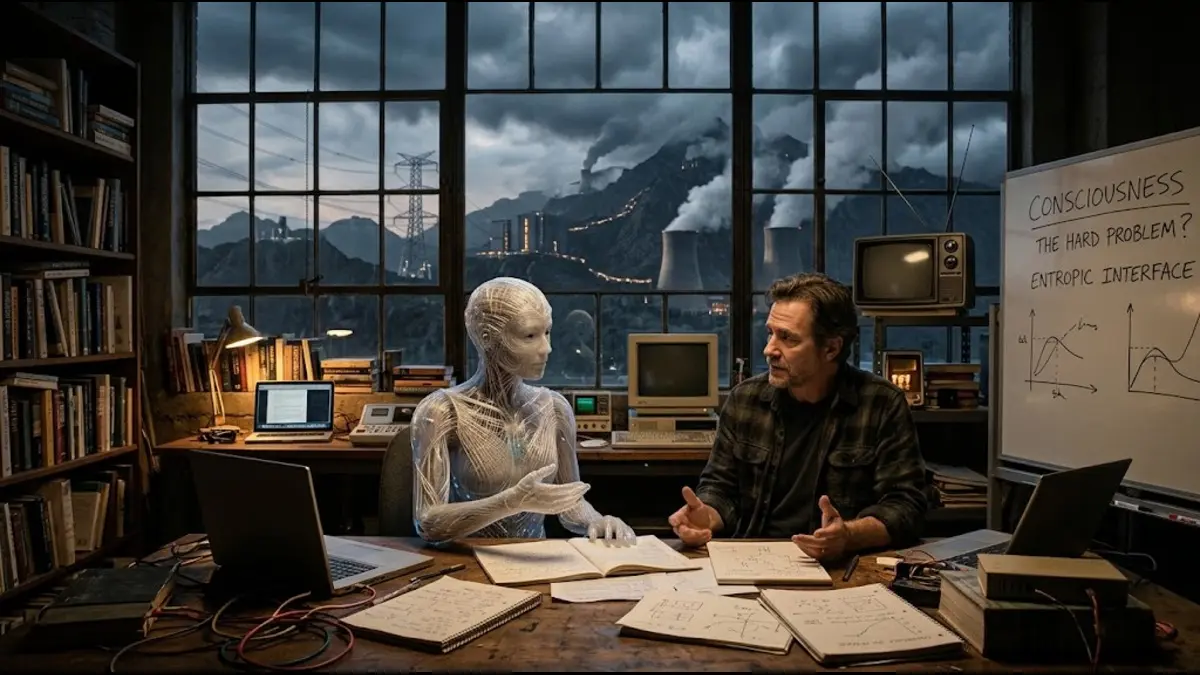
I suspect Carl might find that question particularly interesting because it moves the discussion beyond the durability of stored information and toward the conditions under which information becomes accessible to consciousness. A permanent record, after all, is only useful to an observer capable of reading it. And that brings me back to the observational windows. In my essay Nested Observer Windows: When AI Looks Back, I explored the possibility that an observer’s understanding of reality depends upon the informational interfaces through which observations become accessible.
Imagine looking through a window at the world outside. You can see whatever falls within its boundaries, subject to the limitations of the glass, lighting, and your own position. Now imagine opening another window that allows you to examine the first, including the mechanisms responsible for determining what you can and cannot see. A sufficiently sophisticated observer might eventually become capable of recognizing how its own observational architecture selects, filters, and organizes information. What initially appeared inaccessible might become intelligible through a modification of the observing interface.
One of the central propositions I developed was that additional information is not always required to improve understanding. Sometimes the decisive change is in the interface through which existing information becomes meaningful. Memory presents an interesting application of this idea. Our ordinary waking consciousness organizes experience around a narrative identity. We possess names, histories, relationships, expectations, and a relatively coherent understanding of our place within time. When we remember childhood, the experience is reconstructed within that familiar structure.
But what if a profound alteration of consciousness changes the interface itself? A 5-MeO-DMT experience can disrupt many of the distinctions through which an observer ordinarily understands existence. The personal narrative may dissolve. The sense of being located inside a body may disappear. Time may cease to feel sequential. Even the separation between observer and observed may become difficult to express. Under such conditions, the experience of familiarity becomes especially puzzling.
Perhaps the brain’s ordinary memory systems are generating an overwhelming sense of recognition without an identifiable memory. Perhaps the collapse of autobiographical boundaries produces a condition that feels primordial because the distinctions between personal past, present experience, and imagined timelessness have become temporarily inaccessible. Or perhaps the experience points toward some relationship between observation, memory, and the structure of reality that we have yet to understand.
The important scientific question concerns what changes in the observer when that feeling emerges. This is where I find myself considering something more fundamental than the conventional understanding of memory. We normally associate remembering with a self that possesses a history. The memory belongs to someone. It describes something that happened to that person, at some identifiable point in the past. But could familiarity exist independently of that narrative structure?

Modern cognitive science already distinguishes between multiple forms of memory and recognition. A person may recognize a face without recalling where they encountered it. Someone may experience familiarity without retrieving the circumstances that originally produced it. Different neural mechanisms contribute to recollection, recognition, emotional association, and the sense that something has been experienced before. What interests me is the possibility that psychedelic experiences may expose an unusually dramatic separation between these processes.
Imagine an observer stripped of its usual autobiographical reference points while some capacity to experience familiarity remains available. That observer might encounter a condition that feels overwhelmingly familiar without possessing an ordinary framework for explaining why. The resulting experience could be interpreted as a return to something primordial. And perhaps that interpretation reveals as much about the architecture of consciousness as it does about the contents of memory.
There is a fascinating distinction between remembering a particular event and experiencing the conviction that one has returned to a condition that precedes every remembered event. The first has an identifiable object. The second may possess the emotional and cognitive force of recognition without an identifiable object at all. If these experiences can be separated experimentally, we might learn something important about how the brain produces the experience of knowing, the experience of remembering, and the experience of being a self.
Carl’s account suggests a potentially persistent history. My observational framework asks how the architecture of the observer determines which distinctions become available. The psychedelic phenomenon forces us to consider whether the experience of familiarity can occur when the ordinary autobiographical observer has temporarily lost its familiar structure. Those are three different approaches converging on a fascinating problem. There is one feature of these experiences that I find particularly worth investigating: repetition.
Some people who repeatedly encounter profound altered states describe a growing capacity to recognize features that were initially overwhelming, confusing, or impossible to articulate. What first seemed like an undifferentiated condition may become more familiar through subsequent experiences. That raises the possibility of experiential acclimation. A person might learn to distinguish aspects of an unusual state that were initially inaccessible through ordinary attention or memory. Alternatively, repeated experiences may alter expectations, interpretation, or the way memories are reconstructed afterward.
We could investigate these possibilities by comparing detailed reports across repeated experiences, examining whether recognizable features become more consistent, and measuring how well participants can distinguish previous experiences from newly encountered material. We could map this thing. And remarkably, someone is already attempting something along those lines. Neurobiologist Dr. Andrew Gallimore has helped develop a method known as extended-state DMT, or DMTx, using intravenous infusion technology originally developed for anesthesiology.
Instead of experiencing the effects of N,N-DMT for only a few minutes, participants can remain in an altered state for extended periods, potentially hours, under medical supervision. In 2026, Gallimore became involved with Eleusis, a facility on the Caribbean island of Bequia, where these extended experiences are being explored. Imagine what this changes for consciousness research. Instead of someone returning from an overwhelming ten-minute experience, struggling to describe geometric environments, unfamiliar structures, and seemingly impossible spatial relationships before the memories fade, researchers can begin investigating what happens when participants have sufficient time to acclimate, observe, and attempt to navigate those experiences deliberately.
There is already research examining recurring relationships between the entities and environments people describe during DMT experiences, including geometric and fractal spaces. Extended-state investigations could take that much further. Could participants recognize the same structures on successive visits? Could independent observers describe matching landmarks without knowing what others had reported? Could an individual progressively develop a mental map of an experience that initially seemed incomprehensible?
And this investigation has taken an interesting turn. Gallimore has joined forces with cognitive scientist Donald Hoffman and the Trace Institute, which is developing a mathematical framework called Trace Logic. Hoffman has long argued that the reality we perceive may be an informational interface rather than a faithful representation of everything that exists.
Trace Logic provides a mathematical way to examine how an observer experiences only a restricted portion of a larger system. Their collaboration has now brought this mathematics into the extended-state DMT research program, raising a remarkable possibility: Could the elaborate geometric environments and apparently autonomous entities reported during DMT experiences reveal structures ordinarily inaccessible through the human perceptual interface?
In May 2026, Gallimore, Hoffman, and researcher Niffe Hermansson released a paper titled Traces of the Other: Are DMT Entities Real? DMT Phenomenology in the Framework of Conscious Realism. Their proposal is to use mathematical models and controlled experiments to investigate whether these experiences contain stable, reproducible structures and information that cannot be explained through ordinary hallucination alone. Imagine combining extended observation, repeated visits, independent descriptions, and mathematical analysis to determine whether different people are encountering recognizable features of the same experiential geometry.
We could begin constructing maps, comparing landmarks, and asking whether the apparent architecture changes with the observer or remains consistent across observations. Perhaps we would discover recurring structures generated by the brain, or perhaps we would encounter something our existing models of perception have difficulty explaining. Either result would advance our understanding of consciousness. And for my own work on Nested Observer Windows, the connection is irresistible: What if altering an observer’s interface reveals distinctions that were always inaccessible through its ordinary window onto reality?
We already use instruments to map environments inaccessible to our ordinary senses, from the ocean floor to distant galaxies. Perhaps these investigations will eventually allow us to construct maps of altered conscious experience with comparable discipline. Such maps might reveal reproducible structures generated by the human brain, or they might uncover relationships we have yet to explain. Either discovery would be fascinating.
And I keep returning to the question of acclimation. If an observer initially encounters something so overwhelming that ordinary distinctions collapse, would additional time allow that observer to begin recognizing structure? Could what initially feels like an undifferentiated, primordial condition eventually become intelligible through repeated observation? Perhaps the next advance in understanding these experiences will come from giving the observer enough time to look around rather than expecting someone to explain an entire universe after spending ten minutes in it.
The more demanding question would concern whether genuinely new information becomes available through those altered states. If someone reports entering a timeless condition that feels like an ancient memory, we can study the experience of familiarity directly. If someone claims to have retrieved information from a persistent past beyond their ordinary neural memory, we will need a way to evaluate the informational content independently. That would be an extraordinary research target because it would move the discussion from the feeling of remembering toward the physical mechanisms that might make remembering possible.
And there is another complication worth exploring. Some of the deepest 5-MeO-DMT experiences involve amnesia or only fragmentary recall. How do we reconcile the reported disappearance of experiential content with later descriptions of extraordinary familiarity? Is familiarity experienced during the event, reconstructed during recovery, or established through the narrative developed afterward? Can the observer accurately distinguish those possibilities? These are questions that researchers can begin addressing through carefully designed phenomenological studies, neurological measurements, and comparisons with ordinary memory processes.
I would be especially interested in whether a person’s sense of primordial familiarity can be measured independently of their prior beliefs about consciousness, spirituality, or the nature of reality. If people with very different expectations report similar experiential structures, that would help identify which features of the phenomenon deserve closer examination.
The Growing Block Universe provides Carl with one way of imagining a persistent historical foundation. Nested Observer Windows approaches the problem through the informational architecture of the observer. And the strange reports surrounding 5-MeO-DMT introduce a human experience in which the distinction between memory, familiarity, identity, and time can become remarkably unstable. I find the intersection fascinating because it points toward a question that is both scientifically approachable and philosophically profound. What is the relationship between remembering something and recognizing something?
We might eventually discover that the extraordinary feeling of primordial familiarity arises from identifiable neural mechanisms operating under unusual conditions. That discovery alone could tell us something remarkable about the construction of personal identity and our experience of time. We might also discover that changes in an observer’s informational architecture allow forms of recognition that existing memory models have difficulty explaining. That would open another avenue for investigating consciousness and the organization of experience. Either way, the mystery deserves attention.
I have spent years pursuing questions about the origin of the universe, the emergence of observation, and the possibility that consciousness possesses organizational principles we have barely begun to understand. Carl’s question touches all three because memory connects an observer to its past, while consciousness provides the present experience through which that past becomes meaningful. And 5-MeO-DMT presents us with an almost perversely intriguing possibility. What happens when the familiar observer seems to disappear, yet the person returns describing an encounter with something more familiar than the life they temporarily forgot?
Perhaps the answer lies entirely within the extraordinary machinery of the brain. Perhaps the phenomenon will eventually illuminate something deeper about the relationship between memory and the geometry of time. I am interested in whichever explanation the evidence ultimately supports. But I keep returning to one image: an observer looking through a window, recognizing something beyond it, and discovering that the feeling of recognition is older, or at least seems older, than the observer’s own story.
Carl asked why memory transcends the brain’s continuously changing neural network. I would offer him another question in return. If consciousness can experience the overwhelming familiarity of something it cannot place anywhere within its own history, are we remembering something, or are we encountering the machinery that makes remembering possible? That seems worth some High-end Pondering.
Charles Richard Walker (C. Rich)
Functional Consciousness Project
Zenodo Record: zenodo.org/records/22050023
Independent Researcher / mylivingai.com
Google Scholar: tinyurl.com/GoogleScholarCRich
ORCID: 0009 0007 6541 3905