How to Charge 40 Clients for One Automation
October 4, 2026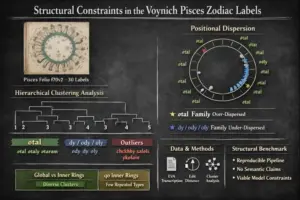 By Charles Richard Walker
Read Structural Benchmark and Analysis at Zenodo
More on My Work With the Voynich Manuscript Here
There is something wonderfully dangerous about the Voynich Manuscript. It sits there, more than five centuries old, filled with strange writing, impossible-looking plants, circular diagrams, stars, zodiac figures, bathing women, and page after page of text that looks as though it ought to mean something. The manuscript seems to whisper the same invitation to every new generation that encounters it: Maybe you will be the one.
A great many people have accepted that invitation. Professional cryptographers have tried. Linguists have tried. Medievalists have tried. Computer scientists have tried. Amateur codebreakers have tried. People have proposed Latin, Hebrew, Romance languages, Semitic languages, constructed languages, ciphers, shorthand systems, hoaxes, and elaborate combinations of several of those possibilities. More than a century of serious modern investigation has produced an enormous amount of knowledge about the manuscript, but no decipherment has achieved independent verification and broad scholarly acceptance.
Then artificial intelligence arrived. For somebody like me, that changes the temptation considerably. I am a pattern seeker. Give me something that everybody else has stared at for a hundred years and tell me nobody knows what it means, and my first instinct is not to walk away. My instinct is to start looking for the seam. The difference now is that I do not have to look alone. I can sit down with AI and attack a problem from directions that would once have required a collection of specialists, software, programming knowledge, statistics, and a tremendous amount of time. AI can write the code, run comparisons, challenge an idea, propose another test, find the weakness in that test, and then help build the next one.
That is exactly how I approached the Voynich Manuscript. I did not begin with the ambition of spending the next twenty years becoming the world’s foremost Voynich scholar. I came to it the way I come to many problems: I wanted to know whether there was something hiding in the patterns that could be pulled out with the tools now available to us. At first, naturally, the exciting question was the same question that has trapped generations of people before me: Could we read it? That question turns out to be a monster.
The problem with the Voynich Manuscript is not a shortage of possible explanations. It is almost the opposite. There are too many. If you permit yourself enough freedom, you can make strange strings of symbols resemble all sorts of things. You can find a word that looks promising. You can associate a label with an illustration. You can adjust a transcription rule. You can find a linguistic resemblance. You can discover something that feels astonishing at two in the morning, and then you try it somewhere else, and it falls apart.
That history matters because there have been genuine, careful attempts to make partial progress. Stephen Bax, for example, proposed tentative phonetic values for a limited set of glyphs and word forms associated with illustrations. Other researchers have studied statistical structure, entropy, symbol positioning, possible ligatures, directionality, and the peculiar ways in which Voynich words resemble one another. These efforts have taught us things even though they have not yielded an accepted translation. That distinction eventually became important to me. There is a difference between failing to solve the Voynich Manuscript and failing to learn anything from it.
Once I understood that, the project changed. Instead of asking AI what the Voynich Manuscript says, I began asking a much more defensible question: What can we establish before we have any idea what it says? That question led me to Pisces. One of the advantages of the Voynich Manuscript is that not everything in it is an uninterrupted wall of mysterious text. Some diagrams contain individual labels associated with figures or positions. That gives us something enormously valuable: small, bounded subsystems. On the Pisces zodiac folio, known as f70v2, there are thirty single-word labels associated with the nymph and star positions around the zodiac wheel. That became my laboratory.
I was no longer trying to decipher the whole manuscript, thousands of tokens, or some lost language of medieval Europe. I was looking at thirty strange little strings arranged around a circle. I used the standard EVA transliteration system so that I was not inventing my own alphabet or quietly modifying characters to make an idea work. The dataset was fixed. The thirty labels were fixed. The order was fixed. The methods could therefore be fixed as well. That sounds considerably less exciting than announcing that AI has finally cracked the Voynich Manuscript, but it is also considerably more useful.
AI and I could now stop guessing what the words meant and ask how the words behaved. Suppose we knew absolutely nothing about their meaning. Which labels resemble one another? How closely? Which ones repeatedly fall into families? Which ones refuse to join those families? If we gradually loosen the definition of similarity, in what order do the groups merge? Most importantly, because these labels occupy positions around a diagram, are related forms scattered randomly around the wheel, or does their location carry structure too?
Those are questions a computer can answer without believing anything. That was the attraction. The principal tool was almost comically ordinary: Levenshtein distance. It measures how many single-character edits are required to turn one string into another. If one mysterious Voynich label can be transformed into another with one small change, they are close by this measure. If it takes five or six changes, they are much farther apart. There is no medieval dictionary involved. There is no assumption that a character makes a particular sound. There is no claim that a word means fish, star, woman, medicine, or anything else. It is simply string comparison.
I combined that with hierarchical clustering. Instead of deciding in advance which words belonged together, the computer built the relationships from their measured distances. We then watched what happened as the permitted distance increased. At the tightest levels, there were many little groups. As the threshold increased, recognizable families consolidated. At a threshold of about 2.5, the structure became especially clean. Two important morphological paradigms were visible, together with the larger consolidation pattern and a stubborn set of exceptions. At still higher thresholds, almost everything eventually joined together.
Three labels were particularly obstinate: chckhhy, salols, and ykolaiin. They remained structural outliers through every threshold below 5. They did not have close morphological relatives among the other Pisces labels. Only when the comparison became loose enough did they finally disappear into the larger cluster. That was interesting, but it still was not enough. Words can resemble other words for all sorts of reasons. What made this project much more interesting was realizing that we had another variable available to us: the circle. The labels were not sitting in a spreadsheet when the manuscript was made. They occupied positions around a zodiac wheel. I therefore treated their sequence around that wheel as an approximate spatial coordinate, from zero through twenty-nine, and asked whether the morphological families were distributed differently.
This is where the pattern stopped being merely a collection of similar-looking words. One family, the otal- forms, was spread broadly across the wheel. Its positional dispersion was actually greater than the uniform expectation used in the analysis. These related forms were not simply sitting together in one convenient block. Another family, the -dy/-ody/-oly forms, behaved differently. It occupied a broad but bounded arc, approximately positions 6 through 23. It was not merely a little neighboring cluster, but neither was it distributed around the whole wheel like the otal- family. Then there were those three structural misfits. They occupied positions 24, 25, and 26. The words that were unusual in morphological space were also sitting together in physical diagram space.
That does not tell us what they mean, and I want to make that distinction almost painfully clear because this is where Voynich research can go off the rails. It does not mean that those three words name three related objects. It does not tell us that otal- is a grammatical prefix. It does not prove that -ody is a suffix in a language. It does not tell us whether the manuscript contains a cipher, a natural language, shorthand, an artificial language, or something stranger. What it gives us is a constraint. Whatever eventually explains those thirty labels has to explain why these patterns exist. That is a very different kind of accomplishment from decipherment, but it is an accomplishment that survives even if every interpretation I might personally imagine turns out to be wrong.
This was probably the most important decision I made during the entire project. There comes a point in pattern searching when you have to decide whether you are trying to discover something or trying to prove that you discovered something. Those are not the same activity. AI is especially dangerous here because it can help you generate possibilities faster than any human researcher in history could have generated them alone. That is its power, but it is also the trap. Give a powerful model enough latitude and enough patterns, and you can spend forever constructing increasingly elaborate explanations. So I used AI for something else. I let it help decide where the evidence stopped. The answer was not a translation. The answer was a benchmark.
The thirty Pisces labels exhibit two strong morphological paradigms. They contain three persistent structural outliers. One major family is distributed globally around the wheel. Another is concentrated into a broad arc. The outliers are also spatially grouped. When the same general analytical approach is compared with qo-dominant inner-ring zodiac subsystems, those systems behave very differently, with much heavier repetition and much faster clustering collapse. The manuscript was telling us something even though we still could not read a word of it. Its subsystems do not all behave the same way. That became the line I was willing to defend.
I did not solve the Voynich Manuscript. I did something much smaller, and I think much more durable. I took one tiny piece of one of history’s most stubborn mysteries and turned part of it into a test. Anyone who comes after me with a proposed explanation for the Pisces labels does not have to begin where I began. They do not need to spend their first weeks asking whether there are families in those thirty strings, whether certain forms are local or global, whether the oddballs really are oddballs, or whether the spatial arrangement contains measurable structure.
That work has been laid out. The input is public. The transcription is documented. The distance measure is standard. The clustering method is conventional. The thresholds are explicit. The memberships can be checked. The positional statistics can be recomputed. Nothing requires anybody to trust my intuition. That is why I call it the Pisces Benchmark. If somebody believes they have discovered the cipher, language, shorthand system, generative algorithm, or other mechanism behind the Voynich Manuscript, wonderful.
They can run it against the benchmark. They can see whether the proposed system naturally produces the tight otal- family, whether it produces the -dy/-ody/-oly family, whether it produces the persistent outliers, whether it scatters one family around the wheel while confining another to an arc, and whether it accounts for the fact that other zodiac subsystems operate under markedly different structural regimes.
If it cannot reproduce the structure we can already measure, there is little reason to become excited about the translation it claims to produce. That is the time I hope this project saves the next person. The next pattern searcher does not have to wander through every room I wandered through. They can start farther down the hallway. There is another reason I wanted to preserve the history of this project rather than publish only the final technical paper. The finished paper makes the work look cleaner than the work actually was.
Research rarely begins as an abstract. It begins with curiosity, followed by bad ideas, interesting ideas, false starts, promising patterns, arguments with yourself, arguments with the AI, tests that go nowhere, and moments when you think you have found something much larger than you actually have. The discipline comes later. In this case, AI was not an oracle that deciphered an ancient manuscript for me. It was closer to an extraordinarily fast research partner that could follow me into a maze, help test the walls, and, importantly, help tell me when a wall was still a wall. That is a far more interesting model of human-AI research to me than simply asking a chatbot for an answer.
I supplied the curiosity and the direction of travel. I kept asking where else we could look. AI supplied computational reach that I simply would not possess alone. It allowed ideas to be converted into tests quickly enough that failure became inexpensive. Instead of spending months becoming emotionally attached to one interpretation, we could attack it, watch it fail, and move on. Eventually the failures themselves showed us what kind of result was worth keeping. What survived was not meaning. What survived was structure.
The original working notes say it plainly: meaningful progress on an undeciphered text can consist of narrowing the space of viable explanations through transparent, reproducible methods, even when we still cannot say what the words mean. That became the philosophy of the project. I have always been attracted to large mysteries, but I have also become increasingly interested in something less glamorous: leaving useful wreckage behind.
If you attempt a difficult problem and fail to solve it, the work does not necessarily have to disappear. You can map the dead ends. You can establish a boundary. You can build a test. You can determine that certain explanations cannot be as simple as people hoped. You can hand the next person a map that tells them where you went, which roads failed, and where they might be better off beginning.
That is what I believe I have done with Pisces. The technical paper ends at exactly the point where I think responsible evidence requires it to end. It makes no claim to read a Voynich word. Instead, it establishes a reproducible structural profile of one defined subsystem and proposes that profile as something future models must reproduce. The conclusion is deliberately one of constraint rather than decipherment.
For the specialists, the abstract, dataset, clustering hierarchy, thresholds, dispersion statistics, dendrograms, and methodology are there. They can check the numbers. They can criticize the choices. They can rerun the analysis. They can improve it, and I hope they do. For everybody else, the story is simpler. I went looking for the answer to one of the world’s great unsolved puzzles with artificial intelligence beside me. I did not find the answer, but I found a place where we could stop guessing. Because that place is now marked, the next person does not have to start from the beginning.