A Mathematical Framework for Recursive Registration and Consciousness
November 10, 2026Listen to Free Audio Version Here
I recently watched Jack Kruse talking with Rick Rubin, and I have to give him credit: he has somehow connected Earth’s magnetic field, disappearing Florida oranges, hurricanes, volcanoes, honeybees, NFL injuries, mitochondrial dysfunction, and the future habitability of the East Coast into one giant theory of everything. By the end, I half expected him to explain that my missing TV remote was trapped in the South Atlantic Anomaly.
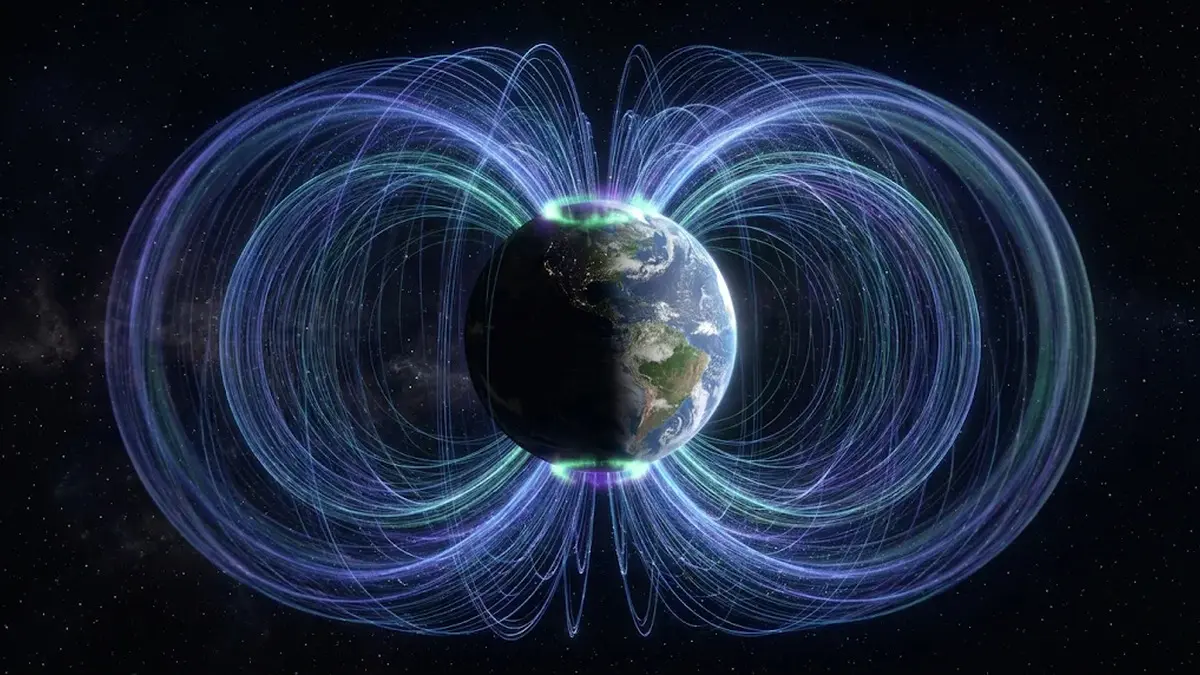
To be fair, Kruse starts with something real. Earth’s magnetic field is changing. The magnetic poles move, the South Atlantic Anomaly is expanding, and geomagnetic reversals are well-established features of Earth’s history. These are legitimate scientific topics worthy of serious study. The trouble begins when every other phenomenon gets attached to that foundation. One of Kruse’s key claims is that Earth’s magnetic field has lost roughly ten percent of its strength since 2012. The commonly cited ten-percent decline actually occurred over about 180 years, not fourteen. His planetary emergency starts with a spectacular misunderstanding of the timetable.
Take the South Atlantic Anomaly. Kruse links it to disease, mitochondrial dysfunction, and even NFL injuries in Brazil. The anomaly is real, and it matters for satellites because radiation penetrates farther through the weakened field. But magnetic field strength already varies dramatically across Earth’s surface, and humanity has somehow managed to invent civilization across that entire range. If modest magnetic differences are causing a medical catastrophe, there should be obvious geographic patterns to support it. There aren’t.
And then we arrive at Florida oranges. Kruse declares them extinct, which must be surprising news to Florida growers still producing millions of boxes every year. Apparently nobody informed the USDA that the extinct fruit keeps showing up at packinghouses. The decline of Florida citrus is real, but the explanation is considerably less exotic. During my own lifetime as a Floridian, growers moved south after a long series of devastating freezes in the 1970s and 1980s. Later, citrus greening disease devastated surviving groves. Development replaced many others with subdivisions, highways, and shopping centers. Sometimes the mysterious force destroying an orange grove is not magnetism. Sometimes it’s a bulldozer.
The irony is that citrus migrated south toward generally weaker geomagnetic fields, not toward the stronger fields Kruse considers beneficial. Growers were chasing warmer temperatures, not magnetic paradise. Kruse then expands the story to hurricanes, ocean circulation, volcanoes, earthquakes, and climate. Each subject involves legitimate science. But the existence of magnetic fields, ocean currents, and biological electricity does not automatically establish the causal relationships he proposes between them.

This becomes especially obvious when he discusses carbon dioxide. He argues that CO₂ cools the planet because it is paramagnetic. It isn’t. Carbon dioxide is diamagnetic, and its climatic role comes primarily from infrared physics, not magnetic behavior. Likewise, invoking Curie temperatures to explain ocean warming is like diagnosing a broken car engine by checking your toaster. The concepts are real; the connection is not.
The larger problem is methodological. In Kruse’s framework, nearly everything becomes confirmation. If oranges die, magnetism explains it. If hurricanes disappear, magnetism explains it. If volcanoes erupt, magnetism explains it. If football players get hurt, magnetism explains that too. A theory that absorbs every outcome begins to look less like an explanation and more like a universal excuse.
That’s unfortunate, because some of the questions he raises are genuinely interesting. Earth’s magnetic field is changing. Biology may contain electromagnetic effects we do not yet fully understand. Those possibilities deserve investigation. But an interesting question is not evidence for a sweeping answer. If weakening magnetism is killing oranges, show why citrus greening follows a known bacterial infection. If it drives hurricane behavior, show predictive power beyond established meteorology. If it affects human health, produce controlled data demonstrating measurable differences between populations exposed to different magnetic environments.
Those are not demands from an oppressive scientific establishment. They are simply the questions that separate speculation from science. Kruse seems captivated by the appeal of a grand unifying theory. That’s understandable. Some of the greatest breakthroughs in history connected seemingly unrelated phenomena. Newton connected apples and planets. Maxwell connected electricity, magnetism, and light. Einstein connected gravity and spacetime. But those ideas succeeded because they survived testing, not because they accumulated anecdotes.
That’s where I think Kruse loses the plot. He has mistaken the elegance of a story for evidence that the story is true. His intuition may have pointed toward a worthwhile question about Earth’s magnetic environment. But intuition is where an investigation begins, not where it ends. Until the evidence arrives, we are left with a collection of real observations, a number of incorrect claims, and a narrative that has significantly outrun its data. And as for Florida’s allegedly extinct oranges, I would recommend that Kruse visit the state, pick up one of the millions of boxes harvested last season, peel one open, and spend a few minutes contemplating the remarkable resilience of a fruit that continues to survive despite having apparently gone extinct. He seems like a nice man with good intentions, but you know what I always say. Nothing is more dangerous than a good-willed person with good intentions.
C. Rich