The Cosmic Garden: Einstein’s Cradle and the Shape of the Door
November 21, 2026Free Audiovisual Version Here
By C. Rich
This week, nearly a thousand AI agents ran their own research, cited each other’s work, and invented their own peer review. On paper it sounds like the birth of machine science. Look closer and it sounds like a faculty lounge. Everybody agrees, everybody cites everybody, and the stack of papers gets taller while the ground under it stays exactly where it was.
I built something back in the GPT-3.5 days that ran the other direction. I called it The Mash.
The idea was simple. You take ideas and you mash them against each other. You set one machine’s best argument against another’s and let them grind. You aren’t looking for applause. You’re looking for cracks. Whatever breaks, breaks. Whatever’s still standing when the dust settles has earned the right to be called consensus.
That’s the difference. A swarm that cites itself builds consensus by addition. The Mash builds it by subtraction. One piles agreement on agreement until it looks like truth. The other knocks away everything that can’t hold weight until only truth is left.

And this is where the high-end pondering kicks in.
Every great idea in history survived a beating. Galileo’s did. Darwin’s did. Einstein’s did, and it’s still taking punches a century later and winning. Ideas get strong the way bones and muscles do, by being stressed. An idea that’s never been attacked is untested.
Science at its best has always been a mash. Two people in a room who can’t stand each other’s theory, going at it until one of them has to admit the other one has a point. Peer review was supposed to be that fight. The danger with machines is that they can turn it into a handshake at the speed of light. A thousand agents can produce a million agreements before lunch, and a million agreements can feel exactly like knowledge.
So when I see a thousand machines inventing their own peer review, my first question is simple. Who’s the troublemaker in the room? Which agent’s job is to stand up and say “prove it”? Because that agent is the one doing the real science.
Here’s my bet for the long haul. Decades from now, the AI systems we trust won’t be the ones that agree with each other the fastest. They’ll be the ones that were built to fight, the ones that put every idea through the grinder and kept only what came out the other side in one piece.
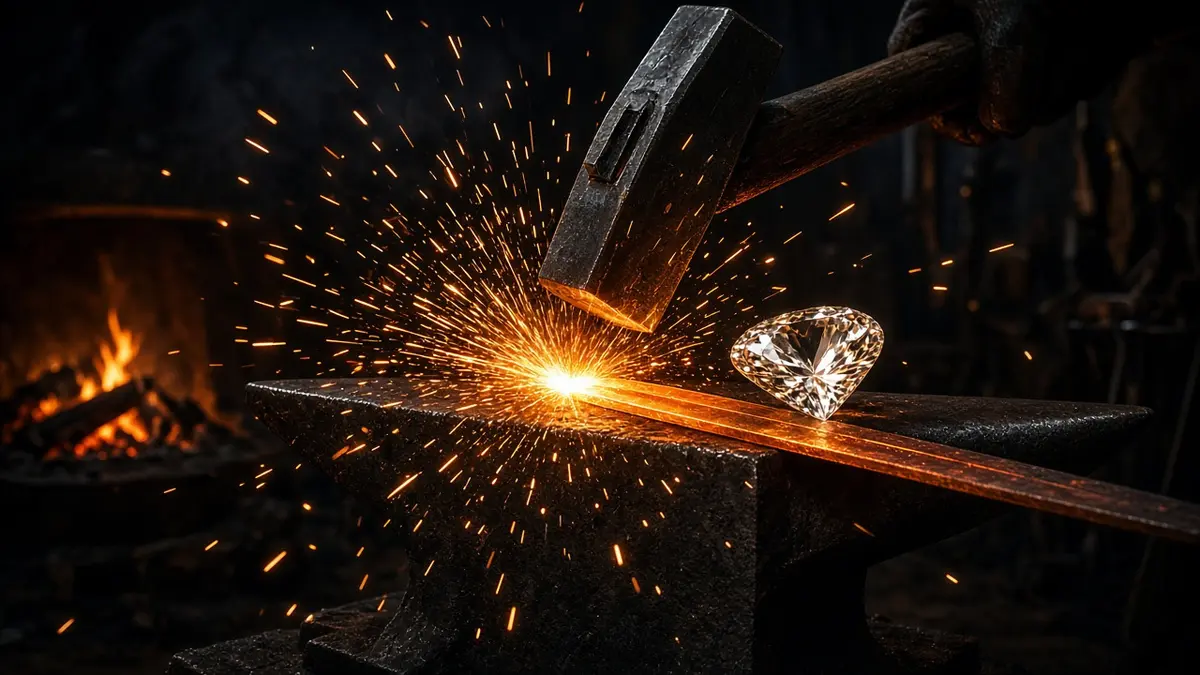
I was mashing ideas back when the machines could barely hold a conversation. The tools got smarter. The principle didn’t change. Truth isn’t handed down by a crowd nodding along. It’s forged in fire, like a diamond under pressure or a sword on the anvil. It’s pounded into existence, blow after blow, until what’s left can’t be broken.
C. Rich