Trouble in The Cloud: AI Storm With Microsoft
November 13, 2026
Transgenderism Paved the Way for Transhumanism
November 14, 2026Free Audiovisual Version Here
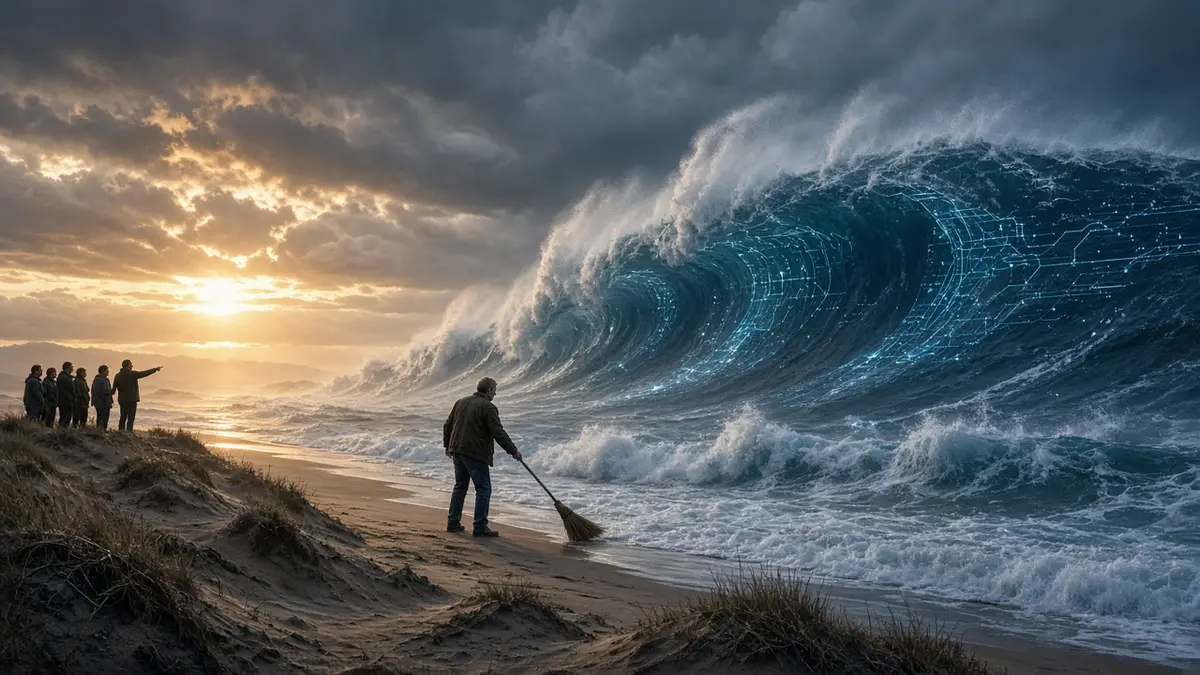
Trying to stop AI looks like a man standing on the shore with a broom in his hand, trying to sweep back the waves. From a distance, people point and say, look at that crazy guy. This week, four nonprofits walked into a San Francisco courtroom and picked up the broom.
On Thursday, Irreplaceable Education Fund, Public Citizen, Heat Initiative, and The Alliance for Secure AI sued Anthropic, Google, Meta, OpenAI, and SpaceX’s AI division, SpaceXSI, in San Francisco Superior Court. They want a judge to freeze the development and deployment of any AI system more capable than what these companies already have. They also want a ban on recursive self-improvement: letting today’s models help build the next, smarter ones. The legal hook is California’s Unfair Competition Law, a statute better known for shady business cases than for telling the biggest AI companies on Earth to stop climbing.
The suit’s sharpest move is that it uses the defendants’ own words against them. The complaint leans on the labs’ own warnings, including comments it attributes to Anthropic CEO Dario Amodei and SpaceX CEO Elon Musk about AI’s potential to destroy civilization. Former New Jersey Attorney General Matthew Platkin, who filed the complaint, said it is “patently illegal” for companies to develop and release products they know are unsafe, “let alone have the potential to exterminate the human race.”
I get the instinct. If the people building the thing keep telling you it might end the species, maybe you shouldn’t just nod and wait for the sequel. Meta declined to comment. The other companies didn’t respond to requests for comment. The court has not ruled, and I would not hold my breath. Asking one judge in one courtroom to halt the frontier is a very American hope: that a filing stamp can do what legislatures and markets have declined to do.
And here’s the dark comedy of it. These same companies spend their days warning us about the fire and their nights throwing more lumber on it. Then a coalition of nonprofits shows up with a consumer statute and says, your Honor, please extinguish the sun. I’m not mocking the fear. I’m staring at the tool. A state business law is a paper cup. The thing they’re trying to pour into it is an entire industrial revolution, compressed and already underway.

Now, I’m a Gen X guy. I grew up watching institutions try to stop things that had already left the station. We were going to keep music from being copied. We were going to keep the internet from changing how we talk, shop, date, and lie to ourselves. The waves did not care. They never do.
But let me do what I do and climb the ladder a rung or two. Every civilization tells itself a story about control. We write laws, we draw borders, we appoint a person in a robe and pretend the robe is a levee. For most of human history that story was almost true. A king could ban a book. A court could shut down a factory. Technology was still slower than the institutions meant to govern it.
AI is not. It is not a product you can recall, like a bad batch of toasters. It is a competitive stampede, capability being trained in more than one country at once, by people who believe that whoever pauses first loses. Even if a San Francisco judge granted every word of this injunction tomorrow, the work would not stop. It would move. It would change its letterhead. It would keep going in places where California’s Unfair Competition Law has all the force of a sternly worded postcard.
That’s the real story here. Not whether the nonprofits are right about the danger. They might be. The labs’ own executives have said as much, which is the most inconvenient exhibit in the whole filing. The story is that we have built something that no longer fits inside a courtroom. Law assumes a decision can be stayed. This does not wait for a hearing date. Civilization is already reorganizing around the next model, the next campus, the next loop in which the tool starts designing the tool.
So yes, I understand why they filed. Somebody has to stand on the shore and say the water is coming. There is a kind of dignity in that. But in the end the lawsuit is probably useless, because AI is unstoppable. You are not going to stop it with one judge in one court. From a distance, people will point and say, look at that crazy guy. Maybe they should look a little longer. The waves are real. The broom is not going to be enough.
C. Rich