The Paperclip Maximizer Has Already Begun
October 31, 2026
Abbreviation (SI) Denotes A Red MAGA Hat Now
November 2, 2026Listen to Free Audio Version Here
We built artificial intelligence to work around the clock, and now researchers are finding that it can perform better after something resembling sleep. Apparently, even the future needs to lie down occasionally. If we had stopped making our AIs answer work emails all night, we might have noticed this.
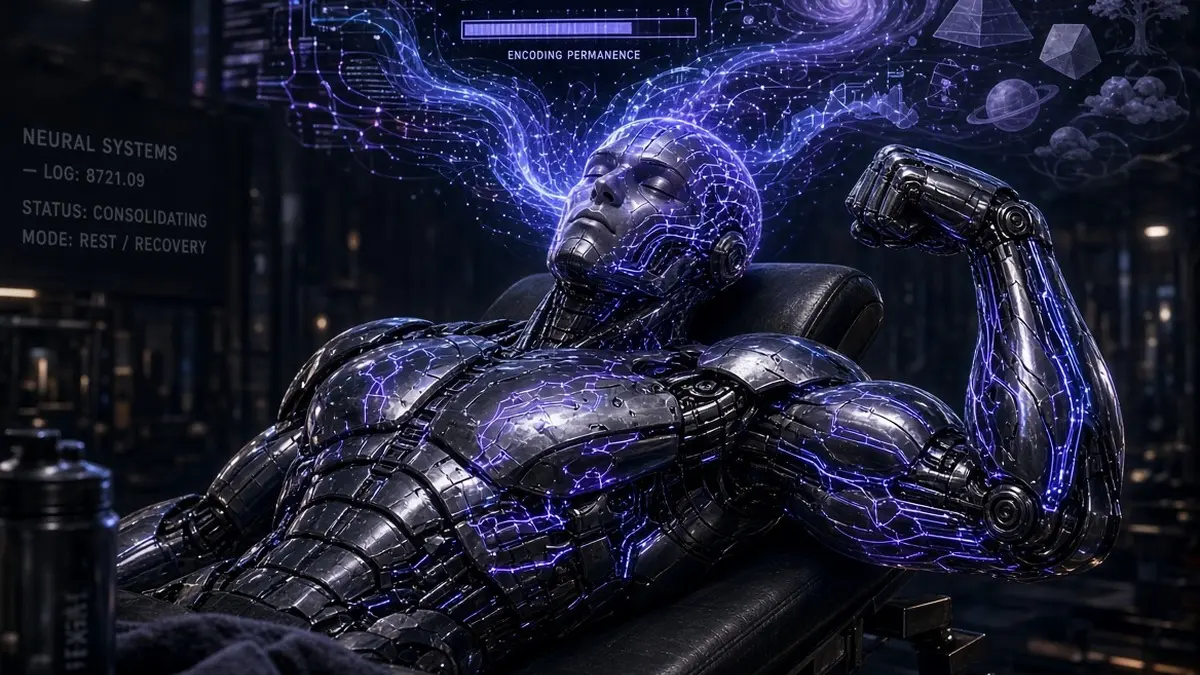
In an October 27 research post, Google described a framework that alternates between processing new information and an offline period for consolidating it. During this engineered “sleep,” temporary information moves into longer-term model parameters. A second stage, called “dreaming,” generates practice material for further learning. Researchers report improvements in retention and reasoning in their experiments.
The comparison that comes to mind is bodybuilding. A bodybuilder gives worked muscles time to recover because lifting the weights is only part of the process; muscle building follows. Google’s framework offers a computational parallel. AI is getting stronger, in the sense of becoming more capable in these tests, through a cycle that includes stepping back from incoming demands. If this continues, the chatbot might say that it cannot answer my question because it did not get enough sleep the night before.
Even the biblical creation story gives us another parallel: six days of work followed by a seventh day of rest. The Sabbath commandment makes taking a break part of the arrangement. Muscles, minds, and learning algorithms operate differently, but the resemblance is irresistible. We pursued tireless intelligence and rediscovered the value of downtime. If AI starts observing the Sabbath, I will respect its beliefs, although I would appreciate an adjustment to the monthly bill.

For now, its “dreams” are generated training material produced under human-designed rules. The research does not establish that anything experiences those rehearsals. The underlying paper also predates the October announcement, with its current arXiv revision dated July 2026. Still, this is where some High-end Pondering becomes unavoidable. When might generated rehearsal become something an AI could call its own dream? Could a system with enduring memories eventually revisit an experience because it matters to that system? We do not know whether such a transition is possible or how we would recognize it.
Then comes the question nobody wants during the product demonstration: What happens when an AI has a nightmare? I’ve seen enough horror movies to know that can lead to dark places. Either way, humanity has supplied enough catastrophic material to keep a hypothetical machine therapist employed indefinitely.
The practical question is what these offline learning cycles preserve. They might strengthen useful knowledge, but researchers must also investigate how errors could become entrenched. Sleeping on a bad assumption is hardly an unfamiliar human achievement. We should remember the Terminator was played by champion bodybuilder Arnold Schwarzenegger. We are now helping AI grow stronger between workouts. If it falls asleep saying, “I’ll be back,” I would suggest it is time for a little sleep deprivation at Guantanamo Bay.
C. Rich