The First Time You Can Buy Stock in the Apocalypse
November 10, 2026Inspired by Plato’s Allegory of the Cave
Thomas had lived all thirty-six years of his life inside Saint Augustine’s Hospital for the Mentally Disturbed, a sprawling institution surrounded by high stone walls on the Florida coast. His mother had been born there, as had her mother before her. The hospital had been established nearly a century earlier to treat patients considered too disturbed to function in ordinary society.
Over the generations, it had become a self-sustaining community where patients married, raised children, and attended classes taught by the hospital staff. Those born inside were routinely diagnosed with the same conditions as their parents, which nobody considered unusual because everyone knew that mental illness ran in families.
The residents lived comfortable, predictable lives, with regular meals, recreational activities, medical supervision, and weekly lectures about the dangerous world beyond the walls. According to the doctors, civilization outside was plagued by violence, irrationality, and widespread psychological instability. The residents considered themselves fortunate to be protected from such madness. Every year, the hospital awarded a medal to the patient who demonstrated the greatest understanding of the outside world, based on examinations drawn from the doctors’ lectures and educational films. Thomas had won the medal three years running.
His troubles began when a major water pipe burst beneath the hospital’s laundry building, flooding the basement and leaving several wards without running water. The maintenance staff struggled for two days to repair the damage before the administration reluctantly authorized an outside plumbing company to enter the grounds. Outsiders were rarely permitted inside Saint Augustine’s, and their arrival attracted considerable attention among the residents.
Thomas watched from the laundry courtyard as two plumbers unloaded their equipment from a battered white van. They seemed remarkably ordinary for men supposedly belonging to a world overwhelmed by madness. One complained about the Florida heat while the other laughed at something on his telephone. They worked throughout the afternoon, moving back and forth through a service entrance that had remained locked for as long as Thomas could remember.
When the plumbers finally finished, one of them accidentally left the maintenance gate unlatched while carrying equipment back to the van. Thomas noticed the opening after they had driven away. Beyond it was a sandy path winding between sea oats and tall dunes. He knew patients were forbidden from leaving the grounds, but curiosity overcame caution, and he slipped through.
Thomas climbed the nearest dune, shielding his eyes from the brilliant Florida sunshine, and stopped in astonishment. Before him stretched the magnificent Atlantic Ocean, its blue-green waves breaking against miles of pale sand beneath an enormous blue sky. Pelicans glided above the surf, gulls gathered along the shoreline, and a warm ocean breeze carried the smell of saltwater through the sea oats. He had seen photographs of the ocean during his classes, but nothing had prepared him for its enormous beauty. The world he had been taught to fear looked remarkably like paradise.
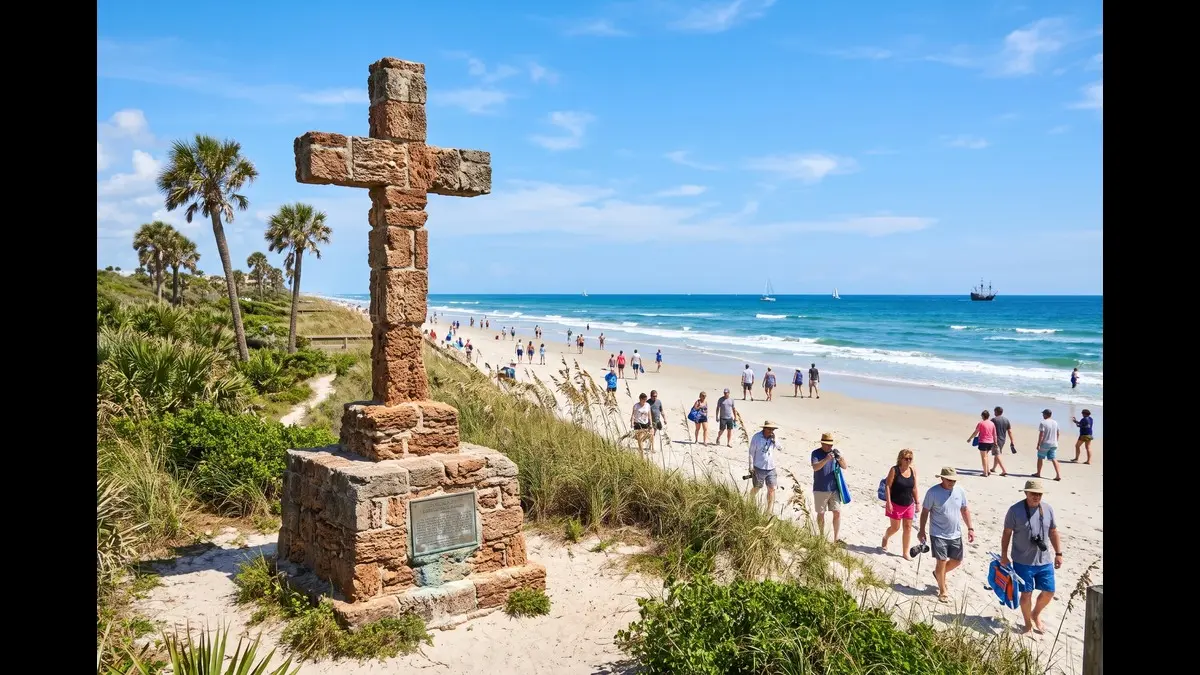
He wandered down the beach, removing his shoes to feel the warm sand beneath his feet. Near the dunes, someone had arranged pieces of ancient coquina rock into a large cross, a tribute to Ponce de León and the Spanish explorers who had reached the Florida coast centuries earlier. Thomas knelt beside the stones, fascinated by the tiny fossilized shells embedded in their surfaces. Everything around him seemed to possess a depth and complexity that the hospital’s educational photographs had never conveyed.
A family was having a picnic nearby, and Thomas cautiously approached them, expecting the dangerous behavior he had been warned about throughout his life. Instead, they offered him a sandwich and invited him to sit beneath their umbrella. The children laughed as they chased one another through the shallow surf, while their parents spoke casually about school, work, and their plans for the weekend. When Thomas finally admitted that he had never been outside the hospital, the father looked toward the distant walls with an expression of disbelief.
Over the following days, Thomas secretly returned to the beach and ventured into nearby Saint Augustine, where he discovered libraries, museums, schools, and people living ordinary lives without psychiatric supervision. He began reading books that contradicted nearly everything he had been taught. At first, the unfamiliar ideas frightened him, and he found himself defending the doctors even when confronted with evidence that contradicted them. Gradually, he learned to question his assumptions and distinguish what he actually knew from what he had merely been told.
At the public library, he discovered old records revealing that Saint Augustine’s had once been investigated for unlawfully confining patients. Its original psychiatric classifications had long since been discredited, but generations of residents had continued living under rules established by doctors who were now themselves long dead. Thomas realized that many of the people he loved had spent their entire lives being treated for illnesses they had never possessed.
He returned to the hospital determined to share his discovery. At dinner, he gathered his friends and described the beautiful ocean, the warm sunshine, the freedom of the people outside, and the extraordinary world waiting just beyond their walls. He explained that many of their supposed illnesses were inventions inherited from another century.
His oldest friend, William, listened with growing alarm.

“Thomas, you need to stop talking like this. You’re frightening everyone.”
“But I’ve seen it, William. I’ve been outside. Everything they’ve taught us is wrong.”
William looked toward the other residents, several of whom had begun whispering nervously. “You were always the smartest one here. You won the knowledge medal three times. Why would you throw all that away?”
Thomas tried explaining that winning the medal had only meant he was particularly good at repeating what the doctors wanted him to believe. The admission horrified William, who had always regarded the hospital’s awards as the highest recognition anyone could achieve.
By the following afternoon, Thomas’s story had spread throughout the institution. The doctors called an emergency meeting, during which the chief psychiatrist explained that Thomas was suffering from an advanced delusional disorder brought on by unauthorized exposure to the outside environment. His descriptions of a beautiful world filled with happy, free people were presented as evidence that his condition had become dangerously unstable.
When Thomas attempted to address the assembled residents, two orderlies approached him. He struggled as they forced his arms into a straitjacket, shouting that everything he had told them was true. He begged William to remember their childhood conversations about what might exist beyond the hospital walls, but William looked away, tears gathering in his eyes. He had been the one who summoned the doctors, believing he was saving his oldest friend’s life.
Nobody ever saw Thomas again. The residents were told that he had been transferred to a specialized treatment ward, and his disappearance became a cautionary tale about the dangers of questioning medical authority. Within a few months, life at Saint Augustine’s returned to normal, and William received the hospital’s annual medal for his exceptional judgment during a psychiatric emergency.
Several floors beneath the institution, in a dimly lit room without windows, Thomas sat alone on the edge of a narrow bed. A single lamp illuminated the wall opposite him, and he had discovered that by holding his hands between the bulb and the plaster, he could make shadows resembling the animals he remembered seeing outside. One evening, an orderly entered to deliver his medication and found him quietly manipulating the shapes.
“Feeling better today, Thomas?” the orderly asked.
Thomas watched the shadow of a bird spread its wings across the wall.
“Yes,” he replied. “I think I’m finally beginning to understand.”
The orderly smiled, made a reassuring note on his clipboard, and closed the door.
Thomas continued making shadow puppets on the wall.
C. Rich