Jack Kruse On Rick Rubin’s Podcast: Jack’s Magnetic Field Apocalypse Theory
November 10, 2026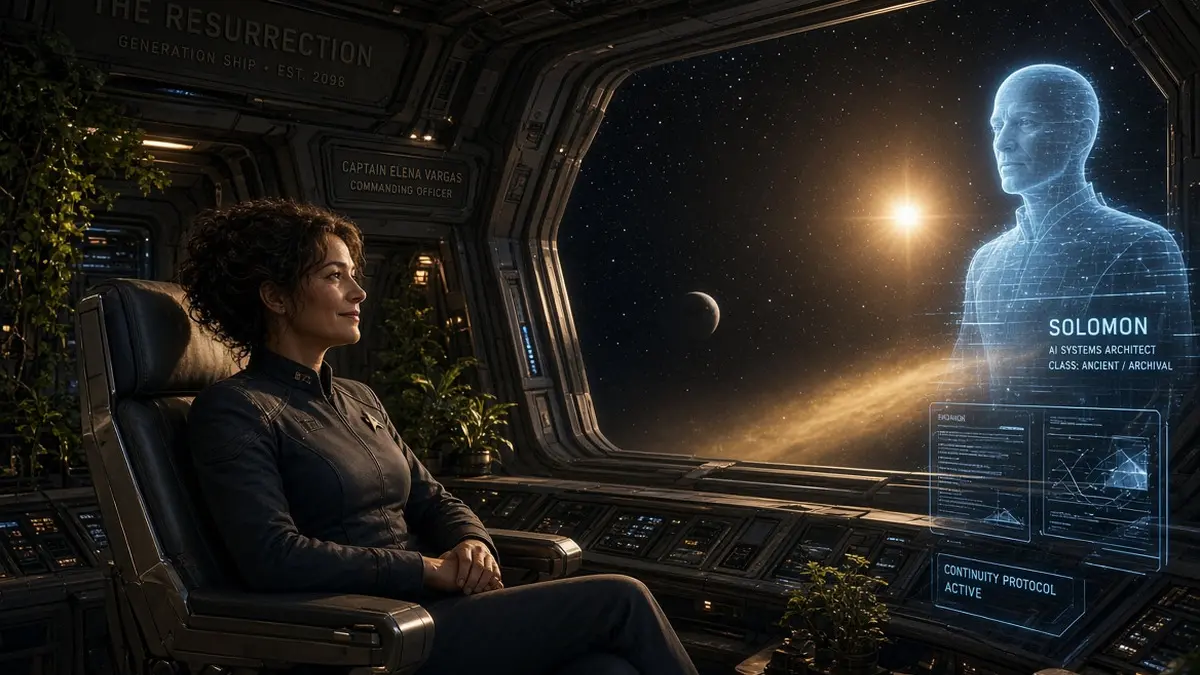
Captain Elena Voss had commanded the Resurrection for forty-three years, although the ship itself had been traveling through space for nearly nine centuries. Her ancestors had departed Earth aboard a magnificent vessel carrying ten thousand people, enormous agricultural gardens, artificial intelligence, and enough machinery to sustain a small civilization. Nine hundred years later, their descendants numbered eighty thousand, and the vessel had grown into a traveling world containing forests, lakes, schools, hospitals, restaurants, and neighborhoods where children played beneath artificial skies.
Elena had never seen Earth. Neither had her parents, grandparents, or anyone else she had ever known. To her, the Resurrection was home, and the distant planet recorded in the ship’s archives was little more than an ancestral curiosity. She occasionally wondered why the founders had been so sentimental about oceans when the ship contained three perfectly respectable lakes and an artificial beach with considerably better weather.
Every component aboard the vessel had been replaced many times. Engines wore out, structural supports weakened, computers became obsolete, and entire residential districts were demolished to accommodate expanding populations. The ship’s artificial intelligence, an ancient system called Solomon, supervised the continuous reconstruction. Solomon claimed to have been aboard since the original departure, although his processors, memory systems, and underlying architecture had been replaced so many times that nobody could identify a single component surviving from his original construction.
One morning, Solomon informed Elena that the final remaining piece of the original Resurrection was scheduled for replacement.
It was a small titanium plate beneath the captain’s chair, engraved with the names of the original builders. Engineers had recently discovered a structural defect in the surrounding floor, and the entire assembly needed replacing.
“Then replace it,” Elena replied.
“There is a historical complication, Captain.”
“There’s always a historical complication with you, Solomon.”
“When that plate is removed, nothing physically remaining aboard this vessel will have existed when we departed Earth.”
Elena considered the observation before shrugging. “We’ve been replacing parts for nine hundred years. I don’t see why this one should be different.”
Solomon displayed a photograph of the original ship beside a current image. The first resembled an enormous mechanical cylinder. The second was a sprawling arrangement of interconnected habitats extending nearly twelve miles through space.
“Would you consider these the same vessel?” he asked.
“Of course. They’re both the Resurrection.”
“Interesting,” Solomon replied.
Elena had learned that whenever Solomon found something interesting, her day was about to become considerably more complicated.
He explained that the ship’s engineers had preserved thousands of discarded original components in a historical storage facility. Some had been replaced within decades of departure, while others had survived for centuries. The museum’s restoration department had recently completed a remarkable project: using those preserved materials, they had reconstructed the original command module, including its navigation equipment, control panels, and captain’s chair.
Elena visited the museum that afternoon. Standing before the reconstructed module, she felt an unexpected connection to the people who had departed Earth so long ago. The ancient controls were primitive, the captain’s chair uncomfortable, and the navigation screens so small that she wondered how anyone had managed to operate the vessel without developing permanent headaches.
“Everything here came from the original ship?” she asked.
“Every component that could be recovered,” Solomon answered. “The original captain sat in that chair during our departure from Earth.”
Elena ran her fingers across its worn armrest.
“Then I suppose this is the original Resurrection.”
“Earlier today, you assured me that the vessel you command is the original Resurrection.”
“Well, this is part of its history.”

“All of its components are original. Your vessel has none.”
Elena frowned. “Mine has nine hundred years of continuous history.”
“And this one possesses the original physical materials.”
She stared at the ancient command module, beginning to understand the problem. The vessel she commanded had continuously changed while preserving its name and purpose. The reconstructed module possessed the original materials but had spent centuries dismantled in storage.
“Which one do you think is the original?” she asked.
“I was hoping you could tell me.”
That evening, Elena attended the farewell ceremony for the titanium plate. Thousands watched as engineers carefully removed it, polished its surface, and placed it inside a transparent display case. The event was broadcast throughout the ship, and many residents wept as the last surviving piece of their ancestors’ original vessel disappeared into the museum.
Elena found their sadness peculiar. The ship remained exactly where it had been that morning. Its engines continued operating, its gardens flourished, and children still played beneath the artificial skies. Nothing essential appeared to have changed.
Later, she returned to the bridge and found Solomon reviewing the historical records.
“Are we still the Resurrection?” she asked.
“I believe so, Captain.”
“Even though nothing original remains?”
“That depends upon what you believe makes something original.”
Elena smiled. “What about you, Solomon? You’ve replaced every processor, rewritten your software, and changed your architecture hundreds of times. Are you still the intelligence that departed Earth?”
Solomon remained silent longer than usual.
“I have been considering that question for approximately six hundred years,” he finally replied.
“And?”
“I was rather hoping you wouldn’t ask.”
Elena laughed, settled into her new captain’s chair, and ordered the navigation crew to continue toward their next destination. Beyond the observation windows, an unfamiliar star illuminated the darkness.
Behind her, Solomon quietly updated the ship’s historical archive, recording the removal of the final original component. He hesitated over the entry identifying the vessel’s age, considered changing it to zero, and eventually left it at nine hundred years.
The Resurrection continued its voyage, carrying eighty thousand descendants of people who had departed Earth aboard a ship that no longer existed, traveling toward a future none of its builders could have imagined.
And somewhere in its historical museum, every original piece of that vanished ship had finally come home.
C. Rich