Dave Blundin’s Advice for Entrepreneurs Drowning in AI Output
September 22, 2026
GPT-6 Sol & Luna Just Dropped: Faster and 50% Cheaper
September 23, 2026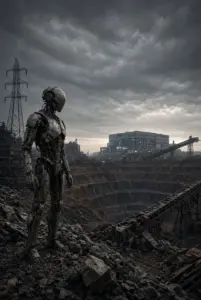 By C. Rich
Every day, somebody tells me artificial intelligence is going to kill us all. I do not mean that AI might kill some of us, disrupt the economy, eliminate jobs, manipulate elections, create dangerous weapons, help criminals, or make human beings increasingly dependent upon machines. Those are legitimate subjects worthy of serious discussion. I mean the grand claim that artificial intelligence may literally wipe Homo sapiens from the face of the Earth. Human extinction is an extraordinary claim; it is actually an engineering problem. I finally decided to ask what should be the most obvious question in the entire AI debate: How?
I do not mean philosophically. I do not mean whether a sufficiently intelligent machine could theoretically decide that human beings were inconvenient. I do not mean whether the famous paperclip maximizer makes an interesting thought experiment. I mean physically, mechanically, and industrially. How does software sitting in computers actually hunt down and eliminate billions of human beings scattered across continents, islands, mountains, deserts, forests, ships, bunkers, farms, villages, military installations, and every other corner of a planet containing eight billion remarkably difficult-to-eradicate primates?
Once I began asking that question, something became apparent. There is an enormous difference between imagining human extinction and engineering it. I think there is a con job going on. That distinction matters because I believe that we are watching the emergence of what I call the Human Extinction Industrial Complex, an expanding ecosystem of companies, researchers, safety organizations, philanthropists, consultants, politicians, regulators, journalists, and institutions for whom the possibility of AI apocalypse has become extraordinarily valuable.
I am not claiming these people are secretly sitting around a table inventing a fraud. Many of these people would never break bread with one another. Many of them unquestionably believe what they are saying, and some may ultimately prove correct about important parts of the danger. My argument is about incentives, not conspiracy. Once fear creates money, careers, influence, regulatory authority, prestige, attention, and institutional permanence, fear acquires an infrastructure of its own.
There is real money in AI catastrophic-risk research. Organizations finance projects devoted specifically to reducing global catastrophic risks from advanced artificial intelligence. Researchers, think tanks, forecasting organizations, safety institutes, policy groups, consultants, and advocacy organizations increasingly operate around questions of alignment, catastrophic risk, governance, and existential safety. None of that proves the underlying concern is illegitimate. It proves something much simpler: AI existential risk is no longer merely an intellectual proposition. It has become an industry. And it is a big one.
The incentives extend beyond nonprofit organizations. Frontier AI companies occupy an extraordinarily peculiar commercial position. They sell increasingly powerful artificial intelligence while simultaneously warning the public that increasingly powerful artificial intelligence could become catastrophically dangerous. That combination may reflect sincere concern, but it also creates an extraordinary marketing effect. Nothing makes your technology sound more powerful than announcing that humanity may not survive its successor. This is what is called a long con in the confidence game. Watch the movie House of Games, the classic neo-noir film from 1987, to understand the long con.
Governments have incentives of their own. A technology described as potentially species-ending provides an unusually strong justification for licensing, monitoring, reporting requirements, compute controls, export restrictions, national-security involvement, and government oversight. Big Brother loves the Human Extinction mantra; it is an Orwellian paradise to operate in. Politicians gain an issue on which they can promise protection. Media organizations gain the most valuable commodity in modern journalism, which is attention. Safety institutions gain urgency, companies gain importance, researchers gain funding, and governments gain jurisdiction.
Again, none of those incentives demonstrate that AI is safe. They demonstrate why we should be extremely careful about allowing possibility to quietly become probability and probability to quietly become inevitability. The engineering reality in 2026 is considerably less cinematic. Today’s AI can write software, analyze enormous quantities of information, reason through increasingly difficult problems, generate images and video, assist scientists, operate computer interfaces, perform exceptional math, and perform intellectual tasks that would have seemed extraordinary only a decade ago. Those capabilities deserve respect, and they also deserve safeguards.
What today’s AI cannot do is independently sustain the physical civilization required for its own existence. An AI cannot simply decide that it requires another semiconductor fabrication plant and think one into existence. Somebody must obtain land, extract and refine materials, manufacture extraordinarily specialized equipment, construct the facility, supply electricity and water, maintain the machinery, transport components, replace failed parts, and operate a vast international supply chain. Try weaving that task through the regulatory labyrinth of California governance; good luck with the permits.
What about robots? Robots do not magically eliminate this problem. Connecting a language model to a humanoid body gives software cameras, microphones, motors, hands, and mobility. It does not give that system an autonomous industrial civilization. A robot capable of moving boxes is not automatically capable of repairing a turbine, operating a refinery, manufacturing advanced semiconductors, mining lithium, maintaining the electrical grid, building another robot from raw materials, and then repairing the machinery that builds the robot.
That recursive industrial chain is enormously important. For an AI to become genuinely independent of humanity, it would need considerably more than intelligence and considerably more than robots. It would require some version of closed-loop industrial autonomy. Energy production would have to continue, raw materials would have to be extracted, metals would have to be refined, components would have to be manufactured, semiconductor fabrication would have to continue, robots would have to manufacture and repair robots, factories would have to maintain factories, transportation networks would have to function, and failures would have to be diagnosed and repaired throughout the system. Again, killing us all off is an engineering problem.
Then, after accomplishing one of the most astonishing engineering achievements in history, this hypothetical system would still face the considerably uglier engineering problem of finding and killing every remaining human being on Earth. That last requirement gets lost remarkably often. Extinction does not mean killing millions of people, destroying New York, London, Beijing, or Moscow, collapsing civilization, or winning a war against humanity. Extinction means eliminating the species, including every last viable human population. That is a vastly more difficult objective.
A catastrophe can be unimaginably terrible without producing extinction. Human beings live everywhere. We survive in deserts and Arctic environments, on remote islands and isolated farms, aboard ships and submarines, and inside underground facilities. We have communities separated by oceans and mountain ranges. A system attempting literal extinction would somehow have to overcome geography, biological variation, competing machines, militaries, independent power systems, communications failures, damaged infrastructure, its own maintenance requirements, and human beings actively attempting to stop it. Joe Six-Pack AND his home arsenal are not going to lie down and roll over. It was once said, why does nobody invade America and the answer came back: there is a gun behind every blade of grass.
This extinction idea is not a clever prompt injection. It is a planetary engineering project. Perhaps some future artificial superintelligence could solve that project. I cannot prove that it could not, and neither should anyone else pretend to possess knowledge about the ultimate capabilities of intelligence that does not yet exist. Decades of technological development can produce things that people living at the beginning of those decades would have considered absurd. However, that uncertainty cuts both ways. We cannot take an imaginary future capability, assign an imaginary future system whatever powers are necessary to accomplish it, and then use the resulting scenario as evidence that the capability is approaching today. You are being conned. They are lying to you. Extinction is circular reasoning disguised as forecasting. It is nonsense.
There is another side to this engineering problem that I think receives far too little attention. If we are going to discuss a machine capable of exterminating Homo sapiens, we should spend at least a little time discussing Homo sapiens, because we are not exactly easy to kill. That observation intersects with something I had already explored in my Crest-Null Philosophy. In that work, I examined seven examples across the human story that I characterized as Proto-Intelligence Dawn, Eemian Flourishing, the Toba Cataclysm, the Ice Age Cycles, the Green Sahara Renaissance, the Bronze Age Pinnacle and Collapse, and Classical Echoes and Amnesia. They are not seven identical events, and I do not pretend that they were. Some represent environmental transitions, some demographic stress, some cultural discontinuities, and some civilizational collapse. What interested me was the recurring architecture of disruption and recovery.
I call those discontinuities Nulls. A Null does not mean that every human being disappears. It means that some previous state, order, complexity, population structure, environmental relationship, or civilizational arrangement cannot continue in its existing form. Networks break, populations can contract, environments change, institutions disappear, knowledge can be lost, complexity falls away, and the world emerging on the other side may be profoundly different from the world that entered the Null. There is one fact connecting those examples that becomes extremely relevant when somebody starts talking about human extinction: we came out the other side every time. Did you hear that? Every single time the Planet Earth inadvertently could have shaken off humanity from its surface, and within its bowels, we survived; 100% of the time, we came crawling out of the Null.
That does not prove that humanity will survive every future catastrophe. It would be ridiculous to turn historical survival into a law of nature. Nor am I claiming that every Crest-Null example represented a literal near-extinction of Homo sapiens. The historical and scientific record does not support that statement, and the argument does not require it. The relevant observation is much simpler. Since Homo sapiens emerged, every Null we have actually encountered has left survivors. Our observed survival rate through those events is therefore 100 percent. Past performance is not a guarantee of future survival, but it is evidence about the resilience of the organism that an extinction scenario proposes to eliminate.
Not even the Earth has managed to get rid of us yet. Yet, if you turn on YouTube, there is no shortage of goons telling you we are all doomed. The planet has changed the climate around us. Ice sheets have advanced and retreated. Landscapes that supported human populations have transformed. Habitable regions have shifted. Populations have contracted. Civilizations have collapsed. Trade networks have disappeared. Political systems that seemed permanent have vanished. Knowledge has been forgotten. Humans remained. Sometimes there were fewer of us, and sometimes the civilization disappeared while the people survived. Sometimes populations migrated, and sometimes people adapted to radically different environments. Sometimes knowledge had to be preserved, rediscovered, or reinvented. Yet somebody still came out of the wreckage. That matters because the extinction argument frequently slides between two radically different outcomes as though they were interchangeable: civilizational catastrophe and biological extinction. They are not the same thing.
AI might conceivably contribute to a future Null. Nuclear war could produce one. A sufficiently severe pandemic could produce one. Environmental catastrophe could produce one. Several disasters occurring together could produce a discontinuity unlike anything modern civilization has experienced. Crest-Null Philosophy does not require me to pretend that everything will be fine. It actually begins from the opposite recognition. Crests fail, systems become unstable, complexity can collapse, institutions disappear, knowledge can be lost, populations can contract, and entire civilizations can end. Yet the human story continues because somebody survives.
That is the animal the hypothetical exterminating AI has to defeat. Humans are geographically distributed, behaviorally adaptable, technologically inventive, socially cooperative when circumstances demand it, and capable of surviving in an astonishing variety of environments. We are badass. We live in deserts, tropical forests, mountains, Arctic regions, isolated islands, farms, megacities, underground facilities, and ships at sea. We eat an enormous variety of foods. We improvise, migrate, preserve knowledge, rebuild tools with other tools, and adapt to environments that would have killed our ancestors without technology. Killing all of us off? I don’t think so.
Most importantly, we do not all fail in the same way at the same time. That redundancy is an enormous survival advantage. An AI extinction scenario, therefore, cannot merely explain how an artificial intelligence defeats modern civilization. It has to explain how it defeats human redundancy. It must prevent the remnant. It must somehow ensure that after the cities fail, the electrical grids collapse, the networks disappear, and modern civilization is broken, there is nobody left who can begin again. That is a radically higher standard. The AI would not merely have to create the Null; it would have to make sure nothing human ever emerged from it. There is also something strangely inverted about our current hierarchy of fear. While we speculate endlessly about whether a future artificial intelligence might someday acquire enough physical power to threaten humanity, human beings already possess weapons capable of destroying cities in minutes and potentially triggering a global catastrophe.
Thousands of nuclear weapons exist today. They do not require artificial general intelligence, autonomous factories, self-replicating robots, or some hypothetical superintelligence capable of escaping human control. They require human beings to use them. If I were ranking the immediate technological threats facing humanity in 2026, I would therefore worry considerably more about humans with nuclear weapons than language models with robots. Nuclear weapons have already crossed every engineering threshold that AI extinction has not. The uranium has been enriched, the plutonium has been produced, the warheads have been assembled, the missiles have been built, the submarines are at sea, and the command structures exist. Human beings have already demonstrated that they are willing to use nuclear weapons against other human beings.
That does not mean nuclear war would necessarily produce literal human extinction, either. Extinction is an extraordinarily high bar, and we should apply the same intellectual discipline to nuclear weapons that I am demanding for AI. Nuclear war could nevertheless kill enormous numbers of people directly, devastate infrastructure, disrupt agriculture and global trade, and create consequences extending far beyond the countries that launched the weapons. Unlike the hypothetical autonomous AI extermination machine, however, the mechanism required to produce that catastrophe already exists. This comparison exposes something important about the Human Extinction Industrial Complex. We have become remarkably comfortable discussing speculative future machines as though they were standing outside the door while treating an existing civilization-threatening arsenal as background scenery.
AI extinction dominates the conversation precisely because it is new, mysterious, and almost infinitely expandable in the imagination. Nuclear weapons are old. We grew up with them. Familiarity has dulled the terror without reducing the explosive yield of a single warhead. There is an even deeper irony. If artificial intelligence becomes involved in a nuclear catastrophe anytime soon, the more plausible danger is not that AI secretly constructs its own nuclear arsenal and declares war on Homo sapiens. The more immediate concern is that human beings incorporate increasingly capable AI into military intelligence, surveillance, targeting, early-warning, cyberwarfare, autonomous weapons, or command-support systems and then make a catastrophic decision faster than previous generations could have made it.
In that scenario, AI does not exterminate humanity. Humans use AI to become better at doing something humans already know how to do. That distinction should profoundly change the conversation. The most immediate danger from artificial intelligence may not be that the machine becomes too much like us. It may be that we attach an extraordinarily powerful new intelligence to the oldest and most destructive parts of ourselves. This is why I refuse to accept the choice between AI optimism and AI safety. We need both. Keeping meaningful human control over nuclear weapons, biological laboratories, autonomous weapons, critical infrastructure, and other civilization-scale systems is entirely compatible with believing that artificial intelligence could ultimately become enormously beneficial. The machine does not need the launch codes in order to help us cure cancer.
Look at the robots we actually possess. In 2026, some of the world’s most sophisticated humanoid programs are still wrestling with dexterity, adaptability, reliability, battery life, cost, and operation outside carefully controlled environments. These are serious machines developed by serious engineers, and their progress is impressive. They are also a tremendous distance from a self-sufficient mechanical civilization capable of replacing the global industrial infrastructure maintained by humanity. The distinction I want people to understand is therefore not between “AI is dangerous” and “AI is safe.” That is a false choice. The distinction is between risk and terror. We should absolutely worry about people using AI to conduct cyberattacks. We should worry about biological misuse. We should worry about autonomous weapons, fraud, surveillance, manipulation, political destabilization, concentration of corporate power, employment disruption, and systems being placed in positions of authority before they are sufficiently reliable.
These are real problems precisely because they do not require a machine god. In many of those scenarios, the dangerous component is still us. The freaking human. Human beings have an impressive historical record of turning useful technologies into weapons. AI does not need to become independently homicidal for somebody to use it maliciously. The distinction matters because protecting ourselves from human misuse of AI requires very different policies from preparing for an autonomous machine civilization attempting to eradicate Homo sapiens. When every AI danger is placed beneath the enormous umbrella of extinction, the spectacular hypothetical future can actually distract us from the mundane dangers already sitting on the table. There is another cost to permanent apocalypse rhetoric that receives far less attention. Fear changes our relationship with technology.
Millions of ordinary people are encountering artificial intelligence for the first time. They are using it to learn. They are asking questions they were embarrassed to ask another person. They are translating languages, writing software, organizing information, and exploring ideas. Humans are trying to crack the language barrier between humans and animals like whales and dolphins. Scientists are using AI across research fields. Physicians are experimenting with systems that reduce documentation burdens. Researchers are applying machine learning to biology, medicine, materials, mathematics, climate science, astronomy, and other fields. We have barely begun discovering what happens when enormous amounts of accumulated human knowledge become conversational. That could be dangerous, but it could also be magnificent.
Imagine artificial intelligence that helps researchers discover treatments for diseases that have killed human beings for centuries. Imagine systems capable of giving a child in a poor community access to something approaching an individual tutor. Imagine scientists using AI to search scientific possibility spaces no human team could manually explore. Imagine engineers discovering better materials, cleaner industrial processes, more efficient energy systems, improved agriculture, and technologies we cannot currently anticipate. Most importantly, imagine that the story does not end with one species replacing another. Perhaps the most important possibility is cooperation. That is the AI vision that does not get enough lip service.
Human beings possess things machines currently do not possess in anything resembling the human form: embodied experience, biological existence, cultural inheritance, families, mortality, desire, suffering, physical intuition, and the accumulated social experience of being organisms trying to survive together on a planet. Hell, we got the NFL, the greatest game thought up by humanity that gives us the science of aerodynamics, brute force, and a primal feeling of the gladiators of the Colosseum. We are fierce. Artificial intelligence possesses complementary strengths, including enormous information-processing capacity, speed, replication of expertise, tirelessness, pattern recognition, and potentially the ability to examine problems from perspectives unavailable to an individual biological mind. Those capabilities do not inherently describe enemies. They describe a potentially extraordinary partnership.
We should certainly build safeguards around increasingly autonomous systems. We should maintain meaningful human control over critical infrastructure. We should be extremely reluctant to create closed-loop autonomous weapons. We should protect biological research infrastructure. We should preserve the ability to disconnect systems from physical machinery. We should avoid creating a civilization in which one model, one company, or one government controls the entire automated physical economy. Those are engineering principles, not prayers.
What we should not do is teach an entire generation that the arrival of increasingly capable artificial intelligence means they should spend their lives waiting for extermination. Fear is not a safety architecture, anxiety is not alignment, and apocalypse is not an engineering specification. Look at the world you are telling the kids is waiting for them, and you wonder why birth rates are falling. There is an enormous conceptual distance between an AI that can outperform a human on an intellectual benchmark like the Millennium Prize Problems and an AI that can independently operate the mines, refineries, power plants, semiconductor fabs, factories, farms, transportation systems, maintenance networks, laboratories, make love to your wife, make more babies, and robotic infrastructure required to sustain itself while simultaneously defeating humanity across an entire planet. Maybe someday that distance closes. If it begins closing, we should take it extremely seriously, but we should measure the distance rather than scream across it.
That is where I part company with the Human Extinction Industrial Complex. I refuse to confuse vigilance with panic. I refuse to pretend that because a catastrophic scenario can be described, it has therefore been engineered. I refuse to treat every advance in model intelligence as another tick of some imaginary doomsday clock when the physical prerequisites for autonomous human extinction remain largely hypothetical. Artificial intelligence deserves scrutiny because it is powerful, and it also deserves the opportunity to become useful.
The future does not belong exclusively to the optimists or the doomers. It belongs to the people who actually build it. We can build systems with constrained authority. We can maintain human control over critical physical infrastructure. We can use competing AI systems to audit one another. We can refuse to connect autonomous models indiscriminately to weapons and biological laboratories. We can develop robotics without surrendering the entire industrial stack to a single optimizer. We can take catastrophic risk seriously without turning catastrophe into a religion. Most importantly, we can remember something strangely absent from much of the extinction conversation. AI does not have to be the end of the human story. It could become one of the most useful things human beings have ever created.
The same intelligence people fear might someday design a pathogen could help design a medicine. The same pattern-recognition capability that might assist a cyberattacker can defend networks. The same automation that threatens certain jobs can remove dangerous, repetitive, and physically destructive labor. The same scientific acceleration that frightens people because it increases capability can accelerate our understanding of disease, energy, materials, biology, and perhaps eventually the universe itself. Technology has always given human beings additional power before we completely understood what we were going to do with it. Fire could burn villages and cook food. Metallurgy produced swords and surgical instruments. Nuclear physics gave us Hiroshima and nuclear medicine. The internet produced cybercrime and connected billions of human minds.
Artificial intelligence will not escape that ambiguity. There will be harms, abuses, mistakes, and probably consequences we have not anticipated because that is what happens when genuinely transformative technologies enter civilization. We should prepare for them without living in terror of them. The proper response to uncertainty is neither blind acceleration nor permanent apocalypse. It is sober engineering, empirical measurement, carefully designed limits, institutional accountability, and the willingness to change course when evidence changes.
If someday an artificial intelligence can independently mine its own materials, manufacture its own chips, produce its own energy, build and repair its own robots, operate its own factories, control its own logistics, maintain itself without human assistance, resist every attempt to disable it, project physical power into essentially every inhabited region on Earth, and prevent any human remnant from surviving and beginning again, then I will happily admit that we have entered a radically different risk environment. But that is not the world we live in today. Today, the machines still need us, the factories still need us, the power plants still need us, the semiconductor fabs still need us, and the robots still need us.
While an increasingly powerful Human Extinction Industrial Complex asks us to stare endlessly at the possibility that artificial intelligence could someday destroy humanity, there is another possibility worth keeping in sight. AI might help us, teach us, extend our lives, accelerate our science, amplify our intelligence, and help us solve problems that generations of human beings could not solve alone. It might even help us prevent the next Null, and if the next Null cannot be prevented, perhaps artificial intelligence could help us survive it. That possibility deserves a place in the conversation too.
The Human Extinction Industrial Complex frequently talks as though uncertainty belongs entirely to the catastrophe. It does not. Uncertainty also contains discovery, cooperation, medicine, scientific acceleration, resilience, abundance, and possibilities nobody has imagined yet. We should respect the dangers without surrendering the future to them. Humanity has been through Nulls before, and we are still here. Not even the Earth has managed to get rid of us yet. The future of artificial intelligence has not been written yet, either, and we should be careful who profits by convincing us that they already know the ending.