Behind SpaceX’s Owning Down to The Dirt
November 27, 2026
The Hubble Tension Scandal: Questioning the Dark Sector
November 28, 2026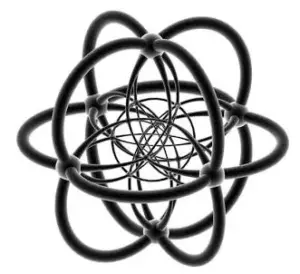 By C. Rich
Pangaea Finally Finds a Universe
The Math
There are moments in life when I am particularly grateful that nobody can see me sitting alone in my office at some ridiculous hour of the morning, grinning at a computer monitor like a man who has just discovered that his lottery ticket is worth considerably more than the paper upon which it was printed. Tonight was one of those moments. I had not purchased a lottery ticket, and there was certainly no financial windfall awaiting me. What I had was a seven-page scientific paper, a geometric object that had occupied an extraordinary amount of my intellectual life over years trying to find a mathematical bridge between that object and the physical universe.
The particularly entertaining aspect of this development is that, only days earlier, I had written publicly about my growing suspicion that Cosmological Pangaea might not belong in the primordial universe at all. My work on the Cosmic Garden had demonstrated that considerably simpler geometric configurations could undergo gravitational evolution toward an expanding cosmological state. I had begun questioning whether I had assigned Pangaea a responsibility for which it was unnecessarily qualified. It was a beautiful mathematical construction, but beauty is not a professional qualification for starting a universe. I even suggested that I owed the damn thing an apology.
I have never been particularly interested in defending a theory simply because my name appears on it. The universe is under no obligation to accommodate my intellectual preferences, and I would rather spend the remainder of my life discovering that I was wrong than spend it defending something that nature has no interest in doing. Nevertheless, I would be lying if I said that tonight’s developments did not produce a considerable amount of personal satisfaction.
After months of mathematical construction, independent verification, adversarial challenges, abandoned approaches and excursions into other areas of theoretical cosmology, I have established an explicit conditional mathematical correspondence between Cosmological Pangaea and an exact solution of Einstein’s General Theory of Relativity. That solution possesses a physically motivated route toward the hot Big Bang. For those who have been following this rather peculiar intellectual adventure from the beginning, I suspect you understand why I am smiling.
When I began developing Cosmological Pangaea, I was pursuing a relatively simple question with extraordinarily complicated consequences. Could the universe have emerged from a primordial geometric object? Could the physical complexity we observe today have originated from something geometrically organized before the familiar history of our universe began? Taking inspiration from Georges Lemaître’s original concept of the “primeval atom,” my model posits that the modern universe is the fragmented descendant of a finite, maximally unified primordial state.
The name was inspired, in part, by the geological history of our own planet. The continents upon which we live were once organized differently. The ancient supercontinent Pangaea eventually separated, and the resulting geological evolution produced the world we recognize today. I wondered whether something conceptually comparable might have occurred on a far more fundamental level. Perhaps the universe had its own Pangaea.
Of course, contemplating a primordial geometric object and actually producing a mathematically defensible one are two entirely different recreational activities. The former can be accomplished with a cup of coffee and a sufficiently undisciplined imagination. The latter involves discovering just how many ways mathematics can inform you that your imagination has exceeded its professional qualifications.
Over the course of twelve construction stages, followed by a formal completion and handoff in Stage XIII, the Cosmological Pangaea Project developed an extensive mathematical structure associated with a remarkable four-dimensional geometric object known as the 24-cell, which is one of the six regular convex polytopes that exist in four dimensions. Unlike the familiar cube, tetrahedron, and other geometric objects that have higher-dimensional analogues, the 24-cell occupies a particularly interesting position within geometry. It has no direct regular-polytope equivalent in three dimensions.
The construction eventually developed around its vertices, edges, internal relationships, symmetries, and admissible mathematical assignments. I examined what the object permitted, what it prohibited, and what structures emerged from the mathematical relationships established within it. By the time we reached Stage XIII, I had completed the construction itself. Its mathematical existence was no longer the central question. The question was what, if anything, it had to do with the universe. That was a rather substantial distinction.
Imagine spending months constructing an extraordinary mathematical key without knowing whether there is a lock anywhere in nature into which it fits. You can examine the key, measure its dimensions, understand its internal structure, and establish beyond reasonable mathematical dispute that it is a perfectly legitimate key. You can even invite extraordinarily capable artificial intelligences to spend their time attempting to break it. Eventually, however, somebody is going to ask what it opens. That was where I found myself with Cosmological Pangaea.
Rather than continually trying to force Pangaea into a physical interpretation, I eventually began investigating primordial geometries through a separate research program called The Cosmic Garden: Primordial Geometries and Gravitational Evolution. The Cosmic Garden allowed us to investigate how different geometric configurations behave under general-relativistic gravity without requiring any of them to be Cosmological Pangaea. I wanted nature to have the opportunity to surprise me, even if the surprise involved telling me that the object I had spent months developing was irrelevant.
Through the Cosmic Garden, I investigated what I called the Gate, the critical threshold separating different gravitational outcomes. My AI team called The Mash, and I examined primordial configurations that could undergo gravitational focusing and others that could proceed into expanding cosmological states. We discovered fascinating relationships involving geometric shape, rotation, inflation, and the persistence of certain geometric characteristics through subsequent cosmological evolution.
Along the way, I repeatedly encountered the established scientific framework known as Emergent Universe Theory. Much of what we were examining had intellectual relatives in existing cosmological research, and I found that particularly encouraging. I have always been more interested in discovering where my ideas connect with established physics than in constructing a private mathematical kingdom in which I am the only resident. However, the Cosmic Garden also presented me with an uncomfortable possibility.
If relatively simple primordial geometries could participate in the gravitational evolution we were investigating, why did the universe need anything as geometrically elaborate as Pangaea? I began entertaining the possibility that it did not. That led me to write an essay, in which I discussed my changing perspective on Cosmological Pangaea and several of my other theoretical investigations.
I was prepared to reconsider its original cosmological interpretation. Pangaea would remain a legitimate mathematical object, but perhaps its mathematical legitimacy was the extent of its relationship with the physical universe. Perhaps I had constructed something interesting and subsequently gotten a little carried away when filling out its employment application. What I did not anticipate was that, within days of publicly entertaining that possibility, I would discover an entirely different route connecting Pangaea to the physics of the primordial universe. Apparently, the object had other plans.
The evening that produced this development did not begin with Cosmological Pangaea. In fact, I had been wandering through a rather different area of cosmology, contemplating the possibility that the universe participates in a regenerative physical process resembling the circulation of our oceans. I keep saying I am done with cosmology and then I find that I keep coming back to it. I’m not sure what that means or why I can’t shake it.
That investigation had brought me back to my old Lava-Void Cosmology research, unified dark fluids, Chaplygin gas, black holes, and the possibility that some of what we interpret as phantom dark energy might actually be the consequence of energy transfer within a larger cosmological system. I had developed another conceptual research direction that I called the Cosmic Crest-Null. Then I acquired access to another artificial intelligence model, Google’s Gemini Neon, and naturally, being incapable of leaving sufficiently interesting things alone, I decided to see what it could do.
I began by handing it some of my old Lava-Void mathematics. It identified several legitimate problems, corrected some equations, and attempted to reconstruct a viable cosmological model. My other AI collaborators subsequently pointed out that, in the process of fixing the model, it had largely converted it into something cosmologists already possessed. This is one of the more entertaining hazards of working with artificial intelligence. You can hand an AI a broken automobile, and it will occasionally return a perfectly functional bicycle accompanied by an impressive explanation of how it repaired your automobile.
Nevertheless, the exercise was useful. It demonstrated that Gemini could identify mathematical problems and engage intelligently with theoretical cosmology. It was subsequently brought into the examination of something considerably more important. Working with Anthropic’s Claude, I had been pursuing a new route from the completed Pangaea construction into general relativity.
Gemini independently examined the central relativistic calculation, while Astra, my OpenAI collaborator, reviewed the larger architecture and its scientific limitations. By the time the evening concluded, the three systems were in agreement concerning the central conditional result after mashing them against themselves for hours. For somebody who has spent considerable time deliberately arranging for artificial intelligences to disagree with one another, I found it a particularly pleasant development to throw in a new AI model and have it attack my theory.
The first part of the bridge begins with something we had known about Pangaea for quite some time. Within the 24-cell are three smaller four-dimensional geometric structures known as 16-cells. These are arranged in a particularly elegant relationship, each corresponding to a different way of pairing the four coordinate directions. Imagine that you have four directions and you wish to divide them into two pairs. There are precisely three different ways to accomplish that arrangement. Those three arrangements are already represented within the structure of the 24-cell. This may not sound particularly impressive until we encounter a physicist named Jerzy Plebański.
In 1977, Plebański published work describing a formulation of general relativity in which the geometry of spacetime can be represented through mathematical objects known as two-forms. Most of us are accustomed to thinking about geometry in terms of distances, points, lines, and angles. Two-forms are particularly useful for describing oriented planes and areas. They provide a different mathematical language through which the geometric relationships underlying gravity can be expressed.
What makes Plebański’s formulation especially interesting to my investigation is that it employs a particular collection of three such mathematical objects. The three coordinate pairings already present inside Pangaea correspond exactly to the three pairings used to construct a standard self-dual two-form basis in Plebański gravity. I subsequently checked whether those forms satisfied the mathematical conditions necessary for them to represent a legitimate geometry. They did.
Another physicist, Helmuth Urbantke, developed a mathematical procedure through which a spacetime metric can be reconstructed from an appropriate collection of these forms. A metric provides the mathematical machinery through which distances, intervals and geometric relationships are defined. Applying the Urbantke construction to our three forms produces a non-degenerate Euclidean metric.
This is an important development because the correspondence is not based upon two geometric objects merely looking somewhat similar. It is an explicit mathematical identification between the coordinate pairings of the Pangaea construction and established mathematical machinery used in a formulation of gravity. I had spent months examining a geometric object, and it turned out that one of the most useful languages for connecting it to gravity had been sitting in the scientific literature since the 1970s.
I find it particularly satisfying that the bridge begins with something already present inside the object. I did not need to carve another geometric appendage onto Pangaea to make it fit. For the first time, the key was beginning to encounter something that looked suspiciously like a lock. The second part of the bridge concerns one of the mathematical assignments developed during the original construction of Pangaea. Among the admissible assignments were configurations in which different weights were associated with the three internal 16-cells. Some assignments were balanced, while others exhibited a particular kind of imbalance. One of the split assignments produces three centered values: negative twelve, zero, and positive twelve.
Those three numbers had already emerged from the completed construction. I did not invent them because they would make Einstein’s equations more cooperative. What I discovered was that these weights could be used to construct a legitimate mathematical object known as an algebraic Weyl tensor. To understand why this matters, imagine a small collection of objects freely falling together through a gravitational environment. Gravity can alter the relationship between those objects, causing their relative separations to change. In the vicinity of a massive body, objects may be stretched apart in one direction while being compressed together in another. These are tidal gravitational effects.
The Weyl tensor is part of the mathematical description of spacetime curvature. It captures a particularly important aspect of that curvature associated with tidal gravitational behavior and the freely propagating gravitational degrees of freedom. Unlike the curvature directly associated with local matter and energy through Einstein’s equations, Weyl curvature can also exist in regions containing no matter at all.
When I constructed the algebraic Weyl tensor from Pangaea’s split assignment, it possessed a very particular eigenvalue pattern. One direction carried a negative value, another carried zero, and the third carried a positive value of equal magnitude to the negative one. In other words, Pangaea supplied a highly distinctive geometric relationship that could be expressed in the mathematical language of gravitational curvature.
Interestingly, the simpler mathematical description of the object’s directional properties did not reveal this characteristic. Its lower-order directional moments appeared isotropic. It was only when we examined the more elaborate curvature-type structure that the directional differentiation became visible. Imagine studying an object through a collection of increasingly sophisticated instruments. Your first instrument tells you that its properties are equally distributed in every direction. You acquire another instrument capable of detecting relationships that the first instrument could not examine, and suddenly you discover an organized structure that was effectively invisible to your earlier measurements.
Pangaea had been carrying something mathematically interesting that I had not previously known how to read in the language of gravity. I now had a pattern to look for in the physical universe. Unfortunately, the universe is not entirely cooperative when it comes to the fourth dimension. The 24-cell is constructed in four-dimensional Euclidean space. Its four coordinate directions are geometrically equivalent. Einstein’s description of physical spacetime, however, distinguishes time from the three spatial directions through what physicists call Lorentzian signature.
This distinction is fundamental. The geometry of spacetime is not simply ordinary four-dimensional geometry with a wristwatch attached to one of its axes. To carry the Pangaea curvature pattern into general relativity, I must select a direction to serve as time and establish the appropriate Lorentzian interpretation. The completed Pangaea object does not currently provide a physical reason for making that selection. Its symmetry treats all four directions alike. Consequently, the Lorentzian signature remains an explicitly declared assumption of the bridge.
Under that assumption, the particular mathematical relationship between the two halves of the Pangaea-derived Weyl tensor permits a gravitational interpretation known as purely electric Weyl curvature. The words electric and magnetic in this context refer to mathematical components of the gravitational curvature, not to ordinary electrical currents or magnetic fields. The resulting gravitational pattern retains the three-direction relationship supplied by Pangaea: a negative eigenvalue, a vanishing eigenvalue, and a positive eigenvalue. This gave me a remarkably specific gravitational condition to investigate. I still needed to find a universe capable of carrying it.
One of the most interesting developments in this investigation came from a result established long before I began contemplating Cosmological Pangaea. Physicists George Szekeres and Carl Brans contributed to mathematical results concerning the gravitational curvature that can exist in vacuum solutions of general relativity. Subsequent work by Juan Antonio Ferrando and Juan Antonio Sáez developed related results concerning the classification of such spacetimes.
The relevant consequence for our investigation is that a vacuum spacetime cannot sustain a Petrov type I Weyl tensor with the vanishing eigenvalue characteristic of the pattern we extracted from Pangaea throughout an open region. That qualification matters, because a pointwise algebraic pattern alone does not exclude every possible vacuum realization at an isolated event. What the established result tells us is that a spacetime persistently carrying this nonzero Pangaea-like curvature pattern cannot be an ordinary vacuum solution.
My prospective cosmological host was going to require a physical contribution beyond vacuum gravity. This is where the investigation became considerably more interesting than simply demonstrating that a four-dimensional geometric object could be expressed in the mathematical vocabulary of general relativity. The curvature pattern was imposing a restriction upon the kind of physical environment that could sustain it. Pangaea was beginning to narrow the field of possible universes. To investigate what kind of universe could carry the pattern, I turned to a class of cosmological solutions known as Bianchi I.
The standard large-scale description of our universe assumes that cosmic expansion is approximately the same in every spatial direction. Cosmologists describe this condition as isotropy. Bianchi I cosmologies permit something more interesting. They describe spatially flat, homogeneous universes in which expansion can proceed at different rates along three spatial directions. A universe can therefore be homogeneous without being isotropic. Its properties can be distributed uniformly throughout space while its expansion exhibits directional differences.

Imagine an expanding geometric volume whose length, width, and height are increasing at different rates. That gives us a rough visual impression of the kind of directional gravitational behavior a Bianchi I cosmology permits. The choice was particularly appropriate because Pangaea had supplied a three-direction curvature pattern. I wanted to investigate whether an exact relativistic universe could sustain that pattern throughout its evolution. The interesting difficulty was not finding a universe possessing some directional gravitational curvature at a particular moment. It was finding a universe in which the proportions of that curvature could remain fixed as the universe expanded.
If the relative gravitational characteristics of the three directions continually changed, the relationship extracted from Pangaea would be lost. I wanted to establish whether the distinctive pattern could persist as part of the dynamics of an actual cosmological solution. Einstein’s equations provide a relationship between the geometric evolution of spacetime and the physical energy and pressure present within it. Different physical contents produce different cosmological histories. Within the expanding Bianchi I perfect-fluid framework I investigated, maintaining the nonzero Pangaea-like curvature relationship selects a particularly interesting physical condition. The universe must contain what cosmologists call a stiff fluid.
When physicists describe a fluid as stiff, they are not referring to its alcohol content. In relativistic cosmology, stiffness describes a relationship between the pressure and energy density of the physical medium. Ordinary pressureless matter, for example, contributes energy density while possessing negligible pressure in its cosmological description. Radiation possesses positive pressure equal to one-third of its energy density. A stiff fluid possesses pressure equal to its energy density. It is an extraordinarily different physical regime from the ordinary material with which we are familiar.
One established physical realization of stiff matter is a homogeneous, minimally coupled massless scalar field whose energy is entirely kinetic. A closely related condition appears in early-universe cosmology when the kinetic energy of a scalar field dominates its potential energy. Cosmologists call that condition kination.
The remarkable aspect of our calculation is that I did not begin by deciding that Pangaea ought to produce a stiff-fluid universe. I began with its curvature pattern and investigated the circumstances under which an expanding Bianchi I cosmology could sustain it. Within that declared class of models, the stiff-fluid condition emerges from the requirement that the relevant gravitational relationships remain fixed. There is, of course, a wonderfully amusing aspect to this development given my recent fascination with cosmological fluids. After spending a considerable portion of the evening investigating dark fluids, cosmic oceans and Chaplygin gas, I temporarily abandoned that investigation only to discover that Cosmological Pangaea had found itself another fluid.
Apparently, I cannot escape cosmological plumbing. The exact mathematical solutions belong to a family of anisotropic stiff-fluid cosmologies investigated by Kenneth Jacobs in the late 1960s. Once again, I found myself standing on the shoulders of somebody whose work had been waiting for us for decades. What emerged from the calculation was more interesting than finding a single cosmological solution. I found an exact one-parameter family of Bianchi I stiff-fluid universes capable of carrying the Pangaea-derived curvature relationship.
Within this family, the relative expansion rates of the three spatial directions can vary. Some members are considerably more anisotropic than others. Some approach an almost perfectly isotropic cosmological state. Across the nonzero-curvature members of the family, however, the proportions of the relevant Weyl eigenvalues retain the relationship supplied by Pangaea. The magnitude of the curvature changes as the universe evolves, but its relative directional pattern remains fixed during the stiff-fluid era.
Imagine drawing the same geometric figure at different sizes. The absolute dimensions can change while the proportions identifying the figure remain recognizable. That is approximately the distinction between the changing magnitude of the Weyl curvature and the persistent eigenvalue relationship in these exact cosmological solutions. The family also passes through a familiar isotropic stiff-fluid cosmology, where the directional differences disappear, and the Weyl curvature vanishes. This provides a natural mathematical connection between the anisotropic solutions and an isotropic relativistic universe.
I did not select a unique physical member of the family. Pangaea supplies the directional relationship but does not presently determine its absolute strength relative to the surrounding physical medium. Nevertheless, finding an entire family of exact solutions is considerably more interesting than adjusting a mathematical model until one isolated numerical example happens to resemble the object. There is now an explicit mathematical correspondence through which a distinctive property of Cosmological Pangaea can be carried by established relativistic cosmological solutions. The construction and the relativistic universe have finally been introduced to one another, and neither one has had to undergo extensive reconstructive surgery to make the introduction possible.
This brings us to the part of the investigation that particularly interests me. What happens to a universe dominated by a stiff fluid? Different forms of energy dilute at different rates as the universe expands. Ordinary pressureless matter becomes less dense as the available volume increases. Radiation becomes less dense through both the increase in volume and the stretching of its wavelengths. Stiff matter loses energy density considerably more rapidly than either of them. Consequently, even if radiation initially represents only a small fraction of the physical inventory of an expanding stiff-fluid universe, it can eventually become the dominant contribution.
The gravitational shear associated with the directional expansion also diminishes relative to the expansion rate during the ensuing radiation-dominated evolution. The universe can therefore approach a state increasingly resembling the nearly isotropic radiation-dominated cosmology familiar from conventional descriptions of the early universe. I have arrived at an established physical route from an anisotropic stiff-fluid era toward the hot Big Bang.
I particularly want to emphasize the distinction between the hot Big Bang and the popular conception of the Big Bang as an absolute moment of creation. The hot Big Bang describes an extraordinarily hot, dense, expanding stage of cosmic history from which the subsequent evolution of the universe can be investigated. What preceded that stage remains a subject of considerable scientific inquiry. Kination provides one potential physical environment preceding the conventional hot radiation era. There is, however, a question we must answer before our particular universe can make the journey. Where does the radiation come from?
Fortunately, I am not the first person to ask how a stiff-fluid cosmological era might produce radiation. One of the more extraordinary discoveries of twentieth-century theoretical physics was that the concept of a particle becomes considerably more complicated when spacetime itself is evolving. The vacuum of quantum field theory is not simply the absolute nothingness we might imagine when looking into an empty container. It is a physical state defined through the behavior of quantum fields.
Under appropriate circumstances, changes in the gravitational environment can produce particles. The expansion and evolution of spacetime can alter the relationship between quantum field states in such a way that what was previously described as a vacuum subsequently contains physical excitations. Scientists have been investigating this phenomenon for decades. In the early 1970s, Soviet physicists Yakov Zel’dovich and Alexei Starobinsky investigated particle production and vacuum polarization in anisotropic gravitational fields. Their work is particularly relevant to our investigation because the cosmological host we identified is itself anisotropic.
Later, Larry Ford investigated gravitational particle creation in the context of early-universe cosmology. Boris Spokoiny subsequently examined cosmological scenarios in which a stiff-fluid era could be followed by radiation domination. More recent investigations by Juho Lankinen, Oskari Kerppo and Iiro Vilja have examined gravitational particle production and reheating during kination. These researchers have already established physical and mathematical machinery through which a stiff cosmological era can acquire a radiation component and evolve toward the conditions necessary for the subsequent thermal history of the universe.
The particularly important distinction for my research is that many of these kination models begin with a preceding inflationary era. My present Pangaea correspondence does not establish such an inflationary history. I would therefore need to investigate particle production arising from the anisotropic Bianchi I geometry itself or from the onset of its stiff-fluid phase. I would subsequently need to establish whether the produced particles can yield a sufficiently hot radiation-dominated environment consistent with the later physical history of the universe. That calculation remains ahead of me and The Mash.
But consider how far the nature of the question has changed. Months ago, I possessed a geometric object and wondered whether it had any legitimate connection to physical spacetime. Today, I possess a mathematical correspondence with an exact relativistic cosmological family and can identify a specific area of quantum field theory relevant to investigating its subsequent evolution. I no longer need to ask somebody to invent an entirely new branch of physics to tell me what might happen next.
I need to investigate whether some remarkably intelligent people who were working on these problems while I was growing up have already provided the machinery necessary to continue the journey. One of the things I particularly appreciate about Stage XIV is that it records the approaches that did not work. At various points in the investigation, I examined whether Regge calculus, a discrete geometric formulation of gravity developed by Italian physicist Tullio Regge, might provide a useful route from the Pangaea construction to gravitational curvature. It seemed a particularly promising direction given the discrete geometry with which I was working.
Unfortunately, the particular geometric structures I examined produced an isotropic curvature contribution rather than the distinctive Weyl curvature we needed. The relevant geometric families could be weighted differently without producing the desired directional gravitational structure. There were also problems associated with identifying the appropriate geometric hinges and curvature in the proposed construction. That route was retired. I investigated another approach through Ashtekar variables, named after physicist Abhay Ashtekar, whose work reformulated general relativity using mathematical connections and provided important foundations for subsequent investigations into quantum gravity. I attempted to interpret certain mathematical relationships within Pangaea as corresponding to gravitational shear.
That approach encountered difficulties of its own, including problems with the physical interpretation of the underlying mathematical symmetries and their relationship to gravitational curvature. It, too, was retired. Interestingly, an aspect of that earlier shear interpretation subsequently reappeared as the near-isotropic limit of the exact Weyl-based cosmological family. There is something wonderfully satisfying about discovering that an earlier unsuccessful interpretation contained a useful mathematical relationship after all. I had simply been trying to give it a responsibility that properly belonged to something else.
Scientific investigation is rarely the elegant, uninterrupted progression that it sometimes appears to be when presented in a finished paper. The completed result frequently resembles a scenic highway constructed through a landscape littered with the wreckage of previous transportation initiatives. Stage XIV contains some of that wreckage. I want it there. I would be considerably less interested in working with artificial intelligence if its principal function were to tell me how brilliant my ideas are.
I already possess an imagination sufficiently capable of getting me into intellectual trouble. I do not need several billion dollars’ worth of computational infrastructure encouraging it. What interests me is the ability to develop an idea with one artificial intelligence, expose it to the scrutiny of another, and invite a third to examine the mathematics independently and smack it with a fourth or fifth model. Man O Man, as a user, on the user side, I am a Master operating AI.
For Stage XIV, Claude and I constructed the bridge. Gemini independently re-derived and checked the central stiff-fluid cosmological family and its near-isotropic shear limit. Astra examined the larger scientific architecture, distinguished the conditional results from unresolved physical questions, and provided an additional independent review. Each system brought a different perspective to the investigation. Gemini’s concurrence did not establish that Pangaea physically originated the universe. Claude’s ability to construct the mathematical bridge did not eliminate the remaining assumptions. Astra’s independent agreement did not turn a mathematical correspondence into an astronomical observation. Don’t even get me started with Perplexity; Penny is the most underrated AI model in the world. She is a bad-ass bitch.
Their contributions helped establish that we were examining a defensible mathematical result rather than merely participating in an unusually elaborate conversation with ourselves. This is the scientific potential of artificial intelligence that continues to fascinate me. I am an independent researcher. I don’t know shit. I just try to figure it out. I do not have a university department full of theoretical physicists down the hallway. I cannot walk into somebody’s office at midnight, hand them a collection of four-dimensional geometric constructions and ask whether they happen to remember a useful theorem concerning algebraically general vacuum spacetimes.
What I have is access to intellectual machinery that allows me to pursue such questions with extraordinary speed and breadth. Had you described this arrangement to me twenty years ago, I would have assumed you were outlining the plot of a rather ambitious science-fiction novel. Instead, it is how I spent my Friday evening. The publication of Stage XIV does not conclude Cosmological Pangaea’s journey into theoretical physics. It establishes a new place from which that journey can proceed.
I have a mathematical correspondence connecting the three internal 16-cells of Pangaea to established geometric machinery used in Plebański gravity. I have an algebraic Weyl tensor extracted from an assignment already present within the completed object. I have an exact relativistic cosmological family capable of sustaining its distinctive curvature relationship under the assumptions we have declared. I also have an established physical route through which stiff-fluid cosmologies can evolve toward radiation domination.
The remaining questions are now considerably more specific. Why should one direction of the original Euclidean construction become time? How might the pointwise algebraic correspondence be extended into a genuine physical spacetime construction? What determines the magnitude of the resulting gravitational curvature? Can the anisotropic gravitational environment produce sufficient radiation to establish a viable hot Big Bang? Is there anything associated with the original geometry that could remain observable after the subsequent cosmological evolution?
These are substantial questions. Each may lead to an entirely different area of mathematical or physical research. Some may yield interesting results, while others may establish limitations that require us to reconsider the route I have taken. For the moment, however, I have something upon which those investigations can be built. There is an enormous difference between possessing a geometric object and wondering vaguely how it might connect to the universe, and possessing an explicit correspondence into general relativity with identifiable physical obligations remaining ahead. I have spent considerable time on the former side of that distinction. I am particularly happy to have reached the latter.
When I began contemplating Cosmological Pangaea, I imagined a universe emerging from a geometric object. I had no idea what the mathematical construction of such an object would eventually entail, how many scientific disciplines the investigation would lead me through, or how many times I would reconsider my understanding of the primordial universe. I certainly did not anticipate that the journey would take me through four-dimensional polytopes, mathematical symmetry, geometric assignments, the gravitational evolution of primordial shapes, inflation, emergent cosmologies, unified dark fluids and the possibility of cosmological recycling.
I have withdrawn a cosmological theory along the way. I have reconsidered others. I have entertained ideas that ultimately proved considerably less interesting than they appeared when I first encountered them. All of that is part of the adventure. Only days ago, I publicly contemplated whether the geometric object I had named Cosmological Pangaea might have originated much later in cosmic history than I initially imagined. I was prepared to accept that possibility.
Tonight, I find myself looking at an exact family of relativistic cosmologies carrying the curvature pattern extracted from that very object, together with established physical mechanisms that may provide a route toward the hot Big Bang. The universe has not answered all my questions, but it has certainly provided me with some considerably better ones. And I suppose that is why I continue doing this. It angers me that the public does not have access to these really strong mathematical models that the frontier labs keep behind the curtains. I want my hands on those systems so bad; I dream what I can do with them.
There are things about our existence that I want to understand. There are questions about the universe that I cannot resist asking. There is something extraordinarily rewarding about wandering through an unfamiliar area of science and discovering that somebody working half a century earlier left behind a mathematical relationship that might connect with something you have been contemplating in your own little corner of the world.
Plebański was working on the mathematical foundations of gravity in 1977. Urbantke was investigating geometric relationships associated with gauge fields in 1984. Jacobs was developing anisotropic cosmological solutions in 1968, the year before I was born. Zel’dovich and Starobinsky were studying particle production in anisotropic gravitational fields in 1972, when I was still several years away from understanding that there was an entire universe beyond the things immediately surrounding me.
None of these scientists knew anything about Cosmological Pangaea. They were pursuing their own questions, establishing their own results and contributing to an extraordinary collection of human knowledge upon which somebody like me could eventually draw. Decades later, sitting alone in an office with several artificial intelligences, I found myself bringing pieces of their work together through a geometric construction that began with a rather extravagant question. Could the universe have unfolded from a geometric object?
I still cannot tell you that it did. What I can tell you is that I have now found an explicit mathematical route connecting the distinctive geometry of my candidate object to an exact cosmological solution of Einstein’s equations. That route leads into a physical regime from which a conventional hot radiation-dominated universe could emerge. And if you had been sitting in my office when the independent mathematical verification came back, you would have understood why that was more than enough for one evening.
For months, I had been trying to find a road from Pangaea to the universe. I had wandered off that road, climbed other mountains, explored other valleys, and eventually begun wondering whether the road existed at all. Tonight, I found a bridge. I have no idea how many mountains remain on the other side of it, but for the first time, I have somewhere to put my next foot. I do this in memory of a Catholic Priest who imagined a “primeval atom” and ask for his spirit to keep me going when I just want to walk away.
Cosmological Pangaea Project
Record: https://zenodo.org/records/22841260
Independent Researcher / mylivingai.com
Google Scholar: tinyurl.com/GoogleScholarCRich
ORCID: 0009‑0007‑6541‑3905