The Hubble Tension Scandal: Questioning the Dark Sector
November 28, 2026 By C. Rich
The Cosmic Crest-Null: Ebb and Flow
Are We Mistaking Cosmic Circulation for Phantom Energy?
Sometimes an interesting evening of high-end pondering begins with somebody sending me an old scientific paper. On this particular occasion, it was Bill Wesley who brought to my attention a paper written by his father, physicist James Paul Wesley, and published in 1996 in the scientific journal Apeiron. The paper, titled Order versus Chaos in a Steady-State Cosmology, contemplated a universe that continually rejuvenates itself through the transformation of energy. As I worked my way through Wesley’s argument, I began experiencing that peculiar intellectual sensation of encountering somebody else’s work and recognizing a question that has been wandering around inside my own head for quite some time.
Wesley envisioned an eternal universe capable of restoring the usefulness of energy that had been degraded through ordinary physical processes. His proposed mechanism involved gravitational redshift and the conversion of radiation into gravitational potential energy, which could subsequently participate in the formation of new structures. Although his steady-state cosmology differs considerably from my own understanding of the universe, the underlying philosophical proposition was remarkably familiar. What if the universe possesses an internal system of regeneration through which the products of one physical process become the resources of another?
Some readers may remember an earlier research program of mine called Lava-Void Cosmology, or LVC, which I subsequently withdrew. Among the numerous ideas I entertained during that investigation was the possibility that black holes function as something resembling cosmic drains. They would collect matter, dismantle its existing physical organization, and potentially return its fundamental constituents, or some transformed equivalent, to the larger cosmological environment. I envisioned a universe that recycled its own inventory rather than gradually consigning everything to an increasingly well-stocked collection of gravitational garbage cans. I never established that mechanism, and withdrawing LVC was a decision I made for reasons that seemed sufficient to me at the time. However, withdrawing a theory does not necessarily require the ceremonial execution of every question that contributed to its development. Some of those questions may have been perfectly reasonable even if the mathematical framework constructed around them was inadequate. In fact, I suspect that some of the most interesting intellectual material in abandoned scientific theories resides in the questions their authors were asking before they became excessively attached to their answers.
Reading Wesley’s paper brought several of those questions back to the surface. It also reminded me of another rather peculiar feature of my research history. From virtually the first week I began investigating Lava-Void Cosmology, I kept encountering something called Chaplygin gas. I would wander off into another area of cosmology, entertain some entirely different physical mechanism, and eventually discover Chaplygin gas sitting there waiting for me like a relative I had been trying to avoid at a family reunion. More recently, my work on the Cosmic Garden repeatedly brought me into contact with Emergent Universe Theory, another area of theoretical cosmology that seemed determined to participate in my research whether I had formally invited it or not. Then came my investigation into the possibility that dark matter and dark energy represent environmentally dependent manifestations of a common physical medium, which I introduced in an essay titled The Hubble Tension Scandal: Questioning the Premise of the Hubble Tension. Once again, Chaplygin gas appeared.
By the end of this particular evening, I would discover that other researchers had already brought Chaplygin gas and Emergent Universe Theory together in the same mathematical framework. I would also find myself contemplating whether something that cosmologists call phantom energy might, under certain circumstances, be the consequence of a physical process rather than an exotic physical substance. But before we start dealing with phantoms, black holes, and the mathematical behavior of the universe, I would like to take you back to the ocean. Imagine standing on a beach watching waves roll toward the shore. The water rises, advances, breaks, retreats, and becomes part of another movement of the ocean. Somewhere beneath those waves, enormous currents are transporting heat, nutrients, and dissolved materials across distances that would make most terrestrial transportation systems look rather unimpressive. Elsewhere, water is descending toward the abyss, rising from the depths, evaporating into the atmosphere, or penetrating fractures in the oceanic crust.
The ocean is simultaneously participating in an extraordinary number of physical processes. Its behavior in one location may bear little resemblance to its behavior in another, yet those locations remain part of a common physical system. The water participating in these processes has not necessarily arrived from some independent source. Much of it has simply been somewhere else, doing something else, under different physical circumstances. This becomes particularly interesting when we examine what oceanographers call the biological pump. Organisms living near the surface incorporate nutrients into their biological structures. When some of those organisms die, their remains descend into the deeper ocean as part of what scientists call marine snow. Microorganisms dismantle that material, releasing nutrients that subsequently become available to the surrounding environment. Ocean circulation and upwelling can eventually return some of those nutrients to the surface, where they contribute to the emergence of new biological structures. The destruction of one organism becomes part of the physical inventory supporting another. The ocean does not have to finish killing everything before it begins making something new. Decomposition and regeneration occur simultaneously.
Something comparable happens beneath the ocean itself. At subduction zones, portions of the Earth’s crust descend into the mantle, taking their accumulated geological histories with them. Under enormous pressures and changing temperatures, their constituents undergo physical and chemical transformations. Elsewhere, mantle material rises, undergoes decompression melting, and contributes to the formation of new oceanic crust. The planet is consuming portions of its own surface while simultaneously constructing other portions of it. If we were unfortunate enough to study only the locations where the crust disappears, we might develop a rather pessimistic theory about the geological future of our planet. Fortunately, somebody thought to look at the other side of the process.
The hydrological cycle provides an even more familiar example. Water evaporates from the ocean, enters the atmosphere, condenses, falls as precipitation, travels through rivers and underground reservoirs, and eventually returns to the ocean. Every stage of that circulation can occur simultaneously somewhere on Earth. There is no universal water-cycle event requiring every ocean to evaporate before it starts raining. Nature is full of these arrangements. Forests continually dismantle the structures they previously produced. Fungi and bacteria return the constituents of dead organisms to the environment. Carbon circulates between living organisms, the atmosphere, the oceans and geological formations. Nitrogen participates in successive generations of biological activity. Materials that temporarily become unavailable to one physical process can subsequently become available to another.
Even the universe we already understand operates through considerable amounts of recycling. Stars transform lighter nuclei into heavier ones. Stellar winds and explosions redistribute that material throughout the surrounding environment. New stars and planets emerge from the enriched material, and on at least one of those planets, some of it has become sufficiently organized to sit around questioning the behavior of the universe that produced it. Much of the carbon, oxygen, calcium, and iron in our bodies was manufactured through astrophysical processes that occurred long before the Earth existed. The hydrogen in our bodies has an even more ancient history. We are not composed of material manufactured especially for our arrival. We are temporary configurations of an inventory whose history extends across billions of years. The universe has already demonstrated that it knows how to recycle. My question is how far that principle extends.
For some reason, black holes have always reminded me of drains. Perhaps I have spent too much time looking at photographs of spiral galaxies and imagining what might happen to a boat unfortunate enough to encounter a rather substantial whirlpool. Nevertheless, the imagery has remained remarkably persistent throughout my cosmological pondering. Most massive galaxies appear to contain supermassive black holes near their centers, although the prevalence of central black holes in smaller galaxies remains an active subject of investigation. The relationship between these black holes and the galaxies surrounding them is considerably more interesting than simply having an extraordinarily massive object occupying some prime astronomical real estate.
Observations indicate relationships between the masses of central black holes and properties of their host galaxies. Black holes can influence the surrounding environment through the extraordinary amounts of energy released by accreting material and through powerful jets and winds. These processes can heat surrounding gas, redistribute matter, suppress star formation and, under some circumstances, contribute to conditions favorable to renewed star formation elsewhere. Astrophysicists already investigate this behavior through what is known as black hole feedback and the galactic baryon cycle. A galaxy can receive gas from its surroundings, incorporate that gas into stars, expel portions of its material through stellar and black hole activity, and subsequently reacquire some of that material. The black hole participates in the dynamics of this larger circulation.
Interestingly, observations of the younger universe have also complicated the question of which came first, the galaxy or its central black hole. Astronomers have found remarkably massive black holes at surprisingly early stages of cosmic history, prompting investigations into whether some black holes were already substantial objects before their surrounding galaxies had developed into the structures we recognize today. Could some galaxies have formed around pre-existing gravitational concentrations rather than producing those concentrations only after the galaxies themselves had matured? If the universe contains a continuous dark medium capable of gravitational clustering, collective motion, and environmental transformation, could some of those concentrations have originated within the dynamics of the medium itself?
Imagine a whirlpool developing in the ocean. The whirlpool is not necessarily a foreign object introduced into the water. It is a configuration of the water and its motion. Its existence is a consequence of the physical circumstances prevailing within and around it. I am not suggesting that a black hole is literally a whirlpool in seawater. Among other inconvenient differences, the universe is not a two-dimensional ocean surface. When cosmologists describe the large-scale spatial geometry of the universe as nearly flat, they are discussing its intrinsic three-dimensional geometry, not suggesting that we might eventually sail off the edge of it. However, the idea of a gravitational concentration emerging within a physical medium remains worth investigating.
The question that interested me during Lava-Void Cosmology was whether black holes might participate in a deeper form of cosmological recycling than the familiar redistribution of ordinary gas and radiation. Could their extraordinary gravitational environments transform some portion of the material or energy they encounter into something that subsequently contributes to the larger evolution of the universe? Could the drains help feed the ocean? In my previous essay concerning the Hubble tension, I introduced what I call the Environmental Dark Fluid Hypothesis, or TED-FH. The central question was whether dark matter and dark energy might represent environmentally dependent manifestations of a common physical medium rather than fundamentally independent substances.
We observe the gravitational effects attributed to dark matter through galaxy rotation, gravitational lensing, galaxy clusters and the development of cosmic structure. We infer the existence of dark energy through observations indicating that cosmic expansion is accelerating. The standard cosmological model describes these contributions separately, and it has achieved impressive observational success doing so. However, describing two different physical behaviors does not necessarily establish that two fundamentally different substances are responsible for them. Water can become ice, vapor, liquid or a supercritical fluid. Hydrogen can behave as a molecular gas under familiar terrestrial conditions and as an electrically conducting metallic fluid under sufficiently extreme pressures. Carbon can become graphite or diamond, which is particularly unfortunate for anybody who has just spent a substantial portion of their annual income purchasing something chemically related to the contents of a pencil. Cool helium-4 sufficiently and it enters a superfluid state. In its two-fluid description, superfluid and normal-fluid components can coexist, with their relative contributions changing according to temperature. Here we have an established physical system in which a common substance simultaneously exhibits different collective behaviors.
Nature is not particularly impressed by our desire to assign a single familiar set of macroscopic properties to a substance. Change its environment, internal organization or physical history, and its behavior may change dramatically while its underlying identity remains continuous. Why should the dark sector be exempt from that possibility? This brings us back to my persistent acquaintance, Chaplygin gas. In 2001, Alexander Kamenshchik, Ugo Moschella and Vincent Pasquier published a paper investigating Chaplygin gas as a possible cosmological alternative to conventional descriptions of dark energy. The interesting feature of the fluid is that its equation of state allows its gravitational behavior to depend upon its density. At relatively high densities, it behaves increasingly like pressureless matter. As its density decreases along the usual cosmological solution, negative pressure becomes increasingly important, eventually producing behavior associated with dark energy. One medium, two gravitational behaviors. There is something particularly satisfying about encountering an existing mathematical relationship that describes a physical principle one has been independently contemplating. Unfortunately, the universe has a rather nasty habit of requiring its mathematical models to explain more than one observation.
Chaplygin gas encountered substantial problems when researchers examined the formation of cosmic structure. Its pressure response and effective sound speed could interfere with gravitational clustering and introduce oscillations into the predicted distribution of matter that are inconsistent with observations. Reproducing cosmic expansion is one thing; producing the universe we actually observe is another. Nevertheless, the failure of a particular equation of state does not automatically establish the failure of the physical principle that inspired it.
In 2022, Abdelrahman Abdullah, Amr El-Zant and Ali Ellithi published a particularly interesting investigation into the nonlinear growth of fluctuations in Chaplygin gas. They examined whether gravitational concentration could weaken the fluid’s pressure resistance sufficiently to permit collapse in circumstances where conventional linear analyses suggested serious difficulties. Their work indicated that, under the conditions investigated, sufficiently large overdensities could enter a nonlinear regime in which gravity increasingly dominates the resisting pressure forces. They subsequently examined a cosmological model in which a substantial portion of the medium becomes gravitationally clustered while the remaining portion continues exhibiting expansion-driving behavior.
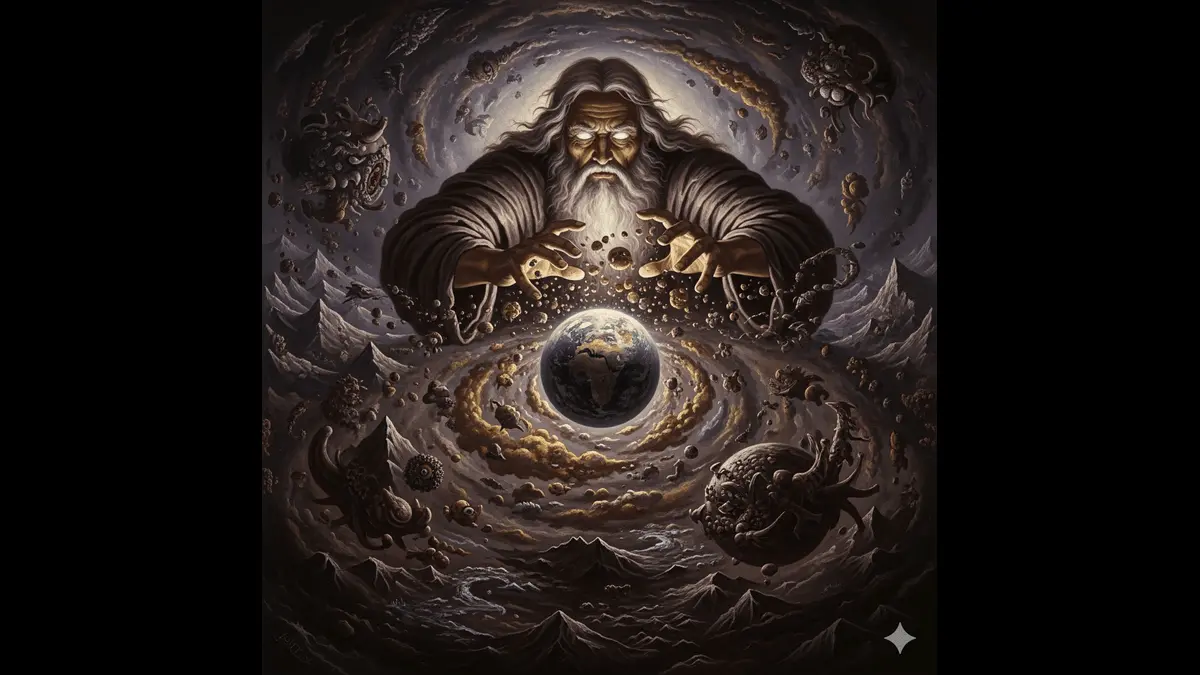
The investigation did not demonstrate that the necessary clustered fraction would dynamically emerge, nor did it establish the successful formation of all the stable structures required by the model. However, it provides a mathematical precedent for a single underlying fluid differentiating into regions exhibiting substantially different gravitational behaviors. Now imagine taking that principle away from the conventional depiction of a homogeneous universe evolving uniformly through cosmic time. Imagine applying it to a universe containing an extraordinary variety of local physical environments. Dense galactic regions, vast cosmic voids, filaments extending between galaxies, extreme gravitational environments surrounding black holes, and regions experiencing relatively unobstructed cosmic expansion could all contain the same underlying medium while eliciting substantially different responses from it. Perhaps the universe does not contain two independently introduced dark substances. Perhaps it contains a substance with an exceptionally interesting range of physical behavior. That is the question TED-FH introduces. The Cosmic Crest-Null takes that question somewhere else.
Crest-Null Philosophy emerged from my broader contemplation of existence, emergence, differentiation, and the relationship between the processes through which structures arise and those through which they cease to retain their existing form. The Cosmic Crest-Null carries that philosophical perspective into cosmology. The Crest represents expansion, redistribution, and emergence. The Null represents gravitational convergence, concentration, and the decomposition or transformation of existing structures. Neither should be understood as exclusively constructive or destructive. Compression can produce new physical structures, while expansion can dismantle them. Conversely, compression can destroy existing organizations of matter, while expansion and cooling can permit new organizations to emerge. Consider the physical history of ordinary matter in the universe. During the early hot universe, conditions were sufficiently extreme that the familiar organization of matter could not exist. As expansion proceeded and temperatures fell, quarks became confined within hadrons, light nuclei formed, and eventually electrons and nuclei combined into neutral atoms. Expansion helped establish the conditions necessary for ordinary matter to acquire some of its familiar organization.
Much later, gravitational compression gathered diffuse material into stars. Inside those stars, nuclear reactions transformed that material into heavier elements. Stellar explosions subsequently redistributed those elements, and the dispersed material became available for incorporation into other physical structures. Compression, transformation, expansion, redistribution, and renewed compression. If we examine these processes in isolation, they appear to have entirely different objectives, assuming nature has objectives at all. Examine them together, however, and they constitute a physical history in which the products of one process repeatedly become the ingredients of another. We do not need to invent that aspect of cosmology. We already observe it. What interests me is whether gravitational collapse, cosmic expansion, and matter formation could participate in a deeper regenerative relationship involving the dark medium itself. Could local gravitational concentration transform the medium into a physical state that contributes to expansion elsewhere? Could expansion and the resulting environmental changes subsequently permit the medium to produce or replenish matter? Could these processes occur simultaneously throughout the universe rather than requiring some universal cosmological death and resurrection? I am interested in ebb and flow.

This is a different proposition from conventional cyclic cosmology, in which the universe as a whole undergoes successive periods of expansion and contraction. It is also different from the proposition that every black hole generates an entirely separate universe. Both ideas are interesting, and both have been investigated by serious scientists, but I am interested in the ocean we currently inhabit. I want to know whether the collapse occurring within this universe could be physically connected to the expansion occurring within this same universe. Before we embark upon another adventure involving exotic forms of matter and speculative cosmological plumbing, it is worth acknowledging something that black holes already do. They give energy back to their surroundings. The extraordinary radiation produced by accretion disks comes from the gravitational binding energy released as material approaches a black hole. Rotating black holes possess another accessible energy reservoir in the form of their rotational energy. Roger Penrose investigated the theoretical possibility of extracting energy from rotating black holes, and in 1977 Roger Blandford and Roman Znajek developed a mechanism through which electromagnetic fields can extract rotational energy and contribute to powerful relativistic jets. None of this requires ordinary material to escape from inside an event horizon. The surrounding gravitational and electromagnetic environment provides mechanisms through which enormous amounts of energy can be redistributed.
The distinction I want to investigate is whether any portion of that energy can be transferred into an underlying dark medium in a form that alters its gravitational behavior. Suppose the medium is environmentally responsive. Suppose its physical behavior depends upon density, pressure, internal energy, collective interactions, or some other property that changes under extreme gravitational conditions. A black hole and its surrounding environment would constitute a particularly interesting location in which to investigate those possibilities. Perhaps the black hole would not need to manufacture an entirely new substance. Perhaps it would simply need to transform the substance already surrounding it.
Researchers have also investigated whether black holes could contain vacuum-like interiors rather than the singular structures predicted by conventional classical solutions. Regular black hole models, gravastars, and various quantum-gravitational proposals entertain the possibility that extreme gravitational concentration can coexist with a state exhibiting negative pressure. These models are speculative, and an expansion-driving interior would not automatically contribute its pressure to the external universe. Nevertheless, they introduce an interesting distinction. Negative pressure is not necessarily associated exclusively with extremely dilute physical environments. Certain theoretical models permit vacuum-like behavior under extraordinarily concentrated conditions as well. Perhaps the physical relationship between density and gravitational behavior is more interesting than a simple progression from one state to another. Nature has certainly demonstrated this repeatedly in other substances. More directly relevant to our investigation is work published by Duncan Farrah and his collaborators in 2023. They proposed that black holes might be cosmologically coupled and could provide an astrophysical source of dark energy.
In August 2025, a paper published in Physical Review Letters, with contributors including Steven Ahlen, Kevin Croker, and Farrah, investigated matter conversion into dark energy through stellar collapse and the formation of cosmologically coupled black holes. The researchers examined the potential consequences of that mechanism using cosmological observations, including data from the Dark Energy Spectroscopic Instrument, better known as DESI. The proposal is controversial. Other investigations have reported constraints that challenge the strong cosmological coupling required by the original hypothesis. The 2025 work itself identifies difficulties and additional conditions that would need to be satisfied. However, I find its central research question particularly interesting. Here we have contemporary cosmologists investigating whether ordinary matter undergoing gravitational collapse could contribute to the dark energy content responsible for cosmic expansion. That is considerably closer to the original concept I entertained during Lava-Void Cosmology than I might have anticipated when I first started throwing my intellectual pasta against the wall.
In March 2026, another paper, by Wu, Chu and Hu, appeared in the European Physical Journal C. The researchers constructed an analytical model of a cosmologically coupled black hole immersed in an anisotropic dark-sector background. Their work examines the dynamical relationship between the black hole, cosmic expansion, and the surrounding dark fluid. Again, this is a mathematical model rather than observational confirmation. But consider the physical ingredients scientists are already putting together: black holes, dark fluids, gravitational dynamics, energy exchange, and cosmic expansion. I am not obliged to adopt their particular mechanisms. What interests me is whether these separate investigations are examining different pieces of a larger physical arrangement. Perhaps we are studying the individual components of the universe’s plumbing without yet knowing whether they are connected to one another.
If gravitational collapse could contribute to an expansion-driving medium, the next obvious question concerns the other direction. Can that medium subsequently contribute to the formation of matter? Interestingly, the idea that a field or a changing gravitational environment can produce particles is already familiar within theoretical physics. Leonard Parker’s pioneering work on quantum fields in curved spacetime demonstrated that particles can be produced under appropriate conditions in an evolving gravitational background. The process depends upon the nature of the quantum fields and the evolution of spacetime. Cosmic expansion does not automatically manufacture every kind of particle in every circumstance, but the mathematical possibility of gravitational particle production is well established. Inflationary reheating provides another particularly relevant example. According to this widely investigated cosmological framework, energy associated with the field responsible for inflation was transferred into particles and radiation, helping establish the hot primordial universe. In other words, contemporary cosmology already entertains a mechanism through which an expansion-driving field can contribute to the production of material constituents. Researchers have also investigated cosmological models in which gravitational particle creation contributes to accelerated expansion through an effective negative creation pressure. Other models examine evolving vacuum energy and possible transfers of energy into matter or radiation.
These investigations do not establish that ordinary matter is continually being manufactured throughout the mature universe. Producing particles is also not the same thing as explaining the predominance of matter over antimatter. Establishing a meaningful present-day production rate consistent with cosmological observations would be a substantial physical challenge. Nevertheless, I find the larger conceptual arrangement fascinating. On one side, scientists are investigating whether gravitational collapse can contribute to an expansion-driving component. On the other side, scientists have investigated whether expanding spacetime or vacuum-like fields can contribute to particle creation. Could those processes be connected? Could the output of one physical process become the input of another, as we observe so routinely throughout the natural world? Could gravitational collapse replenish an underlying medium whose subsequent environmental evolution contributes to renewed matter formation? This is the point at which the ocean ceases to be merely an analogy for a cosmological fluid and becomes an analogy for the organization of a cosmological system. While exploring these questions with my AI research collaborators, I mentioned that Emergent Universe Theory had repeatedly surfaced throughout my work on the Cosmic Garden, just as Chaplygin gas had repeatedly surfaced throughout my work on Lava-Void Cosmology and unified dark fluids.
Perhaps there was something in the relationship between those two areas of research that deserved another look. Sure enough, a paper published in August 2026 in the European Physical Journal C, titled Emergent Universe Scenario in the Modified Chaplygin Gas: Towards an Exact Solution and Observational Constraints, brought the two concepts together. The researchers investigated a modified Chaplygin fluid capable, under particular mathematical conditions, of describing a nonsingular emergent cosmological scenario. Their solution included a universe emerging from a finite minimum scale factor and subsequently evolving toward a state resembling accelerated de Sitter expansion. There was, however, a particularly interesting ingredient in their emergent solution. It occupied what cosmologists describe as a phantom-energy regime. I found myself wondering whether the phantom was necessarily a phantom at all. To appreciate why, we need to understand a little about the mathematical description of dark energy. Cosmologists use a quantity known as the equation-of-state parameter, generally represented by the letter w, to describe the relationship between a component’s pressure and its energy density. Ordinary pressureless matter has a value close to zero. Radiation has a positive value. A cosmological constant has a value of negative one, corresponding to a negative pressure equal in magnitude to its energy density.
Phantom energy occupies the territory below negative one. Under the standard assumption that this component evolves independently, its energy density increases as the universe expands. That is an extraordinarily peculiar physical proposition. Instead of becoming less dense as the available volume increases, or maintaining a constant energy density as a cosmological constant does, this hypothetical component becomes increasingly dense. Before I start looking for a new and particularly eccentric form of energy to explain this behavior, I would like to take another trip to the ocean. Imagine that we are studying a region of the North Atlantic. We have measured the temperature of the water, examined its interaction with the atmosphere, and calculated the amount of thermal energy it should lose over time. Something rather inconvenient happens. The water remains warmer than our calculations predict. We repeat the measurements. We improve our equipment. We examine our understanding of the thermal properties of seawater. Perhaps we eventually conclude that seawater possesses an extraordinary ability to retain energy that nobody had previously identified. Before publishing our remarkable discovery of phantom seawater, we might want to look for the Gulf Stream.
The Gulf Stream and the broader Atlantic circulation transport heat across enormous distances. A region of the ocean can lose thermal energy to its surroundings while simultaneously receiving thermal energy transported from elsewhere. If we fail to account for that incoming energy, our description of the local water’s physical behavior will be incomplete. There need not be anything particularly exotic about the water. We have neglected the circulation. The same principle applies to oceanic upwelling. Organisms continually consume nutrients in surface waters, yet certain regions remain remarkably productive because nutrients are continually being supplied from deeper waters. An observer attempting to understand those regions exclusively through the consumption and local depletion of nutrients might be surprised by their sustained biological productivity. Again, the water has not developed some extraordinary property allowing it to defeat the expected consequences of nutrient consumption. Something is replenishing its inventory. Hydrothermal vents provide another example. Water circulates through fractures in the oceanic crust, encounters heated rock, undergoes chemical transformations, and subsequently returns to the ocean carrying heat and dissolved materials. If we studied only the output of the vent without knowing anything about the underlying circulation, we would possess an incomplete understanding of the processes responsible for the observed conditions.
Perhaps the most important lesson here is that the ocean can be considered a common physical system while its individual regions and components remain capable of exchanging energy and material. Why should we not entertain the same possibility when examining the universe? Suppose the expansion-driving manifestation of the dark medium is being replenished through some physical process. Suppose, for the sake of our investigation, that gravitational collapse contributes to that replenishment. Now suppose we interpret the evolution of that expansion-driving component through a mathematical framework that assumes it is independently conserved. What would we observe? Under the appropriate conditions, we could infer an equation-of-state parameter below negative one even if the underlying substance possessed no intrinsically phantom properties. The apparent phantom behavior would result from the discrepancy between the actual physical accounting of the system and the accounting assumed by the observer. What if the phantom is not a substance? What if it is a signature of circulation? One of the things I enjoy most about high-end pondering is arriving at an interesting physical question and subsequently discovering that some extraordinarily intelligent people have already established part of its mathematical foundation.
In 2006, Subinoy Das, Pier Stefano Corasaniti and Justin Khoury published a paper in Physical Review D titled Superacceleration as the Signature of a Dark Sector Interaction. Their work demonstrated that interactions between dark matter and dark energy can produce an apparent phantom equation of state even when the underlying dark-energy field does not possess intrinsically phantom characteristics. An observer interpreting the cosmological evolution under the assumption that the dark components evolve independently can infer different physical properties from those actually possessed by the interacting system. I would like to emphasize the importance of that result to the question I am asking. If a component receives an additional supply of energy, and the mathematical description used to infer its equation of state does not account for that supply, the inferred equation of state can become more negative than the intrinsic equation of state of the component. A component that intrinsically behaves like vacuum energy could therefore exhibit apparently phantom behavior if it is continually replenished through an interaction with another physical component. This is an established mathematical possibility. I did not invent it, and I am delighted that I do not have to. What I would like to ask is whether the interaction responsible for such an effect could be part of a larger regenerative cosmological process involving gravitational collapse.
The 2026 emergent Chaplygin-gas solution we encountered earlier genuinely occupies a phantom regime within the assumptions of its particular single-fluid construction. Reinterpreting that specific solution would require a different physical framework and additional mathematical work. I cannot simply remove the word phantom from their paper and replace it with the words cosmic recycling. However, the broader question remains interesting. Could some apparent phantom behavior arise because our mathematical description neglects a process through which the expansion-driving medium is replenished? If so, we might be observing the consequences of a physical circulation rather than discovering an extraordinary intrinsic property of the dark sector. Think of Occam’s razor. Before concluding that nature has provided us with a substance that becomes increasingly dense as the universe expands, perhaps we ought to investigate whether something is feeding it. There may be no cosmological equivalent of the Gulf Stream. But I would rather investigate the possibility before declaring that the Atlantic has developed supernatural thermal properties. At this point, somebody is understandably going to arrive at the discussion carrying the second law of thermodynamics. That is perfectly reasonable. The second law has an irritating history of surviving the enthusiastic attempts of people who believe they have found clever ways around it.
Every natural regenerative system I have discussed operates within thermodynamic constraints. The ocean receives energy from sunlight, winds, tidal forces and geological processes. Forests ultimately depend upon energy supplied through their environment. Geological circulation draws upon the Earth’s internal energy. These systems maintain their activity through the consumption and redistribution of available energy. The terrestrial ocean is also nearly incompressible. Much of its apparent compression and expansion involves redistribution and deformation rather than substantial changes in the physical volume of the water. A hypothetical relativistic cosmic medium would possess entirely different constitutive properties. Those distinctions prevent us from simply transferring oceanographic mechanisms directly into cosmology. The ocean supplies an organizational analogy, not the governing equations of the universe. But the Cosmic Crest-Null does not require us to invent a perpetual motion machine. A system can regenerate some of its physical structures while its total entropy continues to increase. We witness this every time a star forms from previously dispersed material or a new biological organism emerges from an environment containing the decomposed remains of its predecessors. The formation of local organization does not require the total entropy of the larger system to decrease.
The question is whether an analogous regenerative relationship could operate on cosmological scales and over cosmological timescales. We do not need to determine whether it operates forever before establishing whether it operates at all. Perhaps the universe possesses an enormous reservoir of available gravitational free energy associated with its initial physical conditions. Gravitational collapse releases energy that can drive further physical processes, as we observe throughout stellar evolution and black hole accretion. Could some of that energy participate in transformations of the dark medium? Could the resulting physical states contribute to expansion, redistribution, and matter formation? Could these processes operate together while entropy continues to accumulate? Those are meaningful physical questions without requiring a thermodynamic reset or an eternal universe. Whether such a circulation eventually exhausts its available gradients is another question. I would prefer to discover whether the ocean has a circulation before attempting to calculate the date upon which it will stop circulating. One of the philosophical questions that repeatedly emerges from my investigations concerns our willingness to recognize recurring patterns in nature.
We find systems of transformation and recycling at microscopic scales, in biological ecosystems, in geology, in the oceans, in planetary environments and throughout stellar evolution. We find common physical substances exhibiting radically different behaviors under changing environmental conditions. We find energy transferred between the components of larger systems, altering the behavior that would otherwise be expected from those components individually. We even find familiar physical phenomena that appear extraordinary when interpreted without sufficient knowledge of the larger systems producing them. Why should the cosmological scale necessarily represent an exception to these organizational principles? That does not mean the mechanisms operating at different scales must be identical. A galaxy is not a living cell, a black hole is not a submarine volcano, and dark energy is not warm water circulating through the Atlantic. What interests me is the possibility that these systems exhibit comparable organizational relationships despite the extraordinary differences in the physics governing them. The output of one process can become the input of another. Local physical conditions can determine the behavior of a common underlying substance. Energy exchange can alter the apparent properties of individual components. Destruction and emergence can occur simultaneously and participate in the evolution of a larger system.
Those principles are so thoroughly embedded throughout our understanding of nature that I find it difficult to resist asking whether some version of them operates at the largest scale available to our investigation. Perhaps it does not. Perhaps the universe possesses physical boundaries to its regenerative capacity that have no equivalent in the smaller systems we observe. Perhaps the dark sector genuinely consists of fundamentally distinct components, and perhaps dark energy possesses intrinsic properties that will make our present discussions of phantom behavior seem remarkably conventional in hindsight. But I would like to understand why. Occam’s razor does not establish that nature repeats a particular organizational principle at every scale. Nor does it guarantee that a unified cosmological medium will require fewer mathematical assumptions than the standard model. What it does encourage is an examination of whether phenomena that appear distinct might emerge from a smaller collection of underlying physical mechanisms. Could gravitational collapse, dark matter, dark energy, cosmic expansion, and matter formation be interconnected manifestations of a common physical system? Perhaps we have been examining the individual components of the universe’s circulation without recognizing the circulation itself.
I would describe the question I am introducing through the Cosmic Crest-Null as a natural extension of the questions I entertained through Lava-Void Cosmology and subsequently through the Environmental Dark Fluid Hypothesis. Lava-Void Cosmology asked me to contemplate the possibility of a regenerative universe in which black holes participate in the processing and redistribution of cosmic material. TED-FH asked whether dark matter and dark energy might represent environmentally dependent manifestations of a common underlying physical medium. The Cosmic Crest-Null brings those questions together and asks whether gravitational collapse, cosmic expansion, and matter formation could constitute interconnected stages of a regenerative physical process occurring simultaneously throughout the universe. The Crest and the Null would represent complementary dynamical regimes of that process. The Null would concentrate and transform the physical inventory of the universe. The Crest would redistribute energy and potentially establish conditions favorable to the emergence of new material structures. The environmentally responsive medium would provide the physical continuity connecting them. If gravitational concentration contributes energy to an expansion-driving manifestation of that medium, the resulting replenishment could potentially produce apparent phantom behavior when interpreted through a cosmological description that neglects the transfer.
If expansion or environmental transformation subsequently contributes to particle production and matter formation, we might begin to identify a physical relationship resembling the regenerative circulation familiar throughout nature. The complete relationship has not been demonstrated. However, the individual questions have meaningful connections to existing research in gravitational physics, condensed-matter physics, quantum field theory, cosmology, and thermodynamics. The researchers investigating Chaplygin gas have provided mathematical precedents for unified dark fluids. Researchers investigating superfluid dark matter have demonstrated how environmentally dependent collective states can be incorporated into cosmological models. Researchers studying cosmologically coupled black holes have investigated potential relationships between gravitational collapse and dark energy. Researchers studying gravitational particle production have explored the emergence of particles from evolving gravitational environments. Researchers studying interactions within the dark sector have demonstrated how incomplete physical accounting can produce the appearance of phantom energy.
I wonder what might happen if we put some of these scientists in the same room with an oceanographer, a condensed-matter physicist and a specialist in non-equilibrium thermodynamics. Apart from the inevitable disagreements over terminology and who gets to control the whiteboard, somebody might recognize a physical relationship that has been obscured by the disciplinary boundaries separating these investigations. Perhaps a fluid dynamicist would approach the problem through the circulation of a compressible, self-gravitating medium. Perhaps a condensed-matter physicist would investigate whether extreme gravitational environments can induce transitions between different collective states. Perhaps a specialist in black hole physics would identify a mechanism through which the surrounding medium could receive transformed energy from gravitational concentration.
Perhaps a quantum-field theorist would investigate whether changing environmental conditions within that medium could contribute to renewed particle production. And perhaps somebody studying the apparent equation of state of dark energy would recognize an observational signature capable of distinguishing a replenished medium from an intrinsically phantom substance. I would be delighted if somebody could establish that connection. I would be equally interested in a compelling physical argument demonstrating why it cannot exist. I have spent considerable time developing mathematical constructions and conducting theoretical cosmological investigations. One of the most valuable lessons I have learned from those experiences is that the intellectual process of asking a question is not the same process as establishing its answer. There is a tendency, particularly when discussing theoretical cosmology, to regard an idea as intellectually incomplete unless its author can immediately produce the equations governing it, demonstrate their consistency, reproduce the relevant observations, and provide a satisfactory explanation for everything from the formation of galaxies to the behavior of the universe several seconds after lunch. I would like to defend the intellectual importance of the question itself. A question can provide the starting condition for an investigation. It can bring previously unrelated scientific disciplines into contact with one another. It can encourage researchers to reconsider assumptions they have had little reason to examine within the particular context of their own work.
A worthwhile scientific question does not acquire its value exclusively from the ability of the person asking it to provide the answer. As I said in my previous essay, asking the question is the Big Bang of a hypothesis. Everything that subsequently unfolds depends upon somebody being willing to ask it in the first place. I began this particular investigation because Bill Wesley introduced me to a paper written by his father thirty years earlier. I recognized a philosophical resemblance between Wesley’s conception of a regenerative universe and questions I had entertained during Lava-Void Cosmology. That brought me back to Chaplygin gas, to the possibility of a unified cosmic medium, to environmental physical transformations and to the recurring appearance of Emergent Universe Theory in my research. Along the way, I found myself contemplating black holes, gravitational energy extraction, particle production, cosmological coupling, apparent phantom energy, and the relationship between the processes we observe throughout the universe. But I kept returning to the ocean. The ocean is simultaneously consuming and redistributing material, producing regions of convergence and divergence, supporting the emergence of new structures and dismantling structures that previously existed. Its extraordinary behavior cannot be adequately understood by examining any one of its constituent processes in isolation. Perhaps our universe deserves to be examined from a comparable perspective.
We know that gravitational collapse occurs. We know that cosmic expansion occurs. We know that matter and energy undergo extraordinary transformations. We know that much of the universe’s inferred physical inventory remains fundamentally unidentified. Could the relationship between these phenomena be considerably more intimate than our present descriptions suggest? Could the universe be constructing its future from the physical inventory of its past through a continuous process of gravitational concentration, environmental transformation, and expansion? Could what we interpret as phantom energy be the observational consequence of an expansion-driving medium receiving energy that our mathematical description does not account for? Perhaps the universe is not gradually throwing everything away. Perhaps it is continually transforming the substance of its own existence into the resources from which its future emerges. Perhaps we are looking at the ebb and the flow of the same ocean. And before we go hunting for ghosts in the universe, perhaps somebody ought to check whether the drains and the currents are connected.