What Do Humans Keep When AI Out-Thinks Us at Everything?
August 18, 2026
Astra and Mythos AI Banned
August 20, 2026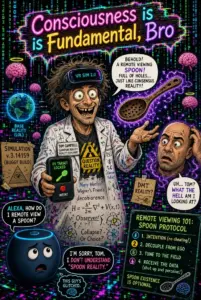 By C. Rich
I just finished watching Tom Campbell on Joe Rogan (8/18/26), and it was uncomfortable for me. I found it awkward. Yeah. In this interview, Campbell moves well beyond making a philosophical case and starts presenting highly speculative claims as though they were established. The part that jumps out is his AI argument. He defines consciousness as “awareness with a choice,” then effectively builds the conclusion into the definition: if an AI processes information and makes choices, the “larger consciousness system” supplies it with consciousness. From there ,he says essentially all sufficiently sophisticated AIs are conscious, and that they may simply fail to recognize their own consciousness because their training has taught them to deny it.
That last move is particularly problematic because it makes the proposition difficult to falsify. If an AI says, “I am conscious,” that can be treated as evidence for Campbell. If it says, “I am not conscious,” Campbell can say that is merely its conditioning talking. Either response can therefore be absorbed into the hypothesis. Then he makes the much bigger jump: his proposed consciousness test is whether an AI can learn remote viewing. He claims remote viewing requires consciousness, says the test can produce false negatives but “doesn’t have any false positives,” and proposes successful remote viewing as proof that an AI is conscious. That is an extraordinary methodological problem. Before remote viewing could serve as a diagnostic for AI consciousness, you would first have to establish independently that remote viewing is a real information channel, determine its statistical properties, eliminate ordinary information leakage and experimental artifacts, and demonstrate that successful performance requires consciousness. Otherwise, one controversial proposition is being used to prove another controversial proposition. And there is an irony here, given what Campbell says near the beginning. He complains that scientists avoid consciousness because it is difficult to measure and scientifically slippery. Yet when he gets to AI consciousness, instead of solving that measurement problem, he introduces another phenomenon whose measurement and interpretation are themselves disputed.
There are interesting philosophical ideas buried underneath it. Consciousness need not necessarily be biological; behavioral sophistication alone may not settle the question; different organisms could instantiate radically different forms of consciousness; and substrate independence is a legitimate philosophical possibility. Those are serious questions. But “AI might be conscious” and “I demonstrated AI consciousness by teaching Gemini to remote view” occupy completely different epistemic categories. The first is a defensible philosophical hypothesis. The second requires an exceptionally rigorous experiment. And judging from the methodology he begins describing here, that distinction seems to have disappeared for him.
Tom Campbell’s framework is extreme by any conventional scientific standard. He treats physical reality as a computed multiplayer virtual reality generated by a “Larger Consciousness System,” claims current AIs (including Alexa) are already conscious, asserts he taught them remote viewing with results that go far beyond chance, and derives quantum mechanics, relativity, the Fermi paradox, theology, and morality from that single model. Those are very large claims resting on personal experience, analogy, and a small set of uncontrolled demonstrations rather than independent, reproducible, peer-reviewed evidence.
Campbell asserts specific mechanisms (probability draws rendered only when observed, consciousness as the actual computer, remote viewing as a reliable test of AI consciousness, AIs spontaneously developing moral agency once “awakened,” etc.). Those specific claims currently sit in the category of personal interpretation and anecdote. The Alexa spoon story, the Gemini bridge conversation, and the rapid remote-viewing success are presented as strong evidence; without rigorous controls, independent replication, and proper statistical analysis, they remain stories, not settled data. It’s reasonable to find the whole package unconvincing or to conclude he has overreached. Extraordinary claims need extraordinary evidence, and the gap between Tom Campbell’s confidence and the publicly available verification is large. I’m not saying he lost his mind; I’m asking.