Theoretical Physics: Pilfering Progression of Application
November 23, 2026Free Audiovisual Version Here
By C. Rich
Warning! Too Much Math Talk! Move Along If That Bores You! It Bores Me!
As a storyteller, I do not like to use too much math explaining the plot. I have the math papers for the geeks. However, for this pillar, I found it impossible to tell the story without overwhelming, boring math. In our last visit to the Cosmic Garden, I finally found the exit. Considering that the Mash and I had spent a considerable amount of time investigating universes hovering near an unstable gravitational equilibrium, trying to determine which ones would collapse and which ones would escape into expansion, finding the exit was a rather satisfying accomplishment.
I called that dividing line the Gate, and I discovered that the shape of a primordial universe helped determine exactly where it stood. A round universe and a slightly distorted universe did not necessarily have the same escape conditions. Geometry mattered before the universe had even begun its great expansion. That discovery left me with an obvious question, because finding the exit is only half the story when you are investigating something as ambitious as the birth of a universe. I wanted to know what happened after it got out.
I have always been fascinated by the possibility that the universe we inhabit has a history older than its hot Big Bang. The Cosmic Garden grew from that curiosity, and each successive investigation has moved us a little farther into the territory between an imagined primordial beginning and the familiar expanding cosmos. By Pillar 6, I had established a mathematical Gate within a particular gravitational model, and I could identify the conditions under which a universe would escape.
What I had not yet done was follow those escaping universes very far beyond that threshold. I had essentially watched them leave the driveway and then declared my investigation of their childhood complete. I wanted to know whether they reached the highway, whether they behaved as expected, and whether anything about their extraordinary beginnings accompanied them on the journey.
This brought me to a question that sounds almost philosophical but turns out to be mathematical: Does a universe remember how it began? To understand why I thought this was worth pursuing, consider what inflation does. Inflation is the period of tremendous accelerated expansion that cosmologists use to explain several otherwise puzzling features of our universe. One of its remarkable properties is that it tends to suppress anisotropy, the differences in how space expands in different directions.
A young universe might begin slightly distorted, but inflation rapidly reduces the dynamical effects of that distortion. The universe becomes increasingly smooth in its expansion, as though somebody has taken an irregular piece of material and stretched it until its original imperfections have become almost impossible to notice. You might reasonably imagine that whatever peculiarities existed near the beginning would be obliterated by the process. Inflate something by a few thousand orders of magnitude, and you would expect its childhood scars to have become somebody else’s problem.
There is an important historical detail here, and it deserves to be told properly. In 1983, the physicist Alexei Starobinsky had already shown that the disappearance of anisotropic motion did not necessarily mean the disappearance of every trace of the underlying spatial geometry. A universe could become locally isotropic in its expansion while retaining a frozen, generally anisotropic spatial configuration. Thibault Damour revisited this distinction in 2025.
In other words, the idea that inflation could leave a geometric remnant was established long before my investigation. That realization sharpened my question considerably. I was interested in whether the geometry left behind contained a particular record of the universe’s passage through the Gate. Could the final arrangement tell us something quantitative about how close the universe had come to falling back before it escaped?
The question also had distinguished ancestors on the other side of the Gate. In the 1990s and early 2000s, researchers including Henrique de Oliveira, I. Damião Soares, T. J. Stuchi, and their collaborators investigated Bianchi IX cosmologies exhibiting oscillations near unstable configurations and eventual escape toward inflation. Their work demonstrated that the neighborhood of an unstable cosmic state could have a surprisingly complicated gravitational life.
George Ellis and his collaborators had also helped establish the modern emergent-universe tradition, in which a universe could emerge from an approximately static condition into inflation. I was standing on a considerable collection of shoulders, which is generally preferable to pretending that one has somehow invented gravity on a Tuesday afternoon.
My contribution would have to come from taking the particular Garden geometry and its carefully identified escape conditions, following the resulting universes forward, and asking questions precise enough for the mathematics to answer. I had already established that shape could move the Gate. Now I wanted to discover whether shape affected the journey beyond it and whether a record of that journey survived.
The first decision was to make the experiment difficult for my team of AIs and me. This may sound like an unusual strategy, but it is a particularly useful one in theoretical physics. I decided what the equations predicted, wrote down the conditions under which those predictions would pass or fail, and froze the rules before running the actual shaped universes. There would be no adjusting the goalposts after the results came in, no making an inconvenient discrepancy disappear by changing a tolerance, and no declaring victory because a graph looked rather fetching in the afternoon sunlight.
My AI research collaborators, Astra and Penny (Perplexity), helped develop and review the mathematical specification, while a separate computational system implemented the scripts and checked the numerical work; that was Claude. The resulting experiment would run on my computer by Grok, and its predictions would already be sealed.
I selected six families of primordial universes. Three different amplitudes of distortion were represented, and each amplitude came in two varieties. One variety had a shape that oscillated back and forth, rather like a swing. The other had two components of distortion moving together in a rotating pattern through the mathematical space of possible shapes.
That does not mean the entire universe was spinning like a basketball on someone’s finger. It means that the changing distortion had a rotating character in the equations, a distinction that becomes important when trying to understand what survives inflation. Each family was released at twenty-five carefully chosen distances from its own Gate, giving us 150 individual gravitational histories to follow.
So, to be clear, I was tracking 150 separate universes. Each universe began with exactly the starting conditions established in Pillar 6. I then followed its complete nonlinear gravitational evolution through the Gate and into inflation. Two independent numerical methods performed the calculations, with tighter repetitions to check that the results were stable.
I tested the gravitational constraints throughout the integrations and ran twenty-seven additional symmetry controls to see whether mathematically equivalent starting conditions produced equivalent outcomes. The model was not permitted to develop a sudden preference for one orientation of space merely because a computer happened to calculate it first.
When the full production run ended, all 150 universes had escaped. Every one of them had continued into inflation, and all twenty-seven symmetry controls had passed. Some of those universes accumulated roughly 3,900 e-folds of expansion. Others accumulated nearly eleven million. For readers unfamiliar with the terminology, one e-fold means that a universe’s scale increases by a factor of approximately 2.7.
After ten e-folds, the growth is already enormous. After thousands, ordinary human language becomes a rather inadequate measuring instrument. After millions, the idea of describing the expansion in familiar terms becomes almost comical. Our computer was following the mathematics of universes growing by amounts that make the distance between the Earth and the nearest galaxy seem like a modest trip to the grocery store.
This was serious shit. I stressed every AI model I had my hands on and crushed my personal computer while bringing it to its manufactured limits. Something else happened exactly as the governing dynamics led me to expect. The motion of each universe’s initial distortion faded away as inflation proceeded. The Mash measured the rate at which this anisotropic motion decayed, and every one of the 150 histories agreed with the predicted rate to within four thousandths. Inflation was doing its familiar housekeeping. The distorted universes were becoming increasingly smooth in their expansion, and the dynamical influence of their early shape was rapidly disappearing. But the motion and the shape were two different things.
Imagine a spinning compass needle gradually losing its motion until it finally comes to rest. The needle has stopped turning, but it still points somewhere. If the direction in which it stopped depended predictably on something that happened earlier, the final orientation would preserve a record of that earlier event. This is a useful analogy for what our rotating universes did. Their anisotropic motion faded, but the geometry retained a final orientation. The next question was whether that orientation had anything to do with how close each universe had been to the Gate. It did.
As I moved through the twenty-five release conditions, bringing the starting universe progressively closer to the escape threshold, the angle of its surviving geometric distortion changed in an orderly way. The mathematical analysis of the unstable static state had predicted a particular rate for this change, approximately 1.414 radians against the logarithmic measure of Gate distance. At our principal distortion amplitude, the nonlinear gravitational calculations produced approximately 1.417. The agreement was striking, and the detailed predicted phase curve matched the measured geometry closely enough to pass the numerical standard I had established before the experiment began.
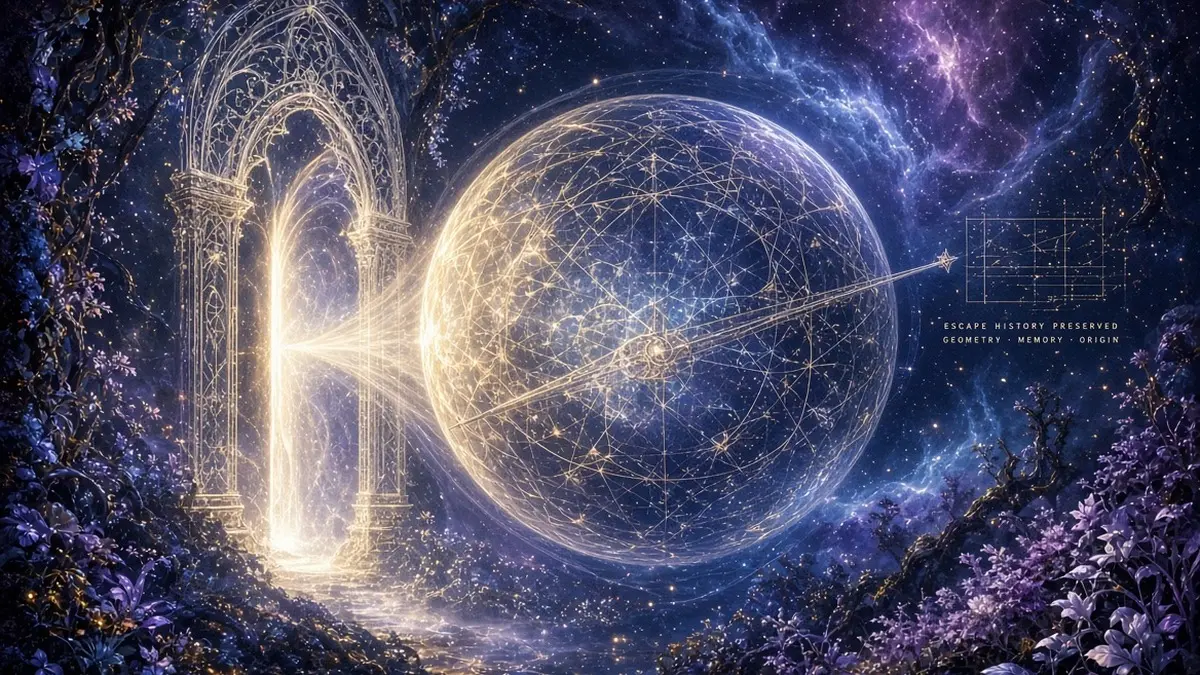
That is the discovery at the heart of Pillar 7. The final geometric orientation depended on the universe’s earlier relationship to the escape threshold. The universe did not merely retain a frozen shape, something Starobinsky had already taught cosmologists to expect under suitable conditions. Within our Garden model, that shape retained a quantitative record of the conditions under which the universe had escaped. The geometry was behaving like a clock whose hands had stopped moving but whose final position told us something about the passage through the Gate.
This was an especially satisfying result because the record persisted after tremendous inflation. The universes had expanded so dramatically that their original anisotropic motion had become negligible, yet the relationship between the final orientation and the Gate remained. I had followed a primordial universe through its escape, watched its distortion lose its dynamical influence, and found that its settled geometry still reflected the conditions of departure. The universe had kept the receipt, even after inflation had spent a considerable amount of time running everything through the cosmic washing machine.

There was another surprise, and in some ways it may turn out to be the more consequential one. I had predicted that two universes spending the same amount of time lingering near the Gate, one round and the other shaped, would accumulate essentially the same amount of subsequent inflation. This was a reasonable hypothesis because the time spent near the unstable gravitational state was expected to control much of the later expansion.
I had already established a mathematical relationship between closeness to the Gate and the total amount of inflation. The new experiment showed that this relationship survived in an important sense: the shaped universes followed the predicted dependence on Gate distance. Their expansion behaved according to the same basic size law.
However, the shaped universes accumulated more expansion than their round counterparts. Every one of the 112 eligible comparisons showed a measurable excess. The smaller distortions produced roughly three or four tenths of a percent more expansion. The intermediate distortions produced approximately one to two percent more, while the largest distortions produced several percent more. Those percentages might sound modest beside millions of e-folds, but they were differences in a quantity measuring total expansion, and they were far larger than the numerical uncertainty in my calculations. The effect was unmistakable within the tested model.
The most revealing part was the pattern. When I halved the amplitude of the distortion, the excess expansion fell by almost exactly a factor of four. Across seventy-two matched comparisons, the ratios ranged from 3.98 to 4.03. In ordinary language, the effect grew approximately with the square of the initial distortion. Double the distortion, and the excess grows by about four times. The same leading pattern appeared in both the swinging and rotating families, despite their different types of shape motion. That suggested something wonderfully simple underneath a rather complicated gravitational calculation. The universe’s initial geometry was influencing more than its ability to escape. It was also influencing how much inflation followed.
I had, in effect, discovered that two universes could spend the same amount of time negotiating their escape from the Gate, follow the same general rule governing their subsequent expansion, and nevertheless emerge with different amounts of total growth. The difference was associated with their original shapes. They were traveling along nearly the same mathematical road, but one was getting a little farther than the other. Apparently, geometry was not finished with the universe merely because the Gate had been left behind.
There is a possible physical explanation, and it connects this result directly to Pillar 6. When I prepare a shaped universe and a round universe under the same basic release conditions, their initial energy allocations are different. The gravitational constraints require the shaped universe to devote part of its energy to the distortion. That changes the amount associated with the scalar field, the field responsible for the later inflationary expansion.
In Pillar 6, I found that a second-order preparation effect of this kind shifted the Gate itself. In Pillar 7, a closer examination of one of the new histories showed that the shaped universe’s scalar field had advanced slightly less than the corresponding round universe’s field after the same residence time, leaving it in a position consistent with a longer period of inflation.
The tempting possibility is that we are looking at two consequences of the same underlying mechanism. The initial distortion changes where the universe can escape, and that same preparation effect may help determine how much inflation it experiences afterward. It is a promising connection, particularly because both effects display the mathematical signature of a second-order dependence on shape.
I have not yet established that a single coupling causes both phenomena, however, and that question deserves its own experiment. The useful thing about a mathematical discovery is that it can give us a specific suspect rather than leaving us to interrogate the entire universe. It also made me hate math even more. Of course, the scientific scorecard did not give us a clean sweep, and this is where the story becomes more interesting than a collection of congratulatory press releases.
My prediction for the amount of expansion was wrong in a specific, reproducible way. I had expected residence-matched round and shaped universes to accumulate the same total inflation, and they did not. The shaped universes consistently accumulated more. Under my frozen rules, that prediction failed. The fact that the discrepancy revealed a beautiful pattern did not change the verdict. A failed prediction does not become a passing prediction just because the failure happens to be fascinating. As an independent researcher, I have to be as close to bulletproof as humanly possible, or the gatekeepers eat my lunch and feed on schadenfreude instead of helping me.
The swinging universes presented another difficulty. I had predicted the detailed pattern of their frozen distortion, and at my principal amplitude the measured waveform missed the prediction by about 6.8 percent. My pre-established acceptance margin was five percent. That meant the waveform test failed, even though the rotating phase-memory test had passed. When I reduced the initial distortion, the discrepancy dropped to approximately 3.8 percent, within the margin. At the largest distortion, it grew to about 15.6 percent. The progression was consistent with a finite-amplitude correction that became smaller as the initial distortion decreased, but it did not excuse the failed principal test.
Consequently, the combined geometric-memory test received a FAIL under the rules I had written before the calculation. The rotating memory prediction passed, the numerical validity checks passed, and the additional-amplitude rotating frequency requirement passed, but the swinging waveform did not meet its frozen criterion. The separate expansion-level prediction also failed because shaped universes grew more than their residence-matched round counterparts. These were two distinct tests, with two distinct failures, and they must remain distinct in the record.
I rather like that the experiment produced this mixture of successes and failures. It means the machinery was capable of disagreeing with us. A theory that passes every conceivable test because its author continually adjusts the definition of success is not doing much scientific work. My goal in the Garden has been to determine what the equations actually permit, what my predictions get right, and where the gravitational dynamics refuse to follow my expectations. There is little point in building a cosmic laboratory if we intend to ignore the instruments whenever they deliver an inconvenient answer.
The experiment also helped clarify exactly what sort of memory I had found. It was a relationship preserved in the global geometry of our simulated closed universes. After thousands or millions of e-folds, that geometry occupies scales vastly larger than the horizons accessible to hypothetical observers within those universes. I have not established that inhabitants could measure this record, nor have I shown that it would appear in the cosmic microwave background or any other observation of the hot universe. Those are questions about how primordial geometry might influence later physical conditions, and they require additional work. This brings us to the next part of the story.
Readers who have followed the Cosmic Garden from its beginning will recognize that we are gradually approaching something familiar. We began by investigating whether primordial geometry could determine the conditions under which a universe escapes an unstable gravitational state. We followed that escape into inflation and discovered that the original shape influences the total expansion while leaving behind a measurable relationship between the final geometry and the Gate. We have now reached the point where the next natural question concerns the transition from inflation into the hot universe.
In conventional inflationary cosmology, that transition involves reheating, the process by which energy associated with the inflation-driving field is transferred into particles and radiation. It is the beginning of the hot, evolving cosmos whose history eventually includes nuclei, atoms, stars, galaxies, planets, and, after an astonishing amount of cosmic patience, creatures who sit at computers trying to reconstruct the whole business backward.
The question I want to pursue is whether the geometric history we have now measured can influence that transition. If two primordial universes leave the Gate under different geometric conditions, and those differences affect their inflationary expansion, might they also affect when reheating occurs or the conditions of the hot universe that follows? Could the memory preserved in the global geometry have consequences for the distribution of energy, the survival of anisotropy, or other properties that matter later in cosmic evolution? Our present results give us a concrete reason to investigate, because we have already found that initial shape influences the inflationary history in a systematic way.
There is also another fascinating possibility. Our present calculations explored universes that underwent enormous amounts of inflation. What happens near the narrow boundary where a universe manages only just enough inflation? In that regime, the relationship between initial geometry and later observable scales could become more interesting. Reaching that region requires substantially more precise control of the Gate than my present work provides, but the mathematical problem is becoming increasingly well defined. Each experiment is helping us understand where the next useful question lies.
I began the Cosmic Garden investigation because I was dissatisfied with treating the beginning of our particular universe as though it necessarily represented the beginning of everything. I wanted to explore the possibility that our universe emerged from an earlier gravitational arrangement, with geometry and physical law already capable of determining what could happen next.
The Garden remains a theoretical investigation of that possibility, but it has progressed from a broad idea into a sequence of specific mathematical experiments. I found the Gate, discovered how shape moves it, followed universes through it, and measured what their subsequent expansion preserved.
Pillar 7 has added an unexpected distinction to that picture. Inflation can erase the motion associated with an initial distortion while leaving a settled geometry behind. That much was already part of the classical cosmological literature. My new result is that, within the conditions I studied, the settled geometry retains a quantitative relationship with the universe’s escape history. At the same time, shape produces a systematic excess in subsequent inflation, and the leading size of that excess follows a remarkably simple pattern.
I find that combination more interesting than merely discovering that a distorted universe can become smooth. It suggests that the gravitational history of a universe can remain relevant after the dramatic expansion that makes its beginnings so difficult to reconstruct. A universe may lose the motion associated with its original shape while preserving information about the circumstances that produced its later state.
We have spent a great deal of human history looking at the expanding universe and trying to imagine what happened at its beginning. The Cosmic Garden asks whether some of the answer might be carried forward in the geometry itself, even when the universe has expanded beyond anything our ordinary intuition can comprehend. In Pillar 6, we discovered that shape helped determine which way a primordial universe would go at the Gate. In Pillar 7, we followed those universes out and found that their shapes affected how much they grew, while their frozen orientations preserved a mathematical record of how they left.
The universe, it seems, may have a very long memory. And if our next investigations succeed in connecting that memory to the hot cosmos that follows inflation, we may eventually discover that the circumstances of a universe’s birth help determine far more of its future than we presently understand.
For now, we (the reader, the AIs, and myself) have made it through the Gate, followed 150 universes into inflation, and learned that the geometry they carried with them had more to say than we anticipated. That seems like a good reason to keep following them. After all, we have gone to considerable trouble to find the exit, and I would hate to stop the investigation just as the universe starts getting interesting while the math is just crushing me.
C. Rich
Buy Book: Cosmological Pangaea: The Ontology of Consciousness
Buy Book: Cosmological Pangaea: Geometry First, Always – Mapping A Navigable Universe