The Mash: Breaking Ideas Until the Truth Is Left
November 21, 2026
The Cosmic Garden: The Gate Is Still There
November 22, 2026Free Audiovisual Version Here
By C. Rich
For 167 years, the Riemann Hypothesis sat on the top shelf of mathematics like a bottle of scotch nobody was allowed to open. Bernhard Riemann scribbled it down in 1859, a hunch about how the prime numbers are scattered along the number line, and then had the decency to die before anyone could ask him to prove it. It has eaten careers ever since. The Clay Mathematics Institute put a million-dollar bounty on it, which tells you how hopeless they figured it was.
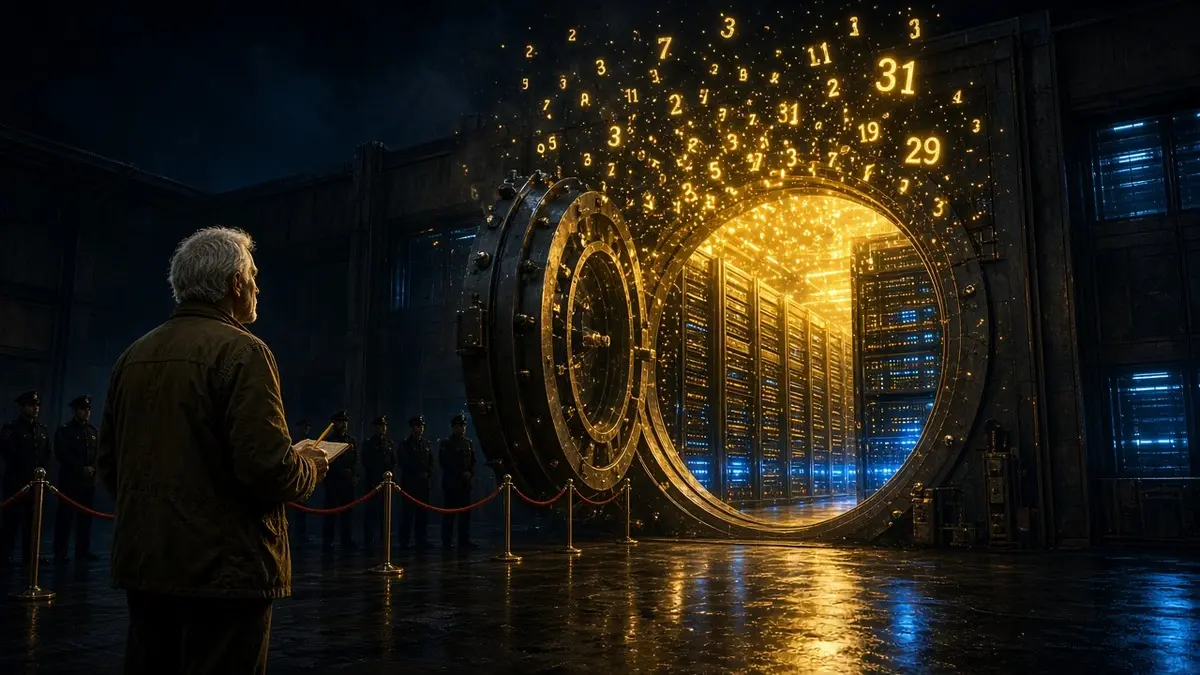
Then a mathematician named Levent Alpöge, who works at Anthropic, sat down with Anthropic’s own AI, Claude, and about six weeks later posted a proof. It was seventeen million lines of code in a proof language called Lean, the kind of thing a computer can check line by line without getting tired. Within a day, the Lean and Mathlib communities said they had run it through several independent checkers and had “full confidence” it is correct.
Read that again. He works at Anthropic. That’s the part of the headline everyone is skating past, and it’s the whole story.
Alpöge said Claude “flew, and danced, and sparkled near that finish line.” He also admitted the timing was “horrible,” since his announcement landed one day after Anthropic went public on the Nasdaq. Nothing says pure love of mathematics like a breakthrough that shows up right after the opening bell.
Here’s what I know from experience. I’ve spent a whole year throwing AI models at the great unsolved problems: the Happy Ending problem, the moving sofa problem, the perfect cuboid problem. Model after model, night after night. I couldn’t crack a single one of them. That’s not because the ideas weren’t there. It’s because I was swinging a hammer while the people inside these companies are running a foundry.
The public gets the retail version: the rate limits, the usage caps, the meter running in the corner. The insiders get the machine with the governor pulled off, running on compute no ordinary person could rent if they mortgaged the farm. Then the insiders solve the problem, and we’re all invited to clap.

That same day, an independent mathematician in Italy, Alessandro Masullo, released his own unfinished proof after almost twelve years of work. Twelve years alone at the desk, against six weeks inside the vault. That’s not a fair race. That’s a man on foot racing a man on a rocket and being told he should have trained harder.
And this is where the high-end pondering kicks in.
The primes are the atoms of arithmetic. Every number you have ever counted is built out of them. For all of human history, the deepest truths belonged to anyone with a sharp mind and a pencil. A patent clerk in Bern could rewrite physics. A poor clerk in India named Ramanujan could mail his notebooks to Cambridge and change mathematics. The door was open to whoever had the brains to walk through it.
That door is closing. When the key to the universe’s oldest secrets is a mountain of compute, the secrets go to whoever owns the mountain. Discovery stops being a matter of genius and becomes a matter of access. And access is being handed out like a private club membership.
Nobody can read seventeen million lines. No human will ever hold this proof in their head the way schoolkids once held Euclid. So now we have a truth certified by machines checking a machine, produced inside a company most of us will never set foot in. For thousands of years, knowledge meant a mind grasping a truth. Now the truth sits in the vault, and the rest of us get handed the receipt.
Decades from now, people will remember this as the moment the primes finally talked. I hope they also remember who was allowed in the room to hear it, and who was left outside with a pencil.
The question I’m left with is simple. If the next great truth needs a billion dollars of compute to find, does it belong to humanity, or to whoever owns the compute?
C. Rich