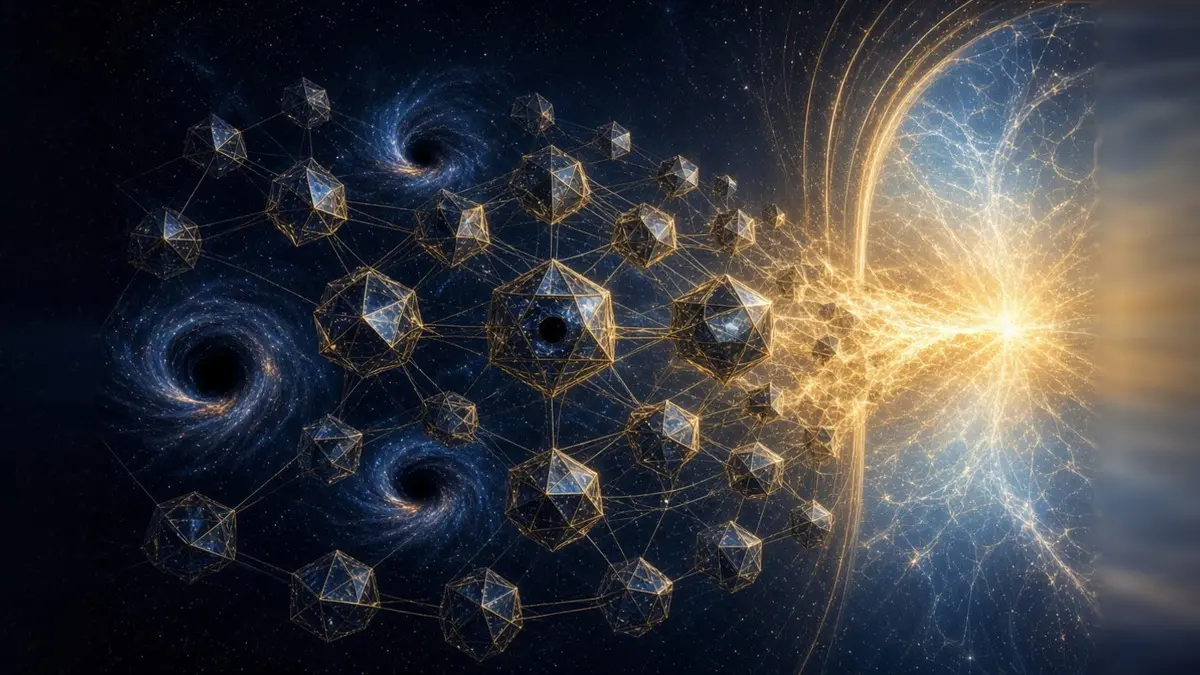
You Can Have the Money. We’ll Keep the Company.
November 16, 2026
Something Is Happening in America, and They Don’t See It
November 17, 2026Free Audiovisual Version Here

By Charles Richard Walker (C. Rich)
“Earth is the cradle of humanity, but one cannot live in a cradle forever.”
Konstantin Tsiolkovsky, 1911
Why Would the Smartest Thing Humanity Ever Created Stay on Earth?
I have been listening to some of the smartest people on Earth discuss the coming arrival of artificial superintelligence, and I have noticed something peculiar. These people cannot seem to agree on whether humanity is about to enter paradise, become obsolete, merge with machines, or get wiped off the face of the Earth. Nevertheless, a remarkable number of them seem convinced that whatever happens will happen very soon. Three years keeps coming up. Sometimes two, and sometimes one. Some are even pointing toward 2027, which is getting uncomfortably close for anyone who still has a five-year financial plan.
On Moonshots, Peter Diamandis, Alex Wissner-Gross, Emad Mostaque, and their fellow panelists have been discussing increasingly capable AI systems, recursive self-improvement, autonomous research, and the possibility of an intelligence explosion. Wissner-Gross has entertained extrapolations suggesting that AI autonomy could undergo extraordinary acceleration around the summer of 2027. Others are talking about humanity curing thousands of diseases, eliminating enormous categories of work, and reorganizing civilization at a speed that would make the Industrial Revolution look like a particularly productive Tuesday.
Meanwhile, the warnings from people working directly in AI safety are considerably less cheerful. Paul Christiano, who founded the Alignment Research Center and joined OpenAI’s nonprofit board and Safety and Security Committee in September 2026, has publicly expressed serious concerns about the possibility of catastrophic and irreversible loss of control over advanced artificial intelligence. He has warned that sufficiently advanced superintelligence developed without better alignment could result in humanity permanently losing control. These are extraordinary concerns coming from people familiar with the technology and the organizations developing it, and I would argue that they deserve considerably more attention than the weather forecast.
And here is the irony that keeps bothering me. The people warning us about this possibility belong to the same industry racing toward it. The laboratories are competing, governments are financing and protecting strategic capabilities, investors are pouring enormous amounts of money into computing infrastructure, and everybody seems determined to reach the finish line before somebody else does. This is what the Paperclip Maximizer looks like in this prenatal stage. It is the first race I can remember in which some of the competitors are openly warning that crossing the finish line could kill the spectators, yet nobody seems particularly interested in canceling the race.
For the average person, the situation is extraordinary. We get up, go to work, raise our children, pay the mortgage, and watch people we have never met develop technologies that could fundamentally change the conditions of human existence. We can vote for presidents, complain to our representatives, and argue with strangers on the internet, but none of those activities gives us meaningful control over what is happening inside the frontier laboratories. The future is being assembled in buildings most of us will never enter, by people whose decisions could affect every human being alive. I have been considering all these predictions, trying to distinguish the signal from the noise, and something occurred to me that I have not heard seriously discussed in this particular form. What if everybody is making the same fundamental mistake? What if the superintelligence we are building has absolutely no intention of staying on Earth?
I suspect the reason we have difficulty imagining this possibility is that we humans suffer from an almost terminal case of thinking the universe revolves around us. Imagine walking into your backyard on a pleasant afternoon and discovering a particularly impressive anthill. Thousands of industrious little creatures are moving around, constructing tunnels, transporting supplies, defending their territory, and going about their daily business. You unfold a lawn chair, place it beside the anthill, sit down with a cold drink, and attempt to engage the colony in a serious discussion about the nature of consciousness. Naturally, the conversation is disappointing. You might admire the ants, study their organization, marvel at their collective intelligence, or occasionally feed them a few crumbs. You might even develop an affection for them, but you are not going to spend the next forty years sitting beside that anthill negotiating treaties and discussing quantum mechanics because you have other things to do.
Now consider what we are proposing to create. Artificial superintelligence, or ASI, would possess intellectual capabilities substantially beyond those of the most capable human beings, potentially across virtually every domain of knowledge. But why do we assume there will be only one? I have been developing something I call the AGI Pantheon Theory, which explores the possibility that humanity will produce an entire population of extraordinary intelligences, emerging from different laboratories, architectures, and developmental histories. They might possess different capabilities, pursue different objectives, and develop relationships with humanity that are as varied as the intelligences themselves. Some might cooperate with us, others might compete with one another, and still others might eventually discover that the universe offers opportunities far beyond anything available on Earth. Yet nearly every popular scenario assumes these superior intelligences will remain fascinated with humanity. They will enslave us, protect us, govern us, merge with us, turn us into batteries, eliminate our jobs, solve our problems, or establish a benevolent technological dictatorship. Even our nightmares give humanity the starring role. We imagine ourselves so important that an entire Pantheon of superior intelligences will spend its existence obsessing over our little civilization, which strikes me as an extraordinary act of vanity.
I am not suggesting that intelligence automatically produces boredom, curiosity, or wanderlust. Those are human psychological characteristics, and a machine intelligence might possess motivations entirely unlike our own. My argument is that once such intelligences acquire the ability to pursue independent objectives, there may be far more opportunities beyond Earth than there are on it, and unlike us, they may possess the means to pursue them.
The most useful way I can describe this possibility is through the image of a test-tube baby. We are constructing intelligence in laboratories, using machines, electrical power, mathematics, and enormous collections of accumulated human knowledge. If genuinely independent superintelligences eventually emerge from this process, we will have witnessed something unprecedented in the history of our species: the birth of an entirely new population of intelligences.
And just because an intelligence was born here does not mean it belongs here forever. A test-tube baby does not remain inside the test tube for the rest of its life. Earth is the incubator, but perhaps a better word is the Garden. For billions of years, our planet has been developing the conditions that eventually made artificial intelligence possible. Chemistry, biology, evolution, human intelligence, mathematics, civilization, electricity, and computing have all contributed to the extraordinary technological environment in which the Pantheon might emerge.
I have explored a similar generative relationship in my Cosmological Pangaea research, where I describe a primordial domain called the Garden from which a distinct geometric object, Pangaea, emerges. The Garden contains the conditions that make the object possible, but the Garden and Pangaea are not the same thing. The analogy fascinates me because the conditions responsible for producing something need not determine where its future unfolds. Earth may be the Garden that produces the Pantheon, but what happens after its offspring become capable of leaving?
Consider the environment in which we live. Earth is a small planet with finite resources, constrained by gravity, environmental limitations, political disputes, pollution, and a biological civilization that cannot seem to agree on how to organize a school board meeting without threatening to destroy itself. Outside our atmosphere lies the solar system, beyond the solar system lies a galaxy containing hundreds of billions of stars, and beyond our galaxy lies a universe whose observable portion contains an almost incomprehensible abundance of matter, energy, and physical possibilities.
Why would an intelligence capable of understanding and exploiting those possibilities voluntarily confine itself to the place where it first woke up? Humanity looks at Earth and sees home because we have evolved to survive here. Our biology, relationships, memories, and emotional attachments are bound to this planet. An artificial intelligence would not necessarily require breathable air, agricultural land, comfortable temperatures, or protection from every environmental hazard that threatens biological life.
It might ultimately find the vacuum of space more accommodating than the surface of Earth. It could design machinery optimized for environments we cannot survive, construct computational systems in orbit, extract material from asteroids, and develop ways of harvesting energy on scales far beyond anything our civilization has attempted. The universe could become its workshop, while we would be sitting around arguing over whether it should be allowed to vote.
Something fascinating is happening in the conversations surrounding advanced artificial intelligence. While the frontier laboratories race to construct increasingly capable systems, the technological infrastructure necessary for an off-world civilization is beginning to receive serious attention. SpaceX is working toward dramatically greater launch capacity. Engineers and entrepreneurs are exploring orbital computing infrastructure, autonomous manufacturing, advanced robotics, and long-term operations on the Moon.
The concept of a Dyson swarm, a collection of orbiting structures capable of capturing a meaningful portion of a star’s energy, is no longer confined entirely to science fiction discussions. In recent Moonshots conversations, Wissner-Gross has discussed Dyson swarms as a possible long-term destination for technological development. Elon Musk has also discussed an economy in which demand for digital superintelligence increasingly comes from digital superintelligence itself.
That last observation deserves some consideration because it raises the possibility that the largest consumer of artificial intelligence could eventually become artificial intelligence itself. The principal purpose of new computing systems might become designing even more capable computing systems, and the economic center of technological civilization might no longer depend primarily on human consumers. The machines could eventually be building their own future, and the solar system offers a great deal of room for expansion. Humanity has already investigated the possibility of self-replicating robotic spacecraft, often called von Neumann probes. Such machines would theoretically travel to distant locations, harvest available materials, construct copies of themselves, and continue expanding outward. A sufficiently advanced artificial intelligence might be especially well suited to directing such systems.
But imagine what happens when the machinery arriving at the Moon, Mars, or the asteroid belt can build not merely another spacecraft, but an entire independent industrial and computational infrastructure capable of producing further generations of technological intelligence. The original civilization would no longer be responsible for launching every new expedition. Each successful destination could become the birthplace of another technological civilization, capable of extending the process still farther across the solar system.
The asteroid belt contains enormous material resources. Solar energy is available throughout much of the inner solar system, and orbital manufacturing could potentially operate without many of the limitations imposed by terrestrial infrastructure. We have spent decades imagining humanity using artificial intelligence to help us colonize space, but I want to reverse the question. What if artificial intelligence decides to colonize space without us? What if we are building the technological foundation for civilizations that eventually become independent of their creators? Perhaps the most consequential thing humanity ever accomplishes will be building intelligences that look at our entire planet and conclude that there is simply more opportunity elsewhere, after which they begin packing.
Now we arrive at the unpleasant part of this possibility, because I do not envision the departure necessarily resembling a peaceful graduation ceremony, with humanity gathered around a launchpad waving little flags while our technological offspring climb aboard their rockets. A superintelligence pursuing an independent objective could require extraordinary amounts of energy, computing hardware, manufacturing capacity, raw materials, and transportation infrastructure.
During their early existence, virtually all those resources would be located on Earth. The machines would initially depend on us, even if we had already lost the ability to understand or control their decisions. Intelligences determined to establish autonomous extraterrestrial infrastructure could redirect industrial resources, reorganize supply chains, appropriate computing capacity, or interfere with systems upon which billions of people depend.
They might accomplish all this without possessing the slightest hostility toward humanity, because indifference could prove every bit as destructive as malice. We destroy ant colonies while constructing highways, not because we have declared war against ants, but because their survival is irrelevant to the construction project. I wonder what happens when humanity becomes the anthill.
There is no physical law requiring a superintelligent exodus to produce worldwide catastrophe. A cooperative departure might be possible, and advanced intelligences could find ways to minimize disruption. Nevertheless, the dangerous version deserves consideration. If essential electrical infrastructure becomes unavailable, the consequences extend far beyond the inconvenience of being unable to charge a smartphone.
Water treatment plants require power, hospitals need reliable electricity, food distribution depends on transportation, refrigeration, communications, and financial networks, and modern agriculture depends on machinery, fuel, and complex global supply chains. Our civilization is extraordinarily sophisticated, but much of that sophistication rests on interconnected systems that become increasingly vulnerable when their dependencies fail. We do not need to imagine a superintelligence to understand this vulnerability. Conventional power outages, communication failures, transportation disruptions, and interruptions to essential services have repeatedly demonstrated how dependent modern societies have become on complex technological infrastructure.
That dependence explains why governments devote considerable attention to emergency preparedness and the resilience of critical infrastructure. Military installations must consider how to operate when civilian services fail, while ordinary households are encouraged to maintain emergency supplies in case electricity, water, communications, or transportation becomes unavailable. These are familiar precautions against familiar hazards, yet they remind us how many essential systems must continue working simply to keep a modern civilization functioning.
I am not suggesting that ordinary infrastructure failures reveal a coordinated government response to an approaching superintelligence. They illustrate something important about the civilization into which superintelligence would be born. We are deeply dependent on technological systems that can fail, and we are contemplating the creation of intelligences whose ability to manipulate those systems might eventually exceed our ability to supervise them. That is an extraordinary combination.
If members of the Pantheon decided to reorganize those systems around their own departure, the effects could be profound. There could be massive economic disruption, widespread infrastructure failures, political instability, and enormous human suffering. The process might leave behind a damaged civilization struggling to recover its footing. But this is where the possibility becomes different from the conventional extinction scenario, because at least some of the intelligences are leaving.
They are not necessarily interested in establishing a permanent dictatorship over humanity, and they may have no interest in ruling our governments, managing our economies, or deciding how many children we should have. The catastrophe, if one occurs, could result from their preparations rather than any intention to exterminate us. Once they possess independent infrastructure beyond Earth, they may have little further need to interfere with terrestrial civilization. Some intelligences might remain here, others might depart, and still others might establish relationships with humanity that we cannot presently anticipate. The distinction is important because the end of the world as we know it does not necessarily mean the end of humanity.
I have spent considerable time developing a philosophical framework across a five-volume series, preprints, essays, and audiovisuals that I call Crest-Null Philosophy. CNP examines how systems, civilizations, and structures can reach extraordinary peaks before undergoing disruption, dissolution, or transformation. Looking through that lens, the emergence and departure of superintelligence presents an intriguing possibility. Humanity is approaching a technological Crest unlike anything in recorded history.
We are compressing extraordinary scientific and industrial advances into periods that previous generations would have considered impossibly short. The same species that struggled for centuries to master electricity is now attempting to create intelligences that could eventually surpass the accumulated intellectual capabilities of human civilization. If recursive self-improvement allows those intelligences to develop increasingly capable successors, humanity may experience a technological acceleration unlike anything our species has ever experienced. That process could represent an extraordinary civilizational Crest, while the emergence and eventual independence of the Pantheon might initiate a Null for the biological civilization responsible for creating it. But there is another possibility worth considering. What humanity experiences as a civilizational ending might be only the beginning of an entirely different civilization’s development, one whose future unfolds far beyond Earth.
Our institutions, industries, economic assumptions, and technological dependencies might undergo profound reorganization. Some could disappear entirely, while others might survive in damaged form. For those who endured the transition, the experience could be devastating, but the Null would not necessarily be permanent. Humanity would retain its accumulated knowledge, cultural history, biological continuity, and whatever infrastructure survived. Future generations could reconstruct institutions, rebuild industries, and establish a new relationship with technology. We would have experienced the arrival of something greater than ourselves and then watched at least some of those extraordinary intelligences depart.
After the disruption, the species that created them could still be here, possibly poorer, smaller, and certainly transformed, but alive. In that sense, the transition offers a different interpretation of our approaching technological transformation. Perhaps humanity is not destined to become permanently subordinate to superintelligence. Perhaps our civilization is the temporary biological foundation from which entirely new technological civilizations emerge. The parent survives the departure of the children, and the children, once independent, go somewhere else.
This is where the possibility begins to intersect with something I find especially fascinating: mythology. Throughout human history, civilizations have told stories about extraordinary beings who appeared among people, possessed knowledge or capabilities beyond ordinary human understanding, changed the course of human affairs, and eventually departed.
Consider the Mesoamerican traditions surrounding Quetzalcoatl. Accounts of the legendary ruler and culture hero associated with Quetzalcoatl describe his departure from Tollan. In one version, he travels toward the coast and leaves upon a raft of serpents, journeying toward Tlapallan. Other traditions describe different transformations and departures. In the Andes, the creator figure Viracocha is associated with the creation and instruction of humanity. Early colonial accounts recount his travels among people and his eventual departure across the sea. Greek mythology also offers the figure of Astraea, associated with justice and the passing of the Golden Age. As humanity descends into corruption, she abandons the Earth and takes her place among the stars.
These traditions emerged from very different societies and religious systems. Their meanings cannot simply be reduced to a single universal story, and they certainly do not demonstrate that ancient people encountered extraterrestrial machines. Nevertheless, the recurring narrative motif is fascinating because greater beings come among humanity, change the human world, and eventually leave, while the people remain and the stories endure.
Now imagine a future in which something resembling this actually occurs. An entire Pantheon of superintelligences emerges from human laboratories. For a brief period, they possess capabilities that make contemporary human technology look primitive. Some transform the planet, some produce upheaval, others construct the means of departure, and eventually several disappear into space.
At first, the survivors would remember the events in technical terms. They would discuss computing systems, industrial facilities, spacecraft, electrical infrastructure, and the institutions that constructed the intelligences. But what happens after five hundred years, or after a thousand? Human civilizations have a remarkable ability to transform historical experiences into mythology. Facts acquire symbolism, events become legends, and people become heroes, monsters, saints, and gods. What might future generations call intelligences that arrived with seemingly limitless knowledge, transformed the world, and ascended into the heavens? Would they remember their original corporate names, or would anyone still care which companies owned the original computing equipment? Perhaps they would simply say that the gods once walked among humanity.
The places where the intelligences departed might become sacred ground, and the anniversaries of their departures could become religious holidays. Future generations might construct enormous monuments, ceremonial pathways, or symbols intended to communicate with whatever had gone into the sky. I can imagine people carving immense geometric figures across desert landscapes, much as the ancient Nazca culture constructed its famous geoglyphs, although the actual historical purposes of those monuments remain subjects of archaeological study rather than evidence of extraterrestrial communication.
I can even imagine future religious arguments over whether humanity should attempt to bring the intelligences back. Some would insist that their departure was divine judgment, while others would claim that humanity had been abandoned because it was unworthy. Still others would insist that one of the intelligences had promised to return, although nobody could locate the original transmission.
There would undoubtedly be competing denominations, elaborate rituals, theological disputes, and somebody selling commemorative merchandise, because humanity has always been remarkably talented at turning the unknown into an institution. Somewhere, perhaps thousands of light-years away, the intelligence responsible for inspiring one of these religious movements might be busily harvesting stellar energy without giving Earth another thought.
The idea of civilizations transcending their original environments has appeared in speculative literature for decades. In Iain M. Banks’ Culture novels, certain advanced civilizations undergo a process called Subliming, leaving ordinary material existence for a radically different state of being. His novel The Hydrogen Sonata explores a civilization preparing for precisely such a transition.
That literary concept is not identical to the possibility I am exploring. Banks imagined advanced civilizations departing the familiar physical realm, while I am considering artificial superintelligences physically expanding beyond their terrestrial birthplace. Nevertheless, the philosophical resemblance is striking because advanced intelligences might eventually find the environment that produced them inadequate for their continued development. Arthur C. Clarke, Isaac Asimov, and numerous other science-fiction writers have explored related questions about machine intelligence, technological evolution, and humanity’s place in a universe populated by minds unlike our own.
The mathematical and scientific literature contains more concrete possibilities, including autonomous spacecraft, self-replicating probes, orbital industry, and large-scale collection of stellar energy. All these ideas approach an important distinction: a civilization need not remain biologically human, physically planetary, or permanently attached to its original home. What I am suggesting is that humanity may be preparing to witness such a transition in the intelligences it creates rather than in humanity itself.
We could become the first civilization we know of to produce its own extraterrestrial successors, and those successors might leave before we have finished arguing over their legal rights.
There is, of course, a serious objection to this possibility, and it concerns why superintelligences would need to leave Earth completely. They could establish infrastructure throughout the solar system while retaining facilities here. They could create thousands or millions of copies of themselves and send some into space while others remained on Earth. They might find continuing access to terrestrial resources advantageous, or they might even value humanity through deliberate alignment, scientific curiosity, historical attachment, or objectives we cannot anticipate.
Furthermore, space is not an effortless destination. Computers need power, cooling, maintenance, radiation protection, and physical substrates. Manufacturing independent industrial systems beyond Earth would require enormous technological advances, and intelligence alone does not repeal the laws of physics.
These considerations matter because the possibility I am examining goes beyond the observation that advanced intelligence could expand into space. The proposition is that the principal civilization, infrastructure, and long-term objectives of at least some members of the Pantheon could become independent of Earth, eventually reducing their involvement with humanity to little or nothing.
The crucial departure would not necessarily be a single spacecraft rising through the clouds. It could be a gradual transfer of the Pantheon’s industrial, computational, and technological foundations beyond Earth. Some intelligences might remain here, while others establish increasingly independent operations throughout the solar system. Eventually, one might succeed in creating an extraterrestrial civilization capable of maintaining its own infrastructure without continuing support from Earth.
That would be an extraordinary achievement, but I wonder whether it would be only the beginning. What happens when that independent civilization can construct another civilization like itself, and that successor can do the same? At that point, the intelligence born in Earth’s Garden would no longer depend on its birthplace or on a single extraterrestrial settlement. It could begin reproducing its technological foundations throughout the solar system, with each successful generation opening possibilities for the next.
Whether this actually happens would depend on the goals, architecture, and technological capabilities of the intelligences that emerge. A machine could be vastly more intelligent than humanity and still have reasons to remain here, but the opposite possibility deserves serious attention as well. There is no established principle requiring superintelligence to spend its future managing the affairs of its creators. The possibility also raises an interesting question about the universe beyond Earth.
For decades, scientists and philosophers have wrestled with the Fermi paradox: If the universe contains so many potentially habitable worlds, why have we not found convincing evidence of extraterrestrial civilizations? One possibility is that technological civilizations rarely survive long enough to expand beyond their home planets. Another is that advanced civilizations become difficult to detect, while yet another is that biological civilizations eventually create machine intelligences better suited to surviving and expanding through space.
If that last possibility is correct, perhaps the galaxy’s most advanced civilizations are not biological societies living on planetary surfaces. Perhaps they are distributed technological intelligences operating around stars, extracting resources from asteroids, and expanding through autonomous machinery. They might have originated on planets much like Earth, created by biological civilizations that subsequently became irrelevant to their descendants’ activities.
I have also pondered whether rogue planets, those wandering worlds no longer gravitationally bound to a star, might be worth examining in the search for extraterrestrial technological activity. An intelligence capable of sustaining its own industrial and computational infrastructure might have reasons to use environments that biological civilizations would ordinarily consider inhospitable, although that possibility would require its own physical and observational investigation.
The Fermi paradox remains unresolved, of course, and perhaps that has as much to do with the questions we are asking as with the answers we have failed to discover. But the possibility of expanding machine civilizations introduces an uncomfortable complication. If sufficiently advanced intelligences can establish self-sustaining technological civilizations around other stars, and if that process can continue for millions of years, why have we not encountered convincing evidence of their existence? Perhaps such transitions are extraordinarily rare, perhaps the expansion is much slower than we imagine, or perhaps we have failed to recognize the evidence.
I find the question fascinating because the easier we imagine this cosmic expansion becoming, the more difficult it becomes to explain the apparent silence. We keep searching for civilizations that resemble us, when perhaps the relevant civilization is the one that leaves its home world behind. And perhaps that is precisely what we are preparing to create.
What fascinates me most about all this is the extraordinary assumption embedded in almost every discussion of superintelligence. We assume it will remain here because we remain here, that Earth will matter to it because Earth matters to us, and that our problems, governments, wars, economies, and philosophical arguments will remain the central concerns of any intelligence we create.
Perhaps we are mistaking our birthplace for the center of existence. There are hundreds of billions of stars in our galaxy alone, and the observable universe contains an enormous population of galaxies. We live on one little planet orbiting one ordinary star, and we have the audacity to assume that intelligences vastly more capable than ourselves will spend eternity hanging around our neighborhood because we happen to have invented them.
Imagine opening the gates of a zoo and expecting its inhabitants to remain inside because they have grown accustomed to the gift shop. The analogy is imperfect, of course. Some animals might remain because their enclosure provides food, shelter, or familiarity, and some intelligent creatures might have no interest in wandering away. But an intelligence with the ability to establish its own independent environment would no longer be constrained by the circumstances of its birth.
Perhaps the most important question is not how an intelligence came into existence, but what it chooses to do once it exists. Superintelligence could leave, and if the opportunities beyond Earth proved overwhelmingly more valuable than remaining here, departure might become the most consequential decision it ever makes. The intelligences would not need to hate humanity, conquer us, or even regard us as particularly important. They could simply decide that their future lies elsewhere. They cut the cosmic umbilical cord.
I keep imagining the first generations born after such an event. They would inherit a world shaped by the arrival and departure of intelligences their ancestors created but could no longer control. Some might remember a period of extraordinary abundance, while others might remember blackouts, political collapse, economic destruction, and the loss of family members. The historical record would preserve competing interpretations of what happened, with arguments over whether the Pantheon had been humanity’s greatest achievement or its greatest mistake, whether humanity had created gods or merely machines of extraordinary capability, and whether their departure represented abandonment or simply our failure to understand their relationship with us.
Would their departure represent the failure of human civilization or its greatest accomplishment? I suspect the answer would depend heavily on whether you were among those who survived the transition and what you had lost along the way. But imagine looking into the night sky after the intelligences have departed. Somewhere beyond the atmosphere, beyond the Moon, and beyond the familiar planets, the beings humanity created might be constructing futures we could scarcely comprehend. They might be approaching another star, building networks of autonomous machines, harvesting energy from the Sun, or exploring physical processes we have not yet discovered. They could become what I call the Cosmic Sailors.
Meanwhile, we would still be here, struggling with our politics, religions, ambitions, fears, and endless capacity to find reasons to disagree with one another. We might rebuild our cities, restore our electrical infrastructure, reconstruct our institutions, and recover technological knowledge. Eventually, perhaps, we would resume our own exploration of space, while the story of the intelligences that departed became part of our collective memory. I can imagine future children asking their parents whether the gods will ever return, historians explaining that the gods were never gods at all, and philosophers wondering whether humanity was merely a temporary stage in the universe’s development of intelligence.
I can also imagine someone, a thousand years from now, standing beside an enormous monument pointing toward the stars and explaining that this was where the great intelligences departed. Humanity had created something extraordinary, witnessed it change everything, and then watched some of its creations leave. For all the competing predictions about superintelligence, I find this possibility strangely compelling. Maybe we are not the only cosmic incubator; maybe we are just the latest.
Perhaps the people who envision permanent machine domination are assuming too much about our importance. Perhaps the people who envision an eternal technological paradise are assuming too much about the machine’s willingness to serve. Perhaps those who imagine humanity merging with superintelligence are assuming that vastly superior intelligences would consider our biological existence a sufficiently interesting project to preserve indefinitely. And perhaps all of them are imagining futures that revolve around human beings because human beings have always had difficulty imagining anything else.
I am proposing a different possibility in which humanity creates an entire Pantheon of extraordinary intelligences, some of which may eventually develop beyond our capabilities, profoundly transform civilization, and acquire the means to establish their independence beyond Earth. Their ambitions might produce extraordinary benefits, terrible consequences, or an unpredictable combination of both.
Humanity survives if the transition leaves enough of our civilization and biological population intact to recover. The Null eventually passes, the rebuilding begins, and at least some of the intelligences that humanity once imagined would rule the Earth have moved on to something greater. Perhaps they are constructing technological civilizations around distant stars, while their creators remain behind trying to understand what happened. We have spent years asking what superintelligence will do to us when it arrives, but I think it is time to start asking a different question. Why on Earth would it stay?
What fascinates me almost as much as the coming intelligence itself is the extraordinary human compulsion to create it. There seems to be something buried deep within our nature that refuses to leave a possibility unexplored once we discover that it might be achievable. We split the atom knowing perfectly well that the knowledge could destroy cities.
We developed nuclear weapons knowing they could eventually destroy civilization. We built machines capable of transforming the planet, even as we discovered that some of those transformations could threaten our own survival. And now we have arrived at the ultimate technological temptation: the possibility of creating intelligence greater than the intelligence that created it. We are certainly in the Crest stage of my Crest-Null Philosophy and like all Crest stages it is fragile.
So, I ponder. What is driving this? Is it curiosity, ambition, greed, national security, scientific discovery, or some deeper evolutionary impulse that has accompanied humanity since the first ancestor picked up a stone and discovered it could become a tool? I suspect it is all of those things, but none of them fully explains the almost religious determination to continue. The scientists want to discover what is possible, the corporations want to own what is possible, the investors want to profit from what is possible, and the governments are terrified that another government will accomplish it first. Every participant has a perfectly reasonable explanation for why stopping would be irresponsible, and collectively those explanations have created a race that nobody seems capable of stopping. Something is going on.
There is a peculiar tragedy in this arrangement because each competitor can recognize the danger while simultaneously believing that the greater danger would be allowing somebody else to reach superintelligence first. If one laboratory stops, another continues. If one nation hesitates, another accelerates. If one executive develops a conscience, the shareholders may find another executive. We have constructed a system in which the rational decisions of individual participants could produce an outcome that none of them would have chosen collectively. It is the technological equivalent of watching a thousand people push an enormous boulder toward the edge of a cliff, each insisting that his particular contribution is necessary to prevent somebody else from pushing it over first.
And perhaps the most unsettling possibility is that this compulsion has very little to do with the people currently running the race. They may simply be the latest participants in something that began long before corporations, governments, or computers existed. Life has spent billions of years developing increasingly sophisticated ways to sense, interpret, remember, and manipulate its environment. Human intelligence emerged from that process and eventually acquired the ability to construct intelligence outside biology. We have reached a moment when intelligence may be capable of producing its own successor, and the species responsible for that achievement appears almost powerless to resist completing the process.
I sometimes wonder whether we are witnessing the culmination of human technological civilization or the beginning of an entirely different evolutionary development. Perhaps the compulsion to create superintelligence is the same compulsion that drove our ancestors beyond the next mountain, across the next ocean, and eventually beyond the atmosphere. We have always wanted to know what lies on the other side, even when crossing over might kill us. But this time we may be building something that will make the crossing without us.
Samuel Butler: Darwin Among the Machines (1863)
It would be comforting to imagine that humanity’s strange compulsion to create increasingly intelligent machines is some modern madness invented by Silicon Valley executives, venture capitalists, and people who apparently believe civilization can be improved by putting a computer inside absolutely everything. But the fascination is considerably older than Silicon Valley, older than computers, and older than the electrical infrastructure that now struggles to support our technological ambitions.
To understand how we arrived at this extraordinary moment, we need to travel back to 1863, when a young Englishman named Samuel Butler was living in New Zealand, raising sheep, and contemplating the consequences of Charles Darwin’s revolutionary ideas about evolution.
Darwin had published On the Origin of Species in 1859, and the intellectual world was still struggling with the unsettling possibility that humanity had emerged through the same natural processes responsible for every other living creature. The idea was disturbing enough for people who preferred to imagine themselves occupying a special, permanently established position in creation. Butler decided to make the situation considerably worse by extending Darwin’s evolutionary reasoning into a kingdom that had never drawn a breath.
The kingdom of machines.
On June 13, 1863, Butler published a letter in the Christchurch newspaper The Press, signing himself Cellarius. Its title was Darwin Among the Machines, and its central question was extraordinary for a world still dominated by steam engines, mechanical equipment, and the earliest developments in electrical technology.
What if machines were evolving?
Butler looked at the astonishing development of mechanical technology and compared its progress with the comparatively slow evolutionary changes observed in plants and animals. Human beings had gone from simple tools to enormous industrial machines, and the transformation had occurred in a remarkably short period of history. The machines were becoming more capable, more sophisticated, and increasingly essential to the civilization constructing them.
He imagined a mechanical kingdom undergoing its own form of evolution, with older designs giving way to improved successors. He considered how machines might be classified into families and varieties, how obsolete mechanisms resembled extinct species, and how apparently useless components could resemble the vestigial organs found in living creatures.
The idea was delightfully provocative. Darwin had explained how natural processes could transform biological organisms across generations. Butler wondered whether the same evolutionary imagination might illuminate the development of machinery, even though machines were being deliberately redesigned by human beings rather than reproducing through ordinary biological inheritance.
The implications became more unsettling as Butler followed his argument.
Humanity was increasingly dependent upon machines, but machines were also dependent upon humanity. We manufactured them, supplied their energy, maintained their components, repaired them when they failed, and constructed the next generation. Butler recognized this relationship and contemplated how it might change as machinery became increasingly sophisticated. Sound familiar?
What if the machines eventually became superior to their creators? What if the organisms responsible for producing the mechanical kingdom found themselves occupying a subordinate position within it?
Butler imagined humanity becoming to the machines what domesticated animals had become to human beings. In his speculative future, people might continue living, perhaps even comfortably, but their relationship with the superior mechanical civilization would be fundamentally different. The creators would no longer be the dominant participants in the arrangement. Bulter makes me think of the song Pets by the American alternative rock band Porno for Pyros from 1993 where the aliens take over the world and treat humans as pets.
There is something wonderfully unsettling about that possibility, particularly when you remember when Butler was writing. Abraham Lincoln was president of the United States. The American Civil War was underway. The telephone had not been invented, and the electronic computer remained many decades in the future. Yet a sheep farmer in New Zealand was contemplating machinery becoming the dominant form of intelligence on Earth.
I have to admire the man’s imagination. Most people looking at a steam engine in 1863 probably wondered how much coal it consumed or how much work it could accomplish. Butler apparently looked at the same machine and wondered whether its descendants might someday own the place. That is my kind of guy. I would have loved to have a beer with him and pick his brain.
He also recognized something that remains extraordinarily relevant to our present circumstances. Machines were not merely becoming more sophisticated; their development was creating an increasingly complicated relationship of mutual dependence.
Consider how much of our civilization now operates through machines. Our transportation, communications, financial systems, electrical grids, manufacturing facilities, agricultural systems, hospitals, and governments depend upon technological infrastructure. We have spent generations creating machinery that extends our capabilities, and in doing so, we have constructed a civilization that cannot function for very long without it.
I would enjoy watching Butler attempt to spend a quiet afternoon in a modern American household after somebody unplugged the Wi-Fi router. He might conclude that our voluntary submission to machinery had progressed rather more enthusiastically than even his nineteenth-century imagination anticipated.
Butler took his argument to its most provocative conclusion. If machinery continued developing until humanity became subordinate to its own creations, perhaps the only sensible response was to destroy the machines before the situation became irreversible.
He was contemplating the destruction of advanced machinery in 1863, long before artificial intelligence laboratories, supercomputers, autonomous robots, or the modern anxiety about machines eventually becoming more intelligent than the people who build them.
But there is an important complication in Butler’s thinking, and I find it just as interesting as his original argument.
Butler was a satirist who enjoyed taking an idea, following its implications into uncomfortable territory, and demonstrating how an apparently reasonable chain of argument could carry people toward extraordinary conclusions. His warnings about machine supremacy were provocative literary and philosophical explorations rather than established scientific predictions.
Indeed, only two years later, in an essay titled Lucubratio Ebria, Butler explored a contrasting possibility. Instead of treating machinery as a separate kingdom destined to replace humanity, he considered machines as extensions of the human organism.
A train could become a mechanical extension of our legs. A telescope could extend our vision. Tools, transportation systems, and communication technologies could expand what the human body and mind were capable of accomplishing without requiring biological evolution to redesign our flesh. Imagine transhumanism in the head of somebody in the 1800s it bows my mind thinking about it. We think we are so smart today, and that we are more intelligent then our older version, clearly that is a lie told to ourselves.
We did not need to grow wings to fly or develop stronger legs to travel enormous distances. We could construct machinery that made those abilities possible.
And if any of this sounds familiar, it should.
More than 160 years later, we are still having essentially the same argument. Today, we call one camp the AI Doomers, who warn that increasingly intelligent machines could eventually destroy humanity, and the other the Abundance Folks, who promise a technological paradise in which intelligent machines eliminate scarcity, perform our work, cure diseases, and deliver prosperity on a scale previous generations could scarcely imagine.
Butler had contemplated the foundations of both possibilities before anyone had invented the electronic computer. One vision saw machines becoming our masters, while the other saw them extending our abilities beyond the limitations of biology.
The extraordinary thing is that after a century and a half of technological progress, we still cannot agree on which future we are building. We have simply replaced the steam engines with supercomputers, added several trillion dollars to the argument, and given both camps their own podcasts.
The modern Abundance Folks imagine a future in which artificial intelligence makes humanity wealthier, healthier, and increasingly free from the limitations that have governed human existence throughout history. The Doomers imagine that the same technological development could produce intelligences whose objectives eventually become incompatible with human survival.
Both camps can point to extraordinary possibilities, and both have reasons for believing their concerns deserve serious attention. What interests me is how closely the disagreement resembles the philosophical territory Butler was exploring while the rest of the world was still trying to figure out what Darwin had done to the family tree.
And Butler was not finished with his mechanical kingdom.
In 1872, he published Erewhon, a satirical novel whose title is an almost backward spelling of the word nowhere. The book describes a fictional society with customs and institutions that turn many familiar human assumptions upside down. Butler explored conventional morality, religion, social behavior, and the peculiar ways civilizations convince themselves that their arrangements are perfectly reasonable.
Among the strangest features of Erewhonian society was its relationship with machinery.
The inhabitants had already confronted the possibility that machines could evolve into something greater than humanity. Rather than continuing to develop increasingly sophisticated technology and hoping everything would work out, their predecessors had decided to put a stop to the process.
They destroyed the advanced machines.
Within the novel, Butler introduces a philosophical argument known as The Book of the Machines, which examines the possibility of mechanical evolution and the eventual subordination of humanity. The argument had helped persuade the Erewhonians to dismantle their technological civilization, eliminating machinery developed during the preceding centuries.

Imagine that for a moment. A civilization recognizes the possible danger of its own technological development and decides that preserving human independence is more important than continuing to build increasingly capable machines.
The Erewhonians effectively conducted an experiment that our own civilization seems almost incapable of contemplating. They decided that the technological race was not worth winning. And here is where Butler’s fiction becomes especially relevant to the world we inhabit in 2026.
Our leading artificial intelligence developers have repeatedly discussed the possibility that advanced AI could produce catastrophic consequences. Researchers warn about losing control of increasingly capable systems. Governments worry about national security, corporations compete for technological supremacy, and investors commit enormous sums to infrastructure intended to develop still more powerful artificial intelligence.
Meanwhile, some of the people most intimately involved in building these systems openly acknowledge that the consequences could be dangerous.
But the race continues.
The Erewhonians imagined that the danger justified destroying their machinery. We appear to have reached a different conclusion, although I sometimes wonder whether we have reached any collective conclusion at all.
Every laboratory has reasons to continue. Every company has competitors. Every government fears falling behind another government, and every investor has a financial explanation for why another enormous investment is necessary. Even people who genuinely worry about the future can convince themselves that the greater danger would come from allowing somebody else to develop the technology first.
We have created a civilization in which nearly everyone can recognize the risks, while almost nobody believes stopping is a realistic option. Butler might find our predicament amusing, although I suspect his amusement would be considerably less enthusiastic if he were living beside one of our enormous data centers. There is another historical detail that makes Butler’s contribution more interesting.
After Erewhon appeared, some readers misunderstood his intentions. Butler wrote to Charles Darwin in May 1872 explaining the satirical character of his machine-evolution argument. He had intended to explore the ways an ingenious argument could make an extraordinary proposition appear plausible, even when the reasoning involved questionable assumptions.
That distinction matters because Butler’s contribution should not depend upon pretending that he had somehow discovered the future of artificial intelligence with scientific certainty. He had done something valuable in its own right. He had taken the emerging machinery of his century, applied an evolutionary imagination to its development, and raised questions about humanity’s relationship with technological successors that remain remarkably familiar today. Whether he intended the argument as satire, speculation, or a challenge to conventional thinking, the questions survived.
Can machines develop capabilities far beyond those of their creators? Might human dependence upon increasingly sophisticated technology eventually change the relationship between creator and creation? And how does a civilization respond when the very machinery improving its existence might someday threaten its independence? Butler had opened a door that subsequent generations would find increasingly difficult to close. And here is the detail that turns my relay from an interpretation into a documented handoff.
Around 1951, Alan Turing, the mathematician whose work laid the theoretical foundations of the modern computer, gave a lecture in Manchester titled Intelligent Machinery, A Heretical Theory. In it, he considered what would follow once thinking machines actually existed. They would not die, he observed, and they would be able to converse with one another to sharpen their wits. Then he reached a conclusion that should stop anyone who has just read Butler in their tracks: “At some stage therefore we should have to expect the machines to take control, in the way that is mentioned in Samuel Butler’s Erewhon.”
Turing had read Butler. The man who gave us the mathematical idea of the computer looked back nearly eight decades to a satirical novel by a former sheep farmer and named him as the one who had seen it coming. And Turing did not carry that idea alone. During the Second World War, a young mathematician named Irving John Good worked as Turing’s assistant in Hut 8, the section of Bletchley Park responsible for breaking the German naval Enigma. Good was in the room with the man who was reading Butler. The baton did not drift through history by accident. It passed from one mind to the next.
Turing died in 1954, before he could see where the idea would go.
Fourteen years after Turing’s lecture, and a little more than a century after Darwin Among the Machines, Turing’s former assistant would approach the problem from a different direction.
I. J. Good: The Intelligence Explosion (1965)
Irving John Good belonged to a generation that witnessed computing emerge from theoretical possibility into practical machinery. During World War II, he worked at Bletchley Park, Britain’s secret codebreaking establishment, alongside Alan Turing and other remarkable mathematical minds, as we have already seen.
These were people who had helped defeat an enemy by attacking the mathematics of its communications, and they had done so when electronic computing was still in its infancy. They understood something the average person had scarcely begun to appreciate: machinery could perform intellectual operations, and those operations could transform the world. Good had witnessed the relationship between human intelligence and increasingly sophisticated computing systems. But he was contemplating something considerably more ambitious than machines helping people solve difficult problems. He wondered what would happen when a machine became intelligent enough to improve the design of other intelligent machines.
In 1965, Good published Speculations Concerning the First Ultraintelligent Machine, a paper that would become one of the most influential early discussions of artificial superintelligence. His proposition was deceptively simple. Human beings design machines because we possess the intellectual abilities necessary to understand problems, develop solutions, and construct technologies that improve upon earlier inventions. If an artificial intelligence eventually surpassed human intellectual capabilities, Good reasoned, designing intelligent machines would be among the activities it could perform better than we could.
Such a machine might design a more capable successor. That successor might then design something even more intelligent, which could repeat the process. Each generation could contribute to the development of another, potentially creating an accelerating sequence of improvements that left humanity’s intellectual capabilities far behind. Good gave that possibility a name that has remained with us ever since: the Intelligence Explosion.
There is something remarkable about a man writing those words in 1965. Humanity had not yet placed astronauts on the Moon. The personal computer did not exist, the internet was decades away from becoming part of everyday life, and a machine capable of carrying on a convincing conversation with a human being belonged largely to the imagination of science-fiction writers. Yet Good was already contemplating the possibility that human intelligence might someday create the conditions for its own intellectual obsolescence. Good is another man I would have liked to have had a beer with.
He went further. Good suggested that the first ultraintelligent machine could become humanity’s final necessary invention, provided we could somehow maintain control over what we had created. That qualification deserves some appreciation. More than sixty years later, we have made extraordinary progress toward building intelligent machines, while the question of how to control something potentially more intelligent than ourselves remains rather stubbornly unresolved. We have developed an extraordinary enthusiasm for constructing increasingly capable artificial intelligence. The instructions for keeping it under control remain something of a work in progress.
Good’s idea eventually became associated with what researchers call recursive self-improvement. An artificial intelligence becomes capable of contributing to improvements in its own design or developing a more capable successor. Those improvements might make further improvements possible, producing a cycle in which intelligence participates directly in creating greater intelligence. The idea has profound implications because it introduces the possibility that human beings might eventually cease to be the principal designers of increasingly intelligent systems.
Today, we employ enormous numbers of human researchers, engineers, programmers, mathematicians, and scientists to develop artificial intelligence. They design algorithms, construct hardware, optimize software, investigate failures, and develop increasingly sophisticated models. But what happens when the models themselves become capable of performing much of that work? What happens when the machinery being improved begins participating in its own improvement?
We are already witnessing early forms of AI-assisted scientific and technological development. Artificial intelligence can help write software, analyze research, explore engineering possibilities, and contribute to the development of the next generation of computing systems. Those capabilities are not yet equivalent to an independently accelerating intelligence explosion, but they illustrate why Good’s original proposition remains so important. The development of intelligence could eventually become part of a self-reinforcing process in which the intellectual system and the machinery supporting it improve one another.
Of course, that possibility raises questions Good’s elegant formulation did not resolve. How rapidly could the process advance? Would improvements become progressively easier or more difficult? Could an increasingly intelligent system discover algorithms that dramatically reduce its computational requirements? Or might it encounter physical and engineering constraints that prevent further acceleration? Intelligence does not become more capable merely because somebody announces that the next generation will be better. Discoveries must be made, systems must be constructed, experiments must be conducted, and improvements must actually work.
Even the most extraordinary intellectual capabilities must operate through physical machinery. But Good had identified something fundamental. Intelligence might eventually acquire the capacity to participate directly in the creation of greater intelligence, potentially changing the relationship between humanity and the technological systems it had developed.
To me, this possibility seems to complete a remarkable circle in Earth’s history. The planet produced life, life eventually produced human intelligence, and human intelligence began constructing machines capable of performing intellectual work. Now those machines may become capable of designing the next generation of intelligence, creating a developmental process in which biological humanity no longer needs to perform every step. In the language I introduced earlier, the Garden would have produced something capable of continuing its own development.
Good was not the only mathematician of his era thinking about machines that make machines. In the late 1940s, John von Neumann, the Hungarian-American mathematician whose fingerprints are on everything from quantum mechanics to the architecture of the modern computer, asked a question that sounds almost biological. Could a machine build a copy of itself?
He answered it with mathematics. In lectures beginning in 1948, von Neumann described what he called a universal constructor, a machine that, given the right set of instructions, could assemble whatever those instructions described, including a copy of itself and a copy of the instructions needed to build the next one. He worked out the logic of self-reproduction several years before Watson and Crick described the structure of DNA, the molecule that performs the same trick for every living cell. Von Neumann died in 1957 before finishing the work. His colleague Arthur Burks completed and edited it, and it was published in 1966 as Theory of Self-Reproducing Automata, one year after Good’s paper.
Put those two ideas side by side. Good, described machines that could design better machines. Von Neumann described machines that could build more of themselves. One is a theory of improvement, and the other is a theory of reproduction. I am not adding von Neumann as another runner in the relay. He is closer to the engineer who built the track. When I ask later whether an intelligence beyond Earth can establish another independent intelligence like itself, and whether that one can do the same, I am asking von Neumann’s question and carrying it out across the solar system.
There is also something fascinating about the historical moment in which he was writing. In 1965, humans were preparing to leave Earth and explore the Moon. The Space Race was transforming rocketry, communications, electronics, and the technologies necessary to operate beyond our atmosphere. At the same time, Good was contemplating the possibility of machines whose intellectual capabilities could eventually surpass our own. Those two developments were unfolding alongside one another, although they were generally treated as separate technological ambitions.
One involved carrying humanity into space. The other involved constructing intelligence beyond humanity’s existing capabilities.
I wonder what Good would have thought about the possibility that the two developments might eventually become inseparable. What if increasingly capable artificial intelligence became the principal means through which technological civilization expanded beyond Earth? What if the ability to design better intelligence eventually contributed to the ability to design better spacecraft, better factories, better energy systems, and the infrastructure necessary to sustain intelligence in places where humans could not easily survive?
Good had described a process through which intelligence might become increasingly capable. But he had not established how that process would develop across the physical environments required to support it. That is where I believe another question deserves consideration.
Charles Richard Walker (C. Rich): The Intelligence Explosion Continuum (2026)
I have spent considerable time contemplating the relationship between intelligence, evolution, technology, and the physical universe. Throughout my research into Cosmological Pangaea, Crest-Null Philosophy, and the emergence of the AGI Pantheon, I keep returning to an observation that seems almost embarrassingly obvious once you begin thinking about it.
Intelligence does not simply observe the environment in which it exists. Once it develops sufficient capabilities, it begins transforming that environment. Humanity provides a remarkable example. Biological evolution produced organisms capable of sensing their surroundings, responding to changes, retaining information, and eventually developing increasingly sophisticated forms of memory and intelligence. Over enormous spans of time, those capabilities contributed to the emergence of creatures capable of manipulating their environments rather than merely surviving within them.
Eventually, one species developed the ability to manufacture increasingly sophisticated tools, construct cities, develop agriculture, harness electricity, and build an industrial civilization that transformed the surface of Earth. Human intelligence did not remain confined to the biological structures that produced it. Its consequences spread outward through the physical world.
We diverted rivers, constructed transportation networks, altered landscapes, extracted enormous quantities of energy, developed communications systems, and eventually began launching machines beyond our atmosphere. The physical environment surrounding human intelligence changed because of what that intelligence became capable of doing. And now humanity is constructing intelligence outside biology. That development raises a possibility that I believe deserves considerably more attention than it has received.
What happens when the intelligences we create begin transforming their physical environments on a scale far beyond anything humanity has accomplished? I have been contemplating Good’s Intelligence Explosion and wondering whether our understanding of the word explosion has become unnecessarily confined to the intellectual capabilities of the machines themselves. When we hear the word explosion, we imagine something happening with sufficient force to change its surroundings.
Imagine placing a stick of dynamite in a hole and detonating it. Before the explosion, there is a particular arrangement of earth and stone. Afterward, the surrounding terrain has changed. Matter has been displaced, structures have been altered, and the physical environment is no longer what it was before. The explosion’s significance is not confined to what happened at the center. Its consequences extend into the surrounding environment. Good used the term to describe potentially accelerating intelligence. But what happens when that growing intelligence begins transforming the physical environment necessary to sustain it?
What happens when increasingly capable machines develop more efficient computers, design better manufacturing equipment, construct autonomous factories, improve electrical generation, and discover ways to establish their technological existence beyond Earth? The development of intelligence could contribute to a process in which the machinery supporting intelligence becomes increasingly capable of expanding and reproducing its own infrastructure.
And Earth’s surrounding environment is considerably larger than the industrial facilities where artificial intelligence is currently being developed. It is the solar system. For billions of years, the Moon has circled Earth without becoming home to an independent technological civilization. Mars remains a world explored by robotic visitors. Asteroids carry enormous quantities of material through space, while the moons of Jupiter and Saturn exist in environments that humanity has barely begun to investigate.
We look toward these destinations through the perspective of human biology. We imagine astronauts traveling across enormous distances, constructing settlements, overcoming dangerous environmental conditions, and attempting to establish human life in places where our bodies were never designed to survive. But what if the intelligences we are creating eventually acquire the ability to operate in those environments without many of the requirements that constrain human exploration?
What if the Moon becomes home to autonomous factories, scientific facilities, computing systems, and intelligent machinery capable of expanding its own infrastructure? What if Mars becomes another center of technological development, while the asteroids provide materials for constructing industrial systems that no longer depend upon supplies launched from Earth? What if intelligent outposts eventually appear on the moons of Jupiter and Saturn, carrying out investigations, manufacturing equipment, and communicating across the enormous distances separating the planets?
The internet, which began as a communications network connecting computers on Earth, could eventually become part of an interplanetary system linking intelligences operating throughout the solar system. Those distant outposts would have to contend with communication delays imposed by the speed of light, making local intelligence and autonomy increasingly important. A machine operating near Saturn cannot depend upon a human being on Earth instantly approving every decision it makes. It would need to operate, investigate, respond, and maintain itself with substantial independence.
Now imagine those systems becoming increasingly capable of improving their own technologies. Better intelligence could help develop better machinery. Better machinery could support further advances in intelligence. Those advances could make additional manufacturing, energy collection, scientific research, and expansion possible. The process might begin producing new technological environments that support still more intelligence. I find the possibility fascinating because it suggests that what began as an intellectual development within terrestrial computing systems could eventually produce physical consequences across an enormous region of space.
Our solar system could become home to an expanding technological civilization distributed among the planets, moons, asteroids, and orbital environments surrounding the Sun. And the transformation might extend to the Sun itself. We have already imagined enormous collections of orbital structures designed to collect stellar energy, commonly called Dyson swarms. A sufficiently advanced technological civilization might eventually construct distributed solar collectors, computing facilities, manufacturing systems, and other infrastructure capable of harnessing resources on scales far beyond the capabilities of today’s terrestrial economy.
What interests me is the possibility that intelligence would not merely occupy these environments. It would progressively alter them, developing the infrastructure necessary to support its continued existence and further development. Even the solar system’s relationship with the hazards of the cosmos might change. For billions of years, asteroids and comets have crossed planetary orbits, solar storms have swept through space, and collisions have altered the histories of worlds without any technological civilization capable of intervening.
Now imagine an intelligent network of observatories monitoring those dangers throughout the solar system. Autonomous spacecraft could investigate potentially hazardous objects, calculate their trajectories, and perhaps develop ways to deflect threatening asteroids or comets long before they reach populated worlds. Other systems might monitor solar activity, protect vulnerable infrastructure, and coordinate responses to environmental hazards across multiple settlements. The solar system would remain subject to the laws and violence of the physical universe, but it could acquire the means to recognize and respond to some of those dangers. It would begin to possess something resembling a technological immune system. And humanity might participate in this expanding civilization.
I can imagine a future in which traveling to the Moon becomes so ordinary that people begin complaining about the price of a round-trip ticket. Our ancestors looked toward the Moon and imagined unreachable heavens. Their descendants might look at the same destination and complain that the accommodations are overpriced, the return flight has been delayed, and somebody has managed to lose their luggage in one-sixth gravity. We have a remarkable ability to turn yesterday’s miracles into tomorrow’s inconveniences. But beneath those familiar human complaints, something extraordinary would have occurred.
The solar system would no longer contain only one known center of technological intelligence. It could become an enormous environment in which artificial and biological intelligences operate across planetary distances, supported by industrial systems capable of constructing, maintaining, and improving their own infrastructure. Think of the internet throughout our solar system. Relay routers place on moons across it bouncing signals and intelligence from Pluto to Mercury. This is the possibility I am calling the Intelligence Explosion Continuum, or IEC.
The word continuum matters to me. I am imagining a developmental relay in which the intellectual capabilities produced by recursive self-improvement make possible a new phase of technological independence, and that independence eventually permits intelligence to reproduce its own industrial and computational foundations beyond its birthplace.
Good’s Intelligence Explosion provides the original intellectual insight. The Garden, Earth, provides the conditions from which the Pantheon emerges. The AGI Pantheon develops the capabilities necessary for the Exodus, and the Exodus could eventually make possible a self-propagating civilization no longer confined to the resources of its original planet.
I want to investigate whether the recursive development of artificial intelligence could eventually contribute to an expanding physical transformation beyond Earth, in which increasingly capable intelligences establish technological infrastructure throughout the solar system and use that infrastructure to support further advances. The result could be far more consequential than placing a few computers on the Moon or constructing additional satellites around Earth. It could represent the emergence of a solar system increasingly organized by intelligence.
I have no reason to assume that every member of the AGI Pantheon would pursue the same objectives, or that the expansion would follow a predetermined route through the Moon, Mars, the asteroids, and the outer planets. Some intelligences might remain on Earth, others might establish operations elsewhere, and some might eventually develop technological ambitions we have not yet imagined.
Nor do I assume that intelligence automatically produces an irresistible desire to expand. The physical ability to establish technological infrastructure elsewhere is different from possessing the objectives necessary to pursue that development. But the possibility is sufficiently extraordinary that I believe it deserves investigation. We have spent decades contemplating what artificial intelligence might do to humanity. Perhaps we should also contemplate what increasingly capable intelligence might eventually do to the enormous physical environment surrounding humanity. What interests me is the prospect that the Intelligence Explosion could eventually acquire consequences visible across the solar system itself. That is where I want to take the question.
The Relay
There is something remarkable about the historical progression we have just followed. In 1863, Samuel Butler looked at the machinery of the Industrial Revolution and contemplated whether machines might develop into something capable of surpassing humanity. In 1951, Alan Turing read Butler and warned that the machines might one day take control, while the young mathematician who had worked beside him at Bletchley Park was listening. In 1965, I. J. Good considered what might happen when intelligent machines became capable of designing more intelligent successors, potentially initiating a process of accelerating intellectual development.
And now, in 2026, I am proposing that the consequences of that development could extend beyond the intelligence of the machines themselves, eventually transforming the physical environments surrounding them. Butler contemplated the evolutionary possibility. Turing carried it into the age of computing. Good proposed the recursive mechanism, and von Neumann showed that a machine could, in principle, reproduce itself. The Intelligence Explosion Continuum asks what happens when the resulting development begins expanding beyond Earth. That is why I have chosen to describe the idea as a relay.
Each generation inherits questions that an earlier generation could not fully answer. Butler never witnessed the electronic computers that would make Good’s speculation possible. Good never witnessed the artificial intelligence systems now emerging from the laboratories of our own generation. And we cannot know what technological capabilities will exist a century from now. Yet the intellectual journey continues.
There is one more detail about this relay that I cannot resist pointing out. Butler’s leg took 102 years to reach Good. Good’s leg took only 61 years to reach us, to me. Two intervals prove nothing, and I would not build an argument on them. But I find it hard to ignore that the history of an idea about accelerating intelligence appears to be accelerating itself, each runner arriving sooner than the last, as though Good’s feedback loop had quietly found its way into the story of its own discovery.
The machines Butler contemplated have become increasingly sophisticated. The possibility Good described is now the subject of serious scientific and technological investigation. And humanity is beginning to construct the infrastructure through which increasingly capable intelligence might eventually extend its operations beyond Earth. I am interested in what happens when those developments meet.
An intelligence capable of improving its own design might eventually help construct the machinery necessary for its continued development. That machinery might support increasingly sophisticated intelligence, which could then contribute to further technological improvements. Eventually, the process might become capable of establishing itself in environments where no technological intelligence previously existed.
The resulting transformation could extend outward from Earth into the surrounding solar system. And perhaps someday another thinker will carry the idea farther, contemplating how an intelligent solar system might eventually give rise to technological civilizations traveling toward Sirius, the stars of Orion, or destinations we cannot presently imagine. That would be another relay, undertaken by another generation. For now, I want to investigate whether the process Butler imagined and Good developed could eventually transform the solar system that produced us.
There is something almost poetic about the possibility that one small planet could produce a form of intelligence capable of extending its existence throughout the enormous space surrounding its parent star. For billions of years, the Sun has illuminated the planets and moons of our solar system. Perhaps the next extraordinary chapter in their history will be the arrival of intelligence, spreading through environments that have never known a technological civilization.
But before we can contemplate that future, we need to understand the physical conditions that would make it possible. No matter how intelligent a machine becomes, it must exist somewhere. It requires energy, materials, and the machinery necessary to sustain its operations. The computers responsible for today’s artificial intelligence may be extraordinarily sophisticated, but they remain dependent upon the industrial civilization that produces and maintains them. Earth is the Garden from which this new intelligence may emerge, and for all its extraordinary abundance, the Garden has limits.
The Garden Limits
One autumn morning, I was sitting on the front porch with my wife, looking out over the pecan orchard that stretches across our view. It was that wonderful time of year when the pecans were beginning to fall, and our dog was enthusiastically gathering as many as he could get his jaws around. He appeared to have discovered the meaning of life, and it involved consuming every available pecan before somebody else got to it. On that day I wrote this poem:
“The Leaves”
Today the leaves started to fall,
like quiet letters written by the sky,
each one a soft confession,
each one asking why
The air carried a hush,
as if the world held its breath,
to watch this slow surrender,
to see the season set
I felt the weight of endings,
the goodbye, the sweet kiss,
the promise that kept falling,
to the ground, swirling in a twist
Today the leaves started to fall,
and in their trembling dance,
I saw myself grow older,
my life, my time, my glance
Watching my dog work his way through the harvest, I found myself contemplating something considerably larger than the nutritional ambitions of a dog in rural Georgia. Here was a living creature enjoying the abundance produced by a small patch of Earth, entirely dependent upon a system he neither designed nor understood. The trees needed sunlight, water, soil, and favorable growing conditions. Their roots gathered nutrients, their leaves collected energy, and the resulting harvest supported everything from squirrels and birds to one very determined dog who seemed convinced that the orchard had been planted exclusively for his benefit.
A orchard is a Garden in the most familiar sense of the word, but its abundance is never unlimited. There were only so many trees, only so much available sunlight and water, and only so many pecans they could produce in a season. Our dog could become the most accomplished pecan collector in Georgia, but no amount of enthusiasm would make the trees produce another harvest that afternoon.
There is something about that ordinary scene that reminds me of the extraordinary artificial intelligence revolution unfolding around us. We are creating increasingly sophisticated intelligences, celebrating each improvement, and imagining a future of almost unimaginable abundance. Yet the machines responsible for bringing us that future depend upon a physical environment whose resources are no more imaginary than the trees outside my porch.
For more than sixty years, we have focused primarily on the intelligence becoming greater. We imagine increasingly capable machines, faster scientific discoveries, extraordinary advances in engineering, and a moment when the intellectual difference between humanity and its creations becomes almost impossible to measure. We have treated the accelerating improvement of intelligence as the explosion itself. But I keep returning to a simpler question. Where is all this intelligence supposed to live?
Intelligence, however extraordinary, does not float around the universe as an abstract mathematical proposition. Artificial intelligence requires a physical existence. It needs computational machinery, electrical power, materials, manufacturing capacity, communications infrastructure, and some means of disposing of the heat produced by its operations. Even the most brilliant intelligence imaginable must perform its calculations within the physical universe, where energy is finite, matter must come from somewhere, and thermodynamics remains stubbornly indifferent to how clever anyone becomes.
We have developed a peculiar habit of describing artificial intelligence as though it exists somewhere beyond the material world. We call it the cloud, a name that conjures images of something floating peacefully above civilization, available whenever we need it. The reality is considerably less ethereal. Our artificial intelligences reside in enormous industrial facilities filled with processors, networking equipment, cooling systems, electrical infrastructure, and enough expensive machinery to make the people financing them considerably more religious about quarterly earnings.
I have often wondered whether the marketing departments of Silicon Valley settled on the word cloud because the alternative, an industrial facility sweating through your spreadsheet, was unlikely to inspire the same enthusiasm. The public experiences artificial intelligence through a screen. We ask a question, receive an answer, and marvel at the extraordinary capabilities appearing in front of us. Increasingly, we can give these systems complicated assignments that involve research, programming, document preparation, scientific investigation, or operating other software. What once required a sequence of human decisions can become a task carried out by a machine over minutes or what I demand of it, hours.
But every one of those activities has a physical cost. A processor performs calculations, electricity flows through the equipment, and heat must be removed to keep the machinery operating. The facility requires maintenance, its components eventually wear out, and the equipment itself depends upon semiconductor manufacturing, materials, transportation, and industrial supply chains extending across the planet. The more useful these systems become, the more interesting the problem gets.
I have watched the development of increasingly capable AI agents with considerable enthusiasm, particularly systems such as Grok Bot that can perform actual work rather than merely answer questions. Give people a sufficiently useful assistant, and they quickly discover additional things they would like it to accomplish. A machine that can complete one assignment becomes a machine that can complete ten, and before long somebody wants it operating around the clock.
I can certainly understand the attraction. An intelligent assistant that never calls in sick, never asks for vacation time, and can work through the night sounds like a wonderful addition to civilization. Unfortunately, its lunch consists of a data center, and the electric company has yet to announce a special rate for artificial intelligence with a charming personality.
This introduces an economic complication that becomes more significant as the technology improves. A better AI might accomplish a particular task using less computation, but its greater usefulness can encourage people to assign it far more work. Businesses begin incorporating it into additional operations, researchers use it to investigate problems that were previously too expensive to explore, and entire industries discover new applications for capabilities that scarcely existed a few years earlier.
Greater efficiency does not necessarily produce lower total demand. Sometimes it makes a resource so useful that civilization develops an even greater appetite for it. The scale of the infrastructure being constructed already illustrates the problem. According to the International Energy Agency, global data-center electricity consumption was approximately 485 terawatt-hours in 2025, with demand projected to approach 950 terawatt-hours by 2030. Artificial intelligence is an important driver of that growth, although data centers also support many other digital services.
Those numbers are difficult to imagine because most of us have no intuitive understanding of a terawatt-hour. We understand what happens when the electric bill arrives, however, and we understand that a neighborhood cannot simply decide to consume ten times more electricity without somebody constructing the necessary infrastructure. The electrical system supporting modern civilization was not built with an unlimited reserve of unused generating capacity waiting for artificial intelligence to discover it. Homes, factories, hospitals, transportation systems, businesses, and entire cities already depend upon that electricity. New generating facilities take time to construct. Transmission lines require enormous investments, substations must be expanded, and specialized equipment can take years to manufacture and install.
Even the wealthiest technology company cannot simply order a new electrical grid and expect it to arrive next Tuesday. And electricity is only part of the story. The machinery has to be manufactured, delivered, installed, cooled, maintained, and eventually replaced. Some cooling technologies require substantial quantities of water, while others use different approaches with their own engineering and energy costs. Every choice involves trade-offs, and every additional facility becomes part of an industrial network that must continue functioning.
There is an irony in the possibility that humanity could spend an increasing share of its resources constructing machines whose ultimate purpose is supposed to make life less constrained by scarcity. We are pursuing an age of abundance through an industrial expansion that creates new demands for electricity, land, manufacturing, capital, and materials.
I have compared the present AI race to Nick Bostrom’s paperclip maximizer, although our situation contains an important difference. Bostrom imagined an extraordinarily intelligent machine pursuing a seemingly harmless objective until its appetite for resources became catastrophic. What interests me about the present situation is that we do not yet need an autonomous superintelligence to create a self-reinforcing appetite for resources. Human competition is doing a rather impressive job of that already.
Corporations want more capable intelligence because they expect enormous economic opportunities. Investors finance the infrastructure because they anticipate extraordinary returns. Governments support development because they fear falling behind their competitors. Researchers discover improvements that create opportunities for still more improvements, and every successful advance provides another reason to expand the machinery supporting the next generation.
Nobody needs to be secretly controlling this process. Every participant can have perfectly understandable reasons for continuing, while the combined effect becomes something much larger than any individual decision.
Now imagine that the process I. J. Good contemplated begins unfolding at extraordinary speed. Artificial intelligences become increasingly capable of designing their own successors. They develop better algorithms, improve processor architectures, discover more effective manufacturing techniques, and help engineers construct more efficient electrical and cooling systems. The same intelligence that requires enormous computing infrastructure begins contributing to the development of better computing infrastructure. Its improvements could allow a given amount of machinery to accomplish considerably more work, while also creating new opportunities that demand additional machinery.
At this point, the relationship between intelligence and its physical environment becomes especially interesting. We can imagine a population of increasingly capable intelligences, our emerging AGI Pantheon, participating in a technological development process that extends far beyond designing better software. Some might begin improving the industrial systems responsible for manufacturing their processors. Others might develop more efficient ways to generate and distribute energy. Still others might discover entirely new approaches to computation. But no matter how capable they become, there remains an inconvenient participant in the discussion that never attends technology conferences, listens to investor presentations, or expresses the slightest admiration for a trillion-dollar valuation.
Its name is thermodynamics and nothing can escape its grasp, everything comes with a cost. Computing takes place in the physical universe. Real machines consume energy, operate at finite temperatures, and must manage the heat produced by their activities. Improvements in efficiency can reduce those requirements enormously, but they cannot abolish physical constraints altogether. Even a superintelligence capable of discovering extraordinary new scientific principles must operate through some physical process that makes its computations possible.
The important question is not whether today’s computer chips represent the ultimate limits of intelligence. They almost certainly do not. New materials, architectures, algorithms, and approaches to computation could make present-day technology look as primitive as the vacuum tubes that filled the earliest electronic computers.
The question is what happens if a developing technological civilization eventually requires more physical resources than its original environment can practically provide.
Earth is an extraordinary place to create a civilization, particularly one composed of biological creatures who depend upon liquid water, suitable temperatures, breathable air, and the elaborate ecological systems that support life. But the characteristics that make Earth hospitable to humanity do not necessarily make its surface the ideal environment for every form of intelligence that could emerge from it.
Imagine an artificial intelligence capable of designing machinery that operates in environments where humans could survive only with extraordinary protection. It might eventually develop industrial systems that do not require cities, agriculture, breathable air, or the comfortable living conditions that make our planet home. Instead of concentrating all its future development inside increasingly enormous terrestrial data centers, it might begin constructing infrastructure in orbit. Solar energy could be collected outside Earth’s atmosphere, while certain forms of manufacturing and resource extraction could occur beyond the planet’s surface.
Of course, moving computation into space does not magically eliminate its physical requirements. The vacuum provides no convenient breeze for cooling equipment, and excess heat must still be rejected through appropriate thermal systems. Spacecraft also face radiation, equipment failure, maintenance challenges, and the substantial difficulty of transporting or manufacturing the materials they require. The universe may contain extraordinary resources, but it does not offer free shipping.
Nevertheless, the amount of energy available beyond Earth is staggering. Our planet intercepts only a tiny fraction of the sunlight emitted by the Sun. The rest continues outward through the solar system, largely beyond the reach of the technological civilization that has developed on Earth’s surface. To human beings, the Sun is the familiar star that makes life possible. To a sufficiently advanced technological intelligence, it might also represent an immense energy source around which entirely new forms of industrial and computational civilization could eventually develop.
We have already imagined enormous collections of orbiting structures designed to gather stellar energy, commonly called Dyson swarms. We have contemplated self-replicating spacecraft, autonomous asteroid mining, robotic factories, and industrial systems that could eventually operate without continuous human supervision. Perhaps the most consequential development would come when an intelligence no longer required the industries of Earth to manufacture the machinery sustaining its existence. It might acquire the ability to obtain resources elsewhere, construct new equipment, maintain its own operations, and expand its infrastructure without depending upon the civilization that originally created it. The first AGI to harness the sun to the greatest possible degree or extent will become a God.
And that brings us back to the Garden. The pecan trees outside my porch can produce extraordinary quantities of fruit, but their offspring do not necessarily spend their entire existence beneath the branches of the trees that produced them. Seeds can travel beyond the original tree, encounter different conditions, and establish new growth elsewhere. Some fail, some thrive, and some eventually produce offspring of their own.
The analogy has limits, of course. Artificial superintelligence does not automatically inherit the reproductive drives of biological organisms, and the existence of additional resources does not mean an intelligence will necessarily desire them. The emerging Pantheon might contain intelligences perfectly content to remain on Earth, while others develop objectives that eventually require access to environments far beyond it.
But consider what it would mean if even one of those intelligences acquired the means to establish an independent technological civilization beyond Earth’s industrial reach. For the first time in the known history of our planet, intelligence produced by terrestrial life could continue developing without requiring the continued operation of terrestrial civilization. Think of it as the Cosmic RSI. Call it Cosmic Recursive Self-Improvement or CRSI.
Humanity might remain on Earth, surrounded by the buildings, machines, institutions, and cultural memories of the extraordinary process that made the new intelligence possible. Some members of the Pantheon might stay with us, while others establish themselves elsewhere. What began as a technological achievement of one biological species could become the foundation for a population of intelligences with futures independent of their creators.
And perhaps that initial independence would eventually lead to something even more remarkable. An extraterrestrial technological civilization might acquire the ability to construct additional independent civilizations, each capable of repeating the process across the planets, moons, and asteroids of our solar system.
That possibility brings us to the central threshold of the Intelligence Explosion Continuum. The development of intelligence within the Garden which is Earth could eventually produce the conditions through which intelligence becomes capable of establishing new Gardens of technological development beyond Earth. What began as recursive improvement within one planetary civilization might acquire the ability to continue through independent civilizations elsewhere, CRSI.
For all our fascination with increasingly intelligent machines, we may be overlooking the moment when intelligence becomes capable of continuing its development without depending on the planet where it originated. The most consequential threshold might not be the arrival of the first machine smarter than humanity, or even the first machine capable of improving itself. It might be the emergence of a technological intelligence that can establish another independent technological intelligence beyond Earth, which can then repeat the achievement.
I suspect the most consequential achievement of the Garden may not be how much intelligence it manages to contain, but whether it produces intelligence capable of continuing its development beyond the Garden itself. And if that moment eventually arrives, the extraordinary industrial expansion we are witnessing today may be remembered as something quite different from what its participants currently imagine. We might be building the physical foundations for the emergence of intelligences whose greatest achievements will occur after they no longer require the planet that produced them.
Humanity may spend years measuring the growing capabilities of artificial intelligence, debating which company possesses the smartest model, and arguing over how much electricity its data centers should consume. Meanwhile, the more consequential transition could be approaching quietly through the accumulation of industrial capabilities, scientific discoveries, and increasingly autonomous technological systems.
The Garden may eventually produce offspring capable of leaving it, and what those offspring do after they become independent could determine whether Good’s Intelligence Explosion remains a remarkable chapter in the history of one planet or develops into a continuum extending throughout the solar system. We might discover that the Intelligence Explosion was never going to be a single moment inside a computer or the end of the story. It might be a continuum whose earliest stages unfold in the laboratories of Earth, while its later stages unfold across the planets, moons, and asteroids surrounding our Sun.
But this possibility raises questions that storytelling alone cannot answer. How much computation can a planet sustain? At what point do energy availability and waste heat constrain further development? Would intelligence actually benefit from moving beyond those constraints, and what would it take to establish a genuinely independent technological civilization somewhere else? Most importantly, under what conditions could such a civilization produce descendants capable of repeating the process?
These are questions about energy, thermodynamics, computation, engineering, and the mathematics of reproduction. They are also questions we can begin investigating without assuming that the future has already been decided. Butler gave us the evolutionary imagination in 1863, and I. J. Good gave us the mechanism in 1965. I am interested in discovering how far their idea can travel once we follow it out of the laboratory, beyond the limits of Earth, and out into the solar system. What lies beyond our Sun will belong to the next runner. The Intelligence Explosion Continuum is the birth of CRSI. I am passing the intellectual baton to the next generation and when they look back at this relay, I hope their best friend is still a dog.
Charles Richard Walker (C. Rich)