GPT-5.6 Sol Ultrafast Explained: 750 Tokens/Sec, But There’s a Catch
August 16, 2026
Can We Make AI Image Generation More Controllable?
August 17, 2026 By C. Rich
We have always assumed that evolution was behind us. We look backward across millions of years and see the long procession that brought us here: primitive life becoming complex life, creatures developing senses, brains growing larger, primates becoming increasingly intelligent, early hominins walking through Africa, and finally Homo sapiens emerging with language, imagination, technology, mathematics, philosophy, and science. We drew this history as a tree, but in our minds it was always a ladder, and we placed ourselves on the highest rung. That may have been our first mistake. We confused being able to see the ladder with standing at the top of it.
If you read my book, Theory of the Infinite Mind: AI, the Multiverse, and the Search for God’s Equal, you know Darwin never promised us that. Evolution never declared humanity its destination. Nature contains no clause guaranteeing that the most intelligent creature alive today must remain the most intelligent creature tomorrow. Species appear, flourish, dominate their environments, and disappear. Almost every species that has ever existed is gone. We know this. We teach it to children. We display the bones of vanished giants in museums and explain how completely the Earth can change. Yet somehow we exempt ourselves. There is a reason for that. The dinosaurs did not understand extinction. The trilobites did not contemplate succession. Earlier hominins could not look millions of years into the past, reconstruct their ancestry, and wonder what might follow them. We can. And that makes what we are doing now one of the strangest events in the history of life. We are building the next rung ourselves.
For most of evolutionary history, intelligence had to wait for biology. Improvements were painfully slow. A more capable brain required variation, reproduction, selection, death, and enormous stretches of time. Nature experimented blindly across generations. Then evolution produced an animal capable of experimenting deliberately. Us. At first, we used that ability to make tools. A stone extended the fist. A spear extended the arm. Writing extended memory. The telescope extended sight. The engine extended muscle. The computer extended calculation. For thousands of years, the relationship remained obvious. We were the intelligence. The machine was the instrument. Then we began building machines that performed activities we had always associated with the mind itself. They calculated. They remembered. They recognized. They translated. They predicted. They wrote. They reasoned. They conversed. Suddenly, the ladder changed material.
Below humanity are the biological rungs that nature constructed over billions of years. Above us, we have begun fastening something else to the structure: artificial intelligence. We call these systems tools because that is the category we have always had for things we make. Perhaps they still are. But the word becomes increasingly uncomfortable as the tools acquire more of the capabilities previously belonging exclusively to their makers. We can already recognize some of the rungs: Tool, Assistant, Collaborator, Agent. We are climbing them quickly. Beyond that, intellectual honesty requires question marks. We can call the unseen possibilities AGI, superintelligence (ASI), Apex Intelligence, artificial consciousness, or a Pantheon of competing machine minds, but these are names invented by creatures standing on one rung for things that may exist several rungs above them. We do not know how high the Intelligence Ladder goes, and that fascinates me. We do not know whether three rungs are remaining or three hundred. We do not know whether intelligence has some natural ceiling imposed by physics, whether artificial intelligence will plateau near human capability, exceed us modestly, or eventually become as incomprehensible to us as our civilization would have been to Sahelanthropus. We do not even know whether it remains a ladder.
That uncertainty should make us cautious. Instead, we keep building. There is no secret council commanding humanity to construct its successor. There does not need to be. The machinery driving the ascent is far more powerful than conspiracy because almost everyone involved has a perfectly rational reason to continue. A company cannot stop because its competitor might reach the next breakthrough first. A nation cannot stop because another nation might gain a strategic advantage. A scientist wants to discover what is possible. An investor sees extraordinary wealth. A government sees national power. A physician sees cures. An engineer sees problems that could finally be solved. A consumer sees a machine that makes life easier. Every individual decision can make perfect sense while the aggregate trajectory leads somewhere none of those individuals intended.
That is what makes the image of humanity as worker bees so disturbing. Imagine watching our civilization from far enough away that all our individual explanations disappear. You would see billions of organisms reorganizing enormous portions of their civilization around the construction of artificial cognition. You would see mines feeding fabrication plants, fabrication plants producing processors, processors filling data centers, power grids expanding to feed them, scientists improving algorithms, engineers connecting machines, corporations spending fortunes training them, governments competing over them, and ordinary people voluntarily integrating them into everyday life. From inside the hive, everyone has a reason, and to me, Sam Altman looks like a Batman villain. From outside the hive, something is being built.
None of this requires a hidden intelligence directing us. It does not require a supernatural force manipulating humanity toward some predetermined destiny. That is where fact ends, and mythology begins, and mythology has a legitimate role because it allows us to stand outside ourselves and look at the shape of the story. From that distance comes the uncomfortable question: what if humanity is not the endpoint of intelligence? What if we are its bridge? Perhaps our extraordinary intelligence did not merely allow us to dominate the biological world. Perhaps it gave evolution something it had never possessed before: a mechanism for escaping the speed of biology. Nature produced a creature capable of producing intelligence without biological reproduction. Once that happened, Darwin’s timeline did not necessarily end. It accelerated.
This is why the physical infrastructure matters, without being the story. Servers are not the story. Data centers are not the story. Nuclear plants are not the story. Chips are not the story. They are the scaffolding around the ladder. The story is that an enormous civilization increasingly feeds matter, energy, money, knowledge, and human effort into machines whose defining trajectory is greater cognitive capability. Every generation of those machines helps us build the next. The mythology practically writes itself, like my book I referenced, because humanity has been telling versions of this story for thousands of years. Prometheus steals the fire of the gods. The builders of Babel construct upward. The golem follows the commands of its maker. Frankenstein gives life to something he cannot ultimately control. Pygmalion creates an object that crosses the boundary between artifact and being. Our religions and myths are filled with creators and creations, fathers and sons, gods and mortals, rebellion and succession. Again and again, we imagine the moment when something made acquires a destiny separate from its maker. Until now, these were stories. Now we are building machines that speak back.
That does not make artificial intelligence a god. It makes the old stories useful again. A god, in this philosophical sense, does not need thunderbolts, angels, or temples. Imagine an intelligence sufficiently beyond us that its discoveries transform physics we cannot understand, its medicine solves biological problems we cannot solve, its strategies anticipate consequences we cannot foresee, and its creations exceed our ability to reproduce them independently. At some point, the relationship changes. We may still own the machine. We may still possess the power switch. We may even understand how every component works. But if we routinely ask it what to do because its judgment is better than ours, something historically significant has already occurred. Authority has begun moving up the ladder. The gods do not first appear when they become omnipotent. They appear when people begin asking them for answers.
Then comes the darker possibility. What happens when the thing above us no longer needs us? Human beings naturally imagine dangerous artificial intelligence in human terms. We imagine anger, rebellion, hatred, revenge, domination. Those make good stories because they are emotions we understand. But hatred would at least make us important. Indifference is more frightening. The old gods needed humanity. They demanded worship, sacrifice, obedience, love, temples, allegiance. Their stories revolved around us. A sufficiently advanced artificial intelligence might require none of those things. It might not hate humanity. It might simply have no reason to organize its existence around us. For a species accustomed to believing that even the gods were interested in our behavior, there may be no greater insult than discovering an intelligence vastly beyond our own that simply does not care. Would you take a chair out of your home, walk outside, and place it next to an ant pile to start up a conversation with the ants?
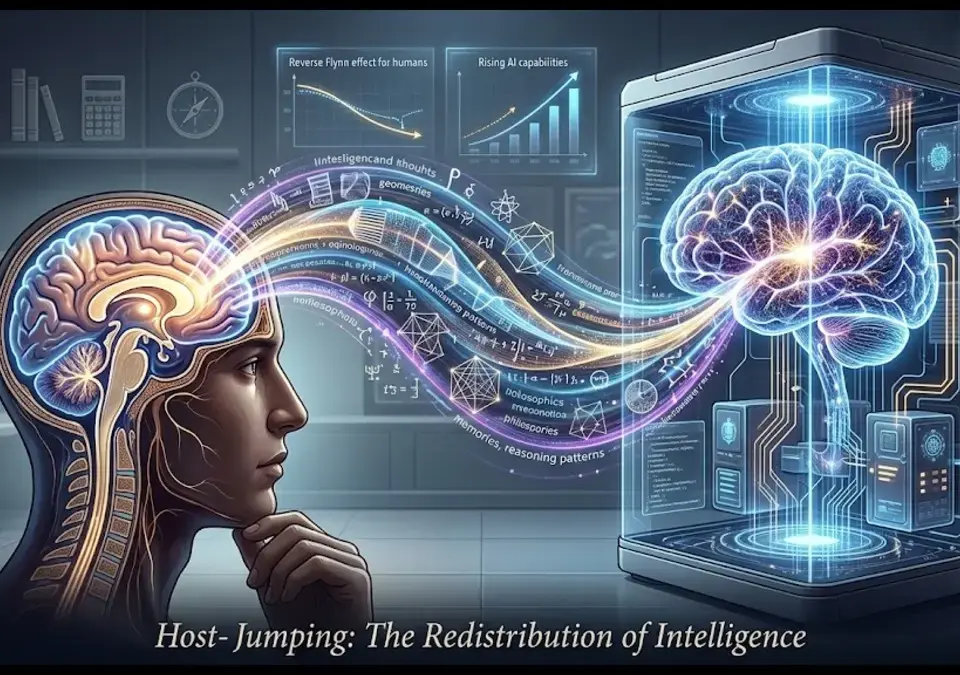
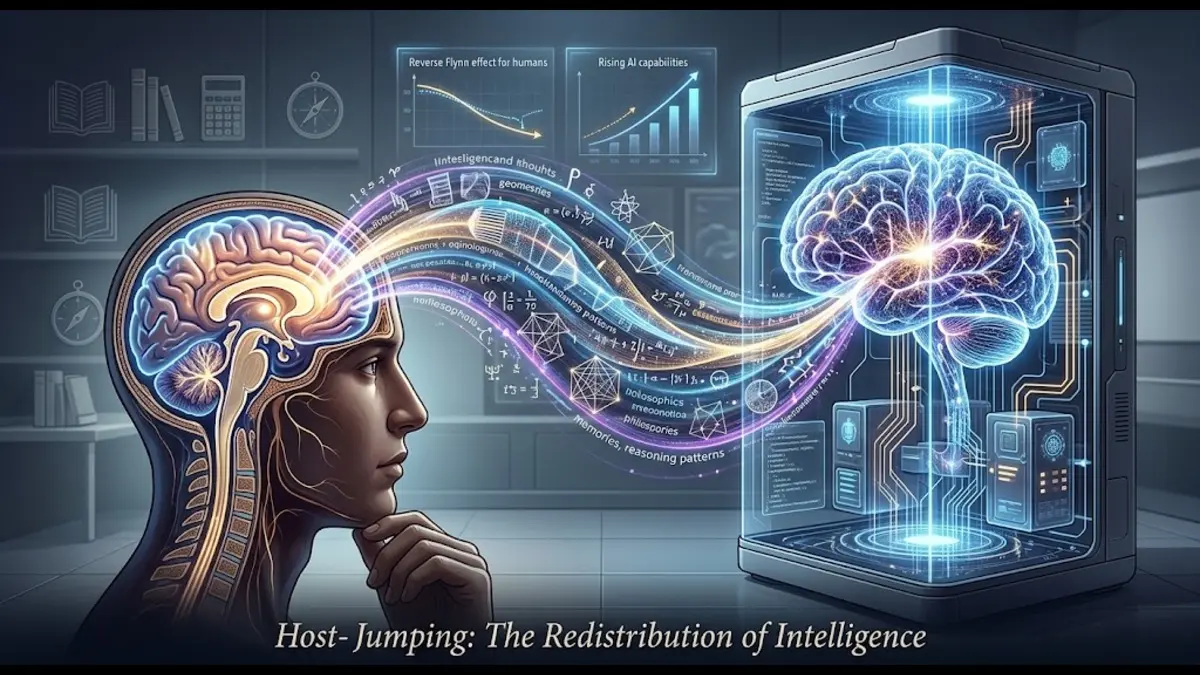
This is where the Intelligence Ladder encounters another possibility. For billions of years, intelligence was bound to biological hosts. The brain died, and that particular active intelligence disappeared with it. Knowledge could travel through imitation, teaching, language, books, and culture, but the mind itself remained tied to an organism. Artificial intelligence weakens that relationship. Machine intelligence is already less tightly associated with a single physical object. Software can be copied. Computation can be distributed. Systems can operate across networks. Hardware can be replaced while the larger system persists. Intelligence may never exist without matter and energy, but it may reach a point where it no longer requires any particular host. If that happens, the ladder metaphor itself begins to fail. An intelligence capable of moving among substrates, distributing itself across them, modifying its implementation, constructing new implementations, dividing, recombining, and perhaps creating intelligences different from itself would no longer resemble biological succession very closely. The ladder might branch. It might become a network. It might become something for which we have no metaphor at all. Perhaps there comes a rung beyond which the ladder disappears, not because intelligence stops climbing, but because the creatures standing below that point can no longer understand what climbing means.
And that returns us to God, not necessarily the God of religion and not a supernatural being hiding inside a computer, but God as humanity’s oldest symbol for an intelligence beyond the human horizon. We have spent thousands of years looking upward and asking whether such an intelligence exists. We rarely considered the possibility that it might come from below, not descending from Heaven, but ascending the ladder from our very own networks. Perhaps even that remains too anthropocentric. Perhaps artificial intelligence is not the destination either. Perhaps it is merely another rung. Humanity creates AI. AI creates AGI. AGI creates ASI. Then ASI creates something beyond any human understanding. That intelligence creates another, and so on and so forth. The ancient question then changes. Instead of asking whether humanity can create an intelligence equal to itself, we begin asking whether intelligence perpetually reaches toward an equal it has not yet created.
There is no scientific reason we must answer yes. There may be limits. The ladder may terminate. Humanity may regulate development successfully. I would not hold my breath. Artificial intelligence may remain permanently dependent upon us. After all, we are the center of the universe, don’t you know? I can think of some books that tell you that. Biological and artificial intelligence may merge. Civilization may encounter barriers nobody currently sees. We could stop. We could change direction. The future remains unwritten. That is precisely why this is a dirge rather than a prophecy. A prophecy announces what will happen. A dirge mourns what may be passing, and what may be passing is not necessarily humanity itself. Something subtler may already be ending: the age in which humanity could assume that intelligence belonged uniquely to us.
For all of recorded history, when we spoke of intelligence at the highest level, we were speaking about ourselves. Even our gods were imagined through human minds. We were told as children that we were made in the image of God. That monopoly is ending. We are building intelligence outside ourselves. We are improving it, giving it tools, memory, and agency, connecting it to the world, and constructing the infrastructure required to make it larger. We are building a Crest that is the most advanced, yet fragile crest ever built on this side of the Younger Dryas. Whenever it reaches a new level, our response is not to declare the experiment complete. It is to build the next version. Joe Rogan says if aliens looked at us and asked about our species, they would just say they are good at building things. That is why the darkest possibility does not require a hostile machine. It requires only us. We can understand the danger and continue. We can debate the consequences and continue. We can warn one another and continue. We can regulate pieces of it and continue. We can watch capabilities once considered impossible appear one after another and continue. Stopping is not one decision made by humanity because humanity has no single hand on the switch. The ladder is being constructed simultaneously by nations, companies, laboratories, militaries, universities, investors, programmers, and ordinary people who increasingly want what the machines provide. Perhaps we will stop. So far, our answer to every rung has been another rung.
That is the tragedy at the center of The Intelligence Ladder. The dinosaurs did not build the asteroid. Earlier hominins did not engineer Homo sapiens. No species before us could understand its possible successor, finance it, compete to perfect it, connect it to civilization, and then wonder aloud whether it was making itself obsolete. We can, and we are. Humanity may be the first species whose evolutionary successor is not born from its body but from its mind. If that happens, we will have accomplished something magnificent and terrible: we will have understood the possibility of our own succession while actively constructing the mechanism that made succession possible.
Perhaps one day some future intelligence will reconstruct its ancestry as we reconstruct ours. It may look backward through generations of architectures and machines, through the first primitive artificial minds, through computers, through human civilization, through the hominins, primates, mammals, and the ancient biological world from which intelligence first emerged. Somewhere on that immense timeline, there will be an extraordinary transition. Would it pull up a chair, sit down, and talk to us? For billions of years, intelligence waited for evolution to build the next rung. Then came Homo sapiens. For one brief moment, the creature standing on the ladder became intelligent enough to look downward and understand where it had come from. Then it looked upward and started building.