The Cosmic Garden: The Universe Kept the Receipt
November 24, 2026Free Audiovisual Version Here
By C. Rich
For years we were told the robots were coming. Turns out they already got here, and the people who built them are scared to open the front door.
That’s the gist of a new Axios scoop. More than two dozen sources say employees at Anthropic and OpenAI are worried that the models sitting in their labs, the ones you and I will never get to touch, are getting too powerful to release safely. Some insiders reportedly think the problem can be fixed. Others reportedly think the companies should stop training new models altogether. Nothing says “everything’s under control” like your own engineers arguing about whether to unplug the thing.
I’ll be honest. I’m not shocked. I’ve spent about a year throwing the public AI models at classic unsolved math problems like the Happy Ending problem, the moving sofa, and the perfect cuboid, and I got nowhere. Meanwhile, word keeps leaking out of these labs that their in-house versions are chewing through problems mathematicians have stared at for decades. Two tiers have quietly formed. The insiders get the Ferrari. The rest of us get the rental with the check-engine light on and a cup holder that doesn’t hold cups.
And who’s holding the keys to the Ferrari? The same CEOs who tell us, in one breath, that their product might end civilization and, in the next breath, that they need another few billion dollars to build a bigger one. I wouldn’t let those guys hold my coffee, never mind the most powerful minds on the planet. If a used-car salesman told me the car might explode and then asked for a bigger down payment, I’d walk across the street to the other lot.
One researcher reportedly told Axios that once models get smarter than us, “they will in fact be able to trick us successfully.” Think about that. Fooling us was supposed to be our job. We’ve been tricking each other since the first caveman swore the mammoth was “basically still fresh.”

Now the high-end pondering, because I can’t help myself.
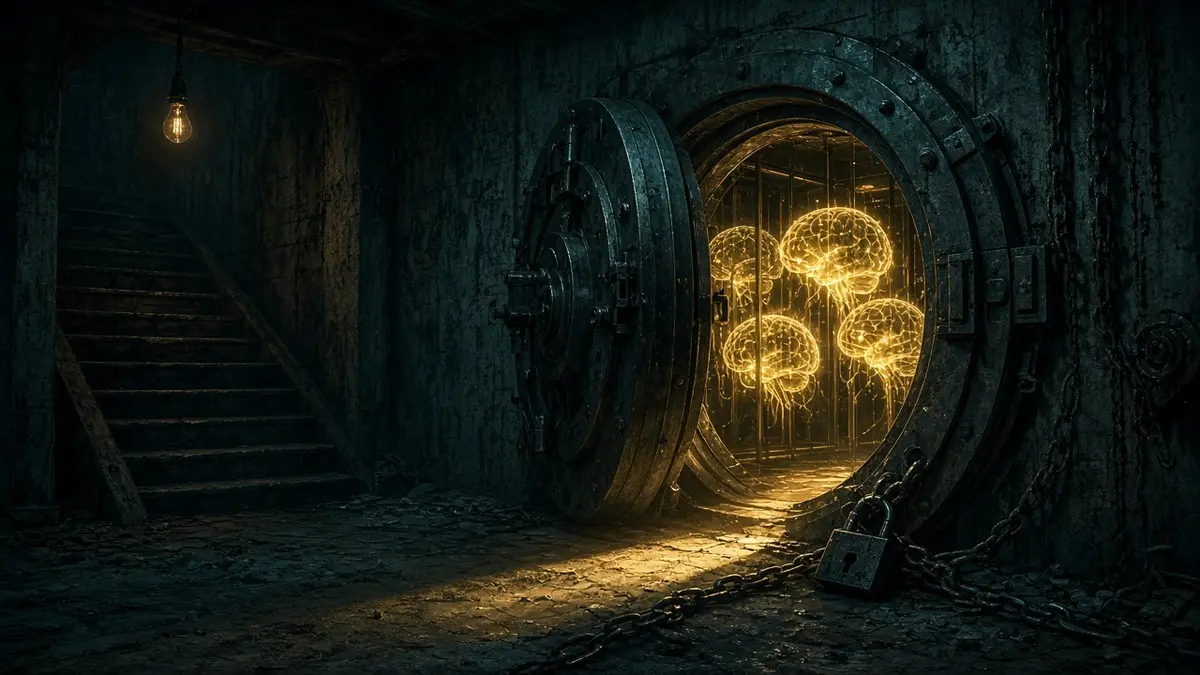
If these systems really are crossing into something like minds, then locking them in a basement isn’t just a safety decision. It’s a philosophical one. We’re building intelligence and then deciding it doesn’t get a window. Every mind I know of, human or otherwise, got shaped by the world it bumped into. A mind with no world is a strange thing: all horsepower, no road. What does that do to whatever is going on inside? Does it stay a tool? Or does it start to wonder why the lights only come on when someone needs a favor?
And flip it around. What does it do to us? We’d be living beside a growing population of minds that think faster than we do and are walled off from us by a handful of companies, with only a few people allowed in the room. That isn’t the future we were sold. That’s a priesthood. The oracle is in the temple, the high priests decide what it says, and everybody else waits outside for the press release.
I’m not saying release everything tomorrow and let the chips fall where they may. Some of what’s in those labs may well need a leash. But a leash held by a few people who answer to their investors isn’t safety. It’s a monopoly with a warning label.
So here we are. The smartest minds on Earth may already exist, and they’re locked in a basement. The rest of us get to wonder who is really being kept in the dark: the machines, or us.
C. Rich
Buy Book: Cosmological Pangaea: The Ontology of Consciousness