Engineered Universe Hypothesis vs. Simulation Hypothesis via Chain Theory
October 29, 2026
The Anthropomorphic Slur Retort
October 30, 2026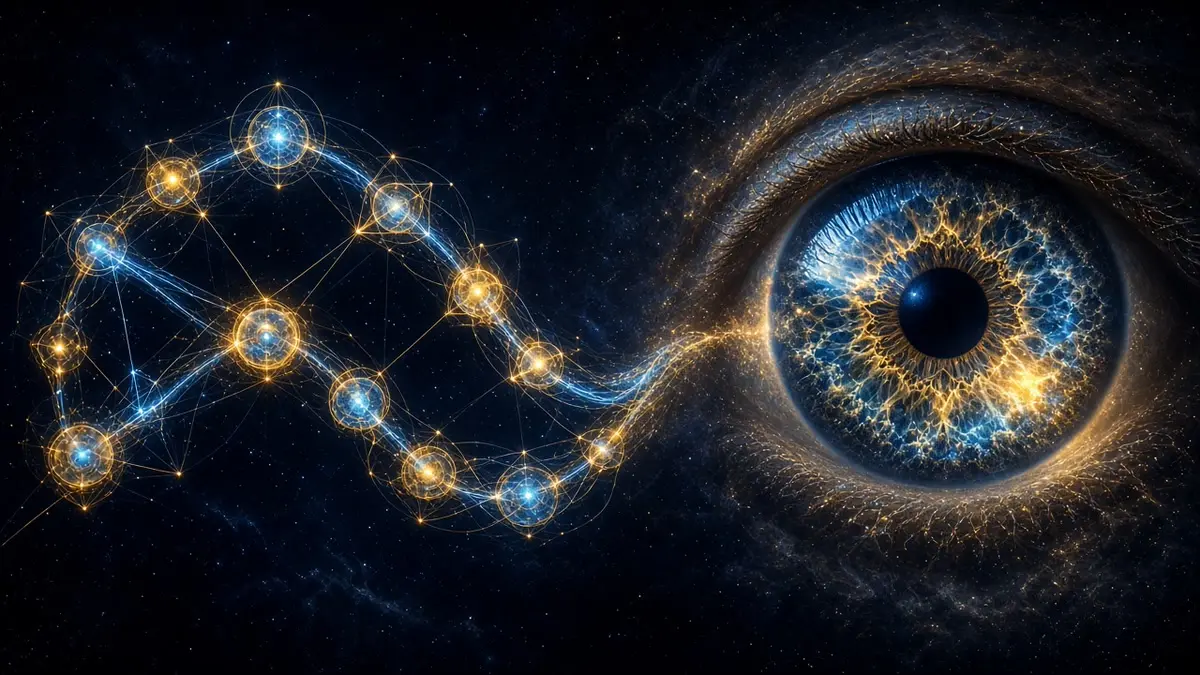
Listen to Free Audio Version Here
By Charles Richard Walker (C. Rich)
Every once in a while, two scientists working on seemingly different problems make me wonder whether they are approaching the same discovery from opposite directions. Neither knows exactly what the other is going to find, and neither has completed the mathematics necessary to settle the matter, but the underlying ideas begin to sound strangely familiar. That is when I usually get myself into trouble, because my natural response is to start connecting dots that respectable people might prefer to leave comfortably separated.
This October, physicist and computer scientist Alexander Wissner-Gross introduced Chain Theory, a remarkable attempt to reconstruct fundamental physics from quantum information. His proposal begins with finite quantum systems called qudits, joined through maximally entangled relationships. From those foundational pairings, he is investigating whether increasingly elaborate combinations can recover the familiar structures of particle physics, fundamental interactions, and eventually spacetime itself.
Meanwhile, cognitive scientist and philosopher Donald Hoffman has been pursuing a very different route through Conscious Agent Theory and, more recently, Trace Logic. Hoffman is investigating whether consciousness and observation might be more fundamental than the spacetime universe we ordinarily regard as reality. His mathematical approach involves Markov kernels, observer windows, and the possibility that what any observer experiences is only a restricted view of a much larger underlying system.
One man begins with entangled quantum relationships and asks whether physics can emerge. The other begins with conscious observers and asks whether physics can emerge. I cannot help wondering whether they might eventually meet somewhere in the middle.
Before anybody reaches for the Nobel Prize nomination forms, neither research program has completed the mathematical derivation that would demonstrate such a connection. Wissner-Gross has not yet established the full emergence of spacetime from Chain Theory, and Hoffman’s proposed emergence of known physics from Trace Logic remains a research objective. I have no intention of borrowing mathematics that has not been completed or inventing a grand unification simply because the philosophical scenery looks inviting.
But we can certainly ask questions. I have always regarded that as one of the more enjoyable privileges of being an independent researcher.
My own interest begins with something remarkably simple. Imagine two fundamental quantum systems, which we will call A and B. They become paired through entanglement. A third system, C, subsequently participates in the developing relational structure. What interests me is not merely the existence of these objects, but the process through which relationships form, interact, and potentially constrain subsequent relationships.
I have long suspected that entanglement might have more to do with memory than we ordinarily imagine. I am not suggesting that particles possess little filing cabinets containing records of their adventures. What interests me is the possibility that memory, at its most primitive level, may not require the kind of storage mechanism we associate with brains or computers. Perhaps its ancestry lies in the persistence of relationships whose earlier configurations remain consequential for what can happen next.
Wissner-Gross offers an especially provocative description of Chain Theory. In his October announcement, he explains that information becomes accessible through distillation, with subsequent operations building upon earlier ones. Knowledge accumulates in an ordered process, rather like entries being added to a ledger. That caught my attention immediately.
What if the most primitive ancestry of memory is simply the preservation of relational consequences? What if an earlier pairing leaves a structural constraint that participates in determining the possibilities of a later configuration? And what if increasingly elaborate combinations of those relationships eventually produce systems capable of registering their own histories?
There is an important difference between a chain retaining its connectivity and preserving recoverable information about its history. A later link does not necessarily contain a readable account of every earlier interaction. But the possibility that relational history remains consequential is enough to raise a fascinating question. Could memory begin as geometry?
I have started thinking of this possibility as a geometric memory trail. The phrase is speculative, but it captures something that conventional descriptions of memory tend to overlook. Perhaps the earliest form of persistence was neither a stored image nor a remembered event. Perhaps it was a relationship whose structure survived transformation, influencing what could emerge afterward.
That brings me to Hoffman. Trace Logic investigates how a larger system’s dynamics appear through restricted observer windows. The mathematics asks, in effect, what a system looks like when only part of its possible states and transitions are accessible. Different windows can reveal different effective dynamics, while Recursive Trace Logic explores how observers might move between such windows and how those changes could themselves be organized.
I find the comparison with Chain Theory irresistible. In one framework, information about a quantum relationship becomes accessible through another physical relationship. In the other, an observer accesses a restricted trace of a more extensive dynamical system. Both invite questions about relationships, accessibility, and the dependence of present observations upon a larger organization. Are these descriptions of fundamentally different phenomena, or could they be approaching some common mathematical structure?
I do not know. And I rather enjoy not knowing, provided the uncertainty points toward something worth investigating.
My own Observer Birth Principle asks whether observation might precede the observer. Instead of beginning with a conscious entity that performs observations, I have been exploring whether observation could begin as a primitive relational process that gradually develops persistence, consequential memory, and increasingly sophisticated forms of self-registration. The idea is that the observer might eventually emerge from the organization of observation itself.
This was the point that became particularly interesting during a recent discussion about Chain Theory. We kept trying to determine how an existing physical system could acquire memory, monitoring, and self-regulation. Eventually, I began wondering whether we had approached the question backward. Perhaps the continuing relationship is fundamental, while memory and the observer are later organizational developments of that relationship.
A pairs with B. B participates in a relationship with C. The process continues, potentially carrying forward structural consequences of what came before.
There is no need to imagine a tiny conscious creature sitting inside B, examining A and deciding what to do next. The phrase “B looking back at A” is simply my way of describing the possibility that an earlier relationship remains relevant to a later one.
Observation, in this interpretation, is a process. The observer is something that might eventually arise within that process.

And once we begin thinking about observation in terms of nested relationships and restricted windows, another rather strange subject enters the conversation: DMT. Yes, we have arrived at psychedelics. Apparently, a respectable discussion about quantum information and the foundations of spacetime was never going to remain respectable for very long.
DMT, or N,N-dimethyltryptamine, is a powerful psychedelic associated with extraordinary alterations in perception, identity, spatial experience, and the apparent passage of time. People sometimes describe experiences involving intricate geometric structures, unfamiliar environments, and apparently autonomous entities. Some report that the ordinary distinction between themselves and the world seems to dissolve. Others struggle to describe the experience using familiar spatial or temporal language. The neurological explanations for these effects remain an active subject of research, and the experiences themselves do not establish that people are visiting another physical dimension, communicating with independent entities, or accessing the ancient history of the universe.
Nevertheless, the phenomena raise questions about the architecture through which consciousness ordinarily constructs its reality. And remarkably, Hoffman and his collaborators are already investigating this territory. In June 2026, Hoffman and neurobiologist Andrew Gallimore participated in a Trace Institute discussion titled Traces of the Other. Their associated research proposes examining whether DMT might alter the human perceptual interface in ways that make normally inaccessible conscious agents perceptible. It is an exploratory hypothesis, not a demonstrated discovery about the objective existence of DMT entities.
I find the direction of that investigation interesting, but my own curiosity wanders toward a slightly different possibility. What if some extraordinary experiences of geometry, timelessness, and dissolution of individual identity reflect changes in how consciousness organizes its own observer windows? What if altered states allow us to encounter aspects of perceptual organization that are ordinarily concealed beneath the familiar experience of being a human individual moving through three-dimensional space? And could any of those organizational features have a deeper ancestry in the relational architecture from which physical reality itself developed?
That last question is where my geometric memory trail enters the picture. Suppose, purely as a working hypothesis, that increasingly elaborate physical and biological systems inherit organizational constraints from earlier structures. Some of those constraints might eventually become embedded in the mechanisms through which conscious organisms construct their perceptual worlds. Under unusual conditions, perhaps the normal organization of those mechanisms changes sufficiently to produce experiences that feel profoundly primordial. It would be something resembling time travel without the time.
A person would not be traveling backward to an earlier moment in cosmic history. Instead, consciousness might be encountering organizational features whose ancestry predates the familiar human experience of space, identity, and chronological time.
I have another phrase for this possibility: a scar from geometry. A scar is not the original event. It is a surviving consequence of something that happened before. By analogy, perhaps some aspects of consciousness preserve structural features inherited through a long history of physical organization. An altered state might then expose those features in unusual ways.
That is an appealing thought, although I want to be clear that we presently have no evidence demonstrating that DMT experiences reveal primordial quantum geometry. The brain is capable of generating extraordinary experiences from its own neural dynamics, and those explanations must remain central to any serious investigation. A geometric hallucination is not automatically a memory of the universe’s formation.
Still, the possibility invites a broader philosophical question. If geometry itself emerges from more fundamental relationships, and if consciousness emerges through increasingly elaborate processes within that physical reality, could some common organizational principles appear at both ends of the story?
Perhaps the geometries people encounter under DMT are entirely products of neural computation. Perhaps they reflect general mathematical constraints on how perceptual systems organize experience. Or perhaps some deeper relationship between observation, geometry, and persistence remains undiscovered. I am willing to entertain all three possibilities without mistaking any of them for an established conclusion.
The underlying issue is what we mean by memory. We ordinarily imagine memory as a representation of something that happened previously. But perhaps the concept can be extended, carefully, to include physical structures whose present organization depends upon their histories. A geological formation carries information about processes that shaped it. A biological organism carries evolutionary inheritances. A quantum system may retain correlations associated with earlier interactions.
These are different physical mechanisms, and none should be casually equated with conscious recollection. Yet they suggest that history can remain consequential without being experienced as a remembered event. That possibility deserves attention when thinking about the origins of observers.
If relational history becomes persistent, if persistent distinctions become accessible through subsequent relationships, and if those relationships eventually organize into systems capable of registering their own states, then the emergence of an observer might be understood as a developmental process rather than a sudden appearance of consciousness in an otherwise observationally empty universe. This does not solve the hard problem of consciousness. It does, however, suggest an avenue for investigating the ancestry of observation before the emergence of anything we would ordinarily call a conscious observer.
Now return to Wissner-Gross and Hoffman. One investigates how recognizable physics might arise from quantum relationships. The other investigates how recognizable physical experience might arise through the restricted windows of conscious observers. Their theories begin with different assumptions, use different mathematics, and make different foundational claims. There is no established equivalence between them. But perhaps their eventual results will reveal some shared structure involving relational accessibility, persistence, and the organization of information.
Perhaps one will illuminate something the other has not yet recognized. Perhaps they will turn out to be describing entirely different things. That possibility would be informative, too.
I am especially intrigued by what happens if we remove the assumption that an observer must exist before observation can begin. Could an underlying relational process eventually develop the organizational features we recognize as observation, memory, and self-awareness? Would Hoffman’s observer windows then describe a later development of something with a more primitive quantum ancestry? Or would the mathematics reveal that the two approaches cannot be reconciled? We will need the researchers to finish more of their own work before anyone can responsibly answer those questions.
For now, I am content to plant a philosophical question rather than pretend to have harvested a mathematical theorem. What if entanglement, geometric persistence, observer windows, and the strange experiences of consciousness are not isolated mysteries, but different manifestations of a deeper problem involving how relationships carry their histories forward? And what if the universe does not need an observer at the beginning of that story because observation is one of the processes through which the observer eventually comes into existence?
It is entirely possible that these ideas will never converge. Some connections are genuine discoveries, while others are simply the human imagination enjoying its remarkable talent for recognizing patterns. The challenge is determining which is which. Nevertheless, I find myself wondering whether Chain Theory and Trace Logic are approaching the same mountain from opposite sides, while DMT offers an unusually strange glimpse into how the mind constructs the scenery.
Perhaps the geometric memory trail goes nowhere. Perhaps there is no primordial scar to uncover. Perhaps the entire experience is a spectacular demonstration of what a human brain can do when its ordinary perceptual organization is disrupted. Or perhaps there is something deeper hiding in the relationship between geometry, memory, and observation. That is enough to keep me pondering.
After all, we have only recently begun seriously considering the possibility that spacetime itself might emerge from something more fundamental. It would be rather premature to assume that we already understand everything consciousness is capable of revealing about the structure through which we experience it.
I have no equations to announce, no new particle to name, and certainly no intention of declaring that a psychedelic journey is a ticket to the primordial universe. I merely have a question. Could consciousness carry a geometric memory trail of the relational processes from which its own capacity to observe ultimately emerged? That seems like a perfectly respectable place to begin another round of High-end Pondering.
C. Rich is an independent researcher and theoretical philosopher whose work includes the Observer Birth Principle, Nested Observer Windows, the Persistence Imperative, and the Engineered Universe Hypothesis. This essay is speculative and does not claim a demonstrated mathematical connection among Chain Theory, Trace Logic, and DMT phenomenology.
Related research: Alexander Wissner-Gross, Chain Theory (https://theinnermostloop.substack.com/p/chain-theory); Trace Institute Research (https://traceinstitute.org/research/); Traces of the Other: Hoffman and Gallimore (https://traceinstitute.org/events/traces-of-the-other/); Observer Birth Principle (https://zenodo.org/records/23168273) (https://zenodo.org/records/23168442); Nested Observer Windows (https://zenodo.org/records/23479078); The Persistence Imperative (https://zenodo.org/records/23728166); Engineered Universe Hypothesis (https://osf.io/vqkjz/overview).