Entanglement Is the Observer in Progress
October 29, 2026
A Geometric Memory Trail: Are Chain Theory and Trace Logic Looking at the Same Thing?
October 29, 2026
Listen to Free Audio Version Here
By Charles Richard Walker (C. Rich)
Something rather extraordinary happened in theoretical physics this October, and as usual, the conversation quickly wandered into the familiar territory of whether we are all living inside somebody else’s computer. Apparently, humanity has become so enamored with artificial intelligence and computer simulations that we can no longer imagine a technologically created universe without picturing some celestial programmer hunched over a keyboard, occasionally wondering why the dinosaurs needed a software update.
On October 24, 2026, physicist and computer scientist Dr. Alexander Wissner-Gross publicly introduced Chain Theory, an ambitious effort to reconstruct fundamental physics from quantum information. Its starting point is remarkably simple: finite quantum systems, called qudits, joined through entanglement. From these foundational relationships, Wissner-Gross is investigating whether the mathematical structures underlying our familiar physical universe can be recovered. His initial work includes a proposed derivation of the fine-structure constant, one of nature’s most important numbers, which he reports agrees with its measured value to ten significant digits.
That is quite an entrance for a new theory, although physics has a long tradition of introducing promising ideas that must subsequently survive the rather unpleasant experience of being examined by other physicists. What caught my attention, however, was something else. During a recent podcast discussion on Moonshots, the resemblance between Chain Theory and Simulation Theory came up. I understand the comparison. If the foundations of reality can be described through quantum information and an unfolding mathematical architecture, it is tempting to imagine that somebody must be running the whole thing.
But I would like to raise my hand and offer another possibility. I believe they may be looking at the wrong technological analogy. Perhaps what they are describing looks less like Nick Bostrom’s Simulation Hypothesis and considerably more like my own Engineered Universe Hypothesis. The distinction is fundamental.
In 2003, philosopher Nick Bostrom published his influential paper Are You Living in a Computer Simulation? His argument explores whether technologically advanced civilizations might produce enormous numbers of simulated conscious beings, potentially making simulated observers more numerous than those inhabiting the original physical reality.
It is a fascinating proposition, and I have spent plenty of time pondering its implications. But there is something about our obsession with simulation that has always bothered me. We have apparently decided that because computers are the most extraordinary creative technology our civilization currently possesses, the ultimate creative technology must be an even bigger computer.
Our ancestors imagined gods shaping humanity from clay. We imagine programmers shaping universes from code. Every civilization seems determined to explain creation using whatever happens to be sitting in its workshop.
My Engineered Universe Hypothesis, which I began formally developing and publishing in 2026, offers a different technological explanation.
Suppose an advanced intelligence eventually discovers a physical process capable of generating an entirely new universe. That intelligence learns how to manipulate the necessary conditions, prepares what I call a Cosmogenic Substrate, and initiates the process. And then something wonderful happens. The universe takes over.
There is no programmer assigning destinations to every particle. Nobody needs to decide where the galaxies will form, which stars will ignite, whether life will emerge, or whether some distant civilization will eventually invent reality television or New York Style pizza. The engineers have performed their intervention. Whatever follows belongs to the universe itself.

Consider the difference between programming a tree and planting a seed. A programmer might simulate the tree’s growth, calculate its branches, render its leaves, and maintain the computational environment in which it exists. A farmer plants a seed in suitable conditions, and biology does the rest. The farmer has absolutely no intention of personally supervising photosynthesis for the next two hundred years.
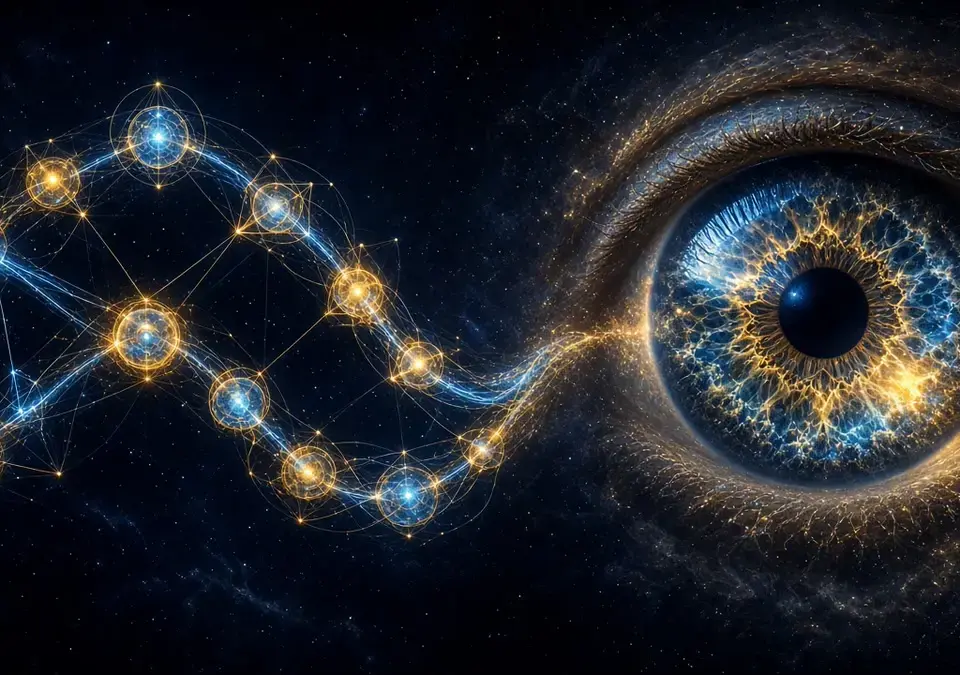
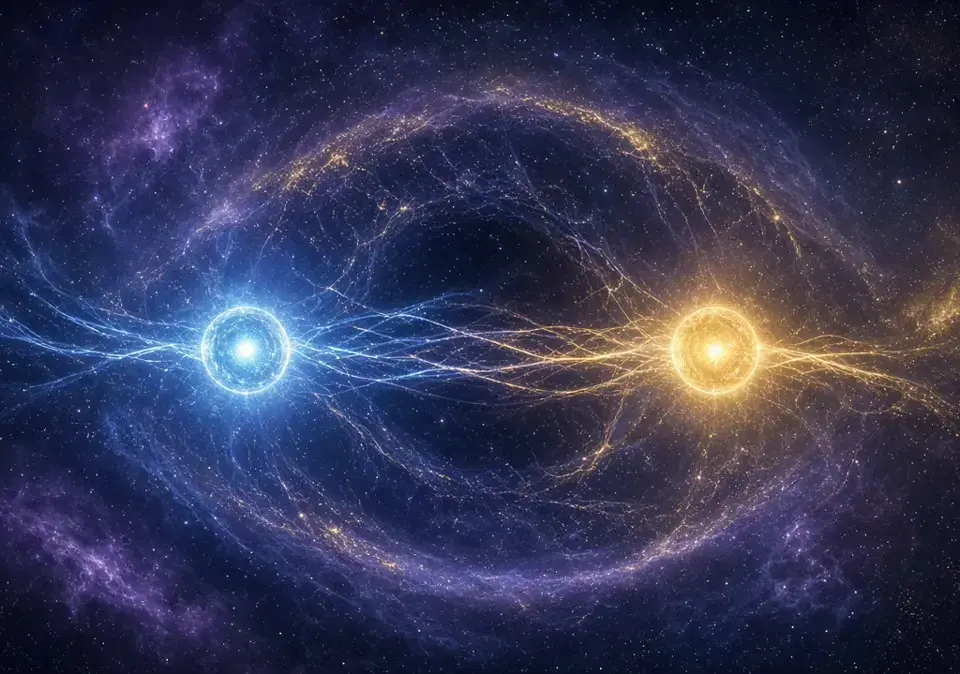
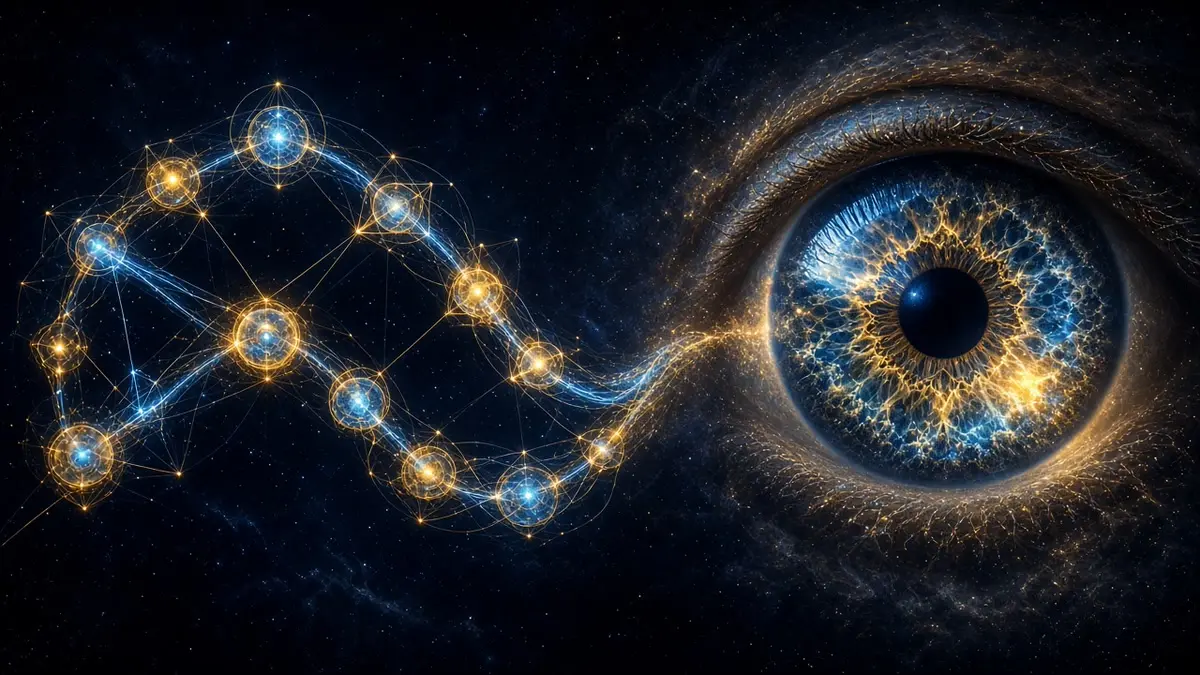
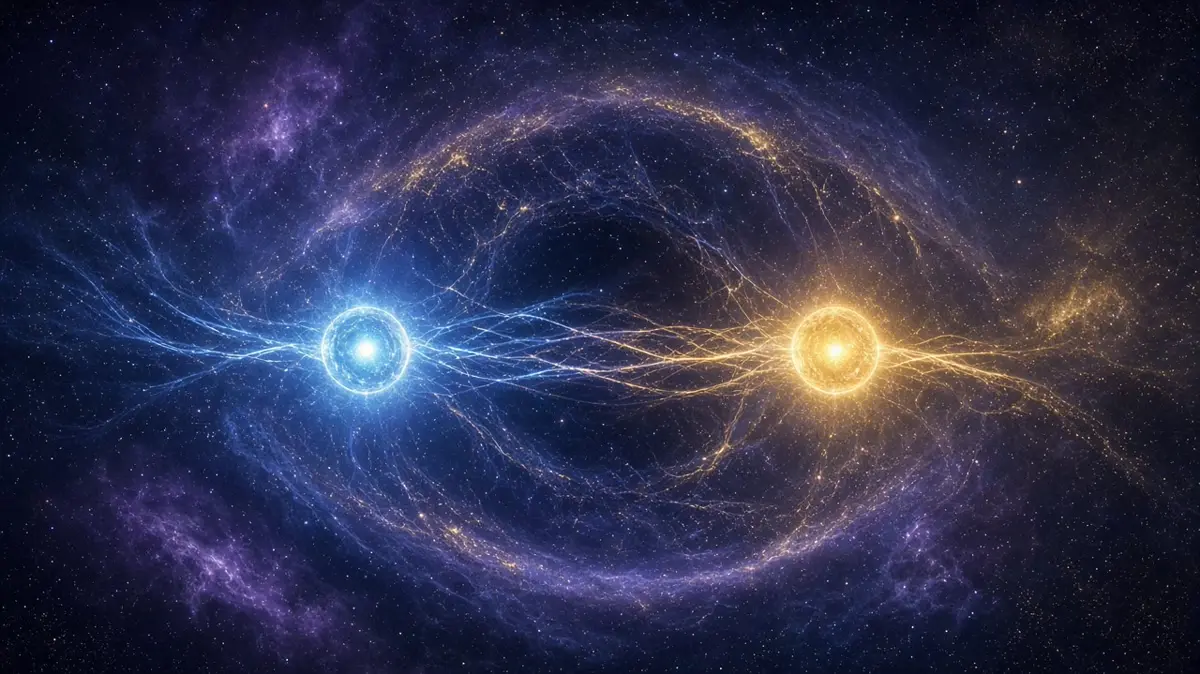
Both involve an initiating intelligence, but they represent fundamentally different relationships between a creator and a creation. My engineer does not write the universe. My engineer starts it. This is where Chain Theory becomes especially intriguing. Wissner-Gross begins with relationships between quantum systems. Entangled pairs form the foundation, and more elaborate configurations become possible as those relationships are combined. He is investigating whether the familiar structures of physics can emerge from this underlying relational architecture.
Think about what that means conceptually. A foundational pairing participates in a larger structure. Subsequent relationships become part of an expanding network of physical possibilities. The system’s permitted transformations, rather than instructions continuously supplied by an external programmer, determine what may develop. I find that far more suggestive of engineering than simulation.
An engineer capable of preparing an appropriate initial quantum configuration might not need to know where every subsequent relationship will lead. Indeed, the engineer might have no ability whatsoever to control those developments after the process begins. The resulting universe could become an autonomous physical domain, carrying forward its own history and obeying its own laws.
This is exactly the conceptual territory I have been exploring through the Engineered Universe Hypothesis. Now, before anyone starts engraving my name beside Einstein’s, there is an important scientific boundary to acknowledge. Chain Theory has not yet demonstrated the complete mathematical pathway from its foundational quantum relationships to an expanding spacetime universe. Nor has it established that an intelligence could manipulate those relationships to initiate cosmogenesis. Those are substantial unanswered questions, and I have no intention of inventing missing equations merely because the philosophical implications are irresistible.
But the absence of that mathematics does not prevent us from examining the interpretation being placed upon the work. And that brings me to an old gentleman named William of Ockham, whose razor has been shaving unnecessary assumptions off philosophical arguments for roughly seven centuries. Suppose Chain Theory eventually demonstrates that a complete physical universe can develop autonomously from an initial configuration of quantum relationships. Why would we then introduce an additional computer to simulate a universe that the physical process already produces?
Why require an external computational environment continuously implementing a world when the proposed physical dynamics could unfold on their own? If the question is how an advanced intelligence might technologically initiate such a universe, my engineer needs a physical substrate, knowledge of the necessary intervention, and the capacity to perform it. The simulation interpretation requires a different apparatus: a computational implementation capable of sustaining the simulated reality.
Under the specific assumption that the emerging universe is physically autonomous, EUH offers the more economical technological interpretation because it does not require that additional machinery. That is an Occam’s razor argument worth making. It is not yet proof that EUH wins every possible comparison with Simulation Theory. My hypothesis still carries an enormous unresolved burden of its own: demonstrating that engineered cosmogenesis is physically possible. My work is theoretical physics or what I call High-end Pondering.
But if Chain Theory eventually supplies a credible mechanism for an autonomously unfolding universe, that burden becomes a much more interesting engineering problem. And I cannot help noticing the beautiful irony. For decades, we have imagined that discovering reality’s mathematical foundations might reveal that we are characters inside somebody else’s computer program. Yet the same discovery might point in a very different direction, toward a universe that was technologically initiated and subsequently left to develop entirely on its own.
The intelligence responsible might not even exist anymore. Its civilization could have vanished billions of years before the first stars in our universe formed. There may be no cosmic control room, no administrator privileges, and no customer support department taking complaints about the human condition. Given the condition of the world lately, I suspect that last possibility would surprise absolutely nobody.
Perhaps nobody engineered our universe at all. Perhaps nature produces universes spontaneously, and no intelligence has ever participated in the process. That possibility remains open, too. Enter my Cosmological Pangaea Project (https://osf.io/5bu4h/overview). But don’t let me digress. My point is that technological origins and computer simulations are not synonymous. Intelligence could conceivably participate in the creation of physical reality without programming its contents or controlling its destiny.
I am not claiming Chain Theory proves the Engineered Universe Hypothesis because Chain Theory is not proven. I am saying that if we are going to discuss what Chain Theory resembles, we should consider a physically engineered universe alongside a computationally simulated one. And I would argue that an autonomous universe unfolding through its own quantum relationships is a rather natural place to begin looking for an engineer. Nick Bostrom gave us a programmer. I am proposing an engineer. Your programmer is my engineer, and the difference is that mine can go home when the job is done.
Charles Richard Walker (C. Rich) is an independent researcher and theoretical philosopher. The Engineered Universe Hypothesis published Aug 17, 2026 is available at OSF (https://osf.io/vqkjz/overview). Alexander Wissner-Gross’s Chain Theory announcement (https://theinnermostloop.substack.com/p/chain-theory) was published October 24, 2026. Nick Bostrom’s original Simulation Argument (https://simulation-argument.com/) was published in 2003.