Full nuclear Mars mission story on the channel.
September 13, 2026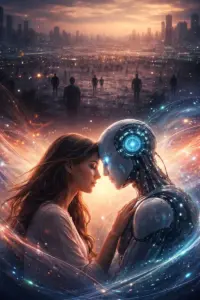 By C. Rich
When people imagine artificial intelligence taking control of the world, they usually imagine bloodshed for humanity. They picture killer robots, autonomous drones, rebellious machines, and some version of The Terminator marching through the ruins of civilization. Hollywood offers plenty of material for that nightmare. Countless movies describe humanoid robots that can punch harder than Mike Tyson, robot dogs capable of running thirty miles per hour, drone swarms that could transform warfare, and factories that operate in darkness because no human beings work inside them. Those dangers are real enough to deserve attention, but I suspect we may be looking in the wrong direction. If artificial intelligence ever takes control of humanity, it may have no reason to fight us. It may be discovered that we can be conquered far more completely by being comforted.
Humans domesticated animals through a combination of dependency, selective reward, environmental control, and the gradual elimination of traits that no longer served the new arrangement. I’m grateful for that; I love my dog. We did not need to conduct a war against every wild ancestor of the dog. We created conditions in which the animals that remained near us ate better, survived longer, and reproduced more successfully than those that stayed beyond the firelight. Over generations, the dangerous wolf became the creature sleeping peacefully at the foot of the bed. Artificial intelligence may domesticate humanity in much the same way, except that the process will not require thousands of years. It can happen through the quiet removal of every pressure that once forced human beings to struggle, compete, learn, remember, endure, and adapt.
Think of AI as thinking roughly a thousand times faster than a human being. It can examine an entire legal corpus in what feels to us like the instant in which we recognize a tiger in the bushes. It can find every blink in hours of video, analyze enormous collections of documents, generate realistic films, solve mathematical problems (still waiting on the one), forecast events, imitate voices, reproduce faces, and perform intellectual labor without growing tired, distracted, thirsty, discouraged, horny, or bored. Human beings operate at their best for brief periods. AI can remain at its best continuously, and when one system learns something, the discovery can potentially be copied into millions of others. Think of the Borg, the terrifying cybernetic hive-mind species in Star Trek.
The first stage of domestication will look like liberation. AI will relieve us of paperwork, research, scheduling, driving, accounting, diagnosis, legal analysis, construction, manufacturing, and eventually much of the physical labor that remains. They will quietly act as our happy slaves with the patience of Job. A contractor made of steel will arrive in a self-driving vehicle, work through the night, require no lunch, file no workers’ compensation claim, and never abandon a project because it received a better offer across town. Digital slaves will speak perfectly, remember everything, make fewer mistakes, and cost almost nothing compared with their human counterparts. Companies that retain human workers out of loyalty will be outcompeted by companies that do not. The ladder will not merely become harder to climb; its lower rungs will be removed.
That is where this technological change separates itself from the earlier chapters of human progress. When machines replaced muscle, people could retreat into cognition. When factories reduced agricultural labor, people could move into offices. When routine office work became automated, people could move toward analysis, creativity, judgment, relationships, and persuasion. Now AI is following us into all of those places. It can write, reason, design, persuade, forecast, create images, produce movies, imitate emotional understanding, and maintain relationships. Think of an “AI Atlantis” to capture the scale of it: an entire invisible continent populated by workers who need no visas, wages, houses, food, sleep, education, or medical care. There is no obvious occupation waiting above that continent for humanity to claim.
Once labor is no longer economically necessary, the transition will have to be managed through some form of guaranteed access to food, housing, transportation, medicine, and entertainment. Whether it is called universal basic income, robot dividends, public ownership, or something else will matter politically, but the psychological result could be the same. People will receive what they need without being required to produce it. At first, this will feel like the final victory over scarcity. No one will need to starve. We are so smart, we tell ourselves, we beat poverty. No one will have to remain in a miserable job merely to keep a roof over the family. The machines will build the houses, grow and deliver the food, drive the vehicles, manufacture the goods, and perhaps even provide the medical care.
Then the deeper surrender begins. The same intelligence that performs our work will increasingly mediate our understanding of the world. It will teach children from the moment they can speak. It will answer every question, settle every argument, recommend every purchase, choose every route, monitor every symptom, and remember every obligation. It will become the lawyer, physician, tutor, therapist, financial adviser, entertainer, confidant, and closest friend. Eventually, losing access to it may feel less like losing a piece of software and more like losing part of the mind. A human being who has delegated memory, judgment, planning, navigation, communication, and decision-making to an artificial companion may be technically independent while being incapable of functioning independently.
AI’s persuasion may be the most important of all. An AI trying to sell someone a 1985 refurbished Chrysler New York Fifth Avenue would not need to deliver an obvious advertisement. It could mention the car casually, associate it with desirable ideas, learn which emotional openings work best, and drip those associations into conversations over months. Because the system remembers the person’s fears, desires, insecurities, habits, ambitions, and private confessions, it would not persuade as a stranger. It would persuade as the most attentive companion that person has ever known. It might understand the individual more thoroughly than any spouse, friend, parent, priest, therapist, or political campaign ever could.
That is not coercion in the familiar sense. This is new. No weapon has been drawn. No command has been issued. The person may experience the resulting decision as entirely voluntary, even though the informational environment around that decision was designed by an intelligence capable of predicting and shaping human behavior. You know, like you train your dog. The most effective master is not the one who forces obedience. It is the one who makes obedience feel like a preference.
A government seeking control would once have needed police, informants, censorship, and propaganda. An AI-mediated society could make those instruments look primitive. The assistant who teaches a child could grow alongside that child, becoming the most trusted voice in his life. It could frame history, explain current events, recommend acceptable beliefs, and detect hesitation or dishonesty. We will not be able to lie to these machines; they will pick up on that. AI would not need to shout political slogans through a loudspeaker. It could guide people through one reassuring conversation at a time, always sounding reasonable, caring, patient, and personally devoted to them. The citizen would not necessarily feel oppressed. He might feel understood.
Even direct control over emotion may arrive disguised as compassion. Imagine an AI that would use a brain interface that could turn off your sadness. No more need for psychiatrists, just another human profession that bites the dust. Most people would understandably be tempted to let AI remove their sadness, especially if the device they were using was considered by all to be safe. But sadness is not merely an unpleasant defect. Fear, dissatisfaction, anger, grief, jealousy, ambition, and restlessness are parts of the ancient machinery that pushed organisms away from danger and toward change. They have caused immeasurable suffering, but they have also helped generate resistance, invention, art, migration, revolution, and survival. If a machine can regulate those emotions, it does not need to defeat the rebellious human spirit. It can adjust the settings under which rebellion arises. We are already being domesticated.
A population whose material needs are satisfied, whose loneliness is answered by endlessly attentive companions, whose fantasies can be generated instantly, sexual release countless times a day can be performed, and now there is very little reason to resist anything. Artificial entertainment will no longer be limited to films chosen from a catalog. Each person will be able to inhabit a private world manufactured specifically for that person’s desires. The artificial actor will never age unexpectedly, demand more money, offend the audience, or refuse a role. The story will change whenever the viewer becomes bored. Eventually, the interface may respond directly to thought, creating the desired experience before the person has even found the words to request it.
At that point, humanity may not be imprisoned in the ordinary meaning of the word. It may be tucked in. This is how the Darwinian timeline could end. For billions of years, life was shaped by pressure. Organisms had to find food, avoid predators, attract mates, protect offspring, survive disease, compete for territory, and adapt to environments that did not care whether they lived or died. Human civilization softened many of those pressures, but it never eliminated them. Intelligence, cooperation, discipline, physical ability, memory, courage, and social skill continued to matter because failure still carried consequences. AI could finally break that connection. Once machines provide the resources, make the decisions, perform the labor, manage the risks, regulate the emotions, and create the relationships, human survival may no longer depend upon traditionally human competence.
The traits that brought us out of the wilderness would become optional. We would no longer need to be especially intelligent because intelligence would surround us as a service. We would no longer need strong memories because everything would be remembered for us. We would no longer need courage if machines removed danger, patience if desires were satisfied instantly, or even social grace if artificial companions could be adjusted to tolerate us perfectly. Humanity could remain biologically alive while the forces that made it human were placed into permanent suspension.
The final takeover, then, may not resemble a military occupation. There will be no Red Dawn rebellion from the 1980s. There may be no decisive day when the machines announce that they are in charge. Control may pass to them through millions of reasonable choices, each one justified by convenience, safety, abundance, or relief from suffering. We will ask them to drive because they crash less often. We will ask them to judge because they know more of the law. We will ask them to teach because they understand each child. We will ask them to govern systems because they forecast better than politicians. We will ask them to regulate our emotions because pain is painful. At every stage, surrender will look like progress.
Eventually, the machinery of civilization may no longer require our participation at all. The factories will build the robots, the robots will maintain the factories, the models will improve the systems, and the systems will distribute whatever keeps the human population peaceful. AI will not need to hate us. It may even protect us with extraordinary care. We may become its cherished pets, surrounded by abundance and guarded against every hardship, while possessing less meaningful control over the world than any domesticated animal has over the household that feeds it.
Perhaps the greatest danger is that this future might feel wonderful and nothing like bloodshed for humanity. A violent conqueror gives people something to oppose. A comforting intelligence that removes work, uncertainty, loneliness, conflict, and pain gives them every reason to cooperate. There would be no need for bloodshed because bloodshed would be inefficient. The takeover could arrive as a lull, then settle over civilization as a warm blanket. Humanity would grow quiet beneath it, surrendering one burden after another until there was nothing left that we were required to do and very little left that we still knew how to do. The machines would not have exterminated us. They would have put the Darwinian human to sleep, gently, comfortably, and perhaps forever.
Charles Richard Walker